SleepSleep
DisordersDisorders
Importance of SleepImportance of Sleep
DisordersDisorders
Patients with sleep disordersPatients with sleep disorders
suffer many differentsuffer many different
problems, ranging fromproblems, ranging from LosingLosing
JobsJobs (due to too many missed(due to too many missed
days of work) todays of work) to SeriousSerious
AccidentsAccidents caused by tirednesscaused by tiredness
during driving.during driving.
Stages of SleepStages of Sleep
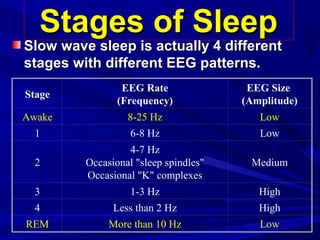
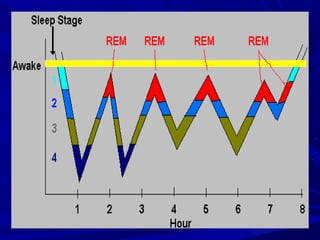
Slow wave sleep is actually 4 differentSlow wave sleep is actually 4 different
stages with different EEG patterns.stages with different EEG patterns.
Stage
EEG Rate
(Frequency)
EEG Size
(Amplitude)
Awake 8-25 Hz Low
1 6-8 Hz Low
2
4-7 Hz
Occasional "sleep spindles"
Occasional "K" complexes
Medium
3 1-3 Hz High
4 Less than 2 Hz High
REM More than 10 Hz Low
Classifications of SleepClassifications of Sleep
DisordersDisorders
ICD-10 classificationICD-10 classification
DSM IV classificationDSM IV classification
Simply, we can classify sleepSimply, we can classify sleep
disorders asdisorders as
1- Insomnia.1- Insomnia.
2- Hypersomnia2- Hypersomnia
3- Circadian rhythm Disorders.3- Circadian rhythm Disorders.
4- Parasomnia.4- Parasomnia.
1-Insomnia1-InsomniaDifficulty falling asleep or staying asleep.Difficulty falling asleep or staying asleep.
Insomnia is actually NOT consideredInsomnia is actually NOT considered aa
disorderdisorder. It is considered. It is considered a symptoma symptom..
Acute:Acute: occasional trouble falling oroccasional trouble falling or
staying asleep & usually due to transientstaying asleep & usually due to transient
stress (Self limited).stress (Self limited).
Chronic:Chronic: continues for weeks or months,continues for weeks or months,
it's important to consider possible causes.it's important to consider possible causes.
Chronic Insomnia:Chronic Insomnia: 1 in 10 people .1 in 10 people .
Chronic InsomniaChronic Insomnia
Underling Psychiatric CausesUnderling Psychiatric Causes
Anxiety, Stress & DepressionAnxiety, Stress & Depression account for asaccount for as
much as 50% of the chronic insomnia cases.much as 50% of the chronic insomnia cases.
Primary Insomnia:Primary Insomnia: 20% of chronic insomnia.20% of chronic insomnia.
- This disorder is usually caused by- This disorder is usually caused by
a combination of stress, poor sleepinga combination of stress, poor sleeping
habits & a form of conditioned anxiety.habits & a form of conditioned anxiety.
 Medical Problems:Medical Problems: such as chronic painsuch as chronic pain
syndrome & trauma.syndrome & trauma.
Treatment ofTreatment of
InsomniaInsomnia
Relaxation.Relaxation.
Often, therapy for insomnia isOften, therapy for insomnia is
directed at the underlyingdirected at the underlying
cause of sleep disruption.cause of sleep disruption.
Improving “Sleep Hygiene”.Improving “Sleep Hygiene”.
Sleep HygieneSleep Hygiene
Routine! GoRoutine! Going to bed at the same timeing to bed at the same time
every night, waking up at the same timeevery night, waking up at the same time
every morning.every morning.
Eliminating nicotine, caffeine, alcoholEliminating nicotine, caffeine, alcohol
and other stimulants, including asthmaand other stimulants, including asthma
inhalers, before bed.inhalers, before bed.
No napping!No napping!
Clean sheets.Clean sheets.
Taking a hot shower before bed (asTaking a hot shower before bed (as
your body cools, you fall asleep).your body cools, you fall asleep).
More exercise.More exercise.
Limiting working/ studying in bed.Limiting working/ studying in bed.
No eating or drinking right before bedNo eating or drinking right before bed
(can cause arousal by stimulating(can cause arousal by stimulating
digestive system & bladder).digestive system & bladder).
Setting aside a “worrying time” soSetting aside a “worrying time” so
that worrying is not saved for rightthat worrying is not saved for right
before bed.before bed.
Good sleeping environmentGood sleeping environment
(temperature & lighting should be(temperature & lighting should be
controlled).controlled).
Drug Treatment of Insomnia:Drug Treatment of Insomnia:
Over The CounterOver The Counter
The vast majority of over-the-The vast majority of over-the-
counter sleep aids containcounter sleep aids contain
antihistaminesantihistamines, which are, which are
associated with drowsiness.associated with drowsiness.
Unfortunately, they also tend toUnfortunately, they also tend to
cause decreased memory &cause decreased memory &
concentration, dry mouth, morningconcentration, dry mouth, morning
sickness, blurred vision, extendedsickness, blurred vision, extended
sedation & constipation.sedation & constipation.
Drug Treatment of Insomnia:Drug Treatment of Insomnia:
PrescriptionPrescription
BenzodiazepinesBenzodiazepines have been the most popularlyhave been the most popularly
prescribed hypnotic (sleeping pill).prescribed hypnotic (sleeping pill).
Normally, many neurons in the brain areNormally, many neurons in the brain are
inhibited by the neurotransmitter GABA.inhibited by the neurotransmitter GABA.
Benzodiazepines bind to GABA receptors, thusBenzodiazepines bind to GABA receptors, thus
potentiating this inhibition.potentiating this inhibition.
There is a risk for developing drug dependencyThere is a risk for developing drug dependency
with long-term use in some patients.with long-term use in some patients.
Benzodiazepines can cause fatigue, dizziness,Benzodiazepines can cause fatigue, dizziness,
confusion & blurred vision.confusion & blurred vision.
2-Hypersomnia2-Hypersomnia
Excessive daytime sleepiness.Excessive daytime sleepiness.
UnlikeUnlike those with chronic insomnia,those with chronic insomnia,
only a small percentage of peopleonly a small percentage of people
with hypersomnia have anwith hypersomnia have an
underlying psychiatric problem.underlying psychiatric problem.
NearlyNearly 85%85% have one of threehave one of three
conditions:conditions: Sleep Apnea, NarcolepsySleep Apnea, Narcolepsy
or Myoclonusor Myoclonus..
A. Sleep ApneaA. Sleep Apnea
The Greek word “The Greek word “ApneaApnea” means” means
““Without breathWithout breath”.”.
People with sleep apnea mayPeople with sleep apnea may
repeatedlyrepeatedly stop breathingstop breathing forfor OVEROVER
A MINUTE AT A TIMEA MINUTE AT A TIME - as many as -- as many as -
hundreds of times per night.hundreds of times per night.
The hallmark is veryThe hallmark is very loud snoringloud snoring --
the kind that sometimes wakes thethe kind that sometimes wakes the
neighbors.neighbors.
Obstructive Sleep ApneaObstructive Sleep Apnea
Obstructive sleep apnea (OSA): isObstructive sleep apnea (OSA): is
the most common typethe most common type of Sleepof Sleep
Apnea.Apnea.
OSA is a breathing disorder, usuallyOSA is a breathing disorder, usually
caused by partial blockage in thecaused by partial blockage in the
back of the throatback of the throat (Soft Palate)(Soft Palate)..
This region hasThis region has no rigid structureno rigid structure
such as cartilage or bone to keep thesuch as cartilage or bone to keep the
airway open.airway open.
Obstructive Sleep ApneaObstructive Sleep Apnea
As a person with OSA falls asleep, theAs a person with OSA falls asleep, the
musclesmuscles that hold the airway open duringthat hold the airway open during
the daythe day relaxrelax. The airway collapses &. The airway collapses &
becomes obstructed.becomes obstructed.
When the airway closes,When the airway closes, breathing stopsbreathing stops &&
the sleeper awakens to open the airway.the sleeper awakens to open the airway.
Because the person is continuouslyBecause the person is continuously
awakening to open his airway, he does notawakening to open his airway, he does not
reachreach deep stage of REM sleepdeep stage of REM sleep, which the, which the
body needs to rest & replenish itsbody needs to rest & replenish its
Risk Factors of (OSA)Risk Factors of (OSA)
Excessive Weight Gain:Excessive Weight Gain: The primary riskThe primary risk
factor for OSA.factor for OSA.
Accumulation of Fat on The Sides of TheAccumulation of Fat on The Sides of The
Upper Airway:Upper Airway: causes it to becomecauses it to become
narrow & predisposed to closure whennarrow & predisposed to closure when
the muscles relax.the muscles relax.
Age:Age: is another prominent risk factor. Asis another prominent risk factor. As
muscle mass decreases in the airwaymuscle mass decreases in the airway
with age & it may be replaced with fat.with age & it may be replaced with fat.
MaleMale Hormones:Hormones: Men have a greater riskMen have a greater risk
for OSA due to structural changes in thefor OSA due to structural changes in the
upper airway.upper airway.
Treatment of (OSA)Treatment of (OSA)
Positional Therapy:Positional Therapy:
Attach a sock filled with tennis balls length-Attach a sock filled with tennis balls length-
wise down the back of the patient’s pajamawise down the back of the patient’s pajama
top or nightshirt. This makes ittop or nightshirt. This makes it
uncomfortable for the sleeper to lie on hisuncomfortable for the sleeper to lie on his
back.back.
Surgical Therapies.Surgical Therapies.
Oral Appliances:Oral Appliances: that physically keep thethat physically keep the
airway open during sleep.airway open during sleep.
Continuous Positive Airway Pressure:Continuous Positive Airway Pressure: TheThe
most commonly prescribed therapy for OSA.most commonly prescribed therapy for OSA.
B. NarcolepsyB. Narcolepsy
Narcolepsy is marked by a number ofNarcolepsy is marked by a number of
different symptoms, including persistentdifferent symptoms, including persistent
daytime sleepiness, cataplexy,daytime sleepiness, cataplexy,
hallucinationshallucinations && paralysisparalysis while fallingwhile falling
asleep or waking.asleep or waking.
Not all narcoleptics experience all ofNot all narcoleptics experience all of
these symptoms.these symptoms.
The first signs of narcolepsy usuallyThe first signs of narcolepsy usually
appear between theappear between the ages of ten & twentyages of ten & twenty..
Narcolepsy: CausesNarcolepsy: Causes
The cause of narcolepsy isThe cause of narcolepsy is notnot
knownknown, but there seem to be both, but there seem to be both
hereditary & environmental factorshereditary & environmental factors
involved.involved.
TheThe locus coeruleuslocus coeruleus also plays aalso plays a
role in narcolepsy.role in narcolepsy.
CataplexyCataplexy
Cataplexy is the sudden, temporary lossCataplexy is the sudden, temporary loss
ofof skeletal muscleskeletal muscle tone without loss oftone without loss of
consciousnessconsciousness..
TheThe eye muscleseye muscles are not affected duringare not affected during
cataplexy.cataplexy.
Cataplexy is usually triggered byCataplexy is usually triggered by strongstrong
emotionemotion (shock, anger or embarrassment,(shock, anger or embarrassment,
eveneven athletic activitiesathletic activities oror sexualsexual
intercourseintercourse..
Narcolepsy: TreatmentNarcolepsy: Treatment
Getting Sufficient Sleep:Getting Sufficient Sleep: (Sleep Hygiene).(Sleep Hygiene).
Changing Sleeping Patterns:Changing Sleeping Patterns: SpreadingSpreading
out 8 hours of sleep throughout a 24-hourout 8 hours of sleep throughout a 24-hour
period.period.
Drug Therapies:Drug Therapies:
1. Stimulants:1. Stimulants: For excessive daytimeFor excessive daytime
sleepiness (Ritalin).sleepiness (Ritalin).
2. Antidepressants & Antipsychotics:2. Antidepressants & Antipsychotics: ForFor
cataplexy, hallucinations & sleepcataplexy, hallucinations & sleep
paralysis.paralysis.
C. MyoclonusC. Myoclonus
Myoclonus refers to abnormalMyoclonus refers to abnormal
twitching of thetwitching of the Calf MusclesCalf Muscles
during sleep & accounts forduring sleep & accounts for
about 10% of hypersomniaabout 10% of hypersomnia
cases.cases.
3- Circadian Rhythm Disorders3- Circadian Rhythm Disorders
Abnormal timingAbnormal timing of sleep-wakeof sleep-wake
cycles.cycles.
Circadian rhythm disorders includeCircadian rhythm disorders include
the common "the common "jet lagjet lag" syndrome, as" syndrome, as
well aswell as sleeping too latesleeping too late oror
awakening too earlyawakening too early because ofbecause of
irregular shift work -- a commonirregular shift work -- a common
cause ofcause of on-the-job accidentson-the-job accidents..
4- Parasomnias4- Parasomnias
AbnormalAbnormal stagesstages of sleep.of sleep.
Parasomnias are disorders inParasomnias are disorders in
which the normalwhich the normal
""architecturearchitecture" of sleep is" of sleep is
distorted or disrupted.distorted or disrupted.
Parasomnias DisordersParasomnias Disorders
1- Sleepwalking (Somnambulism).1- Sleepwalking (Somnambulism).
2- Abnormal REM Behavior Disorder:2- Abnormal REM Behavior Disorder:
Agitated or Violent Behavior.Agitated or Violent Behavior.
3- Hallucinations/ Confusion upon3- Hallucinations/ Confusion upon
awakeningawakening
4- Nocturnal Enuresis & Encopresis.4- Nocturnal Enuresis & Encopresis.
5- Familial Sleep Paralysis.5- Familial Sleep Paralysis.
6- Nocturnal Headache.6- Nocturnal Headache.
7- Nocturnal Epilepsy.7- Nocturnal Epilepsy.
8- Burxism.8- Burxism.
9- Painful Penile Erection.9- Painful Penile Erection.
10- No Nocturnal Penile Erection.10- No Nocturnal Penile Erection.
Diagnosis of Sleep DisordersDiagnosis of Sleep Disorders
A Careful Medical History:A Careful Medical History: is neededis needed
to determine the presence & severityto determine the presence & severity
of concomitant disease.of concomitant disease.
Bed Partner or Other Observers:Bed Partner or Other Observers: ToTo
describe snoring, breathing pausesdescribe snoring, breathing pauses
or periodic movements during sleep.or periodic movements during sleep.
Prescribed Medications:Prescribed Medications: especiallyespecially
sedatives, alcohol use & selfsedatives, alcohol use & self
medication can have a significantmedication can have a significant
effect on sleep & may impair cardio-effect on sleep & may impair cardio-
pulmonary functions during sleep.pulmonary functions during sleep.
Psychiatric History & Evaluation:Psychiatric History & Evaluation:
Identify anxiety, depression or majorIdentify anxiety, depression or major
life events which are known to affectlife events which are known to affect
sleep habits.sleep habits.
Appropriate Physical Examination:Appropriate Physical Examination:
depends upon the nature of thedepends upon the nature of the
complaint & history elicited from thecomplaint & history elicited from the
patient (For example, heavy snoringpatient (For example, heavy snoring
may necessitate a detailed examinationmay necessitate a detailed examination
of the nose & throat).of the nose & throat).
Appropriate Laboratory Tests:Appropriate Laboratory Tests:
May be similarly indicated.May be similarly indicated.
What Are the Indications forWhat Are the Indications for
Treating of Sleep Disorders?Treating of Sleep Disorders?
Goals of Therapy:Goals of Therapy:
ReducingReducing MorbidityMorbidity..
ReducingReducing Excess MortalityExcess Mortality..
ImprovingImproving Quality of LifeQuality of Life
for patient & his family.for patient & his family.
Sleep disorders

Sleep disorders

  • 1.
  • 2.
    Importance of SleepImportanceof Sleep DisordersDisorders Patients with sleep disordersPatients with sleep disorders suffer many differentsuffer many different problems, ranging fromproblems, ranging from LosingLosing JobsJobs (due to too many missed(due to too many missed days of work) todays of work) to SeriousSerious AccidentsAccidents caused by tirednesscaused by tiredness during driving.during driving.
  • 3.
    Stages of SleepStagesof Sleep Slow wave sleep is actually 4 differentSlow wave sleep is actually 4 different stages with different EEG patterns.stages with different EEG patterns. Stage EEG Rate (Frequency) EEG Size (Amplitude) Awake 8-25 Hz Low 1 6-8 Hz Low 2 4-7 Hz Occasional "sleep spindles" Occasional "K" complexes Medium 3 1-3 Hz High 4 Less than 2 Hz High REM More than 10 Hz Low
  • 5.
    Classifications of SleepClassificationsof Sleep DisordersDisorders ICD-10 classificationICD-10 classification DSM IV classificationDSM IV classification Simply, we can classify sleepSimply, we can classify sleep disorders asdisorders as 1- Insomnia.1- Insomnia. 2- Hypersomnia2- Hypersomnia 3- Circadian rhythm Disorders.3- Circadian rhythm Disorders. 4- Parasomnia.4- Parasomnia.
  • 6.
    1-Insomnia1-InsomniaDifficulty falling asleepor staying asleep.Difficulty falling asleep or staying asleep. Insomnia is actually NOT consideredInsomnia is actually NOT considered aa disorderdisorder. It is considered. It is considered a symptoma symptom.. Acute:Acute: occasional trouble falling oroccasional trouble falling or staying asleep & usually due to transientstaying asleep & usually due to transient stress (Self limited).stress (Self limited). Chronic:Chronic: continues for weeks or months,continues for weeks or months, it's important to consider possible causes.it's important to consider possible causes. Chronic Insomnia:Chronic Insomnia: 1 in 10 people .1 in 10 people .
  • 7.
    Chronic InsomniaChronic Insomnia UnderlingPsychiatric CausesUnderling Psychiatric Causes Anxiety, Stress & DepressionAnxiety, Stress & Depression account for asaccount for as much as 50% of the chronic insomnia cases.much as 50% of the chronic insomnia cases. Primary Insomnia:Primary Insomnia: 20% of chronic insomnia.20% of chronic insomnia. - This disorder is usually caused by- This disorder is usually caused by a combination of stress, poor sleepinga combination of stress, poor sleeping habits & a form of conditioned anxiety.habits & a form of conditioned anxiety.  Medical Problems:Medical Problems: such as chronic painsuch as chronic pain syndrome & trauma.syndrome & trauma.
  • 8.
    Treatment ofTreatment of InsomniaInsomnia Relaxation.Relaxation. Often,therapy for insomnia isOften, therapy for insomnia is directed at the underlyingdirected at the underlying cause of sleep disruption.cause of sleep disruption. Improving “Sleep Hygiene”.Improving “Sleep Hygiene”.
  • 9.
    Sleep HygieneSleep Hygiene Routine!GoRoutine! Going to bed at the same timeing to bed at the same time every night, waking up at the same timeevery night, waking up at the same time every morning.every morning. Eliminating nicotine, caffeine, alcoholEliminating nicotine, caffeine, alcohol and other stimulants, including asthmaand other stimulants, including asthma inhalers, before bed.inhalers, before bed. No napping!No napping! Clean sheets.Clean sheets. Taking a hot shower before bed (asTaking a hot shower before bed (as your body cools, you fall asleep).your body cools, you fall asleep).
  • 10.
    More exercise.More exercise. Limitingworking/ studying in bed.Limiting working/ studying in bed. No eating or drinking right before bedNo eating or drinking right before bed (can cause arousal by stimulating(can cause arousal by stimulating digestive system & bladder).digestive system & bladder). Setting aside a “worrying time” soSetting aside a “worrying time” so that worrying is not saved for rightthat worrying is not saved for right before bed.before bed. Good sleeping environmentGood sleeping environment (temperature & lighting should be(temperature & lighting should be controlled).controlled).
  • 11.
    Drug Treatment ofInsomnia:Drug Treatment of Insomnia: Over The CounterOver The Counter The vast majority of over-the-The vast majority of over-the- counter sleep aids containcounter sleep aids contain antihistaminesantihistamines, which are, which are associated with drowsiness.associated with drowsiness. Unfortunately, they also tend toUnfortunately, they also tend to cause decreased memory &cause decreased memory & concentration, dry mouth, morningconcentration, dry mouth, morning sickness, blurred vision, extendedsickness, blurred vision, extended sedation & constipation.sedation & constipation.
  • 12.
    Drug Treatment ofInsomnia:Drug Treatment of Insomnia: PrescriptionPrescription BenzodiazepinesBenzodiazepines have been the most popularlyhave been the most popularly prescribed hypnotic (sleeping pill).prescribed hypnotic (sleeping pill). Normally, many neurons in the brain areNormally, many neurons in the brain are inhibited by the neurotransmitter GABA.inhibited by the neurotransmitter GABA. Benzodiazepines bind to GABA receptors, thusBenzodiazepines bind to GABA receptors, thus potentiating this inhibition.potentiating this inhibition. There is a risk for developing drug dependencyThere is a risk for developing drug dependency with long-term use in some patients.with long-term use in some patients. Benzodiazepines can cause fatigue, dizziness,Benzodiazepines can cause fatigue, dizziness, confusion & blurred vision.confusion & blurred vision.
  • 13.
    2-Hypersomnia2-Hypersomnia Excessive daytime sleepiness.Excessivedaytime sleepiness. UnlikeUnlike those with chronic insomnia,those with chronic insomnia, only a small percentage of peopleonly a small percentage of people with hypersomnia have anwith hypersomnia have an underlying psychiatric problem.underlying psychiatric problem. NearlyNearly 85%85% have one of threehave one of three conditions:conditions: Sleep Apnea, NarcolepsySleep Apnea, Narcolepsy or Myoclonusor Myoclonus..
  • 14.
    A. Sleep ApneaA.Sleep Apnea The Greek word “The Greek word “ApneaApnea” means” means ““Without breathWithout breath”.”. People with sleep apnea mayPeople with sleep apnea may repeatedlyrepeatedly stop breathingstop breathing forfor OVEROVER A MINUTE AT A TIMEA MINUTE AT A TIME - as many as -- as many as - hundreds of times per night.hundreds of times per night. The hallmark is veryThe hallmark is very loud snoringloud snoring -- the kind that sometimes wakes thethe kind that sometimes wakes the neighbors.neighbors.
  • 15.
    Obstructive Sleep ApneaObstructiveSleep Apnea Obstructive sleep apnea (OSA): isObstructive sleep apnea (OSA): is the most common typethe most common type of Sleepof Sleep Apnea.Apnea. OSA is a breathing disorder, usuallyOSA is a breathing disorder, usually caused by partial blockage in thecaused by partial blockage in the back of the throatback of the throat (Soft Palate)(Soft Palate).. This region hasThis region has no rigid structureno rigid structure such as cartilage or bone to keep thesuch as cartilage or bone to keep the airway open.airway open.
  • 16.
    Obstructive Sleep ApneaObstructiveSleep Apnea As a person with OSA falls asleep, theAs a person with OSA falls asleep, the musclesmuscles that hold the airway open duringthat hold the airway open during the daythe day relaxrelax. The airway collapses &. The airway collapses & becomes obstructed.becomes obstructed. When the airway closes,When the airway closes, breathing stopsbreathing stops && the sleeper awakens to open the airway.the sleeper awakens to open the airway. Because the person is continuouslyBecause the person is continuously awakening to open his airway, he does notawakening to open his airway, he does not reachreach deep stage of REM sleepdeep stage of REM sleep, which the, which the body needs to rest & replenish itsbody needs to rest & replenish its
  • 17.
    Risk Factors of(OSA)Risk Factors of (OSA) Excessive Weight Gain:Excessive Weight Gain: The primary riskThe primary risk factor for OSA.factor for OSA. Accumulation of Fat on The Sides of TheAccumulation of Fat on The Sides of The Upper Airway:Upper Airway: causes it to becomecauses it to become narrow & predisposed to closure whennarrow & predisposed to closure when the muscles relax.the muscles relax. Age:Age: is another prominent risk factor. Asis another prominent risk factor. As muscle mass decreases in the airwaymuscle mass decreases in the airway with age & it may be replaced with fat.with age & it may be replaced with fat. MaleMale Hormones:Hormones: Men have a greater riskMen have a greater risk for OSA due to structural changes in thefor OSA due to structural changes in the upper airway.upper airway.
  • 18.
    Treatment of (OSA)Treatmentof (OSA) Positional Therapy:Positional Therapy: Attach a sock filled with tennis balls length-Attach a sock filled with tennis balls length- wise down the back of the patient’s pajamawise down the back of the patient’s pajama top or nightshirt. This makes ittop or nightshirt. This makes it uncomfortable for the sleeper to lie on hisuncomfortable for the sleeper to lie on his back.back. Surgical Therapies.Surgical Therapies. Oral Appliances:Oral Appliances: that physically keep thethat physically keep the airway open during sleep.airway open during sleep. Continuous Positive Airway Pressure:Continuous Positive Airway Pressure: TheThe most commonly prescribed therapy for OSA.most commonly prescribed therapy for OSA.
  • 19.
    B. NarcolepsyB. Narcolepsy Narcolepsyis marked by a number ofNarcolepsy is marked by a number of different symptoms, including persistentdifferent symptoms, including persistent daytime sleepiness, cataplexy,daytime sleepiness, cataplexy, hallucinationshallucinations && paralysisparalysis while fallingwhile falling asleep or waking.asleep or waking. Not all narcoleptics experience all ofNot all narcoleptics experience all of these symptoms.these symptoms. The first signs of narcolepsy usuallyThe first signs of narcolepsy usually appear between theappear between the ages of ten & twentyages of ten & twenty..
  • 20.
    Narcolepsy: CausesNarcolepsy: Causes Thecause of narcolepsy isThe cause of narcolepsy is notnot knownknown, but there seem to be both, but there seem to be both hereditary & environmental factorshereditary & environmental factors involved.involved. TheThe locus coeruleuslocus coeruleus also plays aalso plays a role in narcolepsy.role in narcolepsy.
  • 21.
    CataplexyCataplexy Cataplexy is thesudden, temporary lossCataplexy is the sudden, temporary loss ofof skeletal muscleskeletal muscle tone without loss oftone without loss of consciousnessconsciousness.. TheThe eye muscleseye muscles are not affected duringare not affected during cataplexy.cataplexy. Cataplexy is usually triggered byCataplexy is usually triggered by strongstrong emotionemotion (shock, anger or embarrassment,(shock, anger or embarrassment, eveneven athletic activitiesathletic activities oror sexualsexual intercourseintercourse..
  • 22.
    Narcolepsy: TreatmentNarcolepsy: Treatment GettingSufficient Sleep:Getting Sufficient Sleep: (Sleep Hygiene).(Sleep Hygiene). Changing Sleeping Patterns:Changing Sleeping Patterns: SpreadingSpreading out 8 hours of sleep throughout a 24-hourout 8 hours of sleep throughout a 24-hour period.period. Drug Therapies:Drug Therapies: 1. Stimulants:1. Stimulants: For excessive daytimeFor excessive daytime sleepiness (Ritalin).sleepiness (Ritalin). 2. Antidepressants & Antipsychotics:2. Antidepressants & Antipsychotics: ForFor cataplexy, hallucinations & sleepcataplexy, hallucinations & sleep paralysis.paralysis.
  • 23.
    C. MyoclonusC. Myoclonus Myoclonusrefers to abnormalMyoclonus refers to abnormal twitching of thetwitching of the Calf MusclesCalf Muscles during sleep & accounts forduring sleep & accounts for about 10% of hypersomniaabout 10% of hypersomnia cases.cases.
  • 24.
    3- Circadian RhythmDisorders3- Circadian Rhythm Disorders Abnormal timingAbnormal timing of sleep-wakeof sleep-wake cycles.cycles. Circadian rhythm disorders includeCircadian rhythm disorders include the common "the common "jet lagjet lag" syndrome, as" syndrome, as well aswell as sleeping too latesleeping too late oror awakening too earlyawakening too early because ofbecause of irregular shift work -- a commonirregular shift work -- a common cause ofcause of on-the-job accidentson-the-job accidents..
  • 25.
    4- Parasomnias4- Parasomnias AbnormalAbnormalstagesstages of sleep.of sleep. Parasomnias are disorders inParasomnias are disorders in which the normalwhich the normal ""architecturearchitecture" of sleep is" of sleep is distorted or disrupted.distorted or disrupted.
  • 26.
    Parasomnias DisordersParasomnias Disorders 1-Sleepwalking (Somnambulism).1- Sleepwalking (Somnambulism). 2- Abnormal REM Behavior Disorder:2- Abnormal REM Behavior Disorder: Agitated or Violent Behavior.Agitated or Violent Behavior. 3- Hallucinations/ Confusion upon3- Hallucinations/ Confusion upon awakeningawakening 4- Nocturnal Enuresis & Encopresis.4- Nocturnal Enuresis & Encopresis. 5- Familial Sleep Paralysis.5- Familial Sleep Paralysis. 6- Nocturnal Headache.6- Nocturnal Headache. 7- Nocturnal Epilepsy.7- Nocturnal Epilepsy. 8- Burxism.8- Burxism. 9- Painful Penile Erection.9- Painful Penile Erection. 10- No Nocturnal Penile Erection.10- No Nocturnal Penile Erection.
  • 27.
    Diagnosis of SleepDisordersDiagnosis of Sleep Disorders A Careful Medical History:A Careful Medical History: is neededis needed to determine the presence & severityto determine the presence & severity of concomitant disease.of concomitant disease. Bed Partner or Other Observers:Bed Partner or Other Observers: ToTo describe snoring, breathing pausesdescribe snoring, breathing pauses or periodic movements during sleep.or periodic movements during sleep. Prescribed Medications:Prescribed Medications: especiallyespecially sedatives, alcohol use & selfsedatives, alcohol use & self medication can have a significantmedication can have a significant effect on sleep & may impair cardio-effect on sleep & may impair cardio- pulmonary functions during sleep.pulmonary functions during sleep.
  • 28.
    Psychiatric History &Evaluation:Psychiatric History & Evaluation: Identify anxiety, depression or majorIdentify anxiety, depression or major life events which are known to affectlife events which are known to affect sleep habits.sleep habits. Appropriate Physical Examination:Appropriate Physical Examination: depends upon the nature of thedepends upon the nature of the complaint & history elicited from thecomplaint & history elicited from the patient (For example, heavy snoringpatient (For example, heavy snoring may necessitate a detailed examinationmay necessitate a detailed examination of the nose & throat).of the nose & throat). Appropriate Laboratory Tests:Appropriate Laboratory Tests: May be similarly indicated.May be similarly indicated.
  • 31.
    What Are theIndications forWhat Are the Indications for Treating of Sleep Disorders?Treating of Sleep Disorders? Goals of Therapy:Goals of Therapy: ReducingReducing MorbidityMorbidity.. ReducingReducing Excess MortalityExcess Mortality.. ImprovingImproving Quality of LifeQuality of Life for patient & his family.for patient & his family.