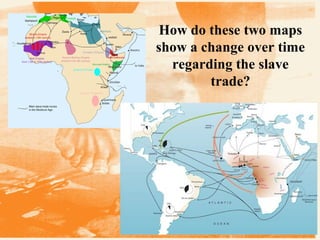
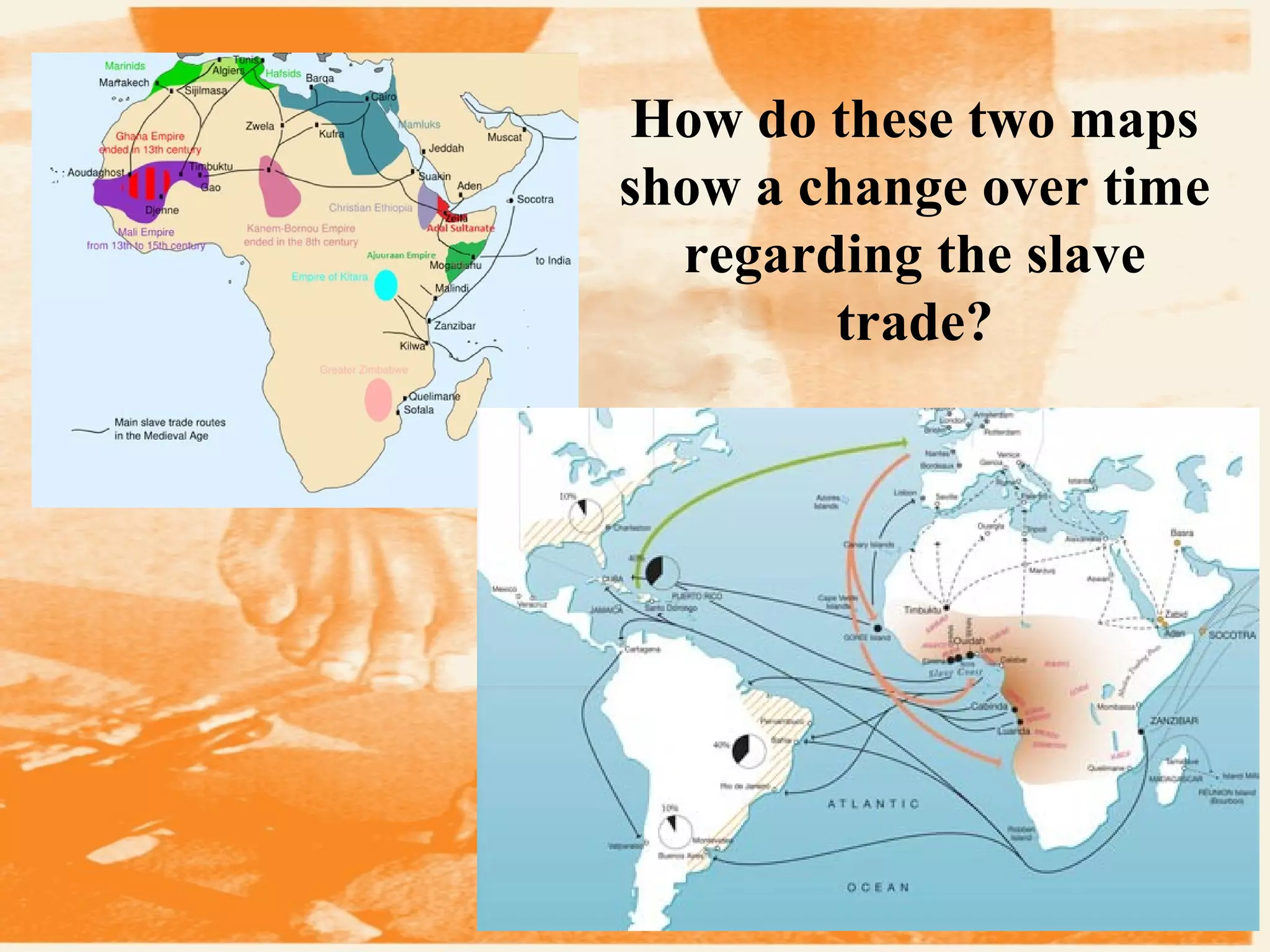
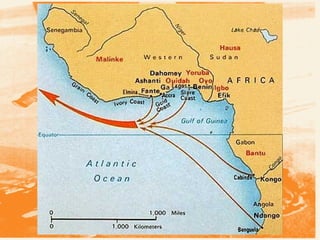

How do these two maps
show a change over time
regarding the slave
trade?
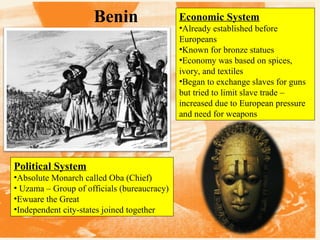
Benin

Political System
•Absolute Monarch called Oba (Chief)
• Uzama – Group of officials (bureaucracy)
•Ewuare the Great
•Independent city-states joined together

Economic System
•Already established before
Europeans
•Known for bronze statues
•Economy was based on spices,
ivory, and textiles
•Began to exchange slaves for guns
but tried to limit slave trade –
increased due to European pressure
and need for weapons
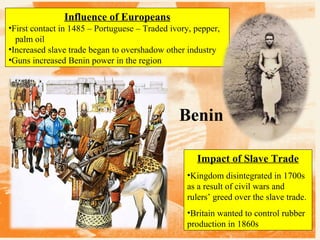
Influence of Europeans
•First contact in 1485 – Portuguese – Traded ivory, pepper,
palm oil
•Increased slave trade began to overshadow other industry
•Guns increased Benin power in the region

Benin
Impact of Slave Trade
•Kingdom disintegrated in 1700s
as a result of civil wars and
rulers’ greed over the slave trade.
•Britain wanted to control rubber
production in 1860s
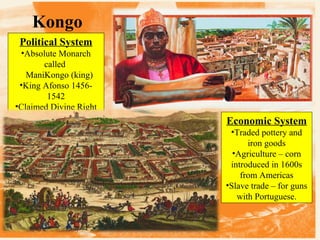
Kongo
Political System
•Absolute Monarch
called
ManiKongo (king)
•King Afonso 14561542
•Claimed Divine Right

Economic System
•Traded pottery and
iron goods
•Agriculture – corn
introduced in 1600s
from Americas
•Slave trade – for guns
with Portuguese.
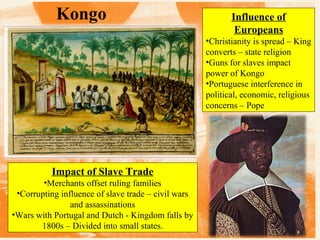
Kongo

Influence of
Europeans
•Christianity is spread – King
converts – state religion
•Guns for slaves impact
power of Kongo
•Portuguese interference in
political, economic, religious
concerns – Pope

Impact of Slave Trade
•Merchants offset ruling families
•Corrupting influence of slave trade – civil wars
and assassinations
•Wars with Portugal and Dutch - Kingdom falls by
1800s – Divided into small states.
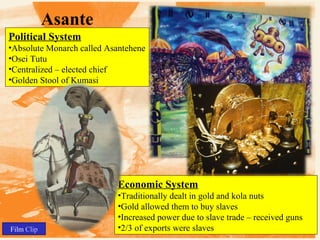
Asante
Political System
•Absolute Monarch called Asantehene
•Osei Tutu
•Centralized – elected chief
•Golden Stool of Kumasi

Economic System

Film Clip

•Traditionally dealt in gold and kola nuts
•Gold allowed them to buy slaves
•Increased power due to slave trade – received guns
•2/3 of exports were slaves
Asante
Influence of Europeans
•Portuguese contact with Asante at Fort of El Mina
•Gun / slave trade

Impact of Slave Trade
•Power declined with end of slave trade in 1800s
•Use of slave trade provided rulers with great wealth
and power –led to conflict with European
•Fell to British in 1901 after a long war
Video Recap
FORCED IMMIGRATION

“Humanity is divided into two
-- the masters and the slaves.”
~Aristotle
The Transatlantic Slave Trade
• The potential wealth to be
made from slavery led to the
triangular trade between
_________________________
Europe, Africa and the
_______________.
Americas.

• Europeans were able to
sell manufactured goods in
exchange for raw materials
____________
and luxury items.
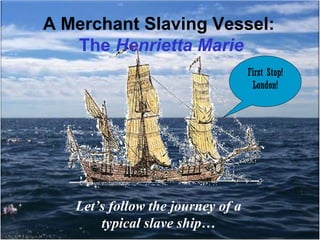
A Merchant Slaving Vessel:
The Henrietta Marie
First Stop!
London!

Let’s follow the journey of a
typical slave ship…
The Port of
London
What ventures
could a wealthy
man like me
invest in?
Hmmmm.

The Henr
i
would sta etta Marie
rt its jour
ney in
London,
a thriving
port built
on the ba
nks
of the Th
ames Riv
er.

•As the capital city, it
was the center of social
and economic
developments;
it was also the place in
which _____________
entrepreneurs
would invest money in
Trading Companies
__________________ to
make money.
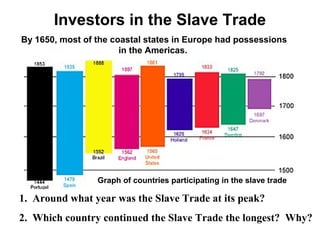
Investors in the Slave Trade
By 1650, most of the coastal states in Europe had possessions
in the Americas.

Graph of countries participating in the slave trade

1. Around what year was the Slave Trade at its peak?
2. Which country continued the Slave Trade the longest? Why?
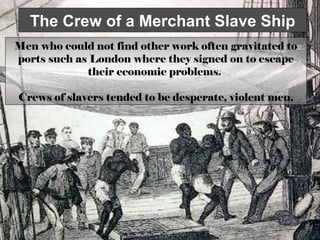
The Crew of a Merchant Slave Ship
Men who could not find other work often gravitated to
ports such as London where they signed on to escape
their economic problems.
Crews of slavers tended to be desperate, violent men.
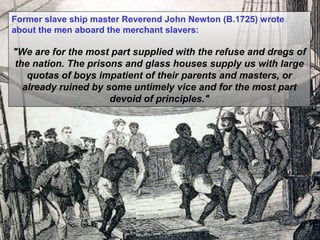
Former slave ship master Reverend John Newton (B.1725) wrote
about the men aboard the merchant slavers:

"We are for the most part supplied with the refuse and dregs of
the nation. The prisons and glass houses supply us with large
quotas of boys impatient of their parents and masters, or
already ruined by some untimely vice and for the most part
devoid of principles."
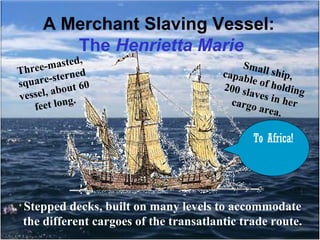
A Merchant Slaving Vessel:
The Henrietta Marie

,
masted
Three- erned
st
quare- ut 60
s
bo
essel, a g.
v
feet lon

Small
s hi p,
capab
l e of h
o l di n g
200 sl
ave s i
n her
c ar go
ar e a.

To Africa!

Stepped decks, built on many levels to accommodate
the different cargoes of the transatlantic trade route.
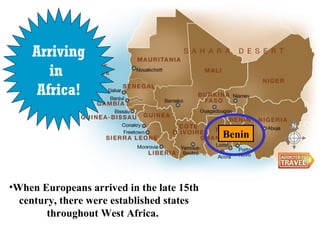
Arriving
in
Africa!
Benin

•When Europeans arrived in the late 15th
century, there were established states
throughout West Africa.
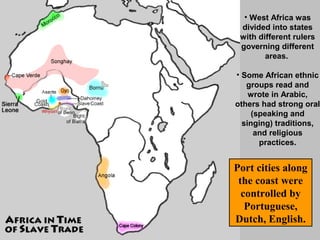
• West Africa was
divided into states
with different rulers
governing different
areas.
• Some African ethnic
groups read and
wrote in Arabic,
others had strong oral
(speaking and
singing) traditions,
and religious
practices.

Port cities along
the coast were
controlled by
Portuguese,
Dutch, English.
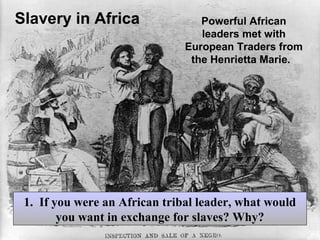
Slavery in Africa

Powerful African
leaders met with
European Traders from
the Henrietta Marie.

1. If you were an African tribal leader, what would
you want in exchange for slaves? Why?
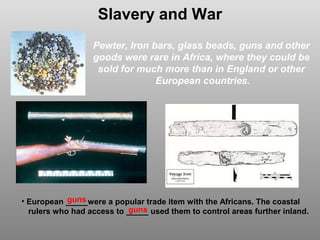
Slavery and War
Pewter, Iron bars, glass beads, guns and other
goods were rare in Africa, where they could be
sold for much more than in England or other
European countries.

guns
• European _____were a popular trade item with the Africans. The coastal
guns
rulers who had access to _____ used them to control areas further inland.
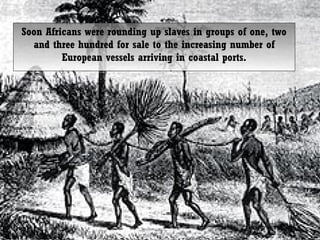
Soon Africans were rounding up slaves in groups of one, two
and three hundred for sale to the increasing number of
European vessels arriving in coastal ports.
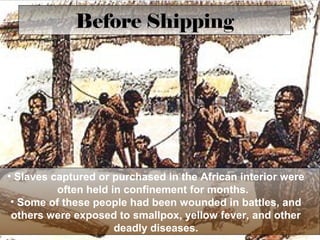
Before Shipping

• Slaves captured or purchased in the African interior were
often held in confinement for months.
• Some of these people had been wounded in battles, and
others were exposed to smallpox, yellow fever, and other
deadly diseases.
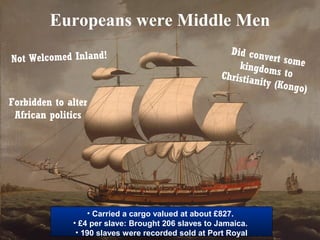
Europeans were Middle Men
Not Welcomed Inland!

Did conv
ert some
kingdom
s to
Christian
ity (Kon
go)

Forbidden to alter
African politics

• Carried a cargo valued at about £827.
• £4 per slave: Brought 206 slaves to Jamaica.
• 190 slaves were recorded sold at Port Royal
The Henrietta Marie
To the
Americas!

• The Middle Passage- The Journey from Africa to the
New World faced by captive slaves – 1 leg of the
triangular trade
• Ships were only supposed to transport 300 people but
some carried 800 people
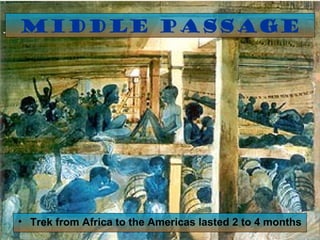
Middle Passage

• Trek from Africa to the Americas lasted 2 to 4 months
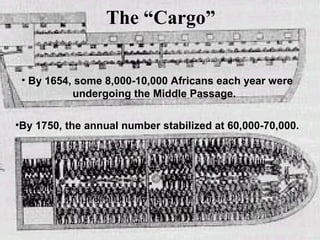
The “Cargo”
• By 1654, some 8,000-10,000 Africans each year were
undergoing the Middle Passage.
•By 1750, the annual number stabilized at 60,000-70,000.
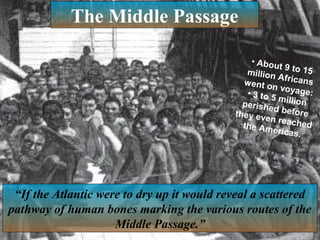
The Middle Passage
• Ab o u
t 9 to 1
5
million
African
s
w en t o n
voyage
:
• 3 to 5
m
perishe illion
d befor
e
t h e y ev
en reac
hed
the Am
ericas.

“If the Atlantic were to dry up it would reveal a scattered
pathway of human bones marking the various routes of the
Middle Passage.”
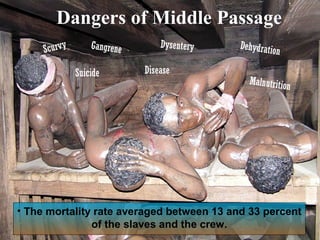
Dangers of Middle Passage
Scurvy

Gangrene

Suicide

Dysentery

Disease

Dehydratio
n

Malnutritio
n

• The mortality rate averaged between 13 and 33 percent
of the slaves and the crew.
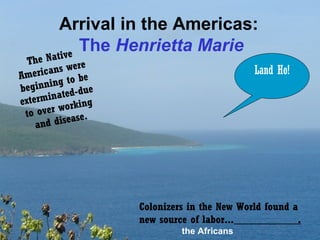
Arrival in the Americas:
The Henrietta Marie
tive

The Na ere
w
ricans
Ame
e
ing to b
beginn ed-due
t
ermina
ext
working
to over ase.
e
and dis

Land Ho!

Colonizers in the New World found a
new source of labor...____________.
the Africans
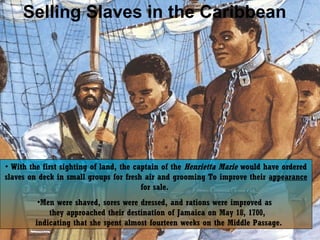
Selling Slaves in the Caribbean

• With the first sighting of land, the captain of the Henrietta Marie would have ordered
slaves on deck in small groups for fresh air and grooming To improve their appearance
for sale.
•Men were shaved, sores were dressed, and rations were improved as
they approached their destination of Jamaica on May 18, 1700,
indicating that she spent almost fourteen weeks on the Middle Passage.
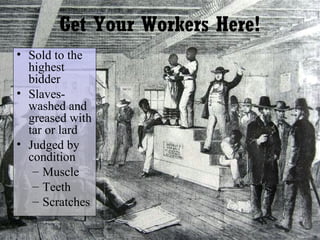
Get Your Workers Here!
• Sold to the
highest
bidder
• Slaveswashed and
greased with
tar or lard
• Judged by
condition
– Muscle
– Teeth
– Scratches
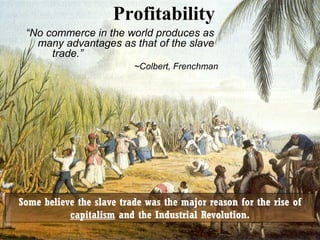
Profitability
“No commerce in the world produces as
many advantages as that of the slave
trade.”
~Colbert, Frenchman

Some believe the slave trade was the major reason for the rise of
capitalism and the Industrial Revolution.
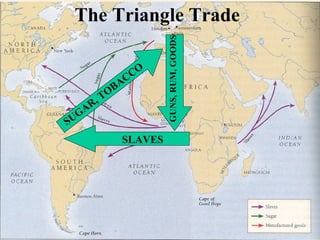
R,
GA
SU

CO
AC
OB
T

SLAVES

GUNS, RUM, GOODS

The Triangle Trade
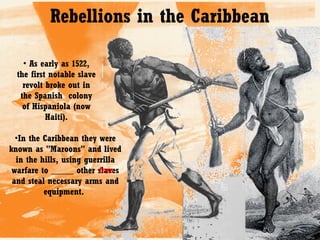
Rebellions in the Caribbean
• As early as 1522,
the first notable slave
revolt broke out in
the Spanish colony
of Hispaniola (now
Haiti).
•In the Caribbean they were
known as "Maroons" and lived
in the hills, using guerrilla
free
warfare to _____ other slaves
and steal necessary arms and
equipment.
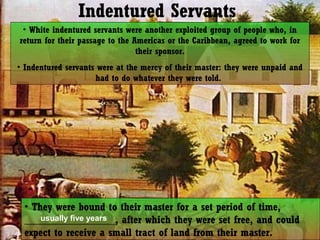
Indentured Servants
• White indentured servants were another exploited group of people who, in
return for their passage to the Americas or the Caribbean, agreed to work for
their sponsor.
• Indentured servants were at the mercy of their master: they were unpaid and
had to do whatever they were told.

• They were bound to their master for a set period of time,
usually five years
_________________, after which they were set free, and could
expect to receive a small tract of land from their master.
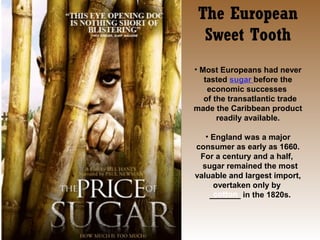
The European
Sweet Tooth
• Most Europeans had never
tasted sugar before the
economic successes
of the transatlantic trade
made the Caribbean product
readily available.
• England was a major
consumer as early as 1660.
For a century and a half,
sugar remained the most
valuable and largest import,
overtaken only by
cotton
_______ in the 1820s.
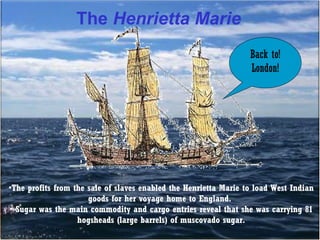
The Henrietta Marie
Back to!
London!

•The profits from the sale of slaves enabled the Henrietta Marie to load West Indian
goods for her voyage home to England.
• Sugar was the main commodity and cargo entries reveal that she was carrying 81
hogsheads (large barrels) of muscovado sugar.
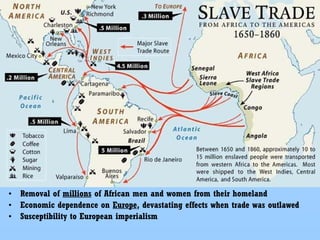
• Removal of millions of African men and women from their homeland
• Economic dependence on Europe, devastating effects when trade was outlawed
• Susceptibility to European imperialism

Slavery

  • 1.
    How do thesetwo maps show a change over time regarding the slave trade?
  • 3.
    Benin Political System •Absolute Monarchcalled Oba (Chief) • Uzama – Group of officials (bureaucracy) •Ewuare the Great •Independent city-states joined together Economic System •Already established before Europeans •Known for bronze statues •Economy was based on spices, ivory, and textiles •Began to exchange slaves for guns but tried to limit slave trade – increased due to European pressure and need for weapons
  • 4.
    Influence of Europeans •Firstcontact in 1485 – Portuguese – Traded ivory, pepper, palm oil •Increased slave trade began to overshadow other industry •Guns increased Benin power in the region Benin Impact of Slave Trade •Kingdom disintegrated in 1700s as a result of civil wars and rulers’ greed over the slave trade. •Britain wanted to control rubber production in 1860s
  • 5.
    Kongo Political System •Absolute Monarch called ManiKongo(king) •King Afonso 14561542 •Claimed Divine Right Economic System •Traded pottery and iron goods •Agriculture – corn introduced in 1600s from Americas •Slave trade – for guns with Portuguese.
  • 6.
    Kongo Influence of Europeans •Christianity isspread – King converts – state religion •Guns for slaves impact power of Kongo •Portuguese interference in political, economic, religious concerns – Pope Impact of Slave Trade •Merchants offset ruling families •Corrupting influence of slave trade – civil wars and assassinations •Wars with Portugal and Dutch - Kingdom falls by 1800s – Divided into small states.
  • 7.
    Asante Political System •Absolute Monarchcalled Asantehene •Osei Tutu •Centralized – elected chief •Golden Stool of Kumasi Economic System Film Clip •Traditionally dealt in gold and kola nuts •Gold allowed them to buy slaves •Increased power due to slave trade – received guns •2/3 of exports were slaves
  • 8.
    Asante Influence of Europeans •Portuguesecontact with Asante at Fort of El Mina •Gun / slave trade Impact of Slave Trade •Power declined with end of slave trade in 1800s •Use of slave trade provided rulers with great wealth and power –led to conflict with European •Fell to British in 1901 after a long war
  • 9.
  • 10.
    FORCED IMMIGRATION “Humanity isdivided into two -- the masters and the slaves.” ~Aristotle
  • 11.
    The Transatlantic SlaveTrade • The potential wealth to be made from slavery led to the triangular trade between _________________________ Europe, Africa and the _______________. Americas. • Europeans were able to sell manufactured goods in exchange for raw materials ____________ and luxury items.
  • 12.
    A Merchant SlavingVessel: The Henrietta Marie First Stop! London! Let’s follow the journey of a typical slave ship…
  • 13.
    The Port of London Whatventures could a wealthy man like me invest in? Hmmmm. The Henr i would sta etta Marie rt its jour ney in London, a thriving port built on the ba nks of the Th ames Riv er. •As the capital city, it was the center of social and economic developments; it was also the place in which _____________ entrepreneurs would invest money in Trading Companies __________________ to make money.
  • 14.
    Investors in theSlave Trade By 1650, most of the coastal states in Europe had possessions in the Americas. Graph of countries participating in the slave trade 1. Around what year was the Slave Trade at its peak? 2. Which country continued the Slave Trade the longest? Why?
  • 15.
    The Crew ofa Merchant Slave Ship Men who could not find other work often gravitated to ports such as London where they signed on to escape their economic problems. Crews of slavers tended to be desperate, violent men.
  • 16.
    Former slave shipmaster Reverend John Newton (B.1725) wrote about the men aboard the merchant slavers: "We are for the most part supplied with the refuse and dregs of the nation. The prisons and glass houses supply us with large quotas of boys impatient of their parents and masters, or already ruined by some untimely vice and for the most part devoid of principles."
  • 17.
    A Merchant SlavingVessel: The Henrietta Marie , masted Three- erned st quare- ut 60 s bo essel, a g. v feet lon Small s hi p, capab l e of h o l di n g 200 sl ave s i n her c ar go ar e a. To Africa! Stepped decks, built on many levels to accommodate the different cargoes of the transatlantic trade route.
  • 18.
    Arriving in Africa! Benin •When Europeans arrivedin the late 15th century, there were established states throughout West Africa.
  • 19.
    • West Africawas divided into states with different rulers governing different areas. • Some African ethnic groups read and wrote in Arabic, others had strong oral (speaking and singing) traditions, and religious practices. Port cities along the coast were controlled by Portuguese, Dutch, English.
  • 20.
    Slavery in Africa PowerfulAfrican leaders met with European Traders from the Henrietta Marie. 1. If you were an African tribal leader, what would you want in exchange for slaves? Why?
  • 21.
    Slavery and War Pewter,Iron bars, glass beads, guns and other goods were rare in Africa, where they could be sold for much more than in England or other European countries. guns • European _____were a popular trade item with the Africans. The coastal guns rulers who had access to _____ used them to control areas further inland.
  • 22.
    Soon Africans wererounding up slaves in groups of one, two and three hundred for sale to the increasing number of European vessels arriving in coastal ports.
  • 23.
    Before Shipping • Slavescaptured or purchased in the African interior were often held in confinement for months. • Some of these people had been wounded in battles, and others were exposed to smallpox, yellow fever, and other deadly diseases.
  • 24.
    Europeans were MiddleMen Not Welcomed Inland! Did conv ert some kingdom s to Christian ity (Kon go) Forbidden to alter African politics • Carried a cargo valued at about £827. • £4 per slave: Brought 206 slaves to Jamaica. • 190 slaves were recorded sold at Port Royal
  • 25.
    The Henrietta Marie Tothe Americas! • The Middle Passage- The Journey from Africa to the New World faced by captive slaves – 1 leg of the triangular trade • Ships were only supposed to transport 300 people but some carried 800 people
  • 26.
    Middle Passage • Trekfrom Africa to the Americas lasted 2 to 4 months
  • 27.
    The “Cargo” • By1654, some 8,000-10,000 Africans each year were undergoing the Middle Passage. •By 1750, the annual number stabilized at 60,000-70,000.
  • 28.
    The Middle Passage •Ab o u t 9 to 1 5 million African s w en t o n voyage : • 3 to 5 m perishe illion d befor e t h e y ev en reac hed the Am ericas. “If the Atlantic were to dry up it would reveal a scattered pathway of human bones marking the various routes of the Middle Passage.”
  • 29.
    Dangers of MiddlePassage Scurvy Gangrene Suicide Dysentery Disease Dehydratio n Malnutritio n • The mortality rate averaged between 13 and 33 percent of the slaves and the crew.
  • 30.
    Arrival in theAmericas: The Henrietta Marie tive The Na ere w ricans Ame e ing to b beginn ed-due t ermina ext working to over ase. e and dis Land Ho! Colonizers in the New World found a new source of labor...____________. the Africans
  • 31.
    Selling Slaves inthe Caribbean • With the first sighting of land, the captain of the Henrietta Marie would have ordered slaves on deck in small groups for fresh air and grooming To improve their appearance for sale. •Men were shaved, sores were dressed, and rations were improved as they approached their destination of Jamaica on May 18, 1700, indicating that she spent almost fourteen weeks on the Middle Passage.
  • 32.
    Get Your WorkersHere! • Sold to the highest bidder • Slaveswashed and greased with tar or lard • Judged by condition – Muscle – Teeth – Scratches
  • 33.
    Profitability “No commerce inthe world produces as many advantages as that of the slave trade.” ~Colbert, Frenchman Some believe the slave trade was the major reason for the rise of capitalism and the Industrial Revolution.
  • 34.
  • 35.
    Rebellions in theCaribbean • As early as 1522, the first notable slave revolt broke out in the Spanish colony of Hispaniola (now Haiti). •In the Caribbean they were known as "Maroons" and lived in the hills, using guerrilla free warfare to _____ other slaves and steal necessary arms and equipment.
  • 36.
    Indentured Servants • Whiteindentured servants were another exploited group of people who, in return for their passage to the Americas or the Caribbean, agreed to work for their sponsor. • Indentured servants were at the mercy of their master: they were unpaid and had to do whatever they were told. • They were bound to their master for a set period of time, usually five years _________________, after which they were set free, and could expect to receive a small tract of land from their master.
  • 37.
    The European Sweet Tooth •Most Europeans had never tasted sugar before the economic successes of the transatlantic trade made the Caribbean product readily available. • England was a major consumer as early as 1660. For a century and a half, sugar remained the most valuable and largest import, overtaken only by cotton _______ in the 1820s.
  • 38.
    The Henrietta Marie Backto! London! •The profits from the sale of slaves enabled the Henrietta Marie to load West Indian goods for her voyage home to England. • Sugar was the main commodity and cargo entries reveal that she was carrying 81 hogsheads (large barrels) of muscovado sugar.
  • 39.
    • Removal ofmillions of African men and women from their homeland • Economic dependence on Europe, devastating effects when trade was outlawed • Susceptibility to European imperialism

Editor's Notes

  • #10 Pirates And Slavers: http://www.youtube.com/watch?v=R9RvR9qGA74