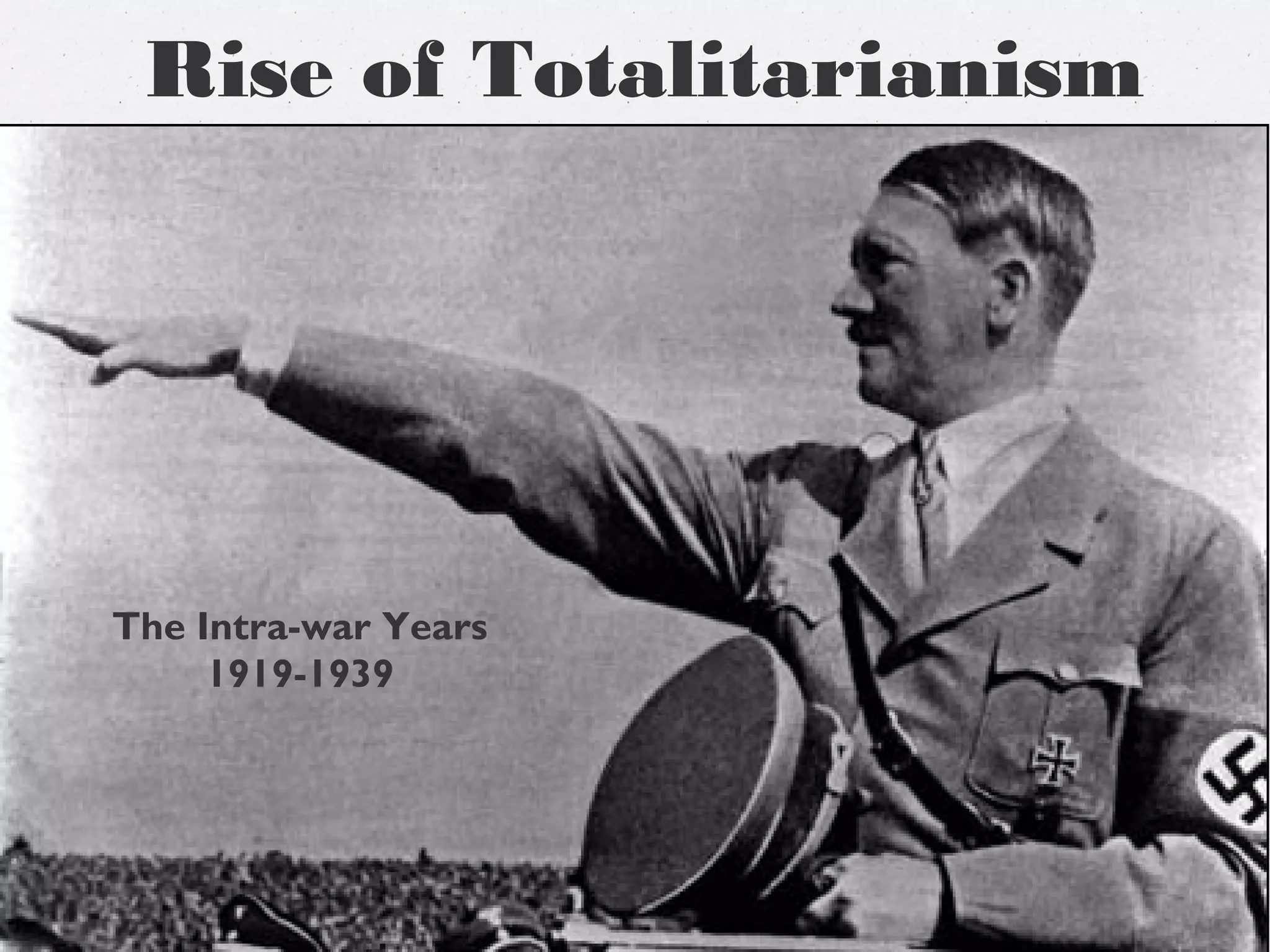
Rise of Totalitarianism
The Intra-war Years
1919-1939
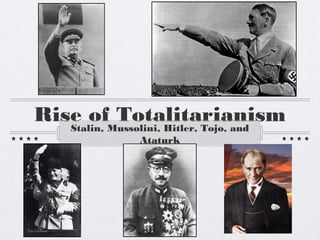
Rise of TotalitarianismStalin, Mussolini, Hitler, Tojo, and
Ataturk
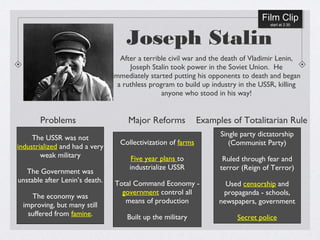
Joseph Stalin
After a terrible civil war and the death of Vladimir Lenin,
Joseph Stalin took power in the Soviet Union. He
immediately started putting his opponents to death and began
a ruthless program to build up industry in the USSR, killing
anyone who stood in his way!
Problems Major Reforms Examples of Totalitarian Rule
The USSR was not
industrialized and had a very
weak military
The Government was
unstable after Lenin’s death.
The economy was
improving, but many still
suffered from famine.
Collectivization of farms
Five year plans to
industrialize USSR
Total Command Economy -
government control all
means of production
Built up the military
Single party dictatorship
(Communist Party)
Ruled through fear and
terror (Reign of Terror)
Used censorship and
propaganda - schools,
newspapers, government
Secret police
Film Clip
start at 2:35
Film Clip
start at 2:35
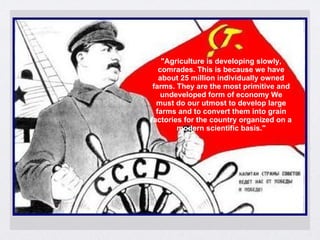
"Agriculture is developing slowly,
comrades. This is because we have
about 25 million individually owned
farms. They are the most primitive and
undeveloped form of economy We
must do our utmost to develop large
farms and to convert them into grain
factories for the country organized on a
modern scientific basis."
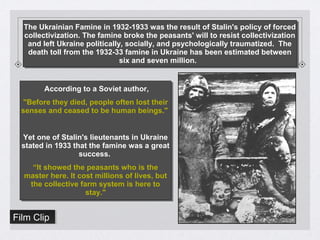
The Ukrainian Famine in 1932-1933 was the result of Stalin's policy of forced
collectivization. The famine broke the peasants' will to resist collectivization
and left Ukraine politically, socially, and psychologically traumatized. The
death toll from the 1932-33 famine in Ukraine has been estimated between
six and seven million.
The Ukrainian Famine in 1932-1933 was the result of Stalin's policy of forced
collectivization. The famine broke the peasants' will to resist collectivization
and left Ukraine politically, socially, and psychologically traumatized. The
death toll from the 1932-33 famine in Ukraine has been estimated between
six and seven million.
According to a Soviet author,
"Before they died, people often lost their
senses and ceased to be human beings."
Yet one of Stalin's lieutenants in Ukraine
stated in 1933 that the famine was a great
success.
“It showed the peasants who is the
master here. It cost millions of lives, but
the collective farm system is here to
stay."
According to a Soviet author,
"Before they died, people often lost their
senses and ceased to be human beings."
Yet one of Stalin's lieutenants in Ukraine
stated in 1933 that the famine was a great
success.
“It showed the peasants who is the
master here. It cost millions of lives, but
the collective farm system is here to
stay."
Film ClipFilm Clip
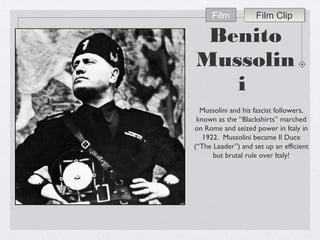
Benito
Mussolin
i
Mussolini and his fascist followers,
known as the “Blackshirts” marched
on Rome and seized power in Italy in
1922. Mussolini became Il Duce
(“The Leader”) and set up an efficient
but brutal rule over Italy!
Film ClipFilm ClipFilm
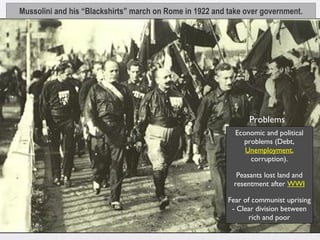
Mussolini and his “Blackshirts” march on Rome in 1922 and take over government.
Problems
Economic and political
problems (Debt,
Unemployment,
corruption).
Peasants lost land and
resentment after WWI
Fear of communist uprising
- Clear division between
rich and poor
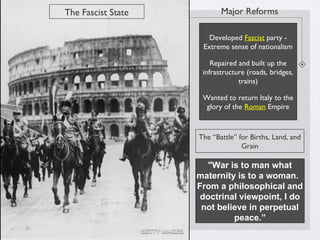
"War is to man what
maternity is to a woman.
From a philosophical and
doctrinal viewpoint, I do
not believe in perpetual
peace.”
The Fascist State
The “Battle” for Births, Land, and
Grain
Major Reforms
Developed Fascist party -
Extreme sense of nationalism
Repaired and built up the
infrastructure (roads, bridges,
trains)
Wanted to return Italy to the
glory of the Roman Empire
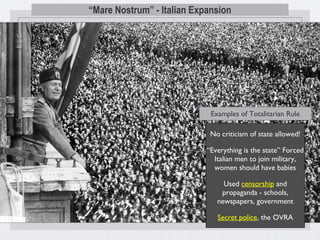
“Mare Nostrum” - Italian Expansion
Examples of Totalitarian Rule
No criticism of state allowed!
“Everything is the state” Forced
Italian men to join military,
women should have babies
Used censorship and
propaganda - schools,
newspapers, government
Secret police, the OVRA
The Capture and Death of
Mussolini!
The Capture and Death of
Mussolini!
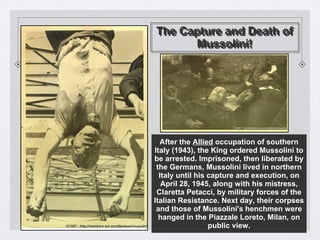
After the Allied occupation of southern
Italy (1943), the King ordered Mussolini to
be arrested. Imprisoned, then liberated by
the Germans, Mussolini lived in northern
Italy until his capture and execution, on
April 28, 1945, along with his mistress,
Claretta Petacci, by military forces of the
Italian Resistance. Next day, their corpses
and those of Mussolini's henchmen were
hanged in the Piazzale Loreto, Milan, on
public view.
Mustafa
Kemal
Ataturk
Mustafa
Kemal
Ataturk
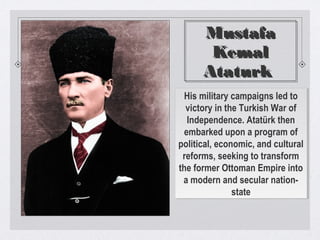
His military campaigns led to
victory in the Turkish War of
Independence. Atatürk then
embarked upon a program of
political, economic, and cultural
reforms, seeking to transform
the former Ottoman Empire into
a modern and secular nation-
state
His military campaigns led to
victory in the Turkish War of
Independence. Atatürk then
embarked upon a program of
political, economic, and cultural
reforms, seeking to transform
the former Ottoman Empire into
a modern and secular nation-
state
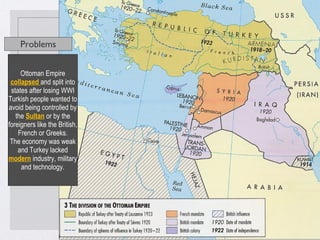
Problems
Ottoman Empire
collapsed and split into
states after losing WWI
Turkish people wanted to
avoid being controlled by
the Sultan or by the
foreigners like the British,
French or Greeks.
The economy was weak
and Turkey lacked
modern industry, military
and technology.
Film Clip
start at 45:33
Film Clip
start at 45:33
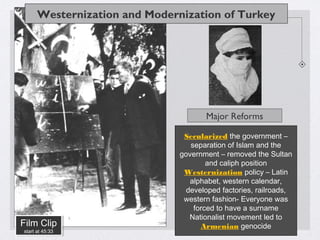
Major Reforms
Secularized the government –
separation of Islam and the
government – removed the Sultan
and caliph position
Westernization policy – Latin
alphabet, western calendar,
developed factories, railroads,
western fashion- Everyone was
forced to have a surname
Nationalist movement led to
Armenian genocide
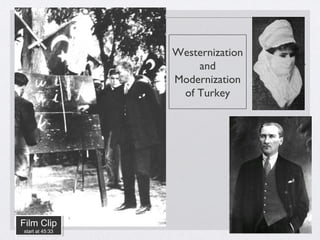
Westernization and Modernization of Turkey
Westernization
and
Modernization
of Turkey
Film Clip
start at 45:33
Film Clip
start at 45:33
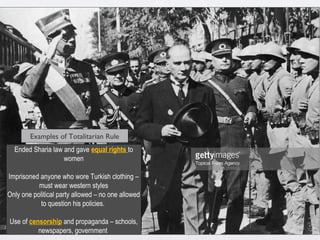
Examples of Totalitarian Rule
Ended Sharia law and gave equal rights to
women
Imprisoned anyone who wore Turkish clothing –
must wear western styles
Only one political party allowed – no one allowed
to question his policies.
Use of censorship and propaganda – schools,
newspapers, government
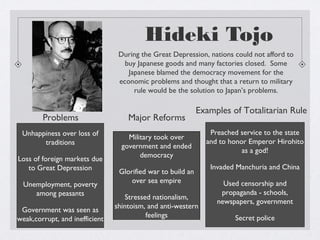
Hideki Tojo
During the Great Depression, nations could not afford to
buy Japanese goods and many factories closed. Some
Japanese blamed the democracy movement for the
economic problems and thought that a return to military
rule would be the solution to Japan’s problems.
Problems Major Reforms
Examples of Totalitarian Rule
Unhappiness over loss of
traditions
Loss of foreign markets due
to Great Depression
Unemployment, poverty
among peasants
Government was seen as
weak,corrupt, and inefficient
Military took over
government and ended
democracy
Glorified war to build an
over sea empire
Stressed nationalism,
shintoism, and anti-western
feelings
Preached service to the state
and to honor Emperor Hirohito
as a god!
Invaded Manchuria and China
Used censorship and
propaganda - schools,
newspapers, government
Secret police
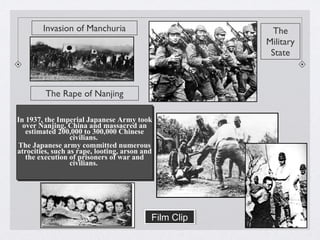
The Rape of Nanjing
The
Military
State
Invasion of Manchuria
In 1937, the Imperial Japanese Army took
over Nanjing, China and massacred an
estimated 200,000 to 300,000 Chinese
civilians.
The Japanese army committed numerous
atrocities, such as rape, looting, arson and
the execution of prisoners of war and
civilians.
In 1937, the Imperial Japanese Army took
over Nanjing, China and massacred an
estimated 200,000 to 300,000 Chinese
civilians.
The Japanese army committed numerous
atrocities, such as rape, looting, arson and
the execution of prisoners of war and
civilians.
Film ClipFilm Clip
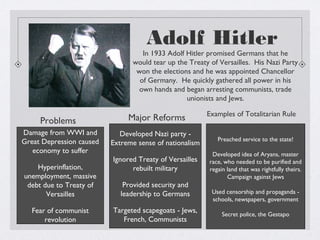
Adolf Hitler
In 1933 Adolf Hitler promised Germans that he
would tear up the Treaty of Versailles. His Nazi Party
won the elections and he was appointed Chancellor
of Germany. He quickly gathered all power in his
own hands and began arresting communists, trade
unionists and Jews.
Problems Major Reforms Examples of Totalitarian Rule
Damage from WWI and
Great Depression caused
economy to suffer
Hyperinflation,
unemployment, massive
debt due to Treaty of
Versailles
Fear of communist
revolution
Developed Nazi party -
Extreme sense of nationalism
Ignored Treaty of Versailles
rebuilt military
Provided security and
leadership to Germans
Targeted scapegoats - Jews,
French, Communists
Preached service to the state!
Developed idea of Aryans, master
race, who needed to be purified and
regain land that was rightfully theirs.
Campaign against Jews
Used censorship and propaganda -
schools, newspapers, government
Secret police, the Gestapo
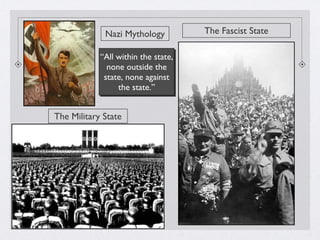
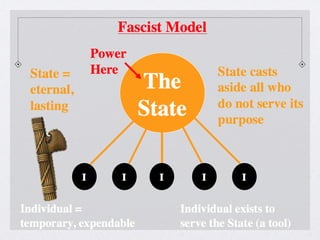
The Fascist State
The Military State
Nazi Mythology
“All within the state,
none outside the
state, none against
the state.”
“All within the state,
none outside the
state, none against
the state.”
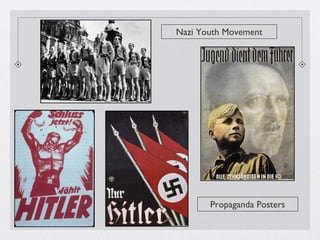
Nazi Youth Movement
Propaganda Posters
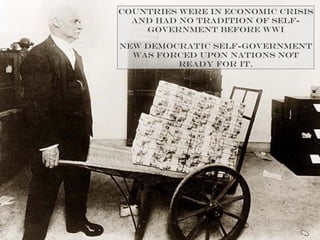
Countries were in economic crisis
and had no tradition of self-
government before WWI
New democratic self-government
was forced upon nations not
ready for it.
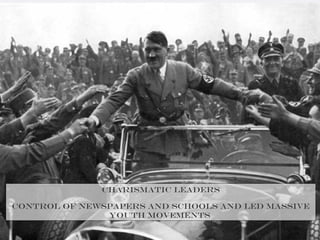
Charismatic leaders
Control of newspapers and schools and led massive
youth movements
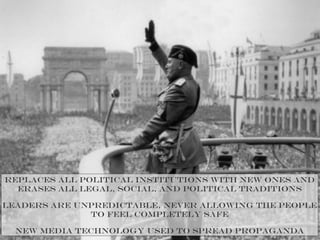
Replaces all political institutions with new ones and
erases all legal, social, and political traditions
Leaders are unpredictable, never allowing the people
to feel completely safe
New media technology used to spread propaganda
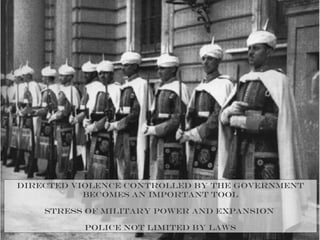
Directed violence controlled by the government
becomes an important tool
Stress of military power and expansion
Police not limited by laws
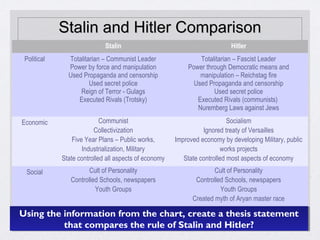
Stalin and Hitler ComparisonStalin and Hitler Comparison
Stalin Hitler
Political Totalitarian – Communist Leader
Power by force and manipulation
Used Propaganda and censorship
Used secret police
Reign of Terror - Gulags
Executed Rivals (Trotsky)
Totalitarian – Fascist Leader
Power through Democratic means and
manipulation – Reichstag fire
Used Propaganda and censorship
Used secret police
Executed Rivals (communists)
Nuremberg Laws against Jews
Economic Communist
Collectivization
Five Year Plans – Public works,
Industrialization, Military
State controlled all aspects of economy
Socialism
Ignored treaty of Versailles
Improved economy by developing Military, public
works projects
State controlled most aspects of economy
Social Cult of Personality
Controlled Schools, newspapers
Youth Groups
Cult of Personality
Controlled Schools, newspapers
Youth Groups
Created myth of Aryan master race
Using the information from the chart, create a thesis statement
that compares the rule of Stalin and Hitler?
Using the information from the chart, create a thesis statement
that compares the rule of Stalin and Hitler?
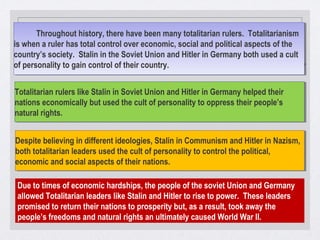
Throughout history, there have been many totalitarian rulers. Totalitarianism
is when a ruler has total control over economic, social and political aspects of the
country’s society. Stalin in the Soviet Union and Hitler in Germany both used a cult
of personality to gain control of their country.
Throughout history, there have been many totalitarian rulers. Totalitarianism
is when a ruler has total control over economic, social and political aspects of the
country’s society. Stalin in the Soviet Union and Hitler in Germany both used a cult
of personality to gain control of their country.
Totalitarian rulers like Stalin in Soviet Union and Hitler in Germany helped their
nations economically but used the cult of personality to oppress their people’s
natural rights.
Totalitarian rulers like Stalin in Soviet Union and Hitler in Germany helped their
nations economically but used the cult of personality to oppress their people’s
natural rights.
Despite believing in different ideologies, Stalin in Communism and Hitler in Nazism,
both totalitarian leaders used the cult of personality to control the political,
economic and social aspects of their nations.
Despite believing in different ideologies, Stalin in Communism and Hitler in Nazism,
both totalitarian leaders used the cult of personality to control the political,
economic and social aspects of their nations.
Due to times of economic hardships, the people of the soviet Union and Germany
allowed Totalitarian leaders like Stalin and Hitler to rise to power. These leaders
promised to return their nations to prosperity but, as a result, took away the
people’s freedoms and natural rights an ultimately caused World War II.

Totalitarian leaders1

  • 1.
    Rise of Totalitarianism TheIntra-war Years 1919-1939
  • 2.
    Rise of TotalitarianismStalin,Mussolini, Hitler, Tojo, and Ataturk
  • 3.
    Joseph Stalin After aterrible civil war and the death of Vladimir Lenin, Joseph Stalin took power in the Soviet Union. He immediately started putting his opponents to death and began a ruthless program to build up industry in the USSR, killing anyone who stood in his way! Problems Major Reforms Examples of Totalitarian Rule The USSR was not industrialized and had a very weak military The Government was unstable after Lenin’s death. The economy was improving, but many still suffered from famine. Collectivization of farms Five year plans to industrialize USSR Total Command Economy - government control all means of production Built up the military Single party dictatorship (Communist Party) Ruled through fear and terror (Reign of Terror) Used censorship and propaganda - schools, newspapers, government Secret police Film Clip start at 2:35 Film Clip start at 2:35
  • 4.
    "Agriculture is developingslowly, comrades. This is because we have about 25 million individually owned farms. They are the most primitive and undeveloped form of economy We must do our utmost to develop large farms and to convert them into grain factories for the country organized on a modern scientific basis."
  • 5.
    The Ukrainian Faminein 1932-1933 was the result of Stalin's policy of forced collectivization. The famine broke the peasants' will to resist collectivization and left Ukraine politically, socially, and psychologically traumatized. The death toll from the 1932-33 famine in Ukraine has been estimated between six and seven million. The Ukrainian Famine in 1932-1933 was the result of Stalin's policy of forced collectivization. The famine broke the peasants' will to resist collectivization and left Ukraine politically, socially, and psychologically traumatized. The death toll from the 1932-33 famine in Ukraine has been estimated between six and seven million. According to a Soviet author, "Before they died, people often lost their senses and ceased to be human beings." Yet one of Stalin's lieutenants in Ukraine stated in 1933 that the famine was a great success. “It showed the peasants who is the master here. It cost millions of lives, but the collective farm system is here to stay." According to a Soviet author, "Before they died, people often lost their senses and ceased to be human beings." Yet one of Stalin's lieutenants in Ukraine stated in 1933 that the famine was a great success. “It showed the peasants who is the master here. It cost millions of lives, but the collective farm system is here to stay." Film ClipFilm Clip
  • 6.
    Benito Mussolin i Mussolini and hisfascist followers, known as the “Blackshirts” marched on Rome and seized power in Italy in 1922. Mussolini became Il Duce (“The Leader”) and set up an efficient but brutal rule over Italy! Film ClipFilm ClipFilm
  • 7.
    Mussolini and his“Blackshirts” march on Rome in 1922 and take over government. Problems Economic and political problems (Debt, Unemployment, corruption). Peasants lost land and resentment after WWI Fear of communist uprising - Clear division between rich and poor
  • 8.
    "War is toman what maternity is to a woman. From a philosophical and doctrinal viewpoint, I do not believe in perpetual peace.” The Fascist State The “Battle” for Births, Land, and Grain Major Reforms Developed Fascist party - Extreme sense of nationalism Repaired and built up the infrastructure (roads, bridges, trains) Wanted to return Italy to the glory of the Roman Empire
  • 9.
    “Mare Nostrum” -Italian Expansion Examples of Totalitarian Rule No criticism of state allowed! “Everything is the state” Forced Italian men to join military, women should have babies Used censorship and propaganda - schools, newspapers, government Secret police, the OVRA
  • 10.
    The Capture andDeath of Mussolini! The Capture and Death of Mussolini! After the Allied occupation of southern Italy (1943), the King ordered Mussolini to be arrested. Imprisoned, then liberated by the Germans, Mussolini lived in northern Italy until his capture and execution, on April 28, 1945, along with his mistress, Claretta Petacci, by military forces of the Italian Resistance. Next day, their corpses and those of Mussolini's henchmen were hanged in the Piazzale Loreto, Milan, on public view.
  • 11.
    Mustafa Kemal Ataturk Mustafa Kemal Ataturk His military campaignsled to victory in the Turkish War of Independence. Atatürk then embarked upon a program of political, economic, and cultural reforms, seeking to transform the former Ottoman Empire into a modern and secular nation- state His military campaigns led to victory in the Turkish War of Independence. Atatürk then embarked upon a program of political, economic, and cultural reforms, seeking to transform the former Ottoman Empire into a modern and secular nation- state
  • 12.
    Problems Ottoman Empire collapsed andsplit into states after losing WWI Turkish people wanted to avoid being controlled by the Sultan or by the foreigners like the British, French or Greeks. The economy was weak and Turkey lacked modern industry, military and technology.
  • 13.
    Film Clip start at45:33 Film Clip start at 45:33 Major Reforms Secularized the government – separation of Islam and the government – removed the Sultan and caliph position Westernization policy – Latin alphabet, western calendar, developed factories, railroads, western fashion- Everyone was forced to have a surname Nationalist movement led to Armenian genocide Westernization and Modernization of Turkey
  • 14.
  • 15.
    Examples of TotalitarianRule Ended Sharia law and gave equal rights to women Imprisoned anyone who wore Turkish clothing – must wear western styles Only one political party allowed – no one allowed to question his policies. Use of censorship and propaganda – schools, newspapers, government
  • 16.
    Hideki Tojo During theGreat Depression, nations could not afford to buy Japanese goods and many factories closed. Some Japanese blamed the democracy movement for the economic problems and thought that a return to military rule would be the solution to Japan’s problems. Problems Major Reforms Examples of Totalitarian Rule Unhappiness over loss of traditions Loss of foreign markets due to Great Depression Unemployment, poverty among peasants Government was seen as weak,corrupt, and inefficient Military took over government and ended democracy Glorified war to build an over sea empire Stressed nationalism, shintoism, and anti-western feelings Preached service to the state and to honor Emperor Hirohito as a god! Invaded Manchuria and China Used censorship and propaganda - schools, newspapers, government Secret police
  • 17.
    The Rape ofNanjing The Military State Invasion of Manchuria In 1937, the Imperial Japanese Army took over Nanjing, China and massacred an estimated 200,000 to 300,000 Chinese civilians. The Japanese army committed numerous atrocities, such as rape, looting, arson and the execution of prisoners of war and civilians. In 1937, the Imperial Japanese Army took over Nanjing, China and massacred an estimated 200,000 to 300,000 Chinese civilians. The Japanese army committed numerous atrocities, such as rape, looting, arson and the execution of prisoners of war and civilians. Film ClipFilm Clip
  • 18.
    Adolf Hitler In 1933Adolf Hitler promised Germans that he would tear up the Treaty of Versailles. His Nazi Party won the elections and he was appointed Chancellor of Germany. He quickly gathered all power in his own hands and began arresting communists, trade unionists and Jews. Problems Major Reforms Examples of Totalitarian Rule Damage from WWI and Great Depression caused economy to suffer Hyperinflation, unemployment, massive debt due to Treaty of Versailles Fear of communist revolution Developed Nazi party - Extreme sense of nationalism Ignored Treaty of Versailles rebuilt military Provided security and leadership to Germans Targeted scapegoats - Jews, French, Communists Preached service to the state! Developed idea of Aryans, master race, who needed to be purified and regain land that was rightfully theirs. Campaign against Jews Used censorship and propaganda - schools, newspapers, government Secret police, the Gestapo
  • 19.
    The Fascist State TheMilitary State Nazi Mythology “All within the state, none outside the state, none against the state.” “All within the state, none outside the state, none against the state.”
  • 20.
  • 22.
    Countries were ineconomic crisis and had no tradition of self- government before WWI New democratic self-government was forced upon nations not ready for it.
  • 23.
    Charismatic leaders Control ofnewspapers and schools and led massive youth movements
  • 24.
    Replaces all politicalinstitutions with new ones and erases all legal, social, and political traditions Leaders are unpredictable, never allowing the people to feel completely safe New media technology used to spread propaganda
  • 25.
    Directed violence controlledby the government becomes an important tool Stress of military power and expansion Police not limited by laws
  • 26.
    Stalin and HitlerComparisonStalin and Hitler Comparison Stalin Hitler Political Totalitarian – Communist Leader Power by force and manipulation Used Propaganda and censorship Used secret police Reign of Terror - Gulags Executed Rivals (Trotsky) Totalitarian – Fascist Leader Power through Democratic means and manipulation – Reichstag fire Used Propaganda and censorship Used secret police Executed Rivals (communists) Nuremberg Laws against Jews Economic Communist Collectivization Five Year Plans – Public works, Industrialization, Military State controlled all aspects of economy Socialism Ignored treaty of Versailles Improved economy by developing Military, public works projects State controlled most aspects of economy Social Cult of Personality Controlled Schools, newspapers Youth Groups Cult of Personality Controlled Schools, newspapers Youth Groups Created myth of Aryan master race Using the information from the chart, create a thesis statement that compares the rule of Stalin and Hitler? Using the information from the chart, create a thesis statement that compares the rule of Stalin and Hitler?
  • 27.
    Throughout history, therehave been many totalitarian rulers. Totalitarianism is when a ruler has total control over economic, social and political aspects of the country’s society. Stalin in the Soviet Union and Hitler in Germany both used a cult of personality to gain control of their country. Throughout history, there have been many totalitarian rulers. Totalitarianism is when a ruler has total control over economic, social and political aspects of the country’s society. Stalin in the Soviet Union and Hitler in Germany both used a cult of personality to gain control of their country. Totalitarian rulers like Stalin in Soviet Union and Hitler in Germany helped their nations economically but used the cult of personality to oppress their people’s natural rights. Totalitarian rulers like Stalin in Soviet Union and Hitler in Germany helped their nations economically but used the cult of personality to oppress their people’s natural rights. Despite believing in different ideologies, Stalin in Communism and Hitler in Nazism, both totalitarian leaders used the cult of personality to control the political, economic and social aspects of their nations. Despite believing in different ideologies, Stalin in Communism and Hitler in Nazism, both totalitarian leaders used the cult of personality to control the political, economic and social aspects of their nations. Due to times of economic hardships, the people of the soviet Union and Germany allowed Totalitarian leaders like Stalin and Hitler to rise to power. These leaders promised to return their nations to prosperity but, as a result, took away the people’s freedoms and natural rights an ultimately caused World War II.