Download to read offline

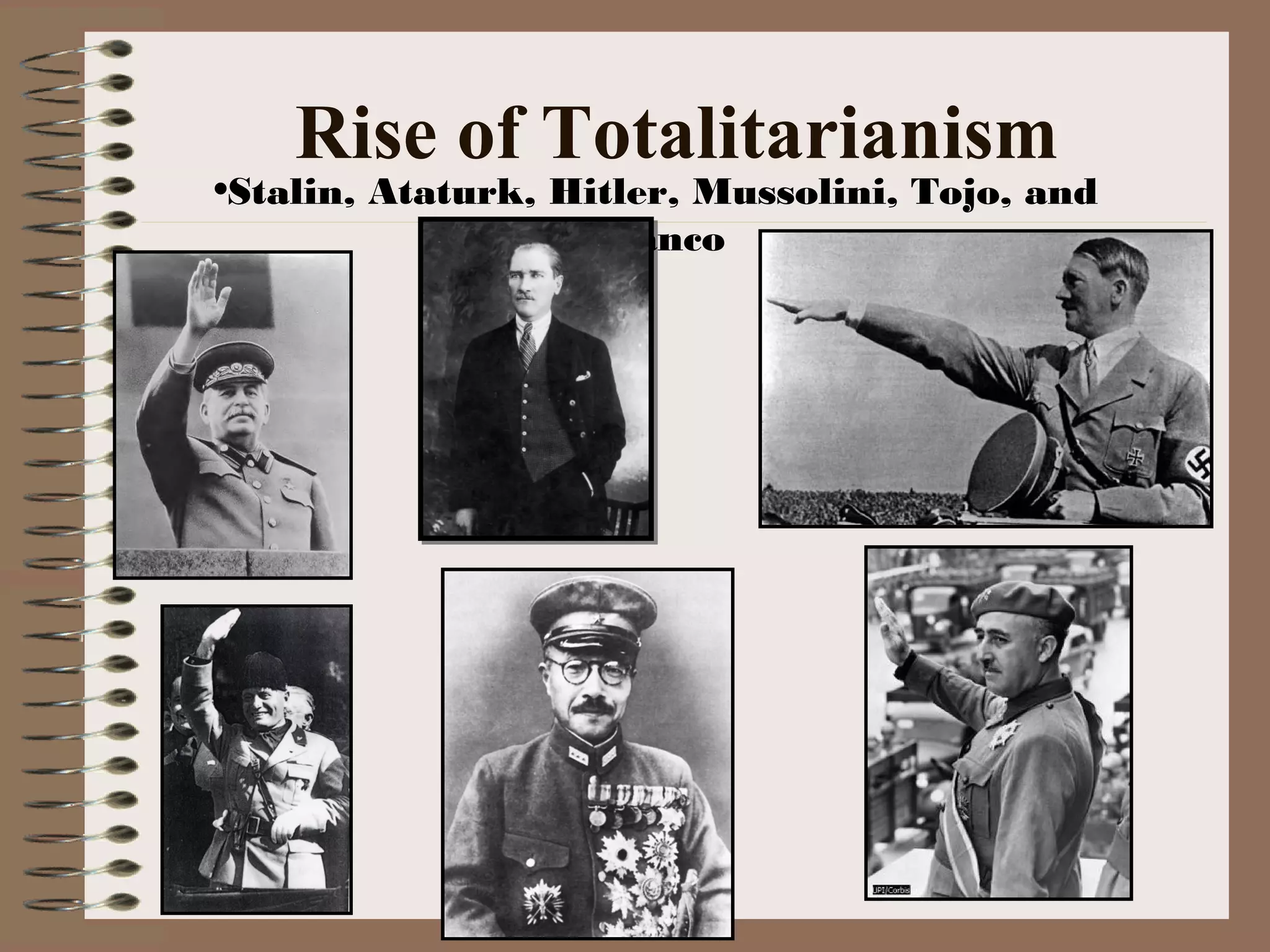
![Modernizing Turkey & Iran
• Mustafa Kemal [Ataturk]
declared the Republic of
Turkey; he passed laws
which westernized his
state (secularization, laws
against veils, Latin script,
ended Shariah).
• Shah Reza Khan Pahlavi
also westernized Iran and
pursued modernization of
infrastructure, civil rights,
health and education.](https://image.slidesharecdn.com/regentsreviewpartii-180529115420/75/Regents-review-part-ii-3-2048.jpg)
![Fascist Italy
• Post-war Italy supported
the Fascist Party of Benito
Mussolini.
• The March on Rome led to
Fascist takeover of Italy.
• Black Shirts [squadristi].
• Normalized relations with
the Pope [Lateran Pacts].
• Italian nationalism [Mare
Nostro, Italia Irredenta];
opposed democracy and
communism.](https://image.slidesharecdn.com/regentsreviewpartii-180529115420/75/Regents-review-part-ii-4-2048.jpg)

![Stalinist Rule
• Joseph Stalin rose to power
after isolating Trotsky
[executed] in the Party.
• Pursued Five Year Plans
[collectivization]; led to the
Terror Famine [kulaks].
• Eliminated enemies in the
Great Purge (1936-39).
• Used the NKVD [secret
police] and gulag prisons.
• Sponsored Socialist Realism
in the arts and atheism.](https://image.slidesharecdn.com/regentsreviewpartii-180529115420/75/Regents-review-part-ii-6-2048.jpg)
![Nazi Germany
• Weimar Republic was
plagued by instability
and hyperinflation.
• Adolf Hitler and his
Nazis tried to take power
in Beerhall Putsch.
• Wrote Mein Kampf [anti-
Semitism, Aryan Master
Race theories].
• Became chancellor and
ended democracy (1933)
• Pursued militaristic and
nationalistic agendas.](https://image.slidesharecdn.com/regentsreviewpartii-180529115420/75/Regents-review-part-ii-7-2048.jpg)
![World War II (1939-45)
• M.A.N.I.A. and the
Invasion of Poland (by
Non-Aggression Pact).
• Munich Conference -
Appeasement
• Blitzkrieg tactics
• Big Three: US [FDR],
USSR [Stalin] and
Britain [Churchill].
• Pearl Harbor invasion.
• Turning points: Miracle
at Dunkirk, Stalingrad,
Midway, D-Day](https://image.slidesharecdn.com/regentsreviewpartii-180529115420/75/Regents-review-part-ii-8-2048.jpg)
![End of the War: Europe
• Allied Invasion of Italy
(Mussolini overthrown)
• D-Day Invasion and the
Liberation of France.
• Battle of the Bulge
• Fall of Berlin [Suicide
of Adolf Hitler] - known
as V.E. Day.
• Yalta and Potsdam
Conferences – plans for
the future of Europe.](https://image.slidesharecdn.com/regentsreviewpartii-180529115420/75/Regents-review-part-ii-9-2048.jpg)

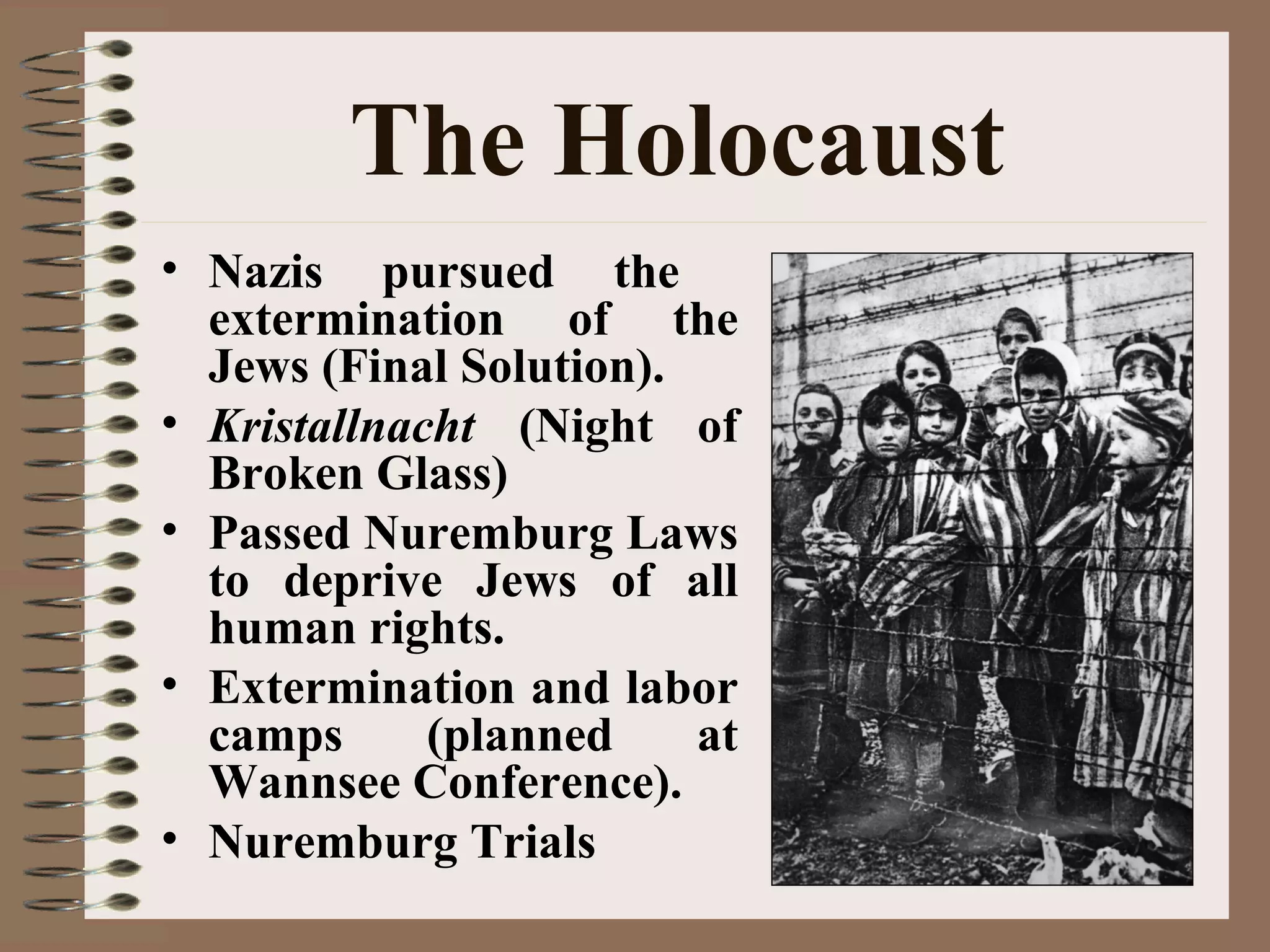
![Indian Nationalism
• The Indian National
Congress followed
Mahatma Gandhi in
his pursuit of non-
violent resistance
[ahimsa] of British rule
[Amritsar Massacre].
• Famous Salt March to
the sea [self-reliance;
boycott of British
goods] was a success.](https://image.slidesharecdn.com/regentsreviewpartii-180529115420/75/Regents-review-part-ii-12-2048.jpg)
![South Asia: India
• Jawaharlal Nehru pursued
socialist policies; non-
alignment; banned caste
system; fought two wars
over Kashmir.
• Indira Gandhi [emergency
rule; nuclear bomb; war
over Bangladesh; attack on
Sikh Golden Temple] and
son Rajiv Gandhi were both
assassinated.
• World’s largest democracy](https://image.slidesharecdn.com/regentsreviewpartii-180529115420/75/Regents-review-part-ii-13-2048.jpg)
![South Asia: Pakistan
• Founded by Muhammad
Ali Jinnah [Muslim
League]; two territories -
E. Pakistan became
Bangladesh.
• Election of Benazir Bhutto
[assassinated].
• Dictators ruled until 2011
[Pervez Musharraf].
• Nuclear weapons power.](https://image.slidesharecdn.com/regentsreviewpartii-180529115420/75/Regents-review-part-ii-14-2048.jpg)
![Chinese Nationalism
• Manchu [Qing] dynasty
was overthrown by Dr.
Sun Yixian [declared the
Republic of China, 1911].
• Pursued Three Principles:
Nationalism, Democracy,
Livelihood.
• Founded the Guomindang
[Nationalist] Party and
even worked with
Communists.](https://image.slidesharecdn.com/regentsreviewpartii-180529115420/75/Regents-review-part-ii-15-2048.jpg)
![Chinese Civil War
• After Dr. Sun’s death, Jiang
Jieshi [Chiang Kaishek] led
the Guomindang.
• Cleared China of warlords
with Communist aid.
• Turned on Communists
[Shanghai Massacre] and
pursued them into the
mountains [Long March].
• Japanese invasion of China
[Rape of Nanjing] caused
both sides to stop fighting.](https://image.slidesharecdn.com/regentsreviewpartii-180529115420/75/Regents-review-part-ii-16-2048.jpg)
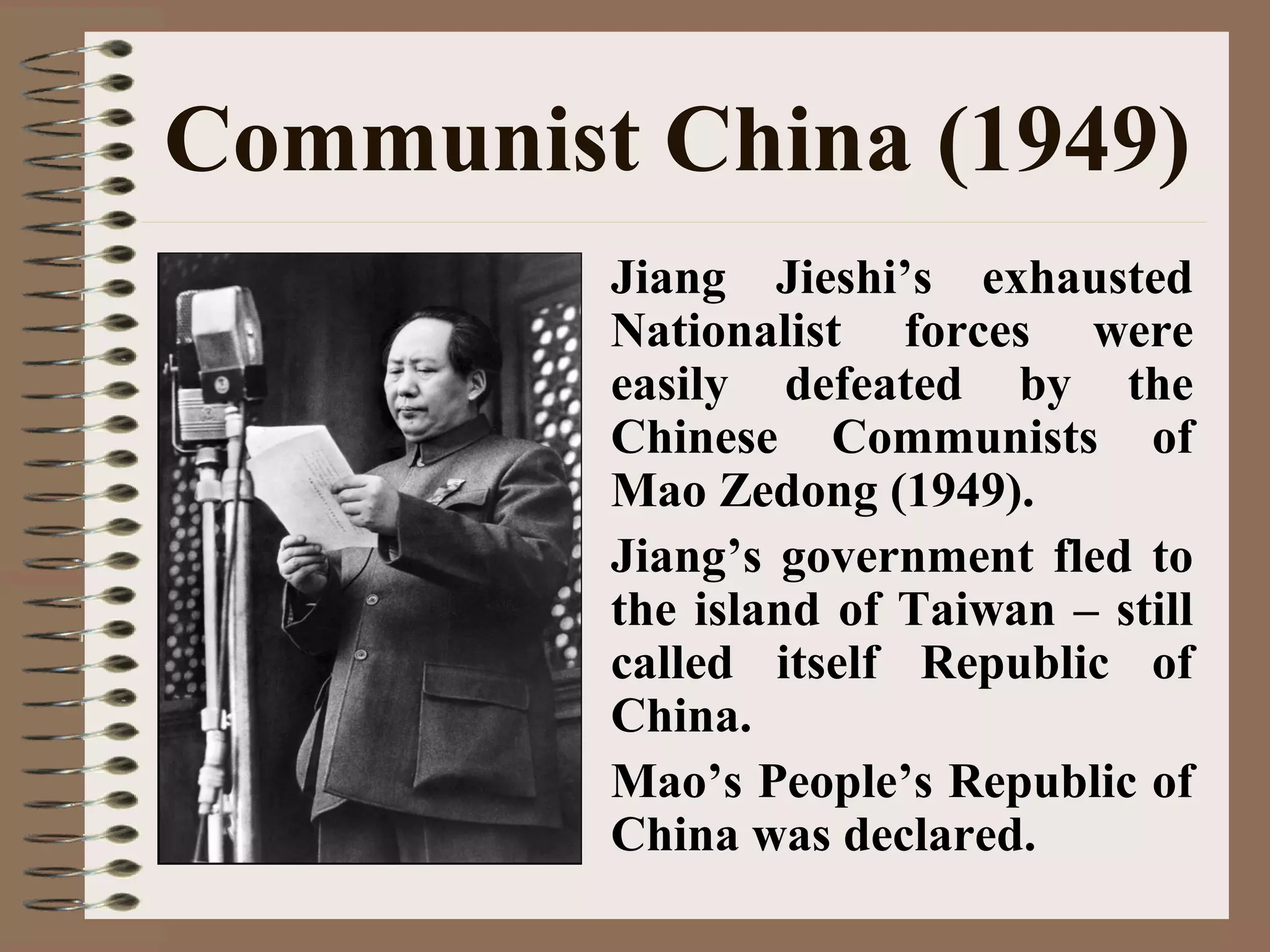
![Mao’s Policies
• Great Leap Forward
[collective farms] and
five year plans led to
millions of deaths –
Mao withdrew from
public.
• Cultural Revolution –
Mao purged his
rivals [pragmatists]
with the Red Guards.
• “Little Red Book”](https://image.slidesharecdn.com/regentsreviewpartii-180529115420/75/Regents-review-part-ii-18-2048.jpg)
![Pan-Africanism
• Developed in ideas of
Marcus Garvey and
Leopold Senghor
[negritude]
• Belief in the unity of
the African peoples.
• Response to European
imperialism and the
rise of nationalism in
Africa.](https://image.slidesharecdn.com/regentsreviewpartii-180529115420/75/Regents-review-part-ii-19-2048.jpg)
![African Independence
• Ghana – Kwame
Nkrumah used general
strikes for independence.
• Kenya – Jomo Kenyatta
and the Mau Mau
uprising [terrorism].
• Nigeria – Ibo declared
Republic of Biafra [led
to death of millions]
• Congo – democracy
overthrown by rebel
groups; Mobutu Sese
Seko became dictator.](https://image.slidesharecdn.com/regentsreviewpartii-180529115420/75/Regents-review-part-ii-20-2048.jpg)
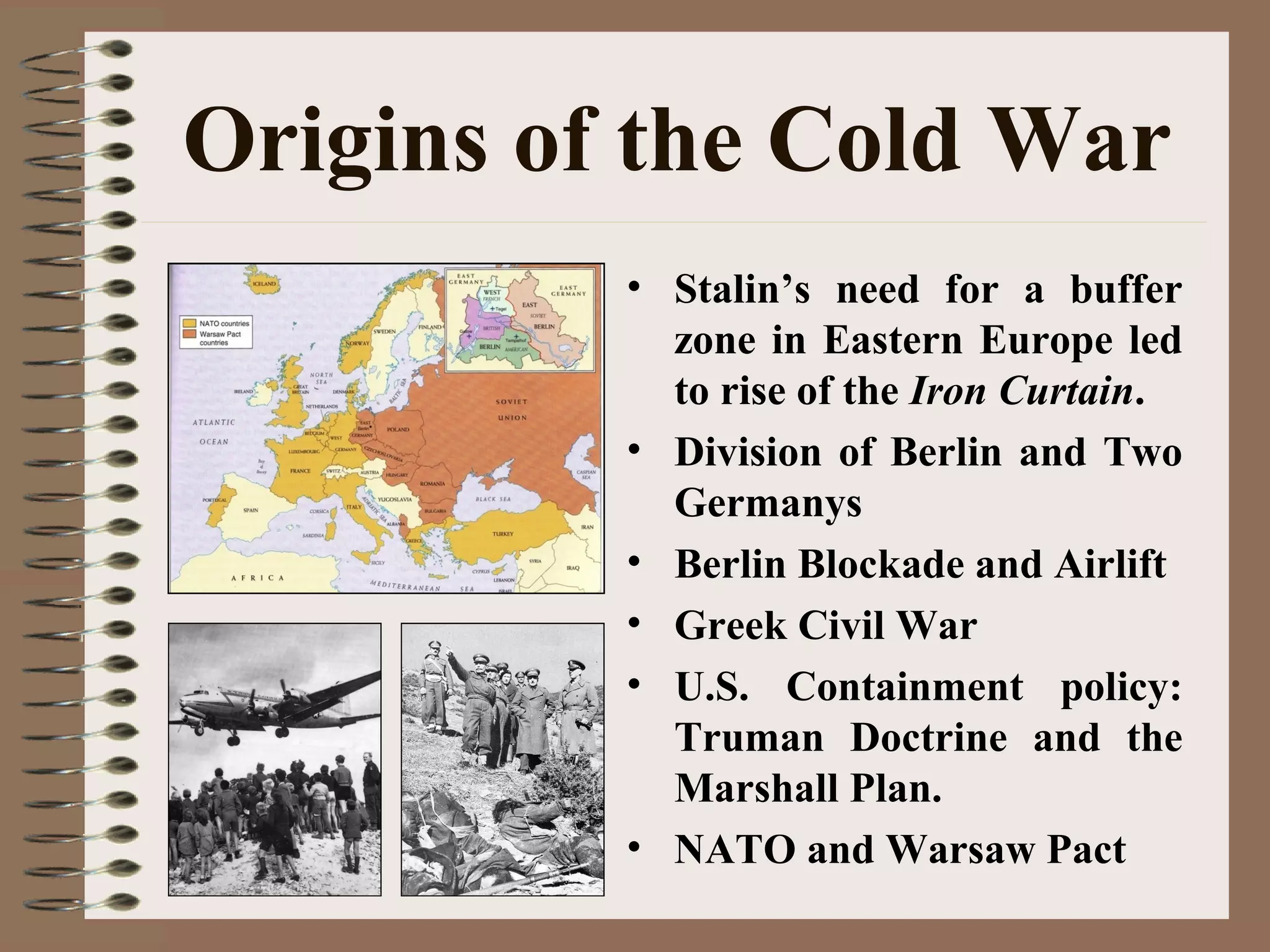

![Western Europe
• W. Germany – “Economic
Miracle” [Konrad Adenauer].
• Rise of the Welfare State –
Britain, France, W. Germany.
• European Unity: European
Community (1957) expands into
European Union (1993).
• Margaret Thatcher – limits on the
welfare state; privatized
industries.
• France – Withdrew from NATO.](https://image.slidesharecdn.com/regentsreviewpartii-180529115420/75/Regents-review-part-ii-24-2048.jpg)
![Cold War in Asia
• Korean War – UN Army
pushes back N. Koreans; Two
Koreas established.
• First Indochina War [Ho Chi
Minh defeats French] – Two
Vietnams (No/So).
• Vietnam War [2nd
Indochina] –
US involvement fails; North
and Vietcong defeat South.
• Conflict expands to Laos and
Cambodia [Khmer Rouge led
by Pol Pot]
• Cambodian “Killing Fields”](https://image.slidesharecdn.com/regentsreviewpartii-180529115420/75/Regents-review-part-ii-25-2048.jpg)


![Post-Cold War Flashpoints
• Chechnya – Russian region
pursuing violent path to
independence [terrorism];
crushed by Vladimir Putin.
• Collapse of Yugoslavia –
led to violence in Bosnia
[Muslims, Serbs and Croats
fight]; Dayton Peace Accords
ended civil war; Kosovo.
• Rwanda and Burundi –
ethnic strife between Hutus
and Tutsis leads to massacre
of 800,000.](https://image.slidesharecdn.com/regentsreviewpartii-180529115420/75/Regents-review-part-ii-29-2048.jpg)
![Mexican Revolution
• Fueled by nationalism
but was caused by
oppressive Mexican
leadership [dictator
Porfirio Diaz].
• While democracy was
gained, civil war led to
millions of deaths.
• Influenced the rise of
the PRI [until 2000].](https://image.slidesharecdn.com/regentsreviewpartii-180529115420/75/Regents-review-part-ii-30-2048.jpg)
![Latin American Dictators
• Argentina – Juan Peron [with
wife Evita] enjoyed popular
support but was ousted by
military; Mothers of the Plaza de
Mayo – silent protest for missing
relatives; dictatorship until 1983
[after defeat in Falklands War].
• Chile – Socialist Pres. Salvador
Allende overthrown by dictator
Augusto Pinochet.
• OAS [Organization of American
States] formed to promote
democracy in the region.](https://image.slidesharecdn.com/regentsreviewpartii-180529115420/75/Regents-review-part-ii-31-2048.jpg)
![Latin American Conflicts
• Nicaragua – ruled by the Marxist
Sandinista regime; challenged by
US backed Contras; ended with
elections (1990).
• El Salvador – attacked by death
squads [death of Archbishop
Romero – liberation theology];
UN peace deal ended civil war
(1991).
• Guatemala – military regime
targeted indigenous peoples
[slaughtered thousands]; peace
with rebels led to stability (1993).](https://image.slidesharecdn.com/regentsreviewpartii-180529115420/75/Regents-review-part-ii-32-2048.jpg)
![Apartheid
• Afrikaners passed apartheid,
townships, homelands.
• ANC [African National
Congress] led by Nelson
Mandela – jailed for treason.
• Soweto Uprising; Sharpeville
Massacre; Bishop Desmond
Tutu spoke against gov’t.
• Sanctions, divestment
• FW deKlerk repealed laws;
released Mandela.
• Mandela became president.](https://image.slidesharecdn.com/regentsreviewpartii-180529115420/75/Regents-review-part-ii-33-2048.jpg)
![Deng’s China
• Deng Xiaoping arrested Gang
of Four [Madame Mao] and
ruled as premier after Mao.
• Introduced policy of the Four
Modernizations [economic
reforms] and gradually
brought capitalism.
• Tiananmen Square Massacre
- pro-democracy protests
crushed in Beijing [Goddess
of Democracy statue]
• Return of Hong Kong from
Britain (1997).](https://image.slidesharecdn.com/regentsreviewpartii-180529115420/75/Regents-review-part-ii-34-2048.jpg)
![Pan-Arabism
• The rise of Gamal Abdel
Nasser in Egypt led to
focus on Pan-Arabism.
• Believed in the unity of
the Arab peoples across
the Middle East (e.g.
Arab League).
• Pursued this in his UAR
[United Arab Republic]
with Syria (1959-61).
• Declined in recent times.](https://image.slidesharecdn.com/regentsreviewpartii-180529115420/75/Regents-review-part-ii-35-2048.jpg)
![Palestine: Two Nationalisms
• Zionists [Theodore Herzl]
were encouraged by the
Balfour Declaration and
settled in Palestine [rise of
Jewish kibbutzim].
• Pan-Arabism and British
promises of liberation
[during World War I] made
Arabs optimistic of
establishing rule over their
Arabic homelands.
• British unable to control
Palestine after World War II](https://image.slidesharecdn.com/regentsreviewpartii-180529115420/75/Regents-review-part-ii-36-2048.jpg)
![Partitions in Asia
• Partition of India into two
states (India and E. and W.
Pakistan) on religious lines.
• Led to three Indo-Pakistani
Wars over Kashmir and
separation of East Pakistan
[Bangladesh].
• Partition of Palestine into
two states (Israel and Arab
state) accepted only by Jews.
• Led to four Arab-Israeli
Wars.](https://image.slidesharecdn.com/regentsreviewpartii-180529115420/75/Regents-review-part-ii-37-2048.jpg)
![Arab-Israeli Conflict
• 1948: Israeli War of
Independence [David
Ben-Gurion]- victory
over four Arab states
• 1956: Suez Canal Crisis
[Nasser nationalizes
canal zone but loses
war]
• 1967: Six Day War
[Golda Meir] – massive
win for Israel
• 1973: Yom Kippur War
– slim victory for Israel
[Anwar Sadat gains
some prestige].](https://image.slidesharecdn.com/regentsreviewpartii-180529115420/75/Regents-review-part-ii-38-2048.jpg)
![Middle Eastern Turmoil
• Lebanese Civil War: Muslims
v. Christians in Beirut (1975)
• PLO [Palestine Liberation
Organization] of Yasser
Arafat used terrorism against
Israelis.
• Muammar Qaddafi of Libya
had ties with terrorist groups.
• Kurdish rebels fight Turks.
• OPEC puts embargo on
Western nations [leads to
worldwide recession].](https://image.slidesharecdn.com/regentsreviewpartii-180529115420/75/Regents-review-part-ii-39-2048.jpg)
![Islamic Fundamentalism
• Iranian Revolution (1979)
brought the Ayatollah
Khomeini to power.
• Created theocratic state
ruled by Shariah law
[based on the Quran] and
the clergy; attacked West.
• US Hostage Crisis.
• Shi’ite leaders clashed
with Sunni leaders: Iran-
Iraq War (1980-88).](https://image.slidesharecdn.com/regentsreviewpartii-180529115420/75/Regents-review-part-ii-40-2048.jpg)
![Irish Independence
• Catholic Ireland was occupied
by English Protestants (16th
Cent.); nationalism grew with
consequences of the Potato
Famine and the struggle for
Home Rule.
• After Easter Uprising (1916),
Ireland [except six counties]
received independence (1922);
IRA and paramilitary groups
formed.
• Good Friday Accord (1995)
reduced the tensions in
Northern Ireland.](https://image.slidesharecdn.com/regentsreviewpartii-180529115420/75/Regents-review-part-ii-41-2048.jpg)

This document provides an overview of global history from the rise of totalitarianism in the early 20th century through developments in the late 20th century. It summarizes key events including the modernization of Turkey and Iran, the fascist rule of Mussolini in Italy, Japanese expansionism, Stalin's rule in the USSR, Nazi Germany, World War II, independence movements in Africa and Asia, the Cold War, conflicts in the Middle East including the Arab-Israeli conflict, and independence in Ireland. The document covers political, economic, and social developments across countries and regions in a broad historical context.


