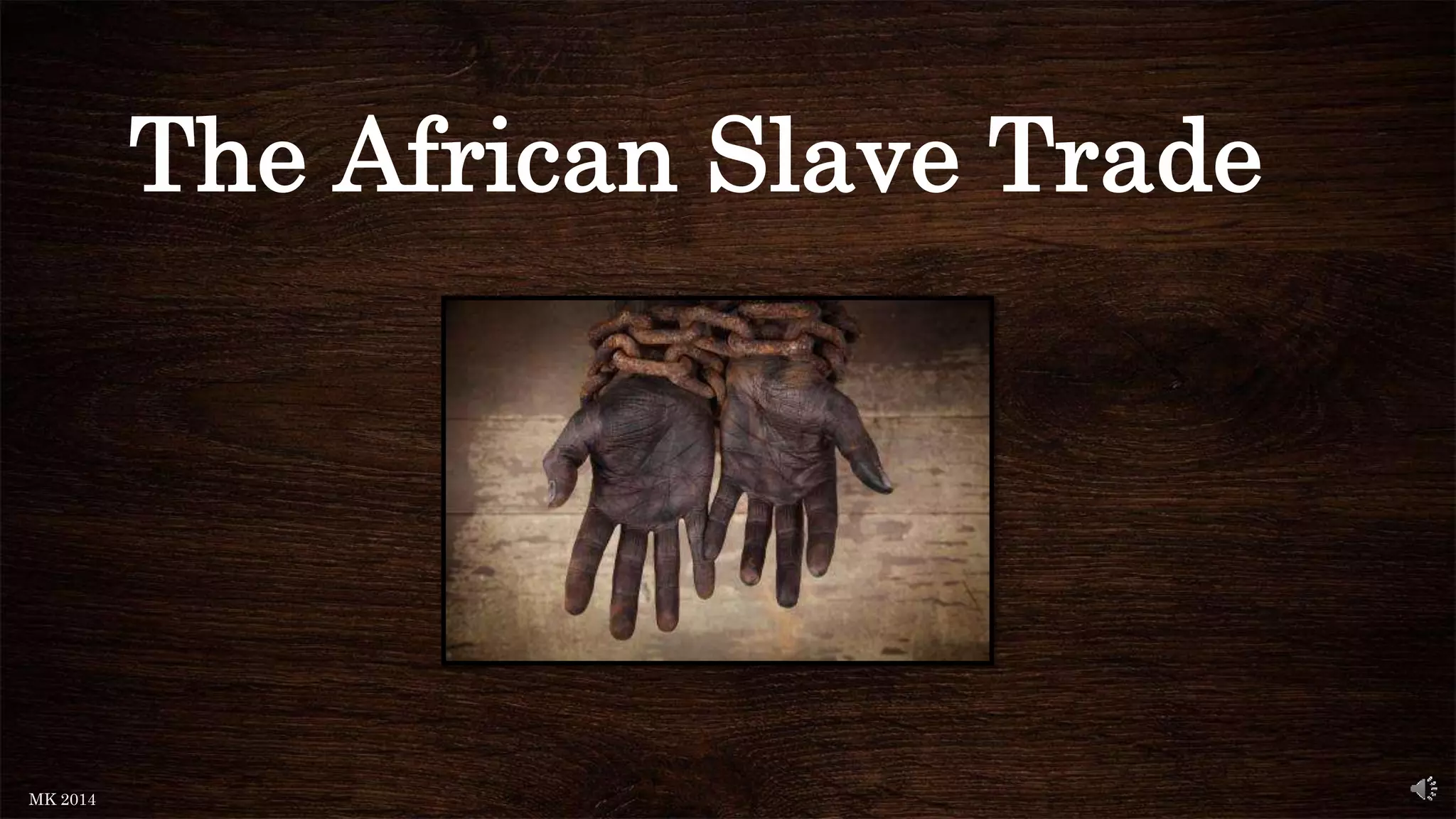
The African Slave Trade
MK 2014
Brief History of Slavery
Slavery in Africa
Arab / African Slavery
European Slave Trade
The Slaving Process
Slavery in the Americas
Comparisons
Life of a Slave
Resistance and Rebellion
Little Known Facts
Effects of Slavery
Slavery Today
We will cover the following:
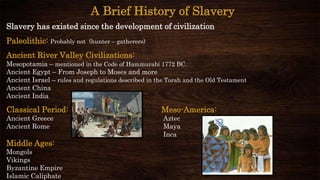
A Brief History of Slavery
Slavery has existed since the development of civilization
Paleolithic: Probably not (hunter – gatherers)
Ancient River Valley Civilizations:
Mesopotamia – mentioned in the Code of Hammurabi 1772 BC.
Ancient Egypt – From Joseph to Moses and more
Ancient Israel – rules and regulations described in the Torah and the Old Testament
Ancient China
Ancient India
Classical Period: Meso-America:
Ancient Greece Aztec
Ancient Rome Maya
Inca
Middle Ages:
Mongols
Vikings
Byzantine Empire
Islamic Caliphate
Slavery in Africa
The history of African slavery can be divided into 3 periods:
1. African enslavement of Africans
The types of slavery in Africa differed depending on the location.
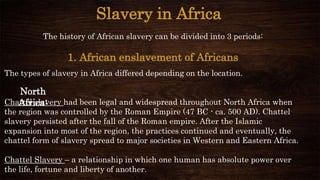
Chattel slavery had been legal and widespread throughout North Africa when
the region was controlled by the Roman Empire (47 BC - ca. 500 AD). Chattel
slavery persisted after the fall of the Roman empire. After the Islamic
expansion into most of the region, the practices continued and eventually, the
chattel form of slavery spread to major societies in Western and Eastern Africa.
Chattel Slavery – a relationship in which one human has absolute power over
the life, fortune and liberty of another.
North
Africa:
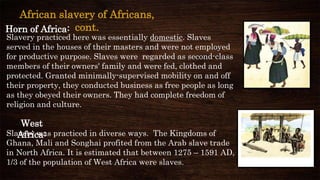
Slavery practiced here was essentially domestic. Slaves
served in the houses of their masters and were not employed
for productive purpose. Slaves were regarded as second-class
members of their owners' family and were fed, clothed and
protected. Granted minimally-supervised mobility on and off
their property, they conducted business as free people as long
as they obeyed their owners. They had complete freedom of
religion and culture.
Slavery was practiced in diverse ways. The Kingdoms of
Ghana, Mali and Songhai profited from the Arab slave trade
in North Africa. It is estimated that between 1275 – 1591 AD,
1/3 of the population of West Africa were slaves.
Horn of Africa:
West
Africa:
African slavery of Africans,
cont.
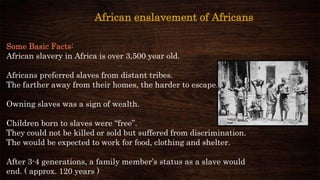
Some Basic Facts:
African slavery in Africa is over 3,500 year old.
Africans preferred slaves from distant tribes.
The farther away from their homes, the harder to escape.
Owning slaves was a sign of wealth.
Children born to slaves were “free”.
They could not be killed or sold but suffered from discrimination.
The would be expected to work for food, clothing and shelter.
After 3-4 generations, a family member’s status as a slave would
end. ( approx. 120 years )
African enslavement of Africans
2. Arab enslavement of Africans
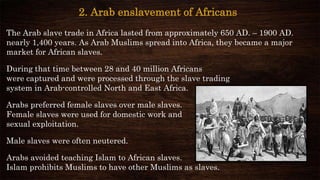
The Arab slave trade in Africa lasted from approximately 650 AD. – 1900 AD.
nearly 1,400 years. As Arab Muslims spread into Africa, they became a major
market for African slaves.
During that time between 28 and 40 million Africans
were captured and were processed through the slave trading
system in Arab-controlled North and East Africa.
Arabs preferred female slaves over male slaves.
Female slaves were used for domestic work and
sexual exploitation.
Male slaves were often neutered.
Arabs avoided teaching Islam to African slaves.
Islam prohibits Muslims to have other Muslims as slaves.
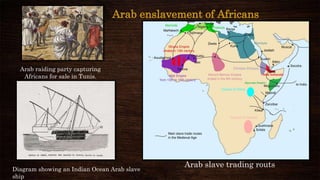
Arab slave trading routs
Diagram showing an Indian Ocean Arab slave
ship
Arab raiding party capturing
Africans for sale in Tunis.
Arab enslavement of Africans
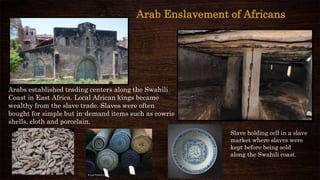
Arabs established trading centers along the Swahili
Coast in East Africa. Local African kings became
wealthy from the slave trade. Slaves were often
bought for simple but in-demand items such as cowrie
shells, cloth and porcelain.
Slave holding cell in a slave
market where slaves were
kept before being sold
along the Swahili coast.
Arab Enslavement of Africans
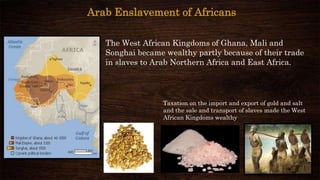
The West African Kingdoms of Ghana, Mali and
Songhai became wealthy partly because of their trade
in slaves to Arab Northern Africa and East Africa.
Taxation on the import and export of gold and salt
and the sale and transport of slaves made the West
African Kingdoms wealthy
Arab Enslavement of Africans
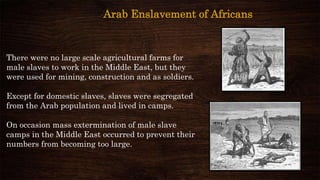
There were no large scale agricultural farms for
male slaves to work in the Middle East, but they
were used for mining, construction and as soldiers.
Except for domestic slaves, slaves were segregated
from the Arab population and lived in camps.
On occasion mass extermination of male slave
camps in the Middle East occurred to prevent their
numbers from becoming too large.
Arab Enslavement of Africans
Arab / African Enslavement of White Europeans
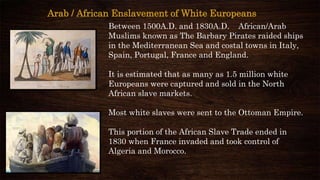
Between 1500A.D. and 1830A.D. African/Arab
Muslims known as The Barbary Pirates raided ships
in the Mediterranean Sea and costal towns in Italy,
Spain, Portugal, France and England.
It is estimated that as many as 1.5 million white
Europeans were captured and sold in the North
African slave markets.
Most white slaves were sent to the Ottoman Empire.
This portion of the African Slave Trade ended in
1830 when France invaded and took control of
Algeria and Morocco.
3. The European Slave Trade
The Portuguese were the first to establish permanent
trading facilities on the West African coast in 1471 AD.
In 1494, the Portuguese had exclusive trade
agreements with several West African kingdoms.
Gold, ivory and pepper were the products they were
most interested in trading for at first.
Europeans had very little need for slaves and they
were a minimal part of the slave trade until after the
conquest of the “New World” - the Americas 1535 AD.
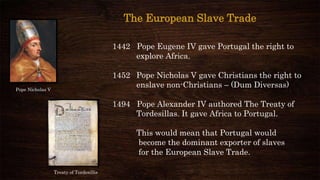
1442 Pope Eugene IV gave Portugal the right to
explore Africa.
1452 Pope Nicholas V gave Christians the right to
enslave non-Christians – (Dum Diversas)
1494 Pope Alexander IV authored The Treaty of
Tordesillas. It gave Africa to Portugal.
This would mean that Portugal would
become the dominant exporter of slaves
for the European Slave Trade.
Pope Nicholas V
The European Slave Trade
Treaty of Tordesillis
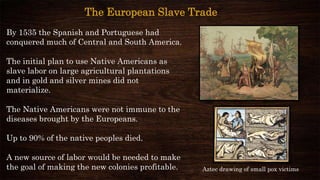
By 1535 the Spanish and Portuguese had
conquered much of Central and South America.
The initial plan to use Native Americans as
slave labor on large agricultural plantations
and in gold and silver mines did not
materialize.
The Native Americans were not immune to the
diseases brought by the Europeans.
Up to 90% of the native peoples died.
A new source of labor would be needed to make
the goal of making the new colonies profitable.
The European Slave Trade
Aztec drawing of small pox victims
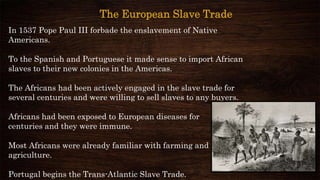
In 1537 Pope Paul III forbade the enslavement of Native
Americans.
To the Spanish and Portuguese it made sense to import African
slaves to their new colonies in the Americas.
The Africans had been actively engaged in the slave trade for
several centuries and were willing to sell slaves to any buyers.
Africans had been exposed to European diseases for
centuries and they were immune.
Most Africans were already familiar with farming and
agriculture.
Portugal begins the Trans-Atlantic Slave Trade.
The European Slave Trade
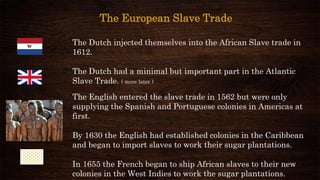
The Dutch injected themselves into the African Slave trade in
1612.
The Dutch had a minimal but important part in the Atlantic
Slave Trade. ( more later )
The English entered the slave trade in 1562 but were only
supplying the Spanish and Portuguese colonies in Americas at
first.
By 1630 the English had established colonies in the Caribbean
and began to import slaves to work their sugar plantations.
In 1655 the French began to ship African slaves to their new
colonies in the West Indies to work the sugar plantations.
The European Slave Trade
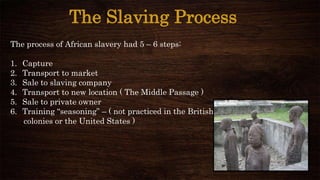
The Slaving Process
The process of African slavery had 5 – 6 steps:
1. Capture
2. Transport to market
3. Sale to slaving company
4. Transport to new location ( The Middle Passage )
5. Sale to private owner
6. Training “seasoning” – ( not practiced in the British
colonies or the United States )
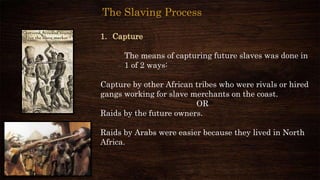
1. Capture
The means of capturing future slaves was done in
1 of 2 ways:
Capture by other African tribes who were rivals or hired
gangs working for slave merchants on the coast.
OR
Raids by the future owners.
Raids by Arabs were easier because they lived in North
Africa.
The Slaving Process
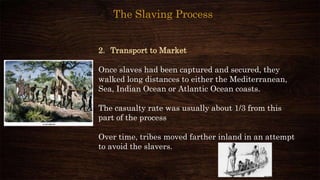
2. Transport to Market
Once slaves had been captured and secured, they
walked long distances to either the Mediterranean,
Sea, Indian Ocean or Atlantic Ocean coasts.
The casualty rate was usually about 1/3 from this
part of the process
Over time, tribes moved farther inland in an attempt
to avoid the slavers.
The Slaving Process
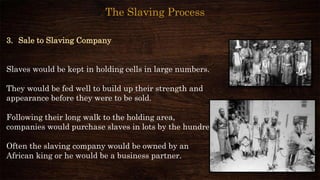
3. Sale to Slaving Company
Slaves would be kept in holding cells in large numbers.
They would be fed well to build up their strength and
appearance before they were to be sold.
Following their long walk to the holding area,
companies would purchase slaves in lots by the hundreds.
Often the slaving company would be owned by an
African king or he would be a business partner.
The Slaving Process
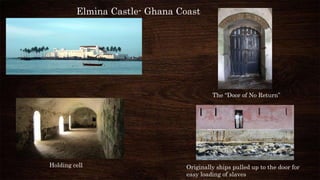
Holding cell
The “Door of No Return”
Originally ships pulled up to the door for
easy loading of slaves
Elmina Castle- Ghana Coast
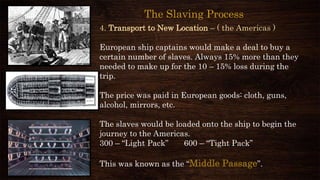
4. Transport to New Location – ( the Americas )
European ship captains would make a deal to buy a
certain number of slaves. Always 15% more than they
needed to make up for the 10 – 15% loss during the
trip.
The price was paid in European goods: cloth, guns,
alcohol, mirrors, etc.
The slaves would be loaded onto the ship to begin the
journey to the Americas.
300 – “Light Pack” 600 – “Tight Pack”
This was known as the “Middle Passage”.
The Slaving Process
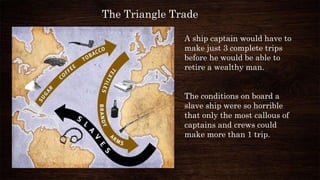
The Triangle Trade
A ship captain would have to
make just 3 complete trips
before he would be able to
retire a wealthy man.
The conditions on board a
slave ship were so horrible
that only the most callous of
captains and crews could
make more than 1 trip.
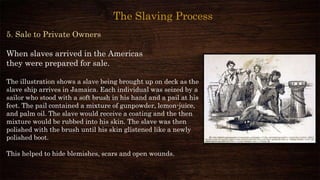
5. Sale to Private Owners
When slaves arrived in the Americas
they were prepared for sale.
The illustration shows a slave being brought up on deck as the
slave ship arrives in Jamaica. Each individual was seized by a
sailor who stood with a soft brush in his hand and a pail at his
feet. The pail contained a mixture of gunpowder, lemon-juice,
and palm oil. The slave would receive a coating and the then
mixture would be rubbed into his skin. The slave was then
polished with the brush until his skin glistened like a newly
polished boot.
This helped to hide blemishes, scars and open wounds.
The Slaving Process
The Slaving Process
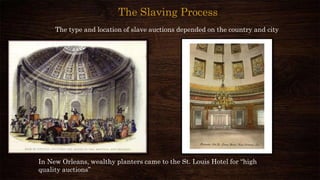
The type and location of slave auctions depended on the country and city
In New Orleans, wealthy planters came to the St. Louis Hotel for “high
quality auctions”
The Slaving Process
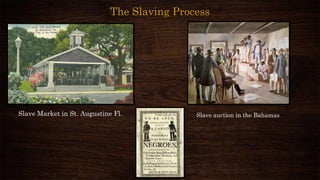
Slave Market in St. Augustine Fl. Slave auction in the Bahamas
The Slaving Process
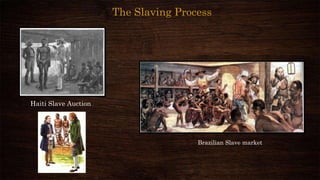
Brazilian Slave market
Haiti Slave Auction
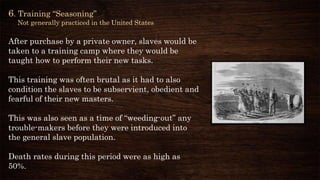
6. Training “Seasoning”
Not generally practiced in the United States
After purchase by a private owner, slaves would be
taken to a training camp where they would be
taught how to perform their new tasks.
This training was often brutal as it had to also
condition the slaves to be subservient, obedient and
fearful of their new masters.
This was also seen as a time of “weeding-out” any
trouble-makers before they were introduced into
the general slave population.
Death rates during this period were as high as
50%.
Slavery in the Americas
European countries colonized the Americas in
pursuit of territorial expansion and economic gain.
Large agricultural plantations became a source of
vast wealth for Europe.
There were different nationalities and cultures
running the plantations and farming conditions
varied according to crops and climate but all shared
the goal of wealth.
This caused slavery to be very different in different
places, but there were aspects of slavery common to
them all.
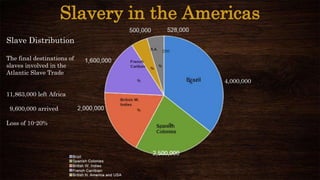
4,000,000
Slave Distribution
The final destinations of
slaves involved in the
Atlantic Slave Trade
11,863,000 left Africa
9,600,000 arrived
Loss of 10-20%
Slavery in the Americas
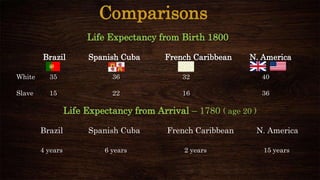
Life Expectancy from Birth 1800
Brazil Spanish Cuba French Caribbean N. America
White 35 36 32 40
Slave 15 22 16 36
Comparisons
Life Expectancy from Arrival – 1780 ( age 20 )
Brazil Spanish Cuba French Caribbean N. America
4 years 6 years 2 years 15 years
Comparisons
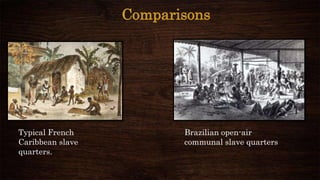
Typical French
Caribbean slave
quarters.
Brazilian open-air
communal slave quarters
Comparisons
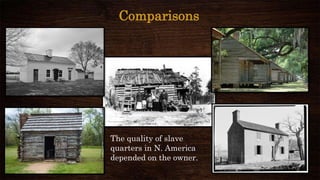
The quality of slave
quarters in N. America
depended on the owner.
Life of a Slave
If you want to know what the life of a slave was like, you must ask the owner,
“What did they want the life of their slaves to be like?”
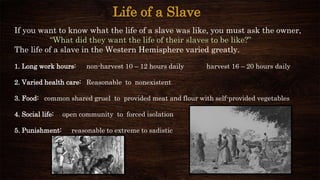
The life of a slave in the Western Hemisphere varied greatly.
1. Long work hours: non-harvest 10 – 12 hours daily harvest 16 – 20 hours daily
2. Varied health care: Reasonable to nonexistent
3. Food: common shared gruel to provided meat and flour with self-provided vegetables
4. Social life: open community to forced isolation
5. Punishment: reasonable to extreme to sadistic
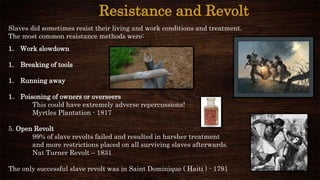
Resistance and Revolt
Slaves did sometimes resist their living and work conditions and treatment.
The most common resistance methods were:
1. Work slowdown
1. Breaking of tools
1. Running away
1. Poisoning of owners or overseers
This could have extremely adverse repercussions!
Myrtles Plantation - 1817
5. Open Revolt
99% of slave revolts failed and resulted in harsher treatment
and more restrictions placed on all surviving slaves afterwards.
Nat Turner Revolt – 1831
The only successful slave revolt was in Saint Dominique ( Haiti ) - 1791
Little Known Facts
The United States
Prior to 1655 there were no legal slaves in America – only indentured servants.
By law they had to be freed after no longer than 7 years of service and receive
20 - 50 acres of land
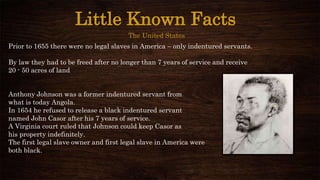
Anthony Johnson was a former indentured servant from
what is today Angola.
In 1654 he refused to release a black indentured servant
named John Casor after his 7 years of service.
A Virginia court ruled that Johnson could keep Casor as
his property indefinitely.
The first legal slave owner and first legal slave in America were
both black.
Little Known Facts
The United States
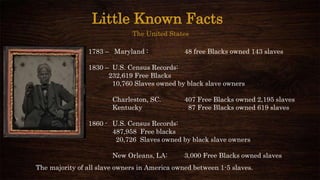
1783 – Maryland : 48 free Blacks owned 143 slaves
1830 – U.S. Census Records:
232,619 Free Blacks
10,760 Slaves owned by black slave owners
Charleston, SC. 407 Free Blacks owned 2,195 slaves
Kentucky 87 Free Blacks owned 619 slaves
1860 - U.S. Census Records:
487,958 Free blacks
20,726 Slaves owned by black slave owners
New Orleans, LA: 3,000 Free Blacks owned slaves
The majority of all slave owners in America owned between 1-5 slaves.
Effects of Slavery
Africa:
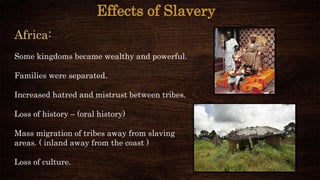
Some kingdoms became wealthy and powerful.
Families were separated.
Increased hatred and mistrust between tribes.
Loss of history – (oral history)
Mass migration of tribes away from slaving
areas. ( inland away from the coast )
Loss of culture.
Effects of Slavery
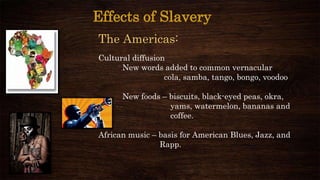
The Americas:
Cultural diffusion
New words added to common vernacular
cola, samba, tango, bongo, voodoo
New foods – biscuits, black-eyed peas, okra,
yams, watermelon, bananas and
coffee.
African music – basis for American Blues, Jazz, and
Rapp.
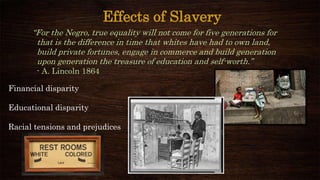
Effects of Slavery
“For the Negro, true equality will not come for five generations for
that is the difference in time that whites have had to own land,
build private fortunes, engage in commerce and build generation
upon generation the treasure of education and self-worth.”
- A. Lincoln 1864
Financial disparity
Educational disparity
Racial tensions and prejudices
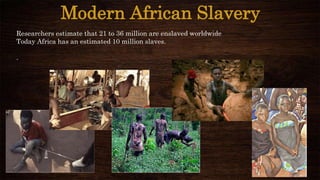
Modern African Slavery
Researchers estimate that 21 to 36 million are enslaved worldwide
Today Africa has an estimated 10 million slaves.
.
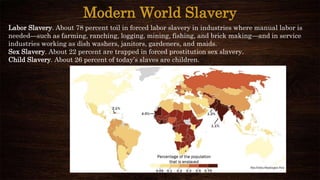
Modern World Slavery
Labor Slavery. About 78 percent toil in forced labor slavery in industries where manual labor is
needed—such as farming, ranching, logging, mining, fishing, and brick making—and in service
industries working as dish washers, janitors, gardeners, and maids.
Sex Slavery. About 22 percent are trapped in forced prostitution sex slavery.
Child Slavery. About 26 percent of today’s slaves are children.
The worst thing about slavery is the absence of hope.

The African Slave Trade

  • 1.
    The African SlaveTrade MK 2014
  • 2.
    Brief History ofSlavery Slavery in Africa Arab / African Slavery European Slave Trade The Slaving Process Slavery in the Americas Comparisons Life of a Slave Resistance and Rebellion Little Known Facts Effects of Slavery Slavery Today We will cover the following:
  • 3.
    A Brief Historyof Slavery Slavery has existed since the development of civilization Paleolithic: Probably not (hunter – gatherers) Ancient River Valley Civilizations: Mesopotamia – mentioned in the Code of Hammurabi 1772 BC. Ancient Egypt – From Joseph to Moses and more Ancient Israel – rules and regulations described in the Torah and the Old Testament Ancient China Ancient India Classical Period: Meso-America: Ancient Greece Aztec Ancient Rome Maya Inca Middle Ages: Mongols Vikings Byzantine Empire Islamic Caliphate
  • 4.
    Slavery in Africa Thehistory of African slavery can be divided into 3 periods: 1. African enslavement of Africans The types of slavery in Africa differed depending on the location. Chattel slavery had been legal and widespread throughout North Africa when the region was controlled by the Roman Empire (47 BC - ca. 500 AD). Chattel slavery persisted after the fall of the Roman empire. After the Islamic expansion into most of the region, the practices continued and eventually, the chattel form of slavery spread to major societies in Western and Eastern Africa. Chattel Slavery – a relationship in which one human has absolute power over the life, fortune and liberty of another. North Africa:
  • 5.
    Slavery practiced herewas essentially domestic. Slaves served in the houses of their masters and were not employed for productive purpose. Slaves were regarded as second-class members of their owners' family and were fed, clothed and protected. Granted minimally-supervised mobility on and off their property, they conducted business as free people as long as they obeyed their owners. They had complete freedom of religion and culture. Slavery was practiced in diverse ways. The Kingdoms of Ghana, Mali and Songhai profited from the Arab slave trade in North Africa. It is estimated that between 1275 – 1591 AD, 1/3 of the population of West Africa were slaves. Horn of Africa: West Africa: African slavery of Africans, cont.
  • 6.
    Some Basic Facts: Africanslavery in Africa is over 3,500 year old. Africans preferred slaves from distant tribes. The farther away from their homes, the harder to escape. Owning slaves was a sign of wealth. Children born to slaves were “free”. They could not be killed or sold but suffered from discrimination. The would be expected to work for food, clothing and shelter. After 3-4 generations, a family member’s status as a slave would end. ( approx. 120 years ) African enslavement of Africans
  • 7.
    2. Arab enslavementof Africans The Arab slave trade in Africa lasted from approximately 650 AD. – 1900 AD. nearly 1,400 years. As Arab Muslims spread into Africa, they became a major market for African slaves. During that time between 28 and 40 million Africans were captured and were processed through the slave trading system in Arab-controlled North and East Africa. Arabs preferred female slaves over male slaves. Female slaves were used for domestic work and sexual exploitation. Male slaves were often neutered. Arabs avoided teaching Islam to African slaves. Islam prohibits Muslims to have other Muslims as slaves.
  • 8.
    Arab slave tradingrouts Diagram showing an Indian Ocean Arab slave ship Arab raiding party capturing Africans for sale in Tunis. Arab enslavement of Africans
  • 9.
    Arabs established tradingcenters along the Swahili Coast in East Africa. Local African kings became wealthy from the slave trade. Slaves were often bought for simple but in-demand items such as cowrie shells, cloth and porcelain. Slave holding cell in a slave market where slaves were kept before being sold along the Swahili coast. Arab Enslavement of Africans
  • 10.
    The West AfricanKingdoms of Ghana, Mali and Songhai became wealthy partly because of their trade in slaves to Arab Northern Africa and East Africa. Taxation on the import and export of gold and salt and the sale and transport of slaves made the West African Kingdoms wealthy Arab Enslavement of Africans
  • 11.
    There were nolarge scale agricultural farms for male slaves to work in the Middle East, but they were used for mining, construction and as soldiers. Except for domestic slaves, slaves were segregated from the Arab population and lived in camps. On occasion mass extermination of male slave camps in the Middle East occurred to prevent their numbers from becoming too large. Arab Enslavement of Africans
  • 12.
    Arab / AfricanEnslavement of White Europeans Between 1500A.D. and 1830A.D. African/Arab Muslims known as The Barbary Pirates raided ships in the Mediterranean Sea and costal towns in Italy, Spain, Portugal, France and England. It is estimated that as many as 1.5 million white Europeans were captured and sold in the North African slave markets. Most white slaves were sent to the Ottoman Empire. This portion of the African Slave Trade ended in 1830 when France invaded and took control of Algeria and Morocco.
  • 13.
    3. The EuropeanSlave Trade The Portuguese were the first to establish permanent trading facilities on the West African coast in 1471 AD. In 1494, the Portuguese had exclusive trade agreements with several West African kingdoms. Gold, ivory and pepper were the products they were most interested in trading for at first. Europeans had very little need for slaves and they were a minimal part of the slave trade until after the conquest of the “New World” - the Americas 1535 AD.
  • 14.
    1442 Pope EugeneIV gave Portugal the right to explore Africa. 1452 Pope Nicholas V gave Christians the right to enslave non-Christians – (Dum Diversas) 1494 Pope Alexander IV authored The Treaty of Tordesillas. It gave Africa to Portugal. This would mean that Portugal would become the dominant exporter of slaves for the European Slave Trade. Pope Nicholas V The European Slave Trade Treaty of Tordesillis
  • 15.
    By 1535 theSpanish and Portuguese had conquered much of Central and South America. The initial plan to use Native Americans as slave labor on large agricultural plantations and in gold and silver mines did not materialize. The Native Americans were not immune to the diseases brought by the Europeans. Up to 90% of the native peoples died. A new source of labor would be needed to make the goal of making the new colonies profitable. The European Slave Trade Aztec drawing of small pox victims
  • 16.
    In 1537 PopePaul III forbade the enslavement of Native Americans. To the Spanish and Portuguese it made sense to import African slaves to their new colonies in the Americas. The Africans had been actively engaged in the slave trade for several centuries and were willing to sell slaves to any buyers. Africans had been exposed to European diseases for centuries and they were immune. Most Africans were already familiar with farming and agriculture. Portugal begins the Trans-Atlantic Slave Trade. The European Slave Trade
  • 17.
    The Dutch injectedthemselves into the African Slave trade in 1612. The Dutch had a minimal but important part in the Atlantic Slave Trade. ( more later ) The English entered the slave trade in 1562 but were only supplying the Spanish and Portuguese colonies in Americas at first. By 1630 the English had established colonies in the Caribbean and began to import slaves to work their sugar plantations. In 1655 the French began to ship African slaves to their new colonies in the West Indies to work the sugar plantations. The European Slave Trade
  • 18.
    The Slaving Process Theprocess of African slavery had 5 – 6 steps: 1. Capture 2. Transport to market 3. Sale to slaving company 4. Transport to new location ( The Middle Passage ) 5. Sale to private owner 6. Training “seasoning” – ( not practiced in the British colonies or the United States )
  • 19.
    1. Capture The meansof capturing future slaves was done in 1 of 2 ways: Capture by other African tribes who were rivals or hired gangs working for slave merchants on the coast. OR Raids by the future owners. Raids by Arabs were easier because they lived in North Africa. The Slaving Process
  • 20.
    2. Transport toMarket Once slaves had been captured and secured, they walked long distances to either the Mediterranean, Sea, Indian Ocean or Atlantic Ocean coasts. The casualty rate was usually about 1/3 from this part of the process Over time, tribes moved farther inland in an attempt to avoid the slavers. The Slaving Process
  • 21.
    3. Sale toSlaving Company Slaves would be kept in holding cells in large numbers. They would be fed well to build up their strength and appearance before they were to be sold. Following their long walk to the holding area, companies would purchase slaves in lots by the hundreds. Often the slaving company would be owned by an African king or he would be a business partner. The Slaving Process
  • 22.
    Holding cell The “Doorof No Return” Originally ships pulled up to the door for easy loading of slaves Elmina Castle- Ghana Coast
  • 23.
    4. Transport toNew Location – ( the Americas ) European ship captains would make a deal to buy a certain number of slaves. Always 15% more than they needed to make up for the 10 – 15% loss during the trip. The price was paid in European goods: cloth, guns, alcohol, mirrors, etc. The slaves would be loaded onto the ship to begin the journey to the Americas. 300 – “Light Pack” 600 – “Tight Pack” This was known as the “Middle Passage”. The Slaving Process
  • 24.
    The Triangle Trade Aship captain would have to make just 3 complete trips before he would be able to retire a wealthy man. The conditions on board a slave ship were so horrible that only the most callous of captains and crews could make more than 1 trip.
  • 25.
    5. Sale toPrivate Owners When slaves arrived in the Americas they were prepared for sale. The illustration shows a slave being brought up on deck as the slave ship arrives in Jamaica. Each individual was seized by a sailor who stood with a soft brush in his hand and a pail at his feet. The pail contained a mixture of gunpowder, lemon-juice, and palm oil. The slave would receive a coating and the then mixture would be rubbed into his skin. The slave was then polished with the brush until his skin glistened like a newly polished boot. This helped to hide blemishes, scars and open wounds. The Slaving Process
  • 26.
    The Slaving Process Thetype and location of slave auctions depended on the country and city In New Orleans, wealthy planters came to the St. Louis Hotel for “high quality auctions”
  • 27.
    The Slaving Process SlaveMarket in St. Augustine Fl. Slave auction in the Bahamas
  • 28.
    The Slaving Process BrazilianSlave market Haiti Slave Auction
  • 29.
    6. Training “Seasoning” Notgenerally practiced in the United States After purchase by a private owner, slaves would be taken to a training camp where they would be taught how to perform their new tasks. This training was often brutal as it had to also condition the slaves to be subservient, obedient and fearful of their new masters. This was also seen as a time of “weeding-out” any trouble-makers before they were introduced into the general slave population. Death rates during this period were as high as 50%.
  • 30.
    Slavery in theAmericas European countries colonized the Americas in pursuit of territorial expansion and economic gain. Large agricultural plantations became a source of vast wealth for Europe. There were different nationalities and cultures running the plantations and farming conditions varied according to crops and climate but all shared the goal of wealth. This caused slavery to be very different in different places, but there were aspects of slavery common to them all.
  • 31.
    4,000,000 Slave Distribution The finaldestinations of slaves involved in the Atlantic Slave Trade 11,863,000 left Africa 9,600,000 arrived Loss of 10-20% Slavery in the Americas
  • 32.
    Life Expectancy fromBirth 1800 Brazil Spanish Cuba French Caribbean N. America White 35 36 32 40 Slave 15 22 16 36 Comparisons Life Expectancy from Arrival – 1780 ( age 20 ) Brazil Spanish Cuba French Caribbean N. America 4 years 6 years 2 years 15 years
  • 33.
  • 34.
    Comparisons The quality ofslave quarters in N. America depended on the owner.
  • 35.
    Life of aSlave If you want to know what the life of a slave was like, you must ask the owner, “What did they want the life of their slaves to be like?” The life of a slave in the Western Hemisphere varied greatly. 1. Long work hours: non-harvest 10 – 12 hours daily harvest 16 – 20 hours daily 2. Varied health care: Reasonable to nonexistent 3. Food: common shared gruel to provided meat and flour with self-provided vegetables 4. Social life: open community to forced isolation 5. Punishment: reasonable to extreme to sadistic
  • 36.
    Resistance and Revolt Slavesdid sometimes resist their living and work conditions and treatment. The most common resistance methods were: 1. Work slowdown 1. Breaking of tools 1. Running away 1. Poisoning of owners or overseers This could have extremely adverse repercussions! Myrtles Plantation - 1817 5. Open Revolt 99% of slave revolts failed and resulted in harsher treatment and more restrictions placed on all surviving slaves afterwards. Nat Turner Revolt – 1831 The only successful slave revolt was in Saint Dominique ( Haiti ) - 1791
  • 37.
    Little Known Facts TheUnited States Prior to 1655 there were no legal slaves in America – only indentured servants. By law they had to be freed after no longer than 7 years of service and receive 20 - 50 acres of land Anthony Johnson was a former indentured servant from what is today Angola. In 1654 he refused to release a black indentured servant named John Casor after his 7 years of service. A Virginia court ruled that Johnson could keep Casor as his property indefinitely. The first legal slave owner and first legal slave in America were both black.
  • 38.
    Little Known Facts TheUnited States 1783 – Maryland : 48 free Blacks owned 143 slaves 1830 – U.S. Census Records: 232,619 Free Blacks 10,760 Slaves owned by black slave owners Charleston, SC. 407 Free Blacks owned 2,195 slaves Kentucky 87 Free Blacks owned 619 slaves 1860 - U.S. Census Records: 487,958 Free blacks 20,726 Slaves owned by black slave owners New Orleans, LA: 3,000 Free Blacks owned slaves The majority of all slave owners in America owned between 1-5 slaves.
  • 39.
    Effects of Slavery Africa: Somekingdoms became wealthy and powerful. Families were separated. Increased hatred and mistrust between tribes. Loss of history – (oral history) Mass migration of tribes away from slaving areas. ( inland away from the coast ) Loss of culture.
  • 40.
    Effects of Slavery TheAmericas: Cultural diffusion New words added to common vernacular cola, samba, tango, bongo, voodoo New foods – biscuits, black-eyed peas, okra, yams, watermelon, bananas and coffee. African music – basis for American Blues, Jazz, and Rapp.
  • 41.
    Effects of Slavery “Forthe Negro, true equality will not come for five generations for that is the difference in time that whites have had to own land, build private fortunes, engage in commerce and build generation upon generation the treasure of education and self-worth.” - A. Lincoln 1864 Financial disparity Educational disparity Racial tensions and prejudices
  • 42.
    Modern African Slavery Researchersestimate that 21 to 36 million are enslaved worldwide Today Africa has an estimated 10 million slaves. .
  • 43.
    Modern World Slavery LaborSlavery. About 78 percent toil in forced labor slavery in industries where manual labor is needed—such as farming, ranching, logging, mining, fishing, and brick making—and in service industries working as dish washers, janitors, gardeners, and maids. Sex Slavery. About 22 percent are trapped in forced prostitution sex slavery. Child Slavery. About 26 percent of today’s slaves are children.
  • 44.
    The worst thingabout slavery is the absence of hope.