AMERICAN REVOLUTION
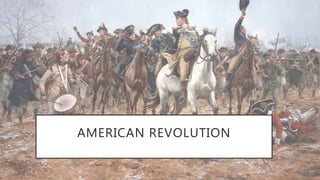
• Also known as the American Revolutionary War and the U.S.
War of Independence, the conflict arose from growing
tensions between residents of Great Britain’s 13 North
American colonies and the colonial government, which
represented the British crown from 1754-1783.
FRENCH-INDIAN WAR (1754-63)
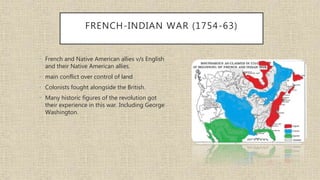
• French and Native American allies v/s English
and their Native American allies.
• main conflict over control of land
• Colonists fought alongside the British.
• Many historic figures of the revolution got
their experience in this war. Including George
Washington.
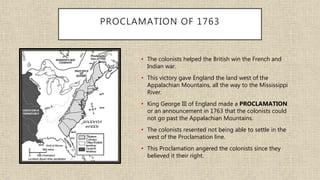
PROCLAMATION OF 1763
• The colonists helped the British win the French and
Indian war.
• This victory gave England the land west of the
Appalachian Mountains, all the way to the Mississippi
River.
• King George III of England made a PROCLAMATION
or an announcement in 1763 that the colonists could
not go past the Appalachian Mountains.
• The colonists resented not being able to settle in the
west of the Proclamation line.
• This Proclamation angered the colonists since they
believed it their right.
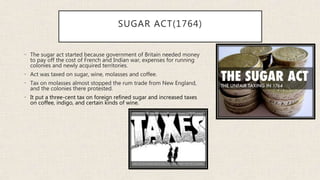
SUGAR ACT(1764)
• The sugar act started because government of Britain needed money
to pay off the cost of French and Indian war, expenses for running
colonies and newly acquired territories.
• Act was taxed on sugar, wine, molasses and coffee.
• Tax on molasses almost stopped the rum trade from New England,
and the colonies there protested.
• It put a three-cent tax on foreign refined sugar and increased taxes
on coffee, indigo, and certain kinds of wine.
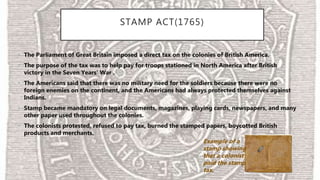
STAMP ACT(1765)
• The Parliament of Great Britain imposed a direct tax on the colonies of British America.
• The purpose of the tax was to help pay for troops stationed in North America after British
victory in the Seven Years' War .
• The Americans said that there was no military need for the soldiers because there were no
foreign enemies on the continent, and the Americans had always protected themselves against
Indians.
• Stamp became mandatory on legal documents, magazines, playing cards, newspapers, and many
other paper used throughout the colonies.
• The colonists protested, refused to pay tax, burned the stamped papers, boycotted British
products and merchants.
Example of a
stamp showing
that a colonist
paid the stamp
tax.
TOWNSHEND ACT(1767)
• In 1767, The English Parliament passed the Townshend
Revenue Acts, imposing a new series of taxes on the
colonists to pay for the costs of administering and
protecting the American colonies. Items taxed included
imports such as paper, tea, glass, lead and paints.
• The Act also established a colonial board of customs
commissioners in Boston.
• This indirect tax was collected at the sea ports before
items reached colonial stores. Therefore, when the
colonists went to buy these items, the tax was already
included in the price. (Unlike the Stamp Act, where the
colonists were aware of the added tax.)
• The colonists did recognize the indirect tax and once
again boycotted British goods. Colonists were
extremely upset with the unjust form of “Taxation
without Representation!”
BOSTON MASSACRE(1770)
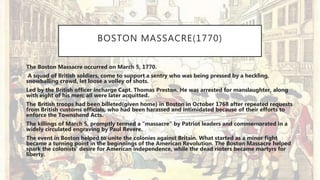
• The Boston Massacre occurred on March 5, 1770.
• A squad of British soldiers, come to support a sentry who was being pressed by a heckling,
snowballing crowd, let loose a volley of shots.
• Led by the British officer incharge Capt. Thomas Preston. He was arrested for manslaughter, along
with eight of his men; all were later acquitted.
• The British troops had been billeted(given home) in Boston in October 1768 after repeated requests
from British customs officials, who had been harassed and intimidated because of their efforts to
enforce the Townshend Acts.
• The killings of March 5, promptly termed a “massacre” by Patriot leaders and commemorated in a
widely circulated engraving by Paul Revere.
• The event in Boston helped to unite the colonies against Britain. What started as a minor fight
became a turning point in the beginnings of the American Revolution. The Boston Massacre helped
spark the colonists' desire for American independence, while the dead rioters became martyrs for
liberty.
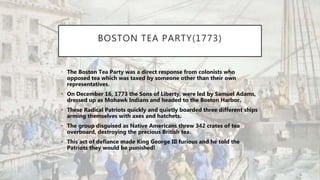
BOSTON TEA PARTY(1773)
• The Boston Tea Party was a direct response from colonists who
opposed tea which was taxed by someone other than their own
representatives.
• On December 16, 1773 the Sons of Liberty, were led by Samuel Adams,
dressed up as Mohawk Indians and headed to the Boston Harbor.
• These Radical Patriots quickly and quietly boarded three different ships
arming themselves with axes and hatchets.
• The group disguised as Native Americans threw 342 crates of tea
overboard, destroying the precious British tea.
• This act of defiance made King George III furious and he told the
Patriots they would be punished!
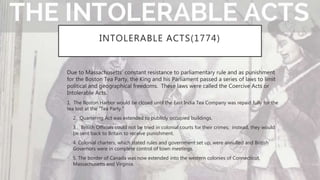
INTOLERABLE ACTS(1774)
• Due to Massachusetts’ constant resistance to parliamentary rule and as punishment
for the Boston Tea Party, the King and his Parliament passed a series of laws to limit
political and geographical freedoms. These laws were called the Coercive Acts or
Intolerable Acts.
1. The Boston Harbor would be closed until the East India Tea Company was repaid fully for the
tea lost at the “Tea Party.”
• 2. Quartering Act was extended to publicly occupied buildings.
• 3. British Officials could not be tried in colonial courts for their crimes; instead, they would
be sent back to Britain to receive punishment.
• 4. Colonial charters, which stated rules and government set up, were annulled and British
Governors were in complete control of town meetings.
• 5. The border of Canada was now extended into the western colonies of Connecticut,
Massachusetts and Virginia.
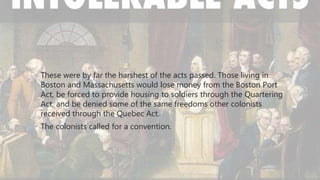
• These were by far the harshest of the acts passed. Those living in
Boston and Massachusetts would lose money from the Boston Port
Act, be forced to provide housing to soldiers through the Quartering
Act, and be denied some of the same freedoms other colonists
received through the Quebec Act.
• The colonists called for a convention.
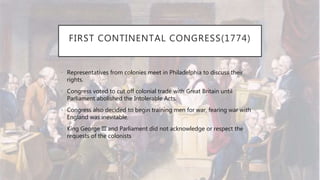
FIRST CONTINENTAL CONGRESS(1774)
• Representatives from colonies meet in Philadelphia to discuss their
rights.
• Congress voted to cut off colonial trade with Great Britain until
Parliament abolished the Intolerable Acts.
• Congress also decided to begin training men for war, fearing war with
England was inevitable.
• King George III and Parliament did not acknowledge or respect the
requests of the colonists
BATTLE OF LEXINGTON AND
CONCORD(1774)
• The British soldiers marched out of Boston to seize the colonists’
gunpowder and firearms in Concord, Massachusetts.
• Paul Revere helped alert the Minutemen that the British were on the
move by hanging lanterns in the church steeple. He also rode through
the town to warn that, “The British are coming!”
• Although the Minutemen were ready for the British in Lexington,
Massachusetts, they were outnumbered and defeated.
• Messengers were able to warn colonists in Concord, Massachusetts and
only a portion of the supplies were destroyed.
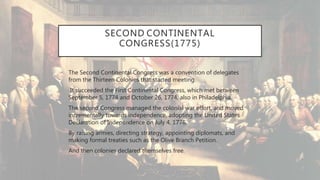
SECOND CONTINENTAL
CONGRESS(1775)
• The Second Continental Congress was a convention of delegates
from the Thirteen Colonies that started meeting.
• It succeeded the First Continental Congress, which met between
September 5, 1774 and October 26, 1774, also in Philadelphia.
• The second Congress managed the colonial war effort, and moved
incrementally towards independence, adopting the United States
Declaration of Independence on July 4, 1776.
• By raising armies, directing strategy, appointing diplomats, and
making formal treaties such as the Olive Branch Petition.
• And then colonies declared themselves free.
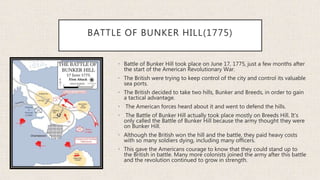
BATTLE OF BUNKER HILL(1775)
• Battle of Bunker Hill took place on June 17, 1775, just a few months after
the start of the American Revolutionary War.
• The British were trying to keep control of the city and control its valuable
sea ports.
• The British decided to take two hills, Bunker and Breeds, in order to gain
a tactical advantage.
• The American forces heard about it and went to defend the hills.
• The Battle of Bunker Hill actually took place mostly on Breeds Hill. It's
only called the Battle of Bunker Hill because the army thought they were
on Bunker Hill.
• Although the British won the hill and the battle, they paid heavy costs
with so many soldiers dying, including many officers.
• This gave the Americans courage to know that they could stand up to
the British in battle. Many more colonists joined the army after this battle
and the revolution continued to grow in strength.
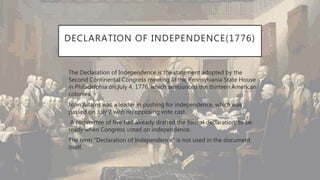
DECLARATION OF INDEPENDENCE(1776)
• The Declaration of Independence is the statement adopted by the
Second Continental Congress meeting at the Pennsylvania State House
in Philadelphia on July 4, 1776, which announced the thirteen American
colonies.
• John Adams was a leader in pushing for independence, which was
passed on July 2 with no opposing vote cast.
• A committee of five had already drafted the formal declaration, to be
ready when Congress voted on independence.
• The term "Declaration of Independence" is not used in the document
itself.
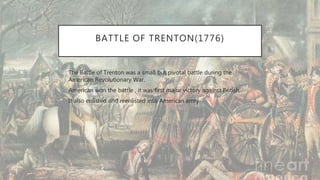
BATTLE OF TRENTON(1776)
• The Battle of Trenton was a small but pivotal battle during the
American Revolutionary War.
• American won the battle , it was first major victory against British.
• It also enlisted and reenlisted into American army.
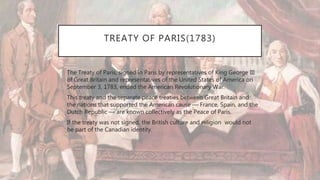
TREATY OF PARIS(1783)
• The Treaty of Paris, signed in Paris by representatives of King George III
of Great Britain and representatives of the United States of America on
September 3, 1783, ended the American Revolutionary War.
• This treaty and the separate peace treaties between Great Britain and
the nations that supported the American cause — France, Spain, and the
Dutch Republic — are known collectively as the Peace of Paris.
• If the treaty was not signed, the British culture and religion would not
be part of the Canadian identity.

American revolution

  • 1.
  • 2.
    • Also knownas the American Revolutionary War and the U.S. War of Independence, the conflict arose from growing tensions between residents of Great Britain’s 13 North American colonies and the colonial government, which represented the British crown from 1754-1783.
  • 5.
    FRENCH-INDIAN WAR (1754-63) •French and Native American allies v/s English and their Native American allies. • main conflict over control of land • Colonists fought alongside the British. • Many historic figures of the revolution got their experience in this war. Including George Washington.
  • 6.
    PROCLAMATION OF 1763 •The colonists helped the British win the French and Indian war. • This victory gave England the land west of the Appalachian Mountains, all the way to the Mississippi River. • King George III of England made a PROCLAMATION or an announcement in 1763 that the colonists could not go past the Appalachian Mountains. • The colonists resented not being able to settle in the west of the Proclamation line. • This Proclamation angered the colonists since they believed it their right.
  • 7.
    SUGAR ACT(1764) • Thesugar act started because government of Britain needed money to pay off the cost of French and Indian war, expenses for running colonies and newly acquired territories. • Act was taxed on sugar, wine, molasses and coffee. • Tax on molasses almost stopped the rum trade from New England, and the colonies there protested. • It put a three-cent tax on foreign refined sugar and increased taxes on coffee, indigo, and certain kinds of wine.
  • 8.
    STAMP ACT(1765) • TheParliament of Great Britain imposed a direct tax on the colonies of British America. • The purpose of the tax was to help pay for troops stationed in North America after British victory in the Seven Years' War . • The Americans said that there was no military need for the soldiers because there were no foreign enemies on the continent, and the Americans had always protected themselves against Indians. • Stamp became mandatory on legal documents, magazines, playing cards, newspapers, and many other paper used throughout the colonies. • The colonists protested, refused to pay tax, burned the stamped papers, boycotted British products and merchants. Example of a stamp showing that a colonist paid the stamp tax.
  • 9.
    TOWNSHEND ACT(1767) • In1767, The English Parliament passed the Townshend Revenue Acts, imposing a new series of taxes on the colonists to pay for the costs of administering and protecting the American colonies. Items taxed included imports such as paper, tea, glass, lead and paints. • The Act also established a colonial board of customs commissioners in Boston. • This indirect tax was collected at the sea ports before items reached colonial stores. Therefore, when the colonists went to buy these items, the tax was already included in the price. (Unlike the Stamp Act, where the colonists were aware of the added tax.) • The colonists did recognize the indirect tax and once again boycotted British goods. Colonists were extremely upset with the unjust form of “Taxation without Representation!”
  • 10.
    BOSTON MASSACRE(1770) • TheBoston Massacre occurred on March 5, 1770. • A squad of British soldiers, come to support a sentry who was being pressed by a heckling, snowballing crowd, let loose a volley of shots. • Led by the British officer incharge Capt. Thomas Preston. He was arrested for manslaughter, along with eight of his men; all were later acquitted. • The British troops had been billeted(given home) in Boston in October 1768 after repeated requests from British customs officials, who had been harassed and intimidated because of their efforts to enforce the Townshend Acts. • The killings of March 5, promptly termed a “massacre” by Patriot leaders and commemorated in a widely circulated engraving by Paul Revere. • The event in Boston helped to unite the colonies against Britain. What started as a minor fight became a turning point in the beginnings of the American Revolution. The Boston Massacre helped spark the colonists' desire for American independence, while the dead rioters became martyrs for liberty.
  • 11.
    BOSTON TEA PARTY(1773) •The Boston Tea Party was a direct response from colonists who opposed tea which was taxed by someone other than their own representatives. • On December 16, 1773 the Sons of Liberty, were led by Samuel Adams, dressed up as Mohawk Indians and headed to the Boston Harbor. • These Radical Patriots quickly and quietly boarded three different ships arming themselves with axes and hatchets. • The group disguised as Native Americans threw 342 crates of tea overboard, destroying the precious British tea. • This act of defiance made King George III furious and he told the Patriots they would be punished!
  • 12.
    INTOLERABLE ACTS(1774) • Dueto Massachusetts’ constant resistance to parliamentary rule and as punishment for the Boston Tea Party, the King and his Parliament passed a series of laws to limit political and geographical freedoms. These laws were called the Coercive Acts or Intolerable Acts. 1. The Boston Harbor would be closed until the East India Tea Company was repaid fully for the tea lost at the “Tea Party.” • 2. Quartering Act was extended to publicly occupied buildings. • 3. British Officials could not be tried in colonial courts for their crimes; instead, they would be sent back to Britain to receive punishment. • 4. Colonial charters, which stated rules and government set up, were annulled and British Governors were in complete control of town meetings. • 5. The border of Canada was now extended into the western colonies of Connecticut, Massachusetts and Virginia.
  • 13.
    • These wereby far the harshest of the acts passed. Those living in Boston and Massachusetts would lose money from the Boston Port Act, be forced to provide housing to soldiers through the Quartering Act, and be denied some of the same freedoms other colonists received through the Quebec Act. • The colonists called for a convention.
  • 14.
    FIRST CONTINENTAL CONGRESS(1774) •Representatives from colonies meet in Philadelphia to discuss their rights. • Congress voted to cut off colonial trade with Great Britain until Parliament abolished the Intolerable Acts. • Congress also decided to begin training men for war, fearing war with England was inevitable. • King George III and Parliament did not acknowledge or respect the requests of the colonists
  • 15.
    BATTLE OF LEXINGTONAND CONCORD(1774) • The British soldiers marched out of Boston to seize the colonists’ gunpowder and firearms in Concord, Massachusetts. • Paul Revere helped alert the Minutemen that the British were on the move by hanging lanterns in the church steeple. He also rode through the town to warn that, “The British are coming!” • Although the Minutemen were ready for the British in Lexington, Massachusetts, they were outnumbered and defeated. • Messengers were able to warn colonists in Concord, Massachusetts and only a portion of the supplies were destroyed.
  • 16.
    SECOND CONTINENTAL CONGRESS(1775) • TheSecond Continental Congress was a convention of delegates from the Thirteen Colonies that started meeting. • It succeeded the First Continental Congress, which met between September 5, 1774 and October 26, 1774, also in Philadelphia. • The second Congress managed the colonial war effort, and moved incrementally towards independence, adopting the United States Declaration of Independence on July 4, 1776. • By raising armies, directing strategy, appointing diplomats, and making formal treaties such as the Olive Branch Petition. • And then colonies declared themselves free.
  • 17.
    BATTLE OF BUNKERHILL(1775) • Battle of Bunker Hill took place on June 17, 1775, just a few months after the start of the American Revolutionary War. • The British were trying to keep control of the city and control its valuable sea ports. • The British decided to take two hills, Bunker and Breeds, in order to gain a tactical advantage. • The American forces heard about it and went to defend the hills. • The Battle of Bunker Hill actually took place mostly on Breeds Hill. It's only called the Battle of Bunker Hill because the army thought they were on Bunker Hill. • Although the British won the hill and the battle, they paid heavy costs with so many soldiers dying, including many officers. • This gave the Americans courage to know that they could stand up to the British in battle. Many more colonists joined the army after this battle and the revolution continued to grow in strength.
  • 18.
    DECLARATION OF INDEPENDENCE(1776) •The Declaration of Independence is the statement adopted by the Second Continental Congress meeting at the Pennsylvania State House in Philadelphia on July 4, 1776, which announced the thirteen American colonies. • John Adams was a leader in pushing for independence, which was passed on July 2 with no opposing vote cast. • A committee of five had already drafted the formal declaration, to be ready when Congress voted on independence. • The term "Declaration of Independence" is not used in the document itself.
  • 19.
    BATTLE OF TRENTON(1776) •The Battle of Trenton was a small but pivotal battle during the American Revolutionary War. • American won the battle , it was first major victory against British. • It also enlisted and reenlisted into American army.
  • 20.
    TREATY OF PARIS(1783) •The Treaty of Paris, signed in Paris by representatives of King George III of Great Britain and representatives of the United States of America on September 3, 1783, ended the American Revolutionary War. • This treaty and the separate peace treaties between Great Britain and the nations that supported the American cause — France, Spain, and the Dutch Republic — are known collectively as the Peace of Paris. • If the treaty was not signed, the British culture and religion would not be part of the Canadian identity.