Global History 10
Content Review
The Scientific Revolution
• Age when science developed in many fields, particularly astronomy and physics.
• Developed Scientific Method: Use of proofs in experiments (empiricism).
• Often clashed with official Church dogma.
• Age when science developed in many fields, particularly astronomy and physics.
• Developed Scientific Method: Use of proofs in experiments (empiricism).
• Often clashed with official Church dogma.
1543-1650
Sir Isaac NewtonSir Isaac Newton
Famous Scientists
• Copernicus – disproved
Geocentric theory with
Heliocentric Theory.
• Kepler proved elliptical
orbits of planets.
• Galileo invented
telescope, observed four
moons of Jupiter.
• Newton created laws of
gravitation and calculus.
Divine Right Monarchs
• Believed in their special
status as kings chosen by
and accountable only to
God.
• Louis XIV, James I of
England (Stuarts).
• Challenged by
Enlightenment ideals
and led to clashes with
Parliament.
The Enlightenment
• Era of philosophes who emphasized natural
law, scientific progress and technology, deism
and civic freedoms.
• Such natural rights are the foundation of
modern political and economic systems.
The Social Contract
• Belief that Man leaves the
state of nature and enters
into society in order to
form a social contract.
• Thomas Hobbes [negative]
believed in necessity of
absolute government.
• Jean-Jacques Rousseau
added idea of the noble
savage and general will to
the social contract theory.
John Locke
• John Locke believed that
“life, liberty and
property”
must be protected by an
agreement between the
people and the
government [a social
contract]
The KEY thinker of the
Enlightenment!
The KEY thinker of the
Enlightenment!
Voltaire
Influential French
philosophe who
defended freedom of
the press and speech
and blasted religious
intolerance of the
Church
Montesquieu
Father of the political
concept of separation of
powers (three branches of
government: executive,
legislative and judicial) and
balance of powers (checks
and balances)
Directly inspired
the American and
French
Revolutions.
Directly inspired
the American and
French
Revolutions.
Enlightened Despots
• Absolute rulers who
emphasized their
usefulness to society.
• Passed laws on serfdom,
educational and judicial
reforms, and patronized
the arts.
• E.g. Joseph II, Frederick
the Great and Catherine
the Great.
Rule for the people, but not by the people!Rule for the people, but not by the people!
The French Revolution
• Economic turmoil forced
Louis XVI to convene Estates-
General (1788) to raise taxes.
• Third Estate (bourgeoisie and
peasants) declared itself a
National Assembly.
• The SPARK! Mobs in Paris
stormed the Bastille prison
(July 14, 1789).
• The Declaration of the Rights
of Man and a Constitution
were written (1789-91).
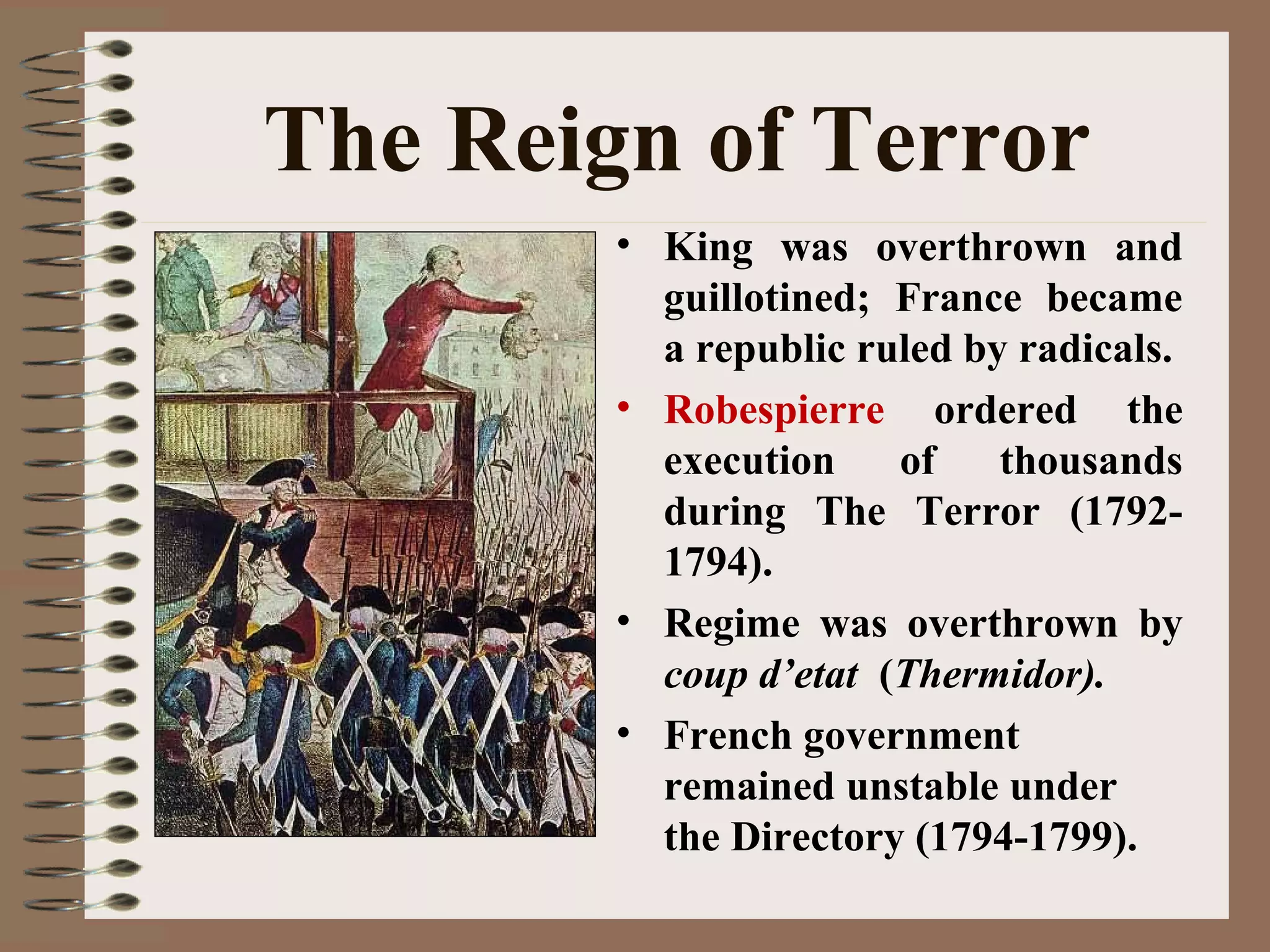
The Reign of Terror
• King was overthrown and
guillotined; France became
a republic ruled by radicals.
• Robespierre ordered the
execution of thousands
during The Terror (1792-
1794).
• Regime was overthrown by
coup d’etat (Thermidor).
• French government
remained unstable under
the Directory (1794-1799).
The Age of Napoleon
• Napoleon Bonaparte
took power and led
France into an age of
military triumph and
empire.
• Used nationalism as a
way of inspiring his
people and others.
• Failed in Russia
(Scorched Earth and
Winter) and defeated
at Waterloo.
Congress of Vienna
• Conservative European
rulers redrew map of
Europe. Wanted a
Balance of Power
• Dominated by Austrian
diplomat Metternich.
• Tried to stop liberal or
nationalist uprisings.
• Known as the Age of
Metternich or Reaction
(1815 - 1848).
Nationalism
• Inspired by Revolutionary
and Napoleonic France.
• Fired up rebels and patriots
across Europe and the
Americas.
• Early example: Haiti (1802).
• Toussaint L’Ouverture led
revolt of slaves against
France.
• Guerilla warfare ultimately
led to independence.
Spanish Colonies
• Spain had conquered
and colonized American
territories (encomienda
system) since Columbus.
• Social class system and
race played great role.
• Enlightenment ideas and
American Revolution
inspired creoles into
actions against colonial
rule.
Latin American Independence
• Mexico rebelled under
Father Hidalgo but was
liberated by 1821.
• Simon Bolivar [The
Liberator] led several
nations to independence
and aided Jose de San
Martin in Argentina and
Chile.
• Bolivar’s ideas for a
democratic union, Gran
Colombia, failed.
Italian Unification
• Kingdom of Sardinia
-Piedmont spearheaded
unification of Italy (led
by Count Cavour and
achieved by Giuseppe
Garibaldi (Red Shirts).
• French helped Sardinia.
• Giuseppe Mazzini had
inspired with his works.
• The Kingdom of Italy
was proclaimed by 1871.
German Unification
• Began with Zollverein.
• Kingdom of Prussia
developed into leading
German power under
Otto von Bismarck.
• Pursued realpolitik.
• Steered Prussia to
victory in three wars
(Franco-Prussian War,
militarism).
• The German Empire
was proclaimed in 1871.
• Ruled by the Kaiser.
Proto-Industrialization
• Began with new farming
techniques – seed drill,
sheep breeding, crop
rotation – in 18th
Century
Britain.
• Enclosure Acts forced
many farmers to migrate
to the cities after losing
lands to wealthy
landowners.
• Urban areas increased in
population.
Industrial Revolution
• Inventions in textiles and
steam triggered industrial
growth.
• Entrepreneurs invested
capital in factories; factory
system led to mass produced
goods.
• Labor abuse against women
and children was common.
• Sadler Commission pushed
for child labor reforms.
• Led to rise of labor unions.
Effects of Industrialization
• Luddites attacked
textile machinery.
• Urbanization
• City life worsened in
hygiene, sanitation,
crime, social unrest
and overpopulation.
• Charles Dickens
portrayed slum life in
realistic novels.
Population Theories
• Thomas Malthus believed
that rises in population will
outpace food production;
this will lead to disaster.
• David Ricardo believed
that increase in wages led
to population increase.
• War and disease would
help decrease populations.
• Jeremy Bentham believed
that government could help
with the “greatest good for
the greatest number”
(known as utilitarianism).
New Ideologies
• Laissez-faire economists
[Adam Smith] believed in
free market (the laws of
supply and demand)
without regulation.
• Socialists believed in
government regulation and
public ownership of the
economy.
• Utopian Socialists [Robert
Owen] believed in
organized communities
sharing in all benefits.
Communism
• Karl Marx wrote The
Communist Manifesto to
describe the history of class
struggle and the eventual
victory of the proletariat
over the bourgeoisie.
• A dictatorship of the
proletariat would create a
communist system where
all wealth was publicly
owned.
• He wrote Kapital together
with Friedrich Engels.
Imperialism
• “Old Imperialism”:
God, gold, glory led
to colonies (1500 –
1700).
• “New Imperialism”:
securing resources
and trade routes and
new markets. (1800 –
1914).
• “The sun never sets
on the British
Empire.”
Social Darwinism
• Belief in the superiority
of European civilization.
• “Survival of the fittest”
used as a racist theory.
• Best example of Social
Darwinism: Kipling
poem, The White Man’s
Burden.
• Asians and Africans
viewed as inferiors who
need to be civilized by
the imperialist powers.
“Scramble for Africa”
• Berlin Conference
(1884) – partition.
• Seeking natural
resources: gold and
diamonds.
• Cecil Rhodes – the
“Cape-to-Cairo”
link.
• Belgian Congo –
King Leopold II.
• Ethiopia and Liberia
remain free.
British Raj in India
• British shaken by
the Sepoy Mutiny in
India (against
foreign rule).
• Sepoys felt
disrespected because
the cartridges used
to load the Enfield
Rifle were sealed
with cow and pig fat,
which goes against
Hindu and Islamic
beliefs.
Spheres of Influence in China
• British defeat China in Opium
Wars: Treaty of Nanking (an
“unequal treaty”).
• Taiping and Boxer Rebellions
against foreigners but defeated by
imperialist powers.
The Meiji Restoration
• Arrival of Commodore
Matthew Perry in Tokyo
(end of isolationism).
• Overthrow of shogun and
restoration of imperial
rule (Emperor Meiji).
• Westernization and
modernization of Japan.
• Japan defeats China in
Sino-Japanese War: gains
resources in Korea and
Manchuria.
Russo-Japanese War
• Russia and Japan fight in
Manchuria (1904-1905):
Trans-Siberian Railway
seen as threat to Japanese
resources.
• Japanese fleet knocks out
Russian navy.
• Treaty of Portsmouth –
Japan emerges as a world
power.
• Rise of Japanese empire.
Ottoman Empire: The Sick Man
of Europe
• Ottoman Empire was in
decline in the 19th
Century.
• The Greeks had gained
independence (1821).
• Russia had fought and won
several wars by 1877.
• The Balkan Wars (1912-
1913) witnessed the defeat
of the Turks in Europe.
• Ethnic unrest made the
Balkans the “powder keg of
Europe.”
World War I (1914-19)
• M.A.N.I.A. and the
Assassination of the
Archduke Franz
Ferdinand (Austria).
• Triple Entente and
Triple Alliance.
• Diplomatic blank
check and ultimatum.
• Trench warfare and
low morale at the
Front.
• Armenian Genocide
(1915).
End of the War
• US entered war in 1917
(Zimmerman Note).
• Wilson’s 14 Points (self-
determination and League
of Nations) proposed (fair
deal).
• Treaty of Versailles
reached with war guilt
clause and reparations from
Germany.
• Map of Europe redrawn
with emphasis on self-
determination (1918).
The Russian Revolution
• Tsarist incompetence led
to Bloody Sunday
Massacre and failing
World War I policies.
• Rasputin caused scandals.
• Tsar Nicholas II
abdicated (Feb. 1917)
• Lenin returned from exile
and proclaimed “Peace,
Bread, Land!”
• Short-lived Kerensky
gov’t overthrown by
Bolsheviks (Oct. 1917).
Lenin’s Policies
• Russian Civil War [Reds v.
Whites] fought and won by
Bolsheviks [led by Leon
Trotsky] in 1920.
• Tsar and his family
executed by Bolsheviks.
• Lenin proclaimed the USSR
[Soviet Union] and pursued
New Economic Policy [NEP]
to build up the economy.
• His death led to power
struggle - Trotsky v. Stalin.
DBQ Review
• Answer all documents (Short Answer)
• Use “half plus one rule” in essay.
• Refer to documents by their “specific
name” not their number (and in
parentheses mention the number).
• Analyze question fully and use as much
outside information as possible.
• In short answer and essay, provide
“outside info”
Global 10 midterm review

Global 10 midterm review

  • 1.
  • 2.
    The Scientific Revolution •Age when science developed in many fields, particularly astronomy and physics. • Developed Scientific Method: Use of proofs in experiments (empiricism). • Often clashed with official Church dogma. • Age when science developed in many fields, particularly astronomy and physics. • Developed Scientific Method: Use of proofs in experiments (empiricism). • Often clashed with official Church dogma. 1543-1650 Sir Isaac NewtonSir Isaac Newton
  • 3.
    Famous Scientists • Copernicus– disproved Geocentric theory with Heliocentric Theory. • Kepler proved elliptical orbits of planets. • Galileo invented telescope, observed four moons of Jupiter. • Newton created laws of gravitation and calculus.
  • 4.
    Divine Right Monarchs •Believed in their special status as kings chosen by and accountable only to God. • Louis XIV, James I of England (Stuarts). • Challenged by Enlightenment ideals and led to clashes with Parliament.
  • 5.
    The Enlightenment • Eraof philosophes who emphasized natural law, scientific progress and technology, deism and civic freedoms. • Such natural rights are the foundation of modern political and economic systems.
  • 6.
    The Social Contract •Belief that Man leaves the state of nature and enters into society in order to form a social contract. • Thomas Hobbes [negative] believed in necessity of absolute government. • Jean-Jacques Rousseau added idea of the noble savage and general will to the social contract theory.
  • 7.
    John Locke • JohnLocke believed that “life, liberty and property” must be protected by an agreement between the people and the government [a social contract] The KEY thinker of the Enlightenment! The KEY thinker of the Enlightenment!
  • 8.
    Voltaire Influential French philosophe who defendedfreedom of the press and speech and blasted religious intolerance of the Church Montesquieu Father of the political concept of separation of powers (three branches of government: executive, legislative and judicial) and balance of powers (checks and balances) Directly inspired the American and French Revolutions. Directly inspired the American and French Revolutions.
  • 9.
    Enlightened Despots • Absoluterulers who emphasized their usefulness to society. • Passed laws on serfdom, educational and judicial reforms, and patronized the arts. • E.g. Joseph II, Frederick the Great and Catherine the Great. Rule for the people, but not by the people!Rule for the people, but not by the people!
  • 10.
    The French Revolution •Economic turmoil forced Louis XVI to convene Estates- General (1788) to raise taxes. • Third Estate (bourgeoisie and peasants) declared itself a National Assembly. • The SPARK! Mobs in Paris stormed the Bastille prison (July 14, 1789). • The Declaration of the Rights of Man and a Constitution were written (1789-91).
  • 11.
    The Reign ofTerror • King was overthrown and guillotined; France became a republic ruled by radicals. • Robespierre ordered the execution of thousands during The Terror (1792- 1794). • Regime was overthrown by coup d’etat (Thermidor). • French government remained unstable under the Directory (1794-1799).
  • 12.
    The Age ofNapoleon • Napoleon Bonaparte took power and led France into an age of military triumph and empire. • Used nationalism as a way of inspiring his people and others. • Failed in Russia (Scorched Earth and Winter) and defeated at Waterloo.
  • 13.
    Congress of Vienna •Conservative European rulers redrew map of Europe. Wanted a Balance of Power • Dominated by Austrian diplomat Metternich. • Tried to stop liberal or nationalist uprisings. • Known as the Age of Metternich or Reaction (1815 - 1848).
  • 14.
    Nationalism • Inspired byRevolutionary and Napoleonic France. • Fired up rebels and patriots across Europe and the Americas. • Early example: Haiti (1802). • Toussaint L’Ouverture led revolt of slaves against France. • Guerilla warfare ultimately led to independence.
  • 15.
    Spanish Colonies • Spainhad conquered and colonized American territories (encomienda system) since Columbus. • Social class system and race played great role. • Enlightenment ideas and American Revolution inspired creoles into actions against colonial rule.
  • 16.
    Latin American Independence •Mexico rebelled under Father Hidalgo but was liberated by 1821. • Simon Bolivar [The Liberator] led several nations to independence and aided Jose de San Martin in Argentina and Chile. • Bolivar’s ideas for a democratic union, Gran Colombia, failed.
  • 17.
    Italian Unification • Kingdomof Sardinia -Piedmont spearheaded unification of Italy (led by Count Cavour and achieved by Giuseppe Garibaldi (Red Shirts). • French helped Sardinia. • Giuseppe Mazzini had inspired with his works. • The Kingdom of Italy was proclaimed by 1871.
  • 18.
    German Unification • Beganwith Zollverein. • Kingdom of Prussia developed into leading German power under Otto von Bismarck. • Pursued realpolitik. • Steered Prussia to victory in three wars (Franco-Prussian War, militarism). • The German Empire was proclaimed in 1871. • Ruled by the Kaiser.
  • 19.
    Proto-Industrialization • Began withnew farming techniques – seed drill, sheep breeding, crop rotation – in 18th Century Britain. • Enclosure Acts forced many farmers to migrate to the cities after losing lands to wealthy landowners. • Urban areas increased in population.
  • 20.
    Industrial Revolution • Inventionsin textiles and steam triggered industrial growth. • Entrepreneurs invested capital in factories; factory system led to mass produced goods. • Labor abuse against women and children was common. • Sadler Commission pushed for child labor reforms. • Led to rise of labor unions.
  • 21.
    Effects of Industrialization •Luddites attacked textile machinery. • Urbanization • City life worsened in hygiene, sanitation, crime, social unrest and overpopulation. • Charles Dickens portrayed slum life in realistic novels.
  • 22.
    Population Theories • ThomasMalthus believed that rises in population will outpace food production; this will lead to disaster. • David Ricardo believed that increase in wages led to population increase. • War and disease would help decrease populations. • Jeremy Bentham believed that government could help with the “greatest good for the greatest number” (known as utilitarianism).
  • 23.
    New Ideologies • Laissez-faireeconomists [Adam Smith] believed in free market (the laws of supply and demand) without regulation. • Socialists believed in government regulation and public ownership of the economy. • Utopian Socialists [Robert Owen] believed in organized communities sharing in all benefits.
  • 24.
    Communism • Karl Marxwrote The Communist Manifesto to describe the history of class struggle and the eventual victory of the proletariat over the bourgeoisie. • A dictatorship of the proletariat would create a communist system where all wealth was publicly owned. • He wrote Kapital together with Friedrich Engels.
  • 25.
    Imperialism • “Old Imperialism”: God,gold, glory led to colonies (1500 – 1700). • “New Imperialism”: securing resources and trade routes and new markets. (1800 – 1914). • “The sun never sets on the British Empire.”
  • 26.
    Social Darwinism • Beliefin the superiority of European civilization. • “Survival of the fittest” used as a racist theory. • Best example of Social Darwinism: Kipling poem, The White Man’s Burden. • Asians and Africans viewed as inferiors who need to be civilized by the imperialist powers.
  • 27.
    “Scramble for Africa” •Berlin Conference (1884) – partition. • Seeking natural resources: gold and diamonds. • Cecil Rhodes – the “Cape-to-Cairo” link. • Belgian Congo – King Leopold II. • Ethiopia and Liberia remain free.
  • 28.
    British Raj inIndia • British shaken by the Sepoy Mutiny in India (against foreign rule). • Sepoys felt disrespected because the cartridges used to load the Enfield Rifle were sealed with cow and pig fat, which goes against Hindu and Islamic beliefs.
  • 29.
    Spheres of Influencein China • British defeat China in Opium Wars: Treaty of Nanking (an “unequal treaty”). • Taiping and Boxer Rebellions against foreigners but defeated by imperialist powers.
  • 30.
    The Meiji Restoration •Arrival of Commodore Matthew Perry in Tokyo (end of isolationism). • Overthrow of shogun and restoration of imperial rule (Emperor Meiji). • Westernization and modernization of Japan. • Japan defeats China in Sino-Japanese War: gains resources in Korea and Manchuria.
  • 31.
    Russo-Japanese War • Russiaand Japan fight in Manchuria (1904-1905): Trans-Siberian Railway seen as threat to Japanese resources. • Japanese fleet knocks out Russian navy. • Treaty of Portsmouth – Japan emerges as a world power. • Rise of Japanese empire.
  • 32.
    Ottoman Empire: TheSick Man of Europe • Ottoman Empire was in decline in the 19th Century. • The Greeks had gained independence (1821). • Russia had fought and won several wars by 1877. • The Balkan Wars (1912- 1913) witnessed the defeat of the Turks in Europe. • Ethnic unrest made the Balkans the “powder keg of Europe.”
  • 33.
    World War I(1914-19) • M.A.N.I.A. and the Assassination of the Archduke Franz Ferdinand (Austria). • Triple Entente and Triple Alliance. • Diplomatic blank check and ultimatum. • Trench warfare and low morale at the Front. • Armenian Genocide (1915).
  • 34.
    End of theWar • US entered war in 1917 (Zimmerman Note). • Wilson’s 14 Points (self- determination and League of Nations) proposed (fair deal). • Treaty of Versailles reached with war guilt clause and reparations from Germany. • Map of Europe redrawn with emphasis on self- determination (1918).
  • 35.
    The Russian Revolution •Tsarist incompetence led to Bloody Sunday Massacre and failing World War I policies. • Rasputin caused scandals. • Tsar Nicholas II abdicated (Feb. 1917) • Lenin returned from exile and proclaimed “Peace, Bread, Land!” • Short-lived Kerensky gov’t overthrown by Bolsheviks (Oct. 1917).
  • 36.
    Lenin’s Policies • RussianCivil War [Reds v. Whites] fought and won by Bolsheviks [led by Leon Trotsky] in 1920. • Tsar and his family executed by Bolsheviks. • Lenin proclaimed the USSR [Soviet Union] and pursued New Economic Policy [NEP] to build up the economy. • His death led to power struggle - Trotsky v. Stalin.
  • 37.
    DBQ Review • Answerall documents (Short Answer) • Use “half plus one rule” in essay. • Refer to documents by their “specific name” not their number (and in parentheses mention the number). • Analyze question fully and use as much outside information as possible. • In short answer and essay, provide “outside info”