The Triangular
Trade
(Trans-Atlantic Slave Trade)
DEFINITION
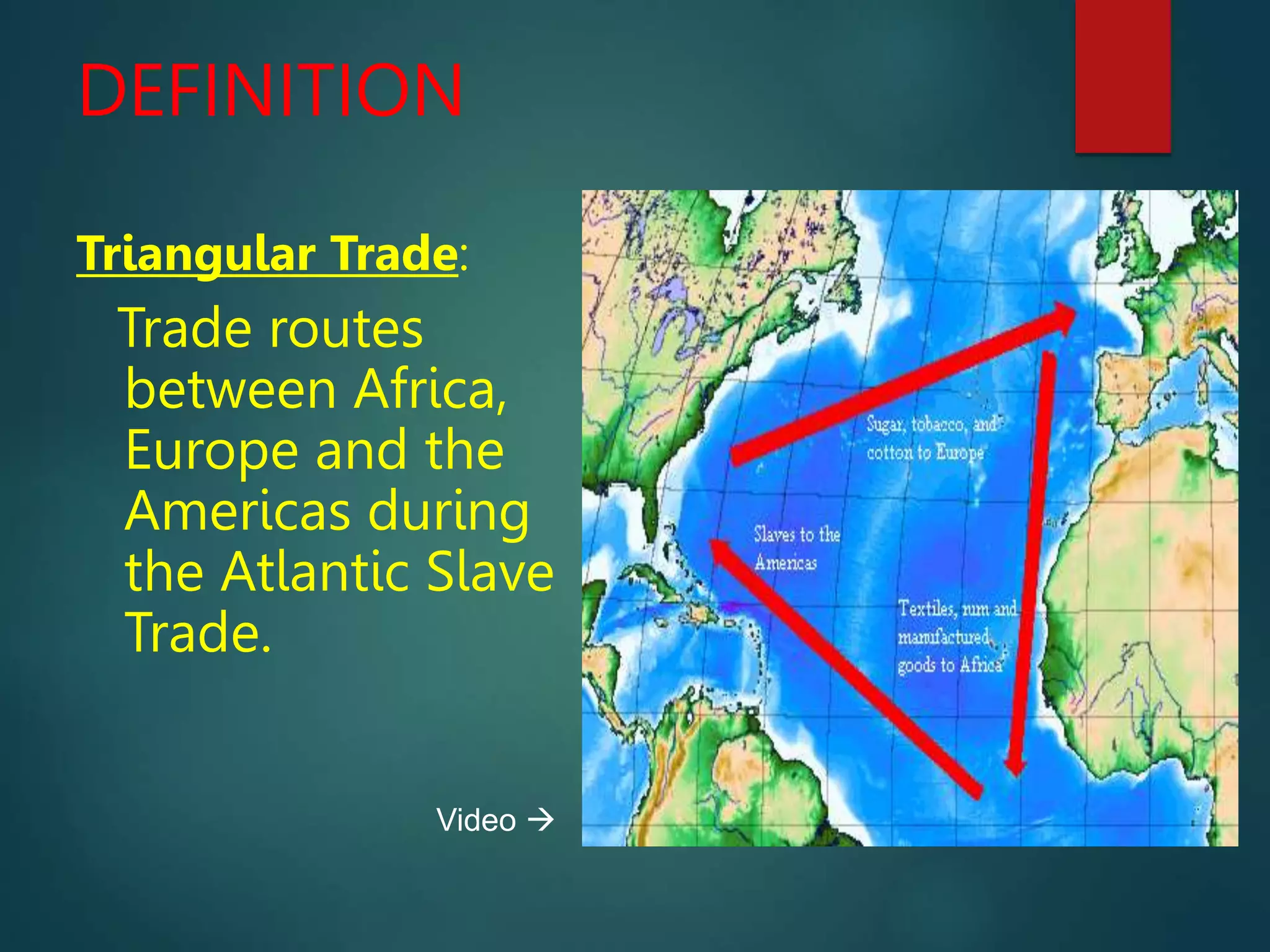
Triangular Trade:
Trade routes
between Africa,
Europe and the
Americas during
the Atlantic Slave
Trade.
Video 
Spain, Portugal,
& England
 They needed slaves to work
on their plantations in
South America, the
Caribbean, & North America
ENGLAND
 At beginning, only a few slaves came to
English colonies.
 But when tobacco, cotton & rice
plantations grew in the colonies, slave
trade increased.
 Britain was given control over much of
slave trade  had a monopoly
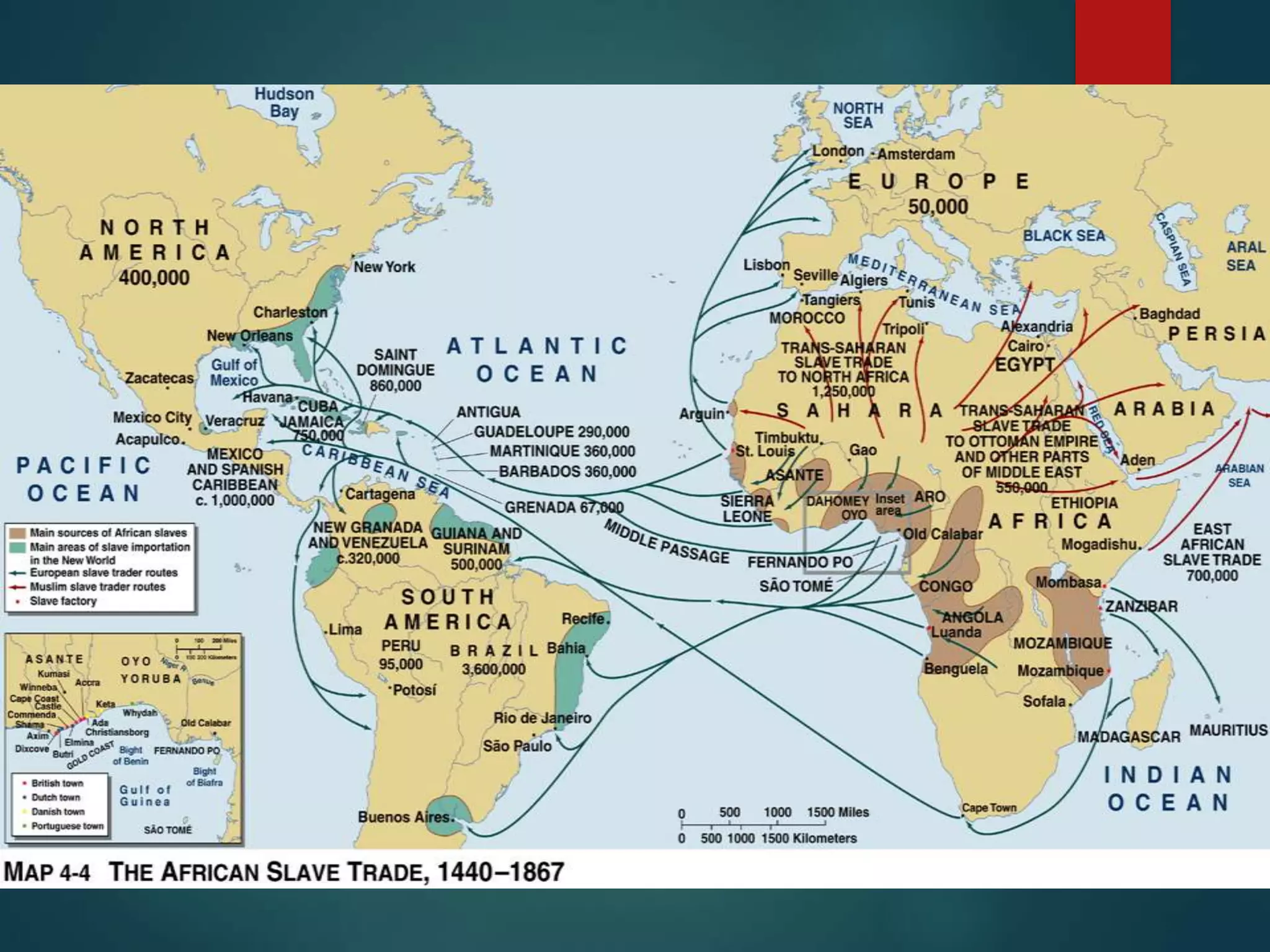
Maps of the Triangular Trade
Leg One: THE OUTWARD PASSAGE
 Ships left Europe loaded with guns, tools, textiles
(manufactured goods)
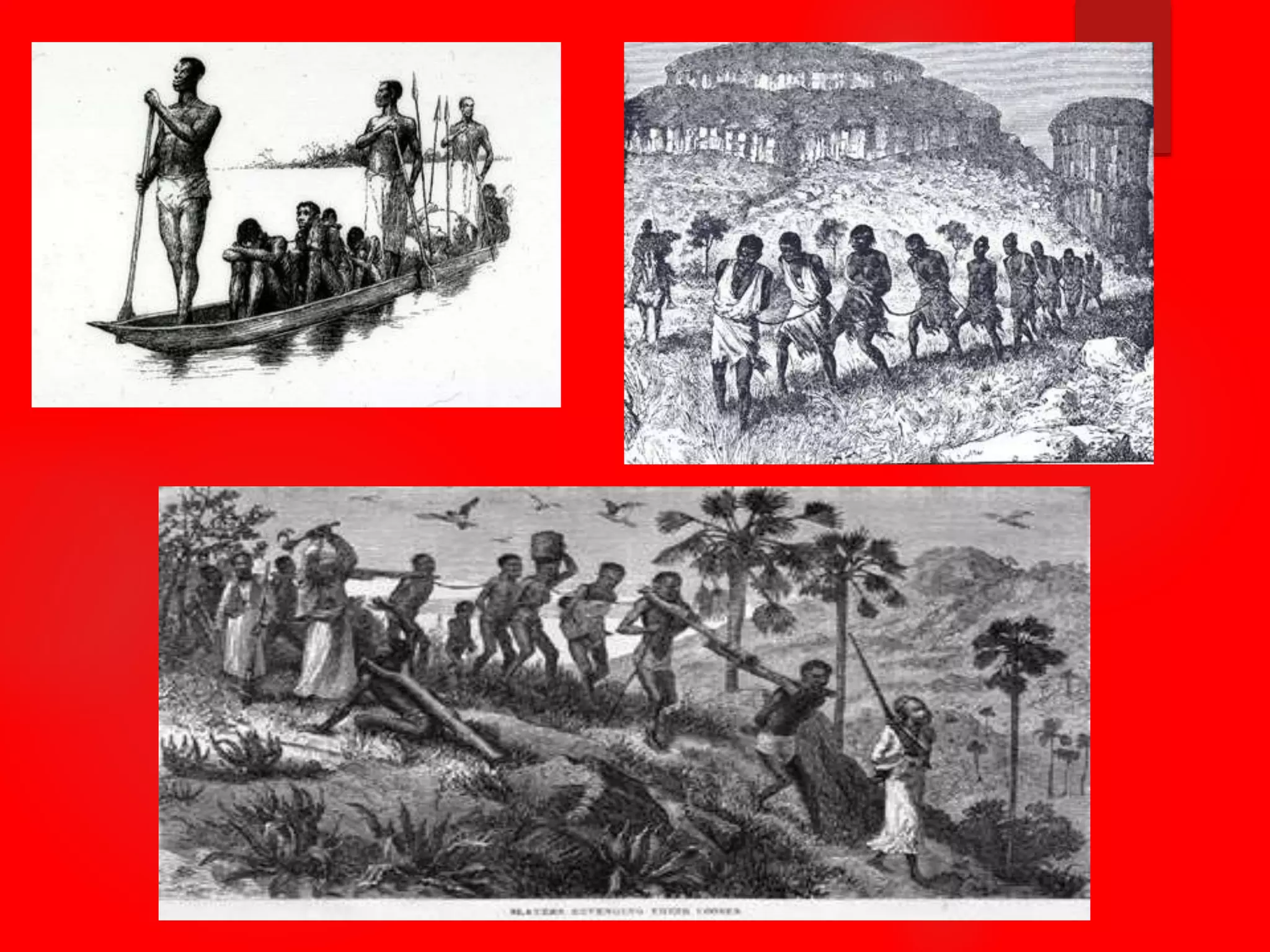
 Crews with guns went ashore to capture slaves &
purchase slaves from tribal leaders.
 Slaves were obtained by:
1. Kidnapping
2. Trading
3. Tributes (gifts)
4. People in debt
5. Criminals
6. Prisoners of tribal wars
Goree, or Slave-Stick
 A forked branch which opens exactly to the size of a
neck so the head can't pass through it.
 The forked branch is pierced with two holes so that
an iron pin comes across the neck of the slave . . .,
so that the smallest movement is sufficient to stop
him and even to strangle him
Goree, or Slave-Stick
Forced Participation
 African Chiefs resisted in the beginning; BUT
needed weapons for defense.
 Europeans too powerful; resistance was
unsuccessful
 If chiefs did not supply slaves, they were
threatened to be taken as slaves.
 Slaves were held in
prisons along the west
coast of Africa.
 They were waiting to put
on slaves ships.
 Those that journeyed
from the interior and
were not fit for the ship
were left on the shores to
die
Fort
Elmina
Leg Two: THE MIDDLE PASSAGE
- Voyage from Africa to Americas
- Ships sailed across Atlantic Ocean from Africa to
Americas, carrying slaves & gold
- Journey took 5-12 weeks
- DISGUSTING CONDITIONS
- Some Africans tried to jump ship, refused to eat &
rebelled.
- Loss of slave’s life = loss of $ for sailors.
Leg Two: THE MIDDLE PASSAGE
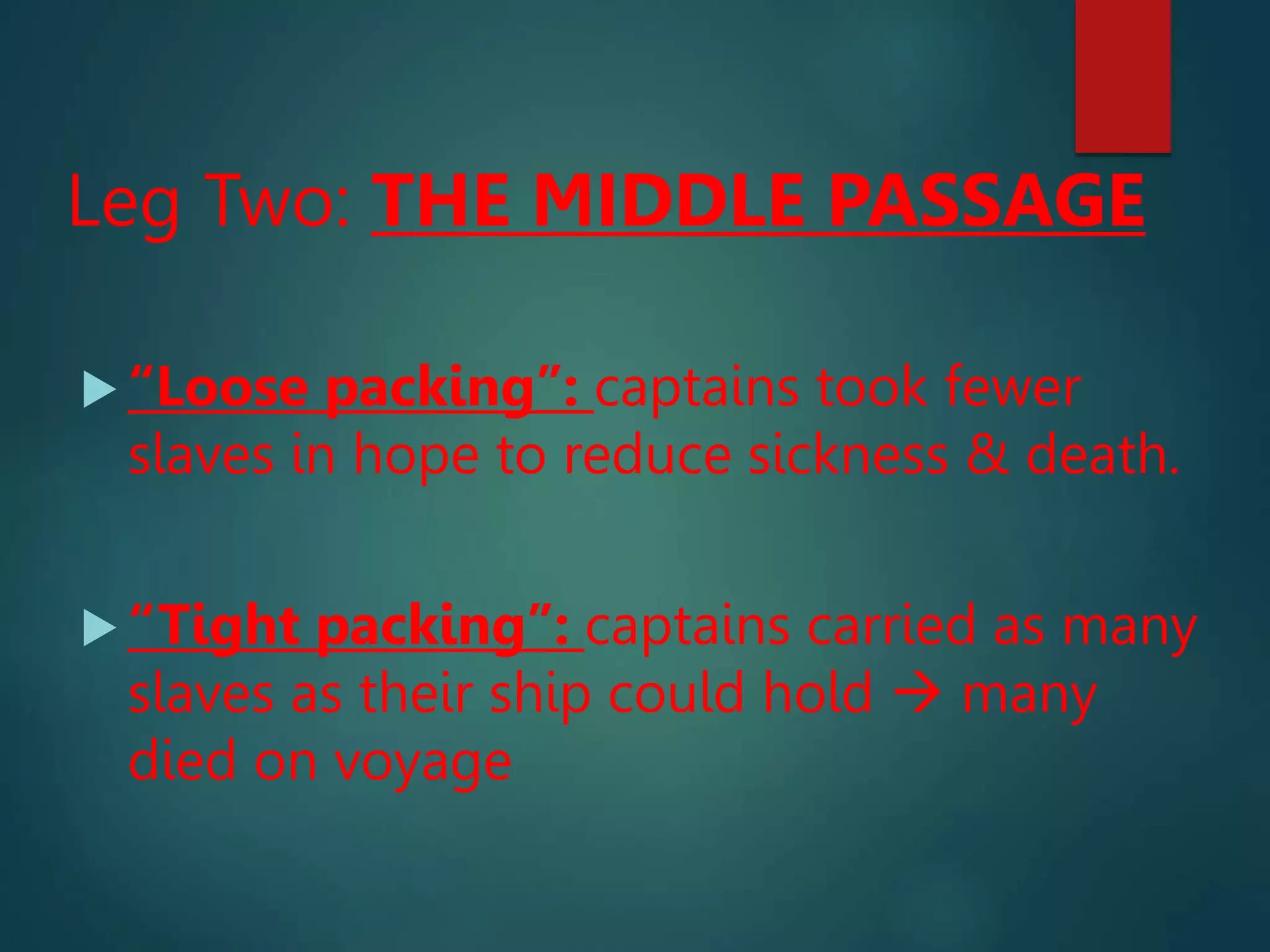
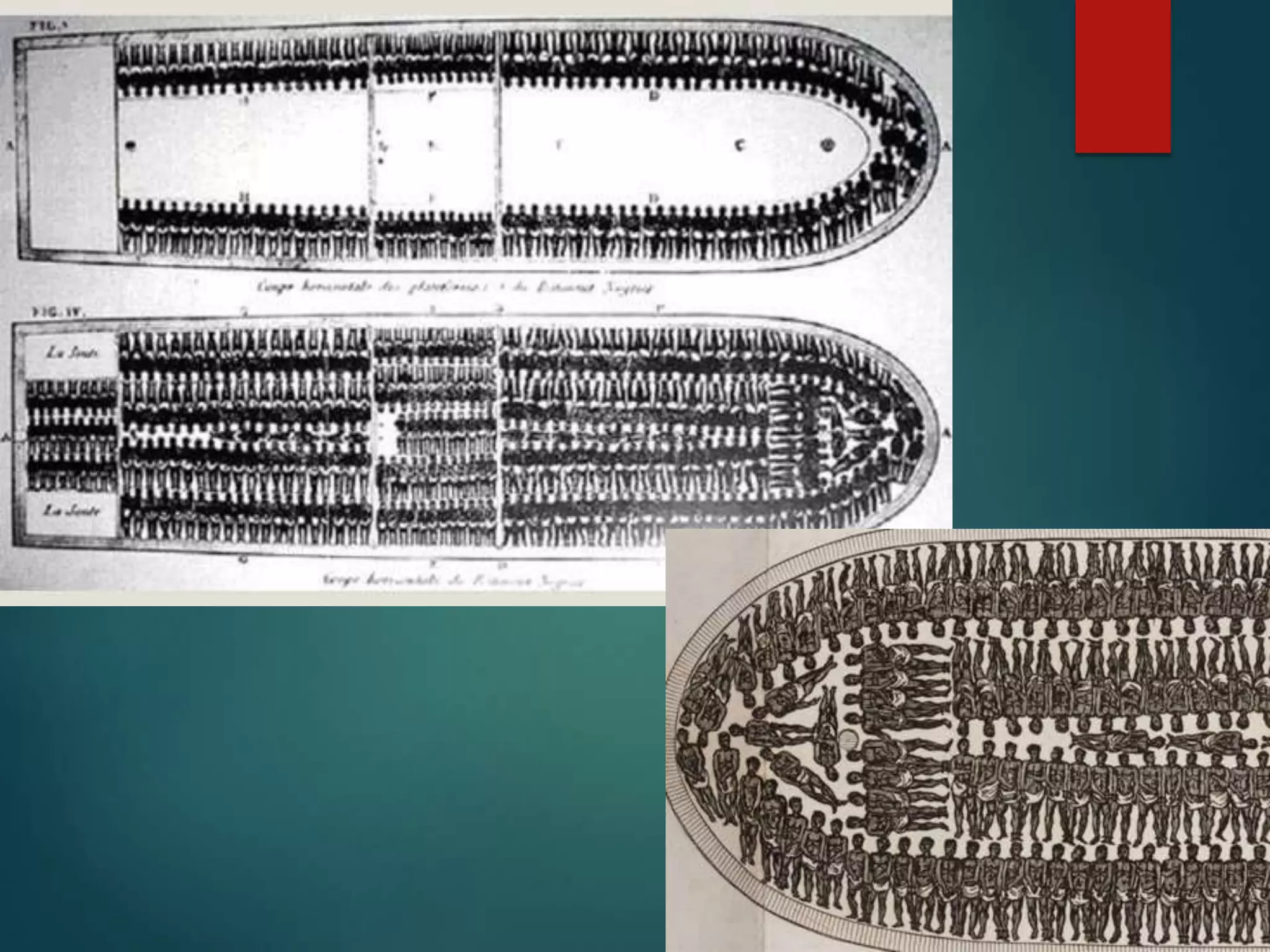
 “Loose packing”: captains took fewer
slaves in hope to reduce sickness & death.
 “Tight packing”: captains carried as many
slaves as their ship could hold  many
died on voyage
Click picture for video
Leg Three: THE HOMEWARD
PASSAGE
 Africans sold at auctions in Americas
 Money from sale would buy cargo of raw
materials: cotton, sugar, spices, rum,
chocolate or tobacco.
 In Europe, converted raw materials into
finished products.
Auctions (don’t write down)
 There were 3 ways slaves were auctioned off:
1. Public Auctions:
- They put tar on the slaves to hide any sores
and cuts
- Slaves were inspected
- An auction to took place and the higher
bidder would get to purchase the slave.
- Bids were taken as long as an inch of a candle
burned.
- Slaves were branded
- Families were separated
- They were given a European name.
Auctions (don’t write down)
2. Private Auctions:
- Similar to public auctions
- They were indoors and red
markers would be placed on the
door to indicate an auction.
Auctions (don’t write down)
3. A Scramble:
- They would take place on the docks
or on the deck of the ship
- There would be a fixed price per
head
- Slave owners would go in and grab
who they wanted to purchase.
AUCTIONS
 American born slaves who had skills were most
expensive
 African born slaves were less $, as they had to be
“broken in”
 Age, sex, & skills determined cost
 Slaves with many scars considered too rebellious
 3 ways: public auction, private auction, or
scramble
Click for Auction Video
SLAVERY ABOLISHED IN
BRITISH EMPIRE
 1807 = slave trade abolished in British Empire  no
slaves carried from Africa in British ships.
 1834 = Emancipation Act: slaves under 6 yrs. old
freed; field hands over 6 worked for 6 more years;
house slaves worked 10 more years
 Britain gave 20 million pounds in compensation to
former slave owners (slaves received nothing)
 1838 all slaves given complete freedom
 Slavery in USA not abolished until 1865
Slave Trade Overview
Video
The Atlantic Slave Trade in
Two Minutes
 http://www.slate.com/articles/life/the_history_of_ameri
can_slavery/2015/06/animated_interactive_of_the_histo
ry_of_the_atlantic_slave_trade.html

Slavery and Triangular Trade notes.ppt

  • 1.
  • 2.
    DEFINITION Triangular Trade: Trade routes betweenAfrica, Europe and the Americas during the Atlantic Slave Trade. Video 
  • 3.
    Spain, Portugal, & England They needed slaves to work on their plantations in South America, the Caribbean, & North America
  • 4.
    ENGLAND  At beginning,only a few slaves came to English colonies.  But when tobacco, cotton & rice plantations grew in the colonies, slave trade increased.  Britain was given control over much of slave trade  had a monopoly
  • 5.
    Maps of theTriangular Trade
  • 9.
    Leg One: THEOUTWARD PASSAGE  Ships left Europe loaded with guns, tools, textiles (manufactured goods)  Crews with guns went ashore to capture slaves & purchase slaves from tribal leaders.  Slaves were obtained by: 1. Kidnapping 2. Trading 3. Tributes (gifts) 4. People in debt 5. Criminals 6. Prisoners of tribal wars
  • 10.
    Goree, or Slave-Stick A forked branch which opens exactly to the size of a neck so the head can't pass through it.  The forked branch is pierced with two holes so that an iron pin comes across the neck of the slave . . ., so that the smallest movement is sufficient to stop him and even to strangle him
  • 11.
  • 13.
    Forced Participation  AfricanChiefs resisted in the beginning; BUT needed weapons for defense.  Europeans too powerful; resistance was unsuccessful  If chiefs did not supply slaves, they were threatened to be taken as slaves.
  • 15.
     Slaves wereheld in prisons along the west coast of Africa.  They were waiting to put on slaves ships.  Those that journeyed from the interior and were not fit for the ship were left on the shores to die
  • 16.
  • 17.
    Leg Two: THEMIDDLE PASSAGE - Voyage from Africa to Americas - Ships sailed across Atlantic Ocean from Africa to Americas, carrying slaves & gold - Journey took 5-12 weeks - DISGUSTING CONDITIONS - Some Africans tried to jump ship, refused to eat & rebelled. - Loss of slave’s life = loss of $ for sailors.
  • 19.
    Leg Two: THEMIDDLE PASSAGE  “Loose packing”: captains took fewer slaves in hope to reduce sickness & death.  “Tight packing”: captains carried as many slaves as their ship could hold  many died on voyage
  • 24.
  • 25.
    Leg Three: THEHOMEWARD PASSAGE  Africans sold at auctions in Americas  Money from sale would buy cargo of raw materials: cotton, sugar, spices, rum, chocolate or tobacco.  In Europe, converted raw materials into finished products.
  • 27.
    Auctions (don’t writedown)  There were 3 ways slaves were auctioned off: 1. Public Auctions: - They put tar on the slaves to hide any sores and cuts - Slaves were inspected - An auction to took place and the higher bidder would get to purchase the slave. - Bids were taken as long as an inch of a candle burned. - Slaves were branded - Families were separated - They were given a European name.
  • 29.
    Auctions (don’t writedown) 2. Private Auctions: - Similar to public auctions - They were indoors and red markers would be placed on the door to indicate an auction.
  • 31.
    Auctions (don’t writedown) 3. A Scramble: - They would take place on the docks or on the deck of the ship - There would be a fixed price per head - Slave owners would go in and grab who they wanted to purchase.
  • 32.
    AUCTIONS  American bornslaves who had skills were most expensive  African born slaves were less $, as they had to be “broken in”  Age, sex, & skills determined cost  Slaves with many scars considered too rebellious  3 ways: public auction, private auction, or scramble
  • 33.
  • 34.
    SLAVERY ABOLISHED IN BRITISHEMPIRE  1807 = slave trade abolished in British Empire  no slaves carried from Africa in British ships.  1834 = Emancipation Act: slaves under 6 yrs. old freed; field hands over 6 worked for 6 more years; house slaves worked 10 more years  Britain gave 20 million pounds in compensation to former slave owners (slaves received nothing)  1838 all slaves given complete freedom  Slavery in USA not abolished until 1865
  • 35.
  • 36.
    The Atlantic SlaveTrade in Two Minutes  http://www.slate.com/articles/life/the_history_of_ameri can_slavery/2015/06/animated_interactive_of_the_histo ry_of_the_atlantic_slave_trade.html