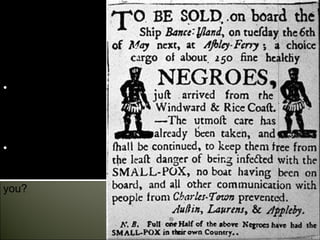
Pre Class Recall our discussion from last week: Why did Europeans become interested in the African continent?  React to this image.  What emotions does it evoke for you?
Between 1450 and 1800 10-15 MILLION Africans were kidnapped and sold into slavery The Trans-Atlantic Slave Trade
The extent of the slave trade   Estimates of the number of slaves sold into the Americas have been hotly debated, but the following figures are a broad outline:  1551 – 1600  0.7 million  1601 - 1650  1 million  1651 - 1700  1.7 million  1701 - 1750  3 million  1751 – 1800  3.8 million ** 1801 - 1850  3.2 million  (source: The Penguin Dictionary of British History; Gardiner, Juliet. Penguin Books: London, p. 622)  invention of the cotton gin
Portuguese – looking for a sea route to India Mapped the coast of West Africa; searched for W. African kingdoms (gold) Other Euro. join in Trading posts Sent missionaries to “civilize” Africans; convert them to Christianity
 
N. & S. American plantations SUGAR = $$$ Colonies needed LABOR in order to be profitable Native Americans died off in large #s
The African Diaspora
 
Most slaves were prisoners of war Some sold themselves into slavery during famines Treated as servants rather than property “ A slaves who knows how to serve inherits his master’s property” Institutionalized slavery Mid 1700s – 100,000/year As demand for slaves increased, so did price Racism  justified treating African slaves as property
What goods were exchanged? Who profited the most from this trade? Triangular Trade
Orange = development of British colonies; DIRECT trade in slaves with Africans
Triangle Trade  linked Europe, Africa and the Americas “ outward passage” – Africans exchanged war captives for manufactured goods ( guns , jewelry, cloth, rum)  “ middle passage” – horrific transport of slaves across the Atlantic, to the Caribbean “ return passage” – raw materials (sugar, tobacco, rice, cotton) from plantations in the Caribbean to Europe
 
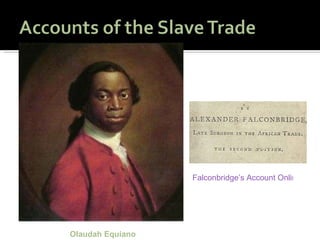
Olaudah Equiano Falconbridge’s Account Online
Pre Class In your notebook , draw an annotated map (in this case, one that shows goods that were exchanged) of the  triangular trade  that linked Europe, Africa   and the Americas.
Triangular Trade
How to Analyze an Image What questions should you ask yourself?
Try to imagine that you are African who has experienced the horrific  middle passage .  Write an account of your experience in which you use  7 facts  that you gathered from viewing the pictures and reading the accounts of Alexander Falconbridge. Underline  the facts in your writing.


When I looked round the ship too and saw a large furnace of copper boiling, and a mulititude of black people of every description chained together, every one of their countenances expressing dejection and sorrow, I no longer doubted of my fate and quite overpowered with horrow and anguish, I fell motionless on the deck and fainted. . . . I asked if we were not to be eaten by those white men with horrible looks, red faces and long hair?“ -_Olaudah Equiano
 
 
"I had seen a black woman slave as I came through the house, who was cooking the dinner, and the poor creature was cruelly loaded with various kinds of iron machines; she had one particularly on her head, which locked her mouth so fast that she could scarcely speak, and could not eat or drink. I [was] much astonished and shocked at this contrivance, which I afterwards learned was called the iron muzzle.“ (Olaudah Equiano)
1807-08 – Britain & US ban Atlantic trade 1834 – Britain bans slavery 1865 – U.S. bans slavery (Civil War)
Depopulation (W. Africa) Stimulation of warfare Dependant relationship with Europe Destruction of slave trade-dependant economies About a quarter of all Africans who were enslaved between 1500 and 1870 were transported across the Atlantic in the years after 1807   2 new African nations were created: Sierra Leone  – 1787 (blacks from England) Liberia  – 1822/47 (freed blacks from U.S.) http://encarta.msn.com/encyclopedia_761595721_3/Atlantic_Slave_Trade.html
Moral/religious shifts New openness to democratic ideas Slave rebellion Changing economy  Detail from ‘ Portrait of William Roscoe ’ by Sir Martin Archer Shee   http://www.liverpoolmuseums.org.uk/ism/slavery/europe/abolition.aspx

The Slave Trade

  • 1.
    Pre Class Recallour discussion from last week: Why did Europeans become interested in the African continent? React to this image. What emotions does it evoke for you?
  • 2.
    Between 1450 and1800 10-15 MILLION Africans were kidnapped and sold into slavery The Trans-Atlantic Slave Trade
  • 3.
    The extent ofthe slave trade Estimates of the number of slaves sold into the Americas have been hotly debated, but the following figures are a broad outline: 1551 – 1600 0.7 million 1601 - 1650 1 million 1651 - 1700 1.7 million 1701 - 1750 3 million 1751 – 1800 3.8 million ** 1801 - 1850 3.2 million (source: The Penguin Dictionary of British History; Gardiner, Juliet. Penguin Books: London, p. 622) invention of the cotton gin
  • 4.
    Portuguese – lookingfor a sea route to India Mapped the coast of West Africa; searched for W. African kingdoms (gold) Other Euro. join in Trading posts Sent missionaries to “civilize” Africans; convert them to Christianity
  • 5.
  • 6.
    N. & S.American plantations SUGAR = $$$ Colonies needed LABOR in order to be profitable Native Americans died off in large #s
  • 7.
  • 8.
  • 9.
    Most slaves wereprisoners of war Some sold themselves into slavery during famines Treated as servants rather than property “ A slaves who knows how to serve inherits his master’s property” Institutionalized slavery Mid 1700s – 100,000/year As demand for slaves increased, so did price Racism justified treating African slaves as property
  • 10.
    What goods wereexchanged? Who profited the most from this trade? Triangular Trade
  • 11.
    Orange = developmentof British colonies; DIRECT trade in slaves with Africans
  • 12.
    Triangle Trade linked Europe, Africa and the Americas “ outward passage” – Africans exchanged war captives for manufactured goods ( guns , jewelry, cloth, rum) “ middle passage” – horrific transport of slaves across the Atlantic, to the Caribbean “ return passage” – raw materials (sugar, tobacco, rice, cotton) from plantations in the Caribbean to Europe
  • 13.
  • 14.
  • 15.
    Pre Class Inyour notebook , draw an annotated map (in this case, one that shows goods that were exchanged) of the triangular trade that linked Europe, Africa and the Americas.
  • 16.
  • 17.
    How to Analyzean Image What questions should you ask yourself?
  • 18.
    Try to imaginethat you are African who has experienced the horrific middle passage . Write an account of your experience in which you use 7 facts that you gathered from viewing the pictures and reading the accounts of Alexander Falconbridge. Underline the facts in your writing.
  • 19.
  • 20.
  • 21.
  • 22.
    When I lookedround the ship too and saw a large furnace of copper boiling, and a mulititude of black people of every description chained together, every one of their countenances expressing dejection and sorrow, I no longer doubted of my fate and quite overpowered with horrow and anguish, I fell motionless on the deck and fainted. . . . I asked if we were not to be eaten by those white men with horrible looks, red faces and long hair?“ -_Olaudah Equiano
  • 23.
  • 24.
  • 25.
    "I had seena black woman slave as I came through the house, who was cooking the dinner, and the poor creature was cruelly loaded with various kinds of iron machines; she had one particularly on her head, which locked her mouth so fast that she could scarcely speak, and could not eat or drink. I [was] much astonished and shocked at this contrivance, which I afterwards learned was called the iron muzzle.“ (Olaudah Equiano)
  • 26.
    1807-08 – Britain& US ban Atlantic trade 1834 – Britain bans slavery 1865 – U.S. bans slavery (Civil War)
  • 27.
    Depopulation (W. Africa)Stimulation of warfare Dependant relationship with Europe Destruction of slave trade-dependant economies About a quarter of all Africans who were enslaved between 1500 and 1870 were transported across the Atlantic in the years after 1807 2 new African nations were created: Sierra Leone – 1787 (blacks from England) Liberia – 1822/47 (freed blacks from U.S.) http://encarta.msn.com/encyclopedia_761595721_3/Atlantic_Slave_Trade.html
  • 28.
    Moral/religious shifts Newopenness to democratic ideas Slave rebellion Changing economy Detail from ‘ Portrait of William Roscoe ’ by Sir Martin Archer Shee http://www.liverpoolmuseums.org.uk/ism/slavery/europe/abolition.aspx