History of African Slavery
• Slavery has existed
since antiquity.
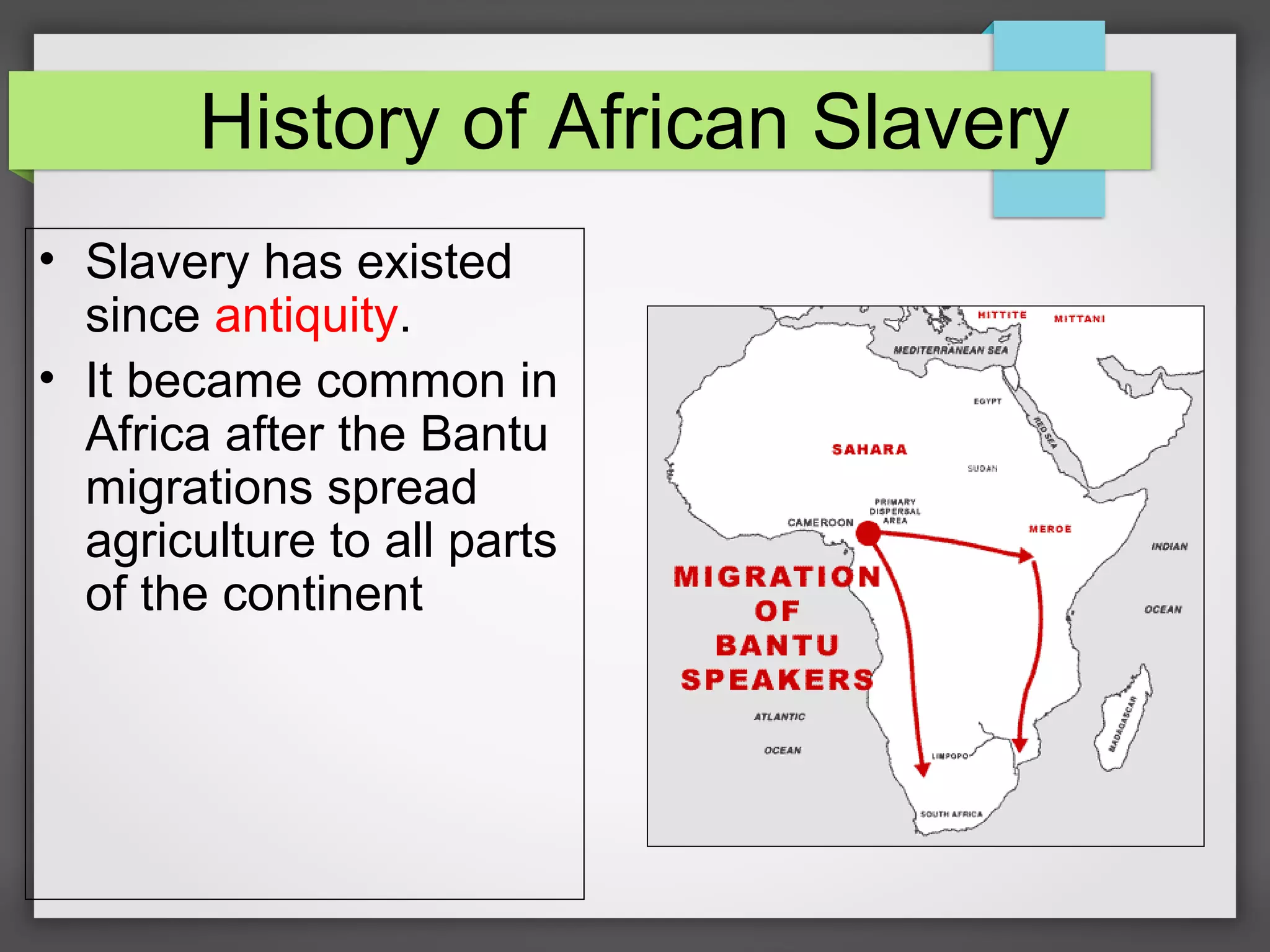
• It became common in
Africa after the Bantu
migrations spread
agriculture to all parts
of the continent
History of African Slavery
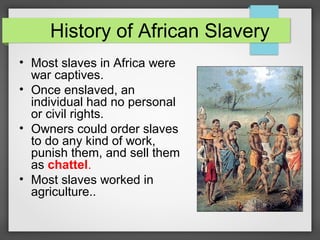
• Most slaves in Africa were
war captives.
• Once enslaved, an
individual had no personal
or civil rights.
• Owners could order slaves
to do any kind of work,
punish them, and sell them
as chattel.
• Most slaves worked in
agriculture..
History of African Slavery
• African law did not recognize individual
land ownership so wealth and power in
Africa came from not owning land, but by
controlling the human labor that made it
productive.
• Slaves were a form of investment and a
sign of wealth.
European Slave Trade
• By the time Europeans arrived in Sub-Saharan
Africa in the 15th and 16th Centuries, the slave
trade was a well-established feature in African
society.
• A detailed system for capturing, selling, and
distributing slaves had been in place for over
500 years.
• With the arrival of the Europeans and the
demand for slaves in the Americas, the slave
trade expanded dramatically.
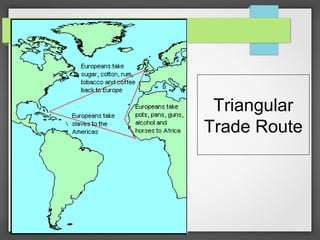
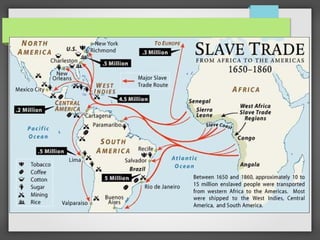
Triangular
Trade Route
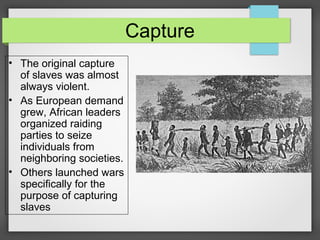
Capture
• The original capture
of slaves was almost
always violent.
• As European demand
grew, African leaders
organized raiding
parties to seize
individuals from
neighboring societies.
• Others launched wars
specifically for the
purpose of capturing
slaves
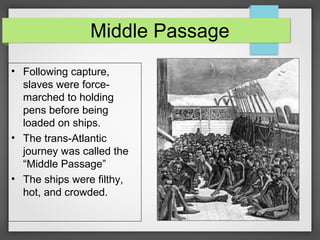
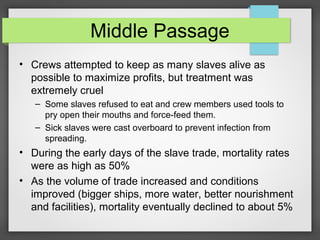
Middle Passage
• Following capture,
slaves were forcemarched to holding
pens before being
loaded on ships.
• The trans-Atlantic
journey was called the
“Middle Passage”
• The ships were filthy,
hot, and crowded.
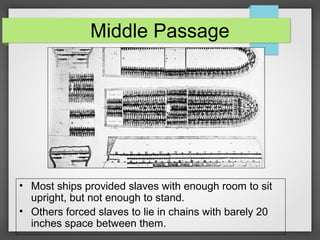
Middle Passage

• Most ships provided slaves with enough room to sit
upright, but not enough to stand.
• Others forced slaves to lie in chains with barely 20
inches space between them.
Middle Passage
• Crews attempted to keep as many slaves alive as
possible to maximize profits, but treatment was
extremely cruel
– Some slaves refused to eat and crew members used tools to
pry open their mouths and force-feed them.
– Sick slaves were cast overboard to prevent infection from
spreading.

• During the early days of the slave trade, mortality rates
were as high as 50%
• As the volume of trade increased and conditions
improved (bigger ships, more water, better nourishment
and facilities), mortality eventually declined to about 5%
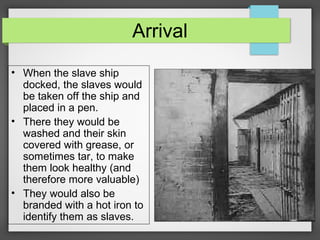
Arrival
• When the slave ship
docked, the slaves would
be taken off the ship and
placed in a pen.
• There they would be
washed and their skin
covered with grease, or
sometimes tar, to make
them look healthy (and
therefore more valuable)
• They would also be
branded with a hot iron to
identify them as slaves.
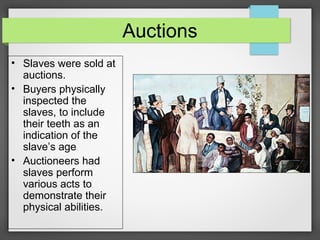
Auctions
• Slaves were sold at
auctions.
• Buyers physically
inspected the
slaves, to include
their teeth as an
indication of the
slave’s age
• Auctioneers had
slaves perform
various acts to
demonstrate their
physical abilities.
Volume of the Slave Trade
• Late 15th and 16th Century… 2,000 Africans
exported each year
• 17th Century… 20,000 per year
• 18th Century… 55,000 per year
– 1780s… 88,000 per year

• All told, some 12 million Africans were
transported to the western hemisphere via the
Atlantic Slave Trade
• Another 4 million died resisting capture or during
captivity before arriving at their destination
Plantations
• In addition to sugar,
plantations produced
crops like tobacco,
indigo, and cotton
• All were designed to
export commercial
crops for profit
• Relied almost
exclusively on large
amounts of slave
labor supervised by
small numbers of
European or EuroAmerican managers

Brazilian sugar mill in the 1830s
Impact of Slave Trade in Africa
• Mixed
– Some states like Rwanda largely
escaped the slave trade through
resistance and geography
– Some like Senegal in west Africa
were hit very hard
– Other societies benefited
economically from selling slaves,
trading, or operating ports
– As abolition took root in the 19th
Century some African merchants
even complained about the loss
of their livelihood

• On the whole, however, the
slave trade devastated Africa

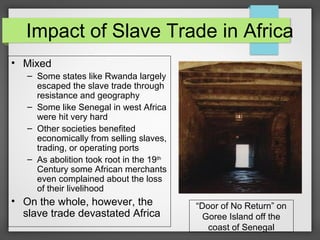
“Door of No Return” on
Goree Island off the
coast of Senegal
Impact of Slave Trade in Africa
• The Atlantic Slave Trade
deprived Africa of about 16
million people and the
continuing Islamic slave
trade consumed another
several million.

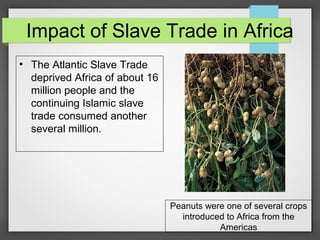
Peanuts were one of several crops
introduced to Africa from the
Americas

Atlantic slave trade

  • 1.
    History of AfricanSlavery • Slavery has existed since antiquity. • It became common in Africa after the Bantu migrations spread agriculture to all parts of the continent
  • 2.
    History of AfricanSlavery • Most slaves in Africa were war captives. • Once enslaved, an individual had no personal or civil rights. • Owners could order slaves to do any kind of work, punish them, and sell them as chattel. • Most slaves worked in agriculture..
  • 3.
    History of AfricanSlavery • African law did not recognize individual land ownership so wealth and power in Africa came from not owning land, but by controlling the human labor that made it productive. • Slaves were a form of investment and a sign of wealth.
  • 4.
    European Slave Trade •By the time Europeans arrived in Sub-Saharan Africa in the 15th and 16th Centuries, the slave trade was a well-established feature in African society. • A detailed system for capturing, selling, and distributing slaves had been in place for over 500 years. • With the arrival of the Europeans and the demand for slaves in the Americas, the slave trade expanded dramatically.
  • 5.
  • 6.
    Capture • The originalcapture of slaves was almost always violent. • As European demand grew, African leaders organized raiding parties to seize individuals from neighboring societies. • Others launched wars specifically for the purpose of capturing slaves
  • 7.
    Middle Passage • Followingcapture, slaves were forcemarched to holding pens before being loaded on ships. • The trans-Atlantic journey was called the “Middle Passage” • The ships were filthy, hot, and crowded.
  • 8.
    Middle Passage • Mostships provided slaves with enough room to sit upright, but not enough to stand. • Others forced slaves to lie in chains with barely 20 inches space between them.
  • 9.
    Middle Passage • Crewsattempted to keep as many slaves alive as possible to maximize profits, but treatment was extremely cruel – Some slaves refused to eat and crew members used tools to pry open their mouths and force-feed them. – Sick slaves were cast overboard to prevent infection from spreading. • During the early days of the slave trade, mortality rates were as high as 50% • As the volume of trade increased and conditions improved (bigger ships, more water, better nourishment and facilities), mortality eventually declined to about 5%
  • 10.
    Arrival • When theslave ship docked, the slaves would be taken off the ship and placed in a pen. • There they would be washed and their skin covered with grease, or sometimes tar, to make them look healthy (and therefore more valuable) • They would also be branded with a hot iron to identify them as slaves.
  • 11.
    Auctions • Slaves weresold at auctions. • Buyers physically inspected the slaves, to include their teeth as an indication of the slave’s age • Auctioneers had slaves perform various acts to demonstrate their physical abilities.
  • 12.
    Volume of theSlave Trade • Late 15th and 16th Century… 2,000 Africans exported each year • 17th Century… 20,000 per year • 18th Century… 55,000 per year – 1780s… 88,000 per year • All told, some 12 million Africans were transported to the western hemisphere via the Atlantic Slave Trade • Another 4 million died resisting capture or during captivity before arriving at their destination
  • 13.
    Plantations • In additionto sugar, plantations produced crops like tobacco, indigo, and cotton • All were designed to export commercial crops for profit • Relied almost exclusively on large amounts of slave labor supervised by small numbers of European or EuroAmerican managers Brazilian sugar mill in the 1830s
  • 15.
    Impact of SlaveTrade in Africa • Mixed – Some states like Rwanda largely escaped the slave trade through resistance and geography – Some like Senegal in west Africa were hit very hard – Other societies benefited economically from selling slaves, trading, or operating ports – As abolition took root in the 19th Century some African merchants even complained about the loss of their livelihood • On the whole, however, the slave trade devastated Africa “Door of No Return” on Goree Island off the coast of Senegal
  • 16.
    Impact of SlaveTrade in Africa • The Atlantic Slave Trade deprived Africa of about 16 million people and the continuing Islamic slave trade consumed another several million. Peanuts were one of several crops introduced to Africa from the Americas