Japan and the Meiji Restoration
The Opening and Modernization of JapanThe Opening and Modernization of Japan
1750-19001750-1900
Tokugawa Period (1600-1868)
• ___________________
• Ruled by Shogun, Emperor as a figurehead
• Capital City of Edo (Tokyo)
• Rigid Social Structure (Daimyo Samurai, peasants, artisans, merchants)
• ___________________
• Ruled by Shogun, Emperor as a figurehead
• Capital City of Edo (Tokyo)
• Rigid Social Structure (Daimyo Samurai, peasants, artisans, merchants)
• Belief Systems
- Shintoism
- Zen Buddhism
- Prohibited Christianity
• Belief Systems
- Shintoism
- Zen Buddhism
- Prohibited Christianity
Himeji Castle: Built in 1600sHimeji Castle: Built in 1600s
Centralized feudalism
“pacified, but not really unified”“pacified, but not really unified”
Tokugawa Period (1600-1868)
• Highly regulated trade
• Limited trade with
China, Korea and Dutch
• Highly regulated trade
• Limited trade with
China, Korea and Dutch
Arrival of the United States
Growing Commercialization
• By 1750, world’s most urbanized country
• Edo was largest city in world– 1 million people
• Emerging capitalist society – literate, educated
population due to Confucian influence
• By 1750, world’s most urbanized country
• Edo was largest city in world– 1 million people
• Emerging capitalist society – literate, educated
population due to Confucian influence
Problems
• Peasants/samurai lured into commerce –
ignored social “status”
• Corruption in government
• 1830 famine– people lost faith in Shogunate
Problems
• Peasants/samurai lured into commerce –
ignored social “status”
• Corruption in government
• 1830 famine– people lost faith in Shogunate
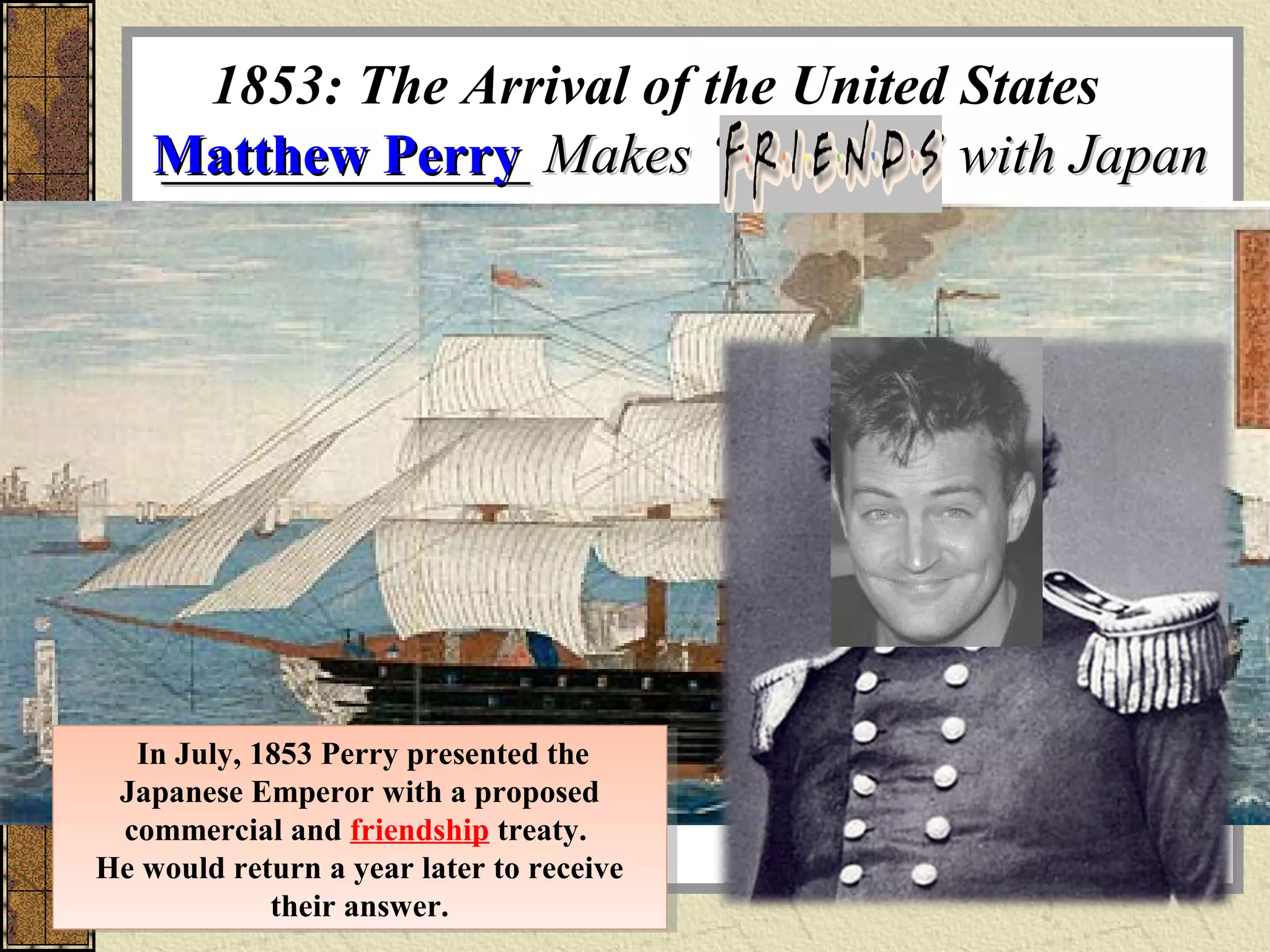
1853: The Arrival of the United States
_____________ Makes “Friends” with Japan_____________ Makes “Friends” with Japan
In July, 1853 Perry presented the
Japanese Emperor with a proposed
commercial and friendship treaty.
He would return a year later to receive
their answer.
In July, 1853 Perry presented the
Japanese Emperor with a proposed
commercial and friendship treaty.
He would return a year later to receive
their answer.
Matthew PerryMatthew Perry
“
Great and good friend,
I have directed Commodore
Perry to assure your imperial
majesty that I entertain the
kindest feelings toward your
majesty's person and
Letter from President Millard Fillmore to the Shogun of JapanLetter from President Millard Fillmore to the Shogun of Japan
… I am desirous that our two
countries should trade with each
other, for the benefit both of Japan
and the United States.
Letter from President Millard Fillmore to the Shogun of JapanLetter from President Millard Fillmore to the Shogun of Japan
...We know that the ancient laws of
your imperial majesty's government
do not allow of foreign trade, except
with the Chinese and the Dutch; but
as the state of the world changes… it
seems to be wise, from time to time,
Letter from President Millard Fillmore to the Shogun of JapanLetter from President Millard Fillmore to the Shogun of Japan
...These are the only objects for which I
have sent Commodore Perry, with a
powerful squadron, to pay a visit to your
imperial majesty's renowned city of Yedo:
friendship, commerce, a supply of coal and
provisions, and protection for our
shipwrecked people."
Letter from President Millard Fillmore to the Shogun of JapanLetter from President Millard Fillmore to the Shogun of Japan
Gunboat Diplomacy
Perry returned in 1854.
This time he appeared with seven ships - four
sailing ships, three steamers – and 1600 men.
So…what’s it
gonna be??
The Treaty of Kanagawa
In 1854 the Treaty of Kanagawa was signed which established:
1. ___________________ friendship between the two countries
2. proper treatment for shipwrecked Americans
3. fuel for American ships
4. two ports opened for trade
In 1854 the Treaty of Kanagawa was signed which established:
1. ___________________ friendship between the two countries
2. proper treatment for shipwrecked Americans
3. fuel for American ships
4. two ports opened for trade
Result:Result:
The signing of this treaty signaled the end of Japanese ________.The signing of this treaty signaled the end of Japanese ________.isolation
Permanent Friendship
The last Tokugawa Shogun
Sakamoto Ryoma
Unequal treaties were seen as humiliating
and some daimyo wanted to remove the
Shogun from power.
Unequal treaties were seen as humiliating
and some daimyo wanted to remove the
Shogun from power.
Sakamoto Ryoma created a plan for Japan to
modernize and unify under the rule of the Emperor.
He convinced the Shogun to resign. He was
assassinated shortly after by a pro-Shogun supporter.
Sakamoto Ryoma created a plan for Japan to
modernize and unify under the rule of the Emperor.
He convinced the Shogun to resign. He was
assassinated shortly after by a pro-Shogun supporter.
Shogun Yoshinobu
“Revere the
Emperor, expel
the
barbarians”
The Meiji Restoration
Over the next generation the whole society
and its institutions were transformed to
serve the needs of _____________.
Over the next generation the whole society
and its institutions were transformed to
serve the needs of _____________.
By 1868, a group of young samurai claimed
that they were restoring power to
___________, the 15 year old Japanese
Emperor.
By 1868, a group of young samurai claimed
that they were restoring power to
___________, the 15 year old Japanese
Emperor.
This period is known as the ______________
Meiji meaning ______________.
This period is known as the ______________
Meiji meaning ______________.
Mutsuhito
Meiji Restoration
modernization
Enlightened Rule
“When I saw a hospital [abroad], I wanted to know how it
was run – who paid the running expenses; when I visited
a bank, I wanted to learn how the money was deposited
and paid out. By similar firsthand questions, I learned
something of the postal system and the military
conscription (draft). A perplexing institution was
representative government.”
“When I saw a hospital [abroad], I wanted to know how it
was run – who paid the running expenses; when I visited
a bank, I wanted to learn how the money was deposited
and paid out. By similar firsthand questions, I learned
something of the postal system and the military
conscription (draft). A perplexing institution was
representative government.”
Fukuzawa Yukichi
Japanese Scholar
Selective Borrowing
Taiping Rebellion
1850-1864
U.S. Civil War
1861-1865Suez Canal
1858-1869
World Events
Political Reforms
“Rich Country, Strong Army!”
•Centralized Nation-State
•Equality under the law
•1889 – Emperor issues a “voluntary gift” to the people – a constitution
•Developed a Parliament called the Diet
•Emperor still had power – influenced by oligarchy
•Centralized Nation-State
•Equality under the law
•1889 – Emperor issues a “voluntary gift” to the people – a constitution
•Developed a Parliament called the Diet
•Emperor still had power – influenced by oligarchy
“Rich Country, Strong Army!”
Military Reforms
•Abolished Samurai class
•No longer allowed to carry swords
•Created modern army based on
conscription from all classes
•Created modern navy
•Abolished Samurai class
•No longer allowed to carry swords
•Created modern army based on
conscription from all classes
•Created modern navy
Economic Reforms “Rich Country, Strong Army!”
• Newly developed State Banks funded new roads, railroads
• Guilds and road tariffs abolished to create national market
• Land reform/new agricultural techniques increased food
• Government dominated mines, shipyards, heavy industry
• Created postal system, commercial laws, schools
• Newly developed State Banks funded new roads, railroads
• Guilds and road tariffs abolished to create national market
• Land reform/new agricultural techniques increased food
• Government dominated mines, shipyards, heavy industry
• Created postal system, commercial laws, schools
Silk factories 1915
Private Enterprise in the Textile Industry
Silk factories 1915
Private Enterprise in the Textile Industry New Western style public educationNew Western style public education
State Sponsored Industry: Ministry of Industry 1870State Sponsored Industry: Ministry of Industry 1870
Landscape art of the 16th
Century displays
themes of isolation, reflection, and simplicity.
Japanese artists and scholars, emulated their
Chinese mentors. This reflective, somewhat
romantic ink landscape includes pale touches
of red and yellow.
1. What Japanese traditions
are depicted in this
painting?
2. What aspects of this
painting reflect western
ideals? Explain.
3. How does this painting
showcase the changing times
of Japan?
1. What Japanese traditions
are depicted in this
painting?
2. What aspects of this
painting reflect western
ideals? Explain.
3. How does this painting
showcase the changing times
of Japan?
Do Now:
Western ____________ was adopted which
allowed the Japanese to fully ______________
in less than 50 years. By the end of the Meiji
Restoration, the Japanese no longer feared
that they would be _____________. Rather,
they set out to practice imperialism
themselves to obtain power and ________
__________. Japan was quickly emerging as a
world-class power using western technology
and methods while still maintaining its
___________ _________ values.
Final ThoughtsFinal Thoughts
technology
industrialize
imperialized
natural
traditional
resources
cultural
This period was known as the _____ _____________.Meiji Restoration

Japanese imperialism

  • 1.
    Japan and theMeiji Restoration The Opening and Modernization of JapanThe Opening and Modernization of Japan 1750-19001750-1900
  • 2.
    Tokugawa Period (1600-1868) •___________________ • Ruled by Shogun, Emperor as a figurehead • Capital City of Edo (Tokyo) • Rigid Social Structure (Daimyo Samurai, peasants, artisans, merchants) • ___________________ • Ruled by Shogun, Emperor as a figurehead • Capital City of Edo (Tokyo) • Rigid Social Structure (Daimyo Samurai, peasants, artisans, merchants) • Belief Systems - Shintoism - Zen Buddhism - Prohibited Christianity • Belief Systems - Shintoism - Zen Buddhism - Prohibited Christianity Himeji Castle: Built in 1600sHimeji Castle: Built in 1600s Centralized feudalism “pacified, but not really unified”“pacified, but not really unified”
  • 3.
    Tokugawa Period (1600-1868) •Highly regulated trade • Limited trade with China, Korea and Dutch • Highly regulated trade • Limited trade with China, Korea and Dutch Arrival of the United States
  • 4.
    Growing Commercialization • By1750, world’s most urbanized country • Edo was largest city in world– 1 million people • Emerging capitalist society – literate, educated population due to Confucian influence • By 1750, world’s most urbanized country • Edo was largest city in world– 1 million people • Emerging capitalist society – literate, educated population due to Confucian influence Problems • Peasants/samurai lured into commerce – ignored social “status” • Corruption in government • 1830 famine– people lost faith in Shogunate Problems • Peasants/samurai lured into commerce – ignored social “status” • Corruption in government • 1830 famine– people lost faith in Shogunate
  • 5.
    1853: The Arrivalof the United States _____________ Makes “Friends” with Japan_____________ Makes “Friends” with Japan In July, 1853 Perry presented the Japanese Emperor with a proposed commercial and friendship treaty. He would return a year later to receive their answer. In July, 1853 Perry presented the Japanese Emperor with a proposed commercial and friendship treaty. He would return a year later to receive their answer. Matthew PerryMatthew Perry
  • 6.
    “ Great and goodfriend, I have directed Commodore Perry to assure your imperial majesty that I entertain the kindest feelings toward your majesty's person and Letter from President Millard Fillmore to the Shogun of JapanLetter from President Millard Fillmore to the Shogun of Japan
  • 7.
    … I amdesirous that our two countries should trade with each other, for the benefit both of Japan and the United States. Letter from President Millard Fillmore to the Shogun of JapanLetter from President Millard Fillmore to the Shogun of Japan
  • 8.
    ...We know thatthe ancient laws of your imperial majesty's government do not allow of foreign trade, except with the Chinese and the Dutch; but as the state of the world changes… it seems to be wise, from time to time, Letter from President Millard Fillmore to the Shogun of JapanLetter from President Millard Fillmore to the Shogun of Japan
  • 9.
    ...These are theonly objects for which I have sent Commodore Perry, with a powerful squadron, to pay a visit to your imperial majesty's renowned city of Yedo: friendship, commerce, a supply of coal and provisions, and protection for our shipwrecked people." Letter from President Millard Fillmore to the Shogun of JapanLetter from President Millard Fillmore to the Shogun of Japan
  • 10.
    Gunboat Diplomacy Perry returnedin 1854. This time he appeared with seven ships - four sailing ships, three steamers – and 1600 men. So…what’s it gonna be??
  • 11.
    The Treaty ofKanagawa In 1854 the Treaty of Kanagawa was signed which established: 1. ___________________ friendship between the two countries 2. proper treatment for shipwrecked Americans 3. fuel for American ships 4. two ports opened for trade In 1854 the Treaty of Kanagawa was signed which established: 1. ___________________ friendship between the two countries 2. proper treatment for shipwrecked Americans 3. fuel for American ships 4. two ports opened for trade Result:Result: The signing of this treaty signaled the end of Japanese ________.The signing of this treaty signaled the end of Japanese ________.isolation Permanent Friendship
  • 12.
    The last TokugawaShogun Sakamoto Ryoma Unequal treaties were seen as humiliating and some daimyo wanted to remove the Shogun from power. Unequal treaties were seen as humiliating and some daimyo wanted to remove the Shogun from power. Sakamoto Ryoma created a plan for Japan to modernize and unify under the rule of the Emperor. He convinced the Shogun to resign. He was assassinated shortly after by a pro-Shogun supporter. Sakamoto Ryoma created a plan for Japan to modernize and unify under the rule of the Emperor. He convinced the Shogun to resign. He was assassinated shortly after by a pro-Shogun supporter. Shogun Yoshinobu “Revere the Emperor, expel the barbarians”
  • 13.
    The Meiji Restoration Overthe next generation the whole society and its institutions were transformed to serve the needs of _____________. Over the next generation the whole society and its institutions were transformed to serve the needs of _____________. By 1868, a group of young samurai claimed that they were restoring power to ___________, the 15 year old Japanese Emperor. By 1868, a group of young samurai claimed that they were restoring power to ___________, the 15 year old Japanese Emperor. This period is known as the ______________ Meiji meaning ______________. This period is known as the ______________ Meiji meaning ______________. Mutsuhito Meiji Restoration modernization Enlightened Rule
  • 14.
    “When I sawa hospital [abroad], I wanted to know how it was run – who paid the running expenses; when I visited a bank, I wanted to learn how the money was deposited and paid out. By similar firsthand questions, I learned something of the postal system and the military conscription (draft). A perplexing institution was representative government.” “When I saw a hospital [abroad], I wanted to know how it was run – who paid the running expenses; when I visited a bank, I wanted to learn how the money was deposited and paid out. By similar firsthand questions, I learned something of the postal system and the military conscription (draft). A perplexing institution was representative government.” Fukuzawa Yukichi Japanese Scholar Selective Borrowing Taiping Rebellion 1850-1864 U.S. Civil War 1861-1865Suez Canal 1858-1869 World Events
  • 15.
    Political Reforms “Rich Country,Strong Army!” •Centralized Nation-State •Equality under the law •1889 – Emperor issues a “voluntary gift” to the people – a constitution •Developed a Parliament called the Diet •Emperor still had power – influenced by oligarchy •Centralized Nation-State •Equality under the law •1889 – Emperor issues a “voluntary gift” to the people – a constitution •Developed a Parliament called the Diet •Emperor still had power – influenced by oligarchy
  • 16.
    “Rich Country, StrongArmy!” Military Reforms •Abolished Samurai class •No longer allowed to carry swords •Created modern army based on conscription from all classes •Created modern navy •Abolished Samurai class •No longer allowed to carry swords •Created modern army based on conscription from all classes •Created modern navy
  • 17.
    Economic Reforms “RichCountry, Strong Army!” • Newly developed State Banks funded new roads, railroads • Guilds and road tariffs abolished to create national market • Land reform/new agricultural techniques increased food • Government dominated mines, shipyards, heavy industry • Created postal system, commercial laws, schools • Newly developed State Banks funded new roads, railroads • Guilds and road tariffs abolished to create national market • Land reform/new agricultural techniques increased food • Government dominated mines, shipyards, heavy industry • Created postal system, commercial laws, schools Silk factories 1915 Private Enterprise in the Textile Industry Silk factories 1915 Private Enterprise in the Textile Industry New Western style public educationNew Western style public education State Sponsored Industry: Ministry of Industry 1870State Sponsored Industry: Ministry of Industry 1870
  • 18.
    Landscape art ofthe 16th Century displays themes of isolation, reflection, and simplicity. Japanese artists and scholars, emulated their Chinese mentors. This reflective, somewhat romantic ink landscape includes pale touches of red and yellow. 1. What Japanese traditions are depicted in this painting? 2. What aspects of this painting reflect western ideals? Explain. 3. How does this painting showcase the changing times of Japan? 1. What Japanese traditions are depicted in this painting? 2. What aspects of this painting reflect western ideals? Explain. 3. How does this painting showcase the changing times of Japan? Do Now:
  • 19.
    Western ____________ wasadopted which allowed the Japanese to fully ______________ in less than 50 years. By the end of the Meiji Restoration, the Japanese no longer feared that they would be _____________. Rather, they set out to practice imperialism themselves to obtain power and ________ __________. Japan was quickly emerging as a world-class power using western technology and methods while still maintaining its ___________ _________ values. Final ThoughtsFinal Thoughts technology industrialize imperialized natural traditional resources cultural This period was known as the _____ _____________.Meiji Restoration

Editor's Notes

  • #15 US Civil war distracted America from the Pacific, The Taiping Rebellion and Suez Canal were seen as crucial enterprises for the West to solve. Selective borrowing enabled the Japanese to quickly modernize and avoid Western Imperialism. These factors all gave Japan the time it needed to upgrade its military and make the necessary political and economic changes to become the main power in the East.