During the three decades following the Civil
War, the United States transformed rapidly
from a rural nation to a more urban one.
Objectives:
Explain the technological developments
that made the growth of cities possible.
Evaluate the role that political machines
played in urban politics in the late 1800s.
1st skyscraper- Home Insurance
Building, Chicago 1854
 The urban population of the United States
grew from about 10 million in 1870 to over
30 million by 1900.
 Immigrants remained in the cities, where
they worked long hours for little pay.
 Still, most immigrants felt their standard of
living had improved in the United States.
 Farmers began moving to cities
because of better paying jobs,
electricity, running water, plumbing,
and entertainment.
Hoyt’s Madison Square
Theater, opened 1865
 Housing and
transportation
needs changed
due to the
increase in the
amount of people
living in cities.
 As the price of
land increased,
building owners
began to build up.
Called the Navarro Flats, this massive fortress of
Gilded-Age extravagance was built in the mid-1880s.
The Navarro Flats was also an early example of
apartment-style living. At the time, most New Yorkers
of means still preferred living in a single brownstone or
townhouse.
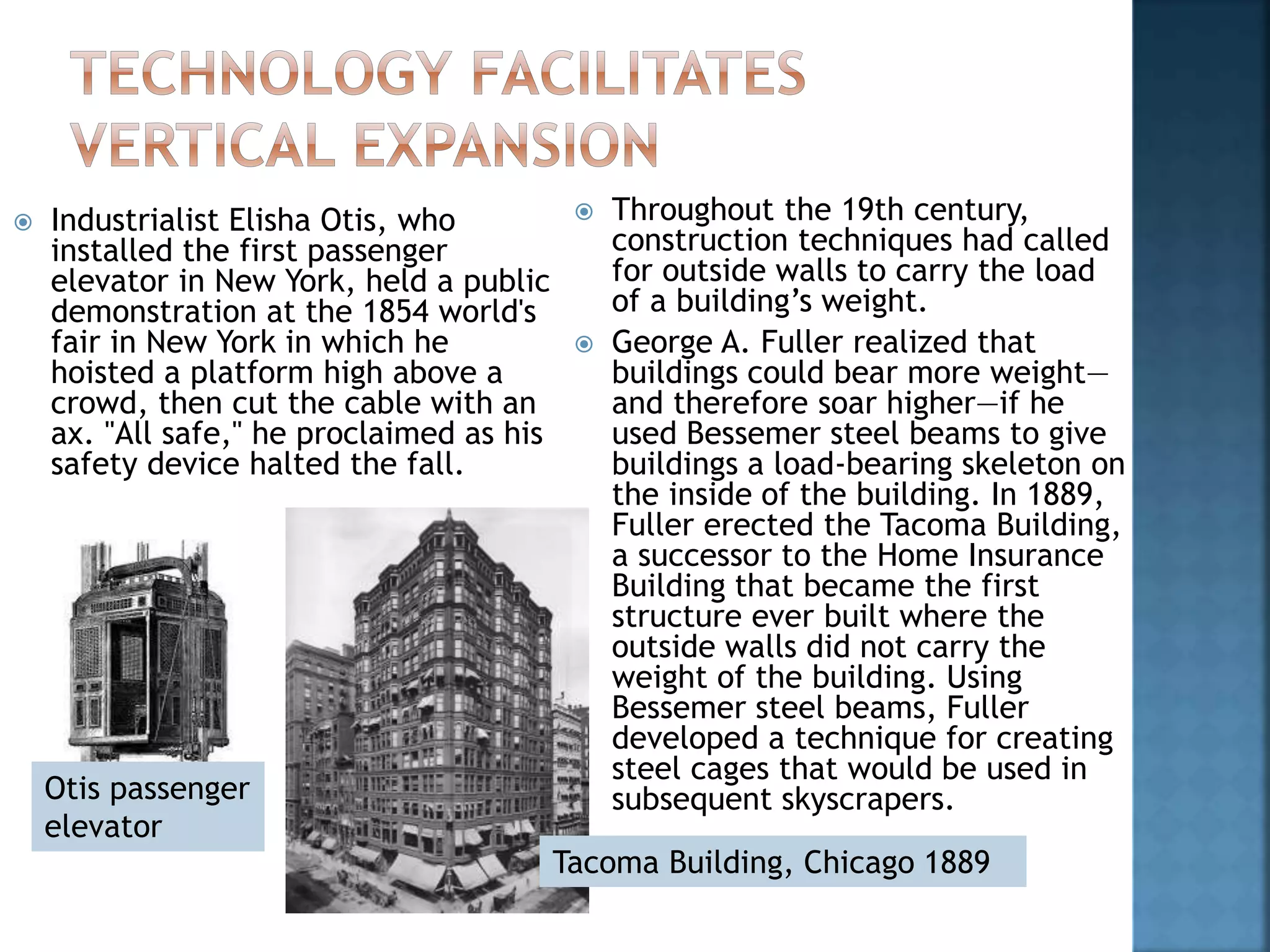
 Industrialist Elisha Otis, who
installed the first passenger
elevator in New York, held a public
demonstration at the 1854 world's
fair in New York in which he
hoisted a platform high above a
crowd, then cut the cable with an
ax. "All safe," he proclaimed as his
safety device halted the fall.
 Throughout the 19th century,
construction techniques had called
for outside walls to carry the load
of a building’s weight.
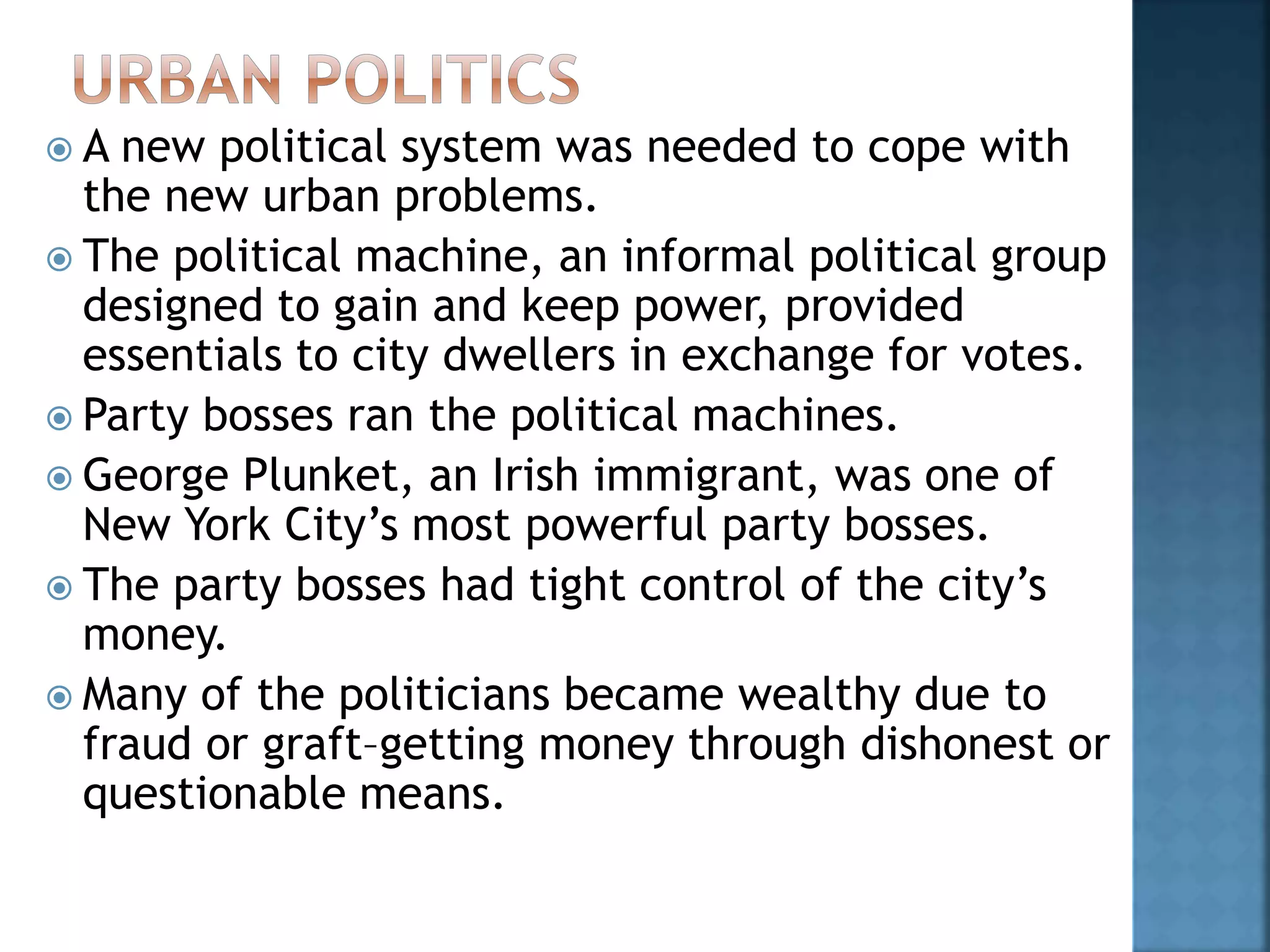
 George A. Fuller realized that
buildings could bear more weight—
and therefore soar higher—if he
used Bessemer steel beams to give
buildings a load-bearing skeleton on
the inside of the building. In 1889,
Fuller erected the Tacoma Building,
a successor to the Home Insurance
Building that became the first
structure ever built where the
outside walls did not carry the
weight of the building. Using
Bessemer steel beams, Fuller
developed a technique for creating
steel cages that would be used in
subsequent skyscrapers.
Tacoma Building, Chicago 1889
Otis passenger
elevator
 Skyscrapers, tall steel
frame buildings, were
constructed to utilize
vertical real estate.
 Chicagoan Louis Sullivan
contributed to the
design of skyscrapers
and was called a "father
of skyscrapers.“ He is
attributed with the
phrase “form follows
function.”
 Frank Lloyd Wright was
influential in the
Prairie School of
architecture and
apprenticed with Louis
Sullivan. He designed
over 1,000 structures
in his lifetime and
changed urban
planning and
development.
Frank Lloyd Wright
Louis Sullivan, 1895
 When the Commercial National
Bank was built in 1910 it was
the first skyscraper built in
Shreveport.
 Peter Youree, president of the
Commercial National Bank,
directed the construction of the
10-story bank building. He is
the same man that Youree Drive
is named after.
 The neo-classicism building,
built with steel, housed several
offices on the top floors.
 Today the building has been
converted to apartments with
commercial space on the
bottom floor.
In the late 1800s, various kinds of mass transit developed to move large
numbers of people around cities quickly. Beginning with the horsecar, and
later to the more sophisticated electric trolley cars and elevated railroads,
engineers created ways to move the ever-expanding population around the
city, even underground.
 Definite boundaries
could be seen
between where the
wealthy, middle class,
and working class
people lived.
 Wealthy families lived
in the heart of the
city where they
constructed elaborate
homes.
 The middle class, which
included doctors,
lawyers, engineers, and
teachers, tended to live
away from the city.
 The majority of urban
dwellers were part of
the working class who
lived in city tenements,
or dark and crowded
multi-family
apartments.
 The growth of cities resulted
in an increase in crime, fire,
disease, and pollution.
 From 1880 to 1900, there
was a large increase in the
murder rate.
 Native-born Americans
blamed immigrants for the
increase in crime.
 Alcohol contributed to
crime in the late 1800s.
 Contaminated drinking
water from improper
sewage disposal resulted
in epidemics of typhoid
fever and cholera.
Colonel George Waring , hired as “sanitation engineer” in 1895, transformed the
image of the sanitation department in New York, dressing workers in white so
they would be affiliated with hygiene and cleanliness. At times the workers
would be attacked by a cynical public, prompting police escorts.
 A new political system was needed to cope with
the new urban problems.
 The political machine, an informal political group
designed to gain and keep power, provided
essentials to city dwellers in exchange for votes.
 Party bosses ran the political machines.
 George Plunket, an Irish immigrant, was one of
New York City’s most powerful party bosses.
 The party bosses had tight control of the city’s
money.
 Many of the politicians became wealthy due to
fraud or graft–getting money through dishonest or
questionable means.
 The most famous New York Democratic political
machine was Tammany Hall.
 During the 1860s and 1870s, Tammany Hall’s boss
was William M. Tweed.
 "Boss" Tweed played a major role in the politics of
19th-century New York City and State. At the height of
his influence, Tweed was the third-largest landowner in
New York City, a director of the Erie Railroad, a
director of the Tenth National Bank, a director of the
New-York Printing Company, the proprietor of the
Metropolitan Hotel, a significant stockholder in iron mines and gas companies, a board
member of the Harlem Gas Light Company, a board member of the Third Avenue Railway
Company, a board member of the Brooklyn Bridge Company, and the president of the
Guardian Savings Bank.
 Tweed’s corruption sent him to prison in 1874. Tweed was convicted for stealing an
amount estimated by an aldermen's committee in 1877 at between $25 million and
$45 million from New York City taxpayers from political corruption, but later estimates
ranged as high as $200 million. Unable to make bail, he escaped from jail once but was
returned to custody. He died in the Ludlow Street Jail in 1878.
 Thomas and James
Pendergast were party
bosses in Kansas City,
Missouri.
 They led state and city
politics from
the 1890s to the 1930s.
 Opponents of political
machines, such as Thomas
Nast, blasted bosses for
their corruption.
Defenders, though, thought
machines supplied
necessary services and
helped to assimilate the
masses of new city
dwellers.
Thomas Nast’s
image of Santa
Clause set the
standard.
Nast political cartoon
of “Boss” Tweed.

Urbanization ch. 10.2

  • 1.
    During the threedecades following the Civil War, the United States transformed rapidly from a rural nation to a more urban one. Objectives: Explain the technological developments that made the growth of cities possible. Evaluate the role that political machines played in urban politics in the late 1800s. 1st skyscraper- Home Insurance Building, Chicago 1854
  • 2.
     The urbanpopulation of the United States grew from about 10 million in 1870 to over 30 million by 1900.  Immigrants remained in the cities, where they worked long hours for little pay.  Still, most immigrants felt their standard of living had improved in the United States.  Farmers began moving to cities because of better paying jobs, electricity, running water, plumbing, and entertainment. Hoyt’s Madison Square Theater, opened 1865
  • 3.
     Housing and transportation needschanged due to the increase in the amount of people living in cities.  As the price of land increased, building owners began to build up. Called the Navarro Flats, this massive fortress of Gilded-Age extravagance was built in the mid-1880s. The Navarro Flats was also an early example of apartment-style living. At the time, most New Yorkers of means still preferred living in a single brownstone or townhouse.
  • 4.
     Industrialist ElishaOtis, who installed the first passenger elevator in New York, held a public demonstration at the 1854 world's fair in New York in which he hoisted a platform high above a crowd, then cut the cable with an ax. "All safe," he proclaimed as his safety device halted the fall.  Throughout the 19th century, construction techniques had called for outside walls to carry the load of a building’s weight.  George A. Fuller realized that buildings could bear more weight— and therefore soar higher—if he used Bessemer steel beams to give buildings a load-bearing skeleton on the inside of the building. In 1889, Fuller erected the Tacoma Building, a successor to the Home Insurance Building that became the first structure ever built where the outside walls did not carry the weight of the building. Using Bessemer steel beams, Fuller developed a technique for creating steel cages that would be used in subsequent skyscrapers. Tacoma Building, Chicago 1889 Otis passenger elevator
  • 5.
     Skyscrapers, tallsteel frame buildings, were constructed to utilize vertical real estate.  Chicagoan Louis Sullivan contributed to the design of skyscrapers and was called a "father of skyscrapers.“ He is attributed with the phrase “form follows function.”  Frank Lloyd Wright was influential in the Prairie School of architecture and apprenticed with Louis Sullivan. He designed over 1,000 structures in his lifetime and changed urban planning and development. Frank Lloyd Wright Louis Sullivan, 1895
  • 6.
     When theCommercial National Bank was built in 1910 it was the first skyscraper built in Shreveport.  Peter Youree, president of the Commercial National Bank, directed the construction of the 10-story bank building. He is the same man that Youree Drive is named after.  The neo-classicism building, built with steel, housed several offices on the top floors.  Today the building has been converted to apartments with commercial space on the bottom floor.
  • 7.
    In the late1800s, various kinds of mass transit developed to move large numbers of people around cities quickly. Beginning with the horsecar, and later to the more sophisticated electric trolley cars and elevated railroads, engineers created ways to move the ever-expanding population around the city, even underground.
  • 8.
     Definite boundaries couldbe seen between where the wealthy, middle class, and working class people lived.  Wealthy families lived in the heart of the city where they constructed elaborate homes.  The middle class, which included doctors, lawyers, engineers, and teachers, tended to live away from the city.  The majority of urban dwellers were part of the working class who lived in city tenements, or dark and crowded multi-family apartments.
  • 9.
     The growthof cities resulted in an increase in crime, fire, disease, and pollution.  From 1880 to 1900, there was a large increase in the murder rate.  Native-born Americans blamed immigrants for the increase in crime.  Alcohol contributed to crime in the late 1800s.  Contaminated drinking water from improper sewage disposal resulted in epidemics of typhoid fever and cholera. Colonel George Waring , hired as “sanitation engineer” in 1895, transformed the image of the sanitation department in New York, dressing workers in white so they would be affiliated with hygiene and cleanliness. At times the workers would be attacked by a cynical public, prompting police escorts.
  • 10.
     A newpolitical system was needed to cope with the new urban problems.  The political machine, an informal political group designed to gain and keep power, provided essentials to city dwellers in exchange for votes.  Party bosses ran the political machines.  George Plunket, an Irish immigrant, was one of New York City’s most powerful party bosses.  The party bosses had tight control of the city’s money.  Many of the politicians became wealthy due to fraud or graft–getting money through dishonest or questionable means.
  • 11.
     The mostfamous New York Democratic political machine was Tammany Hall.  During the 1860s and 1870s, Tammany Hall’s boss was William M. Tweed.  "Boss" Tweed played a major role in the politics of 19th-century New York City and State. At the height of his influence, Tweed was the third-largest landowner in New York City, a director of the Erie Railroad, a director of the Tenth National Bank, a director of the New-York Printing Company, the proprietor of the Metropolitan Hotel, a significant stockholder in iron mines and gas companies, a board member of the Harlem Gas Light Company, a board member of the Third Avenue Railway Company, a board member of the Brooklyn Bridge Company, and the president of the Guardian Savings Bank.  Tweed’s corruption sent him to prison in 1874. Tweed was convicted for stealing an amount estimated by an aldermen's committee in 1877 at between $25 million and $45 million from New York City taxpayers from political corruption, but later estimates ranged as high as $200 million. Unable to make bail, he escaped from jail once but was returned to custody. He died in the Ludlow Street Jail in 1878.
  • 12.
     Thomas andJames Pendergast were party bosses in Kansas City, Missouri.  They led state and city politics from the 1890s to the 1930s.  Opponents of political machines, such as Thomas Nast, blasted bosses for their corruption. Defenders, though, thought machines supplied necessary services and helped to assimilate the masses of new city dwellers. Thomas Nast’s image of Santa Clause set the standard. Nast political cartoon of “Boss” Tweed.