Atlantic Slave Trade
Theme: Slavery as a product of
globalization, its effects on Africa and the
Americas, and the impact of
Enlightenment ideas on eventual abolition
History of African Slavery
• Slavery has existed
since antiquity
• It became common
in Africa after the
Bantu migrations
spread agriculture to
all parts of the
continent
History of African Slavery
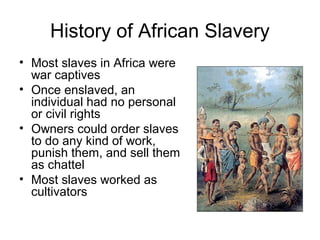
• Most slaves in Africa were
war captives
• Once enslaved, an
individual had no personal
or civil rights
• Owners could order slaves
to do any kind of work,
punish them, and sell them
as chattel
• Most slaves worked as
cultivators
History of African Slavery
• African law did not recognize individual
land ownership so wealth and power in
Africa came from not owning land but
by controlling the human labor that
made it productive
• Slaves were a form of investment and a
sign of wealth
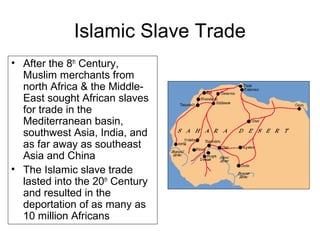
Islamic Slave Trade
• After the 8th
Century,
Muslim merchants from
north Africa & the Middle-
East sought African slaves
for trade in the
Mediterranean basin,
southwest Asia, India, and
as far away as southeast
Asia and China
• The Islamic slave trade
lasted into the 20th
Century
and resulted in the
deportation of as many as
10 million Africans
European Slave Trade
• By the time Europeans arrived in Sub-Saharan
Africa in the 15th
and 16th
Centuries, the slave
trade was a well-established feature in African
society
• A detailed system for capturing, selling, and
distributing slaves had been in place for over
500 years
• With the arrival of the Europeans and the
demand for slaves in the Americas, the slave
trade expanded dramatically
Portuguese Slave Traders
• Portuguese began
capturing slaves in Africa
in the 15th
Century, but
quickly learned it was
easier to buy them
• In Europe, slaves usually
worked as miners,
porters, or domestic
servants since free
peasants and serfs
cultivated the land
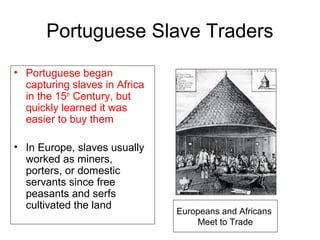
Europeans and Africans
Meet to Trade
Portuguese Slave Trade
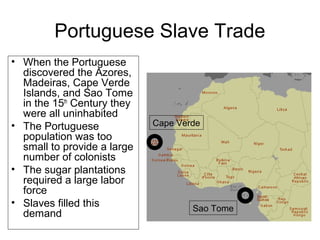
• When the Portuguese
discovered the Azores,
Madeiras, Cape Verde
Islands, and Sao Tome
in the 15th
Century they
were all uninhabited
• The Portuguese
population was too
small to provide a large
number of colonists
• The sugar plantations
required a large labor
force
• Slaves filled this
demand
Sao Tome
Cape Verde
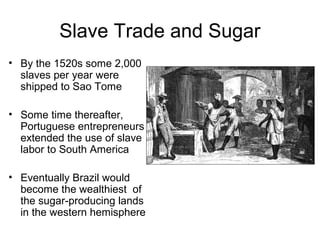
Slave Trade and Sugar
• By the 1520s some 2,000
slaves per year were
shipped to Sao Tome
• Some time thereafter,
Portuguese entrepreneurs
extended the use of slave
labor to South America
• Eventually Brazil would
become the wealthiest of
the sugar-producing lands
in the western hemisphere
Slavery Expands
• As disease reduced the native populations in
Spanish conquered territories, the Spanish
began relying on imported slaves from Africa
• In 1518, the first shipment of slaves went directly
from west Africa to the Caribbean where the
slaves worked on sugar plantations
• By the 1520s, the Spanish had introduced
slaves to Mexico, Peru, and Central America
where they worked as cultivators and miners
• By the early 17th
Century, the British had
introduced slaves to North America
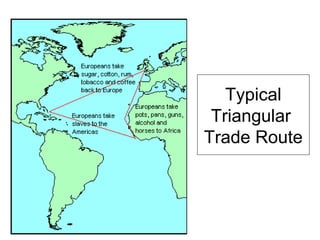
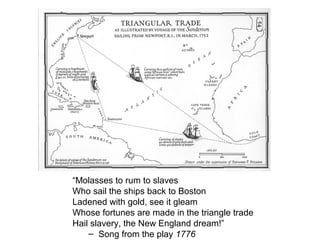
Triangular Trade
• The demand for labor in the western
hemisphere stimulated a profitable three-
legged trading pattern
– European manufactured goods, namely cloth
and metal wares, especially firearms, went to
Africa where they were exchanged for slaves
– The slaves were then shipped to the Caribbean
and Americas where they were sold for cash or
sometimes bartered for sugar or molasses
– Then the ships returned to Europe loaded with
American products
Typical
Triangular
Trade Route
“Molasses to rum to slaves
Who sail the ships back to Boston
Ladened with gold, see it gleam
Whose fortunes are made in the triangle trade
Hail slavery, the New England dream!”
– Song from the play 1776
Capture
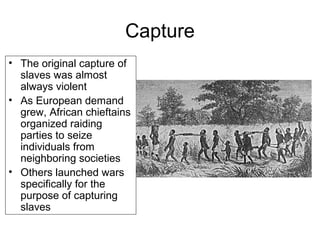
• The original capture of
slaves was almost
always violent
• As European demand
grew, African chieftains
organized raiding
parties to seize
individuals from
neighboring societies
• Others launched wars
specifically for the
purpose of capturing
slaves
Middle Passage
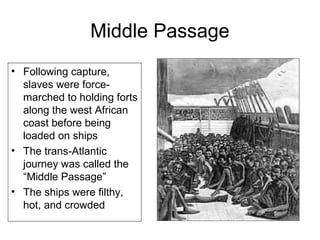
• Following capture,
slaves were force-
marched to holding forts
along the west African
coast before being
loaded on ships
• The trans-Atlantic
journey was called the
“Middle Passage”
• The ships were filthy,
hot, and crowded
Middle Passage
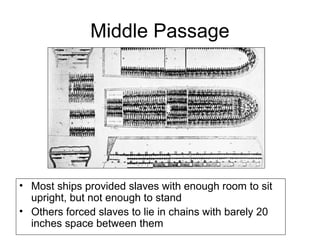
• Most ships provided slaves with enough room to sit
upright, but not enough to stand
• Others forced slaves to lie in chains with barely 20
inches space between them
Middle Passage
• Crews attempted to keep as many slaves alive as
possible to maximize profits, but treatment was
extremely cruel
– Some slaves refused to eat and crew members used tools to
pry open their mouths and force-feed them
– Sick slaves were cast overboard to prevent infection from
spreading
• During the early days of the slave trade, mortality rates
were as high as 50%
• As the volume of trade increased and conditions
improved (bigger ships, more water, better nourishment
and facilities), mortality eventually declined to about 5%
Middle Passage
• The time a ship took to make the Middle Passage
depended upon several factors.
• With good conditions and few delays, a 17th Century
Portuguese slave ship typically took 30 to 50 days to sail
from Angola to Brazil.
• British, French, and Dutch ships transporting slaves
between Guinea and their Caribbean island possessions
took 60 to 90 days.
• As larger merchant ships were introduced, these times
reduced somewhat
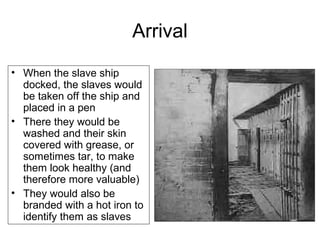
Arrival
• When the slave ship
docked, the slaves would
be taken off the ship and
placed in a pen
• There they would be
washed and their skin
covered with grease, or
sometimes tar, to make
them look healthy (and
therefore more valuable)
• They would also be
branded with a hot iron to
identify them as slaves
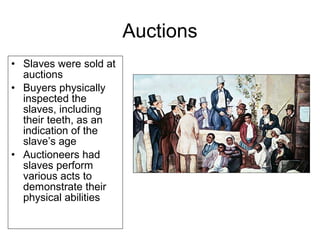
Auctions
• Slaves were sold at
auctions
• Buyers physically
inspected the
slaves, including
their teeth, as an
indication of the
slave’s age
• Auctioneers had
slaves perform
various acts to
demonstrate their
physical abilities
Auctions
“We were not many days in the merchant’s custody, before
we were sold after their usual manner... On a signal given,
(as the beat of a drum), buyers rush at once into the yard
where the slaves are confined, and make a choice of that
parcel they like best. The noise and clamor with which this
is attended, and the eagerness visible in the countenances
of the buyers, serve not a little to increase the
apprehension of terrified Africans... In this manner, without
scruple, are relations and friends separated, most of them
never to see each other again. I remember in the vessel in
which I was brought over... there were several brothers
who, in the sale, were sold in different lots; and it was very
moving on this occasion, to see and hear their cries in
parting.”
– Olaudah Equiano, The Interesting Narrative of Olaudah Equiano
Volume of the Slave Trade
• Late 15th
- 16th
Century… 2,000 Africans
exported each year
• 17th
Century… 20,000 per year
• 18th
Century… 55,000 per year
– 1780s… 88,000 per year
• All told, 12 million Africans were transported
to the western hemisphere via the Atlantic Slave
Trade
• Another 4 million died resisting capture or during
captivity before arriving at their destination
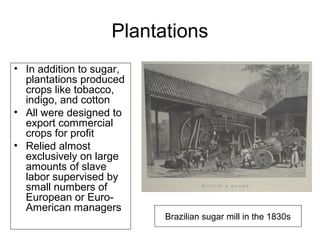
Plantations
• In addition to sugar,
plantations produced
crops like tobacco,
indigo, and cotton
• All were designed to
export commercial
crops for profit
• Relied almost
exclusively on large
amounts of slave
labor supervised by
small numbers of
European or Euro-
American managers
Brazilian sugar mill in the 1830s
Slavery in the Caribbean
and South America
• Disease, brutal working conditions, and poor sanitation
and nutrition resulted in high mortality rates
• Owners imported mainly male slaves and allowed few
to establish families which resulted in low reproduction
• To keep up the needed numbers, plantation owners
imported a steady stream of slaves
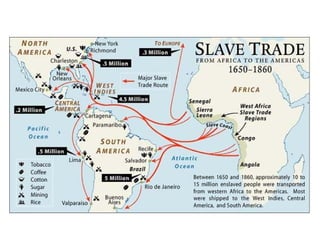
– Of all slaves delivered to the western hemisphere, about 50%
went to Caribbean destinations
– About 33% went to Brazil
– Smaller numbers went elsewhere in South and Central
America
Slavery in North America
• Diseases took less of a toll in North America and
living conditions were usually less brutal
• Plantation owners imported large numbers of
female slaves and encouraged their slaves to
form families and bear children
– Only about 5% of slaves delivered to the western
hemisphere went to North America
Forms of Resistance
• Work slowly
• Sabotage
• Runaway
– “Maroons” gathered together and built self-governing
communities
• Revolt
– Slaves outnumbered the owners and supervisors so
revolt was always a threat
– While causing much destruction, revolts were usually
able to be suppressed because the owners had
access to arms, horses, and military forces
Saint-Dominique
• The only revolt to
successfully abolish
slavery occurred on the
French sugar colony of
Saint Dominique in 1793
• The slaves declared
independence from
France, renamed the
country Haiti, and
established a self-
governing republic in 1804
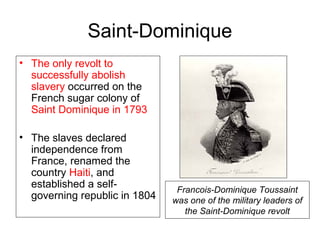
Francois-Dominique Toussaint
was one of the military leaders of
the Saint-Dominique revolt
Abolitionists
Key Figures who led pushed for the abolition
of slavery included:
Former Slaves
– Olaudah Equiano
Politicians
– William Wilberforce
Religious Leaders
– John Wesley
Revolutionaries
– Simon Bolivar
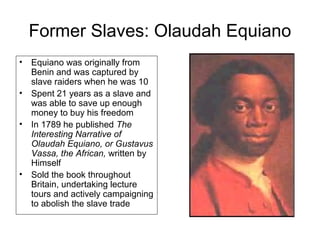
Former Slaves: Olaudah Equiano
• Equiano was originally from
Benin and was captured by
slave raiders when he was 10
• Spent 21 years as a slave and
was able to save up enough
money to buy his freedom
• In 1789 he published The
Interesting Narrative of
Olaudah Equiano, or Gustavus
Vassa, the African, written by
Himself
• Sold the book throughout
Britain, undertaking lecture
tours and actively campaigning
to abolish the slave trade
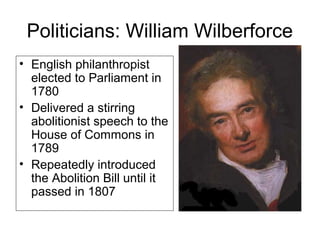
Politicians: William Wilberforce
• English philanthropist
elected to Parliament in
1780
• Delivered a stirring
abolitionist speech to the
House of Commons in
1789
• Repeatedly introduced
the Abolition Bill until it
passed in 1807
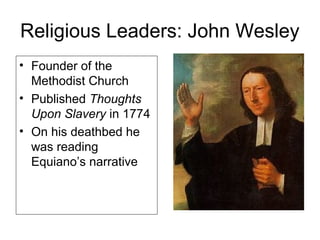
Religious Leaders: John Wesley
• Founder of the
Methodist Church
• Published Thoughts
Upon Slavery in 1774
• On his deathbed he
was reading
Equiano’s narrative
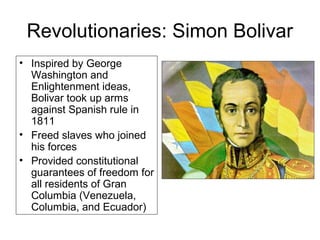
Revolutionaries: Simon Bolivar
• Inspired by George
Washington and
Enlightenment ideas,
Bolivar took up arms
against Spanish rule in
1811
• Freed slaves who joined
his forces
• Provided constitutional
guarantees of freedom for
all residents of Gran
Columbia (Venezuela,
Columbia, and Ecuador)
Timeline for Abolition of
the Slave Trade
• 1803: Denmark abolishes slave trade.
• 1807: Britain abolishes slave trade.
• 1807: U.S. passes legislation banning slave trade, to take effect 1808.
• 1810: British negotiate an agreement with Portugal calling for gradual
abolition of slave trade in the South Atlantic.
• 1815: At the Congress of Vienna, the British pressure Spain, Portugal,
France and the Netherlands to agree to abolish the slave trade (though
Spain and Portugal are permitted a few years of continued slaving to
replenish labor supplies).
• 1817: Great Britain and Spain sign a treaty prohibiting the slave trade:
Spain agrees to end the slave trade north of the equator immediately, and
south of the equator in 1820. British naval vessels are given right to
search suspected slavers. Still, loopholes in the treaty undercut its goals
and the slave trade continues strongly until 1830.
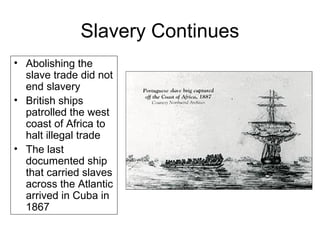
Slavery Continues
• Abolishing the
slave trade did not
end slavery
• British ships
patrolled the west
coast of Africa to
halt illegal trade
• The last
documented ship
that carried slaves
across the Atlantic
arrived in Cuba in
1867
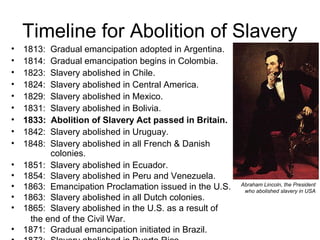
Timeline for Abolition of Slavery
• 1813: Gradual emancipation adopted in Argentina.
• 1814: Gradual emancipation begins in Colombia.
• 1823: Slavery abolished in Chile.
• 1824: Slavery abolished in Central America.
• 1829: Slavery abolished in Mexico.
• 1831: Slavery abolished in Bolivia.
• 1833: Abolition of Slavery Act passed in Britain.
• 1842: Slavery abolished in Uruguay.
• 1848: Slavery abolished in all French & Danish
colonies.
• 1851: Slavery abolished in Ecuador.
• 1854: Slavery abolished in Peru and Venezuela.
• 1863: Emancipation Proclamation issued in the U.S.
• 1863: Slavery abolished in all Dutch colonies.
• 1865: Slavery abolished in the U.S. as a result of
the end of the Civil War.
• 1871: Gradual emancipation initiated in Brazil.
Abraham Lincoln, the President
who abolished slavery in USA
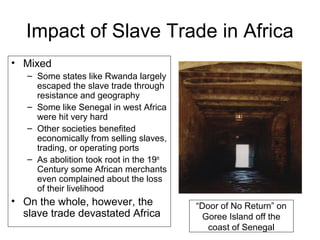
Impact of Slave Trade in Africa
• Mixed
– Some states like Rwanda largely
escaped the slave trade through
resistance and geography
– Some like Senegal in west Africa
were hit very hard
– Other societies benefited
economically from selling slaves,
trading, or operating ports
– As abolition took root in the 19th
Century some African merchants
even complained about the loss
of their livelihood
• On the whole, however, the
slave trade devastated Africa
“Door of No Return” on
Goree Island off the
coast of Senegal
Impact of Slave Trade in Africa
• The Atlantic Slave Trade
deprived Africa of about
16 million people and the
continuing Islamic slave
trade consumed another
several million
• Overall the African
population rose thanks
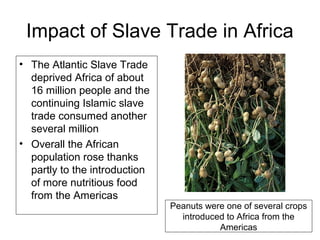
partly to the introduction
of more nutritious food
from the Americas
Peanuts were one of several crops
introduced to Africa from the
Americas
Impact of Slave Trade in Africa
• The slave trade distorted African sex ratios
– Approximately 2/3 of all exported slaves were male
• Slavers preferred young men between the ages
of 14 and 35 to maximize investment potential
and be suitable for hard labor
• The sexual imbalance in some parts of Africa
such as Angola encouraged polygamy and
caused women to take on duties that had
previously been the responsibility of men
Impact of Slave Trade in Africa
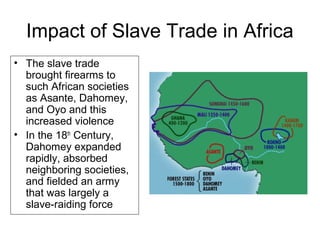
• The slave trade
brought firearms to
such African societies
as Asante, Dahomey,
and Oyo and this
increased violence
• In the 18th
Century,
Dahomey expanded
rapidly, absorbed
neighboring societies,
and fielded an army
that was largely a
slave-raiding force
African Diaspora
• Obviously, the main contribution slaves brought
to the western hemisphere was an incredible
amount of labor, without which the prosperous
new societies could not have developed
• However they brought other contributions as
well:
– Slaves built hybrid cultural traditions made up of
African, European, and American elements
– Influenced language by creating tongues that drew on
several African and European languages
African Diaspora
• Impacted on cuisine by
introducing African foods to
Caribbean and American
societies
– For example, combined African
okra with European-style sautéed
vegetables and American shellfish
to make gumbo
• Introduced rice cultivation to
tropical and subtropical regions
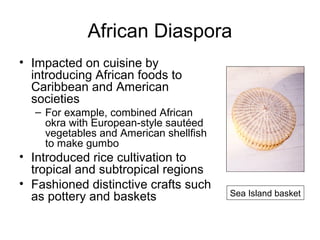
• Fashioned distinctive crafts such
as pottery and baskets Sea Island basket
African Diaspora
• Many slaves were either Christians when they
left Africa or converted to Christianity after their
arrival in the western hemisphere
• Their Christianity was not exactly like European
Christianity and made considerable room for
African traditions
– Associated African deities with Christian saints
– Relied heavily on African rituals such as drumming,
dancing, and sacrificing animals
– Preserved their belief in spirits and supernatural
powers and made use of magic, sorcery, witchcraft,
and spirit possession
Australia’s Slave Trade
“Blackbirding”
What was ‘blackbirding’ and why
did it come into existence?
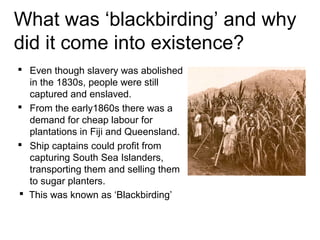
 Even though slavery was abolished
in the 1830s, people were still
captured and enslaved.
 From the early1860s there was a
demand for cheap labour for
plantations in Fiji and Queensland.
 Ship captains could profit from
capturing South Sea Islanders,
transporting them and selling them
to sugar planters.
 This was known as ‘Blackbirding’
How were Islanders kidnapped?
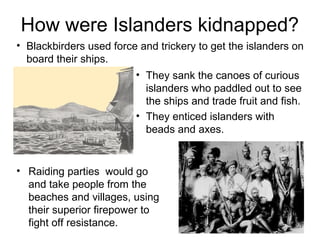
• They sank the canoes of curious
islanders who paddled out to see
the ships and trade fruit and fish.
• They enticed islanders with
beads and axes.
• Blackbirders used force and trickery to get the islanders on
board their ships.
• Raiding parties would go
and take people from the
beaches and villages, using
their superior firepower to
fight off resistance.
Dangers
of the
voyage
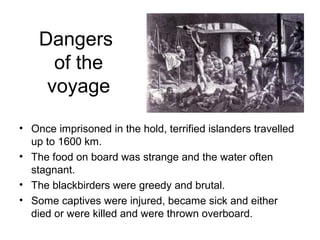
• Once imprisoned in the hold, terrified islanders travelled
up to 1600 km.
• The food on board was strange and the water often
stagnant.
• The blackbirders were greedy and brutal.
• Some captives were injured, became sick and either
died or were killed and were thrown overboard.
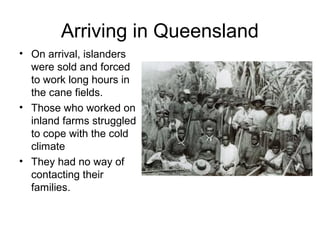
Arriving in Queensland
• On arrival, islanders
were sold and forced
to work long hours in
the cane fields.
• Those who worked on
inland farms struggled
to cope with the cold
climate
• They had no way of
contacting their
families.
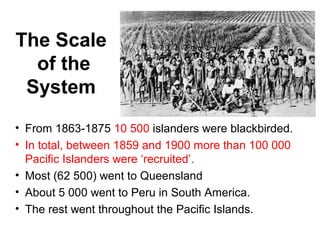
The Scale
of the
System
• From 1863-1875 10 500 islanders were blackbirded.
• In total, between 1859 and 1900 more than 100 000
Pacific Islanders were ‘recruited’.
• Most (62 500) went to Queensland
• About 5 000 went to Peru in South America.
• The rest went throughout the Pacific Islands.
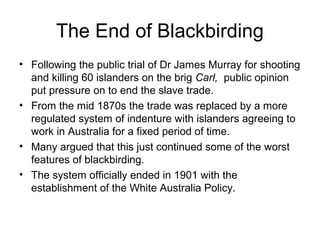
The End of Blackbirding
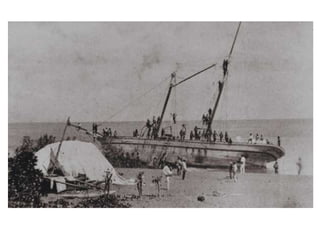
• Following the public trial of Dr James Murray for shooting
and killing 60 islanders on the brig Carl, public opinion
put pressure on to end the slave trade.
• From the mid 1870s the trade was replaced by a more
regulated system of indenture with islanders agreeing to
work in Australia for a fixed period of time.
• Many argued that this just continued some of the worst
features of blackbirding.
• The system officially ended in 1901 with the
establishment of the White Australia Policy.
Trans atlantic slave trade + blackbirding

Trans atlantic slave trade + blackbirding

  • 1.
    Atlantic Slave Trade Theme:Slavery as a product of globalization, its effects on Africa and the Americas, and the impact of Enlightenment ideas on eventual abolition
  • 2.
    History of AfricanSlavery • Slavery has existed since antiquity • It became common in Africa after the Bantu migrations spread agriculture to all parts of the continent
  • 3.
    History of AfricanSlavery • Most slaves in Africa were war captives • Once enslaved, an individual had no personal or civil rights • Owners could order slaves to do any kind of work, punish them, and sell them as chattel • Most slaves worked as cultivators
  • 4.
    History of AfricanSlavery • African law did not recognize individual land ownership so wealth and power in Africa came from not owning land but by controlling the human labor that made it productive • Slaves were a form of investment and a sign of wealth
  • 5.
    Islamic Slave Trade •After the 8th Century, Muslim merchants from north Africa & the Middle- East sought African slaves for trade in the Mediterranean basin, southwest Asia, India, and as far away as southeast Asia and China • The Islamic slave trade lasted into the 20th Century and resulted in the deportation of as many as 10 million Africans
  • 6.
    European Slave Trade •By the time Europeans arrived in Sub-Saharan Africa in the 15th and 16th Centuries, the slave trade was a well-established feature in African society • A detailed system for capturing, selling, and distributing slaves had been in place for over 500 years • With the arrival of the Europeans and the demand for slaves in the Americas, the slave trade expanded dramatically
  • 7.
    Portuguese Slave Traders •Portuguese began capturing slaves in Africa in the 15th Century, but quickly learned it was easier to buy them • In Europe, slaves usually worked as miners, porters, or domestic servants since free peasants and serfs cultivated the land Europeans and Africans Meet to Trade
  • 8.
    Portuguese Slave Trade •When the Portuguese discovered the Azores, Madeiras, Cape Verde Islands, and Sao Tome in the 15th Century they were all uninhabited • The Portuguese population was too small to provide a large number of colonists • The sugar plantations required a large labor force • Slaves filled this demand Sao Tome Cape Verde
  • 9.
    Slave Trade andSugar • By the 1520s some 2,000 slaves per year were shipped to Sao Tome • Some time thereafter, Portuguese entrepreneurs extended the use of slave labor to South America • Eventually Brazil would become the wealthiest of the sugar-producing lands in the western hemisphere
  • 10.
    Slavery Expands • Asdisease reduced the native populations in Spanish conquered territories, the Spanish began relying on imported slaves from Africa • In 1518, the first shipment of slaves went directly from west Africa to the Caribbean where the slaves worked on sugar plantations • By the 1520s, the Spanish had introduced slaves to Mexico, Peru, and Central America where they worked as cultivators and miners • By the early 17th Century, the British had introduced slaves to North America
  • 11.
    Triangular Trade • Thedemand for labor in the western hemisphere stimulated a profitable three- legged trading pattern – European manufactured goods, namely cloth and metal wares, especially firearms, went to Africa where they were exchanged for slaves – The slaves were then shipped to the Caribbean and Americas where they were sold for cash or sometimes bartered for sugar or molasses – Then the ships returned to Europe loaded with American products
  • 12.
  • 13.
    “Molasses to rumto slaves Who sail the ships back to Boston Ladened with gold, see it gleam Whose fortunes are made in the triangle trade Hail slavery, the New England dream!” – Song from the play 1776
  • 14.
    Capture • The originalcapture of slaves was almost always violent • As European demand grew, African chieftains organized raiding parties to seize individuals from neighboring societies • Others launched wars specifically for the purpose of capturing slaves
  • 15.
    Middle Passage • Followingcapture, slaves were force- marched to holding forts along the west African coast before being loaded on ships • The trans-Atlantic journey was called the “Middle Passage” • The ships were filthy, hot, and crowded
  • 16.
    Middle Passage • Mostships provided slaves with enough room to sit upright, but not enough to stand • Others forced slaves to lie in chains with barely 20 inches space between them
  • 17.
    Middle Passage • Crewsattempted to keep as many slaves alive as possible to maximize profits, but treatment was extremely cruel – Some slaves refused to eat and crew members used tools to pry open their mouths and force-feed them – Sick slaves were cast overboard to prevent infection from spreading • During the early days of the slave trade, mortality rates were as high as 50% • As the volume of trade increased and conditions improved (bigger ships, more water, better nourishment and facilities), mortality eventually declined to about 5%
  • 18.
    Middle Passage • Thetime a ship took to make the Middle Passage depended upon several factors. • With good conditions and few delays, a 17th Century Portuguese slave ship typically took 30 to 50 days to sail from Angola to Brazil. • British, French, and Dutch ships transporting slaves between Guinea and their Caribbean island possessions took 60 to 90 days. • As larger merchant ships were introduced, these times reduced somewhat
  • 19.
    Arrival • When theslave ship docked, the slaves would be taken off the ship and placed in a pen • There they would be washed and their skin covered with grease, or sometimes tar, to make them look healthy (and therefore more valuable) • They would also be branded with a hot iron to identify them as slaves
  • 20.
    Auctions • Slaves weresold at auctions • Buyers physically inspected the slaves, including their teeth, as an indication of the slave’s age • Auctioneers had slaves perform various acts to demonstrate their physical abilities
  • 21.
    Auctions “We were notmany days in the merchant’s custody, before we were sold after their usual manner... On a signal given, (as the beat of a drum), buyers rush at once into the yard where the slaves are confined, and make a choice of that parcel they like best. The noise and clamor with which this is attended, and the eagerness visible in the countenances of the buyers, serve not a little to increase the apprehension of terrified Africans... In this manner, without scruple, are relations and friends separated, most of them never to see each other again. I remember in the vessel in which I was brought over... there were several brothers who, in the sale, were sold in different lots; and it was very moving on this occasion, to see and hear their cries in parting.” – Olaudah Equiano, The Interesting Narrative of Olaudah Equiano
  • 22.
    Volume of theSlave Trade • Late 15th - 16th Century… 2,000 Africans exported each year • 17th Century… 20,000 per year • 18th Century… 55,000 per year – 1780s… 88,000 per year • All told, 12 million Africans were transported to the western hemisphere via the Atlantic Slave Trade • Another 4 million died resisting capture or during captivity before arriving at their destination
  • 23.
    Plantations • In additionto sugar, plantations produced crops like tobacco, indigo, and cotton • All were designed to export commercial crops for profit • Relied almost exclusively on large amounts of slave labor supervised by small numbers of European or Euro- American managers Brazilian sugar mill in the 1830s
  • 24.
    Slavery in theCaribbean and South America • Disease, brutal working conditions, and poor sanitation and nutrition resulted in high mortality rates • Owners imported mainly male slaves and allowed few to establish families which resulted in low reproduction • To keep up the needed numbers, plantation owners imported a steady stream of slaves – Of all slaves delivered to the western hemisphere, about 50% went to Caribbean destinations – About 33% went to Brazil – Smaller numbers went elsewhere in South and Central America
  • 25.
    Slavery in NorthAmerica • Diseases took less of a toll in North America and living conditions were usually less brutal • Plantation owners imported large numbers of female slaves and encouraged their slaves to form families and bear children – Only about 5% of slaves delivered to the western hemisphere went to North America
  • 27.
    Forms of Resistance •Work slowly • Sabotage • Runaway – “Maroons” gathered together and built self-governing communities • Revolt – Slaves outnumbered the owners and supervisors so revolt was always a threat – While causing much destruction, revolts were usually able to be suppressed because the owners had access to arms, horses, and military forces
  • 28.
    Saint-Dominique • The onlyrevolt to successfully abolish slavery occurred on the French sugar colony of Saint Dominique in 1793 • The slaves declared independence from France, renamed the country Haiti, and established a self- governing republic in 1804 Francois-Dominique Toussaint was one of the military leaders of the Saint-Dominique revolt
  • 29.
    Abolitionists Key Figures wholed pushed for the abolition of slavery included: Former Slaves – Olaudah Equiano Politicians – William Wilberforce Religious Leaders – John Wesley Revolutionaries – Simon Bolivar
  • 30.
    Former Slaves: OlaudahEquiano • Equiano was originally from Benin and was captured by slave raiders when he was 10 • Spent 21 years as a slave and was able to save up enough money to buy his freedom • In 1789 he published The Interesting Narrative of Olaudah Equiano, or Gustavus Vassa, the African, written by Himself • Sold the book throughout Britain, undertaking lecture tours and actively campaigning to abolish the slave trade
  • 31.
    Politicians: William Wilberforce •English philanthropist elected to Parliament in 1780 • Delivered a stirring abolitionist speech to the House of Commons in 1789 • Repeatedly introduced the Abolition Bill until it passed in 1807
  • 32.
    Religious Leaders: JohnWesley • Founder of the Methodist Church • Published Thoughts Upon Slavery in 1774 • On his deathbed he was reading Equiano’s narrative
  • 33.
    Revolutionaries: Simon Bolivar •Inspired by George Washington and Enlightenment ideas, Bolivar took up arms against Spanish rule in 1811 • Freed slaves who joined his forces • Provided constitutional guarantees of freedom for all residents of Gran Columbia (Venezuela, Columbia, and Ecuador)
  • 34.
    Timeline for Abolitionof the Slave Trade • 1803: Denmark abolishes slave trade. • 1807: Britain abolishes slave trade. • 1807: U.S. passes legislation banning slave trade, to take effect 1808. • 1810: British negotiate an agreement with Portugal calling for gradual abolition of slave trade in the South Atlantic. • 1815: At the Congress of Vienna, the British pressure Spain, Portugal, France and the Netherlands to agree to abolish the slave trade (though Spain and Portugal are permitted a few years of continued slaving to replenish labor supplies). • 1817: Great Britain and Spain sign a treaty prohibiting the slave trade: Spain agrees to end the slave trade north of the equator immediately, and south of the equator in 1820. British naval vessels are given right to search suspected slavers. Still, loopholes in the treaty undercut its goals and the slave trade continues strongly until 1830.
  • 35.
    Slavery Continues • Abolishingthe slave trade did not end slavery • British ships patrolled the west coast of Africa to halt illegal trade • The last documented ship that carried slaves across the Atlantic arrived in Cuba in 1867
  • 36.
    Timeline for Abolitionof Slavery • 1813: Gradual emancipation adopted in Argentina. • 1814: Gradual emancipation begins in Colombia. • 1823: Slavery abolished in Chile. • 1824: Slavery abolished in Central America. • 1829: Slavery abolished in Mexico. • 1831: Slavery abolished in Bolivia. • 1833: Abolition of Slavery Act passed in Britain. • 1842: Slavery abolished in Uruguay. • 1848: Slavery abolished in all French & Danish colonies. • 1851: Slavery abolished in Ecuador. • 1854: Slavery abolished in Peru and Venezuela. • 1863: Emancipation Proclamation issued in the U.S. • 1863: Slavery abolished in all Dutch colonies. • 1865: Slavery abolished in the U.S. as a result of the end of the Civil War. • 1871: Gradual emancipation initiated in Brazil. Abraham Lincoln, the President who abolished slavery in USA
  • 37.
    Impact of SlaveTrade in Africa • Mixed – Some states like Rwanda largely escaped the slave trade through resistance and geography – Some like Senegal in west Africa were hit very hard – Other societies benefited economically from selling slaves, trading, or operating ports – As abolition took root in the 19th Century some African merchants even complained about the loss of their livelihood • On the whole, however, the slave trade devastated Africa “Door of No Return” on Goree Island off the coast of Senegal
  • 38.
    Impact of SlaveTrade in Africa • The Atlantic Slave Trade deprived Africa of about 16 million people and the continuing Islamic slave trade consumed another several million • Overall the African population rose thanks partly to the introduction of more nutritious food from the Americas Peanuts were one of several crops introduced to Africa from the Americas
  • 39.
    Impact of SlaveTrade in Africa • The slave trade distorted African sex ratios – Approximately 2/3 of all exported slaves were male • Slavers preferred young men between the ages of 14 and 35 to maximize investment potential and be suitable for hard labor • The sexual imbalance in some parts of Africa such as Angola encouraged polygamy and caused women to take on duties that had previously been the responsibility of men
  • 40.
    Impact of SlaveTrade in Africa • The slave trade brought firearms to such African societies as Asante, Dahomey, and Oyo and this increased violence • In the 18th Century, Dahomey expanded rapidly, absorbed neighboring societies, and fielded an army that was largely a slave-raiding force
  • 41.
    African Diaspora • Obviously,the main contribution slaves brought to the western hemisphere was an incredible amount of labor, without which the prosperous new societies could not have developed • However they brought other contributions as well: – Slaves built hybrid cultural traditions made up of African, European, and American elements – Influenced language by creating tongues that drew on several African and European languages
  • 42.
    African Diaspora • Impactedon cuisine by introducing African foods to Caribbean and American societies – For example, combined African okra with European-style sautéed vegetables and American shellfish to make gumbo • Introduced rice cultivation to tropical and subtropical regions • Fashioned distinctive crafts such as pottery and baskets Sea Island basket
  • 43.
    African Diaspora • Manyslaves were either Christians when they left Africa or converted to Christianity after their arrival in the western hemisphere • Their Christianity was not exactly like European Christianity and made considerable room for African traditions – Associated African deities with Christian saints – Relied heavily on African rituals such as drumming, dancing, and sacrificing animals – Preserved their belief in spirits and supernatural powers and made use of magic, sorcery, witchcraft, and spirit possession
  • 44.
  • 45.
    What was ‘blackbirding’and why did it come into existence?  Even though slavery was abolished in the 1830s, people were still captured and enslaved.  From the early1860s there was a demand for cheap labour for plantations in Fiji and Queensland.  Ship captains could profit from capturing South Sea Islanders, transporting them and selling them to sugar planters.  This was known as ‘Blackbirding’
  • 46.
    How were Islanderskidnapped? • They sank the canoes of curious islanders who paddled out to see the ships and trade fruit and fish. • They enticed islanders with beads and axes. • Blackbirders used force and trickery to get the islanders on board their ships. • Raiding parties would go and take people from the beaches and villages, using their superior firepower to fight off resistance.
  • 47.
    Dangers of the voyage • Onceimprisoned in the hold, terrified islanders travelled up to 1600 km. • The food on board was strange and the water often stagnant. • The blackbirders were greedy and brutal. • Some captives were injured, became sick and either died or were killed and were thrown overboard.
  • 48.
    Arriving in Queensland •On arrival, islanders were sold and forced to work long hours in the cane fields. • Those who worked on inland farms struggled to cope with the cold climate • They had no way of contacting their families.
  • 49.
    The Scale of the System •From 1863-1875 10 500 islanders were blackbirded. • In total, between 1859 and 1900 more than 100 000 Pacific Islanders were ‘recruited’. • Most (62 500) went to Queensland • About 5 000 went to Peru in South America. • The rest went throughout the Pacific Islands.
  • 50.
    The End ofBlackbirding • Following the public trial of Dr James Murray for shooting and killing 60 islanders on the brig Carl, public opinion put pressure on to end the slave trade. • From the mid 1870s the trade was replaced by a more regulated system of indenture with islanders agreeing to work in Australia for a fixed period of time. • Many argued that this just continued some of the worst features of blackbirding. • The system officially ended in 1901 with the establishment of the White Australia Policy.