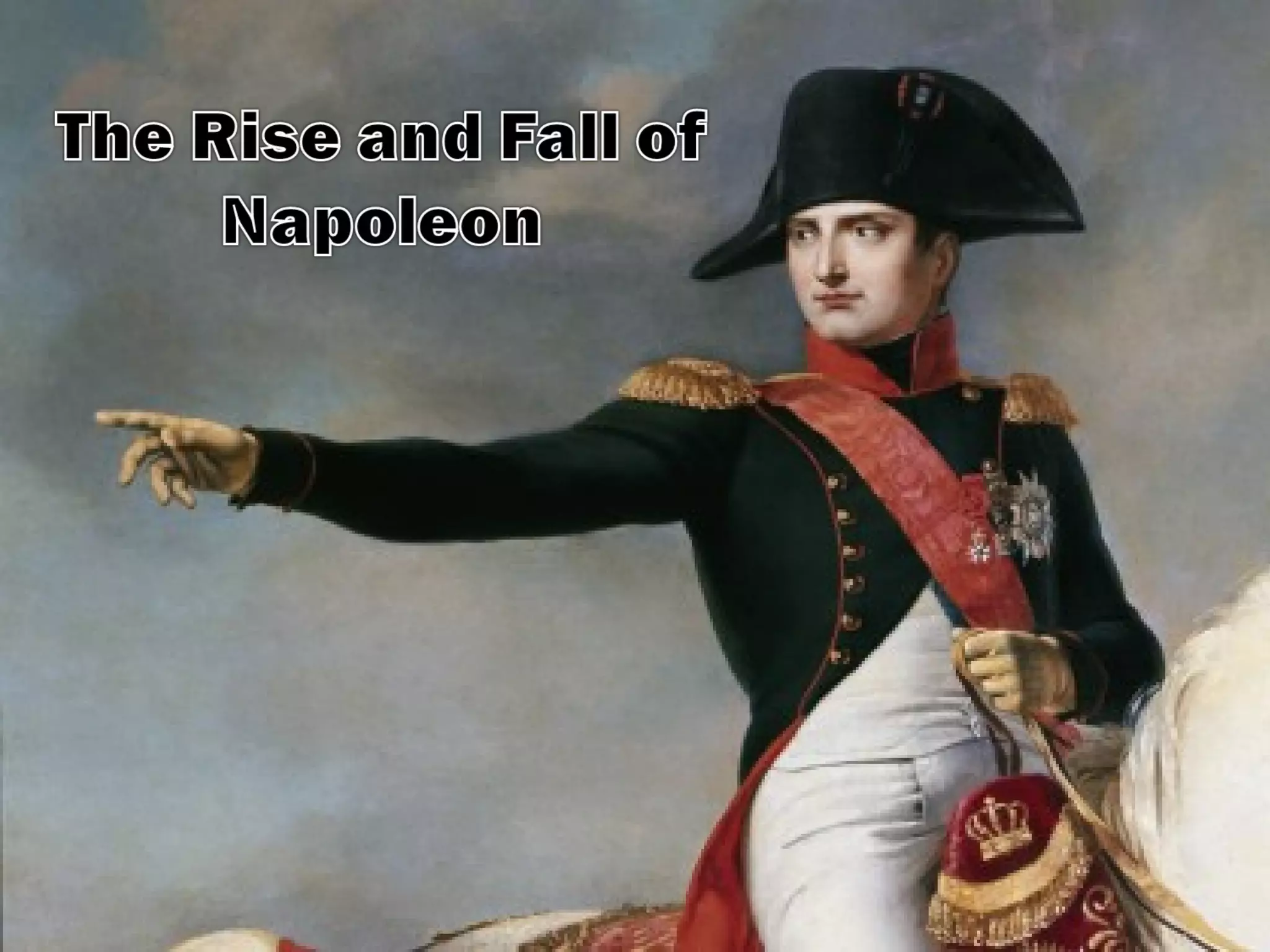
NapoleonNapoleonNapoleonNapoleon
1. A brilliant military leader, Napoleon
became a general at the age of 24.
1. A brilliant military leader, Napoleon
became a general at the age of 24.
2. In 1799, the popular general took over
the government in a coup d’etat and
named himself first consul.
2. In 1799, the popular general took over
the government in a coup d’etat and
named himself first consul.
3. In 1802 he became consul for life
4. In 1804 he crowned himself Emperor
NapoleonNapoleon
““Napoleon CrossingNapoleon Crossing
the Alps”the Alps”
Jacques-LouisJacques-Louis
DavidDavid
18011801
“France has more need of me than I have need of France.”
NapoleonNapoleon
““Napoleon CrossingNapoleon Crossing
the Alps”the Alps”
Jacques-LouisJacques-Louis
DavidDavid
18011801
“France has more need of me than I have need of France.”
NapoleonNapoleon
““Napoleon CrossingNapoleon Crossing
the Alps”the Alps”
Jacques-LouisJacques-Louis
DavidDavid
18011801
Film ClipFilm Clip
Napoleon Crossing the AlpsNapoleon Crossing the Alps
Paul Delaroche, 1850Paul Delaroche, 1850 Jacques-Louis David, 1801Jacques-Louis David, 1801
Do Now:
Answer the two questions on the worksheet
Napoleon BonaparteNapoleon Bonaparte
Positive Impact Negative Impact
Think about this…
Is Napoleon a Hero or a Tyrant?
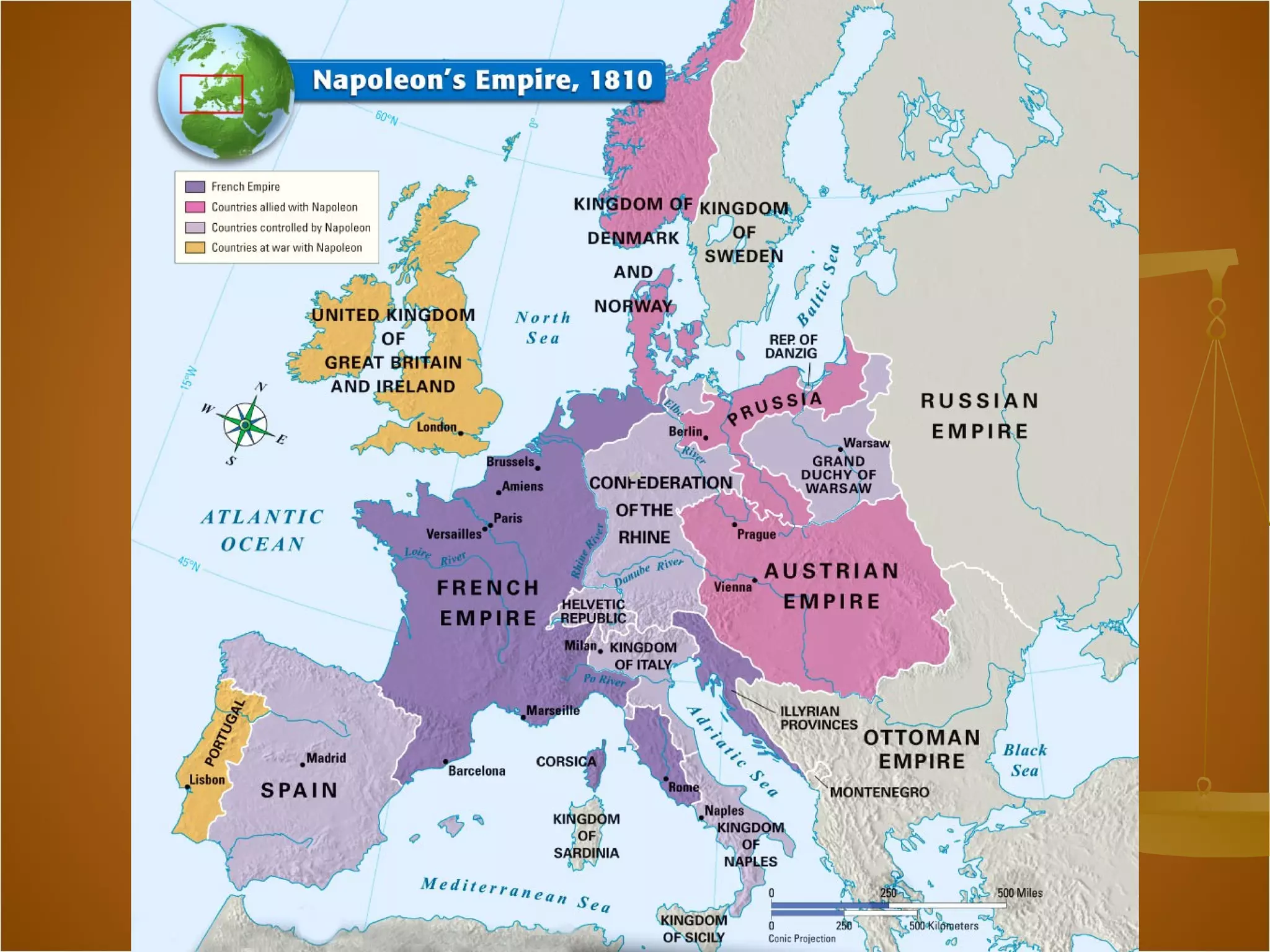
Napoleon’s EmpireNapoleon’s Empire
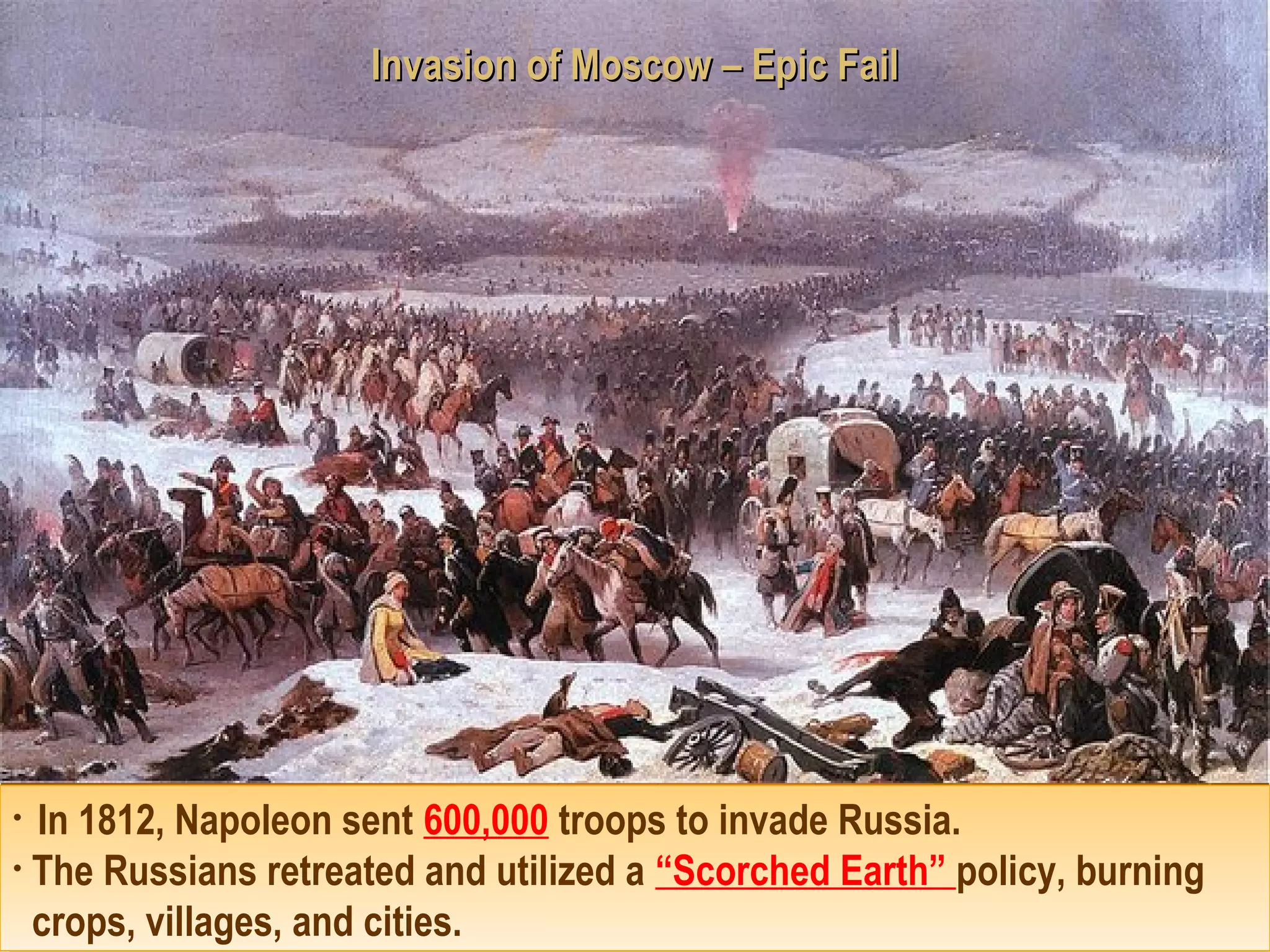
How does this Painting portray the condition of the French Army in Russia?How does this Painting portray the condition of the French Army in Russia?
Invasion of Moscow – Epic FailInvasion of Moscow – Epic Fail
• In 1812, Napoleon sent 600,000 troops to invade Russia.
• The Russians retreated and utilized a “Scorched Earth” policy, burning
crops, villages, and cities.
• In 1812, Napoleon sent 600,000 troops to invade Russia.
• The Russians retreated and utilized a “Scorched Earth” policy, burning
crops, villages, and cities.
• When the harsh winter arrived, the French Troops had little food and no shelter.
• The French were forced to retreat 1,000 miles. Only 100,000 survived.
• When the harsh winter arrived, the French Troops had little food and no shelter.
• The French were forced to retreat 1,000 miles. Only 100,000 survived.
How does the artist portray
Napoleon? Explain why?
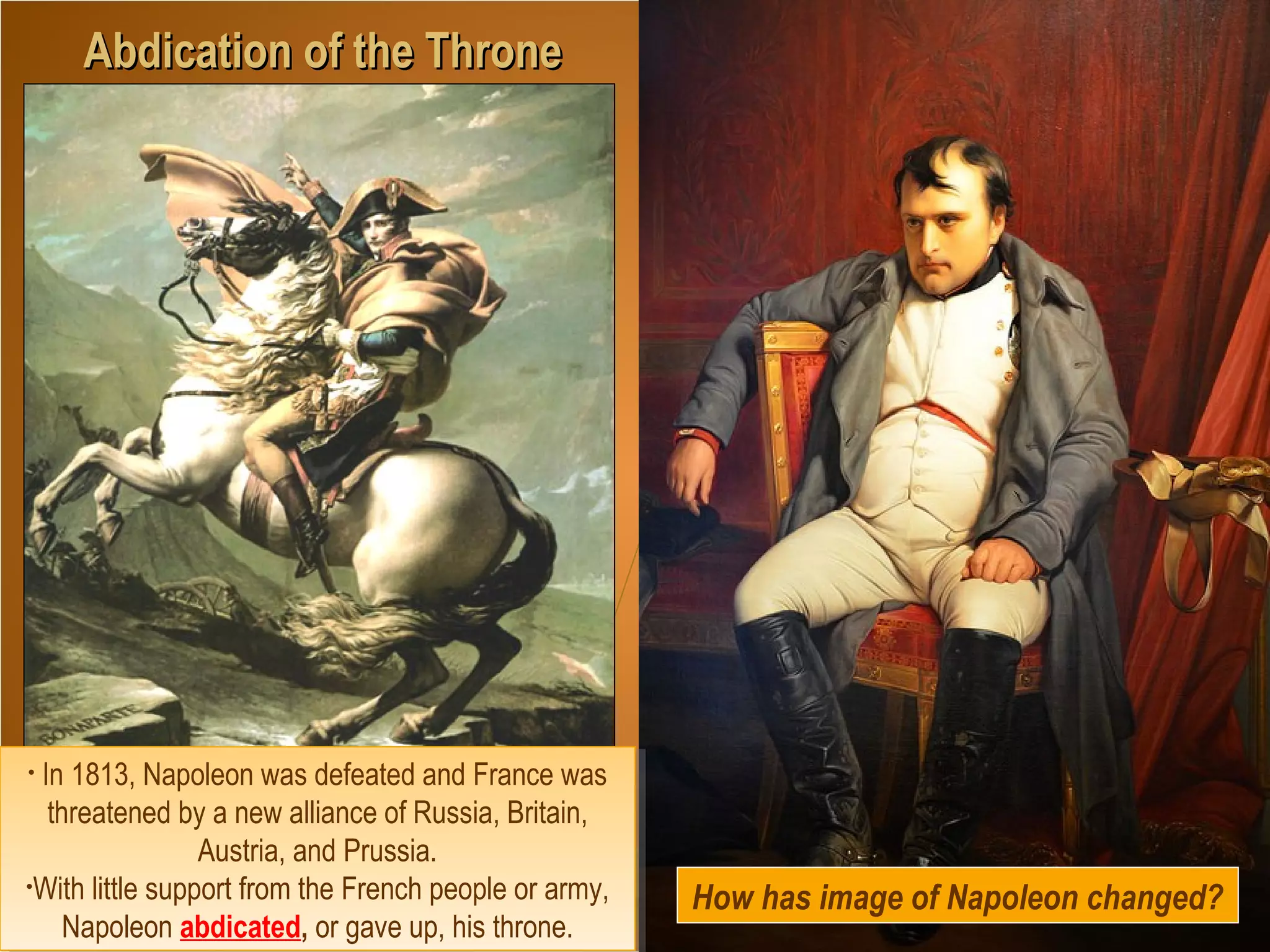
Abdication of the ThroneAbdication of the Throne
• In 1813, Napoleon was defeated and France was
threatened by a new alliance of Russia, Britain,
Austria, and Prussia.
•With little support from the French people or army,
Napoleon abdicated, or gave up, his throne.
• In 1813, Napoleon was defeated and France was
threatened by a new alliance of Russia, Britain,
Austria, and Prussia.
•With little support from the French people or army,
Napoleon abdicated, or gave up, his throne.
How has image of Napoleon changed?
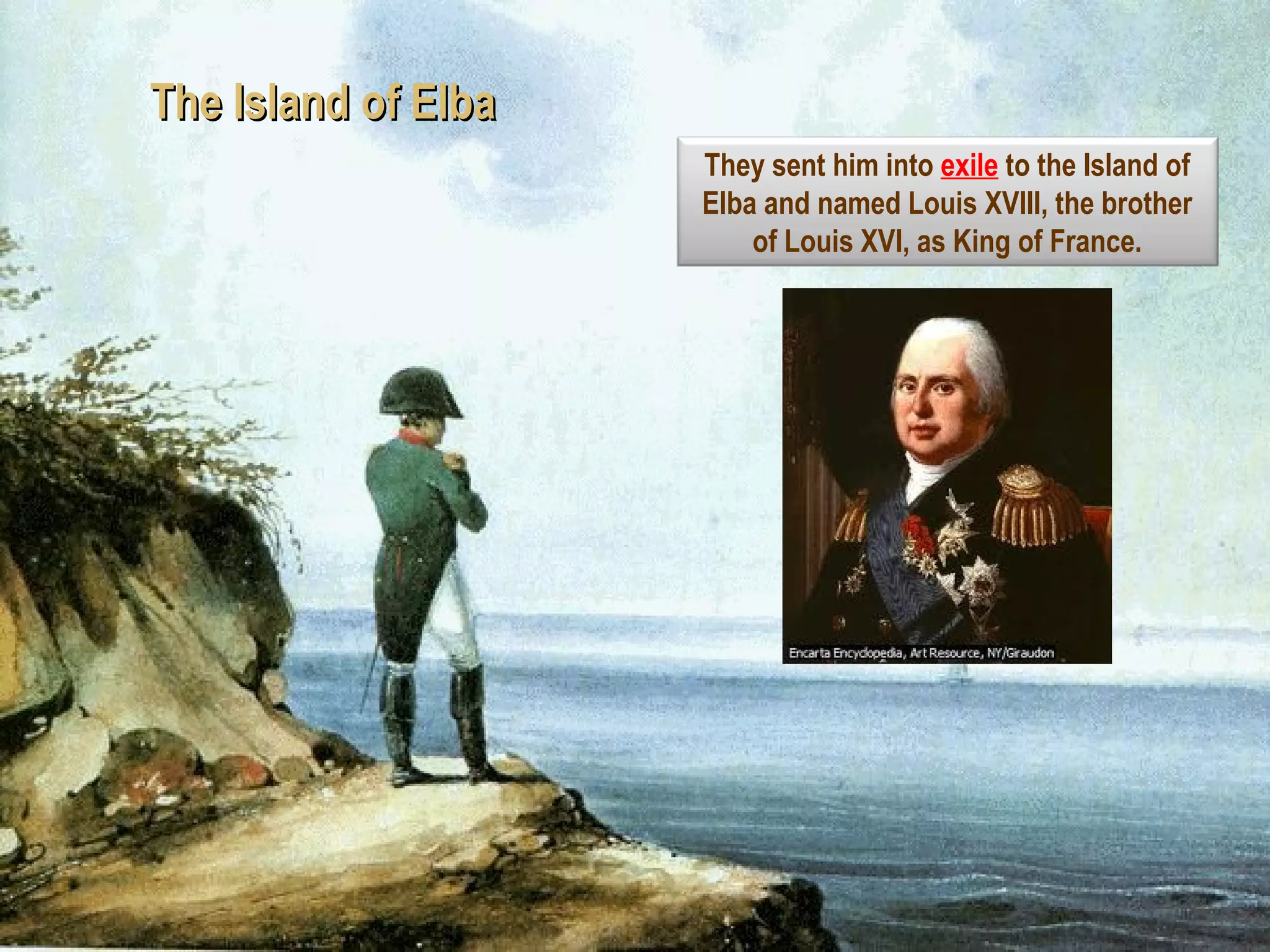
The Island of ElbaThe Island of Elba
They sent him into exile to the Island of
Elba and named Louis XVIII, the brother
of Louis XVI, as King of France.
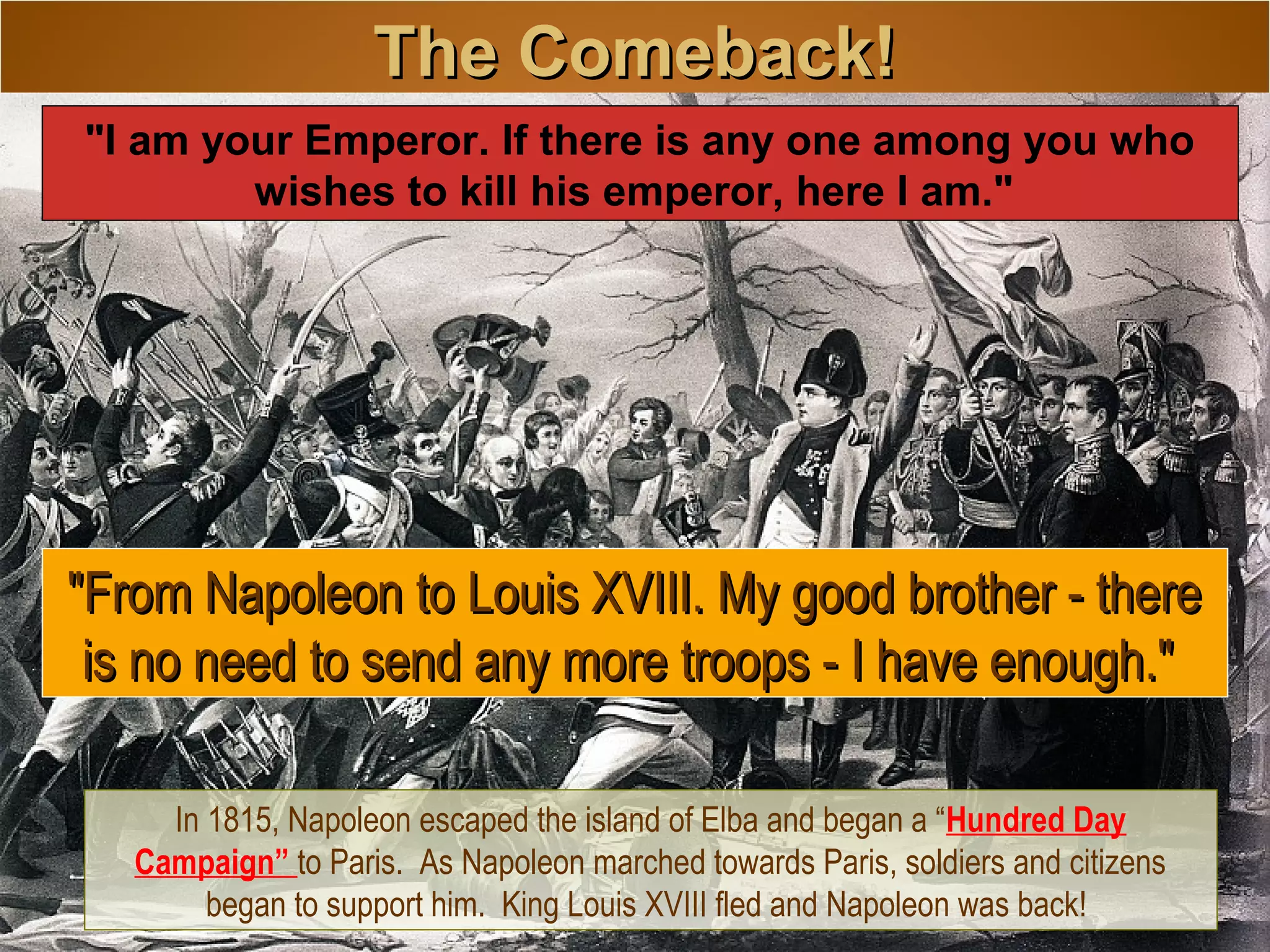
The Comeback!The Comeback!
In 1815, Napoleon escaped the island of Elba and began a “Hundred Day
Campaign” to Paris. As Napoleon marched towards Paris, soldiers and citizens
began to support him. King Louis XVIII fled and Napoleon was back!
"From Napoleon to Louis XVIII. My good brother - there"From Napoleon to Louis XVIII. My good brother - there
is no need to send any more troops - I have enough."is no need to send any more troops - I have enough."
"I am your Emperor. If there is any one among you who
wishes to kill his emperor, here I am."
Battle of WaterlooBattle of Waterloo
June 18th
, 1815, Napoleon was defeated
at the Battle of Waterloo by an allied
force of British and Prussian troops.
June 18th
, 1815, Napoleon was defeated
at the Battle of Waterloo by an allied
force of British and Prussian troops.
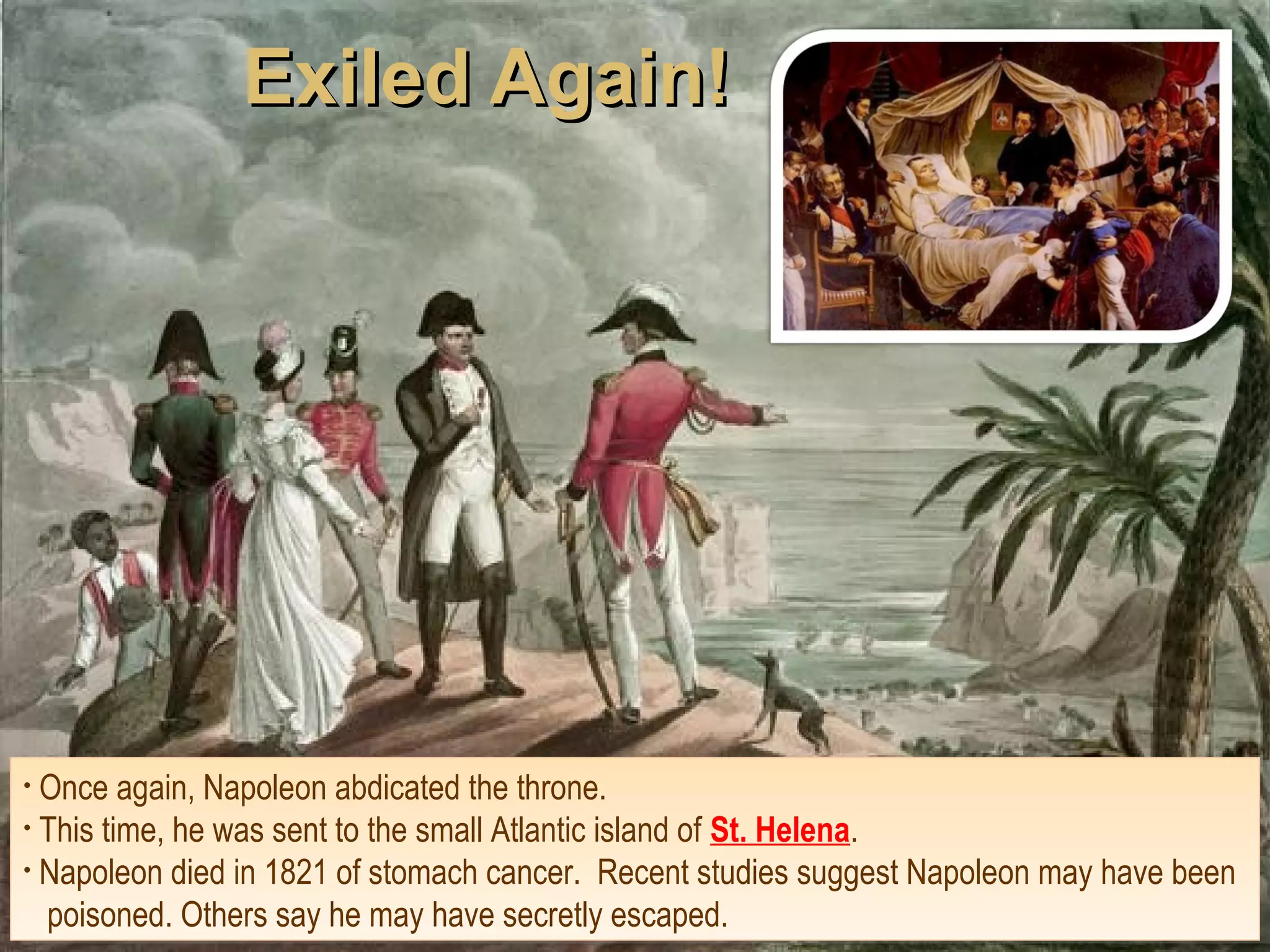
Exiled Again!Exiled Again!
• Once again, Napoleon abdicated the throne.
• This time, he was sent to the small Atlantic island of St. Helena.
• Napoleon died in 1821 of stomach cancer. Recent studies suggest Napoleon may have been
poisoned. Others say he may have secretly escaped.
• Once again, Napoleon abdicated the throne.
• This time, he was sent to the small Atlantic island of St. Helena.
• Napoleon died in 1821 of stomach cancer. Recent studies suggest Napoleon may have been
poisoned. Others say he may have secretly escaped.
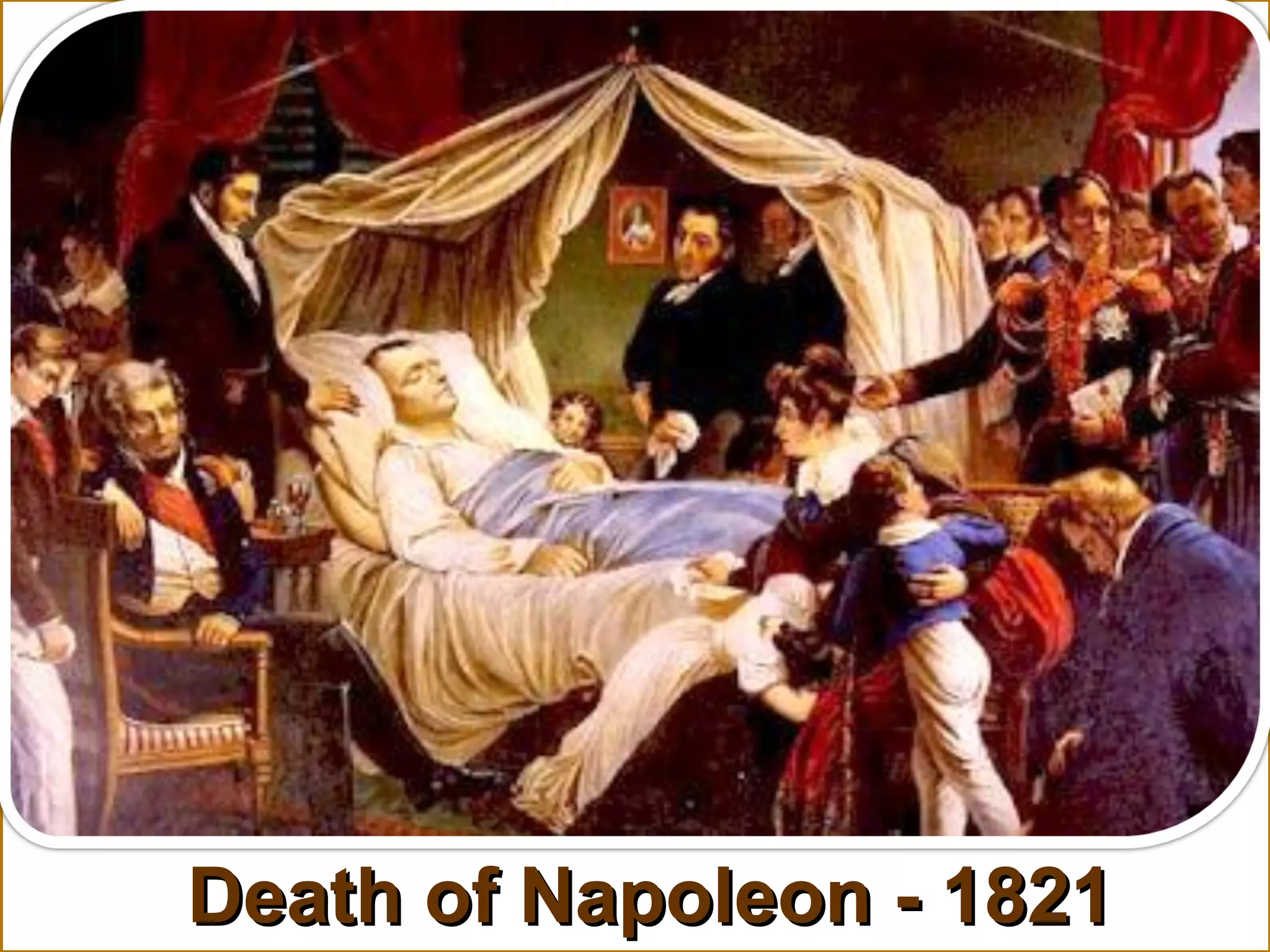
Death of Napoleon - 1821Death of Napoleon - 1821
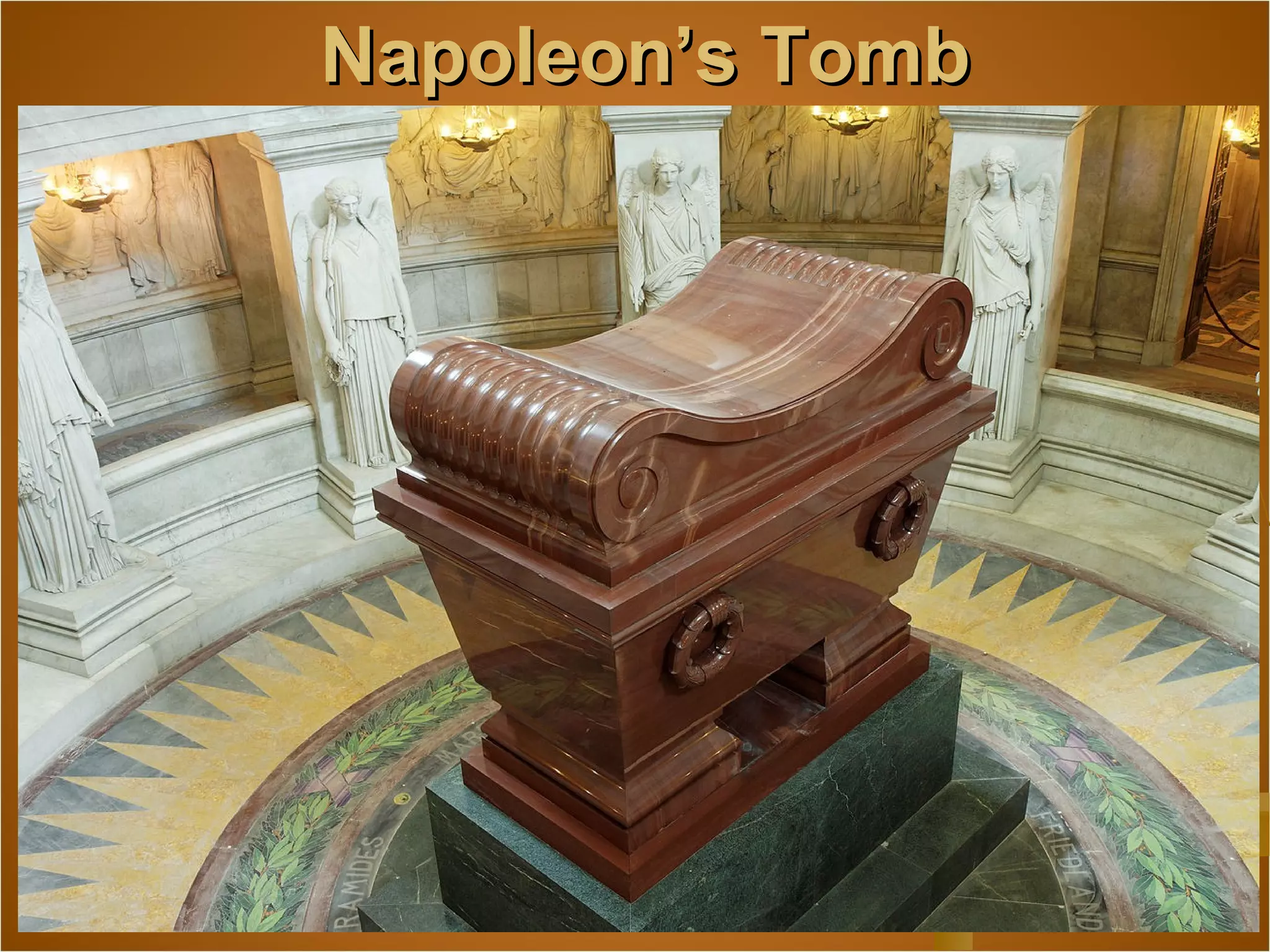
Napoleon’s TombNapoleon’s Tomb
NAPOLEONNAPOLEON
Line 1 - Name of ruler
Line 2 - “Ruler/Leader of.....”
Line 3 - Three traits that describe the ruler
Line 4 - “Who has helped to” (2 good things)
Line 5 - “But also ”(2 bad things)
Line 6 - “Who will be remembered because of...”
Create a Bio- Poem
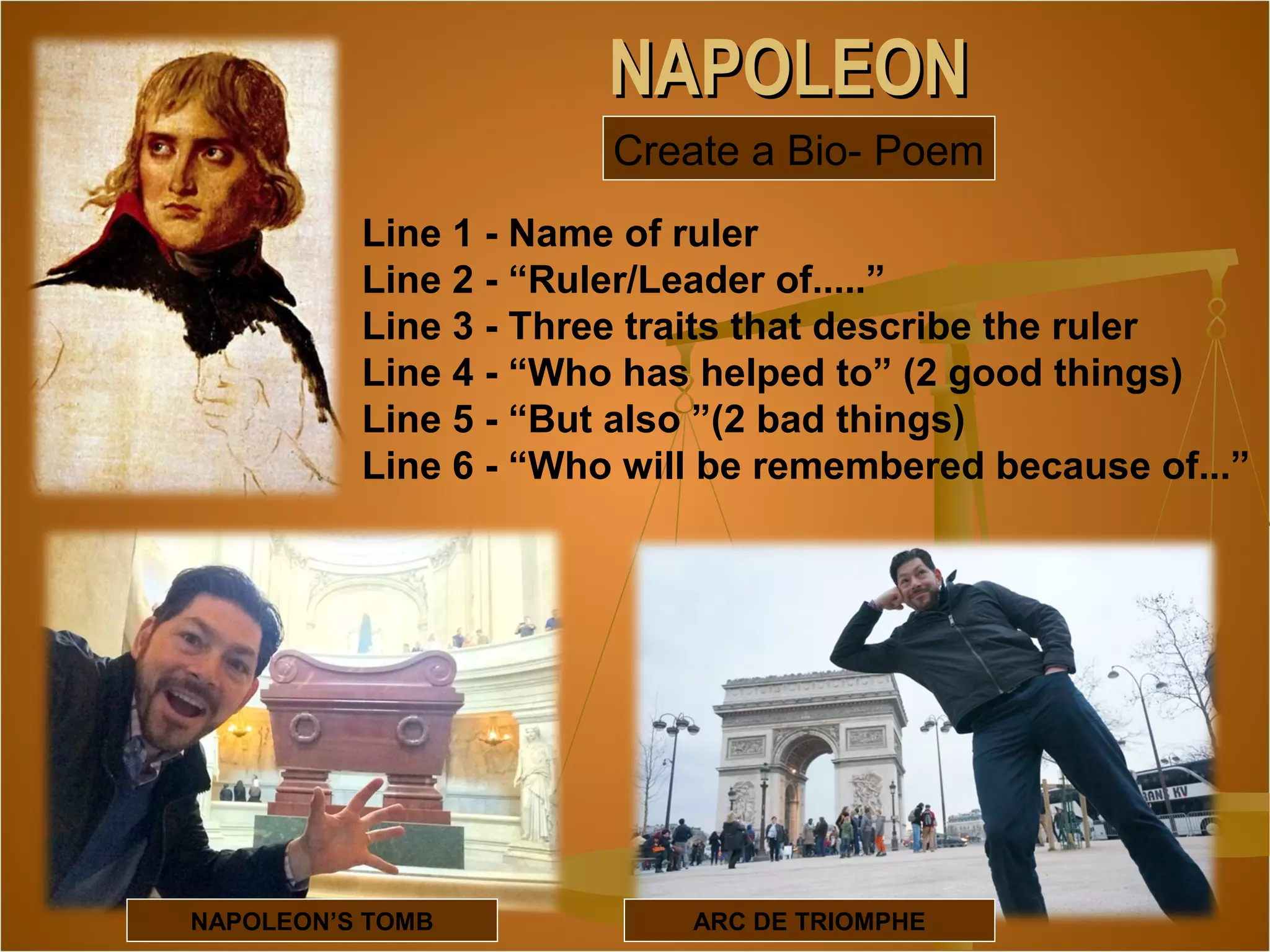
NAPOLEON’S TOMB ARC DE TRIOMPHE
LegacyLegacy
“I closed the gulf of anarchy and brought order out of
chaos. I rewarded merit regardless of birth or wealth,
wherever I found it. I abolished feudalism and restored
equality to all regardless of religion and before the law. I
fought the decrepit monarchies of the Old Regime
because the alternative was the destruction of all this. I
purified the Revolution.”
Did Napoleon do more to preserve the legacy of the
French Revolution or to destroy it?
Is he a Hero or a Tyrant?
"So he too is nothing more than an ordinary man. Now he
will also trample all human rights underfoot, and only
pander to his ambition; he will place himself above
everyone else and become a tyrant!"
- Ludwig von Beethoven
Following the defeat of Napoleon, the major European powers of the
day met in Vienna, Austria to establish a plan for peace and resolve
other problems that were created by Napoleon.
This was called The Congress of Vienna. The major powers involved
were Austria, Prussia, Russia, Britain, and France.
Congress of Vienna
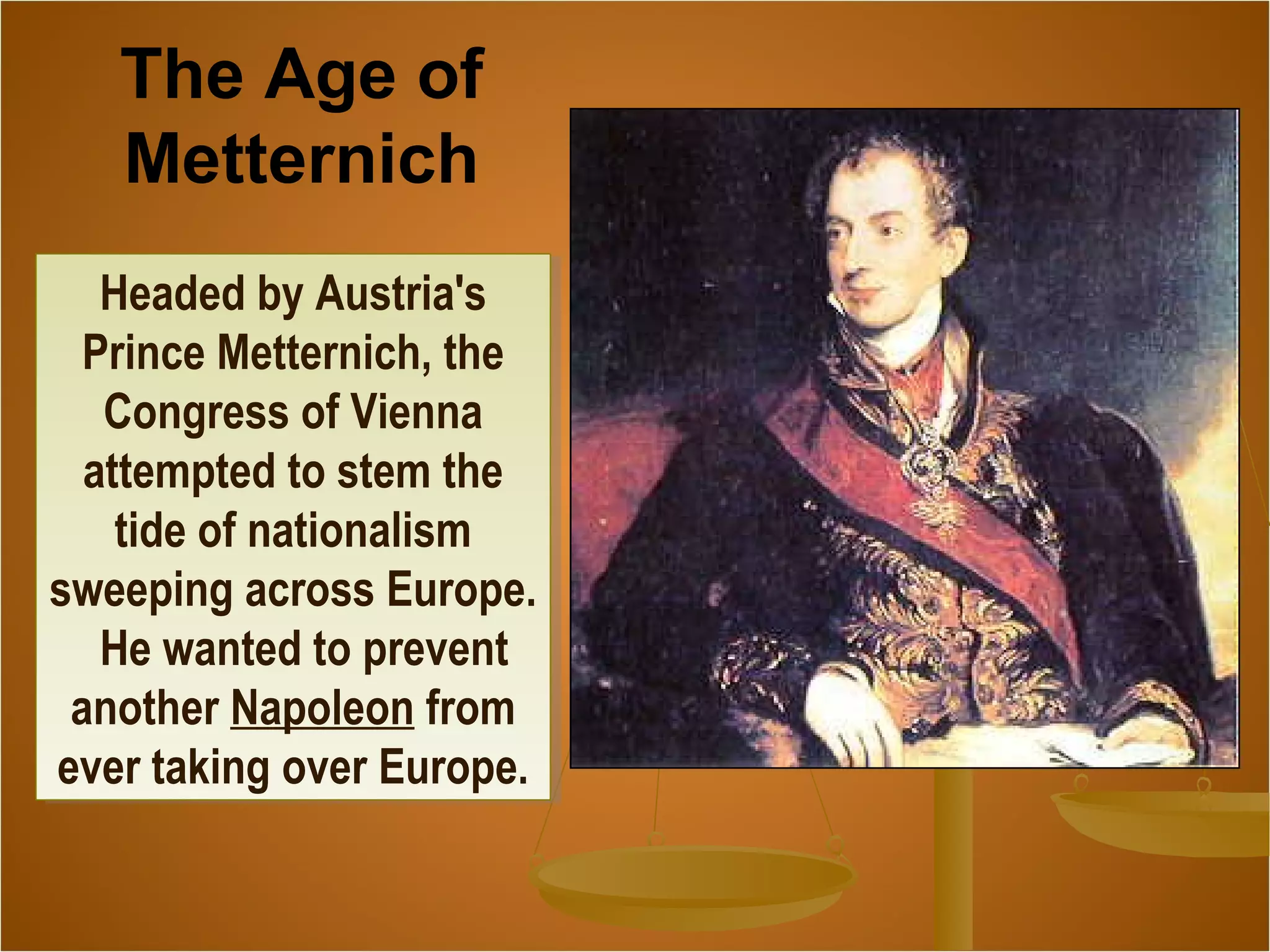
Headed by Austria's
Prince Metternich, the
Congress of Vienna
attempted to stem the
tide of nationalism
sweeping across Europe.
He wanted to prevent
another Napoleon from
ever taking over Europe.
Headed by Austria's
Prince Metternich, the
Congress of Vienna
attempted to stem the
tide of nationalism
sweeping across Europe.
He wanted to prevent
another Napoleon from
ever taking over Europe.
The Age of
Metternich
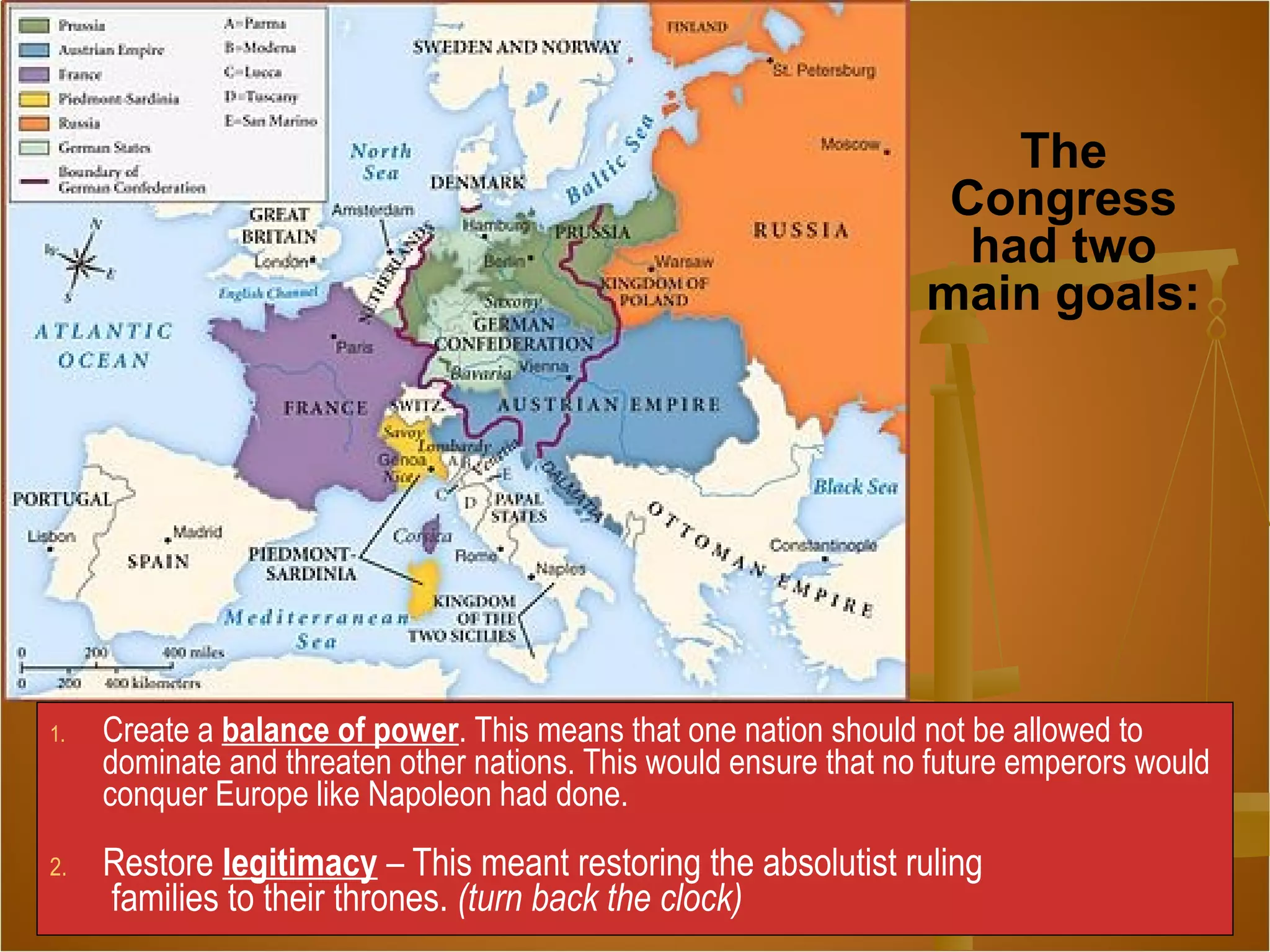
1. Create a balance of power. This means that one nation should not be allowed to
dominate and threaten other nations. This would ensure that no future emperors would
conquer Europe like Napoleon had done.
2. Restore legitimacy – This meant restoring the absolutist ruling
families to their thrones. (turn back the clock)
The
Congress
had two
main goals:
3. Although the leaders of Europe wanted to weaken France, they
chose to keep the country intact to prevent French resentment or
nationalism and keep a balance of power.
3. Although the leaders of Europe wanted to weaken France, they
chose to keep the country intact to prevent French resentment or
nationalism and keep a balance of power.
Countries around France were strengthened. The Spanish Monarchy was
restored, The Netherlands was created and Prussia and Austria gained power.
Louis XVIII was put back on French throne.
Peace in Europe lasted 40 years and large scale was was prevented for 100

Rise and Fall of Napoleon

  • 2.
    NapoleonNapoleonNapoleonNapoleon 1. A brilliantmilitary leader, Napoleon became a general at the age of 24. 1. A brilliant military leader, Napoleon became a general at the age of 24. 2. In 1799, the popular general took over the government in a coup d’etat and named himself first consul. 2. In 1799, the popular general took over the government in a coup d’etat and named himself first consul. 3. In 1802 he became consul for life 4. In 1804 he crowned himself Emperor
  • 3.
    NapoleonNapoleon ““Napoleon CrossingNapoleon Crossing theAlps”the Alps” Jacques-LouisJacques-Louis DavidDavid 18011801 “France has more need of me than I have need of France.”
  • 4.
    NapoleonNapoleon ““Napoleon CrossingNapoleon Crossing theAlps”the Alps” Jacques-LouisJacques-Louis DavidDavid 18011801 “France has more need of me than I have need of France.”
  • 5.
    NapoleonNapoleon ““Napoleon CrossingNapoleon Crossing theAlps”the Alps” Jacques-LouisJacques-Louis DavidDavid 18011801 Film ClipFilm Clip
  • 6.
    Napoleon Crossing theAlpsNapoleon Crossing the Alps Paul Delaroche, 1850Paul Delaroche, 1850 Jacques-Louis David, 1801Jacques-Louis David, 1801 Do Now: Answer the two questions on the worksheet
  • 7.
    Napoleon BonaparteNapoleon Bonaparte PositiveImpact Negative Impact Think about this… Is Napoleon a Hero or a Tyrant?
  • 8.
  • 9.
    How does thisPainting portray the condition of the French Army in Russia?How does this Painting portray the condition of the French Army in Russia?
  • 10.
    Invasion of Moscow– Epic FailInvasion of Moscow – Epic Fail • In 1812, Napoleon sent 600,000 troops to invade Russia. • The Russians retreated and utilized a “Scorched Earth” policy, burning crops, villages, and cities. • In 1812, Napoleon sent 600,000 troops to invade Russia. • The Russians retreated and utilized a “Scorched Earth” policy, burning crops, villages, and cities.
  • 11.
    • When theharsh winter arrived, the French Troops had little food and no shelter. • The French were forced to retreat 1,000 miles. Only 100,000 survived. • When the harsh winter arrived, the French Troops had little food and no shelter. • The French were forced to retreat 1,000 miles. Only 100,000 survived.
  • 12.
    How does theartist portray Napoleon? Explain why? Abdication of the ThroneAbdication of the Throne • In 1813, Napoleon was defeated and France was threatened by a new alliance of Russia, Britain, Austria, and Prussia. •With little support from the French people or army, Napoleon abdicated, or gave up, his throne. • In 1813, Napoleon was defeated and France was threatened by a new alliance of Russia, Britain, Austria, and Prussia. •With little support from the French people or army, Napoleon abdicated, or gave up, his throne. How has image of Napoleon changed?
  • 13.
    The Island ofElbaThe Island of Elba They sent him into exile to the Island of Elba and named Louis XVIII, the brother of Louis XVI, as King of France.
  • 14.
    The Comeback!The Comeback! In1815, Napoleon escaped the island of Elba and began a “Hundred Day Campaign” to Paris. As Napoleon marched towards Paris, soldiers and citizens began to support him. King Louis XVIII fled and Napoleon was back! "From Napoleon to Louis XVIII. My good brother - there"From Napoleon to Louis XVIII. My good brother - there is no need to send any more troops - I have enough."is no need to send any more troops - I have enough." "I am your Emperor. If there is any one among you who wishes to kill his emperor, here I am."
  • 15.
    Battle of WaterlooBattleof Waterloo June 18th , 1815, Napoleon was defeated at the Battle of Waterloo by an allied force of British and Prussian troops. June 18th , 1815, Napoleon was defeated at the Battle of Waterloo by an allied force of British and Prussian troops.
  • 16.
    Exiled Again!Exiled Again! •Once again, Napoleon abdicated the throne. • This time, he was sent to the small Atlantic island of St. Helena. • Napoleon died in 1821 of stomach cancer. Recent studies suggest Napoleon may have been poisoned. Others say he may have secretly escaped. • Once again, Napoleon abdicated the throne. • This time, he was sent to the small Atlantic island of St. Helena. • Napoleon died in 1821 of stomach cancer. Recent studies suggest Napoleon may have been poisoned. Others say he may have secretly escaped.
  • 17.
    Death of Napoleon- 1821Death of Napoleon - 1821
  • 18.
  • 19.
    NAPOLEONNAPOLEON Line 1 -Name of ruler Line 2 - “Ruler/Leader of.....” Line 3 - Three traits that describe the ruler Line 4 - “Who has helped to” (2 good things) Line 5 - “But also ”(2 bad things) Line 6 - “Who will be remembered because of...” Create a Bio- Poem NAPOLEON’S TOMB ARC DE TRIOMPHE
  • 20.
    LegacyLegacy “I closed thegulf of anarchy and brought order out of chaos. I rewarded merit regardless of birth or wealth, wherever I found it. I abolished feudalism and restored equality to all regardless of religion and before the law. I fought the decrepit monarchies of the Old Regime because the alternative was the destruction of all this. I purified the Revolution.” Did Napoleon do more to preserve the legacy of the French Revolution or to destroy it? Is he a Hero or a Tyrant? "So he too is nothing more than an ordinary man. Now he will also trample all human rights underfoot, and only pander to his ambition; he will place himself above everyone else and become a tyrant!" - Ludwig von Beethoven
  • 21.
    Following the defeatof Napoleon, the major European powers of the day met in Vienna, Austria to establish a plan for peace and resolve other problems that were created by Napoleon. This was called The Congress of Vienna. The major powers involved were Austria, Prussia, Russia, Britain, and France. Congress of Vienna
  • 22.
    Headed by Austria's PrinceMetternich, the Congress of Vienna attempted to stem the tide of nationalism sweeping across Europe. He wanted to prevent another Napoleon from ever taking over Europe. Headed by Austria's Prince Metternich, the Congress of Vienna attempted to stem the tide of nationalism sweeping across Europe. He wanted to prevent another Napoleon from ever taking over Europe. The Age of Metternich
  • 23.
    1. Create abalance of power. This means that one nation should not be allowed to dominate and threaten other nations. This would ensure that no future emperors would conquer Europe like Napoleon had done. 2. Restore legitimacy – This meant restoring the absolutist ruling families to their thrones. (turn back the clock) The Congress had two main goals:
  • 24.
    3. Although theleaders of Europe wanted to weaken France, they chose to keep the country intact to prevent French resentment or nationalism and keep a balance of power. 3. Although the leaders of Europe wanted to weaken France, they chose to keep the country intact to prevent French resentment or nationalism and keep a balance of power.
  • 25.
    Countries around Francewere strengthened. The Spanish Monarchy was restored, The Netherlands was created and Prussia and Austria gained power. Louis XVIII was put back on French throne. Peace in Europe lasted 40 years and large scale was was prevented for 100

Editor's Notes

  • #7 David later became an active supporter of the French Revolution and friend of Maximilien Robespierre (1758–1794), and was effectively a dictator of the arts under the French Republic. Imprisoned after Robespierre's fall from power, he aligned himself with yet another political regime upon his release, that of Napoleon I. Delarouche was a French painter. He was trained by Antoine-Jean, Baron Gros, who was painting life-size historical subjects and had many students.