CH. 4.3 ATLANTIC
SLAVE TRADE
And African
Cooperation
AROUND 1500,
EUROPEAN
COLONISTS
BEGAN
ENSLAVING
AFRICANS IN THE
AMERICAS IN
ORDER TO MEET
THEIR GREAT
DEMAND FOR
LARGE NUMBERS
OF CHEAP
LABORERS.
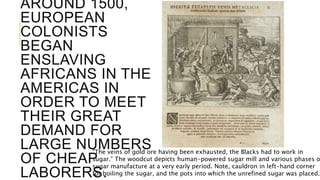
"The veins of gold ore having been exhausted, the Blacks had to work in
sugar.” The woodcut depicts human-powered sugar mill and various phases o
sugar manufacture at a very early period. Note, cauldron in left-hand corner
for boiling the sugar, and the pots into which the unrefined sugar was placed.
SLAVERY IN AFRICA- HAD EXISTED FOR MANY
YEARS BUT WAS NOT A MAJOR INSTITUTION. IT
WAS NOT UNTIL THE 7TH CENTURY, WITH THE
SPREAD OF ISLAM ACROSS AFRICA, THAT
SLAVERY AND THE SLAVE TRADE INCREASED.
Between 650 and 1600-
black and white Muslims
transported about 4.8
million Africans to the
Muslim lands of Southwest
Asia.
These slaves had some legal
rights and opportunities.
Some served as generals in
the army. Some owned
large estates and slaves.
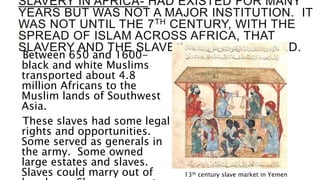
Slaves could marry out of 13th century slave market in Yemen
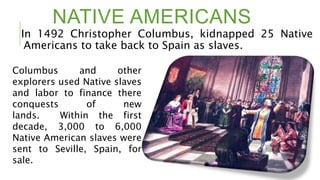
NATIVE AMERICANS
In 1492 Christopher Columbus, kidnapped 25 Native
Americans to take back to Spain as slaves.
Columbus and other
explorers used Native slaves
and labor to finance there
conquests of new
lands. Within the first
decade, 3,000 to 6,000
Native American slaves were
sent to Seville, Spain, for
sale.
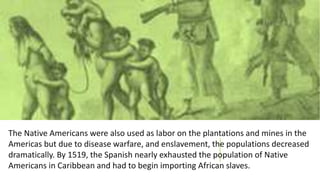
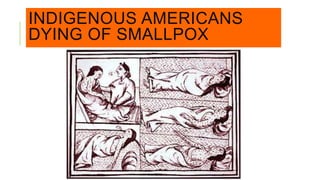
The Native Americans were also used as labor on the plantations and mines in the
Americas but due to disease warfare, and enslavement, the populations decreased
dramatically. By 1519, the Spanish nearly exhausted the population of Native
Americans in Caribbean and had to begin importing African slaves.
INDIGENOUS AMERICANS
DYING OF SMALLPOX
ADVANTAGES OF AFRICANS
. A new labor force was required and Africa
provided an unlimited supply of slaves to fill the
job. Europeans saw several advantages to using
Africans as their labor force:
Many Africans had been exposed to various European
diseases and had built up some immunity to them.
Many Africans had experience in farming and could be
taught large-scale plantation work.
Africans had little knowledge of the land and had no
familiar tribes in which to hide making them less likely to
PUNISHMENT
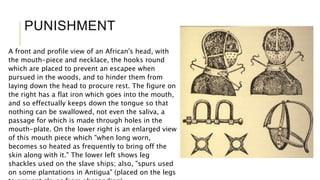
A front and profile view of an African's head, with
the mouth-piece and necklace, the hooks round
which are placed to prevent an escapee when
pursued in the woods, and to hinder them from
laying down the head to procure rest. The figure on
the right has a flat iron which goes into the mouth,
and so effectually keeps down the tongue so that
nothing can be swallowed, not even the saliva, a
passage for which is made through holes in the
mouth-plate. On the lower right is an enlarged view
of this mouth piece which "when long worn,
becomes so heated as frequently to bring off the
skin along with it." The lower left shows leg
shackles used on the slave ships; also, "spurs used
on some plantations in Antigua" (placed on the legs
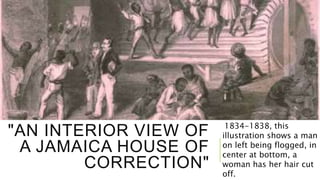
"AN INTERIOR VIEW OF
A JAMAICA HOUSE OF
CORRECTION"
1834-1838, this
illustration shows a man
on left being flogged, in
center at bottom, a
woman has her hair cut
off.
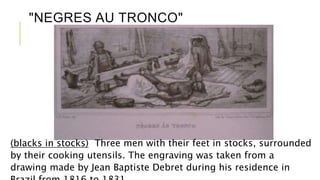
"NEGRES AU TRONCO"
(blacks in stocks) Three men with their feet in stocks, surrounded
by their cooking utensils. The engraving was taken from a
drawing made by Jean Baptiste Debret during his residence in
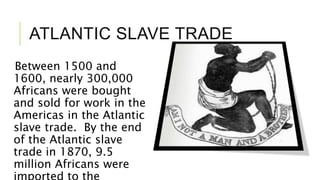
ATLANTIC SLAVE TRADE
Between 1500 and
1600, nearly 300,000
Africans were bought
and sold for work in the
Americas in the Atlantic
slave trade. By the end
of the Atlantic slave
trade in 1870, 9.5
million Africans were
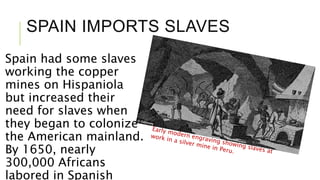
SPAIN IMPORTS SLAVES
Spain had some slaves
working the copper
mines on Hispaniola
but increased their
need for slaves when
they began to colonize
the American mainland.
By 1650, nearly
300,000 Africans
labored in Spanish
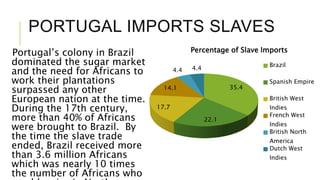
PORTUGAL IMPORTS SLAVES
Portugal’s colony in Brazil
dominated the sugar market
and the need for Africans to
work their plantations
surpassed any other
European nation at the time.
During the 17th century,
more than 40% of Africans
were brought to Brazil. By
the time the slave trade
ended, Brazil received more
than 3.6 million Africans
which was nearly 10 times
the number of Africans who
35.4
22.1
17.7
14.1
4.4 4.4
Percentage of Slave Imports
Brazil
Spanish Empire
British West
Indies
French West
Indies
British North
America
Dutch West
Indies
The English soon began to
dominate the slave trade
with their growing demand
for cheap labor in their
American colonies. From
1690 until they abolished
the slave trade in 1807,
England had imported
nearly 1.7 million Africans
to their colonies in the
West Indies. Only about
400,000 Africans were
imported to Britain’s North
American colonies.
However, the slave
population steadily grew to
about 2 million by 1830 in
the United States.
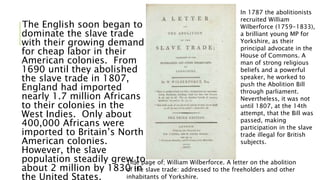
In 1787 the abolitionists
recruited William
Wilberforce (1759-1833),
a brilliant young MP for
Yorkshire, as their
principal advocate in the
House of Commons. A
man of strong religious
beliefs and a powerful
speaker, he worked to
push the Abolition Bill
through parliament.
Nevertheless, it was not
until 1807, at the 14th
attempt, that the Bill was
passed, making
participation in the slave
trade illegal for British
subjects.
Title page of; William Wilberforce. A letter on the abolition
of the slave trade: addressed to the freeholders and other
inhabitants of Yorkshire.
THE FORCED
JOURNEY
And African Cooperation
MANY AFRICAN RULERS AND MERCHANTS PLAYED A
WILLING ROLE IN THE ATLANTIC SLAVE TRADE.
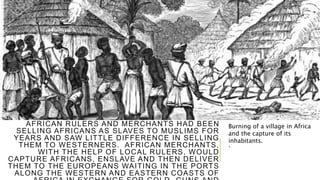
AFRICAN RULERS AND MERCHANTS HAD BEEN
SELLING AFRICANS AS SLAVES TO MUSLIMS FOR
YEARS AND SAW LITTLE DIFFERENCE IN SELLING
THEM TO WESTERNERS. AFRICAN MERCHANTS,
WITH THE HELP OF LOCAL RULERS, WOULD
CAPTURE AFRICANS, ENSLAVE AND THEN DELIVER
THEM TO THE EUROPEANS WAITING IN THE PORTS
ALONG THE WESTERN AND EASTERN COASTS OF
.
Burning of a village in Africa
and the capture of its
inhabitants.
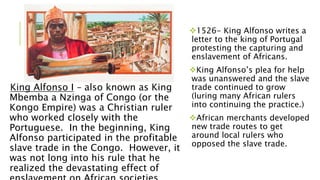
King Alfonso I – also known as King
Mbemba a Nzinga of Congo (or the
Kongo Empire) was a Christian ruler
who worked closely with the
Portuguese. In the beginning, King
Alfonso participated in the profitable
slave trade in the Congo. However, it
was not long into his rule that he
realized the devastating effect of
1526- King Alfonso writes a
letter to the king of Portugal
protesting the capturing and
enslavement of Africans.
King Alfonso’s plea for help
was unanswered and the slave
trade continued to grow
(luring many African rulers
into continuing the practice.)
African merchants developed
new trade routes to get
around local rulers who
opposed the slave trade.
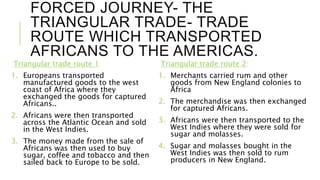
FORCED JOURNEY- THE
TRIANGULAR TRADE- TRADE
ROUTE WHICH TRANSPORTED
AFRICANS TO THE AMERICAS.
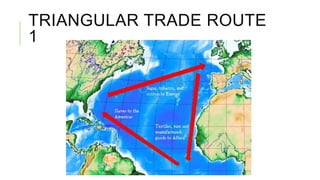
Triangular trade route 1:
1. Europeans transported
manufactured goods to the west
coast of Africa where they
exchanged the goods for captured
Africans..
2. Africans were then transported
across the Atlantic Ocean and sold
in the West Indies.
3. The money made from the sale of
Africans was then used to buy
sugar, coffee and tobacco and then
sailed back to Europe to be sold.
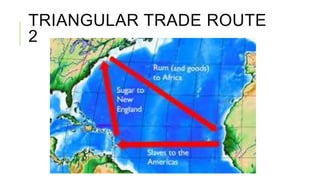
Triangular trade route 2:
1. Merchants carried rum and other
goods from New England colonies to
Africa
2. The merchandise was then exchanged
for captured Africans.
3. Africans were then transported to the
West Indies where they were sold for
sugar and molasses.
4. Sugar and molasses bought in the
West Indies was then sold to rum
producers in New England.
TRIANGULAR TRADE ROUTE
1
TRIANGULAR TRADE ROUTE
2
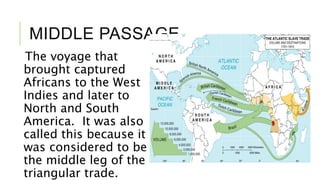
MIDDLE PASSAGE
The voyage that
brought captured
Africans to the West
Indies and later to
North and South
America. It was also
called this because it
was considered to be
the middle leg of the
triangular trade.
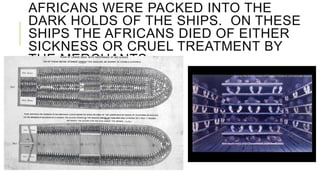
AFRICANS WERE PACKED INTO THE
DARK HOLDS OF THE SHIPS. ON THESE
SHIPS THE AFRICANS DIED OF EITHER
SICKNESS OR CRUEL TREATMENT BY
THE MERCHANTS.

Ch. 4.3 atlantic slave trade

  • 1.
    CH. 4.3 ATLANTIC SLAVETRADE And African Cooperation
  • 2.
    AROUND 1500, EUROPEAN COLONISTS BEGAN ENSLAVING AFRICANS INTHE AMERICAS IN ORDER TO MEET THEIR GREAT DEMAND FOR LARGE NUMBERS OF CHEAP LABORERS. "The veins of gold ore having been exhausted, the Blacks had to work in sugar.” The woodcut depicts human-powered sugar mill and various phases o sugar manufacture at a very early period. Note, cauldron in left-hand corner for boiling the sugar, and the pots into which the unrefined sugar was placed.
  • 3.
    SLAVERY IN AFRICA-HAD EXISTED FOR MANY YEARS BUT WAS NOT A MAJOR INSTITUTION. IT WAS NOT UNTIL THE 7TH CENTURY, WITH THE SPREAD OF ISLAM ACROSS AFRICA, THAT SLAVERY AND THE SLAVE TRADE INCREASED. Between 650 and 1600- black and white Muslims transported about 4.8 million Africans to the Muslim lands of Southwest Asia. These slaves had some legal rights and opportunities. Some served as generals in the army. Some owned large estates and slaves. Slaves could marry out of 13th century slave market in Yemen
  • 4.
    NATIVE AMERICANS In 1492Christopher Columbus, kidnapped 25 Native Americans to take back to Spain as slaves. Columbus and other explorers used Native slaves and labor to finance there conquests of new lands. Within the first decade, 3,000 to 6,000 Native American slaves were sent to Seville, Spain, for sale.
  • 5.
    The Native Americanswere also used as labor on the plantations and mines in the Americas but due to disease warfare, and enslavement, the populations decreased dramatically. By 1519, the Spanish nearly exhausted the population of Native Americans in Caribbean and had to begin importing African slaves.
  • 6.
  • 7.
    ADVANTAGES OF AFRICANS .A new labor force was required and Africa provided an unlimited supply of slaves to fill the job. Europeans saw several advantages to using Africans as their labor force: Many Africans had been exposed to various European diseases and had built up some immunity to them. Many Africans had experience in farming and could be taught large-scale plantation work. Africans had little knowledge of the land and had no familiar tribes in which to hide making them less likely to
  • 8.
    PUNISHMENT A front andprofile view of an African's head, with the mouth-piece and necklace, the hooks round which are placed to prevent an escapee when pursued in the woods, and to hinder them from laying down the head to procure rest. The figure on the right has a flat iron which goes into the mouth, and so effectually keeps down the tongue so that nothing can be swallowed, not even the saliva, a passage for which is made through holes in the mouth-plate. On the lower right is an enlarged view of this mouth piece which "when long worn, becomes so heated as frequently to bring off the skin along with it." The lower left shows leg shackles used on the slave ships; also, "spurs used on some plantations in Antigua" (placed on the legs
  • 9.
    "AN INTERIOR VIEWOF A JAMAICA HOUSE OF CORRECTION" 1834-1838, this illustration shows a man on left being flogged, in center at bottom, a woman has her hair cut off.
  • 10.
    "NEGRES AU TRONCO" (blacksin stocks) Three men with their feet in stocks, surrounded by their cooking utensils. The engraving was taken from a drawing made by Jean Baptiste Debret during his residence in
  • 11.
    ATLANTIC SLAVE TRADE Between1500 and 1600, nearly 300,000 Africans were bought and sold for work in the Americas in the Atlantic slave trade. By the end of the Atlantic slave trade in 1870, 9.5 million Africans were
  • 12.
    SPAIN IMPORTS SLAVES Spainhad some slaves working the copper mines on Hispaniola but increased their need for slaves when they began to colonize the American mainland. By 1650, nearly 300,000 Africans labored in Spanish
  • 13.
    PORTUGAL IMPORTS SLAVES Portugal’scolony in Brazil dominated the sugar market and the need for Africans to work their plantations surpassed any other European nation at the time. During the 17th century, more than 40% of Africans were brought to Brazil. By the time the slave trade ended, Brazil received more than 3.6 million Africans which was nearly 10 times the number of Africans who 35.4 22.1 17.7 14.1 4.4 4.4 Percentage of Slave Imports Brazil Spanish Empire British West Indies French West Indies British North America Dutch West Indies
  • 14.
    The English soonbegan to dominate the slave trade with their growing demand for cheap labor in their American colonies. From 1690 until they abolished the slave trade in 1807, England had imported nearly 1.7 million Africans to their colonies in the West Indies. Only about 400,000 Africans were imported to Britain’s North American colonies. However, the slave population steadily grew to about 2 million by 1830 in the United States. In 1787 the abolitionists recruited William Wilberforce (1759-1833), a brilliant young MP for Yorkshire, as their principal advocate in the House of Commons. A man of strong religious beliefs and a powerful speaker, he worked to push the Abolition Bill through parliament. Nevertheless, it was not until 1807, at the 14th attempt, that the Bill was passed, making participation in the slave trade illegal for British subjects. Title page of; William Wilberforce. A letter on the abolition of the slave trade: addressed to the freeholders and other inhabitants of Yorkshire.
  • 15.
  • 16.
    MANY AFRICAN RULERSAND MERCHANTS PLAYED A WILLING ROLE IN THE ATLANTIC SLAVE TRADE. AFRICAN RULERS AND MERCHANTS HAD BEEN SELLING AFRICANS AS SLAVES TO MUSLIMS FOR YEARS AND SAW LITTLE DIFFERENCE IN SELLING THEM TO WESTERNERS. AFRICAN MERCHANTS, WITH THE HELP OF LOCAL RULERS, WOULD CAPTURE AFRICANS, ENSLAVE AND THEN DELIVER THEM TO THE EUROPEANS WAITING IN THE PORTS ALONG THE WESTERN AND EASTERN COASTS OF . Burning of a village in Africa and the capture of its inhabitants.
  • 17.
    King Alfonso I– also known as King Mbemba a Nzinga of Congo (or the Kongo Empire) was a Christian ruler who worked closely with the Portuguese. In the beginning, King Alfonso participated in the profitable slave trade in the Congo. However, it was not long into his rule that he realized the devastating effect of 1526- King Alfonso writes a letter to the king of Portugal protesting the capturing and enslavement of Africans. King Alfonso’s plea for help was unanswered and the slave trade continued to grow (luring many African rulers into continuing the practice.) African merchants developed new trade routes to get around local rulers who opposed the slave trade.
  • 18.
    FORCED JOURNEY- THE TRIANGULARTRADE- TRADE ROUTE WHICH TRANSPORTED AFRICANS TO THE AMERICAS. Triangular trade route 1: 1. Europeans transported manufactured goods to the west coast of Africa where they exchanged the goods for captured Africans.. 2. Africans were then transported across the Atlantic Ocean and sold in the West Indies. 3. The money made from the sale of Africans was then used to buy sugar, coffee and tobacco and then sailed back to Europe to be sold. Triangular trade route 2: 1. Merchants carried rum and other goods from New England colonies to Africa 2. The merchandise was then exchanged for captured Africans. 3. Africans were then transported to the West Indies where they were sold for sugar and molasses. 4. Sugar and molasses bought in the West Indies was then sold to rum producers in New England.
  • 19.
  • 20.
  • 21.
    MIDDLE PASSAGE The voyagethat brought captured Africans to the West Indies and later to North and South America. It was also called this because it was considered to be the middle leg of the triangular trade.
  • 22.
    AFRICANS WERE PACKEDINTO THE DARK HOLDS OF THE SHIPS. ON THESE SHIPS THE AFRICANS DIED OF EITHER SICKNESS OR CRUEL TREATMENT BY THE MERCHANTS.