Assalamualaikum & Good Morning Think Good and Do Good Things Only
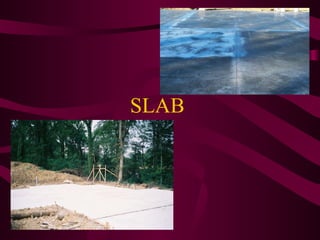
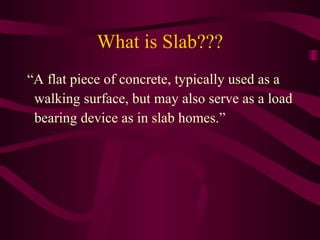
SLAB
What is Slab??? “A flat piece of concrete, typically used as a walking surface, but may also serve as a load  bearing device as in slab homes.”
FUNCTION Provide a flat surface To support load Sound, heat and fire insulator Act as a divider (privacy) for the occupants Upper slab became the ceiling for the   storey below Space between slab and ceiling can be used   to place building facilities
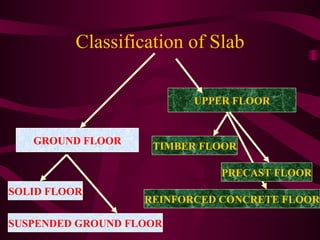
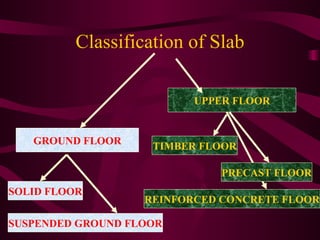
Classification of Slab GROUND FLOOR UPPER FLOOR SOLID FLOOR SUSPENDED GROUND FLOOR TIMBER FLOOR REINFORCED CONCRETE FLOOR PRECAST FLOOR
Characteristic of Ground Floor Simple design Load will be supported by the ground Less problem related to distance of span Choice to construct solid floor or   suspended ground floor will depends on   nature of the building and site condition
DESIGN CONSIDERATION Among the design function that need to be taken in consideration for construction of ground floor  slab is The provision of a uniform, level surface  Sufficient strength and stability  Exclusion of dampness from inside of building  Thermal insulation (max.0.45 W/square metreK Resistance to fire
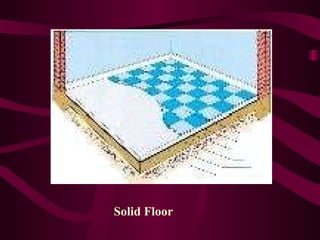
Solid Floor
Solid Floor / Non Suspended Floor Constructed using concrete Doesn’t use timber so there will be no   decay Solid floor need other finishing
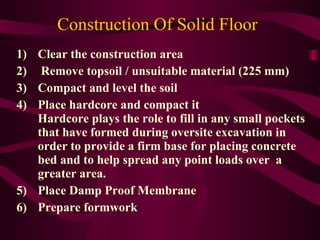
Construction Of Solid Floor Clear the construction area Remove topsoil / unsuitable material (225 mm) Compact and level the soil Place hardcore and compact it Hardcore plays the role to fill in any small pockets that have formed during oversite excavation in order to provide a firm base for placing concrete bed and to help spread any point loads over  a greater area. Place Damp Proof Membrane Prepare formwork
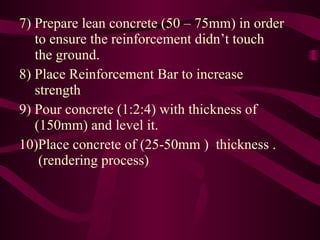
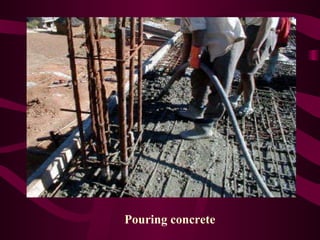
7) Prepare lean concrete (50 – 75mm) in order   to ensure the reinforcement didn’t touch   the ground.  8) Place Reinforcement Bar to increase   strength 9) Pour concrete (1:2:4) with thickness of   (150mm) and level it. 10)Place concrete of (25-50mm )  thickness .    (rendering process)
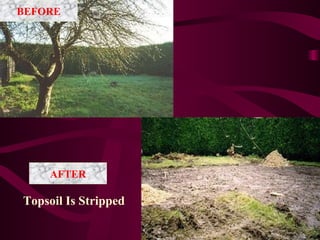
Topsoil Is Stripped AFTER BEFORE
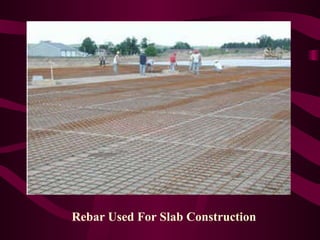
Rebar Used For Slab Construction
Pouring concrete
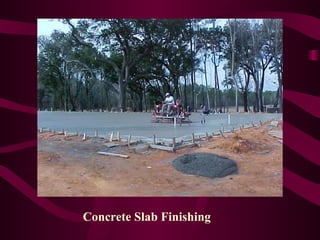
Concrete Slab Finishing
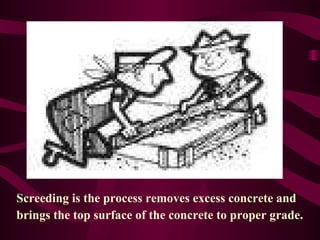
Screeding is the process removes excess concrete and  brings the top surface of the concrete to proper grade.
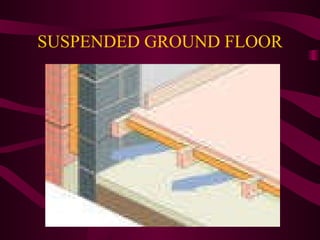
SUSPENDED GROUND FLOOR
SUSPENDED GROUND FLOOR A ground floor need to be suspended under the following condition: a) domestic buildings on sloping sites where    more than 600mm depth of infill would be    required b) where the bearing capacity and nature of the    ground different from one part to another c) where the ground is shrinkable clay,    expansive material or unstable soil type.
Suspended floors / slab is fixed some distance above the ground. There are 2 types of suspended ground floor such as  a) Suspended timber ground floors b) Suspended precast concrete floors
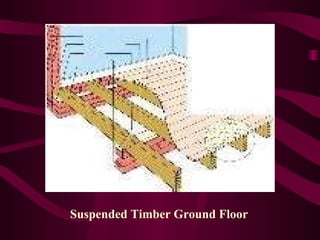
Suspended Timber Ground Floor
Suspended Timber Ground Floor it has some flexibility and will accept nail   fixing (solid ground floor can’t use nail) Under side of ground floor must kept dry to   prevent fungus attack Susceptible to dry rot and draughts but it can   be avoided if the floor is designed correctly. Adequate ventilation under the floor and   correct positioning of dampproof courses can   keep the under floor area and timber dry.
Space beneath the suspended timber floor is   ideal for running electric cables, water pipes   and gas pipes It’s more expensive form of construction   than concrete floor Cheaper than precast concrete flooring   system
UPPER FLOOR
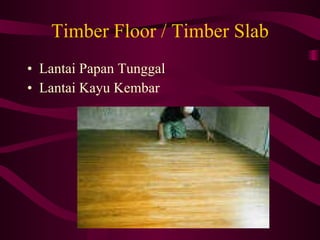
Timber Floor / Timber Slab Lantai Papan Tunggal Lantai Kayu Kembar
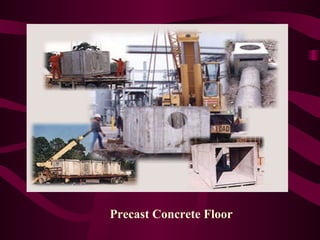
Precast Concrete Floor
PRECAST CONCRETE FLOOR Advantages of Precast Concrete floor is a) Doesn’t need formwork b) Time taken for concrete to cure in the    formwork can be eliminated c) Better quality control  d) Doesn’t need many workers as in in-situ    concrete construction e) fast completion of construction project
long spans available with precast concrete flooring   systems reduce the number of secondary beam   required and maximize the column free space. Fire resistance ratings normally between 1 & 2   hours Among the things that need to be considered   before considering any system of precast concrete   flooring are:  a) maximum span  f) Sound insulation   b) nature of support  g) Thermal insulation    properties c) weight of units  h) Fire resistance of units d) thickness of units  i) Speed of construction e) Amount of temporary support required
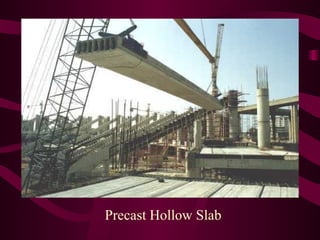
There are many types of precast concrete   floor such as : a) Precast Hollow Floors b) Composite floors Precast hollow floor units are available in a variety of sections such as box planks / beams, tee section, I beam sections and channel sections. Composite floors are combination of precast units and insitu concrete.
Precast Hollow Slab
Precast Hollow Floors more economic compared to in-situ floor  due to reduction in volume of concrete   used, weight of reinforcement and size of   foundation. cheaper than composite in-situ concrete is not required Units are self centering so, no need temporary   support Construction period is shorter
Composite Floors
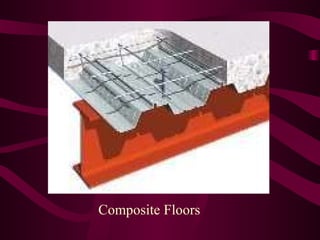
Composite Floors combination of precast units and in situ   concrete. precast units that are usually prestressed  /   reinforced with high yield bars are used to   provide the strength of the floor with the   smallest depth practicable At the same time, act as permanent formwork   to the in-situ topping that provides the   compressive strength required.
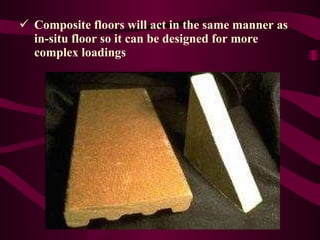
Composite floors will act in the same manner as   in-situ floor so it can be designed for more   complex loadings
Reinforced Concrete Slab / Floor In- Situ construction Flat Slab Flat Plate Slab Waffle Slab / Honeycomb Floors Beam Floor Slab
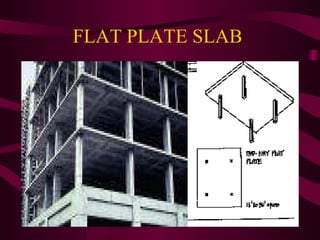
FLAT PLATE SLAB
FLAT PLATE SYSTEM Simple construction Flat plate construction can minimize storey   height (piping, wall cladding, elevators etc)   in areas with absolute height restrictions. Low storey heights due to shallow floor Spans < 20ft (residential & light commercial) Flat ceilings (reduced finishing cost) Have the simplest formwork
Least labor costs  Can be applied for short to medium spans   with light loadings  Also reduce building weight and effective   area of wind loads
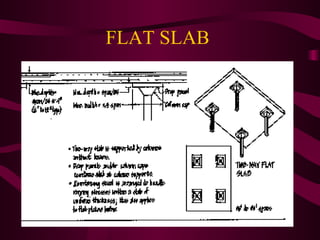
FLAT SLAB
FLAT SLAB Reduce slab displacement Increased slab shear resistance This system provide relatively a flat ceilings (reduce finishing cost) Low storey heights due to shallow floor Medium span with light loading Spans 20 to 40 ft Live load > 100psf (garage, warehouses)
WAFFLE SLAB
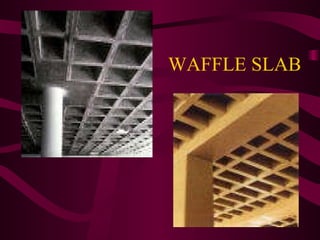
WAFFLE SLAB Used as alternative to an in-site flat slab or a beam and slab suspended floor This is because it requires less concrete, less reinforcement and can be used to reduce the number of beams and columns required with the resultant savings on foundations. Moulds are very strong, lightweight & capable of supporting all the normal loads encountered in building works.
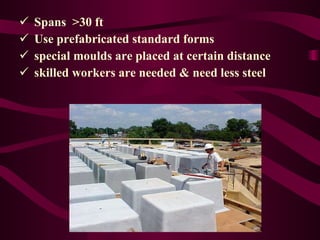
Spans  >30 ft Use prefabricated standard forms special moulds are placed at certain distance  skilled workers are needed & need less steel
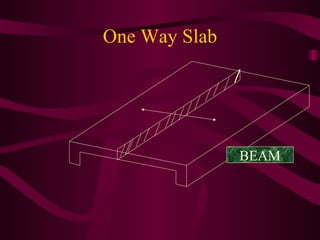
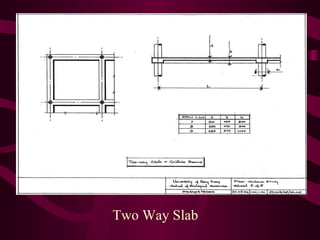
SLAB DESIGN One Way Slab Two Way Slab  - Require less steel - Few two slabs built in the area of high    labor costs  - Suitable for minimizing deflections
One Way Slab BEAM
Two Way Slab
SLAB FAILURE :  CAUSES & EFFECT
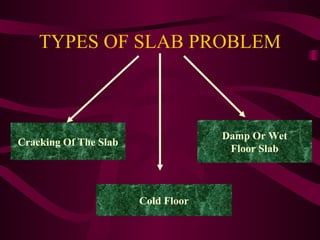
TYPES OF SLAB PROBLEM Cracking Of The Slab Cold Floor Damp Or Wet  Floor Slab
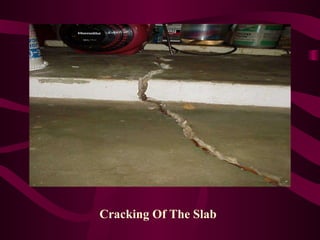
CRACKING OF THE SLAB : CAUSES Poor construction techniques and practices Differential / Uneven settlement Inadequate structural strength of concrete  Improper placement of reinforcing & mesh
Cracking Of The Slab
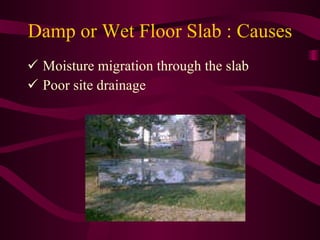
Damp or Wet Floor Slab : Causes Moisture migration through the slab Poor site drainage
Life Is Very Short So Make It Meaningful Love & Appreciate Your Parents Always

Slab

  • 1.
    Assalamualaikum & GoodMorning Think Good and Do Good Things Only
  • 2.
  • 3.
    What is Slab???“A flat piece of concrete, typically used as a walking surface, but may also serve as a load bearing device as in slab homes.”
  • 4.
    FUNCTION Provide aflat surface To support load Sound, heat and fire insulator Act as a divider (privacy) for the occupants Upper slab became the ceiling for the storey below Space between slab and ceiling can be used to place building facilities
  • 5.
    Classification of SlabGROUND FLOOR UPPER FLOOR SOLID FLOOR SUSPENDED GROUND FLOOR TIMBER FLOOR REINFORCED CONCRETE FLOOR PRECAST FLOOR
  • 6.
    Classification of SlabGROUND FLOOR UPPER FLOOR SOLID FLOOR SUSPENDED GROUND FLOOR TIMBER FLOOR REINFORCED CONCRETE FLOOR PRECAST FLOOR
  • 7.
    Characteristic of GroundFloor Simple design Load will be supported by the ground Less problem related to distance of span Choice to construct solid floor or suspended ground floor will depends on nature of the building and site condition
  • 8.
    DESIGN CONSIDERATION Amongthe design function that need to be taken in consideration for construction of ground floor slab is The provision of a uniform, level surface Sufficient strength and stability Exclusion of dampness from inside of building Thermal insulation (max.0.45 W/square metreK Resistance to fire
  • 9.
  • 10.
    Solid Floor /Non Suspended Floor Constructed using concrete Doesn’t use timber so there will be no decay Solid floor need other finishing
  • 11.
    Construction Of SolidFloor Clear the construction area Remove topsoil / unsuitable material (225 mm) Compact and level the soil Place hardcore and compact it Hardcore plays the role to fill in any small pockets that have formed during oversite excavation in order to provide a firm base for placing concrete bed and to help spread any point loads over a greater area. Place Damp Proof Membrane Prepare formwork
  • 12.
    7) Prepare leanconcrete (50 – 75mm) in order to ensure the reinforcement didn’t touch the ground. 8) Place Reinforcement Bar to increase strength 9) Pour concrete (1:2:4) with thickness of (150mm) and level it. 10)Place concrete of (25-50mm ) thickness . (rendering process)
  • 13.
    Topsoil Is StrippedAFTER BEFORE
  • 14.
    Rebar Used ForSlab Construction
  • 15.
  • 16.
  • 17.
    Screeding is theprocess removes excess concrete and brings the top surface of the concrete to proper grade.
  • 18.
  • 19.
    SUSPENDED GROUND FLOORA ground floor need to be suspended under the following condition: a) domestic buildings on sloping sites where more than 600mm depth of infill would be required b) where the bearing capacity and nature of the ground different from one part to another c) where the ground is shrinkable clay, expansive material or unstable soil type.
  • 20.
    Suspended floors /slab is fixed some distance above the ground. There are 2 types of suspended ground floor such as a) Suspended timber ground floors b) Suspended precast concrete floors
  • 21.
  • 22.
    Suspended Timber GroundFloor it has some flexibility and will accept nail fixing (solid ground floor can’t use nail) Under side of ground floor must kept dry to prevent fungus attack Susceptible to dry rot and draughts but it can be avoided if the floor is designed correctly. Adequate ventilation under the floor and correct positioning of dampproof courses can keep the under floor area and timber dry.
  • 23.
    Space beneath thesuspended timber floor is ideal for running electric cables, water pipes and gas pipes It’s more expensive form of construction than concrete floor Cheaper than precast concrete flooring system
  • 24.
  • 25.
    Timber Floor /Timber Slab Lantai Papan Tunggal Lantai Kayu Kembar
  • 26.
  • 27.
    PRECAST CONCRETE FLOORAdvantages of Precast Concrete floor is a) Doesn’t need formwork b) Time taken for concrete to cure in the formwork can be eliminated c) Better quality control d) Doesn’t need many workers as in in-situ concrete construction e) fast completion of construction project
  • 28.
    long spans availablewith precast concrete flooring systems reduce the number of secondary beam required and maximize the column free space. Fire resistance ratings normally between 1 & 2 hours Among the things that need to be considered before considering any system of precast concrete flooring are: a) maximum span f) Sound insulation b) nature of support g) Thermal insulation properties c) weight of units h) Fire resistance of units d) thickness of units i) Speed of construction e) Amount of temporary support required
  • 29.
    There are manytypes of precast concrete floor such as : a) Precast Hollow Floors b) Composite floors Precast hollow floor units are available in a variety of sections such as box planks / beams, tee section, I beam sections and channel sections. Composite floors are combination of precast units and insitu concrete.
  • 30.
  • 31.
    Precast Hollow Floorsmore economic compared to in-situ floor due to reduction in volume of concrete used, weight of reinforcement and size of foundation. cheaper than composite in-situ concrete is not required Units are self centering so, no need temporary support Construction period is shorter
  • 32.
  • 33.
    Composite Floors combinationof precast units and in situ concrete. precast units that are usually prestressed / reinforced with high yield bars are used to provide the strength of the floor with the smallest depth practicable At the same time, act as permanent formwork to the in-situ topping that provides the compressive strength required.
  • 34.
    Composite floors willact in the same manner as in-situ floor so it can be designed for more complex loadings
  • 35.
    Reinforced Concrete Slab/ Floor In- Situ construction Flat Slab Flat Plate Slab Waffle Slab / Honeycomb Floors Beam Floor Slab
  • 36.
  • 37.
    FLAT PLATE SYSTEMSimple construction Flat plate construction can minimize storey height (piping, wall cladding, elevators etc) in areas with absolute height restrictions. Low storey heights due to shallow floor Spans < 20ft (residential & light commercial) Flat ceilings (reduced finishing cost) Have the simplest formwork
  • 38.
    Least labor costs Can be applied for short to medium spans with light loadings Also reduce building weight and effective area of wind loads
  • 39.
  • 40.
    FLAT SLAB Reduceslab displacement Increased slab shear resistance This system provide relatively a flat ceilings (reduce finishing cost) Low storey heights due to shallow floor Medium span with light loading Spans 20 to 40 ft Live load > 100psf (garage, warehouses)
  • 41.
  • 42.
    WAFFLE SLAB Usedas alternative to an in-site flat slab or a beam and slab suspended floor This is because it requires less concrete, less reinforcement and can be used to reduce the number of beams and columns required with the resultant savings on foundations. Moulds are very strong, lightweight & capable of supporting all the normal loads encountered in building works.
  • 43.
    Spans >30ft Use prefabricated standard forms special moulds are placed at certain distance skilled workers are needed & need less steel
  • 44.
    SLAB DESIGN OneWay Slab Two Way Slab - Require less steel - Few two slabs built in the area of high labor costs - Suitable for minimizing deflections
  • 45.
  • 46.
  • 47.
    SLAB FAILURE : CAUSES & EFFECT
  • 48.
    TYPES OF SLABPROBLEM Cracking Of The Slab Cold Floor Damp Or Wet Floor Slab
  • 49.
    CRACKING OF THESLAB : CAUSES Poor construction techniques and practices Differential / Uneven settlement Inadequate structural strength of concrete Improper placement of reinforcing & mesh
  • 50.
  • 51.
    Damp or WetFloor Slab : Causes Moisture migration through the slab Poor site drainage
  • 52.
    Life Is VeryShort So Make It Meaningful Love & Appreciate Your Parents Always