Presented by:
Syed Abdul Rahman
The
Composite
Construction
• The two complementary materials, structural steel and
reinforced concrete, are introduced.
• To explain the composite action of the two different
materials and to show how the structural members are
used, particularly in building construction.
• The use of composite construction for buildings is
outlined.
• Its Advantages and Disadvantages are also illustrated.
Objective
Introduction
 The most important and most frequently encountered
combination of construction materials is that of steel and
concrete, with applications in multi-storey commercial
buildings and factories, as well as in bridges.
 Composite construction refers to two load-carrying
structural members that are integrally connected and
deflect as a single unit.
 This has become a standard type of construction in high
rise buildings selected by many Architects , Engineers
and Developers.
 Composite floor systems are considered by many to be
the highest quality type of construction.
These essentially different materials are completely
compatible and complementary to each other.
 Almost the same thermal expansion;
 An ideal combination of strengths with the concrete
efficient in compression and the steel in tension;
 Concrete also gives corrosion protection and thermal
insulation to the steel at elevated temperatures.
 The Indian Code of Practice for Composite
Construction in Structural Steel and Concrete (IS:
11384 – 1985)
Introduction...
The Indian Code of Practice for Composite
Construction in Structural Steel and Concrete
(IS: 11384 – 1985)
• The maximum strain in concrete at outermost compression member is
taken as 0.0035 in bending.
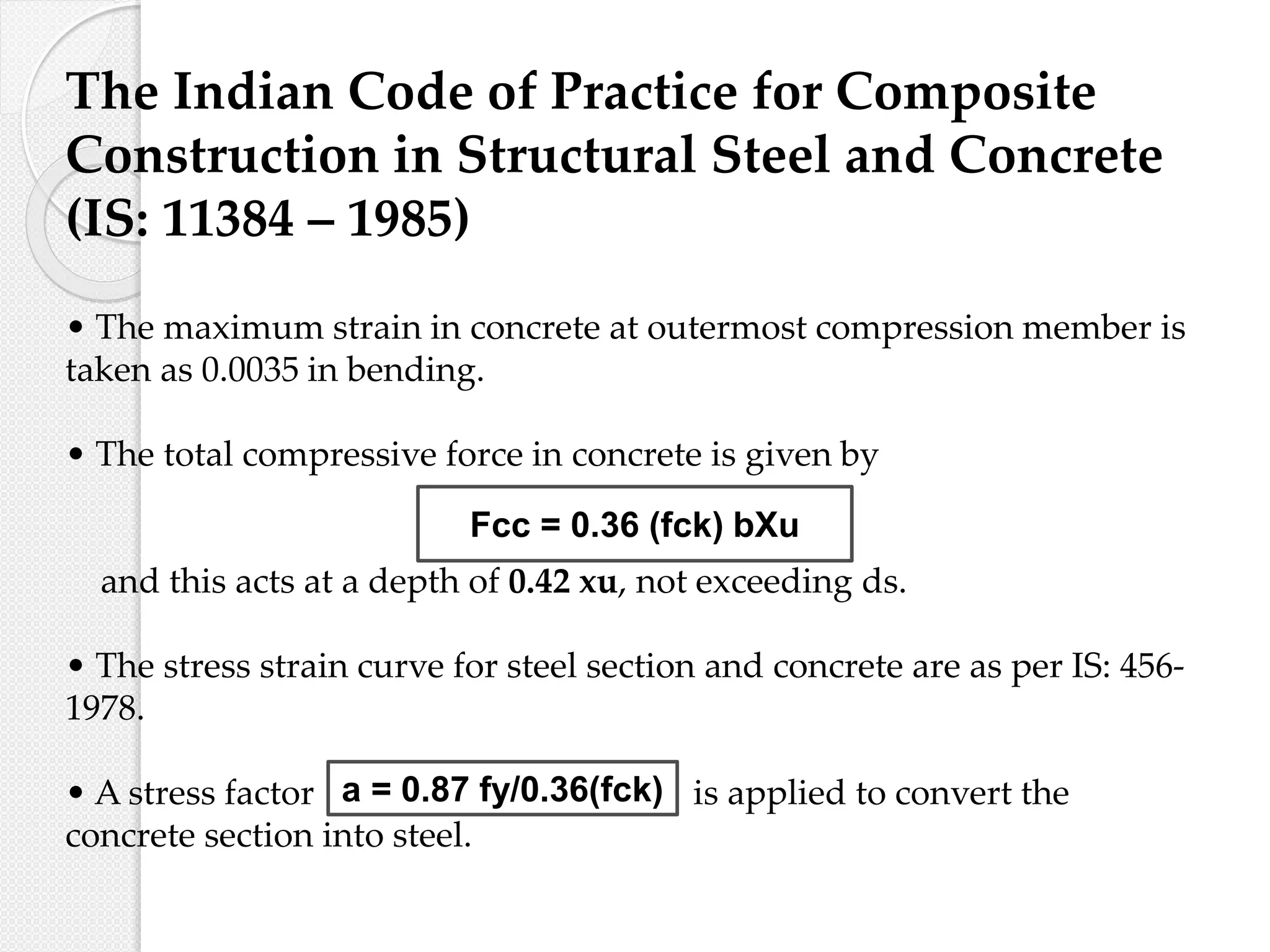
• The total compressive force in concrete is given by
and this acts at a depth of 0.42 xu, not exceeding ds.
• The stress strain curve for steel section and concrete are as per IS: 456-
1978.
• A stress factor is applied to convert the
concrete section into steel.
Fcc = 0.36 (fck) bXu
a = 0.87 fy/0.36(fck)
Advantages
Composite construction used for commercial and other
multi-storey buildings, offers the following main advantages
to the designer and client
• The concrete acts together with the steel to create a stiffer,
lighter, less expensive structure .
• Speed and simplicity of construction - Faster to erect,
nearly 25% faster then traditional construction.
• Lighter construction than a traditional concrete building.
• Less material handling at site.
• Has better ductility and hence superior lateral load
behavior; better earthquake resistance.
• Ability to cover large column free area in buildings and
longer span for bridges/flyovers.
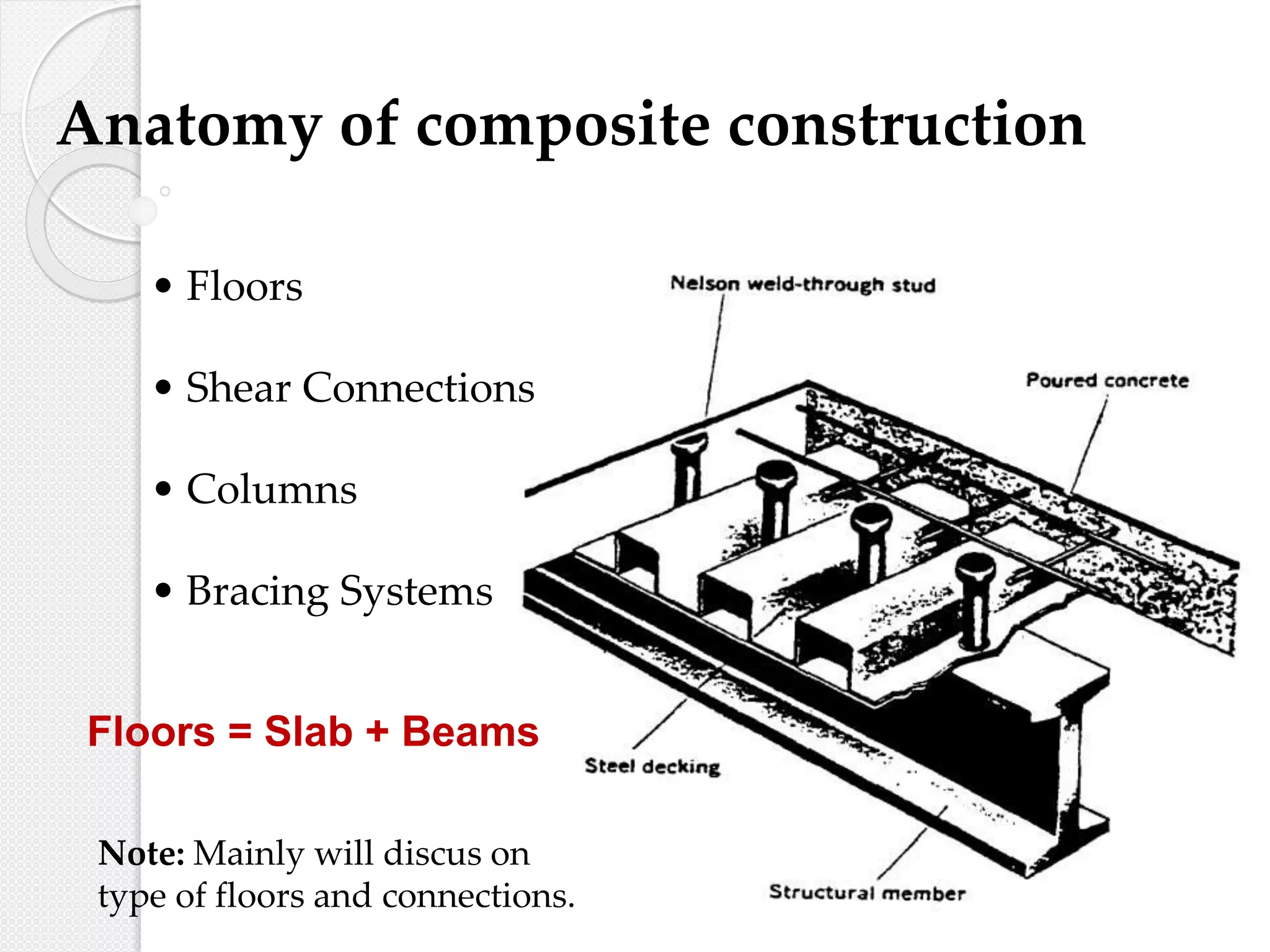
• Floors
• Shear Connections
• Columns
• Bracing Systems
Anatomy of composite construction
Floors = Slab + Beams
Note: Mainly will discus on
type of floors and connections.
Common Types of Floor Systems
• Concrete slabs supported by open-web joists
• One-way and two-way reinforced concrete slabs
supported on steel beams
• Concrete slab and steel beam composite floors
• Composite profiled decking floors
• Precast concrete floors on steel beams
Note: The most common arrangement found in composite floor
systems is a rolled or built-up steel beam connected to a formed steel
deck and concrete slab. Mostly Profiled Decking Floors system is used
in composite construction.
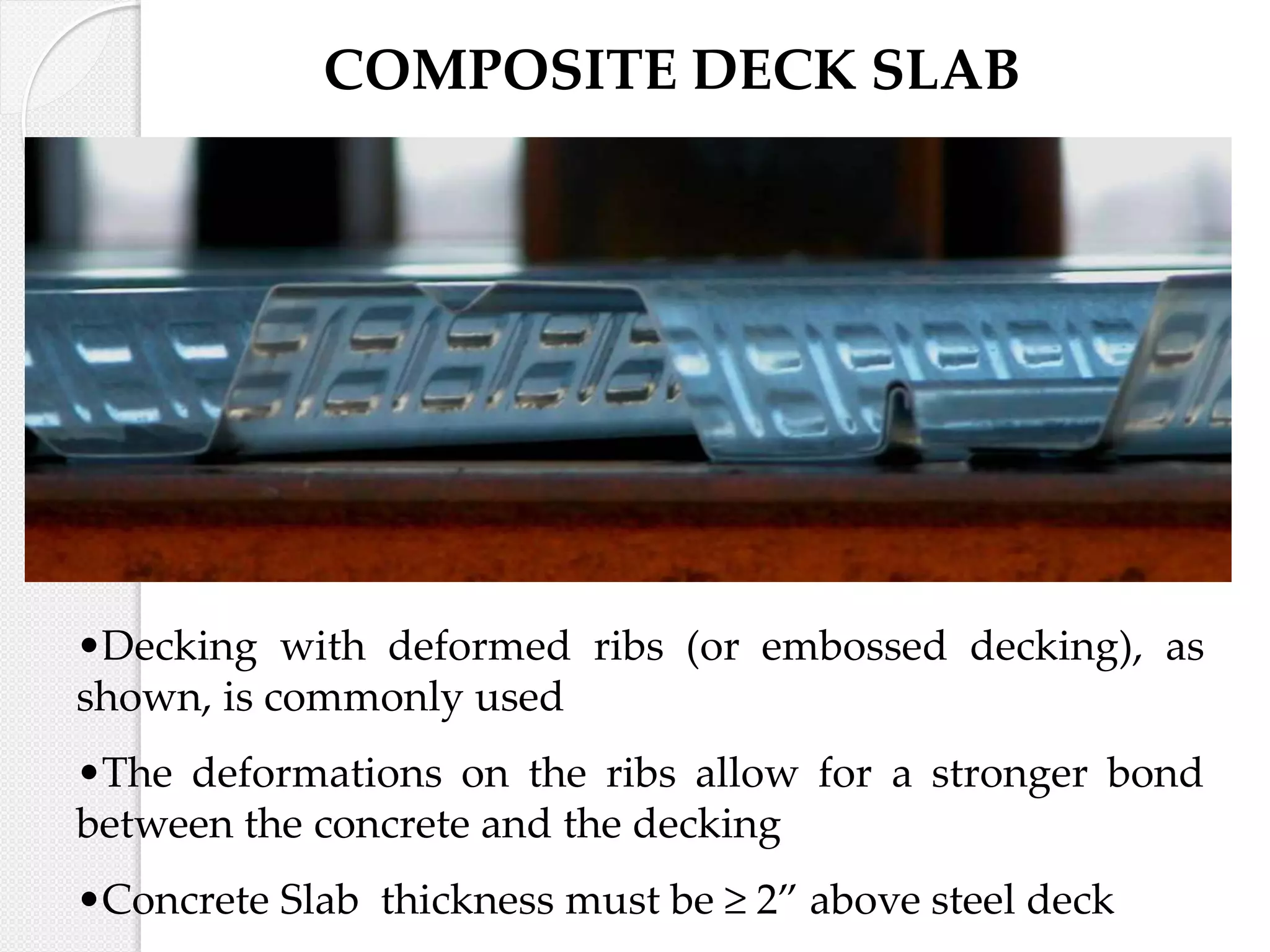
•Decking with deformed ribs (or embossed decking), as
shown, is commonly used
•The deformations on the ribs allow for a stronger bond
between the concrete and the decking
•Concrete Slab thickness must be ≥ 2” above steel deck
COMPOSITE DECK SLAB
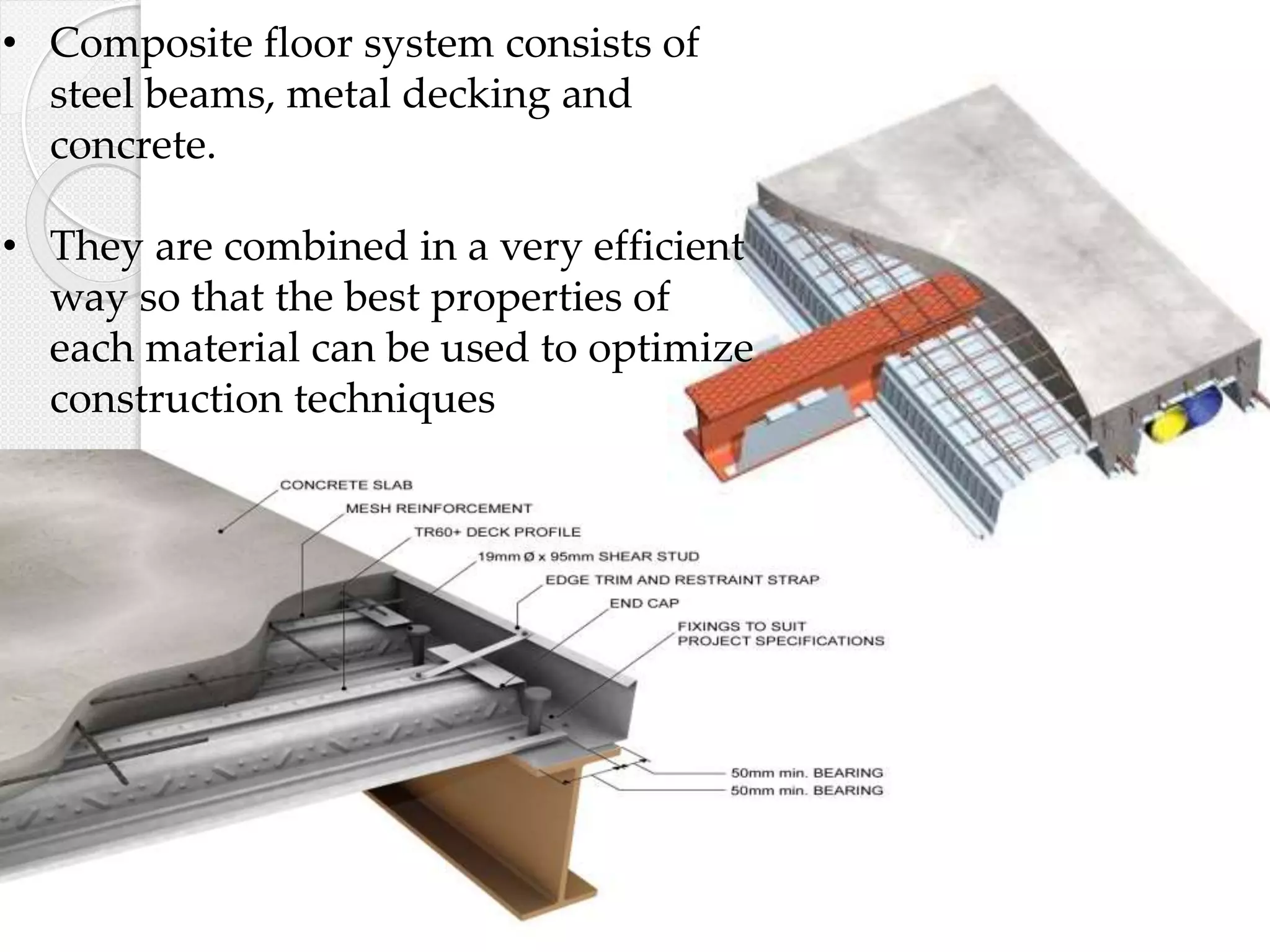
• Composite floor system consists of
steel beams, metal decking and
concrete.
• They are combined in a very efficient
way so that the best properties of
each material can be used to optimize
construction techniques
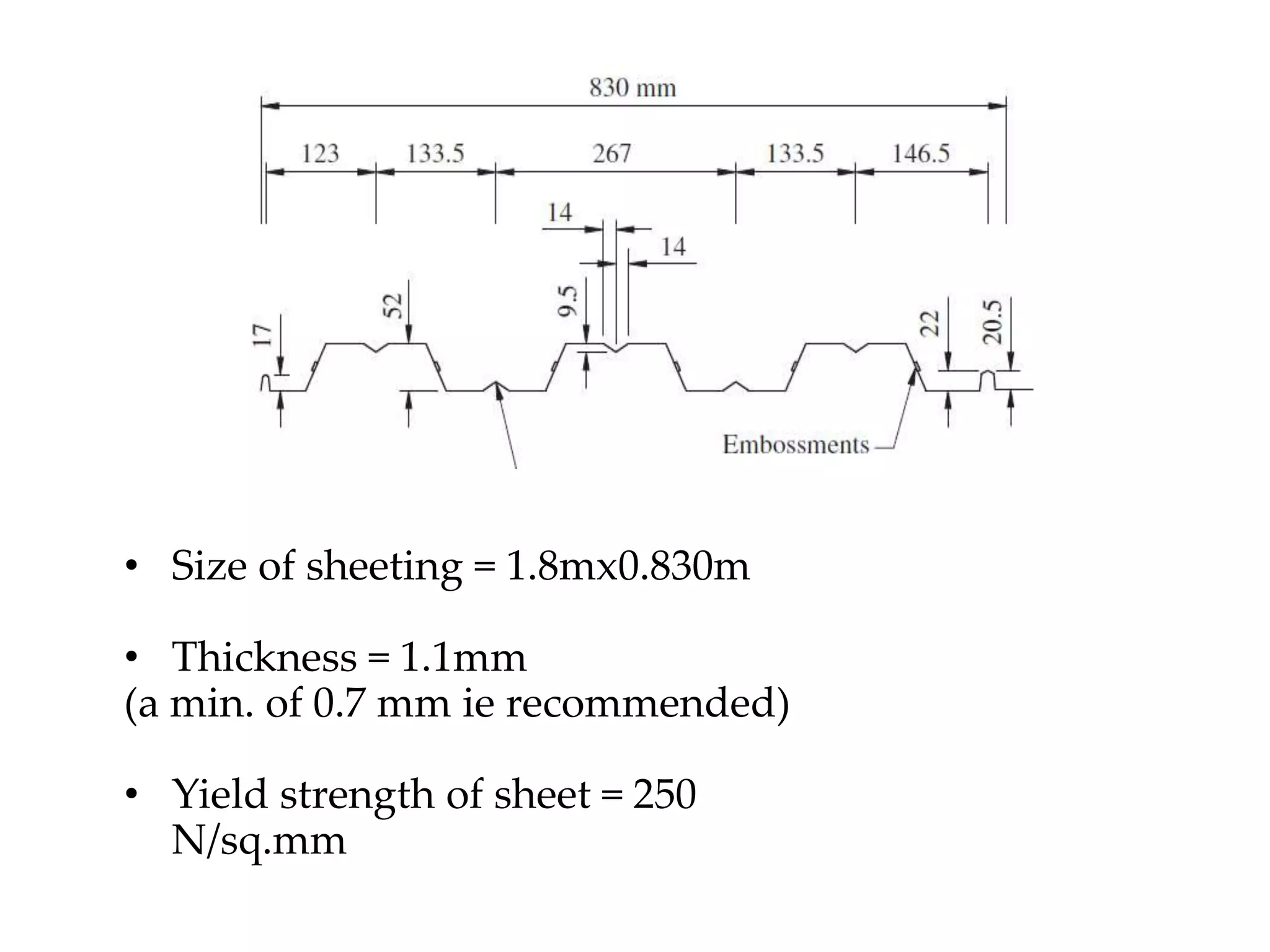
• Size of sheeting = 1.8mx0.830m
• Thickness = 1.1mm
(a min. of 0.7 mm ie recommended)
• Yield strength of sheet = 250
N/sq.mm
• Do not need form work.
• Lightweight concrete is used resulting in
reduced dead weight.
• Decking distributes shrinkage strains, thus
prevents serious cracking.
• Decking stabilizes the beam against lateral
buckling, until the concrete hardens.
Advantages of Profiled decking floors
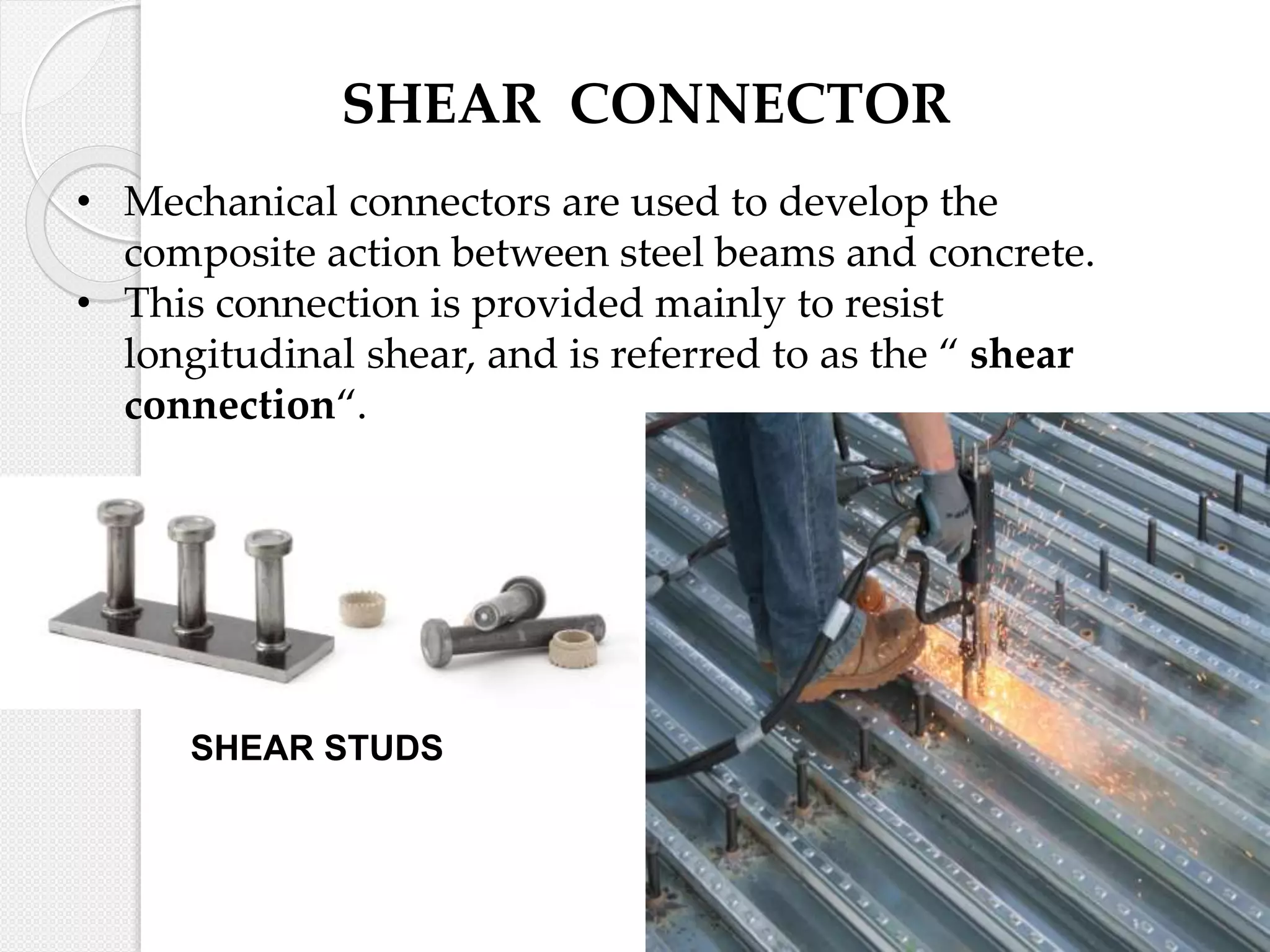
SHEAR CONNECTOR
• Mechanical connectors are used to develop the
composite action between steel beams and concrete.
• This connection is provided mainly to resist
longitudinal shear, and is referred to as the “ shear
connection“.
SHEAR STUDS
REQUIREMENTS OF SHEAR STUDS
• Shear stud diameter ≤ ¾” or ≤ 2.5 tf (prevent tear out).
 (tf – thickness of flange or steel deck )
• Shear studs must extend 1½” above top of deck
• They must transfer direct shear at their base.
• They must create a tensile link into the concrete.
• They must be economic to manufacture and fix.
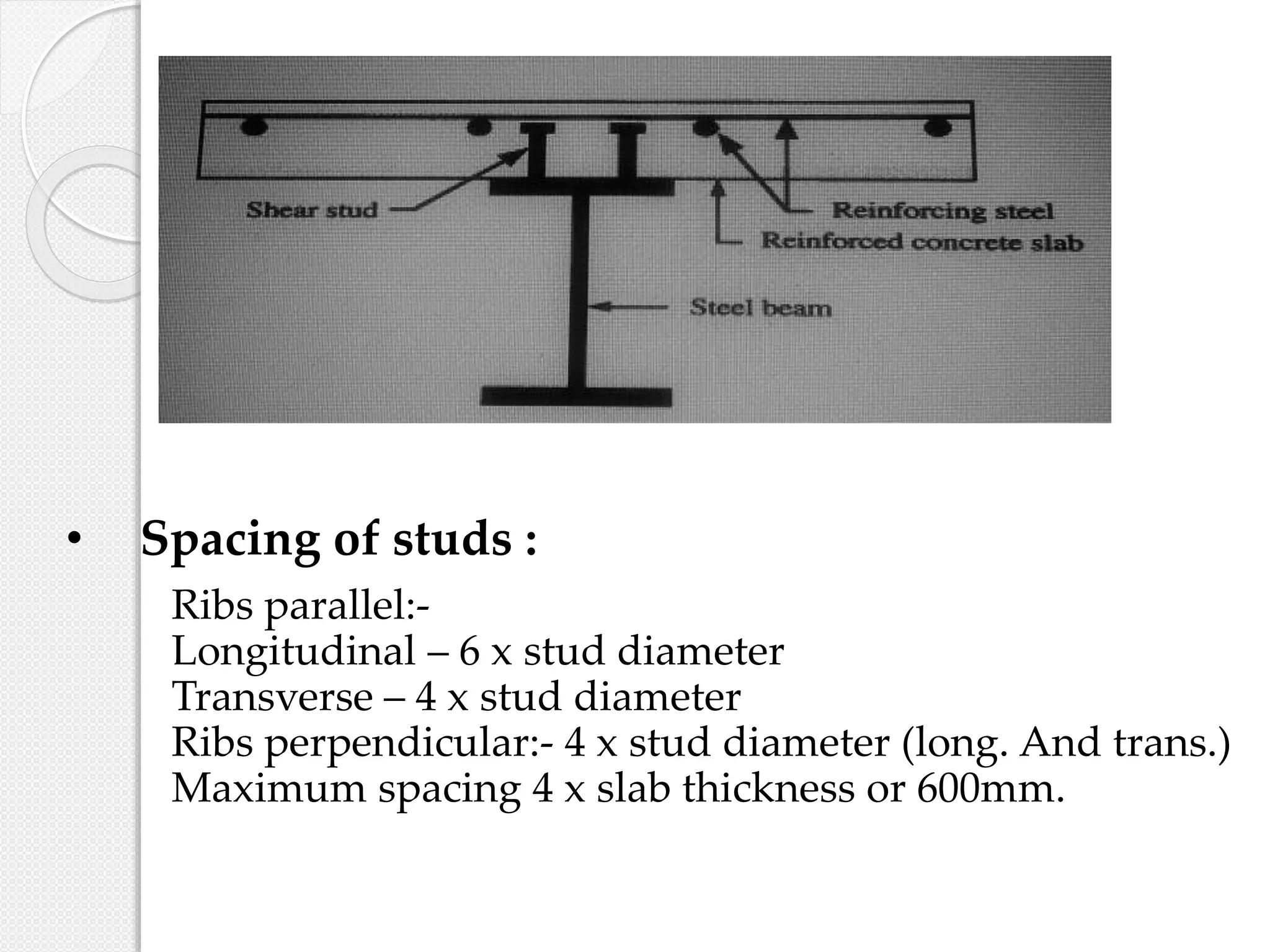
Ribs parallel:-
Longitudinal – 6 x stud diameter
Transverse – 4 x stud diameter
Ribs perpendicular:- 4 x stud diameter (long. And trans.)
Maximum spacing 4 x slab thickness or 600mm.
• Spacing of studs :
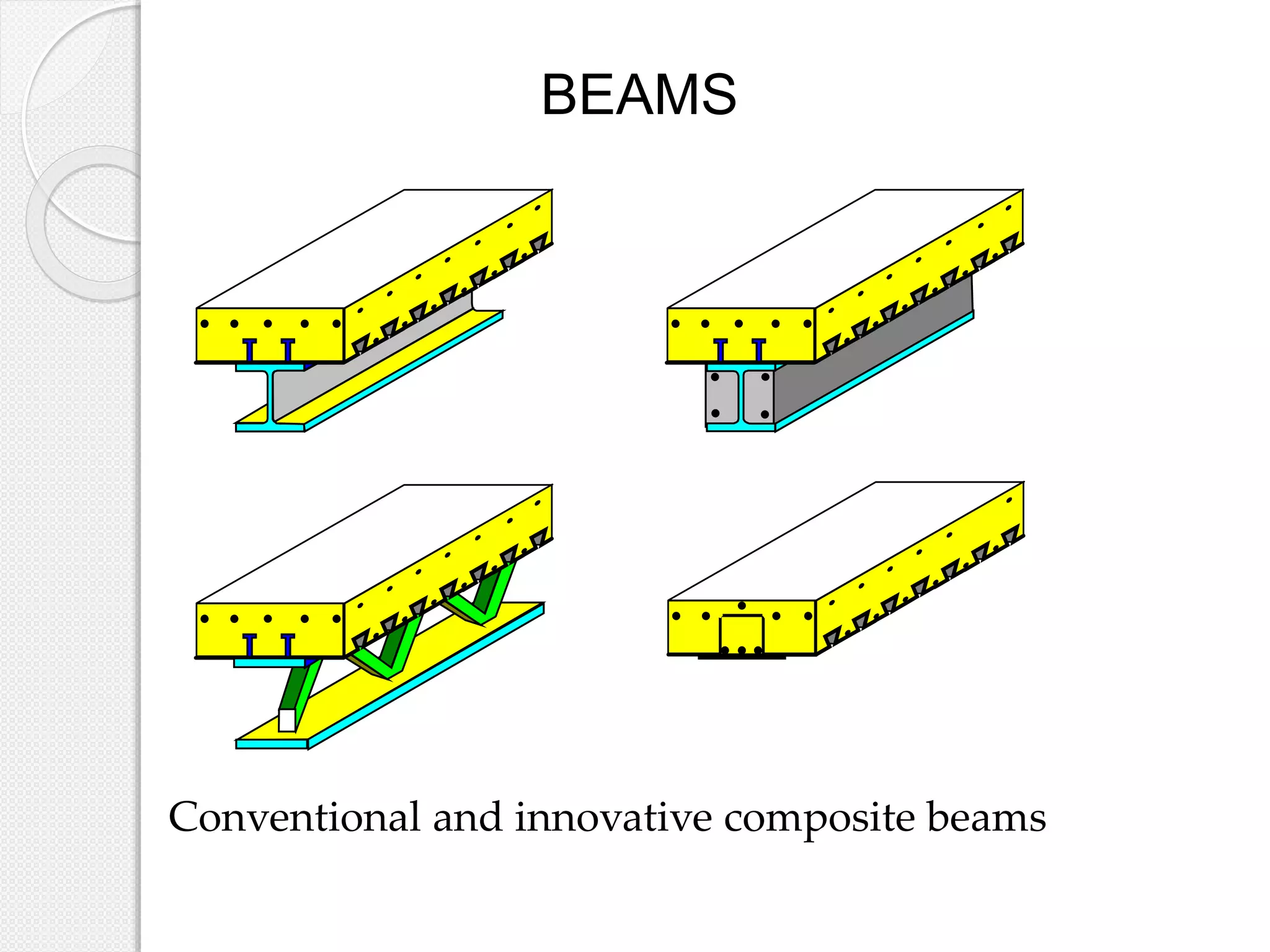
BEAMS
Conventional and innovative composite beams
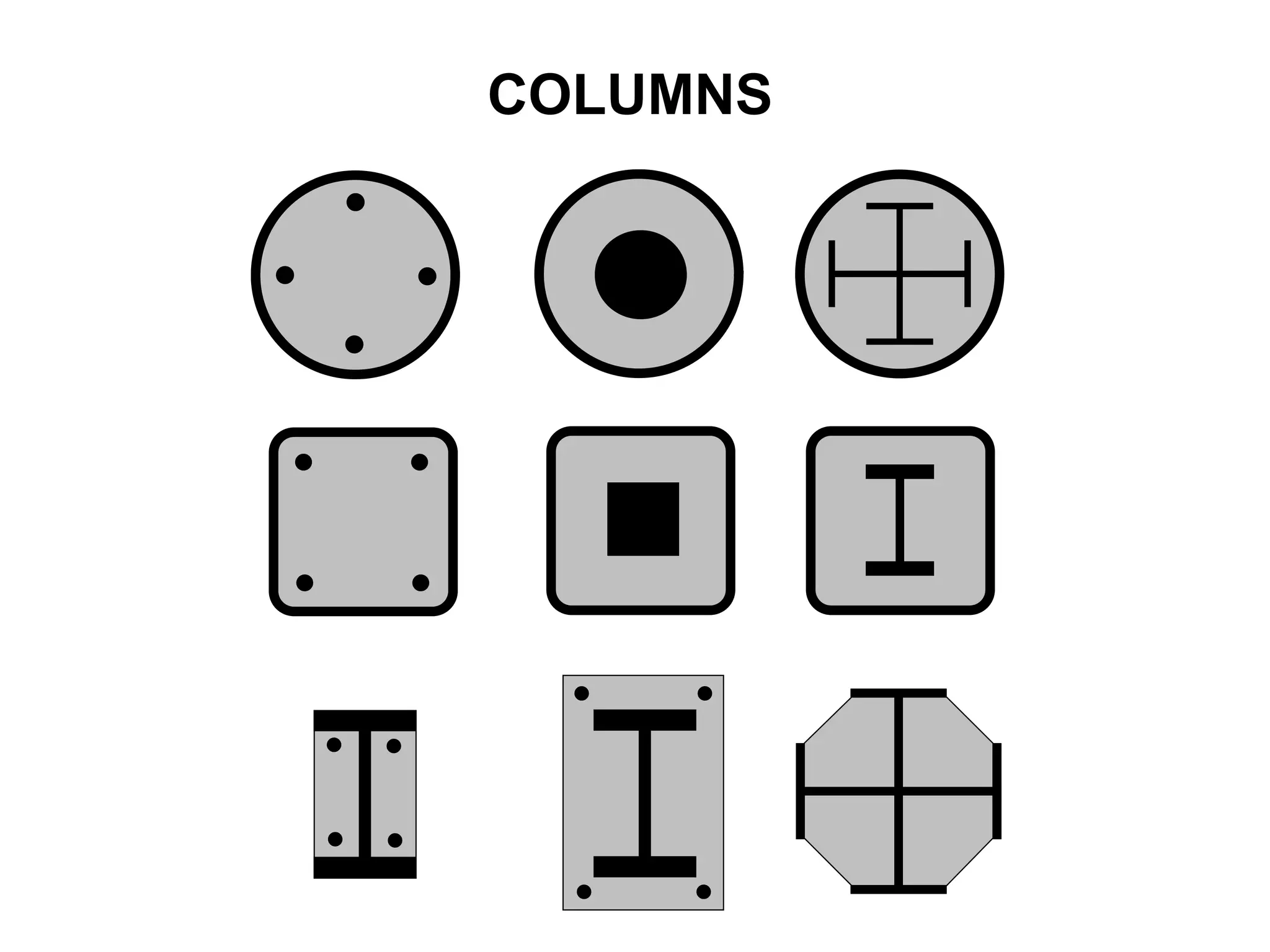
COLUMNS
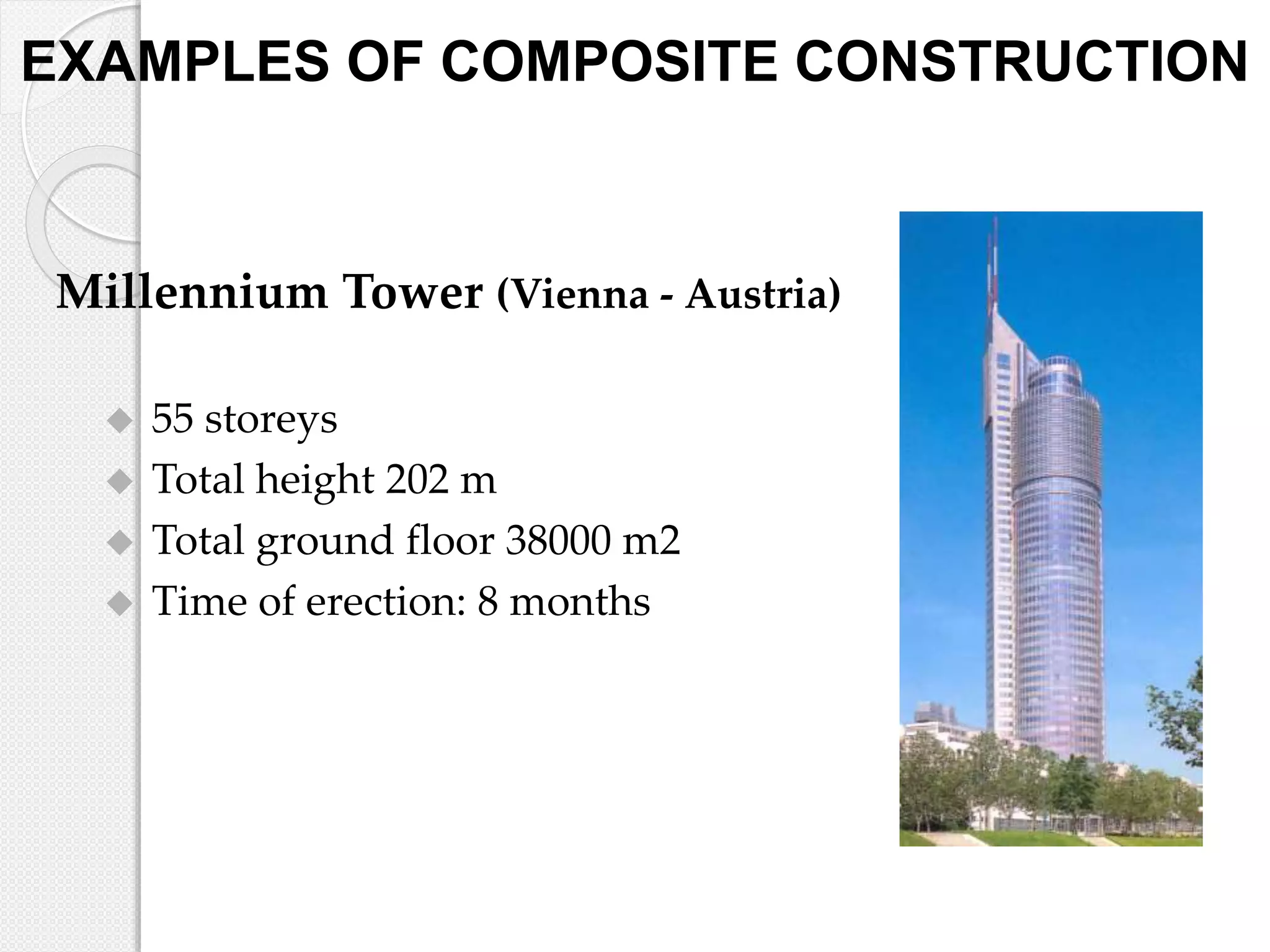
Millennium Tower (Vienna - Austria)
EXAMPLES OF COMPOSITE CONSTRUCTION
 55 storeys
 Total height 202 m
 Total ground floor 38000 m2
 Time of erection: 8 months
Composite columns
Concrete core
Composite Slim floor beams
Concrete slab
42,3 m
Composite
frame
Total time of erection: 8 month
max. speed 2 to 2.5 storeys per week!
Parking deck “DEZ” (Innsbruck - Austria)
 4 storeys
 Ground dimensions 60 x 30 m
 Max. span length 10.58 m with
26 cm slim floor slab (= l/40)
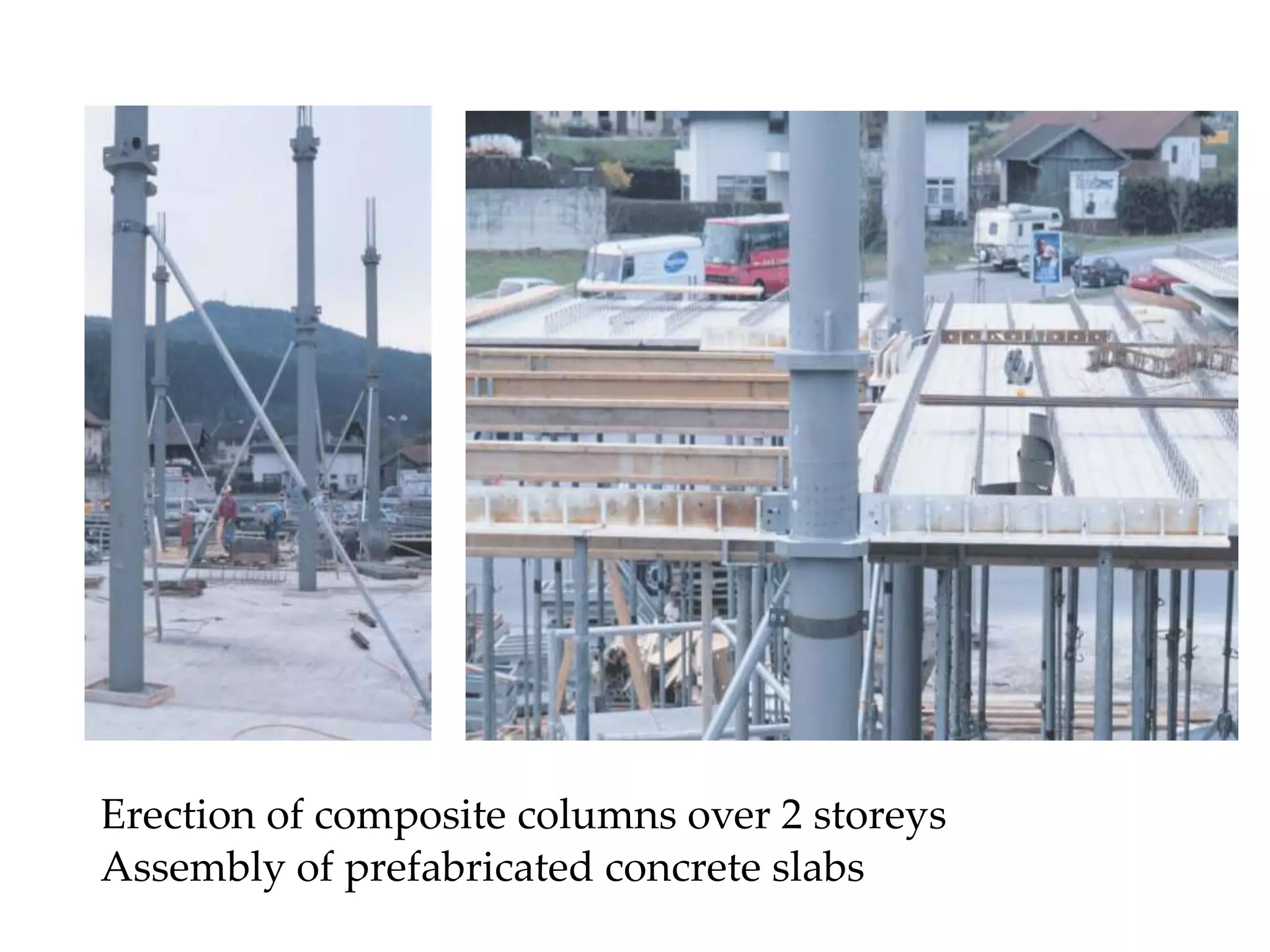
Erection of composite columns over 2 storeys
Assembly of prefabricated concrete slabs
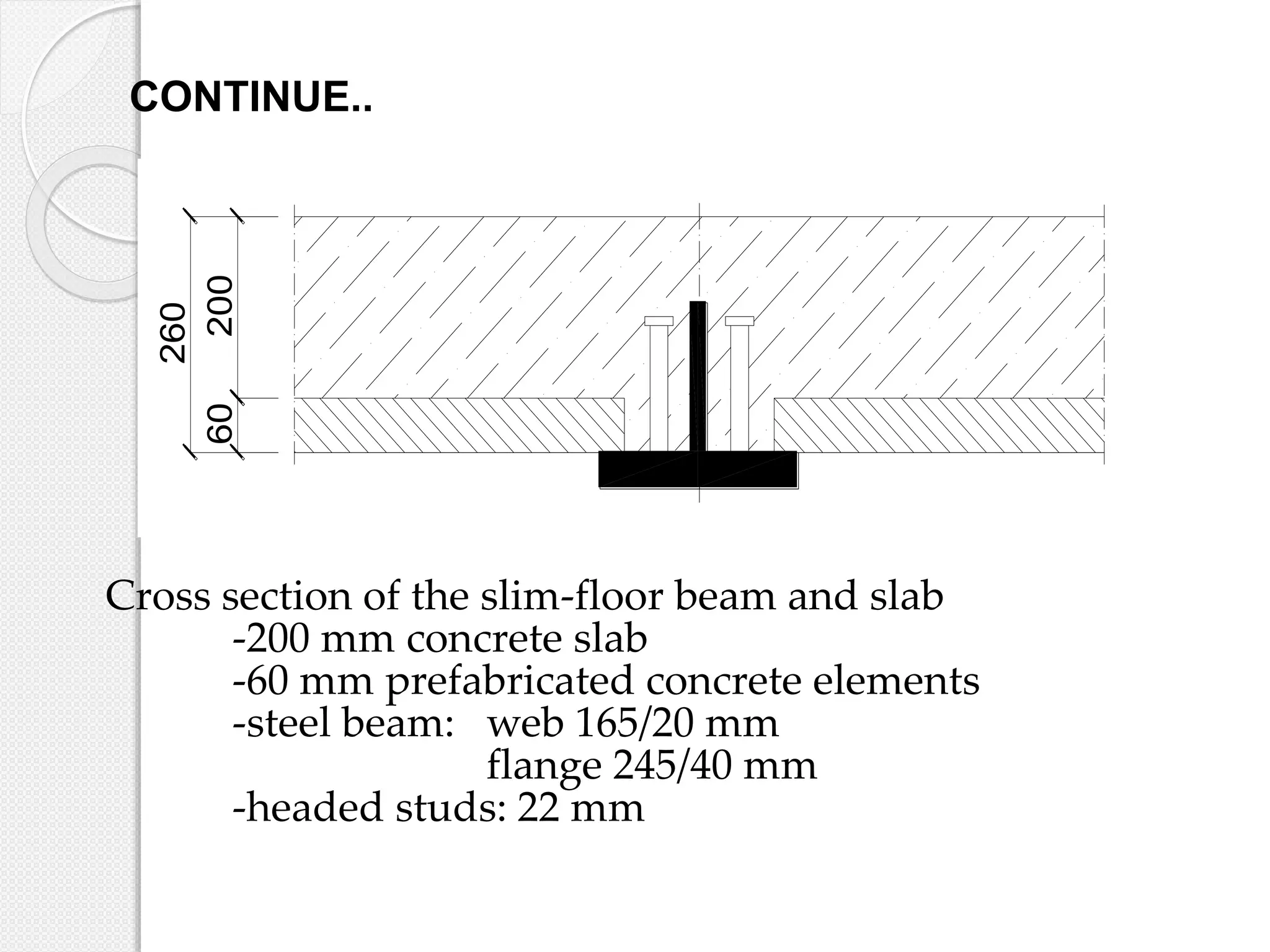
Cross section of the slim-floor beam and slab
-200 mm concrete slab
-60 mm prefabricated concrete elements
-steel beam: web 165/20 mm
flange 245/40 mm
-headed studs: 22 mm
60
260
200
CONTINUE..
COMPARISON OF RCC, STEEL, COMPOSITE
CONSTRUCTION (G+30 STORY)
In the comparative study includes,
• Deflections of the members,
• Size and material consumption of members in composite
with respect to R.C.C. and Steel sections.
Project details:
• Here Zone IV is taken as per IS 1893 : 2000, a typical office
building plan is selected with area covering 24 m x 42 m.
• Modeling was done with ETABS
Cost comparison bar chart for various storeys
CONCLUSION
As the results show the Steel option is better than R.C.C. But the
Composite option for high rise building is best suited among all three
options.
The reduction in the dead weight of the Steel framed structure is 32
% with respect to R.C.C. frame Structure and Composite framed
structure is 30 % with respect to R.C.C. framed structure.
Axial forces in column have been reduced by average 46% in steel
structure and reduced by average 7% in Composite framed
structure as compared to R.C.C. framed structure.
Steel and composite structure gives more ductility to the structure
as compared to the R.C.C. which is best suited under the effect of
lateral forces.
Total saving in the composite option as compared to the R.C.C.
results in 10 % so as with Steel it will be 6-7%.
http://bcef.in/Download/new/Articles/Comparative%20study%20of%20RCC-Steel-
Composite%20high%20rise%20building.pdf
http://www.ijera.com/papers/Vol4_issue4/Version%201/BI044369376.pdf
file:///F:/MINI%20PROJECT/seminar/composite%20structure%20(31-38).pdf
file:///F:/MINI%20PROJECT/seminar/COMPOSITE%201.pdf
http://www.steel-insdag.org/TeachingMaterial/chapter21.pdf
https://www.google.co.in/?gws_rd=ssl
References
Composite construction or Composite Structure/Frame

Composite construction or Composite Structure/Frame

  • 1.
    Presented by: Syed AbdulRahman The Composite Construction
  • 2.
    • The twocomplementary materials, structural steel and reinforced concrete, are introduced. • To explain the composite action of the two different materials and to show how the structural members are used, particularly in building construction. • The use of composite construction for buildings is outlined. • Its Advantages and Disadvantages are also illustrated. Objective
  • 3.
    Introduction  The mostimportant and most frequently encountered combination of construction materials is that of steel and concrete, with applications in multi-storey commercial buildings and factories, as well as in bridges.  Composite construction refers to two load-carrying structural members that are integrally connected and deflect as a single unit.  This has become a standard type of construction in high rise buildings selected by many Architects , Engineers and Developers.  Composite floor systems are considered by many to be the highest quality type of construction.
  • 4.
    These essentially differentmaterials are completely compatible and complementary to each other.  Almost the same thermal expansion;  An ideal combination of strengths with the concrete efficient in compression and the steel in tension;  Concrete also gives corrosion protection and thermal insulation to the steel at elevated temperatures.  The Indian Code of Practice for Composite Construction in Structural Steel and Concrete (IS: 11384 – 1985) Introduction...
  • 5.
    The Indian Codeof Practice for Composite Construction in Structural Steel and Concrete (IS: 11384 – 1985) • The maximum strain in concrete at outermost compression member is taken as 0.0035 in bending. • The total compressive force in concrete is given by and this acts at a depth of 0.42 xu, not exceeding ds. • The stress strain curve for steel section and concrete are as per IS: 456- 1978. • A stress factor is applied to convert the concrete section into steel. Fcc = 0.36 (fck) bXu a = 0.87 fy/0.36(fck)
  • 6.
    Advantages Composite construction usedfor commercial and other multi-storey buildings, offers the following main advantages to the designer and client • The concrete acts together with the steel to create a stiffer, lighter, less expensive structure . • Speed and simplicity of construction - Faster to erect, nearly 25% faster then traditional construction. • Lighter construction than a traditional concrete building. • Less material handling at site. • Has better ductility and hence superior lateral load behavior; better earthquake resistance. • Ability to cover large column free area in buildings and longer span for bridges/flyovers.
  • 7.
    • Floors • ShearConnections • Columns • Bracing Systems Anatomy of composite construction Floors = Slab + Beams Note: Mainly will discus on type of floors and connections.
  • 8.
    Common Types ofFloor Systems • Concrete slabs supported by open-web joists • One-way and two-way reinforced concrete slabs supported on steel beams • Concrete slab and steel beam composite floors • Composite profiled decking floors • Precast concrete floors on steel beams Note: The most common arrangement found in composite floor systems is a rolled or built-up steel beam connected to a formed steel deck and concrete slab. Mostly Profiled Decking Floors system is used in composite construction.
  • 9.
    •Decking with deformedribs (or embossed decking), as shown, is commonly used •The deformations on the ribs allow for a stronger bond between the concrete and the decking •Concrete Slab thickness must be ≥ 2” above steel deck COMPOSITE DECK SLAB
  • 10.
    • Composite floorsystem consists of steel beams, metal decking and concrete. • They are combined in a very efficient way so that the best properties of each material can be used to optimize construction techniques
  • 11.
    • Size ofsheeting = 1.8mx0.830m • Thickness = 1.1mm (a min. of 0.7 mm ie recommended) • Yield strength of sheet = 250 N/sq.mm
  • 12.
    • Do notneed form work. • Lightweight concrete is used resulting in reduced dead weight. • Decking distributes shrinkage strains, thus prevents serious cracking. • Decking stabilizes the beam against lateral buckling, until the concrete hardens. Advantages of Profiled decking floors
  • 13.
    SHEAR CONNECTOR • Mechanicalconnectors are used to develop the composite action between steel beams and concrete. • This connection is provided mainly to resist longitudinal shear, and is referred to as the “ shear connection“. SHEAR STUDS
  • 14.
    REQUIREMENTS OF SHEARSTUDS • Shear stud diameter ≤ ¾” or ≤ 2.5 tf (prevent tear out).  (tf – thickness of flange or steel deck ) • Shear studs must extend 1½” above top of deck • They must transfer direct shear at their base. • They must create a tensile link into the concrete. • They must be economic to manufacture and fix.
  • 15.
    Ribs parallel:- Longitudinal –6 x stud diameter Transverse – 4 x stud diameter Ribs perpendicular:- 4 x stud diameter (long. And trans.) Maximum spacing 4 x slab thickness or 600mm. • Spacing of studs :
  • 16.
  • 17.
  • 18.
    Millennium Tower (Vienna- Austria) EXAMPLES OF COMPOSITE CONSTRUCTION  55 storeys  Total height 202 m  Total ground floor 38000 m2  Time of erection: 8 months
  • 19.
    Composite columns Concrete core CompositeSlim floor beams Concrete slab 42,3 m Composite frame Total time of erection: 8 month max. speed 2 to 2.5 storeys per week!
  • 20.
    Parking deck “DEZ”(Innsbruck - Austria)  4 storeys  Ground dimensions 60 x 30 m  Max. span length 10.58 m with 26 cm slim floor slab (= l/40)
  • 21.
    Erection of compositecolumns over 2 storeys Assembly of prefabricated concrete slabs
  • 22.
    Cross section ofthe slim-floor beam and slab -200 mm concrete slab -60 mm prefabricated concrete elements -steel beam: web 165/20 mm flange 245/40 mm -headed studs: 22 mm 60 260 200 CONTINUE..
  • 23.
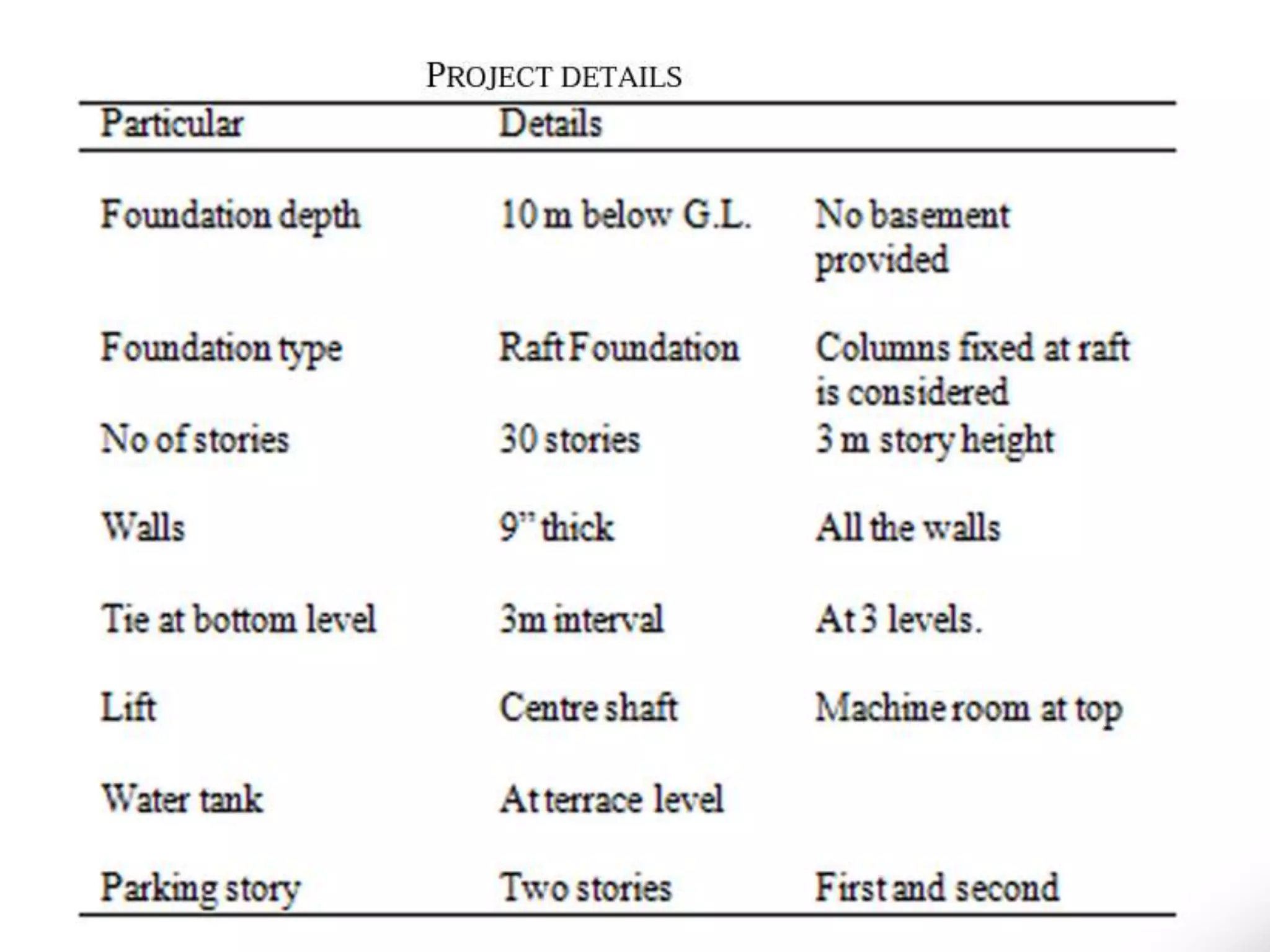
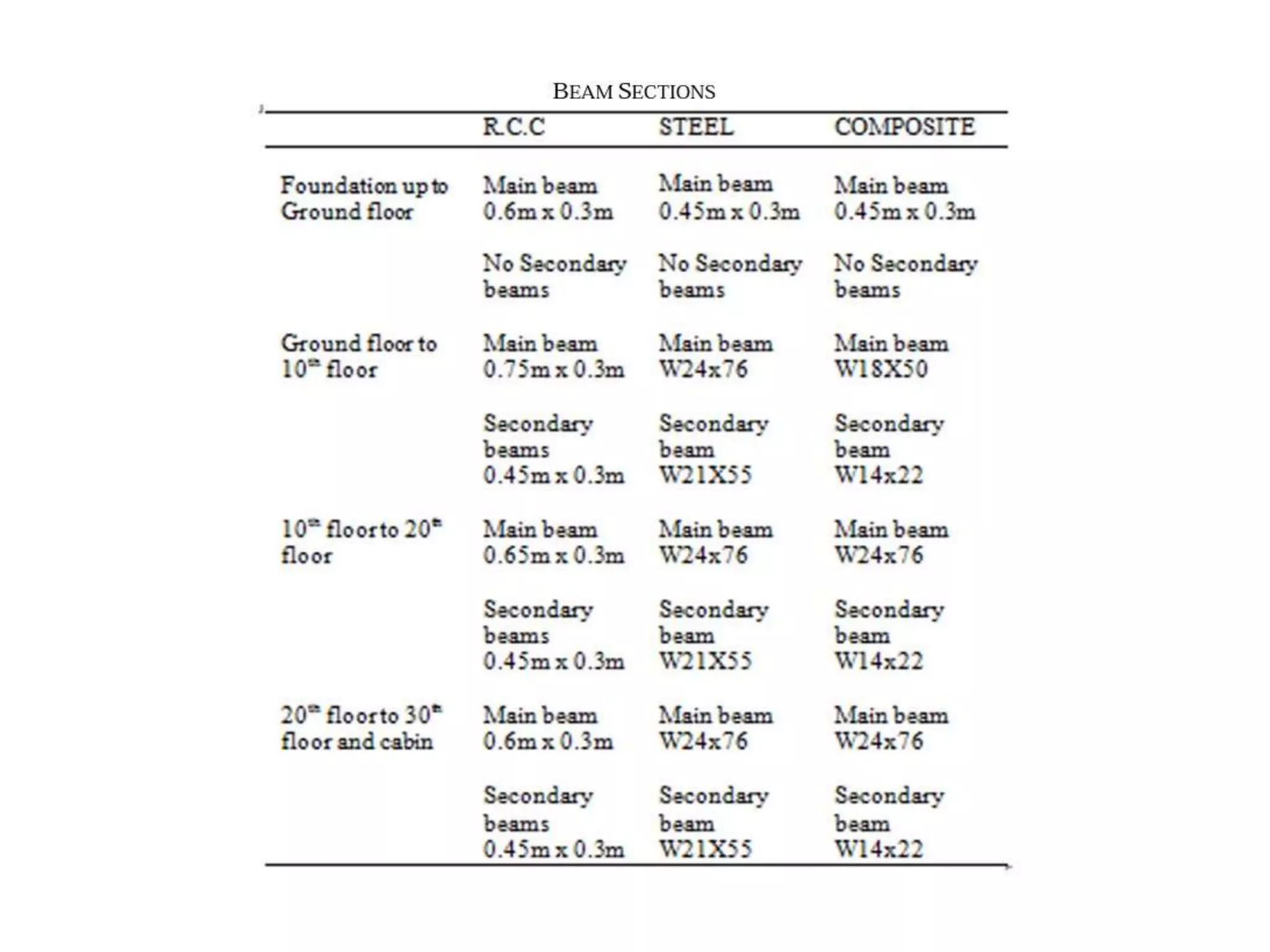
    COMPARISON OF RCC,STEEL, COMPOSITE CONSTRUCTION (G+30 STORY) In the comparative study includes, • Deflections of the members, • Size and material consumption of members in composite with respect to R.C.C. and Steel sections. Project details: • Here Zone IV is taken as per IS 1893 : 2000, a typical office building plan is selected with area covering 24 m x 42 m. • Modeling was done with ETABS
  • 28.
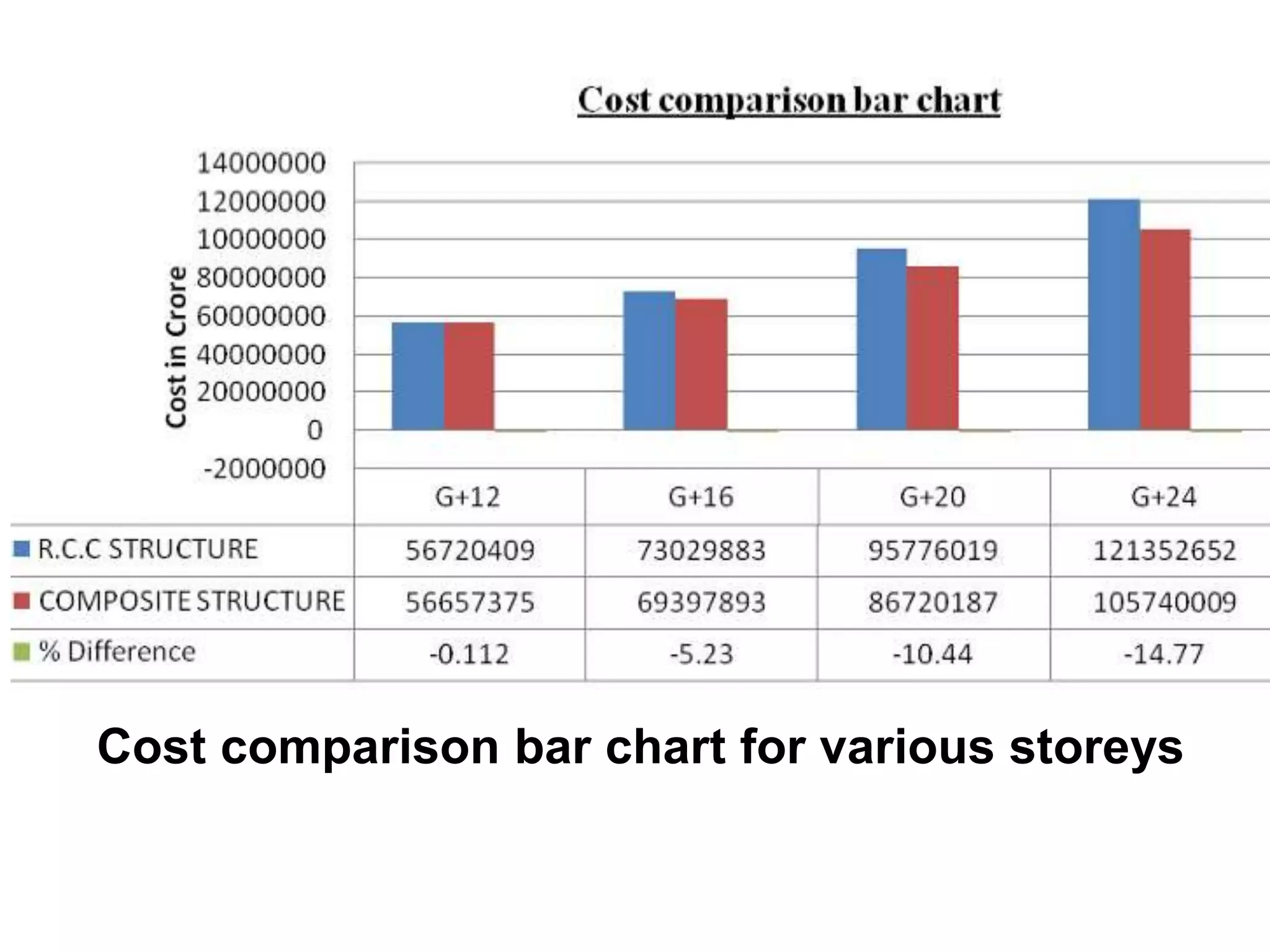
    Cost comparison barchart for various storeys
  • 29.
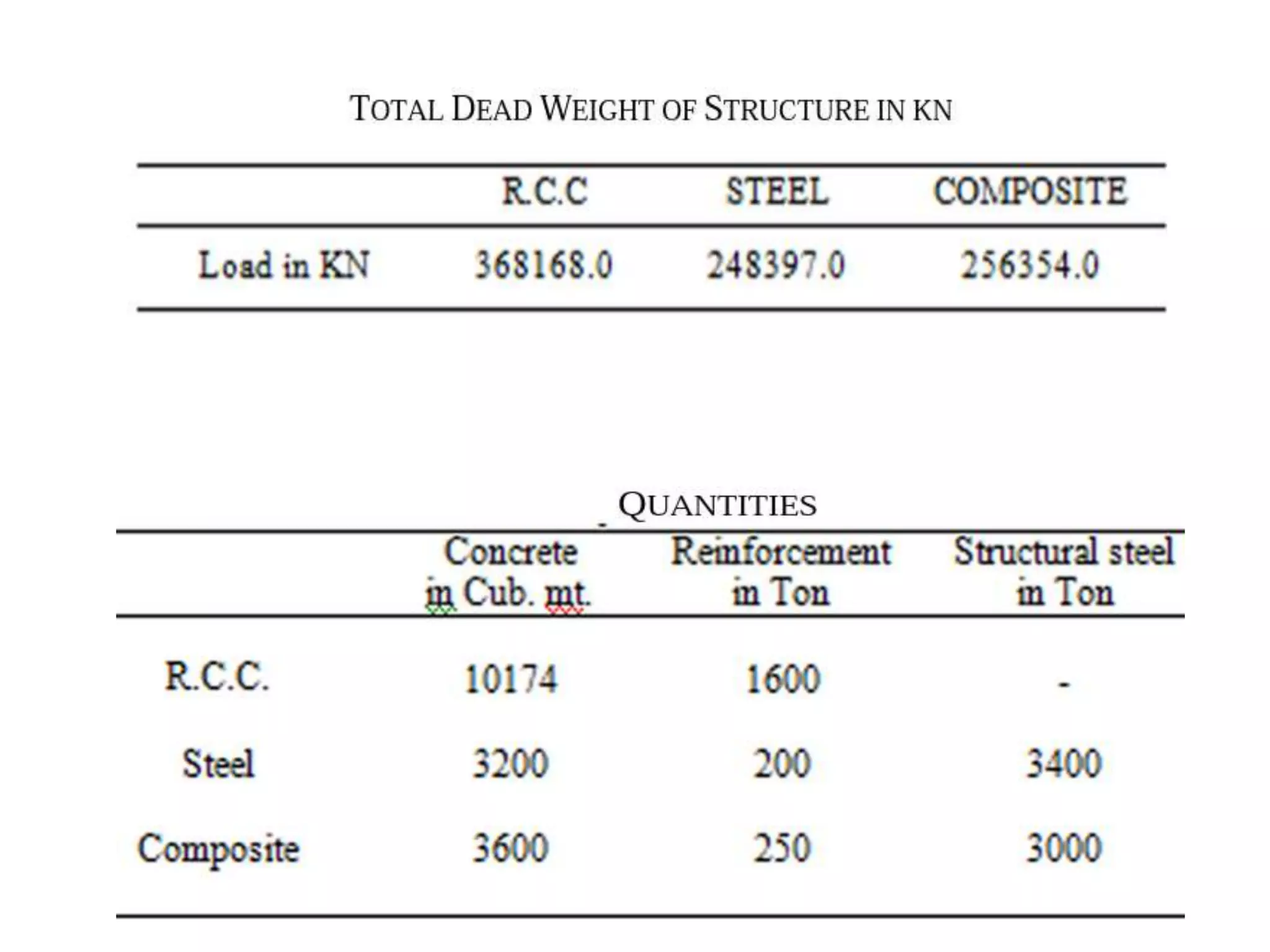
    CONCLUSION As the resultsshow the Steel option is better than R.C.C. But the Composite option for high rise building is best suited among all three options. The reduction in the dead weight of the Steel framed structure is 32 % with respect to R.C.C. frame Structure and Composite framed structure is 30 % with respect to R.C.C. framed structure. Axial forces in column have been reduced by average 46% in steel structure and reduced by average 7% in Composite framed structure as compared to R.C.C. framed structure. Steel and composite structure gives more ductility to the structure as compared to the R.C.C. which is best suited under the effect of lateral forces. Total saving in the composite option as compared to the R.C.C. results in 10 % so as with Steel it will be 6-7%.
  • 30.

Editor's Notes

  • #4  A composite member is defined as consisting of a rolled or a built-up structural steel shape that is either filled with concrete, encased by reinforced concrete or structurally connected to a reinforced concrete slab. Composite members are constructed such that the structural steel shape and the concrete act together to resist axial compression and /or bending.
  • #5  a stress factor a = 0.87 fy/0.36(fck)cu is applied to convert the concrete section into steel.
  • #7 Ability to cover large column free area in buildings and longer span for bridges/flyovers. This leads to more usable space. Reduced beam depth reduces the story height and consequently the cost of cladding in a building and lowers the cost of embankment in a flyover. More use of a material i.e. steel, which is durable, fully recyclable on replacement and environment friendly. Reductions in overall weight of structure and thereby reduction in foundation costs.
  • #10 The decking not only acts as permanent formwork to the concrete, but also provides sufficient shear bond with the concrete so that, when the concrete has gained strength, the two materials act together compositely.
  • #14 Composite beams are normally hot rolled or fabricated steel sections that act compositely with the slab. The composite interaction is achieved by the attachment of shear connectors to the top flange of the beam. These connectors generally take the form of headed studs.
  • #30 Shear forces in secondary beams are increased by average 83.3% in steel structure and reduced by average 10 % in composite structure as compared to R.C.C. framed structure while in main beams shear forces are increased by average 131% in steel structure and reduced by average 100 % in composite structure as compared to R.C.C. framed structure. Bending moments in secondary beams are increased by average 83.3% in steel structure and reduced by average 48 % in composite structure as compared to R.C.C. framed structure while in main beams bending moments are increased 131% in steel structure and increased by average 117 % in composite structure as compared to R.C.C. framed structure.