The wow
factor!
How?
What?
Barsha (BA13ARC009), Mansi(BA13ARC031), Pranjal(BA13ARC028), Mohit(BA13ARC036)
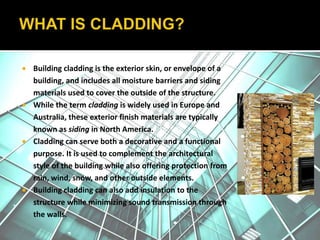
 Building cladding is the exterior skin, or envelope of a
building, and includes all moisture barriers and siding
materials used to cover the outside of the structure.
 While the term cladding is widely used in Europe and
Australia, these exterior finish materials are typically
known as siding in North America.
 Cladding can serve both a decorative and a functional
purpose. It is used to complement the architectural
style of the building while also offering protection from
rain, wind, snow, and other outside elements.
 Building cladding can also add insulation to the
structure while minimizing sound transmission through
the walls.
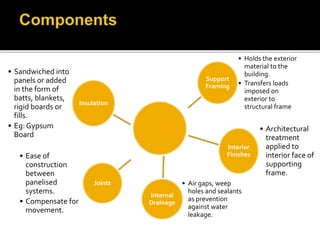
Support
Framing
• Holds the exterior
material to the
building.
• Transfers loads
imposed on
exterior to
structural frame
Interior
Finishes
• Architectural
treatment
applied to
interior face of
supporting
frame.
Internal
Drainage
• Air gaps, weep
holes and sealants
as prevention
against water
leakage.
Insulation
• Sandwiched into
panels or added
in the form of
batts, blankets,
rigid boards or
fills.
• Eg: Gypsum
Board
Joints
• Ease of
construction
between
panelised
systems.
• Compensate for
movement.
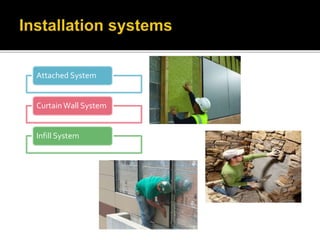
Attached System
Curtain Wall System
Infill System
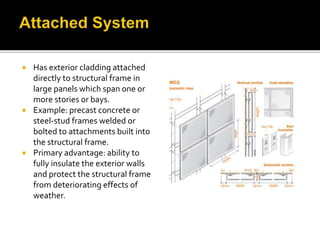
 Has exterior cladding attached
directly to structural frame in
large panels which span one or
more stories or bays.
 Example: precast concrete or
steel-stud frames welded or
bolted to attachments built into
the structural frame.
 Primary advantage: ability to
fully insulate the exterior walls
and protect the structural frame
from deteriorating effects of
weather.
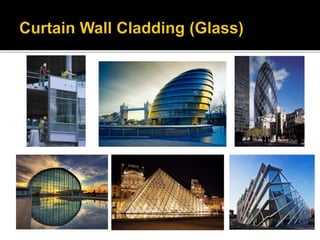
 Similar to attached system
except it is attached to the
structural frame with clip
angles or sub-framing.
 Examples: metal or glass
walls which enclose most
modern skyscrapers.Also,
natural stones and light
weight precast panels.
 Primary advantage:
standard design requiring
less time in pre-construction
and manufacturing.
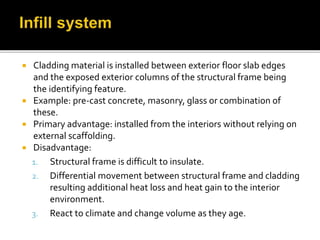
 Cladding material is installed between exterior floor slab edges
and the exposed exterior columns of the structural frame being
the identifying feature.
 Example: pre-cast concrete, masonry, glass or combination of
these.
 Primary advantage: installed from the interiors without relying on
external scaffolding.
 Disadvantage:
1. Structural frame is difficult to insulate.
2. Differential movement between structural frame and cladding
resulting additional heat loss and heat gain to the interior
environment.
3. React to climate and change volume as they age.
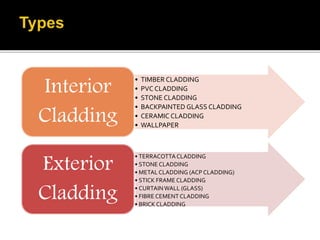
• TIMBER CLADDING
• PVC CLADDING
• STONE CLADDING
• BACKPAINTED GLASS CLADDING
• CERAMIC CLADDING
• WALLPAPER
Interior
Cladding
• TERRACOTTACLADDING
• STONE CLADDING
• METALCLADDING (ACP CLADDING)
• STICK FRAME CLADDING
• CURTAINWALL (GLASS)
• FIBRE CEMENTCLADDING
• BRICK CLADDING
Exterior
Cladding
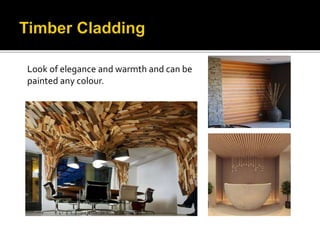
Look of elegance and warmth and can be
painted any colour.
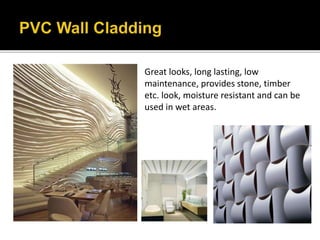
Great looks, long lasting, low
maintenance, provides stone, timber
etc. look, moisture resistant and can be
used in wet areas.
Popular interior wall cladding feature
in homes and commercial buildings.
Provides posh, clean and sophisticated
look.
Colour Spray is a
uniquely
formulated resin
based paint system
which is ideal for
the back painting of
glass for wall
claddings in any
colour imaginable.
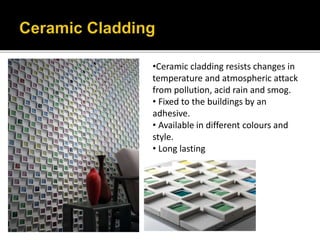
•Ceramic cladding resists changes in
temperature and atmospheric attack
from pollution, acid rain and smog.
• Fixed to the buildings by an
adhesive.
• Available in different colours and
style.
• Long lasting
Used for completely aesthetic purposes they
are available in infinite number of patterns and
designs. Due to their texture and sheen, they
score over paints. They are paper, vinyl and real
fabric based.
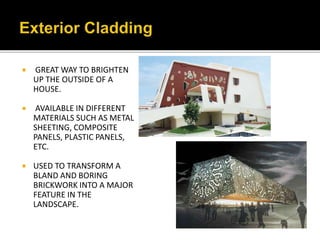
 GREAT WAY TO BRIGHTEN
UP THE OUTSIDE OF A
HOUSE.
 AVAILABLE IN DIFFERENT
MATERIALS SUCH AS METAL
SHEETING, COMPOSITE
PANELS, PLASTIC PANELS,
ETC.
 USED TO TRANSFORM A
BLAND AND BORING
BRICKWORK INTO A MAJOR
FEATURE IN THE
LANDSCAPE.
 Aluminium composite panels (ACP) &
extruded aluminium are used. They are light
weight, non-corrosive and recyclable in
nature, have high strength-to-weight ratio and
come in diverse colours and finishes.
 Copper, another type of metal cladding is
used for its aesthetics alone.
 Zinc is very expensive but aesthetically eye-
catching and durable.
Natural clay based tiles factory
extruded and kiln dried to provide a
durable cladding product. Colour is
created by adding specific dyes,
custom shapes also possible.
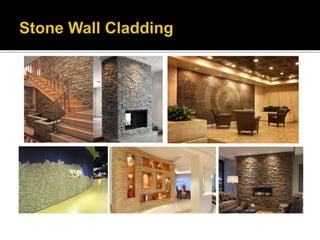
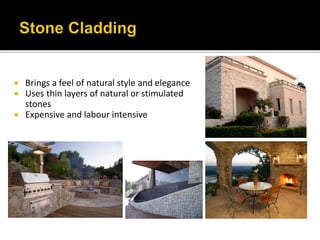
 Brings a feel of natural style and elegance
 Uses thin layers of natural or stimulated
stones
 Expensive and labour intensive
 For safety reasons, brick
cladding is not
recommended in seismically
active areas, where bricks
could collapse during an
earthquake.
 Brick cladding is designed to
shed and repel water so
that the water cannot reach
the internal framing of the
building. This reduces the
risk of damage to the
framing caused by mold and
mildew. It also keeps the
interior dry and pleasant.
 Timber cladding is done in dry areas and hilly areas.
 Effective temperature insulator as it keeps the interior cool.
 Fitted by tongue and groove joints mostly.
 Requires thorough maintenance.
 Small tiles plastered onto the
wall surface for aesthetic
appeal.
 Has no insulation property.
 Available in variety of colours.
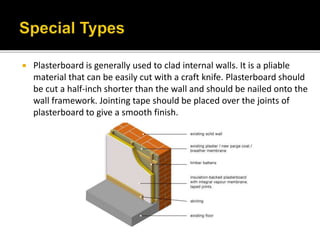
 Plasterboard is generally used to clad internal walls. It is a pliable
material that can be easily cut with a craft knife. Plasterboard should
be cut a half-inch shorter than the wall and should be nailed onto the
wall framework. Jointing tape should be placed over the joints of
plasterboard to give a smooth finish.
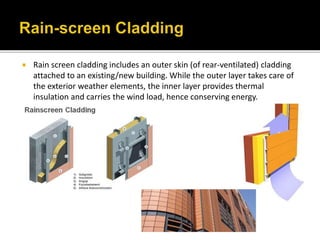
 Rain screen cladding includes an outer skin (of rear-ventilated) cladding
attached to an existing/new building. While the outer layer takes care of
the exterior weather elements, the inner layer provides thermal
insulation and carries the wind load, hence conserving energy.
 With the advent of green buildings, the trend of green walls have
come into place. It can be installed both in the interiors and the
exterior.
Application of aluminum or vinyl sheeting ,cut and
formed with a brake to fit over the exterior, wood trim
of a building is called window capping. The aluminum is
intended to make aging trim with peeling paint look
better, reduce future paint maintenance, and provide
a weather-proof layer to control the infiltration of
water.
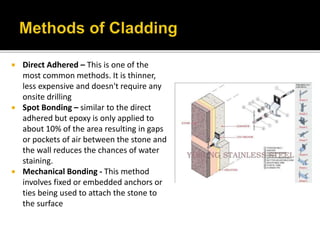
 Direct Adhered – This is one of the
most common methods. It is thinner,
less expensive and doesn't require any
onsite drilling
 Spot Bonding – similar to the direct
adhered but epoxy is only applied to
about 10% of the area resulting in gaps
or pockets of air between the stone and
the wall reduces the chances of water
staining.
 Mechanical Bonding - This method
involves fixed or embedded anchors or
ties being used to attach the stone to
the surface
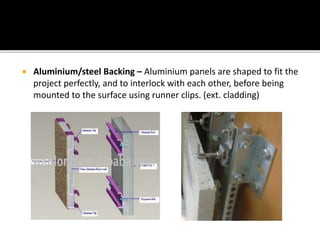
 Aluminium/steel Backing – Aluminium panels are shaped to fit the
project perfectly, and to interlock with each other, before being
mounted to the surface using runner clips. (ext. cladding)
ADVANTAGE DISADVANATGE
 Initial installation is costlier
than normal paint.
 Needs timely maintainance.
 If not installed propoerly, the
units tend to fall off.
 Installation time is huge
depending on the surface of
the building
 Low Maintenance
 Can be easily cleaned
 Protection from weather
elements
 Noise, heat control
 Light weight
 Aesthetic appeal
 Cladding: council on tall buildings and habitats, McGrawHill
Publishing House.
 Wikipedia
 Tatasteelconstruction

cladding

  • 1.
    The wow factor! How? What? Barsha (BA13ARC009),Mansi(BA13ARC031), Pranjal(BA13ARC028), Mohit(BA13ARC036)
  • 2.
     Building claddingis the exterior skin, or envelope of a building, and includes all moisture barriers and siding materials used to cover the outside of the structure.  While the term cladding is widely used in Europe and Australia, these exterior finish materials are typically known as siding in North America.  Cladding can serve both a decorative and a functional purpose. It is used to complement the architectural style of the building while also offering protection from rain, wind, snow, and other outside elements.  Building cladding can also add insulation to the structure while minimizing sound transmission through the walls.
  • 3.
    Support Framing • Holds theexterior material to the building. • Transfers loads imposed on exterior to structural frame Interior Finishes • Architectural treatment applied to interior face of supporting frame. Internal Drainage • Air gaps, weep holes and sealants as prevention against water leakage. Insulation • Sandwiched into panels or added in the form of batts, blankets, rigid boards or fills. • Eg: Gypsum Board Joints • Ease of construction between panelised systems. • Compensate for movement.
  • 4.
    Attached System Curtain WallSystem Infill System
  • 5.
     Has exteriorcladding attached directly to structural frame in large panels which span one or more stories or bays.  Example: precast concrete or steel-stud frames welded or bolted to attachments built into the structural frame.  Primary advantage: ability to fully insulate the exterior walls and protect the structural frame from deteriorating effects of weather.
  • 6.
     Similar toattached system except it is attached to the structural frame with clip angles or sub-framing.  Examples: metal or glass walls which enclose most modern skyscrapers.Also, natural stones and light weight precast panels.  Primary advantage: standard design requiring less time in pre-construction and manufacturing.
  • 7.
     Cladding materialis installed between exterior floor slab edges and the exposed exterior columns of the structural frame being the identifying feature.  Example: pre-cast concrete, masonry, glass or combination of these.  Primary advantage: installed from the interiors without relying on external scaffolding.  Disadvantage: 1. Structural frame is difficult to insulate. 2. Differential movement between structural frame and cladding resulting additional heat loss and heat gain to the interior environment. 3. React to climate and change volume as they age.
  • 8.
    • TIMBER CLADDING •PVC CLADDING • STONE CLADDING • BACKPAINTED GLASS CLADDING • CERAMIC CLADDING • WALLPAPER Interior Cladding • TERRACOTTACLADDING • STONE CLADDING • METALCLADDING (ACP CLADDING) • STICK FRAME CLADDING • CURTAINWALL (GLASS) • FIBRE CEMENTCLADDING • BRICK CLADDING Exterior Cladding
  • 9.
    Look of eleganceand warmth and can be painted any colour.
  • 10.
    Great looks, longlasting, low maintenance, provides stone, timber etc. look, moisture resistant and can be used in wet areas.
  • 12.
    Popular interior wallcladding feature in homes and commercial buildings. Provides posh, clean and sophisticated look. Colour Spray is a uniquely formulated resin based paint system which is ideal for the back painting of glass for wall claddings in any colour imaginable.
  • 13.
    •Ceramic cladding resistschanges in temperature and atmospheric attack from pollution, acid rain and smog. • Fixed to the buildings by an adhesive. • Available in different colours and style. • Long lasting
  • 14.
    Used for completelyaesthetic purposes they are available in infinite number of patterns and designs. Due to their texture and sheen, they score over paints. They are paper, vinyl and real fabric based.
  • 15.
     GREAT WAYTO BRIGHTEN UP THE OUTSIDE OF A HOUSE.  AVAILABLE IN DIFFERENT MATERIALS SUCH AS METAL SHEETING, COMPOSITE PANELS, PLASTIC PANELS, ETC.  USED TO TRANSFORM A BLAND AND BORING BRICKWORK INTO A MAJOR FEATURE IN THE LANDSCAPE.
  • 16.
     Aluminium compositepanels (ACP) & extruded aluminium are used. They are light weight, non-corrosive and recyclable in nature, have high strength-to-weight ratio and come in diverse colours and finishes.  Copper, another type of metal cladding is used for its aesthetics alone.  Zinc is very expensive but aesthetically eye- catching and durable.
  • 17.
    Natural clay basedtiles factory extruded and kiln dried to provide a durable cladding product. Colour is created by adding specific dyes, custom shapes also possible.
  • 18.
     Brings afeel of natural style and elegance  Uses thin layers of natural or stimulated stones  Expensive and labour intensive
  • 20.
     For safetyreasons, brick cladding is not recommended in seismically active areas, where bricks could collapse during an earthquake.  Brick cladding is designed to shed and repel water so that the water cannot reach the internal framing of the building. This reduces the risk of damage to the framing caused by mold and mildew. It also keeps the interior dry and pleasant.
  • 21.
     Timber claddingis done in dry areas and hilly areas.  Effective temperature insulator as it keeps the interior cool.  Fitted by tongue and groove joints mostly.  Requires thorough maintenance.
  • 22.
     Small tilesplastered onto the wall surface for aesthetic appeal.  Has no insulation property.  Available in variety of colours.
  • 23.
     Plasterboard isgenerally used to clad internal walls. It is a pliable material that can be easily cut with a craft knife. Plasterboard should be cut a half-inch shorter than the wall and should be nailed onto the wall framework. Jointing tape should be placed over the joints of plasterboard to give a smooth finish.
  • 24.
     Rain screencladding includes an outer skin (of rear-ventilated) cladding attached to an existing/new building. While the outer layer takes care of the exterior weather elements, the inner layer provides thermal insulation and carries the wind load, hence conserving energy.
  • 25.
     With theadvent of green buildings, the trend of green walls have come into place. It can be installed both in the interiors and the exterior.
  • 26.
    Application of aluminumor vinyl sheeting ,cut and formed with a brake to fit over the exterior, wood trim of a building is called window capping. The aluminum is intended to make aging trim with peeling paint look better, reduce future paint maintenance, and provide a weather-proof layer to control the infiltration of water.
  • 27.
     Direct Adhered– This is one of the most common methods. It is thinner, less expensive and doesn't require any onsite drilling  Spot Bonding – similar to the direct adhered but epoxy is only applied to about 10% of the area resulting in gaps or pockets of air between the stone and the wall reduces the chances of water staining.  Mechanical Bonding - This method involves fixed or embedded anchors or ties being used to attach the stone to the surface
  • 28.
     Aluminium/steel Backing– Aluminium panels are shaped to fit the project perfectly, and to interlock with each other, before being mounted to the surface using runner clips. (ext. cladding)
  • 29.
    ADVANTAGE DISADVANATGE  Initialinstallation is costlier than normal paint.  Needs timely maintainance.  If not installed propoerly, the units tend to fall off.  Installation time is huge depending on the surface of the building  Low Maintenance  Can be easily cleaned  Protection from weather elements  Noise, heat control  Light weight  Aesthetic appeal
  • 30.
     Cladding: councilon tall buildings and habitats, McGrawHill Publishing House.  Wikipedia  Tatasteelconstruction