Skin
1. The skin completely covers the body and is
continuous with the membranes lining the body
orifices.
2. protects the underlying structures from injury and
from invasion by microbes
3. contains sensory (somatic) nerve endings of
pain,temperature and touch
4. is involved in the regulation of body temperature.
1
Structure of the skin
• The skin has a surface area of about 1.5 to
2 m2 in adults and it contains glands, hair
and nails. There are two main layers:
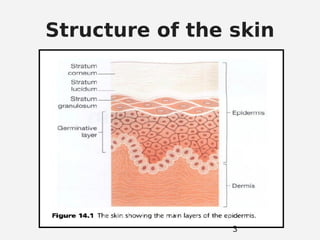
• epidermis
• dermis.
Between the skin and underlying structure
there is a layer of subcutaneous fat.
2
Structure of the skin
3
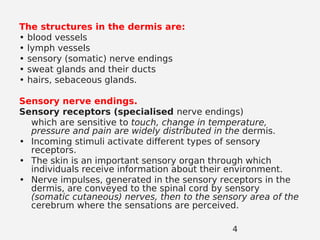
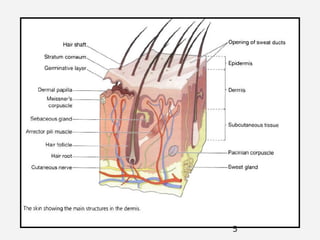
The structures in the dermis are:
• blood vessels
• lymph vessels
• sensory (somatic) nerve endings
• sweat glands and their ducts
• hairs, sebaceous glands.
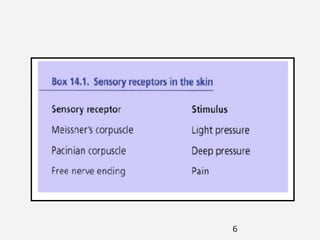
Sensory nerve endings.
Sensory receptors (specialised nerve endings)
which are sensitive to touch, change in temperature,
pressure and pain are widely distributed in the dermis.
• Incoming stimuli activate different types of sensory
receptors.
• The skin is an important sensory organ through which
individuals receive information about their environment.
• Nerve impulses, generated in the sensory receptors in the
dermis, are conveyed to the spinal cord by sensory
(somatic cutaneous) nerves, then to the sensory area of the
cerebrum where the sensations are perceived.
4
5
6
Sensation
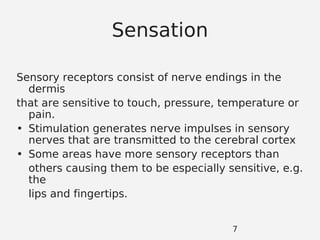
Sensory receptors consist of nerve endings in the
dermis
that are sensitive to touch, pressure, temperature or
pain.
• Stimulation generates nerve impulses in sensory
nerves that are transmitted to the cerebral cortex
• Some areas have more sensory receptors than
others causing them to be especially sensitive, e.g.
the
lips and fingertips.
7

Skin

  • 1.
    Skin 1. The skincompletely covers the body and is continuous with the membranes lining the body orifices. 2. protects the underlying structures from injury and from invasion by microbes 3. contains sensory (somatic) nerve endings of pain,temperature and touch 4. is involved in the regulation of body temperature. 1
  • 2.
    Structure of theskin • The skin has a surface area of about 1.5 to 2 m2 in adults and it contains glands, hair and nails. There are two main layers: • epidermis • dermis. Between the skin and underlying structure there is a layer of subcutaneous fat. 2
  • 3.
  • 4.
    The structures inthe dermis are: • blood vessels • lymph vessels • sensory (somatic) nerve endings • sweat glands and their ducts • hairs, sebaceous glands. Sensory nerve endings. Sensory receptors (specialised nerve endings) which are sensitive to touch, change in temperature, pressure and pain are widely distributed in the dermis. • Incoming stimuli activate different types of sensory receptors. • The skin is an important sensory organ through which individuals receive information about their environment. • Nerve impulses, generated in the sensory receptors in the dermis, are conveyed to the spinal cord by sensory (somatic cutaneous) nerves, then to the sensory area of the cerebrum where the sensations are perceived. 4
  • 5.
  • 6.
  • 7.
    Sensation Sensory receptors consistof nerve endings in the dermis that are sensitive to touch, pressure, temperature or pain. • Stimulation generates nerve impulses in sensory nerves that are transmitted to the cerebral cortex • Some areas have more sensory receptors than others causing them to be especially sensitive, e.g. the lips and fingertips. 7