
SKIN APPENDAGES
Maryam Fida (o-1827)
Integumentary system
Skin
Appendages (specialized derivatives
of skin)
Hairs
Nails
Sebaceous glands
Sweat glands
THE HAIR
Hairs are elastic keratinized threads, vary in
thickness
Derived from an invagination of the epidermis
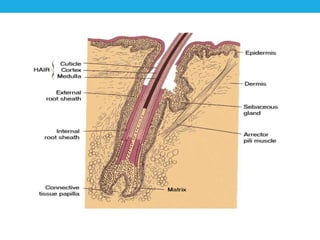
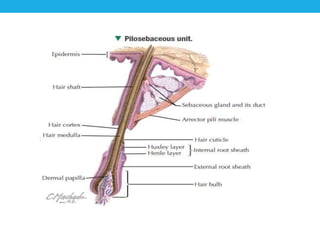
Consist of two portions: Shaft & Root
The shaft projects above the skin surface
 The root is embedded in the skin
Hair root is surrounded by Hair Follicle
Hair follicle consist of epidermal (epithelial) & dermal
(connective tissue) elements
Deep end of hair follicle expanded to form Hair bulb
• Hair follicle is associated with:
• Sebaceous glands
• Arrector pili muscle (smooth muscle)  goose
flesh
• Growth of hair, average rate 2 mm per week
• The production & growth depends upon the hair
follicle that surrounds the root of the hair
• Color of the hair depends on the quantity of
melanin pigment & amount of air in the hair
substance
• Hair shaft  consist of
epithelial cells arranged
in three regions
• Medulla (moderately
keratinized cuboidal
cells)
• Cortex (main bulk,
heavily keratinized cells)
• Cuticle (single layer of
flattened keratinized
cells)
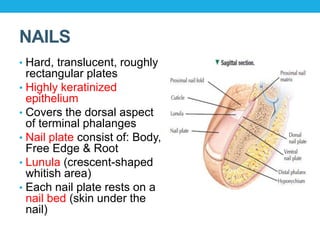
NAILS
• Hard, translucent, roughly
rectangular plates
• Highly keratinized
epithelium
• Covers the dorsal aspect
of terminal phalanges
• Nail plate consist of: Body,
Free Edge & Root
• Lunula (crescent-shaped
whitish area)
• Each nail plate rests on a
nail bed (skin under the
nail)
• Nail bed consist of stratum basale
• Epidermis (stratum basale) of nail bed is
very thick proximally and is called Nail
Matrix
• Nail matrix is responsible for the growth of
nail, exhibit high rate of cell division
• Growth of fingernails is 0.5 mm per week &
growth of toenails is 1 mm per month
• Nail keratin is hard keratin  do not
desquamate
SEBACEOUS GLANDS
• Sebaceous
glands are usually
associated with
hair
• Located between
a hair follicle and
its arrector pili
muscle in the
dermis.
• There are mitotically active cells giving rise
to the larger sebum-producing cells in the
center of the gland  accumulate fat
ultimately breakdown to produce sebum
• Most abundant in the face and scalp,
completely absent in the skin of palm and
soles
• Function  maintenance of proper skin
texture & hair flexibility. In addition, sebum
may possess weak antifungal &
antibacterial properties
Sweat glands
• Classified into two types
• Eccrine sweat glands
• Apocrine sweat glands
• Eccrine sweat glands
are distributed over
whole body
• Apocrine sweat glands
are limited to certain
specific regions of the
body e.g. axilla
ECCRINE SWEAT GLANDS
• Simple tubular glands
• Abundant in the skin of palms and soles
• Terminal secretory portion of sweat gland is
coiled and lie in dermis
• Sweat pore
• Lined by simple cuboidal epithelium
• Secretion is produced in response to heat
and nervous strain
• Sweat is a clear liquid, derived from blood
capillaries and consist of water, potassium,
sodium, chloride, urea, ammonia, uric acid
& lactic acid
• Functions:
• Temperature regulation
• Source of excretion of waste products like
ammonia, urea and uric acid
• Which of the following is composed of
loose connective tissue?
•
a. Epidermis
b. Reticular layer of dermis
c. Hypodermis
d. Both a and b
e. Both b and c
• A new miracle skin cream recently hit the
beauty counters which is suppose to
stimulate collagen production. Which cell is
it supposedly stimulating?
a. Langerhans cell
b. Keratinocyte
c. Melanocyte
d. Merkel cell
e. Fibroblast
• What is the growing part of the nail?
•
a. Lunula
b. Eponychium
c. Matrix
d. Nail bed
e. Root
• Which cell is the most abundant cell in the
epidermis?
•
a. Langerhans cell
b. Keratinocyte
c. Melanocyte
d. Merkel cell
e. Fibroblast
• Which cell is a mechanoreceptors?
•
a. Langerhans cell
b. Keratinocyte
c. Melanocyte
d. Merkel cell
e. Fibroblast
• Which layer of the epidermis is also called
the stratum germinativum?
•
a. Stratum basale
b. Stratum spinosum
c. Stratum granulosum
d. Stratum lucidum
e. Stratum corneum
THANK YOU

Skin appendages

  • 1.
  • 2.
    Integumentary system Skin Appendages (specializedderivatives of skin) Hairs Nails Sebaceous glands Sweat glands
  • 3.
    THE HAIR Hairs areelastic keratinized threads, vary in thickness Derived from an invagination of the epidermis Consist of two portions: Shaft & Root The shaft projects above the skin surface  The root is embedded in the skin Hair root is surrounded by Hair Follicle Hair follicle consist of epidermal (epithelial) & dermal (connective tissue) elements Deep end of hair follicle expanded to form Hair bulb
  • 6.
    • Hair follicleis associated with: • Sebaceous glands • Arrector pili muscle (smooth muscle)  goose flesh • Growth of hair, average rate 2 mm per week • The production & growth depends upon the hair follicle that surrounds the root of the hair • Color of the hair depends on the quantity of melanin pigment & amount of air in the hair substance
  • 7.
    • Hair shaft consist of epithelial cells arranged in three regions • Medulla (moderately keratinized cuboidal cells) • Cortex (main bulk, heavily keratinized cells) • Cuticle (single layer of flattened keratinized cells)
  • 8.
    NAILS • Hard, translucent,roughly rectangular plates • Highly keratinized epithelium • Covers the dorsal aspect of terminal phalanges • Nail plate consist of: Body, Free Edge & Root • Lunula (crescent-shaped whitish area) • Each nail plate rests on a nail bed (skin under the nail)
  • 9.
    • Nail bedconsist of stratum basale • Epidermis (stratum basale) of nail bed is very thick proximally and is called Nail Matrix • Nail matrix is responsible for the growth of nail, exhibit high rate of cell division • Growth of fingernails is 0.5 mm per week & growth of toenails is 1 mm per month • Nail keratin is hard keratin  do not desquamate
  • 10.
    SEBACEOUS GLANDS • Sebaceous glandsare usually associated with hair • Located between a hair follicle and its arrector pili muscle in the dermis.
  • 11.
    • There aremitotically active cells giving rise to the larger sebum-producing cells in the center of the gland  accumulate fat ultimately breakdown to produce sebum • Most abundant in the face and scalp, completely absent in the skin of palm and soles • Function  maintenance of proper skin texture & hair flexibility. In addition, sebum may possess weak antifungal & antibacterial properties
  • 12.
    Sweat glands • Classifiedinto two types • Eccrine sweat glands • Apocrine sweat glands • Eccrine sweat glands are distributed over whole body • Apocrine sweat glands are limited to certain specific regions of the body e.g. axilla
  • 13.
    ECCRINE SWEAT GLANDS •Simple tubular glands • Abundant in the skin of palms and soles • Terminal secretory portion of sweat gland is coiled and lie in dermis • Sweat pore • Lined by simple cuboidal epithelium • Secretion is produced in response to heat and nervous strain
  • 14.
    • Sweat isa clear liquid, derived from blood capillaries and consist of water, potassium, sodium, chloride, urea, ammonia, uric acid & lactic acid • Functions: • Temperature regulation • Source of excretion of waste products like ammonia, urea and uric acid
  • 16.
    • Which ofthe following is composed of loose connective tissue? • a. Epidermis b. Reticular layer of dermis c. Hypodermis d. Both a and b e. Both b and c
  • 17.
    • A newmiracle skin cream recently hit the beauty counters which is suppose to stimulate collagen production. Which cell is it supposedly stimulating? a. Langerhans cell b. Keratinocyte c. Melanocyte d. Merkel cell e. Fibroblast
  • 18.
    • What isthe growing part of the nail? • a. Lunula b. Eponychium c. Matrix d. Nail bed e. Root
  • 19.
    • Which cellis the most abundant cell in the epidermis? • a. Langerhans cell b. Keratinocyte c. Melanocyte d. Merkel cell e. Fibroblast
  • 20.
    • Which cellis a mechanoreceptors? • a. Langerhans cell b. Keratinocyte c. Melanocyte d. Merkel cell e. Fibroblast
  • 21.
    • Which layerof the epidermis is also called the stratum germinativum? • a. Stratum basale b. Stratum spinosum c. Stratum granulosum d. Stratum lucidum e. Stratum corneum
  • 22.