The IntegumentaryThe Integumentary
SystemSystem
Seven Functions of theSeven Functions of the
skin…skin…
1.1. Protective coveringProtective covering
2.2. Regulates bodyRegulates body
temperaturetemperature
3.3. Manufactures VitaminManufactures Vitamin
DD
4.4. Sensory FunctionSensory Function
5.5. Temporary storage ofTemporary storage of
fat, glucose, water andfat, glucose, water and
saltssalts
6.6. Excretion of fluidsExcretion of fluids
7.7. Absorbs certain drugsAbsorbs certain drugs
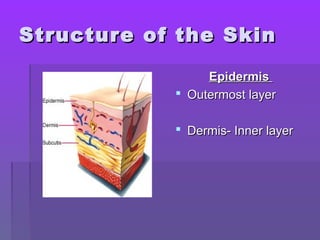
Structure of the SkinStructure of the Skin
EpidermisEpidermis
 Outermost layerOutermost layer
 Dermis- Inner layerDermis- Inner layer
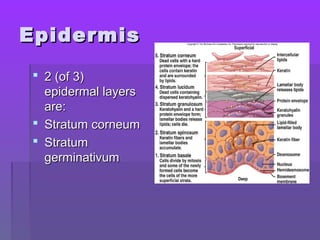
EpidermisEpidermis
 2 (of 3)2 (of 3)
epidermal layersepidermal layers
are:are:
 Stratum corneumStratum corneum
 StratumStratum
germinativumgerminativum
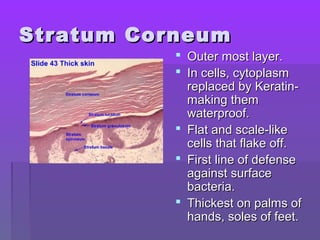
Stratum CorneumStratum Corneum
 Outer most layer.Outer most layer.
 In cells, cytoplasmIn cells, cytoplasm
replaced by Keratin-replaced by Keratin-
making themmaking them
waterproof.waterproof.
 Flat and scale-likeFlat and scale-like
cells that flake off.cells that flake off.
 First line of defenseFirst line of defense
against surfaceagainst surface
bacteria.bacteria.
 Thickest on palms ofThickest on palms of
hands, soles of feet.hands, soles of feet.
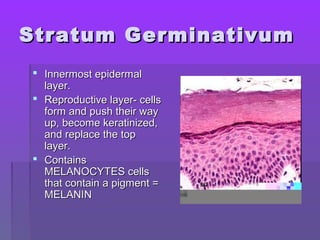
Stratum GerminativumStratum Germinativum
 Innermost epidermalInnermost epidermal
layer.layer.
 Reproductive layer- cellsReproductive layer- cells
form and push their wayform and push their way
up, become keratinized,up, become keratinized,
and replace the topand replace the top
layer.layer.
 ContainsContains
MELANOCYTES cellsMELANOCYTES cells
that contain a pigment =that contain a pigment =
MELANINMELANIN
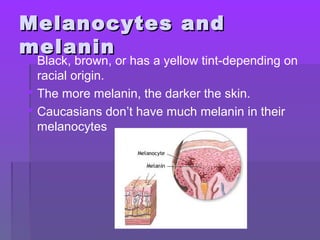
Melanocytes andMelanocytes and
melaninmelanin
 Black, brown, or has a yellow tint-depending on
racial origin.
 The more melanin, the darker the skin.
 Caucasians don’t have much melanin in their
melanocytes
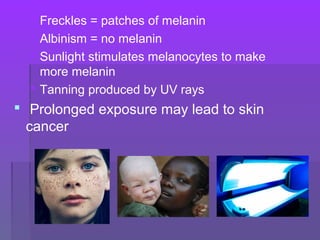
 Freckles = patches of melanin
 Albinism = no melanin
 Sunlight stimulates melanocytes to make
more melanin
 Tanning produced by UV rays
 Prolonged exposure may lead to skin
cancer
PapillaePapillae
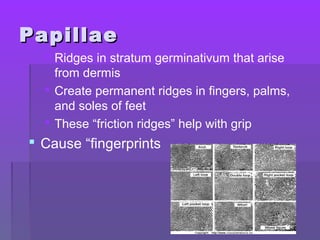
 Ridges in stratum germinativum that arise
from dermis
 Create permanent ridges in fingers, palms,
and soles of feet
 These “friction ridges” help with grip
 Cause “fingerprints
DermisDermis
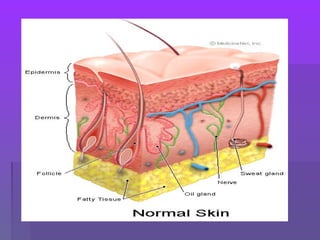
Thicker inner layer that contains:Thicker inner layer that contains:
Connective tissueConnective tissue □□ Hair folliclesHair follicles
Blood vesselsBlood vessels □□ Oil and sweat glandsOil and sweat glands
Nerve endingsNerve endings □□ Fat cellsFat cells
MusclesMuscles
Nerve Receptors inNerve Receptors in
DermisDermis
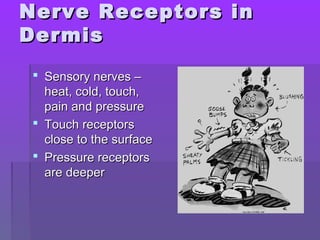
 Sensory nerves –Sensory nerves –
heat, cold, touch,heat, cold, touch,
pain and pressurepain and pressure
 Touch receptorsTouch receptors
close to the surfaceclose to the surface
 Pressure receptorsPressure receptors
are deeperare deeper
Subcutaneous Layer-Subcutaneous Layer-
Adipose tissueAdipose tissue
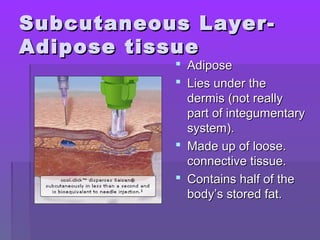
 AdiposeAdipose
 Lies under theLies under the
dermis (not reallydermis (not really
part of integumentarypart of integumentary
system).system).
 Made up of loose.Made up of loose.
connective tissue.connective tissue.
 Contains half of theContains half of the
body’s stored fat.body’s stored fat.
Appendages of theAppendages of the
SkinSkinHAIRHAIR
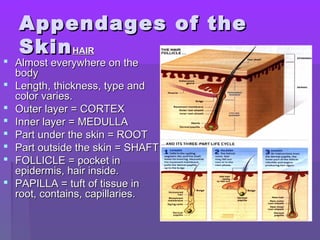
 Almost everywhere on theAlmost everywhere on the
bodybody
 Length, thickness, type andLength, thickness, type and
color varies.color varies.
 Outer layer = CORTEXOuter layer = CORTEX
 Inner layer = MEDULLAInner layer = MEDULLA
 Part under the skin = ROOTPart under the skin = ROOT
 Part outside the skin = SHAFTPart outside the skin = SHAFT
 FOLLICLE = pocket inFOLLICLE = pocket in
epidermis, hair inside.epidermis, hair inside.
 PAPILLA = tuft of tissue inPAPILLA = tuft of tissue in
root, contains, capillaries.root, contains, capillaries.
Arrector Pili MuscleArrector Pili Muscle
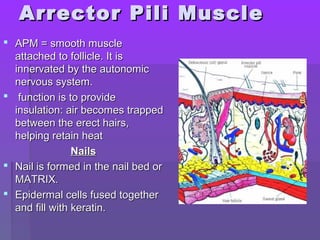
 APM = smooth muscleAPM = smooth muscle
attached to follicle. It isattached to follicle. It is
innervated by the autonomicinnervated by the autonomic
nervous system.nervous system.
 function is to providefunction is to provide
insulation: air becomes trappedinsulation: air becomes trapped
between the erect hairs,between the erect hairs,
helping retain heathelping retain heat
NailsNails
 Nail is formed in the nail bed orNail is formed in the nail bed or
MATRIX.MATRIX.
 Epidermal cells fused togetherEpidermal cells fused together
and fill with keratin.and fill with keratin.
Sweat GlandsSweat Glands
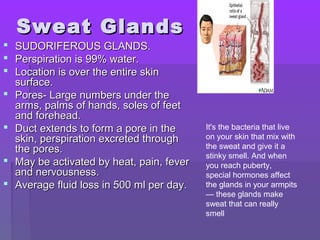
 SUDORIFEROUS GLANDS.SUDORIFEROUS GLANDS.
 Perspiration is 99% water.Perspiration is 99% water.
 Location is over the entire skinLocation is over the entire skin
surface.surface.
 Pores- Large numbers under thePores- Large numbers under the
arms, palms of hands, soles of feetarms, palms of hands, soles of feet
and forehead.and forehead.
 Duct extends to form a pore in theDuct extends to form a pore in the
skin, perspiration excreted throughskin, perspiration excreted through
the pores.the pores.
 May be activated by heat, pain, feverMay be activated by heat, pain, fever
and nervousness.and nervousness.
 Average fluid loss in 500 ml per day.Average fluid loss in 500 ml per day.
It's the bacteria that live
on your skin that mix with
the sweat and give it a
stinky smell. And when
you reach puberty,
special hormones affect
the glands in your armpits
— these glands make
sweat that can really
smell
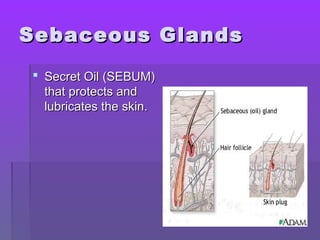
Sebaceous GlandsSebaceous Glands
 Secret Oil (SEBUM)Secret Oil (SEBUM)
that protects andthat protects and
lubricates the skin.lubricates the skin.
Skin andSkin and
MicroorganismsMicroorganisms
 Intact skin = best protection againstIntact skin = best protection against
pathogens, toxins and water loss.pathogens, toxins and water loss.
 Skin generally too dry for microbial growth –Skin generally too dry for microbial growth –
they do grow in moist areas.they do grow in moist areas.
 Most skin bacteria associated with hair folliclesMost skin bacteria associated with hair follicles
or sweat glands.or sweat glands.
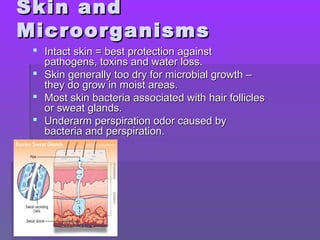
 Underarm perspiration odor caused byUnderarm perspiration odor caused by
bacteria and perspiration.bacteria and perspiration.
 Best way to prevent spread of disease is
hand washing
 Regulation of body temperature
 Manufactures vitamin D
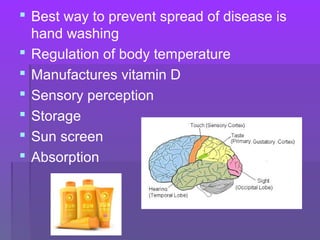
 Sensory perception
 Storage
 Sun screen
 Absorption

Structures integ system

  • 1.
  • 2.
    Seven Functions oftheSeven Functions of the skin…skin… 1.1. Protective coveringProtective covering 2.2. Regulates bodyRegulates body temperaturetemperature 3.3. Manufactures VitaminManufactures Vitamin DD 4.4. Sensory FunctionSensory Function 5.5. Temporary storage ofTemporary storage of fat, glucose, water andfat, glucose, water and saltssalts 6.6. Excretion of fluidsExcretion of fluids 7.7. Absorbs certain drugsAbsorbs certain drugs
  • 3.
    Structure of theSkinStructure of the Skin EpidermisEpidermis  Outermost layerOutermost layer  Dermis- Inner layerDermis- Inner layer
  • 4.
    EpidermisEpidermis  2 (of3)2 (of 3) epidermal layersepidermal layers are:are:  Stratum corneumStratum corneum  StratumStratum germinativumgerminativum
  • 5.
    Stratum CorneumStratum Corneum Outer most layer.Outer most layer.  In cells, cytoplasmIn cells, cytoplasm replaced by Keratin-replaced by Keratin- making themmaking them waterproof.waterproof.  Flat and scale-likeFlat and scale-like cells that flake off.cells that flake off.  First line of defenseFirst line of defense against surfaceagainst surface bacteria.bacteria.  Thickest on palms ofThickest on palms of hands, soles of feet.hands, soles of feet.
  • 6.
    Stratum GerminativumStratum Germinativum Innermost epidermalInnermost epidermal layer.layer.  Reproductive layer- cellsReproductive layer- cells form and push their wayform and push their way up, become keratinized,up, become keratinized, and replace the topand replace the top layer.layer.  ContainsContains MELANOCYTES cellsMELANOCYTES cells that contain a pigment =that contain a pigment = MELANINMELANIN
  • 7.
    Melanocytes andMelanocytes and melaninmelanin Black, brown, or has a yellow tint-depending on racial origin.  The more melanin, the darker the skin.  Caucasians don’t have much melanin in their melanocytes
  • 8.
     Freckles =patches of melanin  Albinism = no melanin  Sunlight stimulates melanocytes to make more melanin  Tanning produced by UV rays  Prolonged exposure may lead to skin cancer
  • 9.
    PapillaePapillae  Ridges instratum germinativum that arise from dermis  Create permanent ridges in fingers, palms, and soles of feet  These “friction ridges” help with grip  Cause “fingerprints
  • 10.
    DermisDermis Thicker inner layerthat contains:Thicker inner layer that contains: Connective tissueConnective tissue □□ Hair folliclesHair follicles Blood vesselsBlood vessels □□ Oil and sweat glandsOil and sweat glands Nerve endingsNerve endings □□ Fat cellsFat cells MusclesMuscles
  • 12.
    Nerve Receptors inNerveReceptors in DermisDermis  Sensory nerves –Sensory nerves – heat, cold, touch,heat, cold, touch, pain and pressurepain and pressure  Touch receptorsTouch receptors close to the surfaceclose to the surface  Pressure receptorsPressure receptors are deeperare deeper
  • 13.
    Subcutaneous Layer-Subcutaneous Layer- AdiposetissueAdipose tissue  AdiposeAdipose  Lies under theLies under the dermis (not reallydermis (not really part of integumentarypart of integumentary system).system).  Made up of loose.Made up of loose. connective tissue.connective tissue.  Contains half of theContains half of the body’s stored fat.body’s stored fat.
  • 14.
    Appendages of theAppendagesof the SkinSkinHAIRHAIR  Almost everywhere on theAlmost everywhere on the bodybody  Length, thickness, type andLength, thickness, type and color varies.color varies.  Outer layer = CORTEXOuter layer = CORTEX  Inner layer = MEDULLAInner layer = MEDULLA  Part under the skin = ROOTPart under the skin = ROOT  Part outside the skin = SHAFTPart outside the skin = SHAFT  FOLLICLE = pocket inFOLLICLE = pocket in epidermis, hair inside.epidermis, hair inside.  PAPILLA = tuft of tissue inPAPILLA = tuft of tissue in root, contains, capillaries.root, contains, capillaries.
  • 15.
    Arrector Pili MuscleArrectorPili Muscle  APM = smooth muscleAPM = smooth muscle attached to follicle. It isattached to follicle. It is innervated by the autonomicinnervated by the autonomic nervous system.nervous system.  function is to providefunction is to provide insulation: air becomes trappedinsulation: air becomes trapped between the erect hairs,between the erect hairs, helping retain heathelping retain heat NailsNails  Nail is formed in the nail bed orNail is formed in the nail bed or MATRIX.MATRIX.  Epidermal cells fused togetherEpidermal cells fused together and fill with keratin.and fill with keratin.
  • 16.
    Sweat GlandsSweat Glands SUDORIFEROUS GLANDS.SUDORIFEROUS GLANDS.  Perspiration is 99% water.Perspiration is 99% water.  Location is over the entire skinLocation is over the entire skin surface.surface.  Pores- Large numbers under thePores- Large numbers under the arms, palms of hands, soles of feetarms, palms of hands, soles of feet and forehead.and forehead.  Duct extends to form a pore in theDuct extends to form a pore in the skin, perspiration excreted throughskin, perspiration excreted through the pores.the pores.  May be activated by heat, pain, feverMay be activated by heat, pain, fever and nervousness.and nervousness.  Average fluid loss in 500 ml per day.Average fluid loss in 500 ml per day. It's the bacteria that live on your skin that mix with the sweat and give it a stinky smell. And when you reach puberty, special hormones affect the glands in your armpits — these glands make sweat that can really smell
  • 17.
    Sebaceous GlandsSebaceous Glands Secret Oil (SEBUM)Secret Oil (SEBUM) that protects andthat protects and lubricates the skin.lubricates the skin.
  • 18.
    Skin andSkin and MicroorganismsMicroorganisms Intact skin = best protection againstIntact skin = best protection against pathogens, toxins and water loss.pathogens, toxins and water loss.  Skin generally too dry for microbial growth –Skin generally too dry for microbial growth – they do grow in moist areas.they do grow in moist areas.  Most skin bacteria associated with hair folliclesMost skin bacteria associated with hair follicles or sweat glands.or sweat glands.  Underarm perspiration odor caused byUnderarm perspiration odor caused by bacteria and perspiration.bacteria and perspiration.
  • 19.
     Best wayto prevent spread of disease is hand washing  Regulation of body temperature  Manufactures vitamin D  Sensory perception  Storage  Sun screen  Absorption