1
The Skin: Anatomy &
Physiology
By
Syed Yousaf Shah
2
Introduction
Largest organ in the body
Varies in thickness at different parts (< 0.5 mm at eyelids to > 5
mm on middle of upper back)
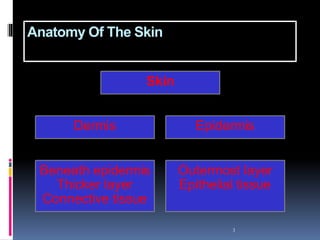
Anatomy Of The Skin
Beneath epidermis
Thicker layer
Connective tissue
Dermis
Outermost layer
Epithelial tissue
Epidermis
Skin
3
4
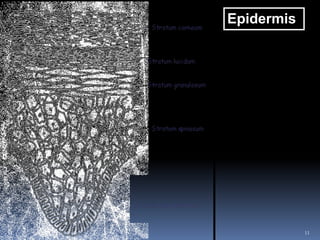
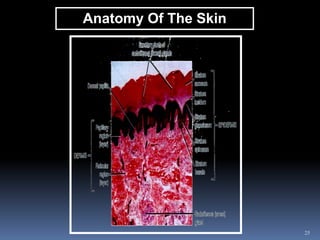
Epidermis
Stratified squamous epithelium
No blood vessels
In palms of hand and soles of feet, epidermis is thicker
Composed of five layers:
[1] Stratum corneum
[2] Stratum lucidum
[3] Stratum granulosum
[4] Stratum spinosum
[5] Stratum basale
5
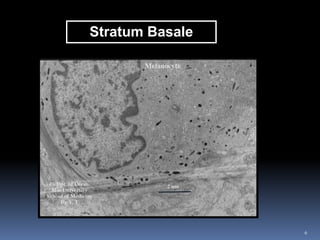
[1] Stratum Basale
Single layer of columnar or cuboidal cells
Lower surface of cells attached to dermis
Receives nutrients from blood in the dermal vessels
Mitosis occurs in this layer
Older cells expelled to outer layer
Melanin is produced in this layer
6
Stratum Basale
7
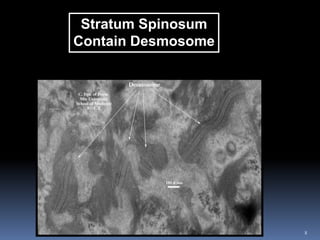
[2] Stratum Spinosum
Prickle cell layer
Several layers of polyhedral (many-sided) cells
Interlocking spine-like projections help binding of this layer
Active protein synthesis takes place (indicates cell growth and
division)
Obtain nutrients through fine elements
Keratinization begins in this layer
Nuclei-containing cells change into flat cells composed of hard
durable protein)
8
Stratum Spinosum
Contain Desmosome
9
[3] Stratum Granulosum
Granular + 2 to 4 cells thick
Cells contain keratohyaline in granules
Final stages of keratinization occur
Loss of fluid, nucleus disintegrates
[4] Stratum Lucidum
Transparent layer
Flat + translucent dead cells
Protection against UV
Lucidum appears in palm of hands and soles of feet to protect
against sun burn
10
[5] Stratum Corneum (Horny Layer)
Thick layer of dead cells
Soft keratin (keep skin elastic)
Cells below contain fatty substrate  keep skin waterproof +
prevent skin cracking and allowing bacteria inside
11
Epidermis
12
Dermis
True skin
Highly elastic, tough and flexible tissue
Meshwork of collagenous, reticular and elastic fibres
Collagenous Fibres
Provide support for skin
Reticular Fibres
Thinner, yet still provide support
Elastic Fibres
Skin flexibility
13
Cells Of The Dermis
a) Fibroblasts
b) Fat cells
c) Macrophages
Dermis subdivided into two main layers:
{1} Upper papillary layer
{2} Reticular layer
14
[1] Upper Papillary Layer
Loose connective tissue
Contain protrusions into epidermis called “PAPILLAE”
Fine capillaries to carry waste away + provide nourishment and
oxygen
Nerve endings for heat, pain, cold, pressure and touch
(Meissner’s corpuscles)
Double row of papillae  better gripping by hands and feet +
distinctive fingerprint patterns
15
[2] Reticular Layer
Elastic network of tough collagen fibres interwoven with elastic
fibres
Collagenous fibres arranged in special pattern
Incisions made parallel to these lines during surgery  wound
heals faster
Contains sebaceous and sweat glands, arrector pili muscle and
hair follicle
Pacinian corpuscles are distributed through the dermis and
function as pressure receptors
Stretch marks and pregnancy due to breaks in collagen and
elastic fibres
16
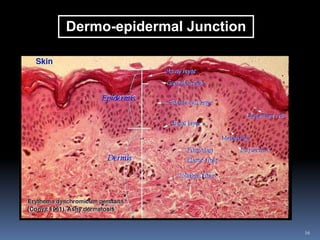
Dermo-epidermal Junction
17
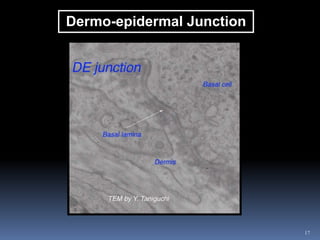
Dermo-epidermal Junction
18
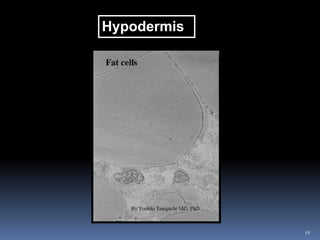
Hypodermis
“Subcutaneous” layer
Thicker than dermis
Thicker in females
Ducts of sweat glands and bases of hair follicles
Area for formation and storage of fat due to:
@ Adipose tissue – containing fat cells
@ Areolar tissue – tissue elasticity
19
Hypodermis
20
Developmental Anatomy of the Skin
Dermis and epidermis are derived from different embryological
tissues
Epidermis derived from “ECTODERM”
Dermis derived from “MESENCHYME”
21
Glands Of The Skin
Two types: Eccrine and Apocrine
Eccrine Glands
Distributed almost all round the body
Secretory portion in hypodermis
Apocrine Glands
Arm pits and dark regions of nipple
Secretes fatty substances
These react to air  YOU STINK
Sweat Glands
22
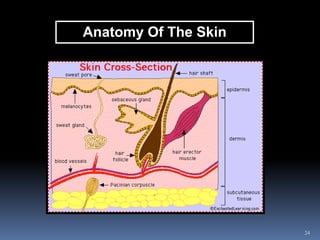
Sebaceous Glands
Located in the dermis
Lubrication and protection
Cluster of cells
Breakdown of inner cells in the cluster  sebum formation
Connected to hair follicles
Sebum  fight bacteria and fungi
Blackheads due to blocked glands
23
Hair
Shaft = protrudes from skin
Root = embedded in skin
Follicle surrounds hair
Arrector pili muscle = bundle of smooth muscle
Arrector pili causes:
a) Hair erection
b) Sebum release from the sebaceous glands
24
Anatomy Of The Skin
25
Anatomy Of The Skin
26
Burns
Seriousness of burns classified according to:
[1] Extent (size of body area involved)
[2] Depth (How many layers of tissue are injured)
First Degree Burn
e.g. Sunburn
Epidermis damaged but not destroyed
Treated by cold water
< 10% of body surface involved
27
Second Degree Burn
Epidermis destroyed
Dermis partly destroyed
> 15% of body surface involved (10% for child)
Body capable of regenerating new skin
Third Degree Burn
Epidermis, dermis and underlying issue are involved
Burns to face, eyelids, hands, feet and > 20% of body surfaces
Less painful than second degree burns because nerve endings
are destroyed
Treated by skin graft
28
Bedsores
Skin close to bone and under constant pressure
Blood vessels compressed  deprive affected tissues of oxygen
and nutrients
e.g. shoulder blades, hips and elbows
First sign is reddened warm spots
Spots turn purplish (indicate blocked blood flow)
Skin breaks and infection occurs
29
Functions Of The Skin
Non-specific immunity (details to follow in later lectures)
[1] Protection
Anatomical barrier against infection
Melanin = screen out excess UV rays
When melanin is darkened by the tan  transferred to outer skin
layers (suntan)  skin less sensitive to sunrays
Dark skin due to wider distribution of melanin beyond stratum
basale into higher levels of epidermis
[2] Thermoregulation
Control of heat production
Shivering
Skeletal muscle
Motor neurons
Control of heat loss
Skin vasocontriction and vasodilation
Skin blood vessels
Sympathetic nervous system
Control of heat loss
Sweating
Sweat glands
Sympathetic nervous system
Hypothalamic thermoregulatory integrating centre
Peripheral Thermoreceptors (Skin)
Skin temperature
30
31
[3] Sensory Perception
Millions of nerve endings
Receptor for pain, heat and pressure
Therefore, maintain homeostasis
[4] Excretion
Excretion of lactic acid and sodium chloride
Urea (1 g nitrogenous waste eliminated through skin per hour)
[5] Vitamin D Synthesis
32
Promotes absorption of calcium and phosphate through intestine
Active vitamin D
Modification by liver and kidney enzymes
Vitamin D3 (Cholecalciferol)
Vitamin D precursor (in skin)
33
Commonly Used Terms Describing Skin
Conditions
Intact “Skin is unbroken”
Contusion “Injury in which skin is unbroken”
Excoriation “Removal of an area of the skin”
Abrasion “Spot rubbed bare of mucous membrane or skin,
and thereby damaged”
Cyanosis “Dusky, bluish colour usually seen in the lips and on
the nail beds, caused by lack of oxygen”

Unit VII: Integumentary System (Skin, Nail & Hair)

  • 1.
    1 The Skin: Anatomy& Physiology By Syed Yousaf Shah
  • 2.
    2 Introduction Largest organ inthe body Varies in thickness at different parts (< 0.5 mm at eyelids to > 5 mm on middle of upper back)
  • 3.
    Anatomy Of TheSkin Beneath epidermis Thicker layer Connective tissue Dermis Outermost layer Epithelial tissue Epidermis Skin 3
  • 4.
    4 Epidermis Stratified squamous epithelium Noblood vessels In palms of hand and soles of feet, epidermis is thicker Composed of five layers: [1] Stratum corneum [2] Stratum lucidum [3] Stratum granulosum [4] Stratum spinosum [5] Stratum basale
  • 5.
    5 [1] Stratum Basale Singlelayer of columnar or cuboidal cells Lower surface of cells attached to dermis Receives nutrients from blood in the dermal vessels Mitosis occurs in this layer Older cells expelled to outer layer Melanin is produced in this layer
  • 6.
  • 7.
    7 [2] Stratum Spinosum Pricklecell layer Several layers of polyhedral (many-sided) cells Interlocking spine-like projections help binding of this layer Active protein synthesis takes place (indicates cell growth and division) Obtain nutrients through fine elements Keratinization begins in this layer Nuclei-containing cells change into flat cells composed of hard durable protein)
  • 8.
  • 9.
    9 [3] Stratum Granulosum Granular+ 2 to 4 cells thick Cells contain keratohyaline in granules Final stages of keratinization occur Loss of fluid, nucleus disintegrates [4] Stratum Lucidum Transparent layer Flat + translucent dead cells Protection against UV Lucidum appears in palm of hands and soles of feet to protect against sun burn
  • 10.
    10 [5] Stratum Corneum(Horny Layer) Thick layer of dead cells Soft keratin (keep skin elastic) Cells below contain fatty substrate  keep skin waterproof + prevent skin cracking and allowing bacteria inside
  • 11.
  • 12.
    12 Dermis True skin Highly elastic,tough and flexible tissue Meshwork of collagenous, reticular and elastic fibres Collagenous Fibres Provide support for skin Reticular Fibres Thinner, yet still provide support Elastic Fibres Skin flexibility
  • 13.
    13 Cells Of TheDermis a) Fibroblasts b) Fat cells c) Macrophages Dermis subdivided into two main layers: {1} Upper papillary layer {2} Reticular layer
  • 14.
    14 [1] Upper PapillaryLayer Loose connective tissue Contain protrusions into epidermis called “PAPILLAE” Fine capillaries to carry waste away + provide nourishment and oxygen Nerve endings for heat, pain, cold, pressure and touch (Meissner’s corpuscles) Double row of papillae  better gripping by hands and feet + distinctive fingerprint patterns
  • 15.
    15 [2] Reticular Layer Elasticnetwork of tough collagen fibres interwoven with elastic fibres Collagenous fibres arranged in special pattern Incisions made parallel to these lines during surgery  wound heals faster Contains sebaceous and sweat glands, arrector pili muscle and hair follicle Pacinian corpuscles are distributed through the dermis and function as pressure receptors Stretch marks and pregnancy due to breaks in collagen and elastic fibres
  • 16.
  • 17.
  • 18.
    18 Hypodermis “Subcutaneous” layer Thicker thandermis Thicker in females Ducts of sweat glands and bases of hair follicles Area for formation and storage of fat due to: @ Adipose tissue – containing fat cells @ Areolar tissue – tissue elasticity
  • 19.
  • 20.
    20 Developmental Anatomy ofthe Skin Dermis and epidermis are derived from different embryological tissues Epidermis derived from “ECTODERM” Dermis derived from “MESENCHYME”
  • 21.
    21 Glands Of TheSkin Two types: Eccrine and Apocrine Eccrine Glands Distributed almost all round the body Secretory portion in hypodermis Apocrine Glands Arm pits and dark regions of nipple Secretes fatty substances These react to air  YOU STINK Sweat Glands
  • 22.
    22 Sebaceous Glands Located inthe dermis Lubrication and protection Cluster of cells Breakdown of inner cells in the cluster  sebum formation Connected to hair follicles Sebum  fight bacteria and fungi Blackheads due to blocked glands
  • 23.
    23 Hair Shaft = protrudesfrom skin Root = embedded in skin Follicle surrounds hair Arrector pili muscle = bundle of smooth muscle Arrector pili causes: a) Hair erection b) Sebum release from the sebaceous glands
  • 24.
  • 25.
  • 26.
    26 Burns Seriousness of burnsclassified according to: [1] Extent (size of body area involved) [2] Depth (How many layers of tissue are injured) First Degree Burn e.g. Sunburn Epidermis damaged but not destroyed Treated by cold water < 10% of body surface involved
  • 27.
    27 Second Degree Burn Epidermisdestroyed Dermis partly destroyed > 15% of body surface involved (10% for child) Body capable of regenerating new skin Third Degree Burn Epidermis, dermis and underlying issue are involved Burns to face, eyelids, hands, feet and > 20% of body surfaces Less painful than second degree burns because nerve endings are destroyed Treated by skin graft
  • 28.
    28 Bedsores Skin close tobone and under constant pressure Blood vessels compressed  deprive affected tissues of oxygen and nutrients e.g. shoulder blades, hips and elbows First sign is reddened warm spots Spots turn purplish (indicate blocked blood flow) Skin breaks and infection occurs
  • 29.
    29 Functions Of TheSkin Non-specific immunity (details to follow in later lectures) [1] Protection Anatomical barrier against infection Melanin = screen out excess UV rays When melanin is darkened by the tan  transferred to outer skin layers (suntan)  skin less sensitive to sunrays Dark skin due to wider distribution of melanin beyond stratum basale into higher levels of epidermis
  • 30.
    [2] Thermoregulation Control ofheat production Shivering Skeletal muscle Motor neurons Control of heat loss Skin vasocontriction and vasodilation Skin blood vessels Sympathetic nervous system Control of heat loss Sweating Sweat glands Sympathetic nervous system Hypothalamic thermoregulatory integrating centre Peripheral Thermoreceptors (Skin) Skin temperature 30
  • 31.
    31 [3] Sensory Perception Millionsof nerve endings Receptor for pain, heat and pressure Therefore, maintain homeostasis [4] Excretion Excretion of lactic acid and sodium chloride Urea (1 g nitrogenous waste eliminated through skin per hour)
  • 32.
    [5] Vitamin DSynthesis 32 Promotes absorption of calcium and phosphate through intestine Active vitamin D Modification by liver and kidney enzymes Vitamin D3 (Cholecalciferol) Vitamin D precursor (in skin)
  • 33.
    33 Commonly Used TermsDescribing Skin Conditions Intact “Skin is unbroken” Contusion “Injury in which skin is unbroken” Excoriation “Removal of an area of the skin” Abrasion “Spot rubbed bare of mucous membrane or skin, and thereby damaged” Cyanosis “Dusky, bluish colour usually seen in the lips and on the nail beds, caused by lack of oxygen”