
THIN LAYER
CHROMATOGRAPHY
PRESENTED BY : MR K V NANDA KUMAR
DEPARTMENT OF PHARMACEUTICAL ANALYSIS
KRISHNA TEJA PHARMACY COLLEGE, TIRUPATHI-517506
11-06-2020 B PHARM PA II - MR K V NANDA KUMAR 1
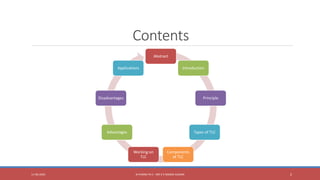
Contents
Abstract
Introduction
Principle
Types of TLC
Components
of TLC
Working on
TLC
Advantages
Disadvantages
Applications
11-06-2020 B PHARM PA II - MR K V NANDA KUMAR 2
Abstract
Thin layer chromatography (TLC) is a type of chromatographic technique which is used for the
separation of the components present in mixture using thin stationary phase.
Separation of the components depends on the competition between the adsorption of solute
on stationary phase and its desorption by the solvent needed to wash out from the stationary
phase.
In this chapter, we have discussed the basic principle of TLC, components of TLC, its working
and applications.
11-06-2020 B PHARM PA II - MR K V NANDA KUMAR 3
Introduction
Thin layer chromatography (TLC) is a type of chromatographic technique which is used for the separation
of the components present in mixture using thin stationary phase (supported by an inert backing).
It is a solid–liquid technique in which there are two phases: one is stationary phase and the other is
mobile phase.
Separation of the components depends on the competition between the adsorption of solute onto the
solid surface (stationary phase) and its desorption by the solvent needed to wash out from the stationary
phase.
In TLC, stationary phase is always in solid state while the mobile phase is always in liquid state.
11-06-2020 B PHARM PA II - MR K V NANDA KUMAR 4
Principle
Separation of individual component present in sample mixture is dependent on the relative
affinity of individual component with stationary phase and the mobile phase.
If the affinity of individual component present in a sample mixture is high with mobile phase,
then it travels over the surface of the stationary phase eluted out. Whereas, if the affinity of
individual component present in sample mixture is higher with stationary phase, then it travels
slowly and retained in the stationary phase. Thus, the separation of components in the mixture is
achieved.
Once the separation occurs, individual components of interest are visualized as spots appeared
at different points on TLC plate.
11-06-2020 B PHARM PA II - MR K V NANDA KUMAR 5
Types of Thin Layer Chromatography
Based on Nature of Phases
Based on Purpose of Use
11-06-2020 B PHARM PA II - MR K V NANDA KUMAR 6
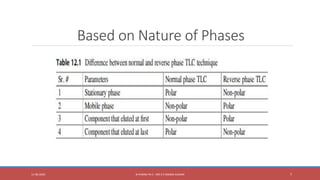
Based on Nature of Phases
11-06-2020 B PHARM PA II - MR K V NANDA KUMAR 7
Based on Purpose of Use
TLC can also be classified into the following two types based on the purpose of the application:
Analytical Chromatography
When the purification of small amount of the compound present in the mixture is required, then
this type of TLC is known as analytical TLC.
Preparative Chromatography
When the purpose is to monitor any progress in chemical reaction occurring in the mixture, then
this type of TLC is known as preparative TLC.
11-06-2020 B PHARM PA II - MR K V NANDA KUMAR 8
Components of Thin Layer
Chromatography
Developing Chamber: used to create and maintain the environment for TLC.
Solid Support: used to support TLC film coated on stationary phase.
Stationary Phase: used to provide facility for the adsorption of analyte on TLC film.
Mobile Phase: solvent system that carries the analyte present in mixture
Pipette: used to load the samples on the stationary phase of TLC film
Forceps: used to handle the TLC plates during and after experiment
11-06-2020 B PHARM PA II - MR K V NANDA KUMAR 9
Working on Thin Layer Chromatography
Preparation of TLC Plates
Activation of Adsorbent
Purification
Preparation of Mobile Phase
Marking on TLC Plate
Preparation of Sample and Standard Solutions
Spotting on TLC Plate
Development
Drying
Detection
11-06-2020 B PHARM PA II - MR K V NANDA KUMAR 10
Preparation of TLC Plates
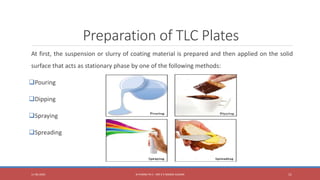
At first, the suspension or slurry of coating material is prepared and then applied on the solid
surface that acts as stationary phase by one of the following methods:
Pouring
Dipping
Spraying
Spreading
11-06-2020 B PHARM PA II - MR K V NANDA KUMAR 11
Activation of Adsorbent
Once the TLC plate is prepared, it is dried by keeping it in air for 30 min and then, it is kept in
oven for another 30 min at 110 C for the complete evaporation of solvent.
This drying technique activates the adsorbent layer on TLC plate.
The most commonly used active layers on TLC plates are silica gel and alumina.
These adsorbents on TLC plate can be activated by heating at 150 C for 4 h.
11-06-2020 B PHARM PA II - MR K V NANDA KUMAR 12
Purification
Sometimes, the adsorbent material may contain any impurity, e.g., silica gel may contain iron
as an impurity.
It is very important that the adsorbent material must be purified.
11-06-2020 B PHARM PA II - MR K V NANDA KUMAR 13
Preparation of Mobile Phase
The mixture of two or more solvents of different polarity with different proportions is often used
for the separation of components present in mixture as compared to that of chemically
homogenous solvents.
11-06-2020 B PHARM PA II - MR K V NANDA KUMAR 14
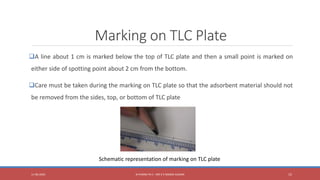
Marking on TLC Plate
A line about 1 cm is marked below the top of TLC plate and then a small point is marked on
either side of spotting point about 2 cm from the bottom.
Care must be taken during the marking on TLC plate so that the adsorbent material should not
be removed from the sides, top, or bottom of TLC plate
11-06-2020 B PHARM PA II - MR K V NANDA KUMAR 15
Schematic representation of marking on TLC plate
Preparation of Sample and Standard
Solutions
Before the preparation of sample and standard solutions for TLC experiments, stock and
dilutions are prepared and calibrated.
One dosage unit or composite of dosage units of analyte is placed in small container, ground to
make its power and transfer to a suitable vessel.
Then, an appropriate solvent is used to dissolve the active ingredient(analyte).
11-06-2020 B PHARM PA II - MR K V NANDA KUMAR 16
Spotting on TLC Plate
For spotting the sample and standard solution on TLC plate, capillary tube or micropipette or
calibrated glass tube or alga micro syringe is used.
It is very important that the solvent used for the preparation of sample must be non-polar and
volatile in nature so that after spotting the sample, the solvent may evaporate from the spots
before developing.
11-06-2020 B PHARM PA II - MR K V NANDA KUMAR 17
Development
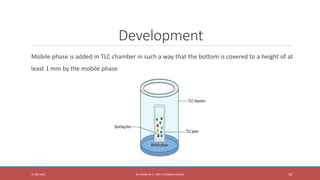
Mobile phase is added in TLC chamber in such a way that the bottom is covered to a height of at
least 1 mm by the mobile phase
11-06-2020 B PHARM PA II - MR K V NANDA KUMAR 18
Drying
Once the development of TLC chamber is done, the solvent (mobile phase) is allowed to reach
a proper distance which is also known as solvent front.
This phase may take 20–40 min.
After the development of chromatogram, TLC plate is taken out and solvent front is marked on
TLC plate.
Then TLC plate is allowed to be air dried.
11-06-2020 B PHARM PA II - MR K V NANDA KUMAR 19
Detection
It can be done either by specific or non-specific methods.
If the analyte is colored, then it can be visually detected easily but for the detection of colorless
analyte on TLC plate, two types of techniques are used:
1. Destructive methods
2. Non destructive methods
11-06-2020 B PHARM PA II - MR K V NANDA KUMAR 20
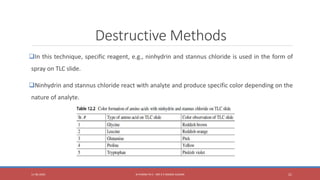
Destructive Methods
In this technique, specific reagent, e.g., ninhydrin and stannus chloride is used in the form of
spray on TLC slide.
Ninhydrin and stannus chloride react with analyte and produce specific color depending on the
nature of analyte.
11-06-2020 B PHARM PA II - MR K V NANDA KUMAR 21
Non-destructive Methods
In this technique, different methods are used.
 For example, for the detection of radioactive materials, Geiger Muller counter is used,
whereas for the detection of fluorescent compounds, UV chamber is used.
 Iodine chamber is also used for the detection of analyte on TLC slide.
11-06-2020 B PHARM PA II - MR K V NANDA KUMAR 22
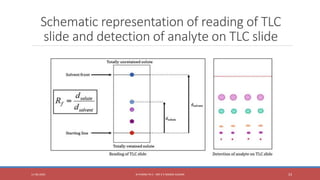
Schematic representation of reading of TLC
slide and detection of analyte on TLC slide
11-06-2020 B PHARM PA II - MR K V NANDA KUMAR 23
Advantages
TLC is a cheaper chromatographic technique.
The purity standards of the given sample can be easily assessed.
The separation process is faster and the selectivity for components is higher.
TLC helps to isolate the most of the components.
TLC helps with the visualization of separated components spots easily.
TLC is a simple process because of its short development time.
TLC helps to identify the individual components easily.
11-06-2020 B PHARM PA II - MR K V NANDA KUMAR 24
Disadvantages
It cannot differentiate between the enantiomers and some isomers.
Stationary phase in TLC is no longer stable.
Results produced by TLC are very difficult to be reproduced.
Only soluble components of interest present in mixture can be separated.
By TLC, only qualitative analysis is possible.
As TLC operates in open system, environmental factors like temperature and humidity may
interfere with the overall results.
11-06-2020 B PHARM PA II - MR K V NANDA KUMAR 25
Applications
It is used for the separation of inorganic ions from the sample solution.
It is widely used for the determination of molecular weight of unknown compounds.
It is widely used in pharmaceutical and natural product analysis.
It is used for the separation of active pharmaceutical ingredients (API) from the mixture and
sample solutions.
It is also used for the identification of API from the mixture during the synthesis of API.
It is also used in the investigation of pharmacokinetic studies of pharmaceutical products.
It is also used for the determination of essential oils in herbal drugs and assay of herbal
medicines.
11-06-2020 B PHARM PA II - MR K V NANDA KUMAR 26
References
Essentials of Pharmaceutical Analysis, Muhammad Sajid Hamid Akash and Kanwal Rehman
11-06-2020 B PHARM PA II - MR K V NANDA KUMAR 27
11-06-2020 B PHARM PA II - MR K V NANDA KUMAR 28

Thin Layer Chromatography

  • 1.
    THIN LAYER CHROMATOGRAPHY PRESENTED BY: MR K V NANDA KUMAR DEPARTMENT OF PHARMACEUTICAL ANALYSIS KRISHNA TEJA PHARMACY COLLEGE, TIRUPATHI-517506 11-06-2020 B PHARM PA II - MR K V NANDA KUMAR 1
  • 2.
    Contents Abstract Introduction Principle Types of TLC Components ofTLC Working on TLC Advantages Disadvantages Applications 11-06-2020 B PHARM PA II - MR K V NANDA KUMAR 2
  • 3.
    Abstract Thin layer chromatography(TLC) is a type of chromatographic technique which is used for the separation of the components present in mixture using thin stationary phase. Separation of the components depends on the competition between the adsorption of solute on stationary phase and its desorption by the solvent needed to wash out from the stationary phase. In this chapter, we have discussed the basic principle of TLC, components of TLC, its working and applications. 11-06-2020 B PHARM PA II - MR K V NANDA KUMAR 3
  • 4.
    Introduction Thin layer chromatography(TLC) is a type of chromatographic technique which is used for the separation of the components present in mixture using thin stationary phase (supported by an inert backing). It is a solid–liquid technique in which there are two phases: one is stationary phase and the other is mobile phase. Separation of the components depends on the competition between the adsorption of solute onto the solid surface (stationary phase) and its desorption by the solvent needed to wash out from the stationary phase. In TLC, stationary phase is always in solid state while the mobile phase is always in liquid state. 11-06-2020 B PHARM PA II - MR K V NANDA KUMAR 4
  • 5.
    Principle Separation of individualcomponent present in sample mixture is dependent on the relative affinity of individual component with stationary phase and the mobile phase. If the affinity of individual component present in a sample mixture is high with mobile phase, then it travels over the surface of the stationary phase eluted out. Whereas, if the affinity of individual component present in sample mixture is higher with stationary phase, then it travels slowly and retained in the stationary phase. Thus, the separation of components in the mixture is achieved. Once the separation occurs, individual components of interest are visualized as spots appeared at different points on TLC plate. 11-06-2020 B PHARM PA II - MR K V NANDA KUMAR 5
  • 6.
    Types of ThinLayer Chromatography Based on Nature of Phases Based on Purpose of Use 11-06-2020 B PHARM PA II - MR K V NANDA KUMAR 6
  • 7.
    Based on Natureof Phases 11-06-2020 B PHARM PA II - MR K V NANDA KUMAR 7
  • 8.
    Based on Purposeof Use TLC can also be classified into the following two types based on the purpose of the application: Analytical Chromatography When the purification of small amount of the compound present in the mixture is required, then this type of TLC is known as analytical TLC. Preparative Chromatography When the purpose is to monitor any progress in chemical reaction occurring in the mixture, then this type of TLC is known as preparative TLC. 11-06-2020 B PHARM PA II - MR K V NANDA KUMAR 8
  • 9.
    Components of ThinLayer Chromatography Developing Chamber: used to create and maintain the environment for TLC. Solid Support: used to support TLC film coated on stationary phase. Stationary Phase: used to provide facility for the adsorption of analyte on TLC film. Mobile Phase: solvent system that carries the analyte present in mixture Pipette: used to load the samples on the stationary phase of TLC film Forceps: used to handle the TLC plates during and after experiment 11-06-2020 B PHARM PA II - MR K V NANDA KUMAR 9
  • 10.
    Working on ThinLayer Chromatography Preparation of TLC Plates Activation of Adsorbent Purification Preparation of Mobile Phase Marking on TLC Plate Preparation of Sample and Standard Solutions Spotting on TLC Plate Development Drying Detection 11-06-2020 B PHARM PA II - MR K V NANDA KUMAR 10
  • 11.
    Preparation of TLCPlates At first, the suspension or slurry of coating material is prepared and then applied on the solid surface that acts as stationary phase by one of the following methods: Pouring Dipping Spraying Spreading 11-06-2020 B PHARM PA II - MR K V NANDA KUMAR 11
  • 12.
    Activation of Adsorbent Oncethe TLC plate is prepared, it is dried by keeping it in air for 30 min and then, it is kept in oven for another 30 min at 110 C for the complete evaporation of solvent. This drying technique activates the adsorbent layer on TLC plate. The most commonly used active layers on TLC plates are silica gel and alumina. These adsorbents on TLC plate can be activated by heating at 150 C for 4 h. 11-06-2020 B PHARM PA II - MR K V NANDA KUMAR 12
  • 13.
    Purification Sometimes, the adsorbentmaterial may contain any impurity, e.g., silica gel may contain iron as an impurity. It is very important that the adsorbent material must be purified. 11-06-2020 B PHARM PA II - MR K V NANDA KUMAR 13
  • 14.
    Preparation of MobilePhase The mixture of two or more solvents of different polarity with different proportions is often used for the separation of components present in mixture as compared to that of chemically homogenous solvents. 11-06-2020 B PHARM PA II - MR K V NANDA KUMAR 14
  • 15.
    Marking on TLCPlate A line about 1 cm is marked below the top of TLC plate and then a small point is marked on either side of spotting point about 2 cm from the bottom. Care must be taken during the marking on TLC plate so that the adsorbent material should not be removed from the sides, top, or bottom of TLC plate 11-06-2020 B PHARM PA II - MR K V NANDA KUMAR 15 Schematic representation of marking on TLC plate
  • 16.
    Preparation of Sampleand Standard Solutions Before the preparation of sample and standard solutions for TLC experiments, stock and dilutions are prepared and calibrated. One dosage unit or composite of dosage units of analyte is placed in small container, ground to make its power and transfer to a suitable vessel. Then, an appropriate solvent is used to dissolve the active ingredient(analyte). 11-06-2020 B PHARM PA II - MR K V NANDA KUMAR 16
  • 17.
    Spotting on TLCPlate For spotting the sample and standard solution on TLC plate, capillary tube or micropipette or calibrated glass tube or alga micro syringe is used. It is very important that the solvent used for the preparation of sample must be non-polar and volatile in nature so that after spotting the sample, the solvent may evaporate from the spots before developing. 11-06-2020 B PHARM PA II - MR K V NANDA KUMAR 17
  • 18.
    Development Mobile phase isadded in TLC chamber in such a way that the bottom is covered to a height of at least 1 mm by the mobile phase 11-06-2020 B PHARM PA II - MR K V NANDA KUMAR 18
  • 19.
    Drying Once the developmentof TLC chamber is done, the solvent (mobile phase) is allowed to reach a proper distance which is also known as solvent front. This phase may take 20–40 min. After the development of chromatogram, TLC plate is taken out and solvent front is marked on TLC plate. Then TLC plate is allowed to be air dried. 11-06-2020 B PHARM PA II - MR K V NANDA KUMAR 19
  • 20.
    Detection It can bedone either by specific or non-specific methods. If the analyte is colored, then it can be visually detected easily but for the detection of colorless analyte on TLC plate, two types of techniques are used: 1. Destructive methods 2. Non destructive methods 11-06-2020 B PHARM PA II - MR K V NANDA KUMAR 20
  • 21.
    Destructive Methods In thistechnique, specific reagent, e.g., ninhydrin and stannus chloride is used in the form of spray on TLC slide. Ninhydrin and stannus chloride react with analyte and produce specific color depending on the nature of analyte. 11-06-2020 B PHARM PA II - MR K V NANDA KUMAR 21
  • 22.
    Non-destructive Methods In thistechnique, different methods are used.  For example, for the detection of radioactive materials, Geiger Muller counter is used, whereas for the detection of fluorescent compounds, UV chamber is used.  Iodine chamber is also used for the detection of analyte on TLC slide. 11-06-2020 B PHARM PA II - MR K V NANDA KUMAR 22
  • 23.
    Schematic representation ofreading of TLC slide and detection of analyte on TLC slide 11-06-2020 B PHARM PA II - MR K V NANDA KUMAR 23
  • 24.
    Advantages TLC is acheaper chromatographic technique. The purity standards of the given sample can be easily assessed. The separation process is faster and the selectivity for components is higher. TLC helps to isolate the most of the components. TLC helps with the visualization of separated components spots easily. TLC is a simple process because of its short development time. TLC helps to identify the individual components easily. 11-06-2020 B PHARM PA II - MR K V NANDA KUMAR 24
  • 25.
    Disadvantages It cannot differentiatebetween the enantiomers and some isomers. Stationary phase in TLC is no longer stable. Results produced by TLC are very difficult to be reproduced. Only soluble components of interest present in mixture can be separated. By TLC, only qualitative analysis is possible. As TLC operates in open system, environmental factors like temperature and humidity may interfere with the overall results. 11-06-2020 B PHARM PA II - MR K V NANDA KUMAR 25
  • 26.
    Applications It is usedfor the separation of inorganic ions from the sample solution. It is widely used for the determination of molecular weight of unknown compounds. It is widely used in pharmaceutical and natural product analysis. It is used for the separation of active pharmaceutical ingredients (API) from the mixture and sample solutions. It is also used for the identification of API from the mixture during the synthesis of API. It is also used in the investigation of pharmacokinetic studies of pharmaceutical products. It is also used for the determination of essential oils in herbal drugs and assay of herbal medicines. 11-06-2020 B PHARM PA II - MR K V NANDA KUMAR 26
  • 27.
    References Essentials of PharmaceuticalAnalysis, Muhammad Sajid Hamid Akash and Kanwal Rehman 11-06-2020 B PHARM PA II - MR K V NANDA KUMAR 27
  • 28.
    11-06-2020 B PHARMPA II - MR K V NANDA KUMAR 28