Simple Machines Part 1
by Mrs. Burch 9/8/17
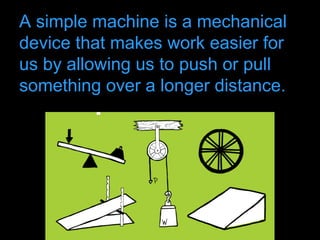
A simple machine is a mechanical
device that makes work easier for
us by allowing us to push or pull
something over a longer distance.
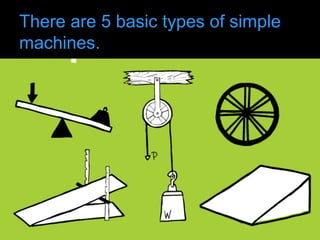
There are 5 basic types of simple
machines.
The 1st
type of simple machine
is...
The Lever
Introduction to Levers
https://youtu.be/YlYEi0PgG1g
Watch this video of a truck
being lifted with a lever.
https://youtu.be/fX3doG_z9l4
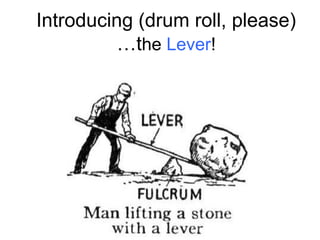
Introducing (drum roll, please)
…the Lever!
A lever includes a stiff structure such as a wood
board that pivots on a fixed point called the fulcrum.
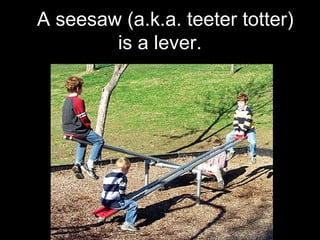
A seesaw (a.k.a. teeter totter)
is a lever.
Every Lever has 3 parts:
1. Resistance (a.k.a. Load)
2. Effort Force (a.k.a. Input Force)
3. Fulcrum
Okay, but what ARE these 3
parts?!?!
Well, let’s look at the 1st
part...Resistance (a.k.a. Load).
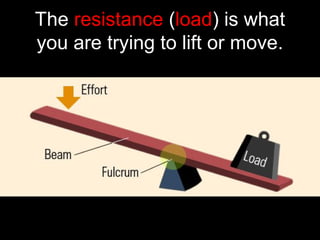
The resistance (load) is what
you are trying to lift or move.
Why do you think the object you
are trying to move is called the
“resistance”?
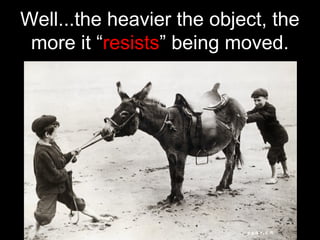
Well...the heavier the object, the
more it “resists” being moved.
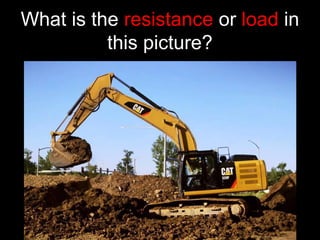
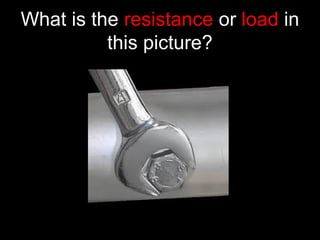
What is the resistance or load in
this picture?
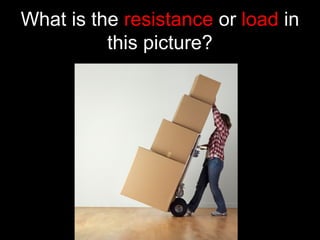
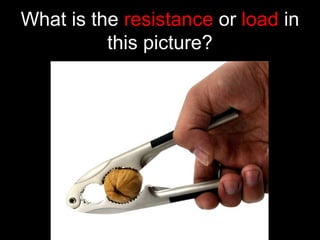
What is the resistance or load in
this picture?
What is the resistance or load in
this picture?
What is the resistance or load in
this picture?
Now, let’s look at the 2nd
part of a
lever...Effort Force (a.k.a. Input
Force).
The Effort Force (a.k.a. Input
Force) is the effort or work you
have to put in, so the object will
move.
Which letter shows the effort force?
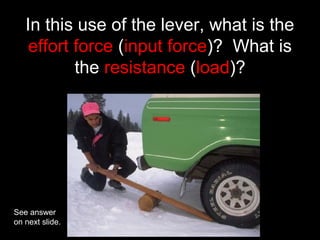
In this use of the lever, what is the
effort force (input force)? What is
the resistance (load)?
See answer
on next slide.
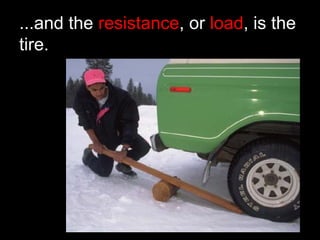
This man must push down on the
board to cause the tire to lift. So,
the effort force is the man pushing
down...
...and the resistance, or load, is the
tire.
Lastly, let’s look at the 3rd
part of
a lever...the Fulcrum.
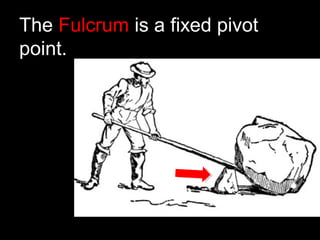
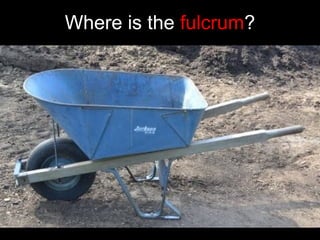
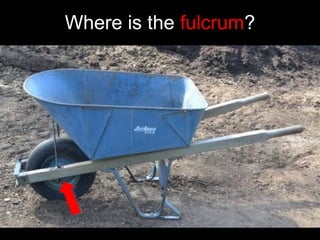
The Fulcrum is a fixed pivot
point.
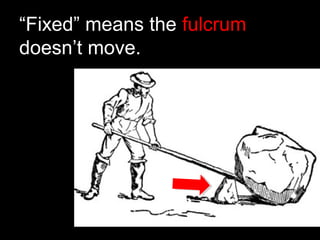
“Fixed” means the fulcrum
doesn’t move.
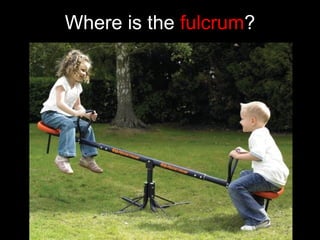
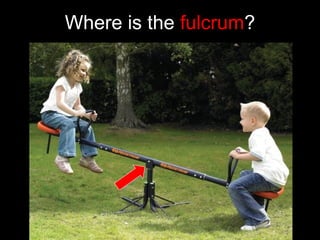
Where is the fulcrum?
Let’s review the parts of a lever:
1. The work you have to put in
to make the object move is
called...
1. The work you have to put in
to make the object move is
called...effort force or input
force.
2. The object that you want to
lift or move is called...
2. The object that you want to
lift or move is called...the
resistance or load.
3. The fixed point on which the
lever pivots is called...
3. The fixed point on which the
lever pivots is called...the
fulcrum.
4. The load is...
4. The load is...the object you
are trying to lift or move.
5. The other word for “load”
is...
5. The other word for “load”
is...“resistance”.
6. Effort force is...
6. Effort force is...the work you
put into moving the object.
7. Another term for effort force
is...
7. Another term for “effort force”
is...“input force”.
8. The fulcrum is...
8. The fulcrum is...the fixed
point on which the lever
pivots.
Good job!
The order of the load, effort, and
fulcrum determines the lever’s
class. There are 3 classes of
levers.
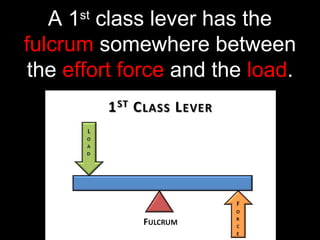
A 1st
class lever has the
fulcrum somewhere between
the effort force and the load.
Go outside to demonstrate 2
levers in action.
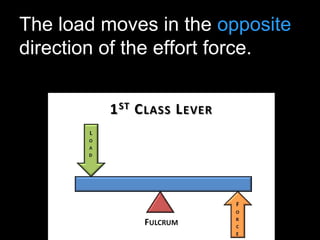
The load moves in the opposite
direction of the effort force.
So, if you push down on one
end of a lever, the load at the
opposite end will move ___ and
vice versa.
If you push down on one end of
a lever, the load at the opposite
end will move _up_ and vice
versa.
1st
Class Lever
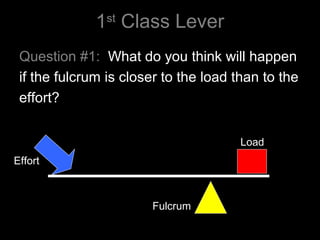
Question #1: What do you think will happen
if the fulcrum is closer to the load than to the
effort?
Effort
Load
Fulcrum
1st
Class Lever
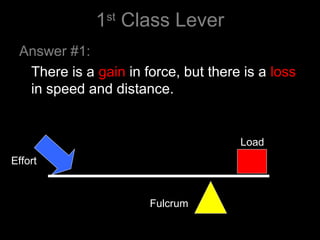
Answer #1:
There is a gain in force, but there is a loss
in speed and distance.
Effort
Load
Fulcrum
1st
Class Lever
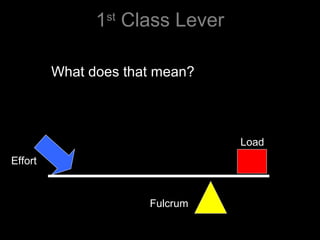
What does that mean?
Effort
Load
Fulcrum
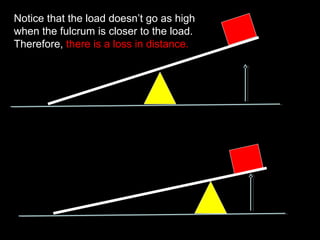
Notice that the load doesn’t go as high
when the fulcrum is closer to the load.
Therefore, there is a loss in distance.
But, if the fulcrum is close to the load, it
will be a lot easier to move. Therefore,
there is a gain in force.
More effort needed
Less effort needed
1st
Class Lever
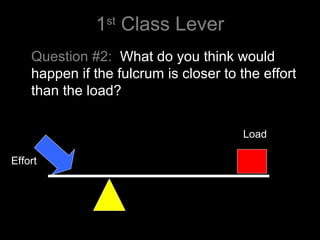
Question #2: What do you think would
happen if the fulcrum is closer to the effort
than the load?
Effort
Load
1st
Class Lever
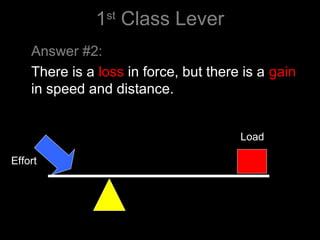
Answer #2:
There is a loss in force, but there is a gain
in speed and distance.
Effort
Load
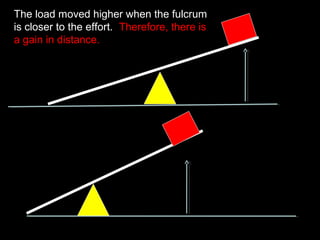
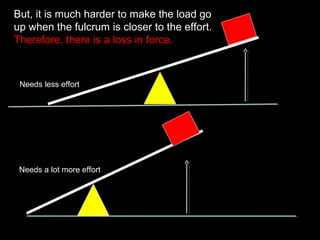
The load moved higher when the fulcrum
is closer to the effort. Therefore, there is
a gain in distance.
But, it is much harder to make the load go
up when the fulcrum is closer to the effort.
Therefore, there is a loss in force.
Needs a lot more effort
Needs less effort
What are some examples of 1st
class levers?
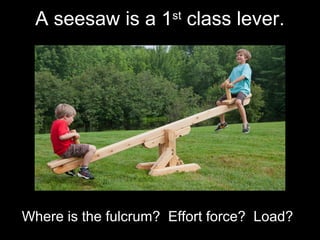
A seesaw is a 1st
class lever.
Where is the fulcrum? Effort force? Load?
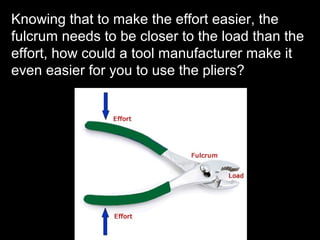
Pliers are a 1st
class lever.
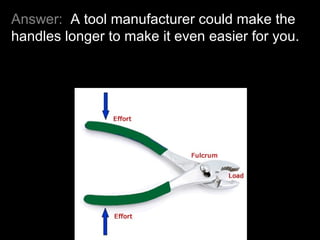
Knowing that to make the effort easier, the
fulcrum needs to be closer to the load than the
effort, how could a tool manufacturer make it
even easier for you to use the pliers?
Answer: A tool manufacturer could make the
handles longer to make it even easier for you.
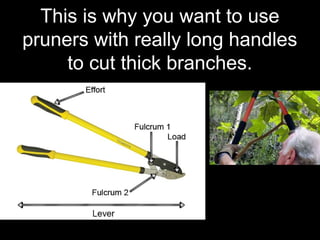
This is why you want to use
pruners with really long handles
to cut thick branches.
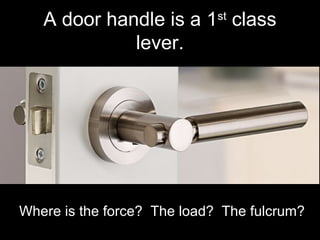
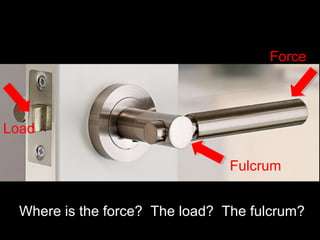
A door handle is a 1st
class
lever.
Where is the force? The load? The fulcrum?
Force
Fulcrum
Load
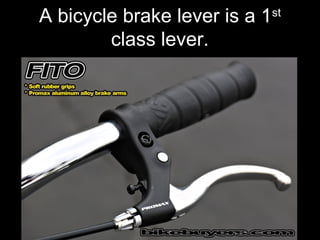
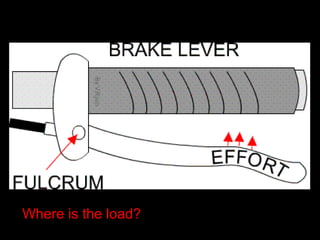
A bicycle brake lever is a 1st
class lever.
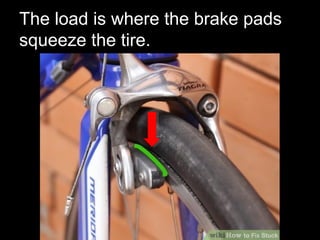
Where is the load?
The load is where the brake pads
squeeze the tire.
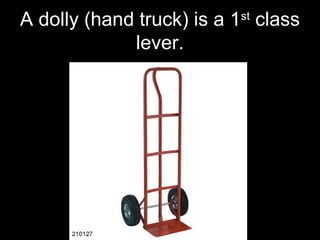
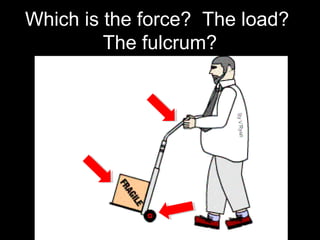
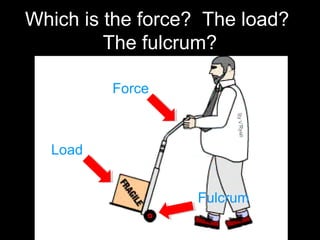
A dolly (hand truck) is a 1st
class
lever.
Which is the force? The load?
The fulcrum?
Which is the force? The load?
The fulcrum?
Force
Load
Fulcrum
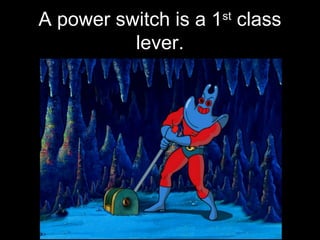
A power switch is a 1st
class
lever.
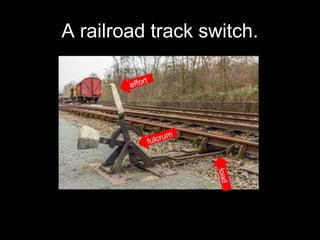
A railroad track switch.
fulcrum
fulcrum
load
load
effort
effort
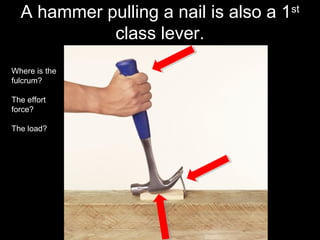
A hammer pulling a nail is also a 1st
class lever.
Where is the
fulcrum?
The effort
force?
The load?
A hammer pulling a nail is also a 1st
class lever.
Where is the
fulcrum?
The effort
force?
The load?
Load
Effort Force
Fulcrum
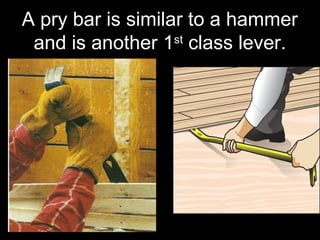
A pry bar is similar to a hammer
and is another 1st
class lever.
Scissors are two 1st
class levers put
together.
loadload
Okay, now we know what a 1st
class lever is like. What about a
2nd
class lever? What is it like?
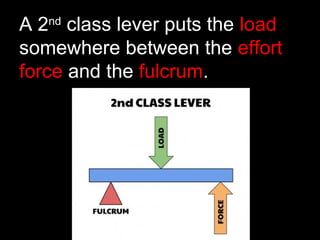
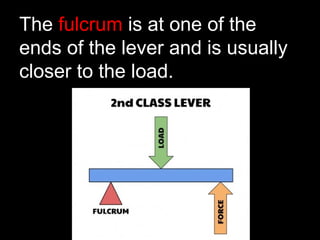
A 2nd
class lever puts the load
somewhere between the effort
force and the fulcrum.
The fulcrum is at one of the
ends of the lever and is usually
closer to the load.
What are some examples of 2nd
class levers?
The wheelbarrow is the most
famous 2nd
class lever.
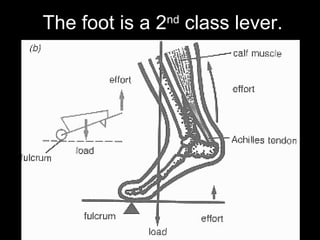
The foot is a 2nd
class lever.
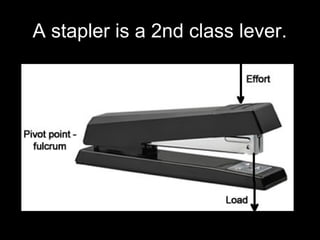
A stapler is a 2nd class lever.
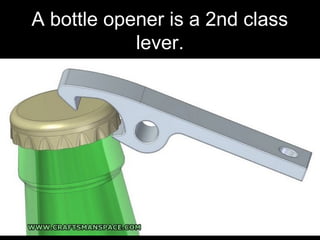
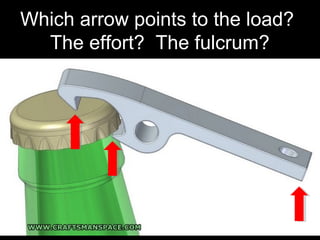
A bottle opener is a 2nd class
lever.
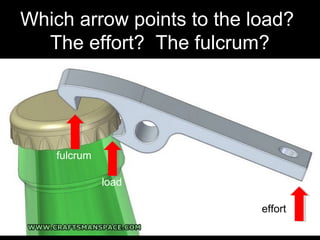
Which arrow points to the load?
The effort? The fulcrum?
Which arrow points to the load?
The effort? The fulcrum?
fulcrum
load
effort
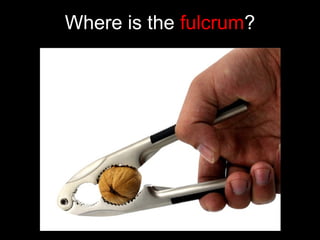
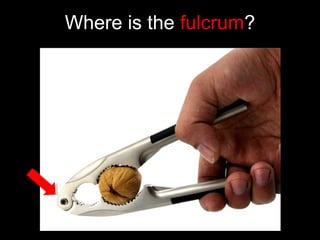
A nutcracker uses two 2nd
class
levers put together.
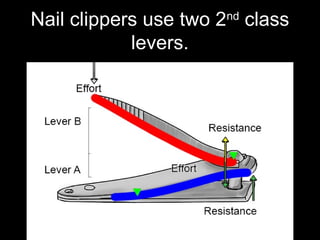
Nail clippers use two 2nd
class
levers.