WORK AND MACHINES
CHAPTER 8
LESSON 4 PART 1: USING
LEVERS
 A screwdriver, used to pry the lid from a can, is an

example of a simple machine
 A simple machine is a tool with few parts that

makes it easier or possible to do work
 Simple machines change the direction,

distance, or size of the force you apply
THE LEVER
 A lever is a simple machine containing a bar

that can turn around a fixed point
 The fixed point of a lever is called a fulcrum
 Levers can have many shapes
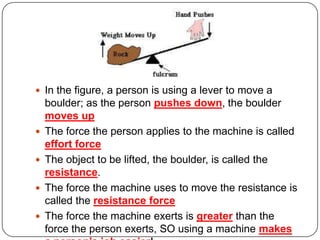
 In the figure, a person is using a lever to move a






boulder; as the person pushes down, the boulder
moves up
The force the person applies to the machine is called
effort force
The object to be lifted, the boulder, is called the
resistance.
The force the machine uses to move the resistance is
called the resistance force
The force the machine exerts is greater than the
force the person exerts, SO using a machine makes
THE THREE CLASSES OF
LEVERS
 Levers can be grouped into three classes
 The classes of levers are based on the position

of the resistance force, the fulcrum, and the
effort force
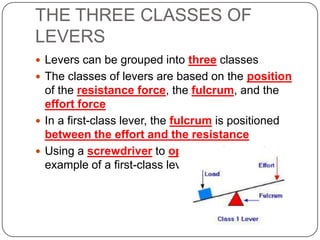
 In a first-class lever, the fulcrum is positioned
between the effort and the resistance
 Using a screwdriver to open a paint can is an
example of a first-class lever
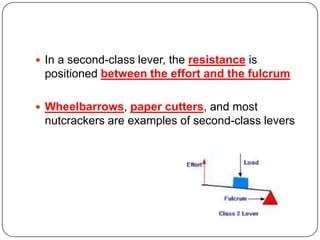
 In a second-class lever, the resistance is

positioned between the effort and the fulcrum
 Wheelbarrows, paper cutters, and most

nutcrackers are examples of second-class levers
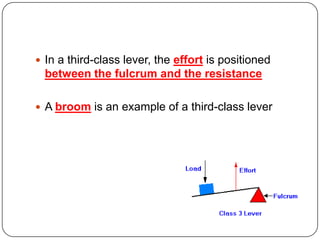
 In a third-class lever, the effort is positioned

between the fulcrum and the resistance
 A broom is an example of a third-class lever
LESSON 4 PART 2: USING
LEVERS
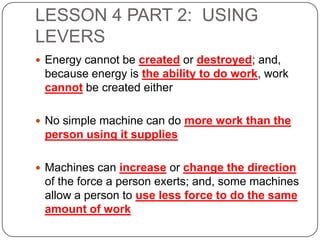
 Energy cannot be created or destroyed; and,

because energy is the ability to do work, work
cannot be created either
 No simple machine can do more work than the

person using it supplies
 Machines can increase or change the direction

of the force a person exerts; and, some machines
allow a person to use less force to do the same
amount of work
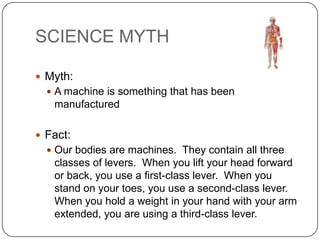
SCIENCE MYTH
 Myth:
 A machine is something that has been

manufactured
 Fact:
 Our bodies are machines. They contain all three

classes of levers. When you lift your head forward
or back, you use a first-class lever. When you
stand on your toes, you use a second-class lever.
When you hold a weight in your hand with your arm
extended, you are using a third-class lever.
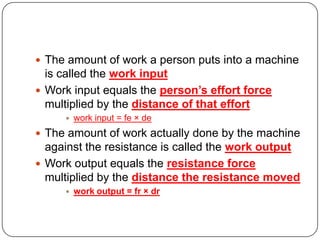
 The amount of work a person puts into a machine

is called the work input
 Work input equals the person’s effort force
multiplied by the distance of that effort


work input = fe × de

 The amount of work actually done by the machine

against the resistance is called the work output
 Work output equals the resistance force
multiplied by the distance the resistance moved


work output = fr × dr
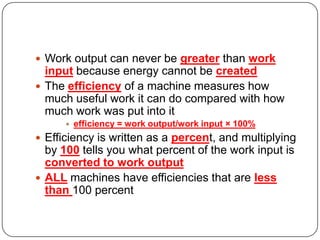
 Work output can never be greater than work

input because energy cannot be created
 The efficiency of a machine measures how
much useful work it can do compared with how
much work was put into it


efficiency = work output/work input × 100%

 Efficiency is written as a percent, and multiplying

by 100 tells you what percent of the work input is
converted to work output
 ALL machines have efficiencies that are less
than 100 percent
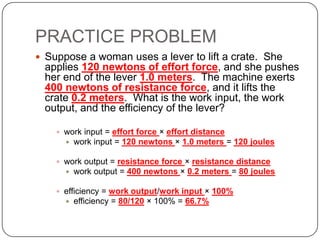
PRACTICE PROBLEM
 Suppose a woman uses a lever to lift a crate. She

applies 120 newtons of effort force, and she pushes
her end of the lever 1.0 meters. The machine exerts
400 newtons of resistance force, and it lifts the
crate 0.2 meters. What is the work input, the work
output, and the efficiency of the lever?
 work input = effort force × effort distance


work input = 120 newtons × 1.0 meters = 120 joules

 work output = resistance force × resistance distance


work output = 400 newtons × 0.2 meters = 80 joules

 efficiency = work output/work input × 100%


efficiency = 80/120 × 100% = 66.7%

Work and machines

  • 1.
  • 2.
    LESSON 4 PART1: USING LEVERS  A screwdriver, used to pry the lid from a can, is an example of a simple machine  A simple machine is a tool with few parts that makes it easier or possible to do work  Simple machines change the direction, distance, or size of the force you apply
  • 3.
    THE LEVER  Alever is a simple machine containing a bar that can turn around a fixed point  The fixed point of a lever is called a fulcrum  Levers can have many shapes
  • 4.
     In thefigure, a person is using a lever to move a     boulder; as the person pushes down, the boulder moves up The force the person applies to the machine is called effort force The object to be lifted, the boulder, is called the resistance. The force the machine uses to move the resistance is called the resistance force The force the machine exerts is greater than the force the person exerts, SO using a machine makes
  • 5.
    THE THREE CLASSESOF LEVERS  Levers can be grouped into three classes  The classes of levers are based on the position of the resistance force, the fulcrum, and the effort force  In a first-class lever, the fulcrum is positioned between the effort and the resistance  Using a screwdriver to open a paint can is an example of a first-class lever
  • 6.
     In asecond-class lever, the resistance is positioned between the effort and the fulcrum  Wheelbarrows, paper cutters, and most nutcrackers are examples of second-class levers
  • 7.
     In athird-class lever, the effort is positioned between the fulcrum and the resistance  A broom is an example of a third-class lever
  • 8.
    LESSON 4 PART2: USING LEVERS  Energy cannot be created or destroyed; and, because energy is the ability to do work, work cannot be created either  No simple machine can do more work than the person using it supplies  Machines can increase or change the direction of the force a person exerts; and, some machines allow a person to use less force to do the same amount of work
  • 9.
    SCIENCE MYTH  Myth: A machine is something that has been manufactured  Fact:  Our bodies are machines. They contain all three classes of levers. When you lift your head forward or back, you use a first-class lever. When you stand on your toes, you use a second-class lever. When you hold a weight in your hand with your arm extended, you are using a third-class lever.
  • 10.
     The amountof work a person puts into a machine is called the work input  Work input equals the person’s effort force multiplied by the distance of that effort  work input = fe × de  The amount of work actually done by the machine against the resistance is called the work output  Work output equals the resistance force multiplied by the distance the resistance moved  work output = fr × dr
  • 11.
     Work outputcan never be greater than work input because energy cannot be created  The efficiency of a machine measures how much useful work it can do compared with how much work was put into it  efficiency = work output/work input × 100%  Efficiency is written as a percent, and multiplying by 100 tells you what percent of the work input is converted to work output  ALL machines have efficiencies that are less than 100 percent
  • 12.
    PRACTICE PROBLEM  Supposea woman uses a lever to lift a crate. She applies 120 newtons of effort force, and she pushes her end of the lever 1.0 meters. The machine exerts 400 newtons of resistance force, and it lifts the crate 0.2 meters. What is the work input, the work output, and the efficiency of the lever?  work input = effort force × effort distance  work input = 120 newtons × 1.0 meters = 120 joules  work output = resistance force × resistance distance  work output = 400 newtons × 0.2 meters = 80 joules  efficiency = work output/work input × 100%  efficiency = 80/120 × 100% = 66.7%