1


Vertical Curves


                  20/01/2013
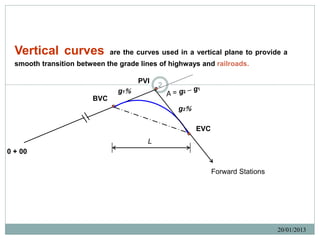
Vertical curves             are the curves used in a vertical plane to provide a
  smooth transition between the grade lines of highways and railroads.

                                      PVI
                                             2
                                g1
                        BVC
                                                  g2

                                                        EVC
                                         L
0 + 00

                                                              Forward Stations


                                                                                 20/01/2013
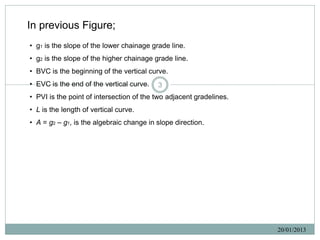
In previous Figure;
• g1 is the slope of the lower chainage grade line.
• g2 is the slope of the higher chainage grade line.
• BVC is the beginning of the vertical curve.
• EVC is the end of the vertical curve.   3
• PVI is the point of intersection of the two adjacent gradelines.
• L is the length of vertical curve.
• A = g2 – g1, is the algebraic change in slope direction.


                                                                     20/01/2013
General Equation of Parabola

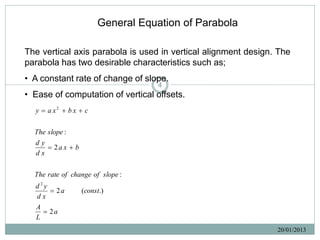
The vertical axis parabola is used in vertical alignment design. The
parabola has two desirable characteristics such as;
• A constant rate of change of slope.
                                    4
• Ease of computation of vertical offsets.
  y  a x2  b x  c

  The slope :
  dy
       2a x  b
  dx

  The rate of change of slope :
  d2y
       2a         (const.)
  dx
   A
      2a
   L
                                                                20/01/2013
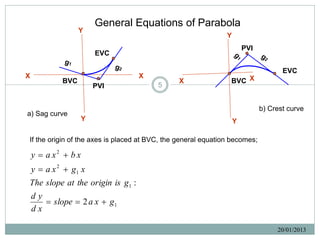
General Equations of Parabola
                   Y
                                                               Y
                                                                       PVI
                         EVC

                                                                                    EVC
X                                 X
             BVC                               X                BVC X
                         PVI             5


                                                                             b) Crest curve
a) Sag curve
                     Y                                             Y

If the origin of the axes is placed at BVC, the general equation becomes;

    y  a x2  b x
    y  a x 2  g1 x
The slope at the origin is g1 :
    dy
        slope  2 a x  g1
    dx

                                                                                  20/01/2013
L
                     L/2             L/2
                                                 E

                                 V
                 x
                           ax2
     g1x
                                       6
                                 m
           BVC
                                 C               E
                                           EVC
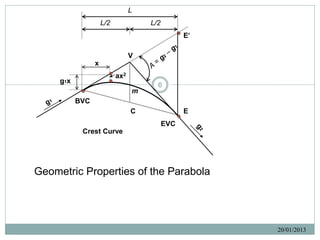
            Crest Curve


Geometric Properties of the Parabola


                                                      20/01/2013
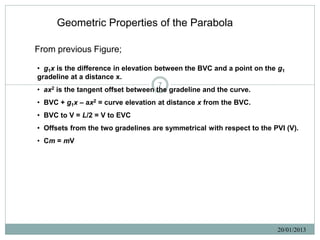
Geometric Properties of the Parabola

From previous Figure;

• g1x is the difference in elevation between the BVC and a point on the g1
gradeline at a distance x.
                                      7
• ax2 is the tangent offset between the gradeline and the curve.
• BVC + g1x – ax2 = curve elevation at distance x from the BVC.
• BVC to V = L/2 = V to EVC
• Offsets from the two gradelines are symmetrical with respect to the PVI (V).
• Cm = mV


                                                                       20/01/2013
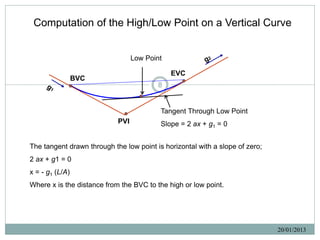
Computation of the High/Low Point on a Vertical Curve


                                  Low Point

                                              EVC
                 BVC
                                         8


                                          Tangent Through Low Point
                            PVI           Slope = 2 ax + g1 = 0


The tangent drawn through the low point is horizontal with a slope of zero;
2 ax + g1 = 0
x = - g1 (L/A)
Where x is the distance from the BVC to the high or low point.


                                                                              20/01/2013
Computing a Vertical Curve
Procedures for computing a vertical curve:
1.   Compute the algebraic difference in grades A = g1 – g2.
2.   Compute the stationing of BVC and EVC. Subtract/add L/2 to the PVI.
3.   Compute the distance from the BVC to the high or low point; x = - g1(L/A). Determine
     the station of the high or low point. 9

4.   Compute the tangent gradeline elevation of the BVC and the EVC.
5.   Compute the tangent gradeline elevation for each required station.
6.   Compute the midpoint of the chord elevation: [(elevation of BVC + elevation of EVC)/2].
7.   Compute the tangent offset d at PVI, Vm, d = (difference in elevation of PVI and C)/2).
8.   Compute the tangent offset for each individual station (see line ax2),
     tangent offset = d (x)2/(L/2)2 = (4d) x2/L2 where x is the distance from the BVC or EVC
     (whichever is closer) to the required station.
9.   Compute the elevation on the curve at each required station by combining the tangent
     offsets with the appropriate tangent gradeline elevations. Add for sag curves and
     subtract for crest curves.


                                                                                  20/01/2013
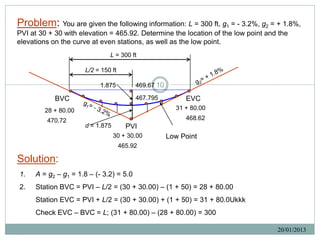
Problem: You are given the following information: L = 300 ft, g1 = - 3.2%, g2 = + 1.8%,
PVI at 30 + 30 with elevation = 465.92. Determine the location of the low point and the
elevations on the curve at even stations, as well as the low point.
                              L = 300 ft

                     L/2 = 150 ft

                          1.875          469.67 10

            BVC                          467.795          EVC
        28 + 80.00                                     31 + 80.00

         470.72                                           468.62
                     d = 1.875        PVI
                                 30 + 30.00          Low Point
                                    465.92

Solution:
1.   A = g2 – g1 = 1.8 – (- 3.2) = 5.0
2.   Station BVC = PVI – L/2 = (30 + 30.00) – (1 + 50) = 28 + 80.00
     Station EVC = PVI + L/2 = (30 + 30.00) + (1 + 50) = 31 + 80.0Ukkk
     Check EVC – BVC = L; (31 + 80.00) – (28 + 80.00) = 300

                                                                                   20/01/2013
Solution:
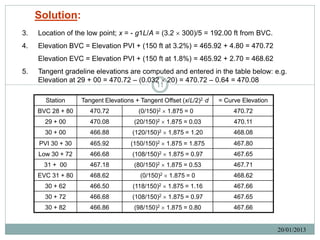
3.   Location of the low point; x = - g1L/A = (3.2  300)/5 = 192.00 ft from BVC.
4.   Elevation BVC = Elevation PVI + (150 ft at 3.2%) = 465.92 + 4.80 = 470.72
     Elevation EVC = Elevation PVI + (150 ft at 1.8%) = 465.92 + 2.70 = 468.62
5.   Tangent gradeline elevations are computed and entered in the table below: e.g.
     Elevation at 29 + 00 = 470.72 – (0.032  20) = 470.72 – 0.64 = 470.08
                                          11

       Station     Tangent Elevations + Tangent Offset (x/L/2)2 .d   = Curve Elevation
     BVC 28 + 80      470.72            (0/150)2  1.875 = 0              470.72
       29 + 00        470.08          (20/150)2  1.875 = 0.03            470.11
       30 + 00        466.88         (120/150)2  1.875 = 1.20            468.08
     PVI 30 + 30      465.92         (150/150)2  1.875 = 1.875           467.80
     Low 30 + 72      466.68         (108/150)2  1.875 = 0.97            467.65
      31 + 00         467.18          (80/150)2  1.875 = 0.53            467.71
     EVC 31 + 80      468.62            (0/150)2  1.875 = 0              468.62
       30 + 62        466.50         (118/150)2  1.875 = 1.16            467.66
       30 + 72        466.68         (108/150)2  1.875 = 0.97            467.65
       30 + 82        466.86          (98/150)2  1.875 = 0.80            467.66


                                                                                         20/01/2013
Solution:
6.   Mid-chord elevation; [470.72 (BVC) + 468.62 (EVC)]/2 = 469.67 ft.
7.   Tangent offset at PVI (d): d = (difference in elevation of PVI and mid-chord)/2
     d = (469.67 – 465.92)/2 = 1.875 ft.
8.   For other stations, tangent offsets are computed by multiplying the distance ratio
     squared (x/L/2)2 by the maximum tangent offset (d). Refer to previous Table.
9.                                          12
     The computed tangent offsets are added to the tangent elevation to determine the
     curve elevation.


                                                                                   20/01/2013
Computing Vertical Curve Directly
          From the General Equation

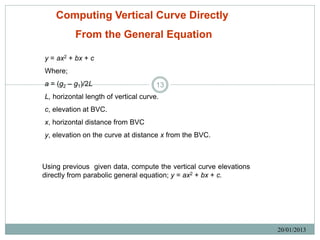
y = ax2 + bx + c
Where;
a = (g2 – g1)/2L                      13
L, horizontal length of vertical curve.
c, elevation at BVC.
x, horizontal distance from BVC
y, elevation on the curve at distance x from the BVC.


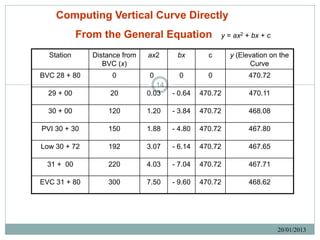
Using previous given data, compute the vertical curve elevations
directly from parabolic general equation; y = ax2 + bx + c.


                                                                   20/01/2013
Computing Vertical Curve Directly
            From the General Equation                 y = ax2 + bx + c

  Station      Distance from   ax2      bx        c      y (Elevation on the
                  BVC (x)                                       Curve
BVC 28 + 80         0          0         0        0            470.72
                                  14
  29 + 00           20         0.03    - 0.64   470.72         470.11

  30 + 00          120         1.20    - 3.84   470.72         468.08

PVI 30 + 30        150         1.88    - 4.80   470.72         467.80

Low 30 + 72        192         3.07    - 6.14   470.72         467.65

 31 + 00           220         4.03    - 7.04   470.72         467.71

EVC 31 + 80        300         7.50    - 9.60   470.72         468.62


                                                                         20/01/2013

Vertical Curves (Part 1)

  • 1.
  • 2.
    Vertical curves are the curves used in a vertical plane to provide a smooth transition between the grade lines of highways and railroads. PVI 2 g1 BVC g2 EVC L 0 + 00 Forward Stations 20/01/2013
  • 3.
    In previous Figure; •g1 is the slope of the lower chainage grade line. • g2 is the slope of the higher chainage grade line. • BVC is the beginning of the vertical curve. • EVC is the end of the vertical curve. 3 • PVI is the point of intersection of the two adjacent gradelines. • L is the length of vertical curve. • A = g2 – g1, is the algebraic change in slope direction. 20/01/2013
  • 4.
    General Equation ofParabola The vertical axis parabola is used in vertical alignment design. The parabola has two desirable characteristics such as; • A constant rate of change of slope. 4 • Ease of computation of vertical offsets. y  a x2  b x  c The slope : dy  2a x  b dx The rate of change of slope : d2y  2a (const.) dx A  2a L 20/01/2013
  • 5.
    General Equations ofParabola Y Y PVI EVC EVC X X BVC X BVC X PVI 5 b) Crest curve a) Sag curve Y Y If the origin of the axes is placed at BVC, the general equation becomes; y  a x2  b x y  a x 2  g1 x The slope at the origin is g1 : dy  slope  2 a x  g1 dx 20/01/2013
  • 6.
    L L/2 L/2 E V x ax2 g1x 6 m BVC C E EVC Crest Curve Geometric Properties of the Parabola 20/01/2013
  • 7.
    Geometric Properties ofthe Parabola From previous Figure; • g1x is the difference in elevation between the BVC and a point on the g1 gradeline at a distance x. 7 • ax2 is the tangent offset between the gradeline and the curve. • BVC + g1x – ax2 = curve elevation at distance x from the BVC. • BVC to V = L/2 = V to EVC • Offsets from the two gradelines are symmetrical with respect to the PVI (V). • Cm = mV 20/01/2013
  • 8.
    Computation of theHigh/Low Point on a Vertical Curve Low Point EVC BVC 8 Tangent Through Low Point PVI Slope = 2 ax + g1 = 0 The tangent drawn through the low point is horizontal with a slope of zero; 2 ax + g1 = 0 x = - g1 (L/A) Where x is the distance from the BVC to the high or low point. 20/01/2013
  • 9.
    Computing a VerticalCurve Procedures for computing a vertical curve: 1. Compute the algebraic difference in grades A = g1 – g2. 2. Compute the stationing of BVC and EVC. Subtract/add L/2 to the PVI. 3. Compute the distance from the BVC to the high or low point; x = - g1(L/A). Determine the station of the high or low point. 9 4. Compute the tangent gradeline elevation of the BVC and the EVC. 5. Compute the tangent gradeline elevation for each required station. 6. Compute the midpoint of the chord elevation: [(elevation of BVC + elevation of EVC)/2]. 7. Compute the tangent offset d at PVI, Vm, d = (difference in elevation of PVI and C)/2). 8. Compute the tangent offset for each individual station (see line ax2), tangent offset = d (x)2/(L/2)2 = (4d) x2/L2 where x is the distance from the BVC or EVC (whichever is closer) to the required station. 9. Compute the elevation on the curve at each required station by combining the tangent offsets with the appropriate tangent gradeline elevations. Add for sag curves and subtract for crest curves. 20/01/2013
  • 10.
    Problem: You aregiven the following information: L = 300 ft, g1 = - 3.2%, g2 = + 1.8%, PVI at 30 + 30 with elevation = 465.92. Determine the location of the low point and the elevations on the curve at even stations, as well as the low point. L = 300 ft L/2 = 150 ft 1.875 469.67 10 BVC 467.795 EVC 28 + 80.00 31 + 80.00 470.72 468.62 d = 1.875 PVI 30 + 30.00 Low Point 465.92 Solution: 1. A = g2 – g1 = 1.8 – (- 3.2) = 5.0 2. Station BVC = PVI – L/2 = (30 + 30.00) – (1 + 50) = 28 + 80.00 Station EVC = PVI + L/2 = (30 + 30.00) + (1 + 50) = 31 + 80.0Ukkk Check EVC – BVC = L; (31 + 80.00) – (28 + 80.00) = 300 20/01/2013
  • 11.
    Solution: 3. Location of the low point; x = - g1L/A = (3.2  300)/5 = 192.00 ft from BVC. 4. Elevation BVC = Elevation PVI + (150 ft at 3.2%) = 465.92 + 4.80 = 470.72 Elevation EVC = Elevation PVI + (150 ft at 1.8%) = 465.92 + 2.70 = 468.62 5. Tangent gradeline elevations are computed and entered in the table below: e.g. Elevation at 29 + 00 = 470.72 – (0.032  20) = 470.72 – 0.64 = 470.08 11 Station Tangent Elevations + Tangent Offset (x/L/2)2 .d = Curve Elevation BVC 28 + 80 470.72 (0/150)2  1.875 = 0 470.72 29 + 00 470.08 (20/150)2  1.875 = 0.03 470.11 30 + 00 466.88 (120/150)2  1.875 = 1.20 468.08 PVI 30 + 30 465.92 (150/150)2  1.875 = 1.875 467.80 Low 30 + 72 466.68 (108/150)2  1.875 = 0.97 467.65 31 + 00 467.18 (80/150)2  1.875 = 0.53 467.71 EVC 31 + 80 468.62 (0/150)2  1.875 = 0 468.62 30 + 62 466.50 (118/150)2  1.875 = 1.16 467.66 30 + 72 466.68 (108/150)2  1.875 = 0.97 467.65 30 + 82 466.86 (98/150)2  1.875 = 0.80 467.66 20/01/2013
  • 12.
    Solution: 6. Mid-chord elevation; [470.72 (BVC) + 468.62 (EVC)]/2 = 469.67 ft. 7. Tangent offset at PVI (d): d = (difference in elevation of PVI and mid-chord)/2 d = (469.67 – 465.92)/2 = 1.875 ft. 8. For other stations, tangent offsets are computed by multiplying the distance ratio squared (x/L/2)2 by the maximum tangent offset (d). Refer to previous Table. 9. 12 The computed tangent offsets are added to the tangent elevation to determine the curve elevation. 20/01/2013
  • 13.
    Computing Vertical CurveDirectly From the General Equation y = ax2 + bx + c Where; a = (g2 – g1)/2L 13 L, horizontal length of vertical curve. c, elevation at BVC. x, horizontal distance from BVC y, elevation on the curve at distance x from the BVC. Using previous given data, compute the vertical curve elevations directly from parabolic general equation; y = ax2 + bx + c. 20/01/2013
  • 14.
    Computing Vertical CurveDirectly From the General Equation y = ax2 + bx + c Station Distance from ax2 bx c y (Elevation on the BVC (x) Curve BVC 28 + 80 0 0 0 0 470.72 14 29 + 00 20 0.03 - 0.64 470.72 470.11 30 + 00 120 1.20 - 3.84 470.72 468.08 PVI 30 + 30 150 1.88 - 4.80 470.72 467.80 Low 30 + 72 192 3.07 - 6.14 470.72 467.65 31 + 00 220 4.03 - 7.04 470.72 467.71 EVC 31 + 80 300 7.50 - 9.60 470.72 468.62 20/01/2013