Three Moment
                                     Equation
                                  Theory of Structure - I


Department of Civil Engineering
University of Engineering and Technology, Taxila, Pakistan
Lecture Outlines


 Introduction

 Proof   of Three Moment Equation
 Example


 Department of                       2
Introduction
 Developed      by French Engineer Clapeyron in
  1857.
 This equation relates the internal moments in
  a continuous beam at three points of support
  to the loads acting between the supports.
 By successive application of this equation
  to each span of the beam, one obtains a set
  of equations that may be solved
  simultaneously for the unknown internal
  moments at the support.
 Department of                        3
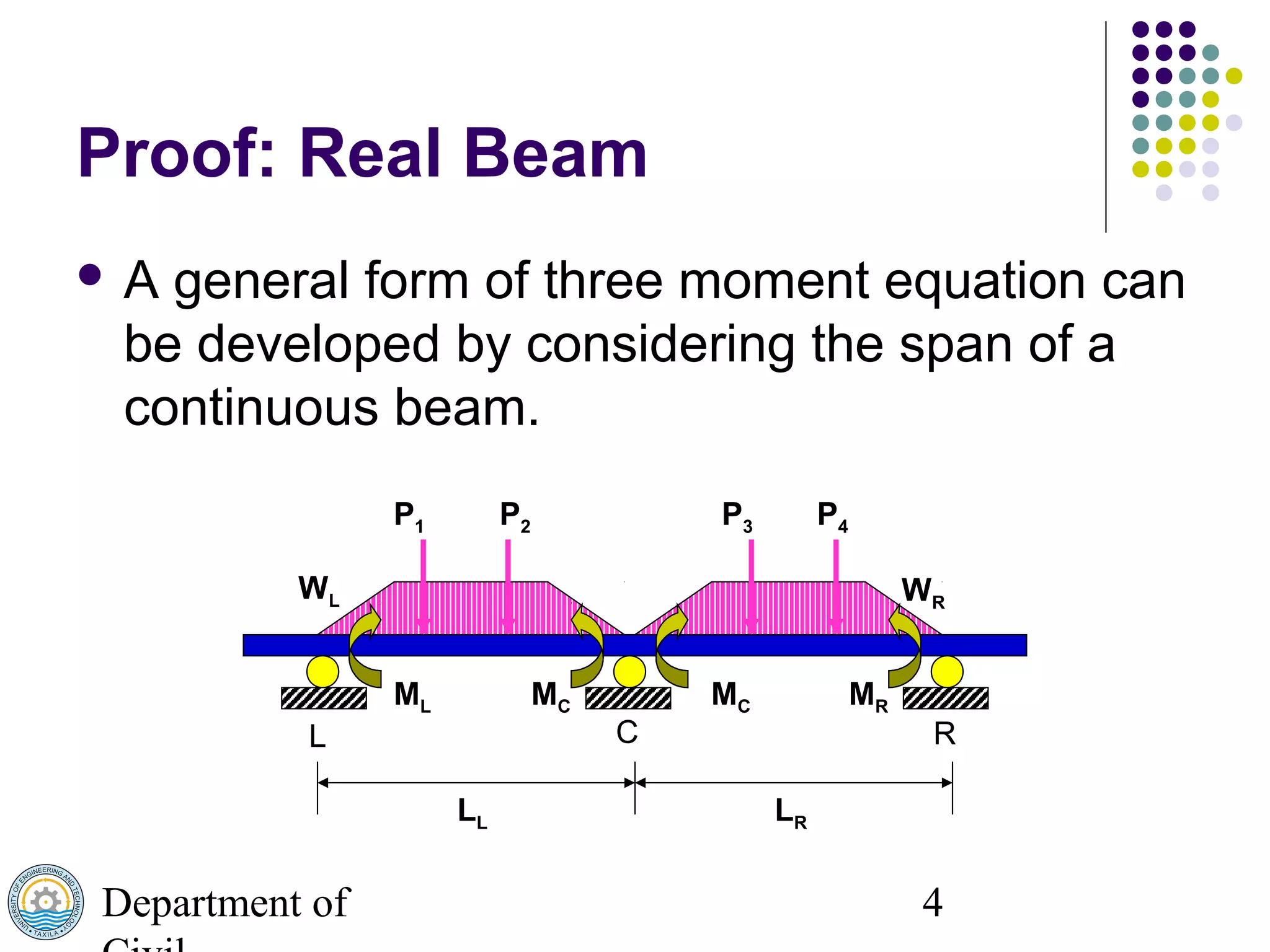
Proof: Real Beam
A general form of three moment equation can
 be developed by considering the span of a
 continuous beam.
                P1        P2            P3        P4

          WL                                                WR


                ML             MC       MC             MR
          L                         C                        R

                     LL                      LR


Department of                                               4
Conjugate Beam (applied
loads)
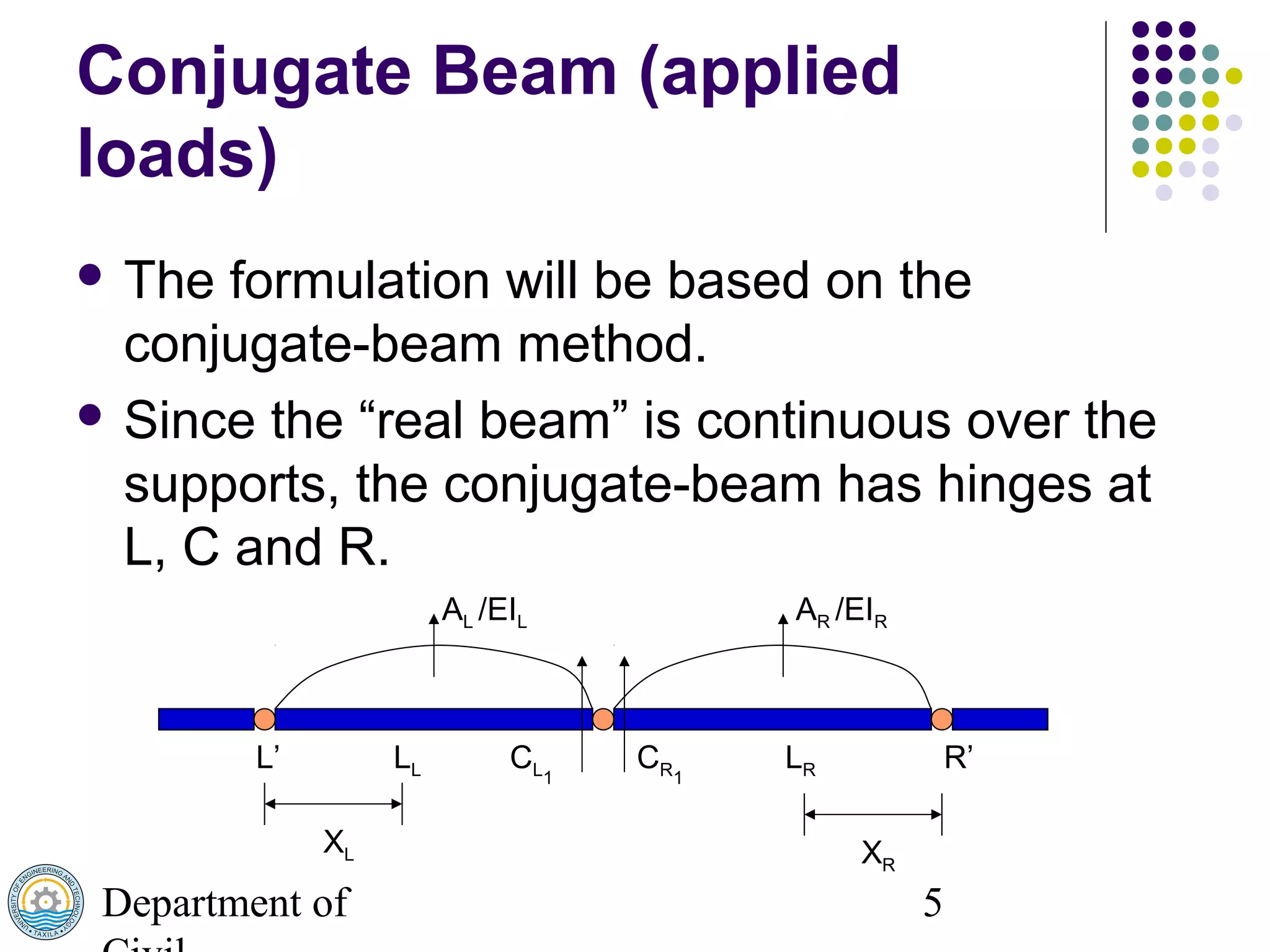
 The  formulation will be based on the
  conjugate-beam method.
 Since the “real beam” is continuous over the
  supports, the conjugate-beam has hinges at
  L, C and R.
                        AL /EIL            AR /EIR


         L’        LL        CL 1   CR 1   LR            R’

              XL                                XR
 Department of                                       5
Conjugate Beam (internal
moments)
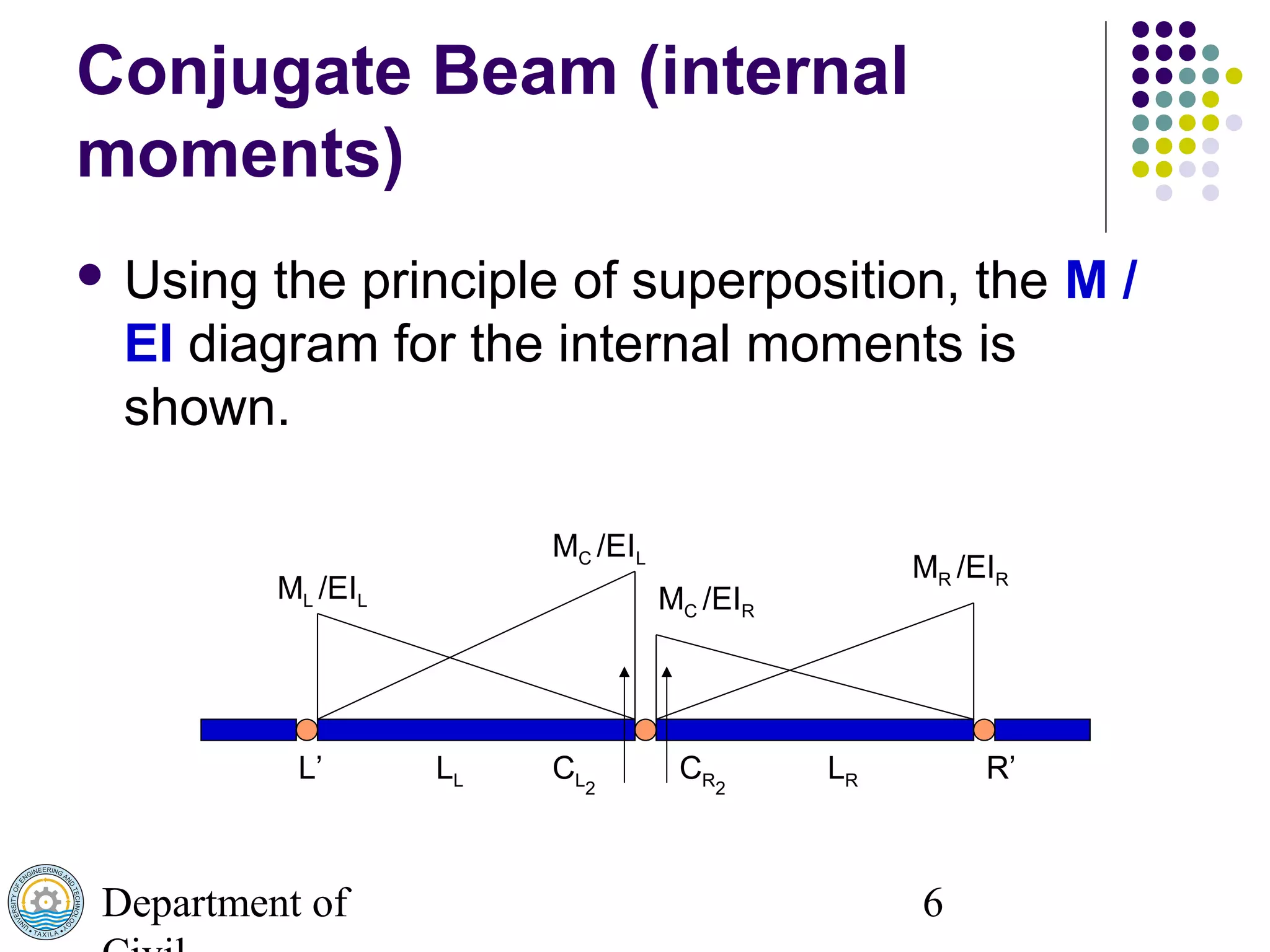
 Usingthe principle of superposition, the M /
 EI diagram for the internal moments is
 shown.

                         MC /EIL
                                                  MR /EIR
          ML /EIL                  MC /EIR


           L’       LL   CL2        CR2      LR        R’


Department of                                     6
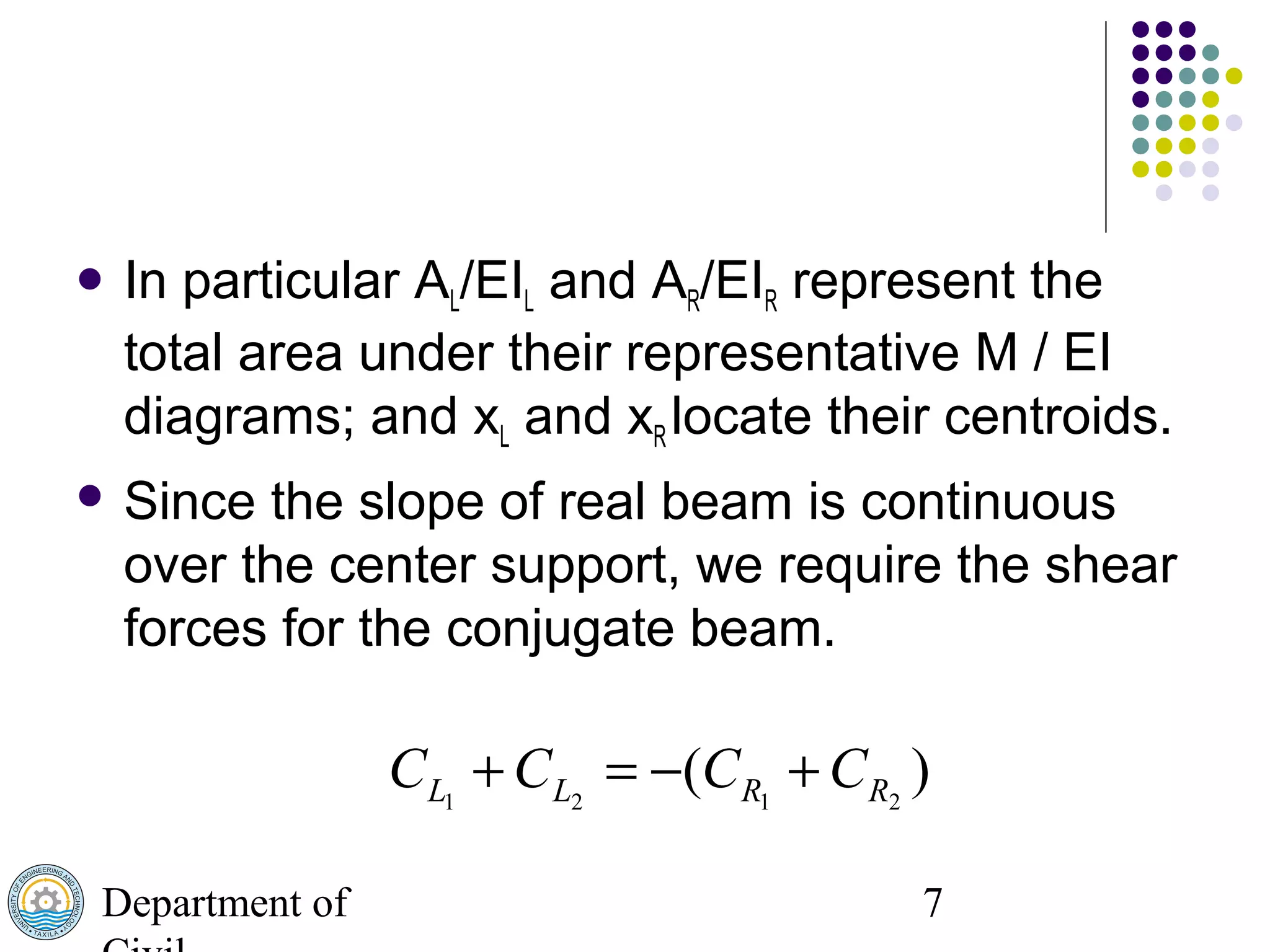
 In particular AL/EIL and AR/EIR represent the
  total area under their representative M / EI
  diagrams; and xL and xR locate their centroids.
 Since  the slope of real beam is continuous
  over the center support, we require the shear
  forces for the conjugate beam.

                 C L1 + C L2 = −(C R1 + C R2 )

 Department of                               7
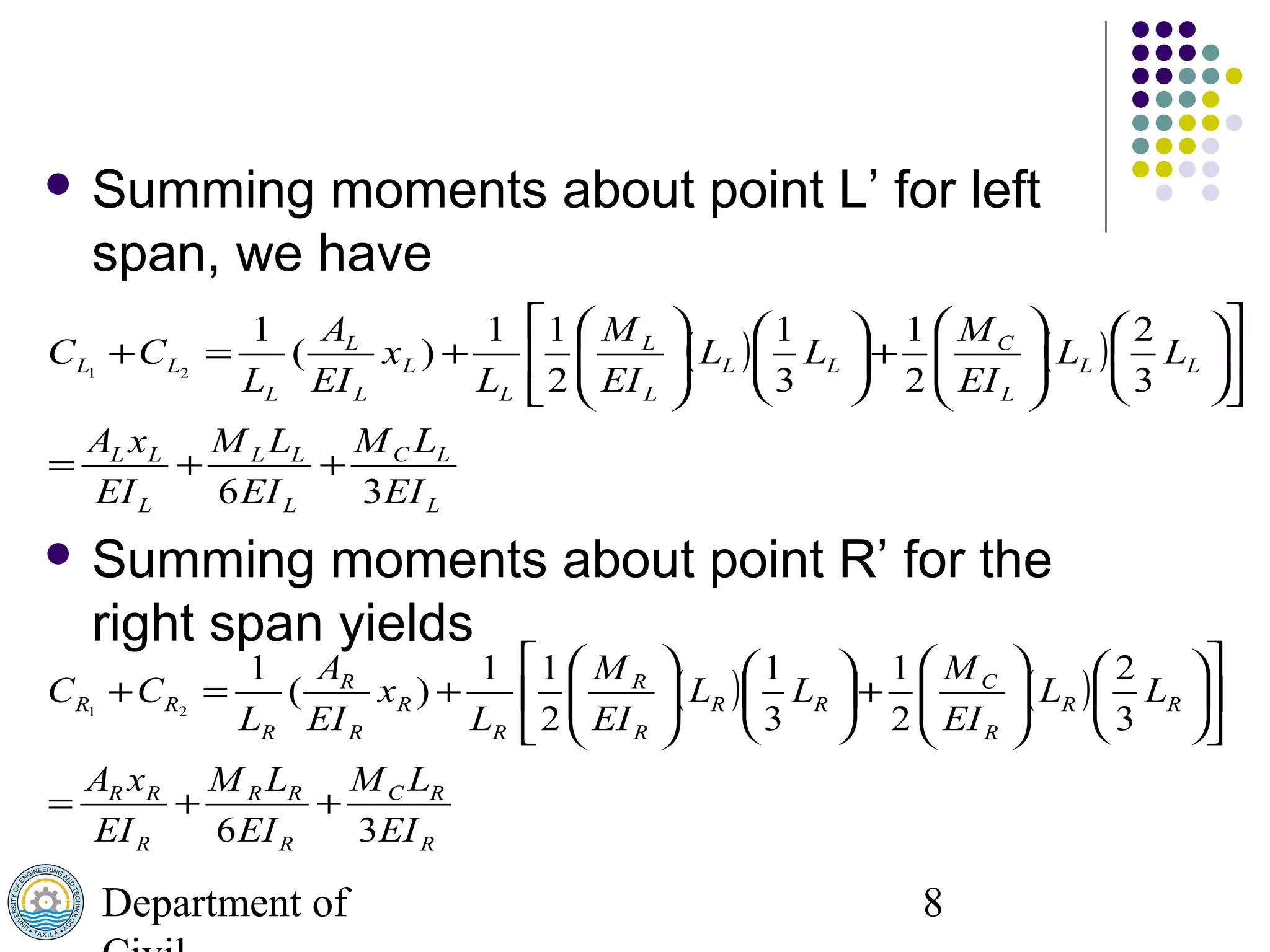
 Summing    moments about point L’ for left
    span, we have
                1 AL           1    1  M L          1  1  M              2   
C L1 + C L2   =   (     xL ) +                ( LL ) LL  +  C      ( LL ) LL 
                LL EI L        LL    2  EI L
                                     
                                                
                                                
                                                                
                                                        3  2  EI L
                                                                         
                                                                               3   
    AL xL M L LL M C LL
=        +        +
    EI L   6 EI L   3EI L
 Summing     moments about point R’ for the
    right span yields
                1 AR           1    1  M R          1  1  M              2   
C R1 + C R2   =   (     xR ) +                ( LR ) LR  +  C     ( LR )  LR 
                LR EI R        LR    2  EI R
                                     
                                                
                                                
                                                                
                                                        3  2  EI R
                                                                        
                                                                               3   
    AR xR M R LR M C LR
=        +        +
    EI R   6 EI R   3EI R

    Department of                                               8
General Equation
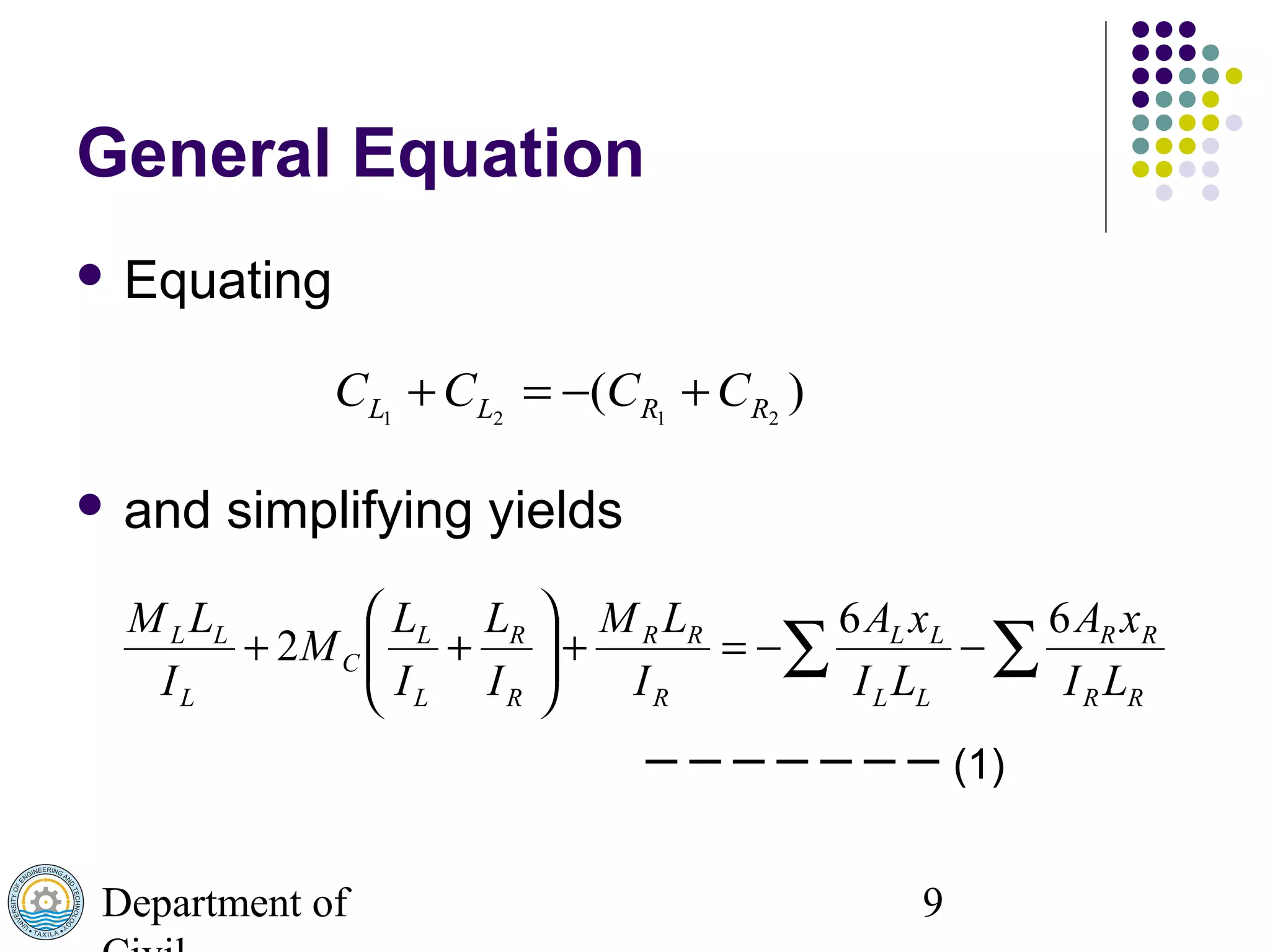
 Equating


             C L1 + C L2 = −(C R1 + C R2 )

 and   simplifying yields
  M L LL         LL LR  M R LR      6 AL xL    6 AR xR
         + 2M C  +  +
                I              = −∑         −∑
   IL            L IR    IR          I L LL     I R LR
                                                 (1)


 Department of                               9
Eq. Modification for point load
and uniformly distributed load
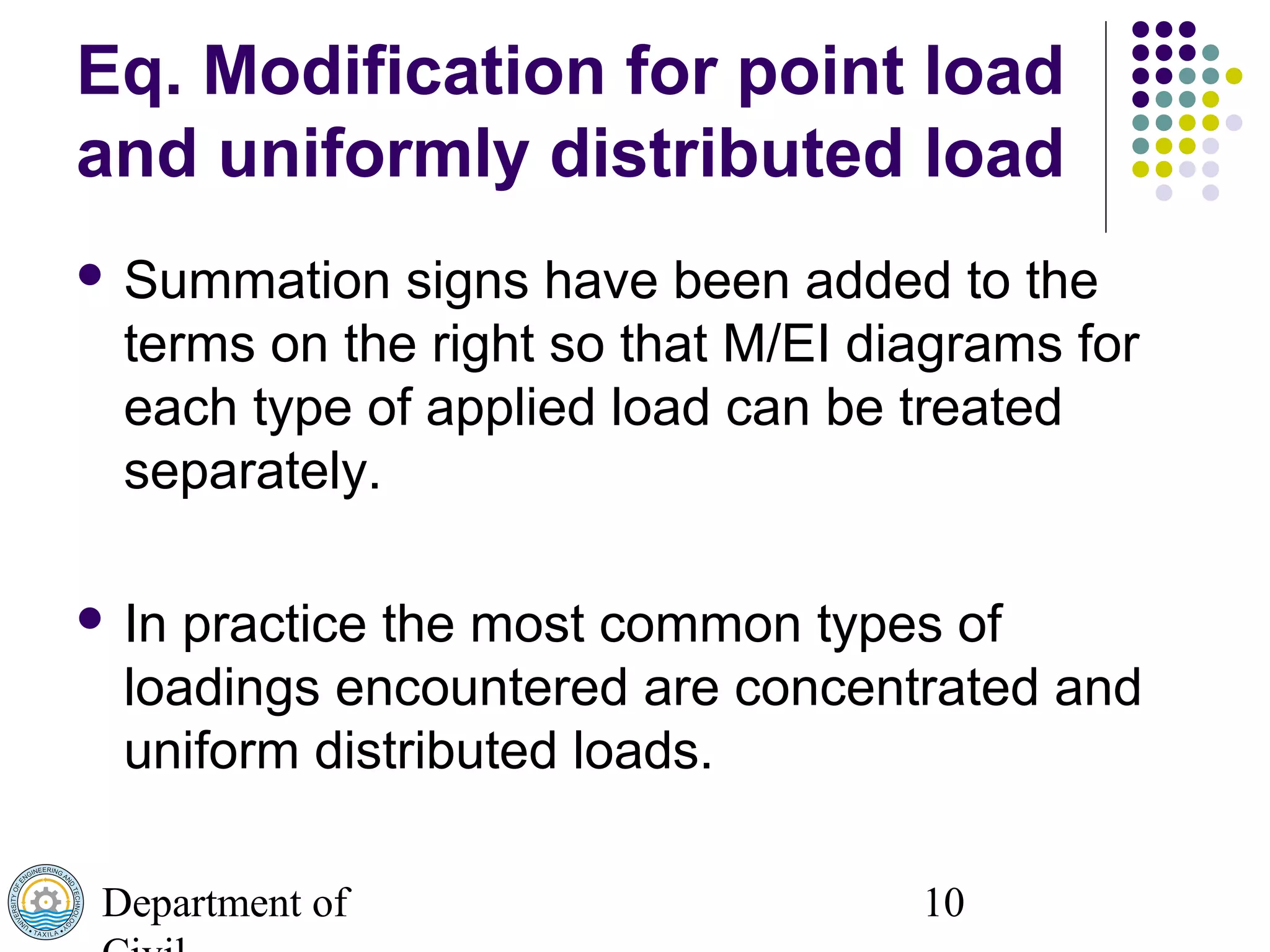
 Summation   signs have been added to the
  terms on the right so that M/EI diagrams for
  each type of applied load can be treated
  separately.

 In practice the most common types of
  loadings encountered are concentrated and
  uniform distributed loads.

 Department of                      10
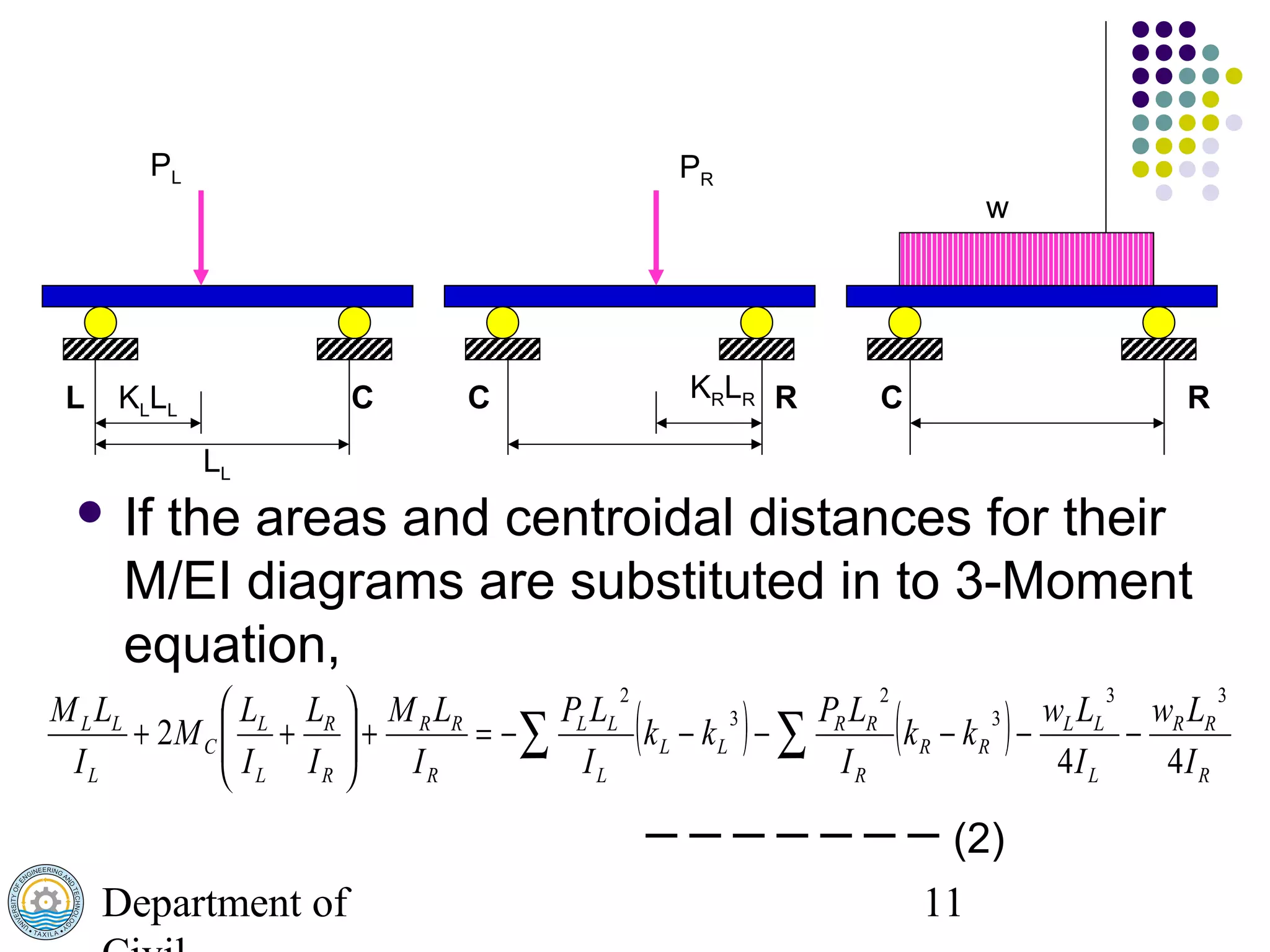
PL                                       PR
                                                                       w


 L   KLLL              C       C                KRLR R         C                      R

            LL
  If  the areas and centroidal distances for their
      M/EI diagrams are substituted in to 3-Moment
      equation,
               LL LR  M R LR
                                            (        )          (          )
                                          2                   2                 3        3
M L LL                              PL LL               PR LR             wL LL wR LR
       + 2M C  +  +          = −∑         kL − kL − ∑
                                                   3                   3
              I                                               kR − kR −         −
 IL            L IR    IR           IL                  IR               4I L     4I R

                                                                     (2)
     Department of                                                  11
Special Case:
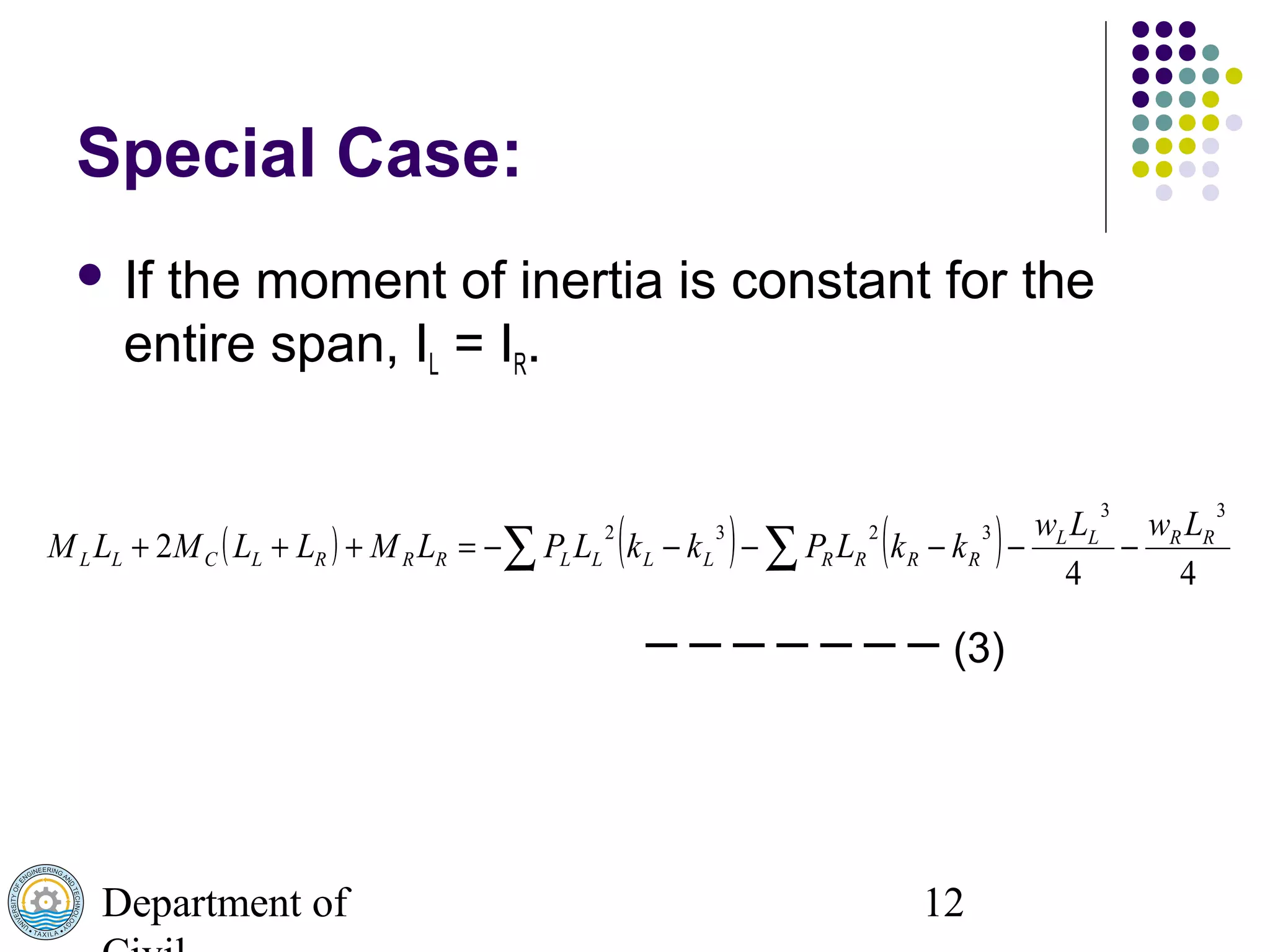
   If the moment of inertia is constant for the
      entire span, IL = IR.


                                                 (        )           (            )
                                                                                            3          3
                                                                                         wL LL wR LR
M L LL + 2M C ( LL + LR ) + M R LR = − ∑ PL LL k L − k L − ∑ PR LR k R − k R
                                             2        3           2            3
                                                                                       −      −
                                                                                           4     4

                                                                           (3)


    Department of                                                         12
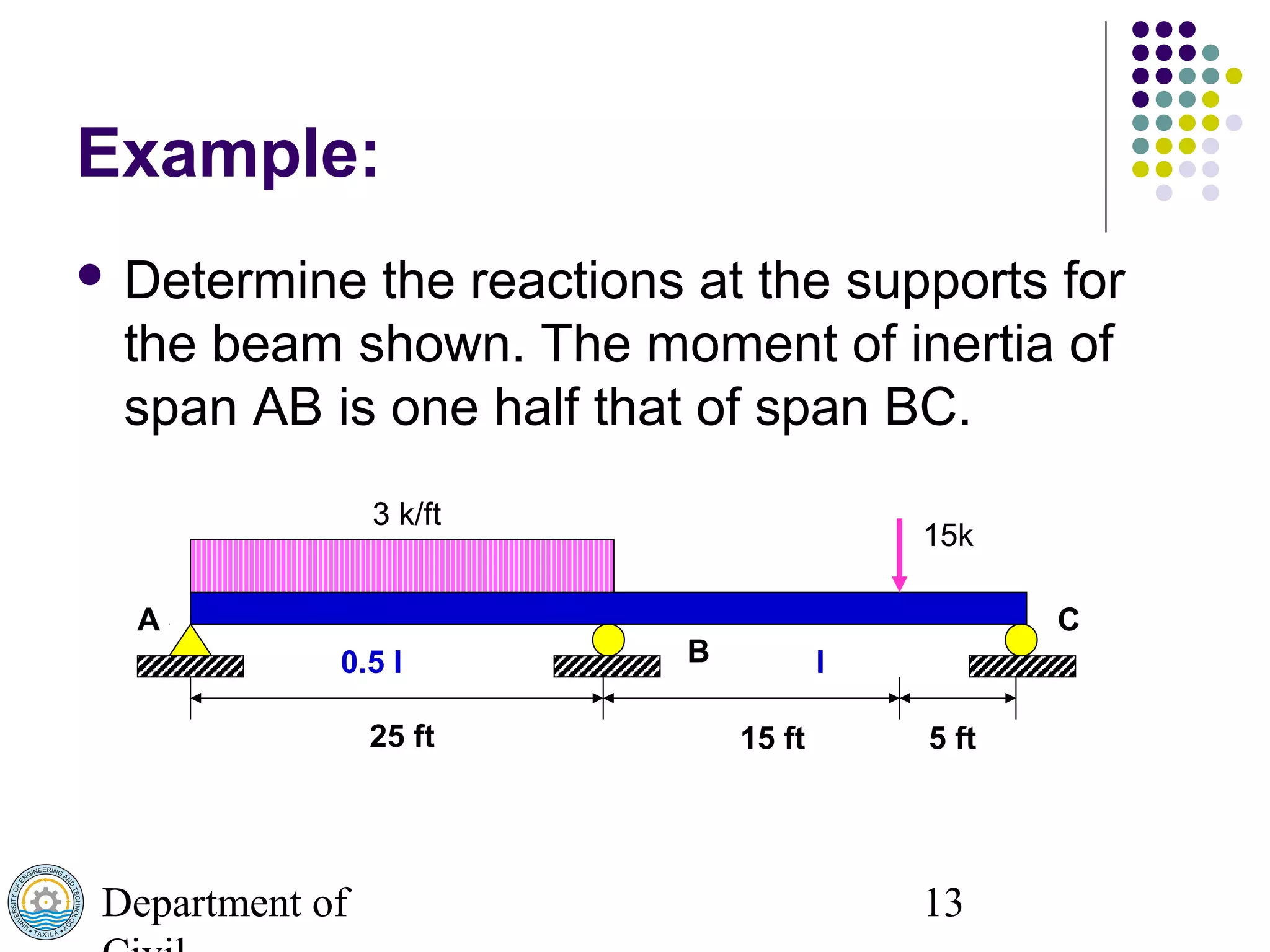
Example:
 Determinethe reactions at the supports for
 the beam shown. The moment of inertia of
 span AB is one half that of span BC.
                3 k/ft
                                         15k

  A                                             C
            0.5 I        B           I

                25 ft        15 ft       5 ft


Department of                            13
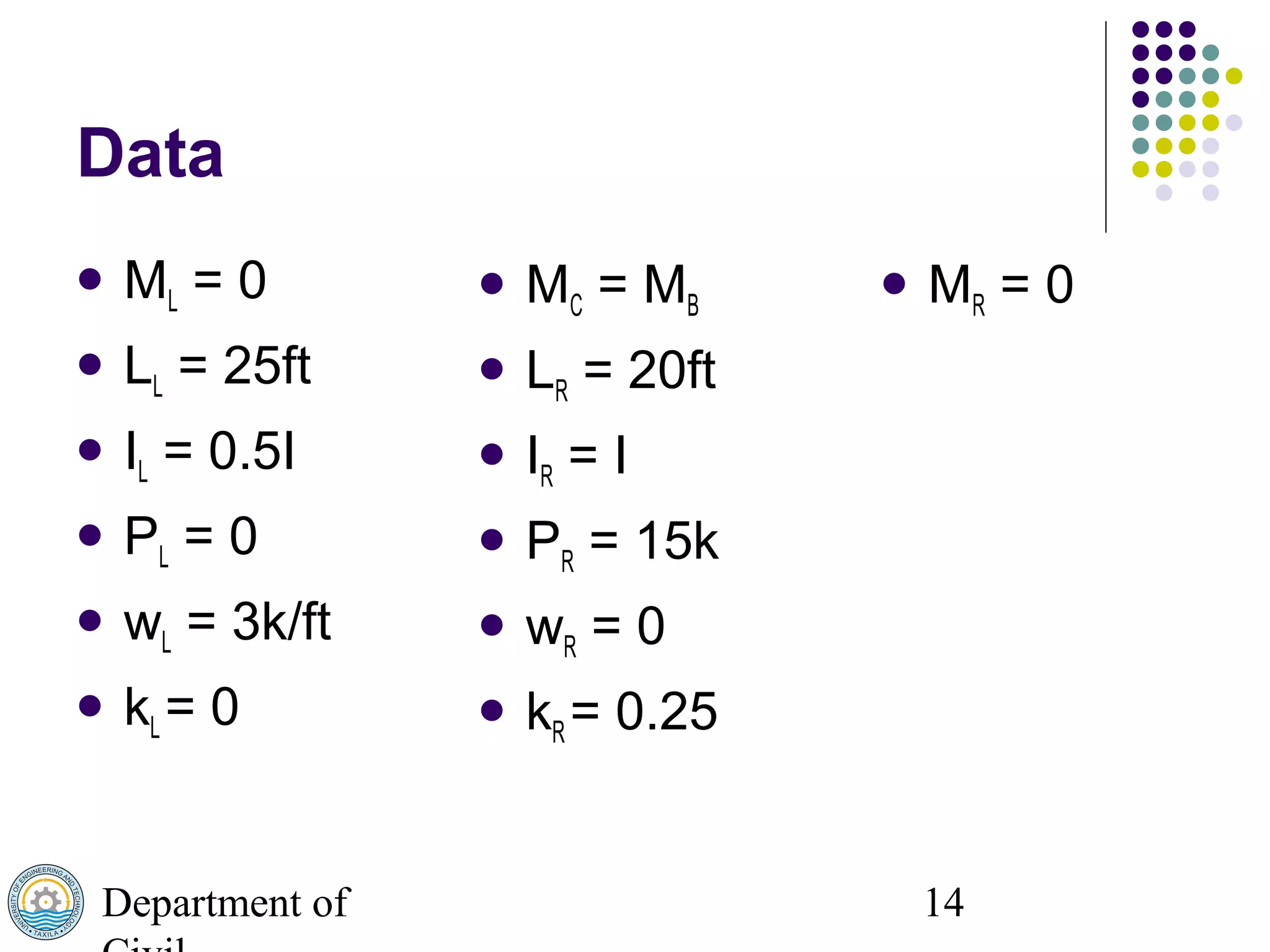
Data
M           =0        M           = MB    M       =0
         L                      C                R

L           = 25ft    L       = 20ft
     L                      R

I       = 0.5I        I       =I
 L                      R

P           =0        P           = 15k
     L                      R

w           = 3k/ft   w           =0
         L                  R

k       =0            k       = 0.25
     L                      R


Department of                               14
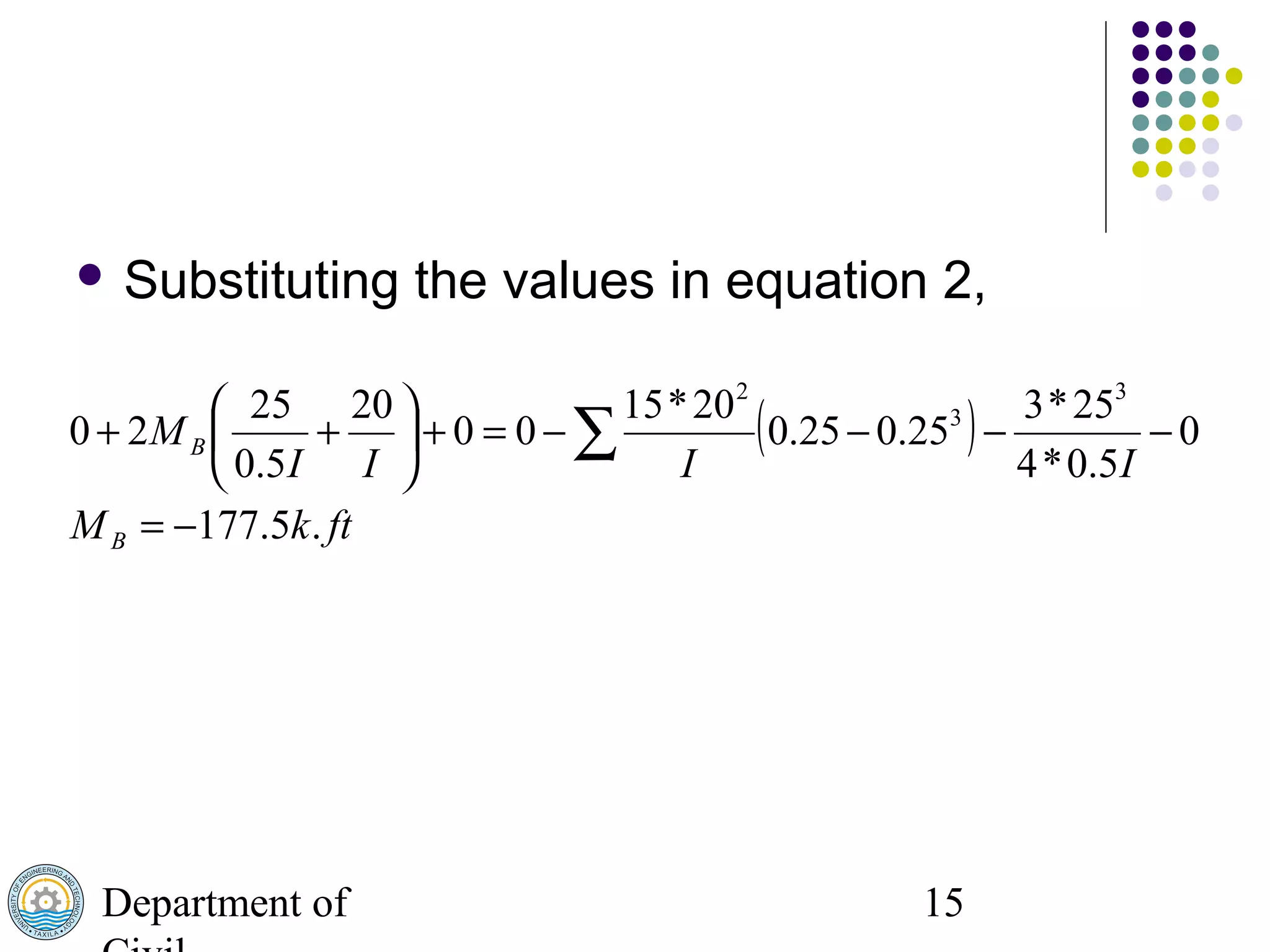
 Substituting     the values in equation 2,

          25 20 
0 + 2M B      + +0 = 0−∑
                           15 * 20 2
                                      (
                                     0.25 − 0.253 − )
                                                    3 * 253
                                                             −0
          0.5I I             I                    4 * 0.5I
M B = −177.5k . ft


 Department of                                 15
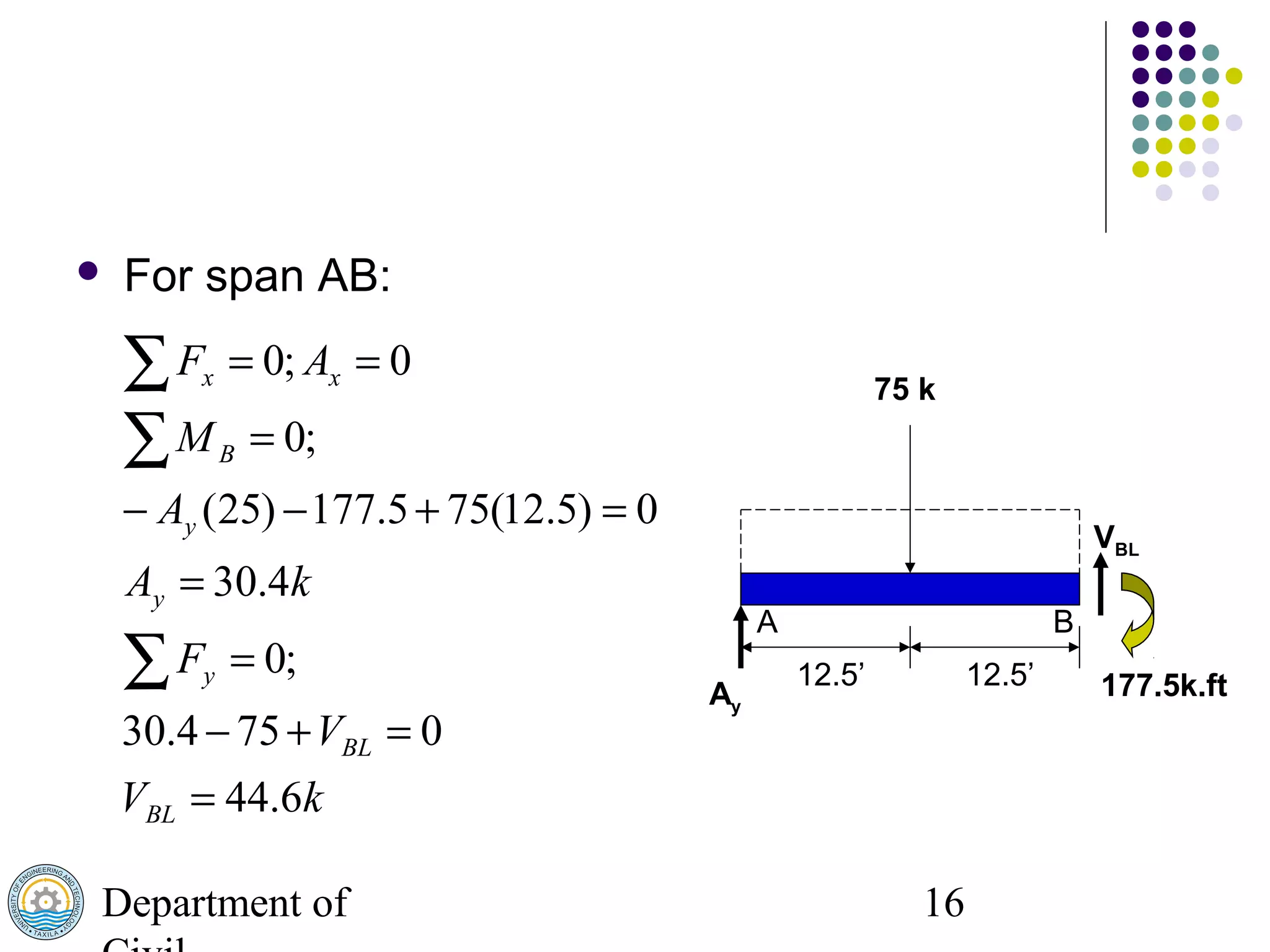
   For span AB:

    ∑ F = 0; A
        x          x   =0
                                                        75 k
    ∑ M = 0;B

    − Ay (25) − 177.5 + 75(12.5) = 0
                                                                            VBL
    Ay = 30.4k
                                            A                           B
    ∑F  y   = 0;
                                       Ay
                                                12.5’           12.5’       177.5k.ft
    30.4 − 75 + VBL = 0
    VBL = 44.6k

Department of                                              16
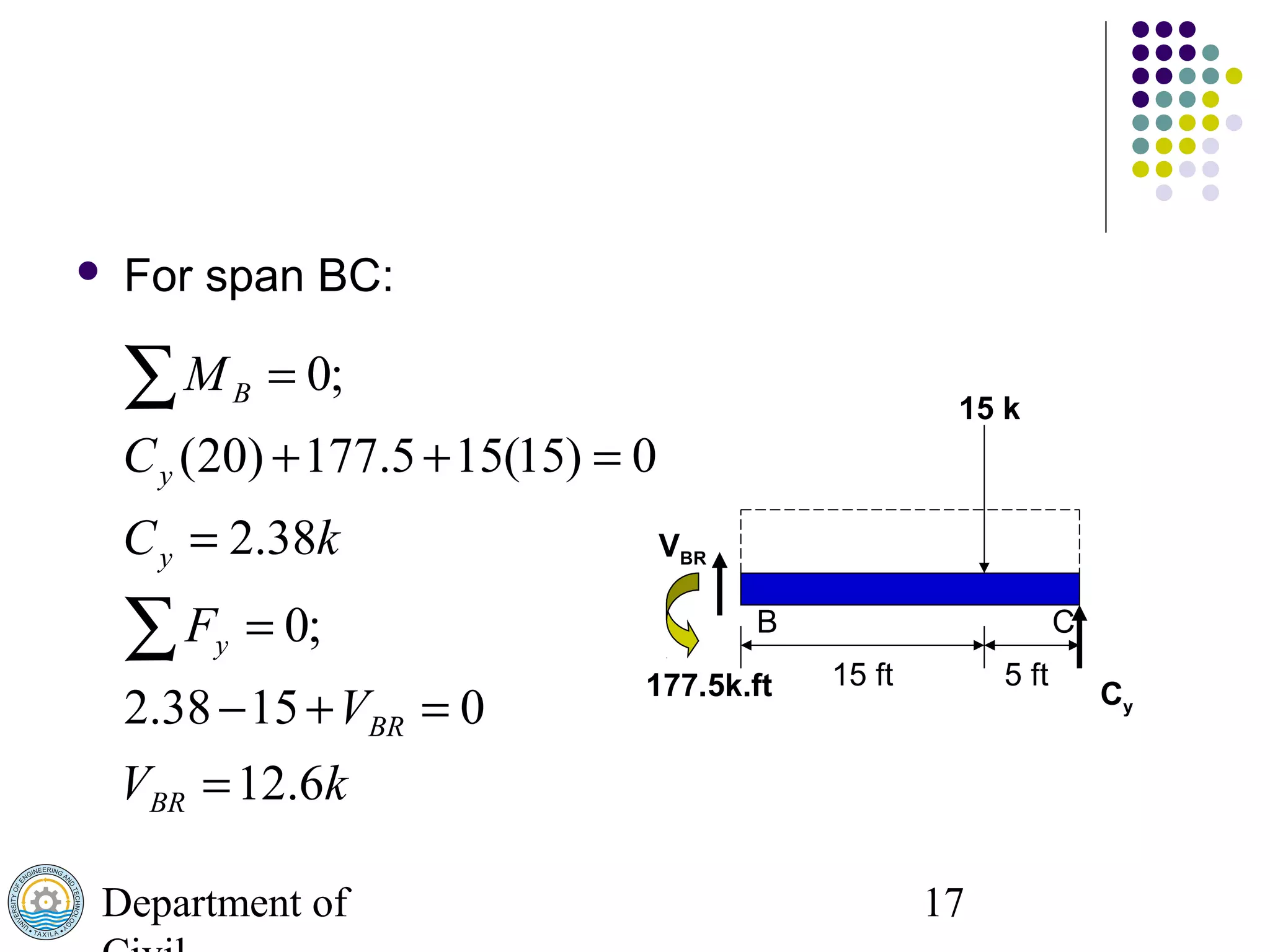
   For span BC:

    ∑M       B   = 0;
                                                       15 k
    C y (20) + 177.5 + 15(15) = 0
    C y = 2.38k                     VBR


    ∑F   y   = 0;                         B
                                              15 ft        5 ft
                                                                  C

                                177.5k.ft
    2.38 − 15 + VBR = 0                                               Cy

    VBR = 12.6k

Department of                                         17
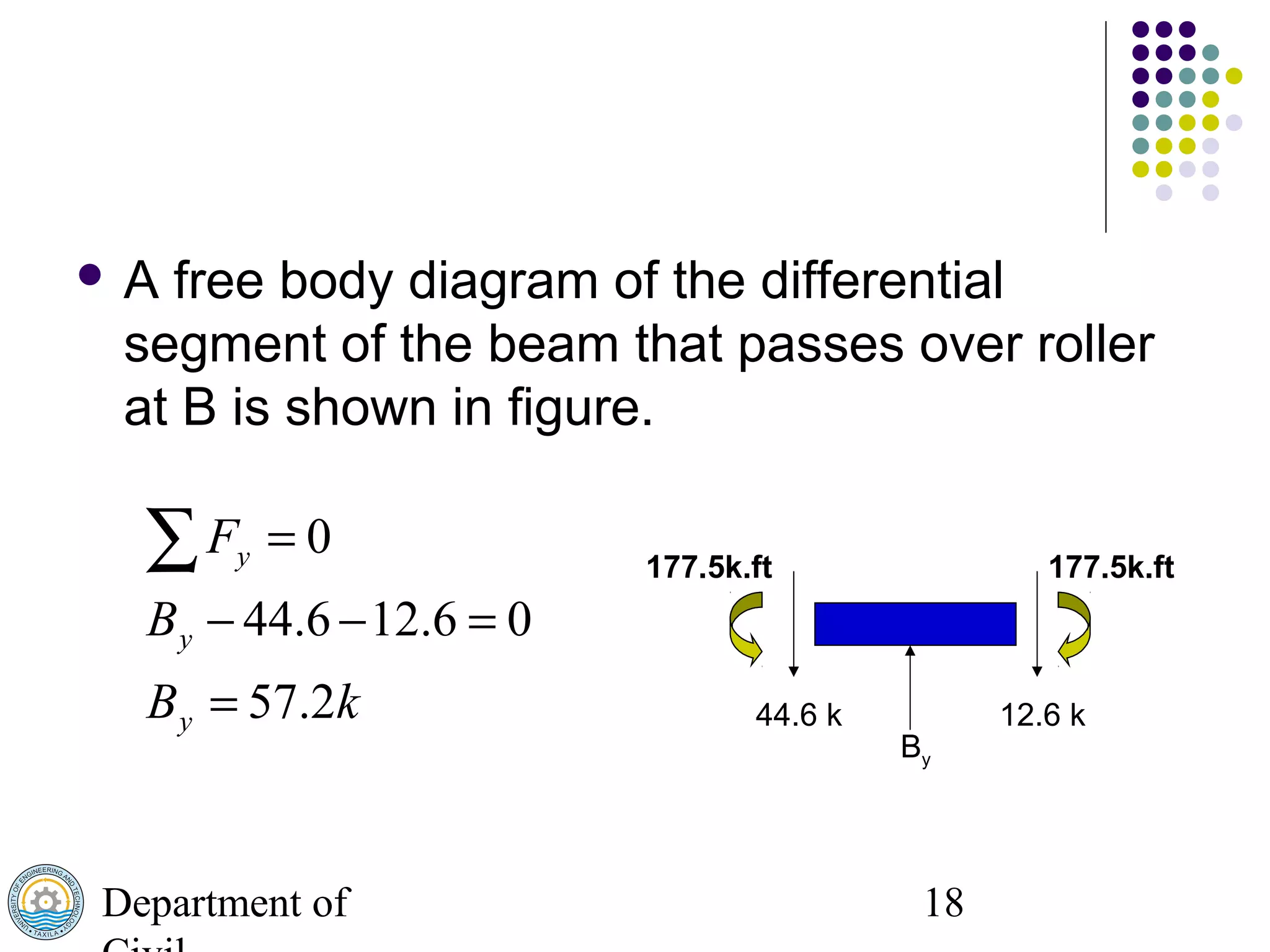
A free body diagram of the differential
 segment of the beam that passes over roller
 at B is shown in figure.

  ∑F   y   =0             177.5k.ft                177.5k.ft
  B y − 44.6 − 12.6 = 0
  B y = 57.2k                    44.6 k         12.6 k
                                          By


Department of                              18
Practice Problems:

 Chapter   9

 Example    9-11 to 9-13 and Exercise

 Structural     Analysis by R C Hibbeler


 Department of                         19
Department of   20

14 three moment equation

  • 1.
    Three Moment Equation Theory of Structure - I Department of Civil Engineering University of Engineering and Technology, Taxila, Pakistan
  • 2.
    Lecture Outlines  Introduction Proof of Three Moment Equation  Example Department of 2
  • 3.
    Introduction  Developed by French Engineer Clapeyron in 1857.  This equation relates the internal moments in a continuous beam at three points of support to the loads acting between the supports.  By successive application of this equation to each span of the beam, one obtains a set of equations that may be solved simultaneously for the unknown internal moments at the support. Department of 3
  • 4.
    Proof: Real Beam Ageneral form of three moment equation can be developed by considering the span of a continuous beam. P1 P2 P3 P4 WL WR ML MC MC MR L C R LL LR Department of 4
  • 5.
    Conjugate Beam (applied loads) The formulation will be based on the conjugate-beam method.  Since the “real beam” is continuous over the supports, the conjugate-beam has hinges at L, C and R. AL /EIL AR /EIR L’ LL CL 1 CR 1 LR R’ XL XR Department of 5
  • 6.
    Conjugate Beam (internal moments) Usingthe principle of superposition, the M / EI diagram for the internal moments is shown. MC /EIL MR /EIR ML /EIL MC /EIR L’ LL CL2 CR2 LR R’ Department of 6
  • 7.
     In particularAL/EIL and AR/EIR represent the total area under their representative M / EI diagrams; and xL and xR locate their centroids.  Since the slope of real beam is continuous over the center support, we require the shear forces for the conjugate beam. C L1 + C L2 = −(C R1 + C R2 ) Department of 7
  • 8.
     Summing moments about point L’ for left span, we have 1 AL 1 1  M L  1  1  M  2  C L1 + C L2 = ( xL ) +   ( LL ) LL  +  C ( LL ) LL  LL EI L LL 2  EI L       3  2  EI L   3  AL xL M L LL M C LL = + + EI L 6 EI L 3EI L  Summing moments about point R’ for the right span yields 1 AR 1 1  M R  1  1  M  2  C R1 + C R2 = ( xR ) +   ( LR ) LR  +  C ( LR )  LR  LR EI R LR 2  EI R       3  2  EI R   3  AR xR M R LR M C LR = + + EI R 6 EI R 3EI R Department of 8
  • 9.
    General Equation  Equating C L1 + C L2 = −(C R1 + C R2 )  and simplifying yields M L LL  LL LR  M R LR 6 AL xL 6 AR xR + 2M C  +  + I  = −∑ −∑ IL  L IR  IR I L LL I R LR (1) Department of 9
  • 10.
    Eq. Modification forpoint load and uniformly distributed load  Summation signs have been added to the terms on the right so that M/EI diagrams for each type of applied load can be treated separately.  In practice the most common types of loadings encountered are concentrated and uniform distributed loads. Department of 10
  • 11.
    PL PR w L KLLL C C KRLR R C R LL  If the areas and centroidal distances for their M/EI diagrams are substituted in to 3-Moment equation,  LL LR  M R LR ( ) ( ) 2 2 3 3 M L LL PL LL PR LR wL LL wR LR + 2M C  +  + = −∑ kL − kL − ∑ 3 3 I  kR − kR − − IL  L IR  IR IL IR 4I L 4I R (2) Department of 11
  • 12.
    Special Case:  If the moment of inertia is constant for the entire span, IL = IR. ( ) ( ) 3 3 wL LL wR LR M L LL + 2M C ( LL + LR ) + M R LR = − ∑ PL LL k L − k L − ∑ PR LR k R − k R 2 3 2 3 − − 4 4 (3) Department of 12
  • 13.
    Example:  Determinethe reactionsat the supports for the beam shown. The moment of inertia of span AB is one half that of span BC. 3 k/ft 15k A C 0.5 I B I 25 ft 15 ft 5 ft Department of 13
  • 14.
    Data M =0 M = MB M =0 L C R L = 25ft L = 20ft L R I = 0.5I I =I L R P =0 P = 15k L R w = 3k/ft w =0 L R k =0 k = 0.25 L R Department of 14
  • 15.
     Substituting the values in equation 2,  25 20  0 + 2M B  + +0 = 0−∑ 15 * 20 2 ( 0.25 − 0.253 − ) 3 * 253 −0  0.5I I  I 4 * 0.5I M B = −177.5k . ft Department of 15
  • 16.
    For span AB: ∑ F = 0; A x x =0 75 k ∑ M = 0;B − Ay (25) − 177.5 + 75(12.5) = 0 VBL Ay = 30.4k A B ∑F y = 0; Ay 12.5’ 12.5’ 177.5k.ft 30.4 − 75 + VBL = 0 VBL = 44.6k Department of 16
  • 17.
    For span BC: ∑M B = 0; 15 k C y (20) + 177.5 + 15(15) = 0 C y = 2.38k VBR ∑F y = 0; B 15 ft 5 ft C 177.5k.ft 2.38 − 15 + VBR = 0 Cy VBR = 12.6k Department of 17
  • 18.
    A free bodydiagram of the differential segment of the beam that passes over roller at B is shown in figure. ∑F y =0 177.5k.ft 177.5k.ft B y − 44.6 − 12.6 = 0 B y = 57.2k 44.6 k 12.6 k By Department of 18
  • 19.
    Practice Problems:  Chapter 9  Example 9-11 to 9-13 and Exercise  Structural Analysis by R C Hibbeler Department of 19
  • 20.