150
Downloadedfrom:09ce.blogspot.com
Providedby:DkMamonai-09CE37
151
Downloadedfrom:09ce.blogspot.com
Providedby:DkMamonai-09CE37
152
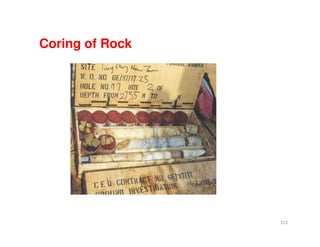
Coring of Rock
Downloadedfrom:09ce.blogspot.com
Providedby:DkMamonai-09CE37
153
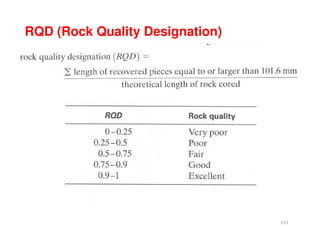
RQD (Rock Quality Designation)
Downloadedfrom:09ce.blogspot.com
Providedby:DkMamonai-09CE37
154
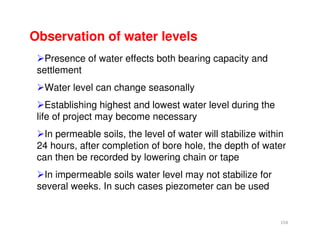
Observation of water levels
Presence of water effects both bearing capacity and
settlement
Water level can change seasonally
Establishing highest and lowest water level during the
life of project may become necessary
In permeable soils, the level of water will stabilize within
24 hours, after completion of bore hole, the depth of water
can then be recorded by lowering chain or tape
In impermeable soils water level may not stabilize for
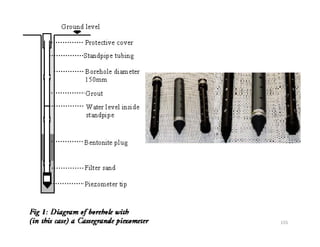
several weeks. In such cases piezometer can be used
Downloadedfrom:09ce.blogspot.com
Providedby:DkMamonai-09CE37
155
Downloadedfrom:09ce.blogspot.com
Providedby:DkMamonai-09CE37
156
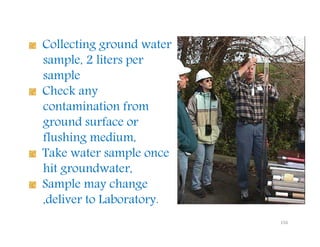
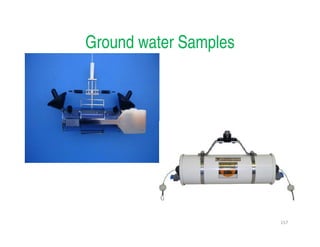
Collecting ground water
sample, 2 liters per
sample
Check any
contamination from
ground surface or
flushing medium,
Take water sample once
hit groundwater,
Sample may change
,deliver to Laboratory.
Downloadedfrom:09ce.blogspot.com
Providedby:DkMamonai-09CE37
157
Ground water Samples
Downloadedfrom:09ce.blogspot.com
Providedby:DkMamonai-09CE37
158
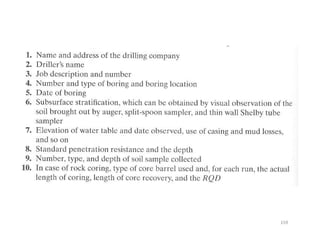
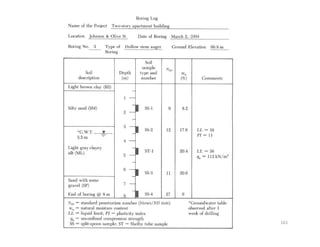
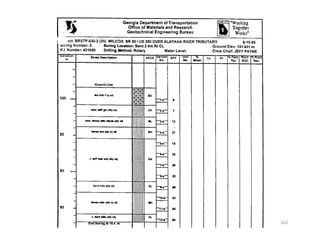
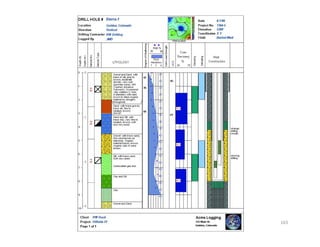
Bore logs
Detailed information obtained from each bore
hole is presented in a graphical form called boring
log
The driller generally record the onsite bore
information as borehole advance
The information should never be left to memory,
but shall be properly recorded on site
Downloadedfrom:09ce.blogspot.com
Providedby:DkMamonai-09CE37
159
Downloadedfrom:09ce.blogspot.com
Providedby:DkMamonai-09CE37
160
After completion of laboratory test results,
Geotechnical Engineer prepare a finished
log…which contains
Driller’s filed log
Results of test conducted in laboratory
Bore logs
Downloadedfrom:09ce.blogspot.com
Providedby:DkMamonai-09CE37
161
Downloadedfrom:09ce.blogspot.com
Providedby:DkMamonai-09CE37
162
Downloadedfrom:09ce.blogspot.com
Providedby:DkMamonai-09CE37
163
Downloadedfrom:09ce.blogspot.com
Providedby:DkMamonai-09CE37
164
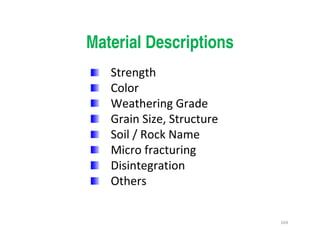
Material Descriptions
Strength
Color
Weathering Grade
Grain Size, Structure
Soil / Rock Name
Micro fracturing
Disintegration
Others
Downloadedfrom:09ce.blogspot.com
Providedby:DkMamonai-09CE37
165
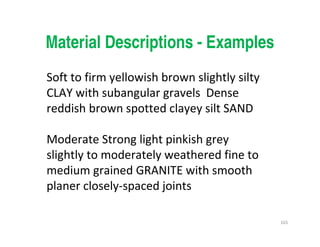
Material Descriptions - Examples
Soft to firm yellowish brown slightly silty
CLAY with subangular gravels Dense
reddish brown spotted clayey silt SAND
Moderate Strong light pinkish grey
slightly to moderately weathered fine to
medium grained GRANITE with smooth
planer closely-spaced joints
Downloadedfrom:09ce.blogspot.com
Providedby:DkMamonai-09CE37
166
Soil Exploration Report
After all the required information has been
obtained a report has to be generated for soil
exploration results
The soil exploration report will be used by
Design Engineers/Contractors for construction
work and design
The format of soil exploration report may vary
project to project or Engineer to Engineer or client
to client depending upon the requirements
Downloadedfrom:09ce.blogspot.com
Providedby:DkMamonai-09CE37
167
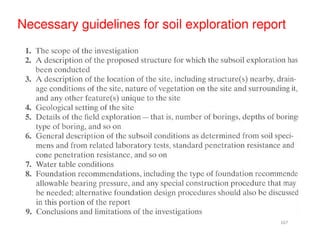
Necessary guidelines for soil exploration report
Downloadedfrom:09ce.blogspot.com
Providedby:DkMamonai-09CE37
168
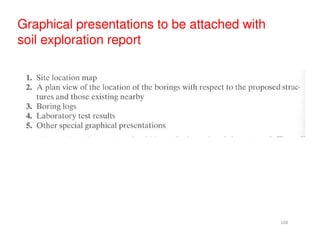
Graphical presentations to be attached with
soil exploration report
Downloadedfrom:09ce.blogspot.com
Providedby:DkMamonai-09CE37
169
Downloadedfrom:09ce.blogspot.com
Providedby:DkMamonai-09CE37
170
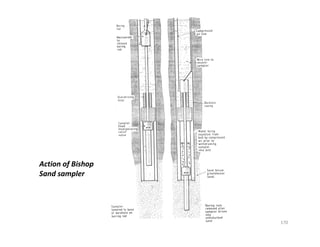
Action of Bishop
Sand sampler
Downloadedfrom:09ce.blogspot.com
Providedby:DkMamonai-09CE37
171
Downloadedfrom:09ce.blogspot.com
Providedby:DkMamonai-09CE37
172
Downloadedfrom:09ce.blogspot.com
Providedby:DkMamonai-09CE37
173
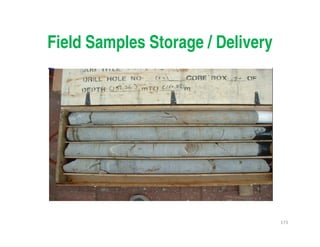
Field Samples Storage / Delivery
Downloadedfrom:09ce.blogspot.com
Providedby:DkMamonai-09CE37
174
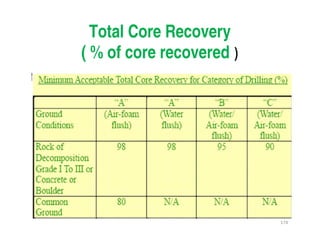
Total Core Recovery
( % of core recovered )
Downloadedfrom:09ce.blogspot.com
Providedby:DkMamonai-09CE37
175
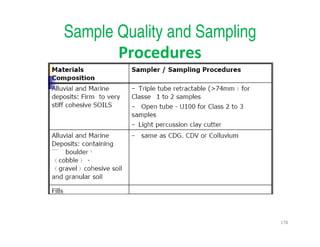
Design Consideration for Sampling
Methods (Sample Quality Classes)
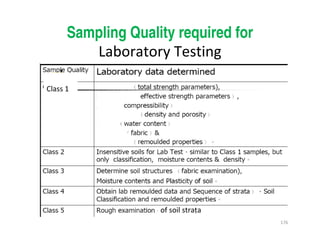
Determine which class of sample to be
collected, consider ground conditions and test
requirements
Design which sampling method to use,
Classification of Sample Quality (Class 1 to Class5(Class 1 to Class5(Class 1 to Class5(Class 1 to Class5)
Undisturbed samples: Class 1Class 1Class 1Class 1 –––– Class 2Class 2Class 2Class 2,,,,
Disturbed samples: Class 3Class 3Class 3Class 3 –––– Class 5Class 5Class 5Class 5
Downloadedfrom:09ce.blogspot.com
Providedby:DkMamonai-09CE37
176
Sampling Quality required for
Laboratory Testing
Class 1
of soil strata
Downloadedfrom:09ce.blogspot.com
Providedby:DkMamonai-09CE37
177
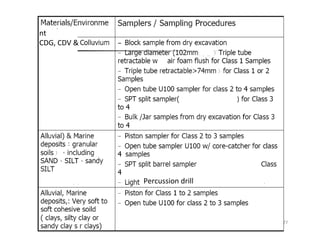
Sample Quality and Sampling
Procedures
Percussion drill
nt
CDG, CDV &
Downloadedfrom:09ce.blogspot.com
Providedby:DkMamonai-09CE37
178
Sample Quality and Sampling
Procedures
Downloadedfrom:09ce.blogspot.com
Providedby:DkMamonai-09CE37
179
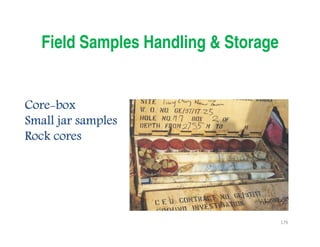
Field Samples Handling & Storage
CoreCoreCoreCore----boxboxboxbox
Small jar samplesSmall jar samplesSmall jar samplesSmall jar samples
Rock coresRock coresRock coresRock cores
Downloadedfrom:09ce.blogspot.com
Providedby:DkMamonai-09CE37
180
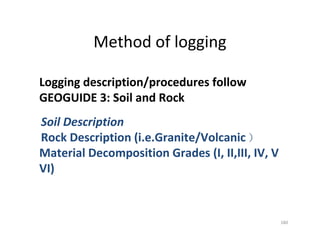
Method of logging
Logging description/procedures follow
GEOGUIDE 3: Soil and Rock
Soil Description
Rock Description (i.e.Granite/Volcanic﹚﹚﹚﹚
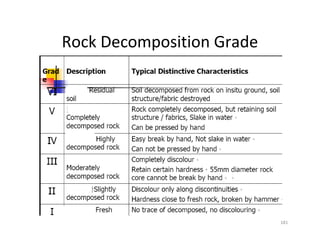
Material Decomposition Grades (I, II,III, IV, V
VI)
Downloadedfrom:09ce.blogspot.com
Providedby:DkMamonai-09CE37
181
Rock Decomposition Grade
Downloadedfrom:09ce.blogspot.com
Providedby:DkMamonai-09CE37
182
Rock Core Description
Total Core Recovery, TCR
Solid Core Recovery, SCR
Rock Quality Designation, RQD
Fracture Index, FI
Downloadedfrom:09ce.blogspot.com
Providedby:DkMamonai-09CE37
183
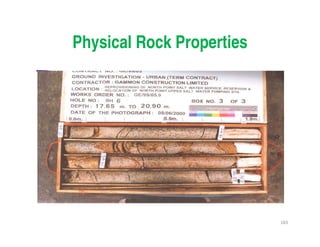
Physical Rock Properties
Downloadedfrom:09ce.blogspot.com
Providedby:DkMamonai-09CE37
184
Downloadedfrom:09ce.blogspot.com
Providedby:DkMamonai-09CE37
185
Downloadedfrom:09ce.blogspot.com
Providedby:DkMamonai-09CE37
186
Downloadedfrom:09ce.blogspot.com
Providedby:DkMamonai-09CE37
187
Downloadedfrom:09ce.blogspot.com
Providedby:DkMamonai-09CE37
188
Downloadedfrom:09ce.blogspot.com
Providedby:DkMamonai-09CE37
189
Downloadedfrom:09ce.blogspot.com
Providedby:DkMamonai-09CE37
190
Downloadedfrom:09ce.blogspot.com
Providedby:DkMamonai-09CE37
191
Downloadedfrom:09ce.blogspot.com
Providedby:DkMamonai-09CE37
192
Downloadedfrom:09ce.blogspot.com
Providedby:DkMamonai-09CE37
193
Downloadedfrom:09ce.blogspot.com
Providedby:DkMamonai-09CE37
194
Downloadedfrom:09ce.blogspot.com
Providedby:DkMamonai-09CE37
195
Downloadedfrom:09ce.blogspot.com
Providedby:DkMamonai-09CE37
196
Downloadedfrom:09ce.blogspot.com
Providedby:DkMamonai-09CE37
197
Downloadedfrom:09ce.blogspot.com
Providedby:DkMamonai-09CE37
198
Downloadedfrom:09ce.blogspot.com
Providedby:DkMamonai-09CE37
199
Downloadedfrom:09ce.blogspot.com
Providedby:DkMamonai-09CE37
200
Downloadedfrom:09ce.blogspot.com
Providedby:DkMamonai-09CE37
201
Downloadedfrom:09ce.blogspot.com
Providedby:DkMamonai-09CE37
202
Downloadedfrom:09ce.blogspot.com
Providedby:DkMamonai-09CE37
203
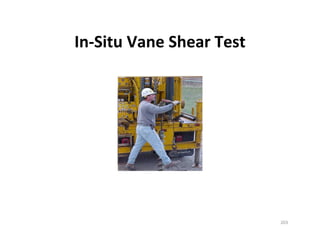
In-Situ Vane Shear Test
Downloadedfrom:09ce.blogspot.com
Providedby:DkMamonai-09CE37
204
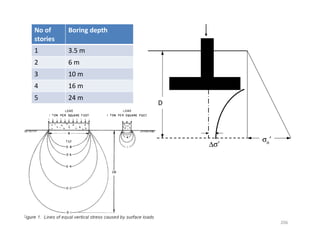
Depth of borings
• ASCE Rule:
1.Determine the net increase in the effective
stress, , under a foundation with depth as
shown in Figure.
2.Estimate the variation of the vertical effective
stress, σo ′, with depth.
3.Determine the depth, D = D1, at which the
effective stress increase , ∆σ′ is equal (1/10) q (q
= estimated net stress on the foundation).
Downloadedfrom:09ce.blogspot.com
Providedby:DkMamonai-09CE37
205
4 . Determine the depth, D = D2, at which
∆σ′/σo′ = 0.05.
5. Choose the smaller of the two depths, D1 and
D2, just determined as the approximate
minimum depth of boring required, unless
bedrock is encountered.
Based on the above rules the depths of
boring for a building with a width of 30 m will
be approximately the following:
Downloadedfrom:09ce.blogspot.com
Providedby:DkMamonai-09CE37
206
No of
stories
Boring depth
1 3.5 m
2 6 m
3 10 m
4 16 m
5 24 m
∆σ′
σo′
D
Downloadedfrom:09ce.blogspot.com
Providedby:DkMamonai-09CE37
207
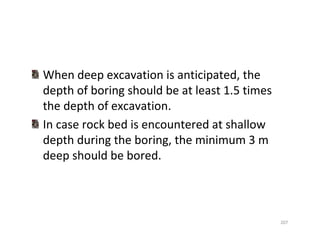
When deep excavation is anticipated, the
depth of boring should be at least 1.5 times
the depth of excavation.
In case rock bed is encountered at shallow
depth during the boring, the minimum 3 m
deep should be bored.
Downloadedfrom:09ce.blogspot.com
Providedby:DkMamonai-09CE37
208
Downloadedfrom:09ce.blogspot.com
Providedby:DkMamonai-09CE37
209
Downloadedfrom:09ce.blogspot.com
Providedby:DkMamonai-09CE37
210
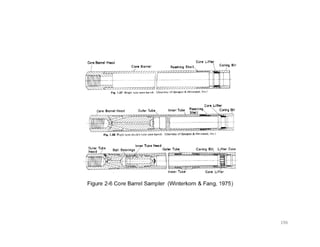
"M" Design core barrels and bits are
used when drilling soft, friable, or
broken formations. They are available
with conventional waterways or
bottom discharge design.
Bottom discharge bits have internal
water ports that permit the water to
bypass the core and prevent erosion
of soft materials.
Downloadedfrom:09ce.blogspot.com
Providedby:DkMamonai-09CE37
211
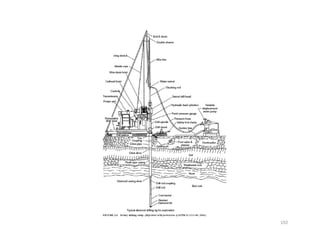
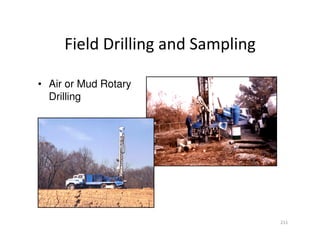
Field Drilling and Sampling
• Air or Mud Rotary
Drilling
Downloadedfrom:09ce.blogspot.com
Providedby:DkMamonai-09CE37
212
Rotary drilling is used primarily for
penetrating the overburden between the
levels of which samples are required.
Coring bits, on the other hand, cut an annular
hole around an intact core which enters the
barrel and is retrieved. Thus the core barrel is
used primarily in rocky strata to get rock
samples. As the rods with the attached bit or
barrel are rotated, a downward pressure is
applied to the drill string to obtain
penetration,
Downloadedfrom:09ce.blogspot.com
Providedby:DkMamonai-09CE37
213
and drilling fluid under pressure is introduced
into the bottom of the hole through the
hollow drill rods and the passages in the bit or
barrel. The drilling fluid serves the dual
function of cooling the bit as it enters the hole
and removing the cuttings from the bottom of
the hole as it returns to the surface in the
annular space between the drill rods and the
walls of the hole.
In an uncased hole, the drilling fluid also
serves to support the walls of the hole.
Downloadedfrom:09ce.blogspot.com
Providedby:DkMamonai-09CE37
214
When boring in soil, the drilling bit is removed
and replaced by a sampler when sampling is
required, but in rocky strata the coring bit is
used to obtain continuous rock samples.
Downloadedfrom:09ce.blogspot.com
Providedby:DkMamonai-09CE37
215
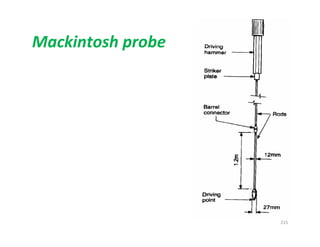
Mackintosh probe
Downloadedfrom:09ce.blogspot.com
Providedby:DkMamonai-09CE37
216
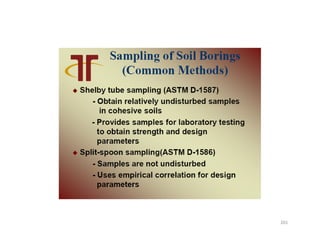
Soil Samples
Soil samples obtained for engineering testing and
analysis, in general, are of two main categories:
Disturbed (but representative)
Undisturbed
Disturbed samples are those obtained using
equipment that destroy the macro structure of the
soil but do not alter its mineralogical composition.
samples can be used for determining the general
lithology of soil deposits, for identification of soil
components and general classification purposes, for
determining grain size, Atterberg limits,and
compaction characteristics of soils.
Downloadedfrom:09ce.blogspot.com
Providedby:DkMamonai-09CE37
217
Disturbed samples can be obtained with a number of
different methods as summarized in Table 3-4.
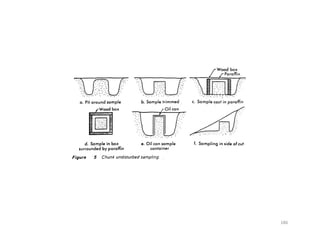
Undisturbed Samples
Undisturbed samples are obtained in clay soil strata
for use in laboratory testing to determine the
engineering properties of those soils.
Undisturbed samples of granular soils can be obtained,
but often specialized procedures are required such as
freezing or resin impregnation and block or core type
sampling.
It should be noted that the term “undisturbed” soil
sample refers to the relative degree of disturbance to
the soil’s in-situ properties.
Downloadedfrom:09ce.blogspot.com
Providedby:DkMamonai-09CE37
218
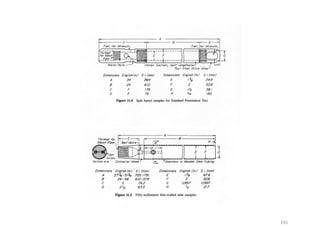
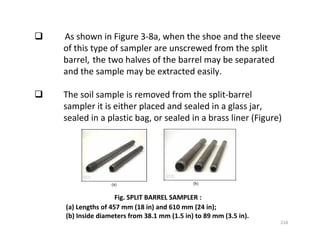
As shown in Figure 3-8a, when the shoe and the sleeve
of this type of sampler are unscrewed from the split
barrel, the two halves of the barrel may be separated
and the sample may be extracted easily.
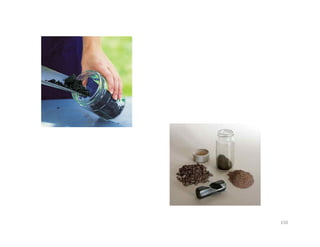
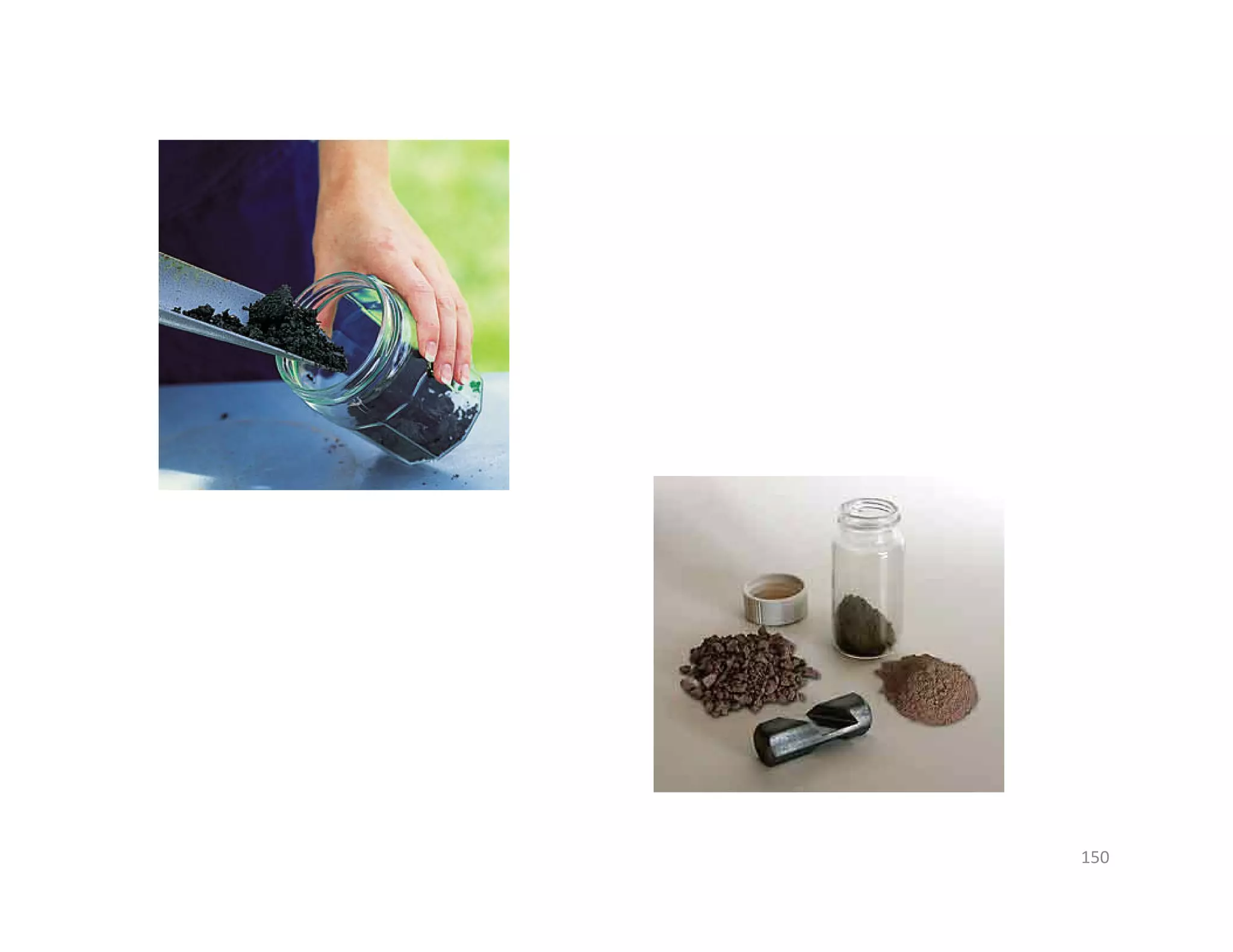
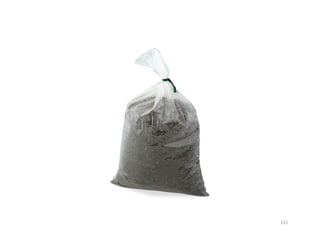
The soil sample is removed from the split-barrel
sampler it is either placed and sealed in a glass jar,
sealed in a plastic bag, or sealed in a brass liner (Figure)
Fig. SPLIT BARREL SAMPLER :
(a) Lengths of 457 mm (18 in) and 610 mm (24 in);
(b) Inside diameters from 38.1 mm (1.5 in) to 89 mm (3.5 in).
Downloadedfrom:09ce.blogspot.com
Providedby:DkMamonai-09CE37
219
Trial Pits and Trenches
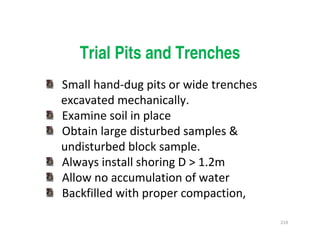
Small hand-dug pits or wide trenches
excavated mechanically.
Examine soil in place
Obtain large disturbed samples &
undisturbed block sample.
Always install shoring D > 1.2m
Allow no accumulation of water
Backfilled with proper compaction,
Downloadedfrom:09ce.blogspot.com
Providedby:DkMamonai-09CE37
220
Trial Pits and Trenches
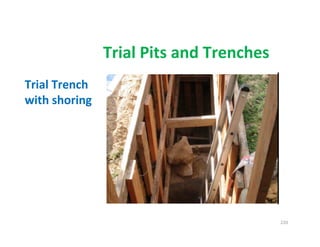
Trial Trench
with shoring
Downloadedfrom:09ce.blogspot.com
Providedby:DkMamonai-09CE37
221
Trial Pits and Trenches
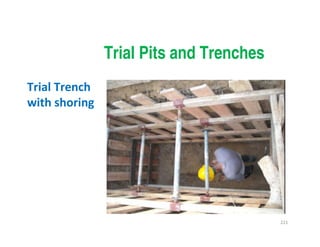
Trial Trench
with shoring
Downloadedfrom:09ce.blogspot.com
Providedby:DkMamonai-09CE37
222
Exploration pits and trenches permit detailed
examination of the soil and rock conditions at
shallow depths and relatively low cost.
Important where significant variations in soil
conditions occur (vertically and horizontally),
large soil and/or non-soil materials exist
(boulders, cobbles, debris) that cannot be
sampled with conventional methods, or buried
features must be identified and/or measured.
Downloadedfrom:09ce.blogspot.com
Providedby:DkMamonai-09CE37
223
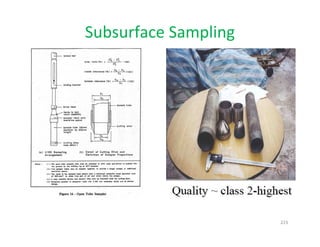
Subsurface Sampling
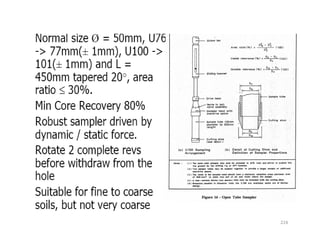
Open Tubes Samplers
Downloadedfrom:09ce.blogspot.com
Providedby:DkMamonai-09CE37
224
Downloadedfrom:09ce.blogspot.com
Providedby:DkMamonai-09CE37
225
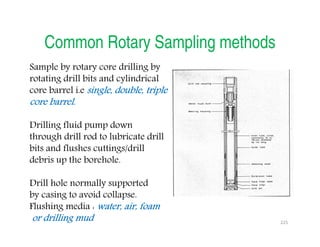
Common Rotary Sampling methods
Sample by rotary core drilling by
rotating drill bits and cylindrical
core barrel i.e single, double, triplesingle, double, triplesingle, double, triplesingle, double, triple
core barrel.core barrel.core barrel.core barrel.
Drilling fluid pump down
through drill rod to lubricate drill
bits and flushes cuttings/drill
debris up the borehole.
Drill hole normally supported
by casing to avoid collapse.
Flushing media : water, air, foamwater, air, foamwater, air, foamwater, air, foam
or drilling mudor drilling mudor drilling mudor drilling mud
Downloadedfrom:09ce.blogspot.com
Providedby:DkMamonai-09CE37
226
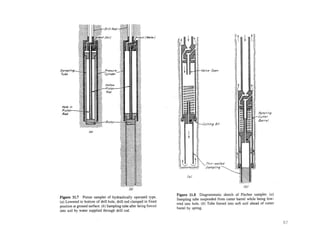
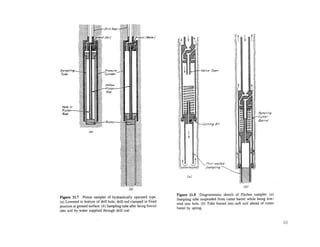
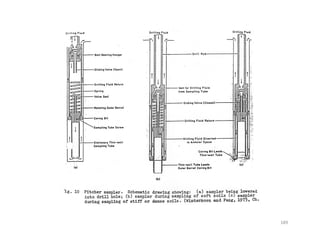
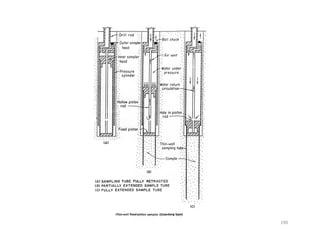
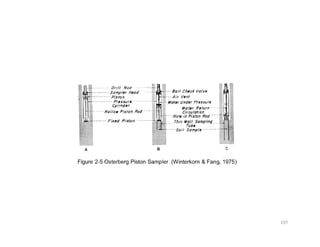
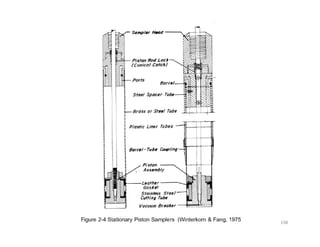
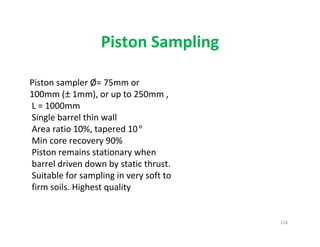
Piston Sampling
Piston sampler Ø= 75mm or
100mm (± 1mm), or up to 250mm ,
L = 1000mm
Single barrel thin wall
Area ratio 10%, tapered 10°
Min core recovery 90%
Piston remains stationary when
barrel driven down by static thrust.
Suitable for sampling in very soft to
firm soils. Highest quality
Downloadedfrom:09ce.blogspot.com
Providedby:DkMamonai-09CE37
227
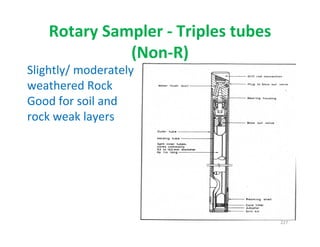
Rotary Sampler - Triples tubes
(Non-R)
Slightly/ moderately
weathered Rock
Good for soil and
rock weak layers
Downloadedfrom:09ce.blogspot.com
Providedby:DkMamonai-09CE37
228
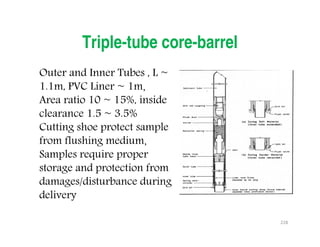
Triple-tube core-barrel
Outer and Inner Tubes , L ~
1.1m, PVC Liner ~ 1m,
Area ratio 10 ~ 15%, inside
clearance 1.5 ~ 3.5%
Cutting shoe protect sample
from flushing medium,
Samples require proper
storage and protection from
damages/disturbance during
delivery
Downloadedfrom:09ce.blogspot.com
Providedby:DkMamonai-09CE37
229
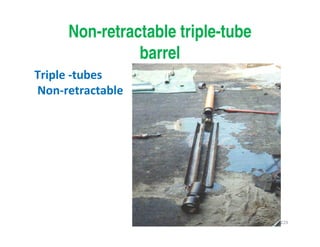
Non-retractable triple-tube
barrel
Triple -tubes
Non-retractable
Downloadedfrom:09ce.blogspot.com
Providedby:DkMamonai-09CE37
230
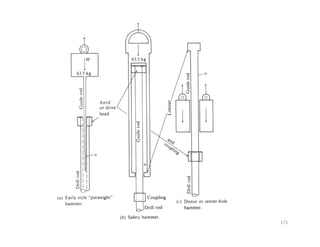
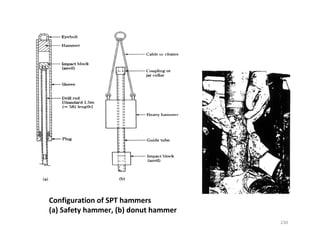
Configuration of SPT hammers
(a) Safety hammer, (b) donut hammer
Downloadedfrom:09ce.blogspot.com
Providedby:DkMamonai-09CE37
231
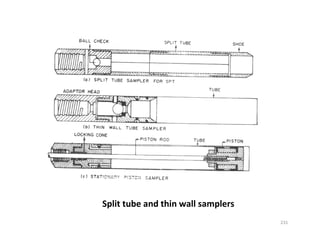
Split tube and thin wall samplers
Downloadedfrom:09ce.blogspot.com
Providedby:DkMamonai-09CE37
232
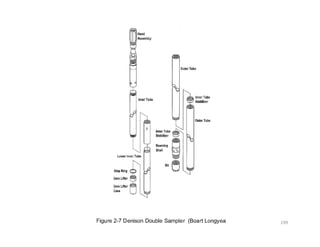
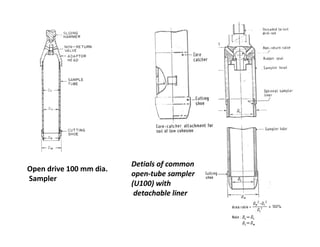
Detials of common
open-tube sampler
(U100) with
detachable liner
Open drive 100 mm dia.
Sampler
Downloadedfrom:09ce.blogspot.com
Providedby:DkMamonai-09CE37
233
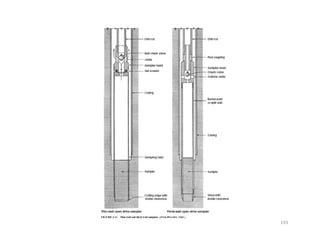
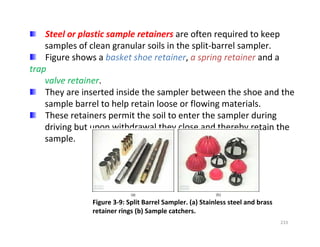
Steel or plastic sample retainers are often required to keep
samples of clean granular soils in the split-barrel sampler.
Figure shows a basket shoe retainer, a spring retainer and a
trap
valve retainer.
They are inserted inside the sampler between the shoe and the
sample barrel to help retain loose or flowing materials.
These retainers permit the soil to enter the sampler during
driving but upon withdrawal they close and thereby retain the
sample.
Figure 3-9: Split Barrel Sampler. (a) Stainless steel and brass
retainer rings (b) Sample catchers.
Downloadedfrom:09ce.blogspot.com
Providedby:DkMamonai-09CE37

Subsurface exploration (part-3)