INTRODUCTION
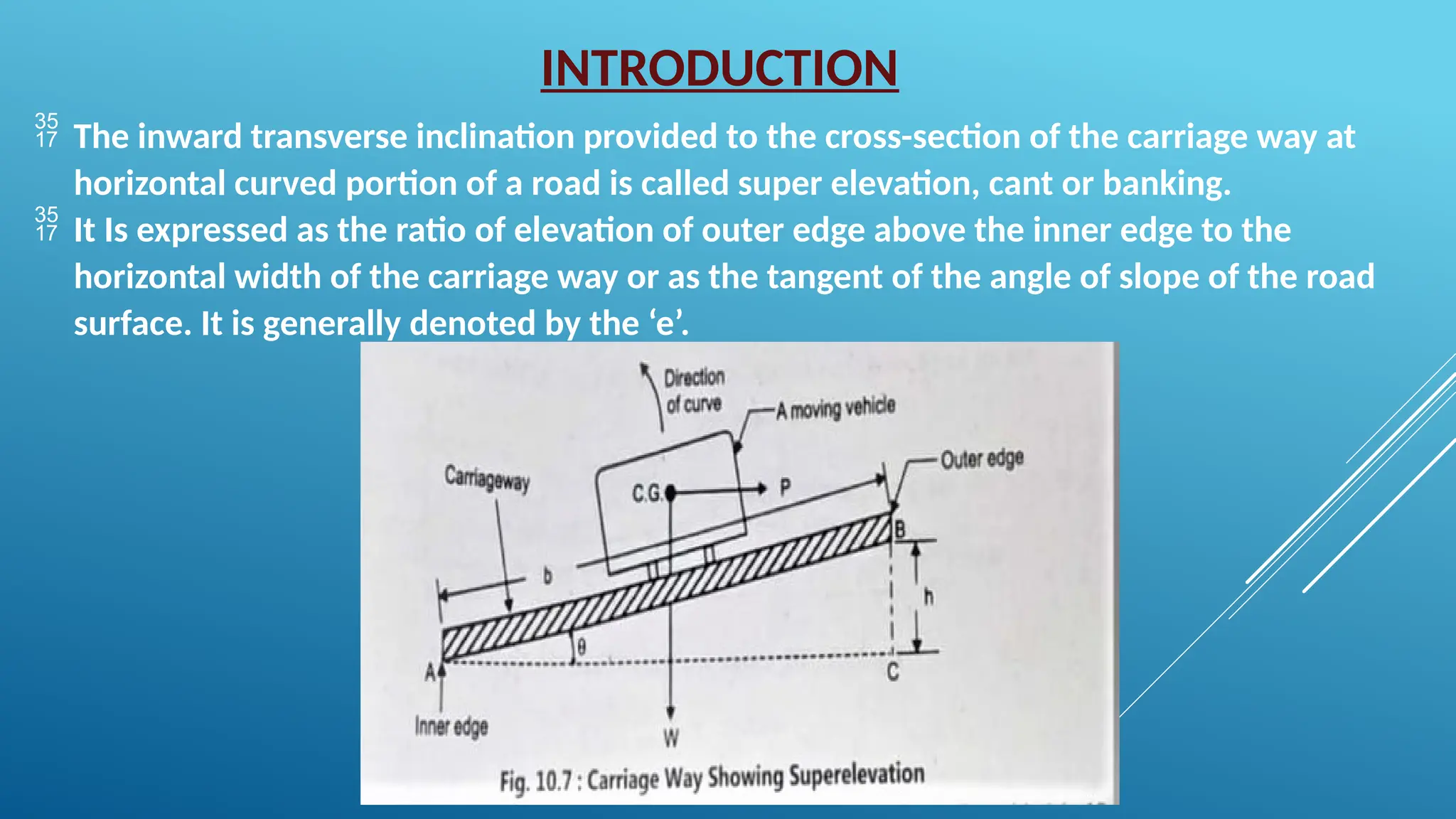
 The inward transverse inclination provided to the cross-section of the carriage way at
horizontal curved portion of a road is called super elevation, cant or banking.
 It Is expressed as the ratio of elevation of outer edge above the inner edge to the
horizontal width of the carriage way or as the tangent of the angle of slope of the road
surface. It is generally denoted by the ‘e’.
OBJECT OF PROVIDING SUPERELEVATION
1. To counteract the effect of centrifugal force acting on the moving vehicle to pull the same outward
on a horizontal curve .
2. To help a fast moving vehicle to negotiate a curved path without overturning and skidding.
3. To ensure safety of the fast moving vehicle.
4. To prevent damaging effect on the road surface due to improper distribution of load.
ADVANTAGES OF PROVIDING SUPERELEVATION
1. It permits running of vehicle at high speed on a curved path or a straight
path without any danger of overturning and thus results into increased
volume of traffic.
2. It also helps to keep the vehicle to their proper side on the pavement and
thus prevents collision of vehicles moving in opposite direction on a curved
portion of the road.
3. It provides drainage of the whole width of the road towards the inner side.
Thus, there is no necessity of providing side drain on the outer side of the
road.
GRADIENT
 The rate or fall provided to the formation of a road along its alignment is called as Garde or gradient.
 It is the longitudinal slope provided to the formation of a road along its alignment.
OBJECT OF PROVIDING GRADENT
A. To make the earth work of the road project economical, since a perfectly level road involves more cutting and filling.
B. To connect the terminal stations situated at different levels.
C. To provide effective drainage of rain water falling over the road surface, particularly when the pavement is provided
with Krebs.
D. To reduce the maintenance coast of the road surface.
FACTORS GOVERNING GRADIENT
The following are the various factors which govern the selection of gradient in the alignment of a road.
1. Nature of ground.
2. Nature of traffic.
3. Drainage required.
4. The type of road surface.
5. The total height to be curved.
6. Road and railway intersections and bridge approaches.
7. Safety required.
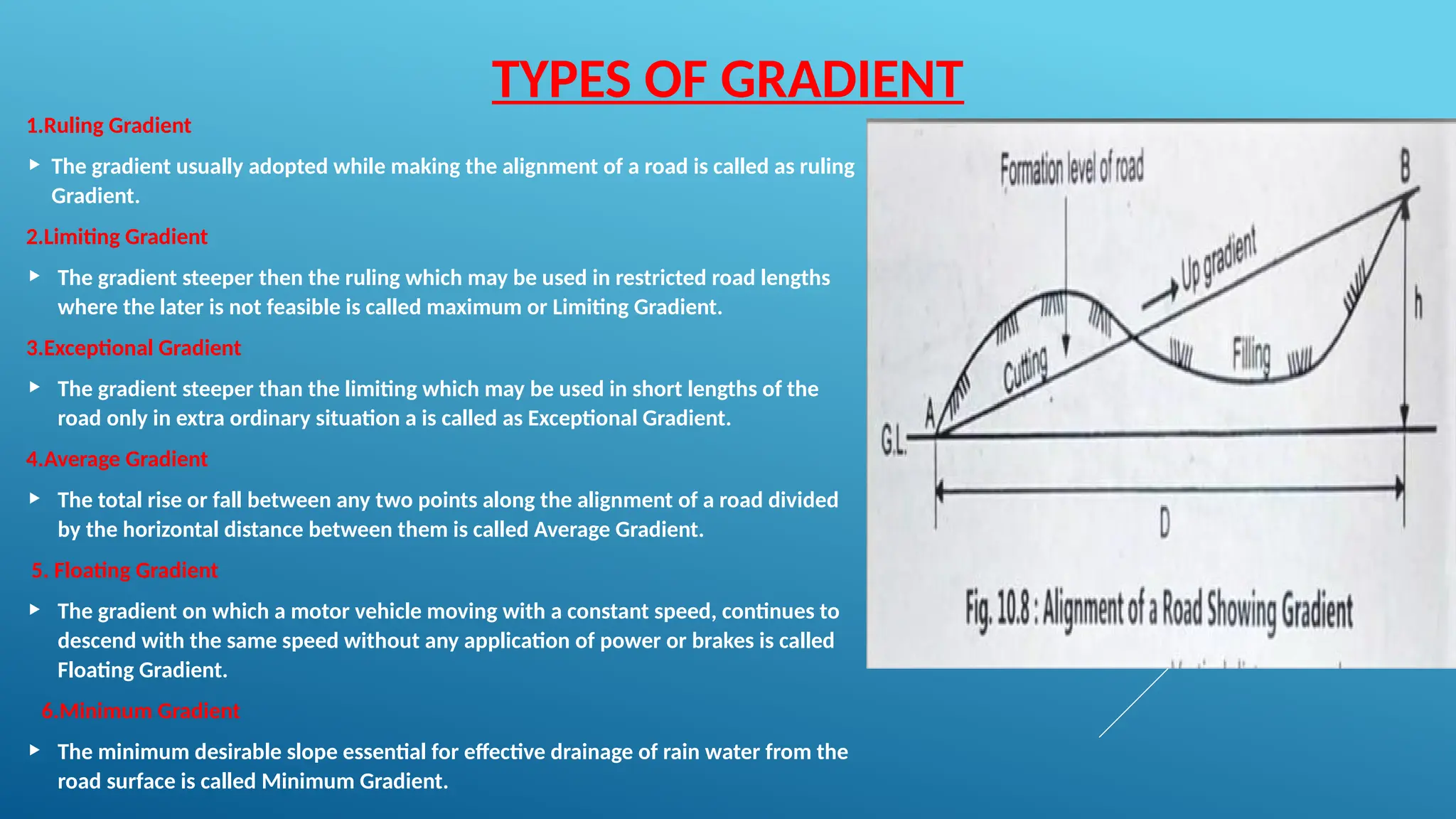
TYPES OF GRADIENT
1.Ruling Gradient
 The gradient usually adopted while making the alignment of a road is called as ruling
Gradient.
2.Limiting Gradient
 The gradient steeper then the ruling which may be used in restricted road lengths
where the later is not feasible is called maximum or Limiting Gradient.
3.Exceptional Gradient
 The gradient steeper than the limiting which may be used in short lengths of the
road only in extra ordinary situation a is called as Exceptional Gradient.
4.Average Gradient
 The total rise or fall between any two points along the alignment of a road divided
by the horizontal distance between them is called Average Gradient.
5. Floating Gradient
 The gradient on which a motor vehicle moving with a constant speed, continues to
descend with the same speed without any application of power or brakes is called
Floating Gradient.
6.Minimum Gradient
 The minimum desirable slope essential for effective drainage of rain water from the
road surface is called Minimum Gradient.
The limiting equilibrium is reached when the full
values of the frictional forces are developed and the
values of FA and FB reach their maximum value of f *
RB and f*RA respectively where ‘f’ is the coefficient of
lateral friction and RA and RB are the normal
reactions at wheels A and B
EQUILIBRIUM OF SUPERELEVATION
The value of coefficient of lateral friction, ‘f’ is taken
as 0.15 for design purposes . The value of tan 0 or
transverse slope due to superelevation seldom
exceeds 0.07 or about 1/15. Hence the value of f tan
0 is about 0.01. Thus the value of (j-fan 0) in the above
equation is equal to 0.99 and may be approximated
to 1.0.
If the speed of the vehicle is represented as V kmph,
the Eq. 48 may be written as follows
If superelevation is provided according to this
formula, the pressures on the outer and inner wheels
will be equal; but this will result in a very high value of
superelevation. As considerable role is played by the
lateral frictional resistance in counteracting the
centrifugal force, it is always taken into account. In
places where superelevation is not
It is possible that at some intersections, a negative
superelevation is unavoidable. Thus the
superelevation 'e' required on a horizontal curve
depends on the radius of the curve R, speed of the
vehicle V and the coefficient of lateral friction or the
transverse skid resistance f. Therefore, in order to
assess the superelevation e required, the speed is
taken as equal to the design speed of the road and
the minimum value of transverse skid resistance f for
design purpose is standardised equal to 0.15.
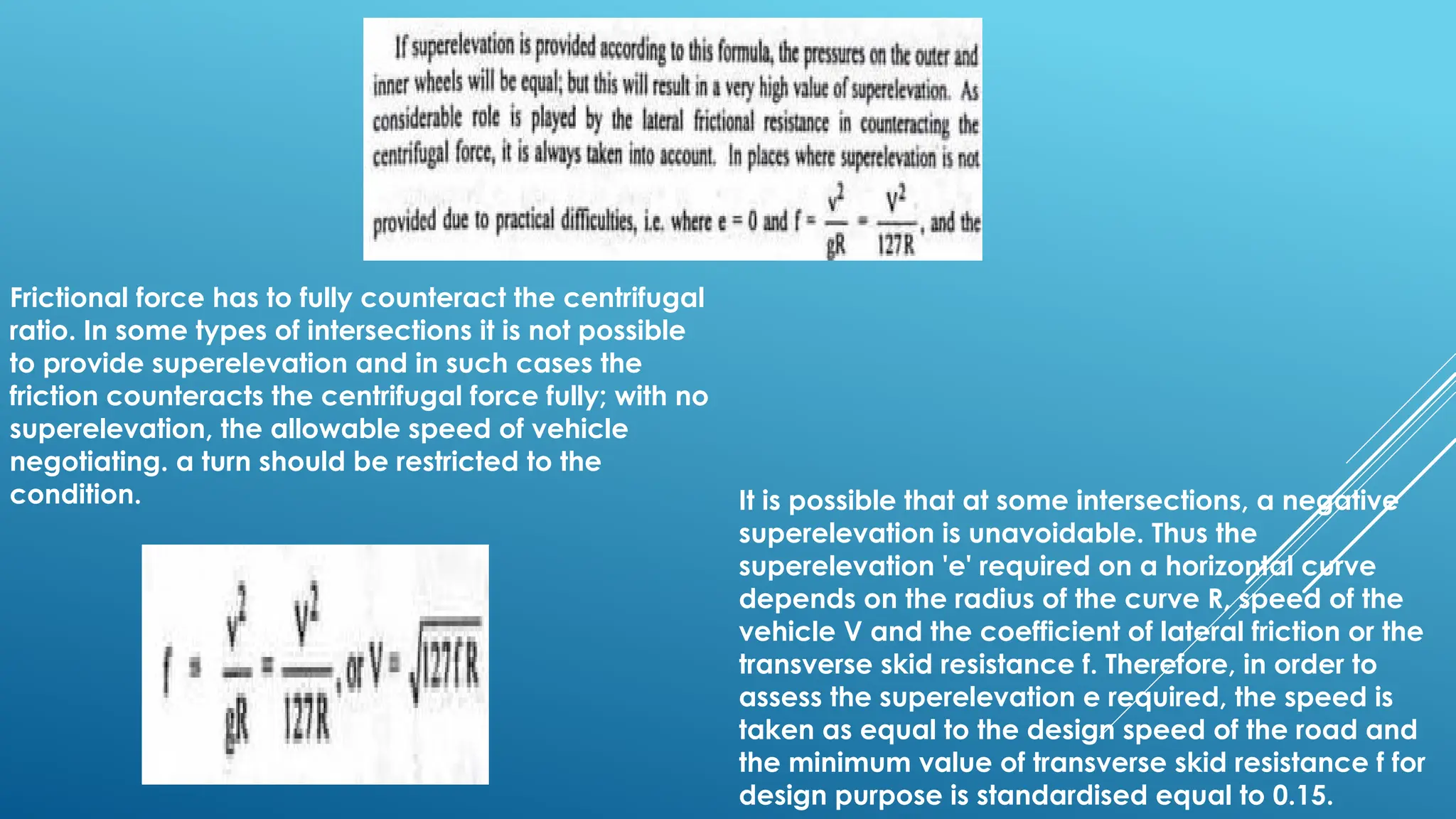
Frictional force has to fully counteract the centrifugal
ratio. In some types of intersections it is not possible
to provide superelevation and in such cases the
friction counteracts the centrifugal force fully; with no
superelevation, the allowable speed of vehicle
negotiating. a turn should be restricted to the
condition.
ATTAINMENT OF SUPERELEVATION ON GROUND SURFACE
 Superelevation is the banking of
roadways on curves to counteract
the centrifugal force acting on the
vehicles. It is achieved by raising
the outer edge of the pavement
relative to the inner edge. Rotation
of pavement is a method of
achieving superelevation by
rotating the pavement about the
inner edge of the pavement.
ROAD CAMBER AS PER
RECOMMENDATIONS OF I.R.C.
Conclusion
Superelevation is provided to counteract the effect
of centrifugal force and to minimize the tendency of
the vehicle to overturn or skid by raising the outer
edge of pavement with respect to the inner edge,
providing a transverse slope throughout the length
of the horizontal curve.

Transportation engineering and it's importanthi.pptx

  • 2.
    INTRODUCTION  The inwardtransverse inclination provided to the cross-section of the carriage way at horizontal curved portion of a road is called super elevation, cant or banking.  It Is expressed as the ratio of elevation of outer edge above the inner edge to the horizontal width of the carriage way or as the tangent of the angle of slope of the road surface. It is generally denoted by the ‘e’.
  • 3.
    OBJECT OF PROVIDINGSUPERELEVATION 1. To counteract the effect of centrifugal force acting on the moving vehicle to pull the same outward on a horizontal curve . 2. To help a fast moving vehicle to negotiate a curved path without overturning and skidding. 3. To ensure safety of the fast moving vehicle. 4. To prevent damaging effect on the road surface due to improper distribution of load. ADVANTAGES OF PROVIDING SUPERELEVATION 1. It permits running of vehicle at high speed on a curved path or a straight path without any danger of overturning and thus results into increased volume of traffic. 2. It also helps to keep the vehicle to their proper side on the pavement and thus prevents collision of vehicles moving in opposite direction on a curved portion of the road. 3. It provides drainage of the whole width of the road towards the inner side. Thus, there is no necessity of providing side drain on the outer side of the road.
  • 4.
    GRADIENT  The rateor fall provided to the formation of a road along its alignment is called as Garde or gradient.  It is the longitudinal slope provided to the formation of a road along its alignment. OBJECT OF PROVIDING GRADENT A. To make the earth work of the road project economical, since a perfectly level road involves more cutting and filling. B. To connect the terminal stations situated at different levels. C. To provide effective drainage of rain water falling over the road surface, particularly when the pavement is provided with Krebs. D. To reduce the maintenance coast of the road surface. FACTORS GOVERNING GRADIENT The following are the various factors which govern the selection of gradient in the alignment of a road. 1. Nature of ground. 2. Nature of traffic. 3. Drainage required. 4. The type of road surface. 5. The total height to be curved. 6. Road and railway intersections and bridge approaches. 7. Safety required.
  • 5.
    TYPES OF GRADIENT 1.RulingGradient  The gradient usually adopted while making the alignment of a road is called as ruling Gradient. 2.Limiting Gradient  The gradient steeper then the ruling which may be used in restricted road lengths where the later is not feasible is called maximum or Limiting Gradient. 3.Exceptional Gradient  The gradient steeper than the limiting which may be used in short lengths of the road only in extra ordinary situation a is called as Exceptional Gradient. 4.Average Gradient  The total rise or fall between any two points along the alignment of a road divided by the horizontal distance between them is called Average Gradient. 5. Floating Gradient  The gradient on which a motor vehicle moving with a constant speed, continues to descend with the same speed without any application of power or brakes is called Floating Gradient. 6.Minimum Gradient  The minimum desirable slope essential for effective drainage of rain water from the road surface is called Minimum Gradient.
  • 6.
    The limiting equilibriumis reached when the full values of the frictional forces are developed and the values of FA and FB reach their maximum value of f * RB and f*RA respectively where ‘f’ is the coefficient of lateral friction and RA and RB are the normal reactions at wheels A and B EQUILIBRIUM OF SUPERELEVATION The value of coefficient of lateral friction, ‘f’ is taken as 0.15 for design purposes . The value of tan 0 or transverse slope due to superelevation seldom exceeds 0.07 or about 1/15. Hence the value of f tan 0 is about 0.01. Thus the value of (j-fan 0) in the above equation is equal to 0.99 and may be approximated to 1.0.
  • 7.
    If the speedof the vehicle is represented as V kmph, the Eq. 48 may be written as follows If superelevation is provided according to this formula, the pressures on the outer and inner wheels will be equal; but this will result in a very high value of superelevation. As considerable role is played by the lateral frictional resistance in counteracting the centrifugal force, it is always taken into account. In places where superelevation is not
  • 8.
    It is possiblethat at some intersections, a negative superelevation is unavoidable. Thus the superelevation 'e' required on a horizontal curve depends on the radius of the curve R, speed of the vehicle V and the coefficient of lateral friction or the transverse skid resistance f. Therefore, in order to assess the superelevation e required, the speed is taken as equal to the design speed of the road and the minimum value of transverse skid resistance f for design purpose is standardised equal to 0.15. Frictional force has to fully counteract the centrifugal ratio. In some types of intersections it is not possible to provide superelevation and in such cases the friction counteracts the centrifugal force fully; with no superelevation, the allowable speed of vehicle negotiating. a turn should be restricted to the condition.
  • 9.
    ATTAINMENT OF SUPERELEVATIONON GROUND SURFACE  Superelevation is the banking of roadways on curves to counteract the centrifugal force acting on the vehicles. It is achieved by raising the outer edge of the pavement relative to the inner edge. Rotation of pavement is a method of achieving superelevation by rotating the pavement about the inner edge of the pavement.
  • 10.
    ROAD CAMBER ASPER RECOMMENDATIONS OF I.R.C.
  • 11.
    Conclusion Superelevation is providedto counteract the effect of centrifugal force and to minimize the tendency of the vehicle to overturn or skid by raising the outer edge of pavement with respect to the inner edge, providing a transverse slope throughout the length of the horizontal curve.