Branch of Civil Engineering that applies
the principles of soil mechanics, surface
rock
mechanics, and groundwater conditions to
the design of foundations, retaining
structures, earth structures, and
environmental containment systems.
Geological Engineers use the principles of the
earth
sciences and geotechnical engineering in the
solution
of problems involving soil, rock and groundwater,
and to design structures in and below the
ground.
Often work with other interdisciplinary
professionals
such as geologists, civil engineers, mining
engineers,
and environmental scientists.
Major projects involve site selection,
natural geologic hazards, foundation
engineering, and groundwater exploration
Geotechnical/Geological Investigations
Foundation Design
Embankments and Dams
Slope Stability/Landslide Mitigation
◦ Pipeline Construction
◦ Environmental
– Corrective Action (Superfund, RCRA,
Industry)
– Landfill Construction
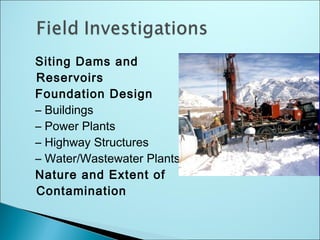
Siting Dams and
Reservoirs
Foundation Design
– Buildings
– Power Plants
– Highway Structures
– Water/Wastewater Plants
Nature and Extent of
Contamination
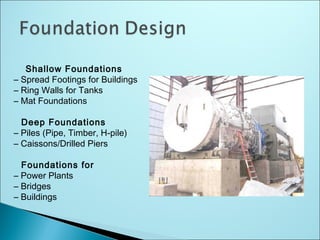
Shallow Foundations
– Spread Footings for Buildings
– Ring Walls for Tanks
– Mat Foundations
Deep Foundations
– Piles (Pipe, Timber, H-pile)
– Caissons/Drilled Piers
Foundations for
– Power Plants
– Bridges
– Buildings
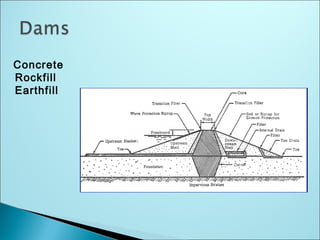
Concrete
Rockfill
Earthfill
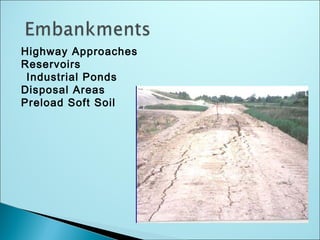
Highway Approaches
Reservoirs
Industrial Ponds
Disposal Areas
Preload Soft Soil
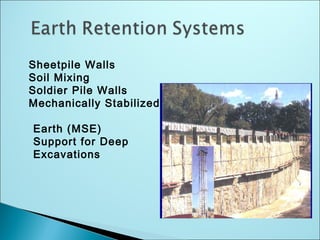
Sheetpile Walls
Soil Mixing
Soldier Pile Walls
Mechanically Stabilized
Earth (MSE)
Support for Deep
Excavations
Natural Slopes
Constructed Slopes
– Fill Slopes
– Excavation Slopes
Slope Movements
– Translational
Slides
– Rotational Slides
– Mudflows
Slope Stabilization
Landfills
– Construction
– Remediation
Corrective Action
– Vertical Cut-Off
Walls
– In-Situ
Remediation
– Capping Systems
Industrial
– Disposal of By-
products
– Waste
Minimization
Investigate the site to determine prior
land use and potential on-site and offsite
impacts.
If impacts exist, determine the
contaminants, extent in all media
(soil, groundwater, sediment, surface
water, etc.) and associated risks to
human health and the environment.

Introduction to Geo technical Engineering 2

  • 1.
    Branch of CivilEngineering that applies the principles of soil mechanics, surface rock mechanics, and groundwater conditions to the design of foundations, retaining structures, earth structures, and environmental containment systems.
  • 3.
    Geological Engineers usethe principles of the earth sciences and geotechnical engineering in the solution of problems involving soil, rock and groundwater, and to design structures in and below the ground. Often work with other interdisciplinary professionals such as geologists, civil engineers, mining engineers, and environmental scientists.
  • 4.
    Major projects involvesite selection, natural geologic hazards, foundation engineering, and groundwater exploration
  • 5.
    Geotechnical/Geological Investigations Foundation Design Embankmentsand Dams Slope Stability/Landslide Mitigation ◦ Pipeline Construction ◦ Environmental – Corrective Action (Superfund, RCRA, Industry) – Landfill Construction
  • 6.
    Siting Dams and Reservoirs FoundationDesign – Buildings – Power Plants – Highway Structures – Water/Wastewater Plants Nature and Extent of Contamination
  • 7.
    Shallow Foundations – SpreadFootings for Buildings – Ring Walls for Tanks – Mat Foundations Deep Foundations – Piles (Pipe, Timber, H-pile) – Caissons/Drilled Piers Foundations for – Power Plants – Bridges – Buildings
  • 8.
  • 9.
  • 10.
    Sheetpile Walls Soil Mixing SoldierPile Walls Mechanically Stabilized Earth (MSE) Support for Deep Excavations
  • 11.
    Natural Slopes Constructed Slopes –Fill Slopes – Excavation Slopes Slope Movements – Translational Slides – Rotational Slides – Mudflows Slope Stabilization
  • 12.
    Landfills – Construction – Remediation CorrectiveAction – Vertical Cut-Off Walls – In-Situ Remediation – Capping Systems Industrial – Disposal of By- products – Waste Minimization
  • 13.
    Investigate the siteto determine prior land use and potential on-site and offsite impacts. If impacts exist, determine the contaminants, extent in all media (soil, groundwater, sediment, surface water, etc.) and associated risks to human health and the environment.