Curves, island,
interchanges and
    freeway


          REPORTED BY:
            JOSEPH R.
            POLICENA
Table of content

 Widening of curves
 Islands
   Island is included in the design by the ff purposes

 Interchange
   Function of freeway interchanges
   Types of interchange
       Four-way interchanges
       three-way interchanges
       two-way interchanges

 Freeway entrance and exit
                                                          Page 2
Widening of curves


                     Page 3
Provision for a wider roadway is necessary on
sharp curve for two lanes pavement under the ff.
                     reason
 1. To force the drivers to
    shy away from the
    pavement edge.
 2. To increase the
    effective transverse
    vehicle width for non-
    tracking of front and
    rear wheel.                              Page 4
Provision for a wider roadway is necessary on
sharp curve for two lanes pavement under the ff.
                     reason
 3. To give additional width due
    to the slanted position of the
    front wheel to the roadway
    center line.
 4. For a 7.2m wide roadway, an
    additional width of 30cm is
    necessary on an open curve
    highway.

                                             Page 5
Islands
 Is a define area between
  traffic lanes for controls of
  vehicle movement and for
  pedestrian refuge. Within an
  intersection, median is
  considered as an island.


                                  Page 6
Island is included in the design by the ff
                puRposes
1. Separation of vehicles flow
2. Separation of conflicts
3. Reduction in excessive
   pavement areas
4. Reduction of traffic and
   indications of proper use of
   intersection

                                        Page 7
Island is included in the design by the ff
                puRposes
5. Arrangement to favor a
   prominent turning movement
6. Location to traffic control
   devices


                                        Page 8
General types and shapes
      of an island


                      Page 9
General types and shapes
      of an island


                      Page 10
General types and shapes
      of an island


                      Page 11
Interchange
 a road junction that typically
  uses grade separation, and
  one or more ramps, to permit
  traffic on at least one highway
  to pass through the junction
  without directly crossing any
  other traffic stream. It differs
  from a standard intersection,
  at which roads cross at grade.
                                     Page 12
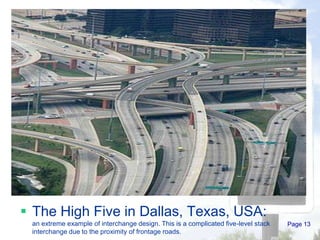
 The High Five in Dallas, Texas, USA:
 an extreme example of interchange design. This is a complicated five-level stack   Page 13
 interchange due to the proximity of frontage roads.
Function of freeway
       interchanges
 To provide separation
  between two or more traffic
  arteries.
 To facilitate easy transfer of
  vehicles from one entry to the
  other or between local
  roadways and the freeway.


                                   Page 14
Use of overpass or underpass?
 UNDERPASS
 Depends       on     topography,
  economy and any other minor
  factors
 Underpass        better      for
  deceleration/acceleration, cost
  and advance warning
 OVERPASS
 Overpass better aesthetics         Page 15
Types of interchange


                       Page 16
Four way interchanges
1. Cloverleaf interchange –
   typically a two-level, four-way
    interchange where all left turns are
    handled by loop ramps (right turns
    if traveling on the left).


                                       Page 17
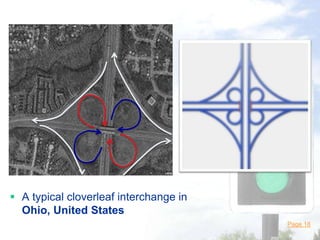
 A typical cloverleaf interchange in
  Ohio, United States
                                        Page 18
Advantage of cloverleaf
 they require only one bridge,
  which makes such junctions
  inexpensive as long as land is
  plentiful
 A major shortcoming of
  cloverleafs, however, is
  weaving and the consequent
  low capacity of this design.

                                   Page 19
Objections to the cloverleaf
   interchange design
 It requires large area of land
 At higher design speed, more
  time is consumed just to
  transverse the longer loops
 Vehicles making left turn execute
  270° right turn and travel greater
  distance becoming very
  unpleasant and hazardous due to
  sharp curves and steep grades.
                                       Page 20
Objections to the cloverleaf
   interchange design
 Vehicles leaving the curve
  loop in one quadrant weave
  those entering the adjacent
  loop from the through road
  way.


                                Page 21
Four way interchanges
2. Stack interchange –
   whereby left turns are
    handled by semi-
    directional flyover/under
    ramps.


                                Page 22
 A multi-level stack interchange
  in Shanghai, China
                                    Page 23
Disadvantages
 Expensive
 creates an eyesore among
  local residents, leading to
  considerable (Not In My Back
  Yard) opposition


                                 Page 24
Four way interchanges
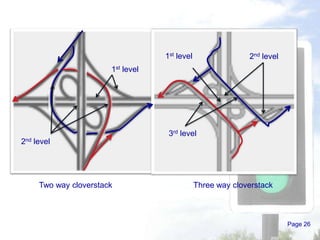
3. Cloverstack interchange –
   Its ramps are longer to allow for
    higher ramp speeds, and loop
    ramp radii are made larger as well.
    The large loop ramps eliminate the
    need for a fourth, and sometimes
    a third level in a typical stack
    interchange, as only two directions
    of travel use flyover/under ramps.
                                    Page 25
1st level                 2nd level
                       1st level


                                    3rd level
2nd level


     Two way cloverstack                       Three way cloverstack


                                                                         Page 26
advantages
 cheaper to build than stack
  interchanges
 less of an eyesore for local
  residents
 weaving is also eliminated


                                 Page 27
disadvantages
 require a lot of land to
  construct
 the loop ramps are not as
  efficient as flyover/under
  ramps in terms of traffic flow


                                   Page 28
Four way interchanges
4. Turbine interchange (whirlpool)
   requires fewer levels (usually two
    or three) while retaining semi-
    directional ramps throughout, and
    has its left-turning ramps sweep
    around     the    center  of    the
    interchange in a spiral pattern in
    right-hand driving.
                                     Page 29
 The Circle Interchange in Chicago, a notable
  turbine interchange
                                                 Page 30
2nd level


                       2nd level                             3rd level
1st level                          1st level


     Two way turbine                           Three way turbine


                                                                   Page 31
Four way interchanges
5. Roundabout interchange –
   The ramps of the interchanging
    highways meet at a roundabout or
    rotary on a separated level above,
    below, or in the middle of the two
    highways.


                                    Page 32
Page 33
Other/hybrid interchanges
1. windmill interchange
   is similar to a turbine
    interchange, but it has
    much sharper turns,
    reducing its size and
    capacity


                              Page 34
Page 35
Other/hybrid interchanges
2. diverging windmill
   increases capacity by
     altering the direction of
     traffic flow of the
     interchanging highways,
     making the connecting
     ramps much more
     direct.
                                 Page 36
Page 37
Other/hybrid interchanges
3. Divided volleyball
   create a wide median
     between the
     carriageways of the two
     interchanging highways,
     using this space for
     connecting ramps.

                               Page 38
Page 39
Other/hybrid interchanges
4. Full diamond
   large, multi-level
    interchanges that use
    flyover/under ramps to
    handle both right and
    left ramps.


                             Page 40
Page 41
Hybrid interchange near Rotterdam,
            Netherlands.

                                     Hybrid interchange near
                                     Cross-Harbour Tunnel,
                                           Hong Kong.
                                                               Page 42
Three way interchanges
 Trumpet interchange
  have been used where one highway
   terminates at another highway. These
   involve at least one loop ramp
   connecting traffic either entering or
   leaving the terminating expressway
   with the far lanes of the continuous
   highway.

                                       Page 43
A trumpet interchange on the
Ottawa River Parkway
                               Page 44
Three way interchanges
 Directional T interchange
   uses flyover/under ramps in all
    directions at a three-way
    interchange. A semi-directional T
    does the same, but some of the
    splits and merges are switched to
    avoid ramps to and from the
    passing lane.
                                    Page 45
Semi-directional-T
interchange in Lausanne,
Switzerland                Page 46
Three way interchanges
 Full Y interchange
   typically used when a three-way
    interchange is required for two or three
    highways      interchanging    in   semi-
    parallel/perpendicular directions, but it
    can also be used in right-angle case as
    well. Their connecting ramps can spur
    from either the right or left side of the
    highway, depending on the direction of
    travel and the angle.                 Page 47
Page 48
Two way interchanges
 Diamond interchange
   interchange involving four ramps
    where they enter and leave the
    freeway at a small angle and
    meet the non-freeway at almost
    right angles.


                                       Page 49
Page 50
Diamond interchange in Ohio, United
States
                                      Page 51
Two way interchanges
 Parclo interchange/folded
  diamond
   also known as a partial
    cloverleaf, is an interchange
    usually involving four to six
    ramps, two of which are loop
    ramps, which connect to the
    non-highway.
                                    Page 52
Page 53
Parclo A-4 interchange in
Ontario, Canada.
                            Page 54
Two way interchanges
 Diverging diamond interchange
   similar to a traditional diamond
    interchange, except that it uses
    directional lanes for the non-highway
    to cross over each other on either
    side of the highway, altering the
    direction of travel on the
    over/underpass through the use of
    traffic lights.                   Page 55
 This allows all turns to and
  from the highway to be
  made without crossing the
  opposite direction of travel,
  increasing the capacity
  when compared to a
  typical diamond
  interchange.
                                  Page 56
One set of
traffic signal


                 Page 57
Page 58
References:
 Highway engineering by
  Clarkson H. Oglesby & R.
  Gary Hicks
 Elements of roads and
  highways by Max Fajardo
 www.highway
  researchinterchangesInterch
  ange (road) - Wikipedia, the
  free encyclopedia.htm
                                  Page 59

Interchange

  • 1.
    Curves, island, interchanges and freeway REPORTED BY: JOSEPH R. POLICENA
  • 2.
    Table of content Widening of curves  Islands  Island is included in the design by the ff purposes  Interchange  Function of freeway interchanges  Types of interchange  Four-way interchanges  three-way interchanges  two-way interchanges  Freeway entrance and exit Page 2
  • 3.
  • 4.
    Provision for awider roadway is necessary on sharp curve for two lanes pavement under the ff. reason 1. To force the drivers to shy away from the pavement edge. 2. To increase the effective transverse vehicle width for non- tracking of front and rear wheel. Page 4
  • 5.
    Provision for awider roadway is necessary on sharp curve for two lanes pavement under the ff. reason 3. To give additional width due to the slanted position of the front wheel to the roadway center line. 4. For a 7.2m wide roadway, an additional width of 30cm is necessary on an open curve highway. Page 5
  • 6.
    Islands  Is adefine area between traffic lanes for controls of vehicle movement and for pedestrian refuge. Within an intersection, median is considered as an island. Page 6
  • 7.
    Island is includedin the design by the ff puRposes 1. Separation of vehicles flow 2. Separation of conflicts 3. Reduction in excessive pavement areas 4. Reduction of traffic and indications of proper use of intersection Page 7
  • 8.
    Island is includedin the design by the ff puRposes 5. Arrangement to favor a prominent turning movement 6. Location to traffic control devices Page 8
  • 9.
    General types andshapes of an island Page 9
  • 10.
    General types andshapes of an island Page 10
  • 11.
    General types andshapes of an island Page 11
  • 12.
    Interchange  a roadjunction that typically uses grade separation, and one or more ramps, to permit traffic on at least one highway to pass through the junction without directly crossing any other traffic stream. It differs from a standard intersection, at which roads cross at grade. Page 12
  • 13.
     The HighFive in Dallas, Texas, USA: an extreme example of interchange design. This is a complicated five-level stack Page 13 interchange due to the proximity of frontage roads.
  • 14.
    Function of freeway interchanges  To provide separation between two or more traffic arteries.  To facilitate easy transfer of vehicles from one entry to the other or between local roadways and the freeway. Page 14
  • 15.
    Use of overpassor underpass?  UNDERPASS  Depends on topography, economy and any other minor factors  Underpass better for deceleration/acceleration, cost and advance warning  OVERPASS  Overpass better aesthetics Page 15
  • 16.
  • 17.
    Four way interchanges 1.Cloverleaf interchange –  typically a two-level, four-way interchange where all left turns are handled by loop ramps (right turns if traveling on the left). Page 17
  • 18.
     A typicalcloverleaf interchange in Ohio, United States Page 18
  • 19.
    Advantage of cloverleaf they require only one bridge, which makes such junctions inexpensive as long as land is plentiful  A major shortcoming of cloverleafs, however, is weaving and the consequent low capacity of this design. Page 19
  • 20.
    Objections to thecloverleaf interchange design  It requires large area of land  At higher design speed, more time is consumed just to transverse the longer loops  Vehicles making left turn execute 270° right turn and travel greater distance becoming very unpleasant and hazardous due to sharp curves and steep grades. Page 20
  • 21.
    Objections to thecloverleaf interchange design  Vehicles leaving the curve loop in one quadrant weave those entering the adjacent loop from the through road way. Page 21
  • 22.
    Four way interchanges 2.Stack interchange –  whereby left turns are handled by semi- directional flyover/under ramps. Page 22
  • 23.
     A multi-levelstack interchange in Shanghai, China Page 23
  • 24.
    Disadvantages  Expensive  createsan eyesore among local residents, leading to considerable (Not In My Back Yard) opposition Page 24
  • 25.
    Four way interchanges 3.Cloverstack interchange –  Its ramps are longer to allow for higher ramp speeds, and loop ramp radii are made larger as well. The large loop ramps eliminate the need for a fourth, and sometimes a third level in a typical stack interchange, as only two directions of travel use flyover/under ramps. Page 25
  • 26.
    1st level 2nd level 1st level 3rd level 2nd level Two way cloverstack Three way cloverstack Page 26
  • 27.
    advantages  cheaper tobuild than stack interchanges  less of an eyesore for local residents  weaving is also eliminated Page 27
  • 28.
    disadvantages  require alot of land to construct  the loop ramps are not as efficient as flyover/under ramps in terms of traffic flow Page 28
  • 29.
    Four way interchanges 4.Turbine interchange (whirlpool)  requires fewer levels (usually two or three) while retaining semi- directional ramps throughout, and has its left-turning ramps sweep around the center of the interchange in a spiral pattern in right-hand driving. Page 29
  • 30.
     The CircleInterchange in Chicago, a notable turbine interchange Page 30
  • 31.
    2nd level 2nd level 3rd level 1st level 1st level Two way turbine Three way turbine Page 31
  • 32.
    Four way interchanges 5.Roundabout interchange –  The ramps of the interchanging highways meet at a roundabout or rotary on a separated level above, below, or in the middle of the two highways. Page 32
  • 33.
  • 34.
    Other/hybrid interchanges 1. windmillinterchange  is similar to a turbine interchange, but it has much sharper turns, reducing its size and capacity Page 34
  • 35.
  • 36.
    Other/hybrid interchanges 2. divergingwindmill  increases capacity by altering the direction of traffic flow of the interchanging highways, making the connecting ramps much more direct. Page 36
  • 37.
  • 38.
    Other/hybrid interchanges 3. Dividedvolleyball  create a wide median between the carriageways of the two interchanging highways, using this space for connecting ramps. Page 38
  • 39.
  • 40.
    Other/hybrid interchanges 4. Fulldiamond  large, multi-level interchanges that use flyover/under ramps to handle both right and left ramps. Page 40
  • 41.
  • 42.
    Hybrid interchange nearRotterdam, Netherlands. Hybrid interchange near Cross-Harbour Tunnel, Hong Kong. Page 42
  • 43.
    Three way interchanges Trumpet interchange  have been used where one highway terminates at another highway. These involve at least one loop ramp connecting traffic either entering or leaving the terminating expressway with the far lanes of the continuous highway. Page 43
  • 44.
    A trumpet interchangeon the Ottawa River Parkway Page 44
  • 45.
    Three way interchanges Directional T interchange  uses flyover/under ramps in all directions at a three-way interchange. A semi-directional T does the same, but some of the splits and merges are switched to avoid ramps to and from the passing lane. Page 45
  • 46.
  • 47.
    Three way interchanges Full Y interchange  typically used when a three-way interchange is required for two or three highways interchanging in semi- parallel/perpendicular directions, but it can also be used in right-angle case as well. Their connecting ramps can spur from either the right or left side of the highway, depending on the direction of travel and the angle. Page 47
  • 48.
  • 49.
    Two way interchanges Diamond interchange  interchange involving four ramps where they enter and leave the freeway at a small angle and meet the non-freeway at almost right angles. Page 49
  • 50.
  • 51.
    Diamond interchange inOhio, United States Page 51
  • 52.
    Two way interchanges Parclo interchange/folded diamond  also known as a partial cloverleaf, is an interchange usually involving four to six ramps, two of which are loop ramps, which connect to the non-highway. Page 52
  • 53.
  • 54.
    Parclo A-4 interchangein Ontario, Canada. Page 54
  • 55.
    Two way interchanges Diverging diamond interchange  similar to a traditional diamond interchange, except that it uses directional lanes for the non-highway to cross over each other on either side of the highway, altering the direction of travel on the over/underpass through the use of traffic lights. Page 55
  • 56.
     This allowsall turns to and from the highway to be made without crossing the opposite direction of travel, increasing the capacity when compared to a typical diamond interchange. Page 56
  • 57.
    One set of trafficsignal Page 57
  • 58.
  • 59.
    References:  Highway engineeringby Clarkson H. Oglesby & R. Gary Hicks  Elements of roads and highways by Max Fajardo  www.highway researchinterchangesInterch ange (road) - Wikipedia, the free encyclopedia.htm Page 59