Four Stroke SI Engine
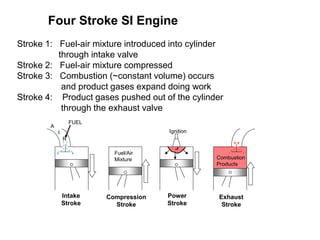
Stroke 1: Fuel-air mixture introduced into cylinder
through intake valve
Stroke 2: Fuel-air mixture compressed
Stroke 3: Combustion (~constant volume) occurs
and product gases expand doing work
Stroke 4: Product gases pushed out of the cylinder
through the exhaust valve
Compression
Stroke
Power
Stroke
Exhaust
Stroke
A
I
R
Combustion
Products
Ignition
Intake
Stroke
FUEL
Fuel/Air
Mixture
Crank shaft
90o
180o
BC
TC
0o
270o
q
Spark plug for SI engine
Fuel injector for CI engine
Top
Center
(TC)
Bottom
Center
(BC)
Valves
Clearance
volume
Cylinder
wall
Piston
Stroke
Cylinder
Components
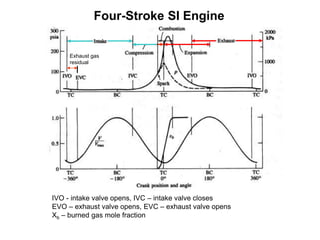
IVO - intake valve opens, IVC – intake valve closes
EVO – exhaust valve opens, EVC – exhaust valve opens
Xb – burned gas mole fraction
Four-Stroke SI Engine
Exhaust gas
residual
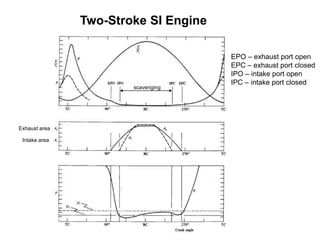
Two Stroke SI Engine
Intake (“Scavenging”)
Compression Ignition
ExhaustExpansion
Fuel-air-oil
mixture
Fuel-air-oil
mixture
compressed
Crank
shaft
Check
valve
Exhaust
port
FOUR STROKE S I Engine
By Naphis Ahamad
5
Cross Loop Uniflow
Two-Stroke Scavenging
EPO – exhaust port open
EPC – exhaust port closed
IPO – intake port open
IPC – intake port closed
Exhaust area
Intake area
Two-Stroke SI Engine
scavenging
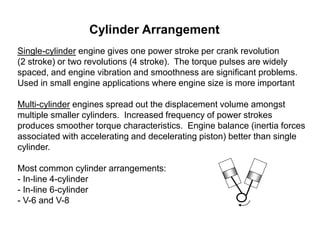
Cylinder Arrangement
Single-cylinder engine gives one power stroke per crank revolution
(2 stroke) or two revolutions (4 stroke). The torque pulses are widely
spaced, and engine vibration and smoothness are significant problems.
Used in small engine applications where engine size is more important
Multi-cylinder engines spread out the displacement volume amongst
multiple smaller cylinders. Increased frequency of power strokes
produces smoother torque characteristics. Engine balance (inertia forces
associated with accelerating and decelerating piston) better than single
cylinder.
Most common cylinder arrangements:
- In-line 4-cylinder
- In-line 6-cylinder
- V-6 and V-8
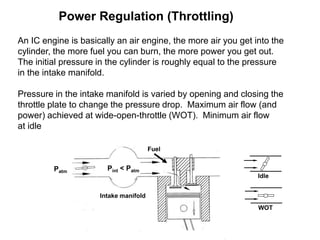
Power Regulation (Throttling)
An IC engine is basically an air engine, the more air you get into the
cylinder, the more fuel you can burn, the more power you get out.
The initial pressure in the cylinder is roughly equal to the pressure
in the intake manifold.
Pressure in the intake manifold is varied by opening and closing the
throttle plate to change the pressure drop. Maximum air flow (and
power) achieved at wide-open-throttle (WOT). Minimum air flow
at idle
Patm
Pint < Patm
Intake manifold
Fuel
WOT
Idle
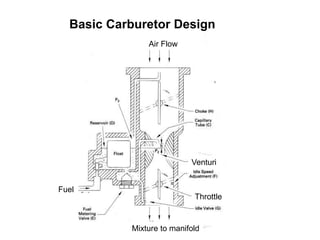
Basic Carburetor Design
Venturi
Throttle
Air Flow
Mixture to manifold
Fuel
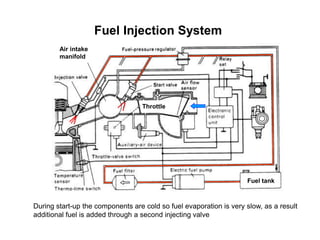
Fuel Injection System
Throttle
Fuel tank
Air intake
manifold
During start-up the components are cold so fuel evaporation is very slow, as a result
additional fuel is added through a second injecting valve
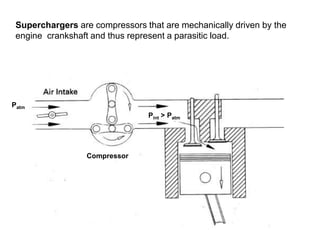
Superchargers are compressors that are mechanically driven by the
engine crankshaft and thus represent a parasitic load.
Compressor
Patm
Pint > Patm
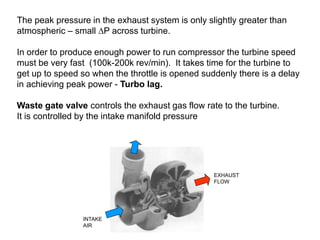
Turbochargers couple a compressor with a turbine driven by the exhaust
gas. The compressor pressure is proportional to the engine speed
The peak pressure in the exhaust system is only slightly greater than
atmospheric – small DP across turbine.
In order to produce enough power to run compressor the turbine speed
must be very fast (100k-200k rev/min). It takes time for the turbine to
get up to speed so when the throttle is opened suddenly there is a delay
in achieving peak power - Turbo lag.
Waste gate valve controls the exhaust gas flow rate to the turbine.
It is controlled by the intake manifold pressure
INTAKE
AIR
EXHAUST
FLOW

Si engines.ppt naphis

  • 1.
    Four Stroke SIEngine Stroke 1: Fuel-air mixture introduced into cylinder through intake valve Stroke 2: Fuel-air mixture compressed Stroke 3: Combustion (~constant volume) occurs and product gases expand doing work Stroke 4: Product gases pushed out of the cylinder through the exhaust valve Compression Stroke Power Stroke Exhaust Stroke A I R Combustion Products Ignition Intake Stroke FUEL Fuel/Air Mixture
  • 2.
    Crank shaft 90o 180o BC TC 0o 270o q Spark plugfor SI engine Fuel injector for CI engine Top Center (TC) Bottom Center (BC) Valves Clearance volume Cylinder wall Piston Stroke Cylinder Components
  • 3.
    IVO - intakevalve opens, IVC – intake valve closes EVO – exhaust valve opens, EVC – exhaust valve opens Xb – burned gas mole fraction Four-Stroke SI Engine Exhaust gas residual
  • 4.
    Two Stroke SIEngine Intake (“Scavenging”) Compression Ignition ExhaustExpansion Fuel-air-oil mixture Fuel-air-oil mixture compressed Crank shaft Check valve Exhaust port
  • 5.
    FOUR STROKE SI Engine By Naphis Ahamad 5
  • 6.
  • 7.
    EPO – exhaustport open EPC – exhaust port closed IPO – intake port open IPC – intake port closed Exhaust area Intake area Two-Stroke SI Engine scavenging
  • 8.
    Cylinder Arrangement Single-cylinder enginegives one power stroke per crank revolution (2 stroke) or two revolutions (4 stroke). The torque pulses are widely spaced, and engine vibration and smoothness are significant problems. Used in small engine applications where engine size is more important Multi-cylinder engines spread out the displacement volume amongst multiple smaller cylinders. Increased frequency of power strokes produces smoother torque characteristics. Engine balance (inertia forces associated with accelerating and decelerating piston) better than single cylinder. Most common cylinder arrangements: - In-line 4-cylinder - In-line 6-cylinder - V-6 and V-8
  • 9.
    Power Regulation (Throttling) AnIC engine is basically an air engine, the more air you get into the cylinder, the more fuel you can burn, the more power you get out. The initial pressure in the cylinder is roughly equal to the pressure in the intake manifold. Pressure in the intake manifold is varied by opening and closing the throttle plate to change the pressure drop. Maximum air flow (and power) achieved at wide-open-throttle (WOT). Minimum air flow at idle Patm Pint < Patm Intake manifold Fuel WOT Idle
  • 10.
    Basic Carburetor Design Venturi Throttle AirFlow Mixture to manifold Fuel
  • 11.
    Fuel Injection System Throttle Fueltank Air intake manifold During start-up the components are cold so fuel evaporation is very slow, as a result additional fuel is added through a second injecting valve
  • 12.
    Superchargers are compressorsthat are mechanically driven by the engine crankshaft and thus represent a parasitic load. Compressor Patm Pint > Patm
  • 13.
    Turbochargers couple acompressor with a turbine driven by the exhaust gas. The compressor pressure is proportional to the engine speed
  • 14.
    The peak pressurein the exhaust system is only slightly greater than atmospheric – small DP across turbine. In order to produce enough power to run compressor the turbine speed must be very fast (100k-200k rev/min). It takes time for the turbine to get up to speed so when the throttle is opened suddenly there is a delay in achieving peak power - Turbo lag. Waste gate valve controls the exhaust gas flow rate to the turbine. It is controlled by the intake manifold pressure INTAKE AIR EXHAUST FLOW