INTERNAL COMBUTION ENGINE
Made by:
Assistant Professor : NAPHIS AHAMAD
MECHANICAL ENGINEERING
6/10/2017 Naphis Ahamad (ME) JIT 1
6/10/2017 Naphis Ahamad (ME) JIT 2
UNIT I
INTRODUCTION What is IC Engine?
An internal combustion engine is a thermal system (power plant) that
converts heat obtained from chemical energy sources (gasoline, natural gas)
into mechanical work.
Where are IC Engines Used?
IC engines are used as the propulsion systems for land transport vehicles
such as automobiles (cars, etc.), marine vehicles (boats, etc.) and small
airplanes. IC engines are also used in portable electrical generators and as
prime mover in grass cutting machine, etc.6/10/2017 Naphis Ahamad (ME) JIT 3
INTRODUCTION
6/10/2017 Naphis Ahamad (ME) JIT 4
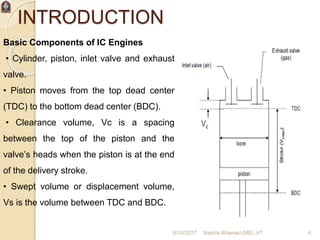
Basic Components of IC Engines
• Cylinder, piston, inlet valve and exhaust
valve.
• Piston moves from the top dead center
(TDC) to the bottom dead center (BDC).
• Clearance volume, Vc is a spacing
between the top of the piston and the
valve’s heads when the piston is at the end
of the delivery stroke.
• Swept volume or displacement volume,
Vs is the volume between TDC and BDC.
Classifications:
Internal Combustion Engines (IC Engines)
External Combustion Engines (EC Engines)
Internal Combustion Engines (IC Engines):
IC Engines are those in which combustion of fuels take places inside engine
cylinder (Example: Petrol, Diesel, GAS)
External Combustion Engines (EC Engines):
EC Engines are those in which combustion of fuels take places outside engine
cylinder (Example: Steam Engine, Steam turbine)6/10/2017 Naphis Ahamad (ME) JIT 5
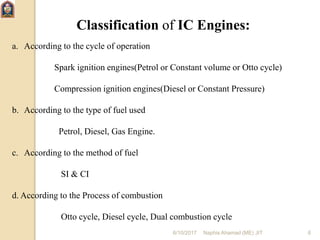
Classification of IC Engines:
a. According to the cycle of operation
Spark ignition engines(Petrol or Constant volume or Otto cycle)
Compression ignition engines(Diesel or Constant Pressure)
b. According to the type of fuel used
Petrol, Diesel, Gas Engine.
c. According to the method of fuel
SI & CI
d. According to the Process of combustion
Otto cycle, Diesel cycle, Dual combustion cycle
6/10/2017 Naphis Ahamad (ME) JIT 6
About Petrol Engine:
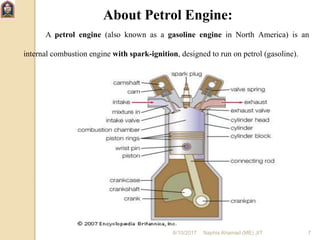
A petrol engine (also known as a gasoline engine in North America) is an
internal combustion engine with spark-ignition, designed to run on petrol (gasoline).
6/10/2017 Naphis Ahamad (ME) JIT 7
Working Cycles Four Stroke Petrol Engine:
 It is also known as Otto cycle or constant volume cycle.
 Cycle of operation is completed in 4-strokes of the piston or 2 revolutions of
the crankshaft.
 Each stroke consists of 180°, of crankshaft rotation and hence a cycle
consists of 720°of crankshaft rotation.
2-stroke: 1 power stroke per 1 crankshaft rev
4-stroke: 1 power stroke per 2 crankshaft rev
6/10/2017 Naphis Ahamad (ME) JIT 8
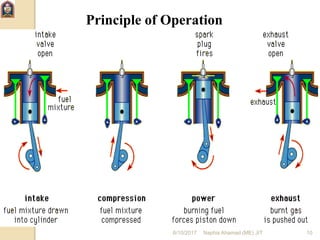
Principle of Operation:
The series of operations of an ideal four-stroke SI engine are as follows
Suction Stroke or charging stroke
Compression Stroke
Expansion or Power Stroke or working stroke
Exhaust Stroke
6/10/2017 Naphis Ahamad (ME) JIT 9
Principle of Operation
6/10/2017 Naphis Ahamad (ME) JIT 10
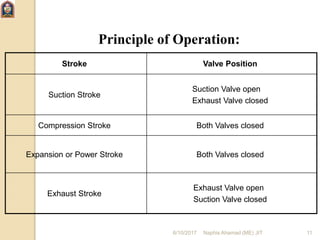
Principle of Operation:
Stroke Valve Position
Suction Stroke
Suction Valve open
Exhaust Valve closed
Compression Stroke Both Valves closed
Expansion or Power Stroke Both Valves closed
Exhaust Stroke
Exhaust Valve open
Suction Valve closed
6/10/2017 Naphis Ahamad (ME) JIT 11
Working Principles of Four Stroke Diesel Engine:
Increased pressure of combustion gases acts on piston -> converted to rotary motion
Can be 2 or 4 stroke engines
2-stroke: 1 power stroke per 1 crankshaft rev
4-stroke: 1 power stroke per 2 crankshaft rev
Engine stroke:
A stroke is a single traverse of the cylinder by the piston (from TDC to BDC)
1 revolution of crankshaft = 2 strokes of piston
6/10/2017 Naphis Ahamad (ME) JIT 12
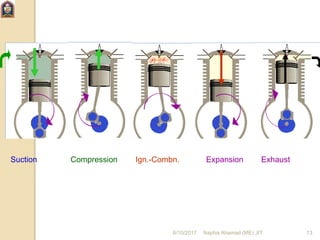
Exhaust
Suction Compression Ign.-Combn. Expansion Exhaust
6/10/2017 Naphis Ahamad (ME) JIT 13
Working Principles Of Four Stroke Diesel Engine:
Intake stroke
Intake valve open, exhaust valve shut
Piston travels from TDC to BDC
Air drawn in
Compression stroke
Intake and exhaust valves shut
Piston travels from BDC to TDC
Temperature and pressure of air increase
6/10/2017 Naphis Ahamad (ME) JIT 14
Working Principles Of Four Stroke Diesel Engine:
Power stroke
Intake and exhaust valves shut
Fuel injected into cylinder and ignites
Piston forced from TDC to BDC
Exhaust stroke
Intake valve shut, exhaust valve open
Piston moves from BDC to TDC
Combustion gases expelled
6/10/2017 Naphis Ahamad (ME) JIT 15
Working Principles Of Two Stroke Petrol
Engine
6/10/2017 Naphis Ahamad (ME) JIT 16
6/10/2017 Naphis Ahamad (ME) JIT 17
Two Stroke Cycle Petrol Engine
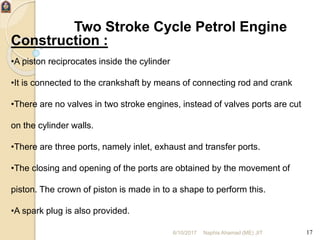
Construction :
•A piston reciprocates inside the cylinder
•It is connected to the crankshaft by means of connecting rod and crank
•There are no valves in two stroke engines, instead of valves ports are cut
on the cylinder walls.
•There are three ports, namely inlet, exhaust and transfer ports.
•The closing and opening of the ports are obtained by the movement of
piston. The crown of piston is made in to a shape to perform this.
•A spark plug is also provided.
6/10/2017 Naphis Ahamad (ME) JIT 18
Two stroke cycle Petrol Engines - Working
• The piston moves up from Bottom Dead Centre (BDC) to
Top Dead Centre (TDC)
• Both transfer and exhaust ports are covered by the piston.
• Air fuel mixture which is transferred already into the engine
cylinder is compressed by moving piston.
• The pressure and temperature increases
• at the end of compression.
6/10/2017 Naphis Ahamad (ME) JIT 19
Two stroke cycle Petrol Engines - Working
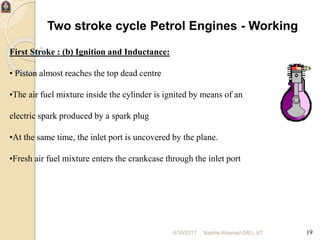
First Stroke : (b) Ignition and Inductance:
• Piston almost reaches the top dead centre
•The air fuel mixture inside the cylinder is ignited by means of an
electric spark produced by a spark plug
•At the same time, the inlet port is uncovered by the plane.
•Fresh air fuel mixture enters the crankcase through the inlet port
6/10/2017 Naphis Ahamad (ME) JIT 20
Two stroke cycle Petrol Engines - Working
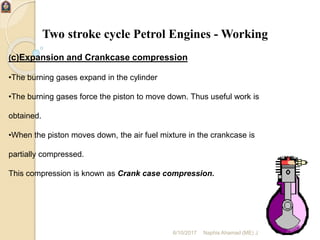
(c)Expansion and Crankcase compression
•The burning gases expand in the cylinder
•The burning gases force the piston to move down. Thus useful work is
obtained.
•When the piston moves down, the air fuel mixture in the crankcase is
partially compressed.
This compression is known as Crank case compression.
6/10/2017 Naphis Ahamad (ME) JIT 21
Two stroke cycle Petrol Engines - Working
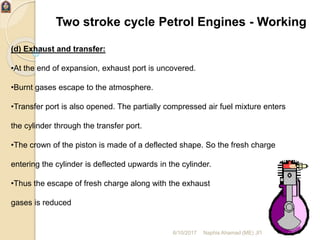
(d) Exhaust and transfer:
•At the end of expansion, exhaust port is uncovered.
•Burnt gases escape to the atmosphere.
•Transfer port is also opened. The partially compressed air fuel mixture enters
the cylinder through the transfer port.
•The crown of the piston is made of a deflected shape. So the fresh charge
entering the cylinder is deflected upwards in the cylinder.
•Thus the escape of fresh charge along with the exhaust
gases is reduced
Compression
Intake and exhaust valves shut
Piston travels from BDC to TDC
Temperature and pressure of air increase
Power stroke
Intake and exhaust valves shut
Fuel injected into cylinder and ignites
Piston forced from TDC to BDC
Working Principles Of Two Stroke Diesel Engine
6/10/2017 Naphis Ahamad (ME) JIT 22
Application Of Four stroke Cycle Engine
Used in heavy vehicles
Buses,
Lorries,
Trucks etc.,
Application Of Two stroke Cycle Engine
Used in light vehicles
Bikes,
Scooters,
Mopeds
Ship propulsion
6/10/2017 Naphis Ahamad (ME) JIT 23
Application Of Four stroke Petrol Engine
Buses ,Trucks
Mobile electric generating sets.
Small pumping sets with side cars
Application Of Four stroke Diesel Engine
30kw-Tractors
40to 100kw – jeeps, buses and trucks
200 to 400kw-Earthmoving m/c
100 to 35000kw-Marine application
6/10/2017 Naphis Ahamad (ME) JIT 24
6/10/2017 Naphis Ahamad (ME) JIT 25
I.C ENGINE TERMINOLGY
6/10/2017 Naphis Ahamad (ME) JIT 26
standard terms used in I.C Engines are
1. Bore: Inside diameter of the cylinder is termed as Bore and it is designated by the
letter d and is usually expressed in millimeter (mm)
2. Top Dead Center (TDC): The extreme position reached by the piston at the top of
the cylinder in the vertical engine is called Top Dead center. It is also called the Inner
dead centre (IDC).
3. Bottom Dead Center (BDC): The extreme position reached by the piston at the
Bottom of the cylinder in the vertical engine is called Bottom Dead center. It is also
called the Outer dead centre (ODC).
6/10/2017 Naphis Ahamad (ME) JIT 27
5. Compression ratio (r): It is the ratio of Maximum cylinder volume to the
Clearance volume.
6. Cylinder volume (v): It is the sum of swept volume and the Clearance volume.
V = Vs + Vc
7. Displacement (or)Swept volume (Vs): It is the volume of space generated by
the movement of piston from one dead center to another dead center. It is expressed
in terms of cubic centimeter (cc) and given by
VS = A * L =  * d2 * L / 4
8. Clearance Volume( Vc): It is the space in the cylinder, when the piston is at Top
Dead Center It is designated as VC and expressed in cubic centimeter (cc).
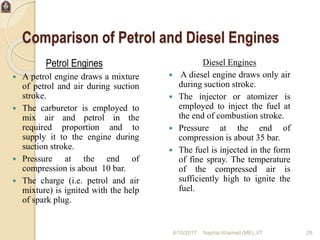
Comparison of Petrol and Diesel Engines
Petrol Engines
 A petrol engine draws a mixture
of petrol and air during suction
stroke.
 The carburetor is employed to
mix air and petrol in the
required proportion and to
supply it to the engine during
suction stroke.
 Pressure at the end of
compression is about 10 bar.
 The charge (i.e. petrol and air
mixture) is ignited with the help
of spark plug.
Diesel Engines
 A diesel engine draws only air
during suction stroke.
 The injector or atomizer is
employed to inject the fuel at
the end of combustion stroke.
 Pressure at the end of
compression is about 35 bar.
 The fuel is injected in the form
of fine spray. The temperature
of the compressed air is
sufficiently high to ignite the
fuel.
6/10/2017 Naphis Ahamad (ME) JIT 28
Comparison of Petrol and Diesel Engines
(contd..)
 The maintenance cost is less.
 The thermal efficiency is
about 26%.
 Overheating trouble is more
due to low thermal efficiency.
 These are high speed engines.
 The petrol engines are
generally employed in light
duty vehicle such as scooters,
motorcycles and cars. These
are also used in aeroplanes.
 The maintenance cost is
more.
 The thermal efficiency is
about 40%.
 Overheating trouble is less
due to high thermal efficiency.
 These are relatively low
speed engines.
 The diesel engines are
generally employed in heavy
duty vehicles like buses,
trucks, and earth moving
machines.
6/10/2017 Naphis Ahamad (ME) JIT 29
VALVE TIMING DIAGRAM
A Valve timing diagram is a graphical representation of the exact moments, in the
sequence of operations, at which the two valves(i.e. inlet & exhaust valves) open
and close as well as firing of fuel. It is, generally, expressed in terms of angular
positions of the crankshaft.
THEORETICAL VALVE TIMING DIAGRAM FOR
FOUR STROKE CYCLE DIESEL ENGINE
6/10/2017 Naphis Ahamad (ME) JIT 30
The theoretical valve timing diagram for a four stroke cycle engine is shown in this
fig. In this diagram, the inlet valve opens at A and the suction takes place from A to
B. The crankshaft revolves through 180 degree and the piston moves from T.D.C. to
B.D.C. At B, the inlet valve closes and the compression takes place from B to C.
The crankshaft revolves through 180 degree and the piston moves from B.D.C. to
T.D.C. At C, the fuel is fired and the expansion takes place from C to D. the
crankshaft revolves through 180 deg. And the piston again moves from T.D.C. to
B.D.C. At D, the exhaust valve opens and the exhaust takes place from D to E. The
crankshaft again revolves through 180 deg. And the piston moves back to T.D.C.
6/10/2017 Naphis Ahamad (ME) JIT 31
ACTUAL VALVE TIMING DIAGRAM FOR FOUR
STROKE CYCLE DIESEL ENGINE
6/10/2017 Naphis Ahamad (ME) JIT 32
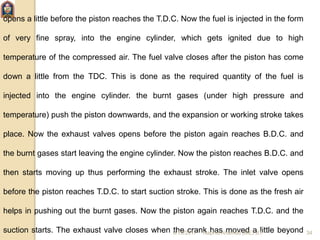
As we seen in the theoretical valve timing diagram, the valves open and close at the
dead centre position of the piston. But, in actual practice they do not open and close
instantaneously at dead centres. The valve operates some degrees before or after the
dead centres. The ignition also occurs a little before the top dead centre. The valve
timing diagram shown is the actual valve timing diagram, where we see that the inlet
valve opens before the piston reaches T.D.C. or in other words while the piston is
moving up before the beginning of the suction stroke. Now the piston reaches the T.D.C.
and the suction stroke starts. The piston reaches the B.D.C. and then starts moving up.
The inlet valve closes, when the crank has moved a little beyond the B.D.C. This is done
as the incoming air continues to flow into the cylinder although the piston is moving
upwards from B.D.C. Now the air is compressed with both valves closed. Fuel valve
6/10/2017 Naphis Ahamad (ME) JIT 33
opens a little before the piston reaches the T.D.C. Now the fuel is injected in the form
of very fine spray, into the engine cylinder, which gets ignited due to high
temperature of the compressed air. The fuel valve closes after the piston has come
down a little from the TDC. This is done as the required quantity of the fuel is
injected into the engine cylinder. the burnt gases (under high pressure and
temperature) push the piston downwards, and the expansion or working stroke takes
place. Now the exhaust valves opens before the piston again reaches B.D.C. and
the burnt gases start leaving the engine cylinder. Now the piston reaches B.D.C. and
then starts moving up thus performing the exhaust stroke. The inlet valve opens
before the piston reaches T.D.C. to start suction stroke. This is done as the fresh air
helps in pushing out the burnt gases. Now the piston again reaches T.D.C. and the
suction starts. The exhaust valve closes when the crank has moved a little beyond6/10/2017 Naphis Ahamad (ME) JIT 34
THEORETICAL VALVE TIMING DIAGRAM FOR
TWO STROKE CYCLE DIESEL ENGINE
done as the burnt gases continue to leave the engine cylinder although the
piston is moving downwards.
6/10/2017 Naphis Ahamad (ME) JIT 35
The theoretical valve timing diagram for a two stroke cycle engine is shown in fig. In
this diagram, the fuel is fired at A and the expansion of gases takes place from A to B.
the crankshaft revolves through approximately 120 deg. and the piston moves from
T.D.C. towards B.D.C. At B, both the valves open and suction as well as exhaust take
place from B to C. At B, both the valves open and suction as well as exhaust takes
place from B to C. The crankshaft revolves through approximately 120 deg. and the
piston moves first to BDC and then little upwards. At C, both the valves close and
compression takes place from C to A. The crankshaft revolves through approximately
120 deg. and the piston moves to B.D.C.
6/10/2017 Naphis Ahamad (ME) JIT 36
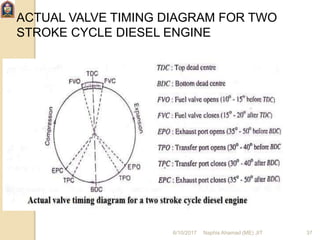
ACTUAL VALVE TIMING DIAGRAM FOR TWO
STROKE CYCLE DIESEL ENGINE
6/10/2017 Naphis Ahamad (ME) JIT 37
As like as four stroke cycle engine, the actual valve timing diagram of two stroke
cycle engine is also different from it’s theoretical valve timing diagram. The actual
valve timing diagram of two stroke cycle engine is shown in fig. As we see that the
expansion of the charge (after ignition) starts as the piston moves T.D.C. towards
B.D.C. First of all, the exhaust port opens before the piston reaches B.D.C. and the
burnt gases start leaving the cylinder. After a small fraction of the crank revolution,
the transfer port also opens and the fresh air enters into the engine cylinder. This is
done as the fresh incoming air helps in pushing out the burnt gases. Now the piston
reaches B.D.C. and then starts moving upwards. As the crank moves a little beyond
B.D.C. first the transfer port closes and then the exhaust port also closes. This is
done to suck fresh air through the transfer port and to exhaust the burnt gases
6/10/2017 Naphis Ahamad (ME) JIT 38
exhaust port simultaneously. Now the charge is compressed with both the ports closed.
Fuel valve opens a little before the piston reaches the T.D.C. Now the fuel is injected in
the form of very fine spray into the engine cylinder, which gets ignited due to high
temperature of the compressed air. The fuel valve closes after the piston has come
down a little from the T.D.C. This is done as the required quantity of fuel is injected into
the engine cylinder. Now the burnt gases (under high pressure and temperature) push
the piston downwards with full force and expansion of the gases takes place. It may be
noted that in a two stroke cycle diesel engine, like two stroke petrol engine, the
exhaust and transfer ports open and close at equal angles on either side of the B.D.C.
position.
6/10/2017 Naphis Ahamad (ME) JIT 39
th
net
in
W
Q

th Carnot
L
H
T
T
,  1
Upon derivation the performance of the real cycle is often measured in
terms of its thermal efficiency
The Carnot cycle was introduced as the most efficient heat engine that
operate between two fixed temperatures TH and TL. The thermal
efficiency of Carnot cycle is given by
40
Carnot Cycle
6/10/2017 Naphis Ahamad (ME) JIT 40
The ideal gas equation is defined as
mRTPVorRTPv 
where P = pressure in kPa
v = specific volume in m3/kg (or V = volume in m3)
R = ideal gas constant in kJ/kg.K
m = mass in kg
T = temperature in K
41 41
6/10/2017 Naphis Ahamad (ME) JIT 41
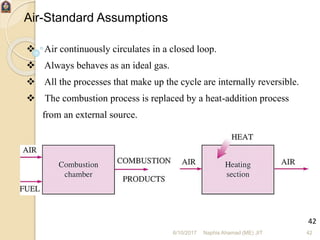
 Air continuously circulates in a closed loop.
 Always behaves as an ideal gas.
 All the processes that make up the cycle are internally reversible.
 The combustion process is replaced by a heat-addition process
from an external source.
42
Air-Standard Assumptions
6/10/2017 Naphis Ahamad (ME) JIT 42
 A heat rejection process that restores the working fluid to its initial
state replaces the exhaust process.
 The cold-air-standard assumptions apply when the working fluid is
air and has constant specific heat evaluated at room temperature
(25o
C or 77o
F).
 No chemical reaction takes place in the engine.
43
Air-Standard Assumptions
6/10/2017 Naphis Ahamad (ME) JIT 43
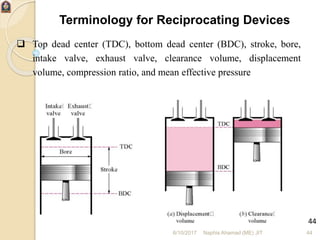
 Top dead center (TDC), bottom dead center (BDC), stroke, bore,
intake valve, exhaust valve, clearance volume, displacement
volume, compression ratio, and mean effective pressure
Terminology for Reciprocating Devices
44
6/10/2017 Naphis Ahamad (ME) JIT 44
 The compression ratio r of an engine
is defined as
r
V
V
V
V
BDC
TDC
 
max
min
 The mean effective pressure (MEP)
is a fictitious pressure that, if it
operated on the piston during the
entire power stroke, would produce
the same amount of net work as that
produced during the actual cycle.
MEP
W
V V
w
v v
net net



max min max min45
6/10/2017 Naphis Ahamad (ME) JIT 45
46
Otto Cycle
The Ideal Cycle for Spark-
Ignition Engines
6/10/2017 Naphis Ahamad (ME) JIT 46
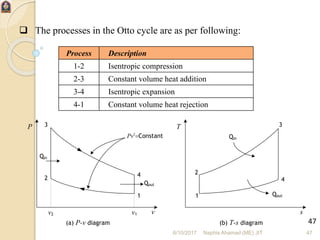
 The processes in the Otto cycle are as per following:
Process Description
1-2 Isentropic compression
2-3 Constant volume heat addition
3-4 Isentropic expansion
4-1 Constant volume heat rejection
1
2
3
4
Qout
Qin
Pvg
Constant
v1v2 v
P
s
T
Qout
Qin
1
2
3
4
(a) P-v diagram (b) T-s diagram 47
6/10/2017 Naphis Ahamad (ME) JIT 47
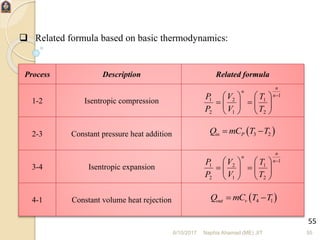
 Related formula based on basic thermodynamics:
Process Description Related formula
1-2 Isentropic compression
2-3 Constant volume heat addition
3-4 Isentropic expansion
4-1 Constant volume heat rejection
1
2
1
1
2
2
1














n
n
n
T
T
V
V
P
P
1
2
1
1
2
2
1














n
n
n
T
T
V
V
P
P
 3 2in vQ mC T T 
 4 1out vQ mC T T 
48
6/10/2017 Naphis Ahamad (ME) JIT 48
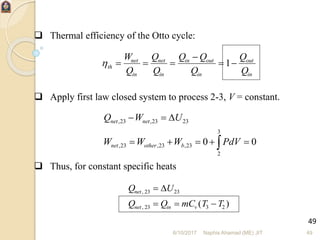
 Thermal efficiency of the Otto cycle:
th
net
in
net
in
in out
in
out
in
W
Q
Q
Q
Q Q
Q
Q
Q
  

 1
 Apply first law closed system to process 2-3, V = constant.
 Thus, for constant specific heats
Q U
Q Q mC T T
net
net in v
,
, ( )
23 23
23 3 2

  

,23 ,23 23
3
,23 ,23 ,23
2
0 0
net net
net other b
Q W U
W W W PdV
  
    
49
6/10/2017 Naphis Ahamad (ME) JIT 49
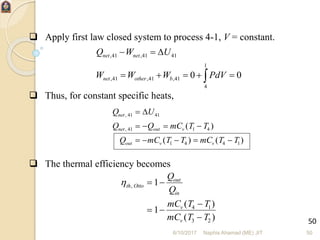
 Apply first law closed system to process 4-1, V = constant.
 Thus, for constant specific heats,
Q U
Q Q mC T T
Q mC T T mC T T
net
net out v
out v v
,
, ( )
( ) ( )
41 41
41 1 4
1 4 4 1

   
    

 The thermal efficiency becomes
th Otto
out
in
v
v
Q
Q
mC T T
mC T T
,
( )
( )
 
 


1
1 4 1
3 2
,41 ,41 41
1
,41 ,41 ,41
4
0 0
net net
net other b
Q W U
W W W PdV
  
    
50
6/10/2017 Naphis Ahamad (ME) JIT 50
th Otto
T T
T T
T T T
T T T
,
( )
( )
( / )
( / )
 


 


1
1
1
1
4 1
3 2
1 4 1
2 3 2
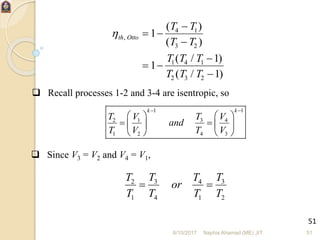
 Recall processes 1-2 and 3-4 are isentropic, so
 Since V3 = V2 and V4 = V1,
3 32 4
1 4 1 2
T TT T
or
T T T T
 
11
32 1 4
1 2 4 3
kk
TT V V
and
T V T V

  
    
   
51
6/10/2017 Naphis Ahamad (ME) JIT 51
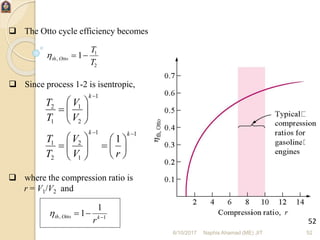
 The Otto cycle efficiency becomes
th Otto
T
T
,  1 1
2
 Since process 1-2 is isentropic,
 where the compression ratio is
r = V1/V2 and
th Otto k
r
,   
1
1
1
1
2 1
1 2
1 1
1 2
2 1
1
k
k k
T V
T V
T V
T V r

 
 
  
 
   
    
  
52
6/10/2017 Naphis Ahamad (ME) JIT 52
 The processes in the Diesel cycle are as per following:
Process Description
1-2 Isentropic compression
2-3
Constant pressure heat addition
3-4 Isentropic expansion
4-1
Constant volume heat rejection
53
Diesel Cycle
6/10/2017 Naphis Ahamad (ME) JIT 53
cv rratiooffCut
v
v
andrrationCompressio
v
v
,,
2
3
2
1

54
Diesel Cycle
6/10/2017 Naphis Ahamad (ME) JIT 54
 Related formula based on basic thermodynamics:
Process Description Related formula
1-2 Isentropic compression
2-3 Constant pressure heat addition
3-4 Isentropic expansion
4-1 Constant volume heat rejection
1
2
1
1
2
2
1














n
n
n
T
T
V
V
P
P
1
2
1
1
2
2
1














n
n
n
T
T
V
V
P
P
 3 2in PQ mC T T 
 4 1out vQ mC T T 
55
6/10/2017 Naphis Ahamad (ME) JIT 55
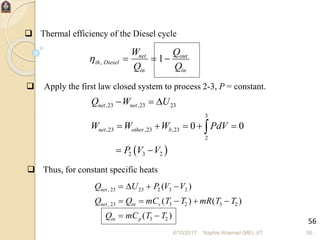
 Thermal efficiency of the Diesel cycle
th Diesel
net
in
out
in
W
Q
Q
Q
,   1
 Apply the first law closed system to process 2-3, P = constant.
 Thus, for constant specific heats
Q U P V V
Q Q mC T T mR T T
Q mC T T
net
net in v
in p
,
,
( )
( ) ( )
( )
23 23 2 3 2
23 3 2 3 2
3 2
  
    
 

 
,23 ,23 23
3
,23 ,23 ,23
2
2 3 2
0 0
net net
net other b
Q W U
W W W PdV
P V V
  
    
 

56
6/10/2017 Naphis Ahamad (ME) JIT 56
 Apply the first law closed system to process 4-1, V = constant
Q U
Q Q mC T T
Q mC T T mC T T
net
net out v
out v v
,
, ( )
( ) ( )
41 41
41 1 4
1 4 4 1

   
    

 Thus, for constant specific heats
 The thermal efficiency becomes
th Diesel
out
in
v
p
Q
Q
mC T T
mC T T
,
( )
( )
 
 


1
1 4 1
3 2
,41 ,41 41
1
,41 ,41 ,41
4
0 0
net net
net other b
Q W U
W W W PdV
  
    
57
6/10/2017 Naphis Ahamad (ME) JIT 57
PV
T
PV
T
V V
T
T
P
P
4 4
4
1 1
1
4 1
4
1
4
1
 

where
 Recall processes 1-2 and 3-4 are isentropic, so
PV PV PV PVk k k k
1 1 2 2 4 4 3 3 and
 Since V4 = V1 and P3 = P2, we divide the second equation by
the first equation and obtain
 Therefore,
34
4 2
k
k
c
VP
r
T V
 
  
 
 , 1
11
1
1
k
c
th Diesel k
c
r
r k r
 

 

58
6/10/2017 Naphis Ahamad (ME) JIT 58
 Dual cycle gives a better approximation to a real engine. The heat addition
process is partly done at a constant volume and partly at constant pressure.
From the P-v diagram, it looks like the heat addition process is a
combination of both Otto and Diesel cycles.
59
Dual Cycle
6/10/2017 Naphis Ahamad (ME) JIT 59
Process Description
1-2 Isentropic compression
2-3 Constant volume heat addition
3-4 Constant pressure heat addition
4-5 Isentropic expansion
5-1 Constant volume heat rejection
 The same procedure as to Otto and Diesel cycles can be applied to Dual
cycle. Upon substitutions, the thermal efficiency of Dual cycle becomes
     1
11
1
1 


 k
vcpp
k
cp
th
rrckr
rr

60
Dual Cycle
6/10/2017 Naphis Ahamad (ME) JIT 60

basics of Internal combution engine

  • 1.
    INTERNAL COMBUTION ENGINE Madeby: Assistant Professor : NAPHIS AHAMAD MECHANICAL ENGINEERING 6/10/2017 Naphis Ahamad (ME) JIT 1
  • 2.
    6/10/2017 Naphis Ahamad(ME) JIT 2 UNIT I
  • 3.
    INTRODUCTION What isIC Engine? An internal combustion engine is a thermal system (power plant) that converts heat obtained from chemical energy sources (gasoline, natural gas) into mechanical work. Where are IC Engines Used? IC engines are used as the propulsion systems for land transport vehicles such as automobiles (cars, etc.), marine vehicles (boats, etc.) and small airplanes. IC engines are also used in portable electrical generators and as prime mover in grass cutting machine, etc.6/10/2017 Naphis Ahamad (ME) JIT 3
  • 4.
    INTRODUCTION 6/10/2017 Naphis Ahamad(ME) JIT 4 Basic Components of IC Engines • Cylinder, piston, inlet valve and exhaust valve. • Piston moves from the top dead center (TDC) to the bottom dead center (BDC). • Clearance volume, Vc is a spacing between the top of the piston and the valve’s heads when the piston is at the end of the delivery stroke. • Swept volume or displacement volume, Vs is the volume between TDC and BDC.
  • 5.
    Classifications: Internal Combustion Engines(IC Engines) External Combustion Engines (EC Engines) Internal Combustion Engines (IC Engines): IC Engines are those in which combustion of fuels take places inside engine cylinder (Example: Petrol, Diesel, GAS) External Combustion Engines (EC Engines): EC Engines are those in which combustion of fuels take places outside engine cylinder (Example: Steam Engine, Steam turbine)6/10/2017 Naphis Ahamad (ME) JIT 5
  • 6.
    Classification of ICEngines: a. According to the cycle of operation Spark ignition engines(Petrol or Constant volume or Otto cycle) Compression ignition engines(Diesel or Constant Pressure) b. According to the type of fuel used Petrol, Diesel, Gas Engine. c. According to the method of fuel SI & CI d. According to the Process of combustion Otto cycle, Diesel cycle, Dual combustion cycle 6/10/2017 Naphis Ahamad (ME) JIT 6
  • 7.
    About Petrol Engine: Apetrol engine (also known as a gasoline engine in North America) is an internal combustion engine with spark-ignition, designed to run on petrol (gasoline). 6/10/2017 Naphis Ahamad (ME) JIT 7
  • 8.
    Working Cycles FourStroke Petrol Engine:  It is also known as Otto cycle or constant volume cycle.  Cycle of operation is completed in 4-strokes of the piston or 2 revolutions of the crankshaft.  Each stroke consists of 180°, of crankshaft rotation and hence a cycle consists of 720°of crankshaft rotation. 2-stroke: 1 power stroke per 1 crankshaft rev 4-stroke: 1 power stroke per 2 crankshaft rev 6/10/2017 Naphis Ahamad (ME) JIT 8
  • 9.
    Principle of Operation: Theseries of operations of an ideal four-stroke SI engine are as follows Suction Stroke or charging stroke Compression Stroke Expansion or Power Stroke or working stroke Exhaust Stroke 6/10/2017 Naphis Ahamad (ME) JIT 9
  • 10.
    Principle of Operation 6/10/2017Naphis Ahamad (ME) JIT 10
  • 11.
    Principle of Operation: StrokeValve Position Suction Stroke Suction Valve open Exhaust Valve closed Compression Stroke Both Valves closed Expansion or Power Stroke Both Valves closed Exhaust Stroke Exhaust Valve open Suction Valve closed 6/10/2017 Naphis Ahamad (ME) JIT 11
  • 12.
    Working Principles ofFour Stroke Diesel Engine: Increased pressure of combustion gases acts on piston -> converted to rotary motion Can be 2 or 4 stroke engines 2-stroke: 1 power stroke per 1 crankshaft rev 4-stroke: 1 power stroke per 2 crankshaft rev Engine stroke: A stroke is a single traverse of the cylinder by the piston (from TDC to BDC) 1 revolution of crankshaft = 2 strokes of piston 6/10/2017 Naphis Ahamad (ME) JIT 12
  • 13.
    Exhaust Suction Compression Ign.-Combn.Expansion Exhaust 6/10/2017 Naphis Ahamad (ME) JIT 13
  • 14.
    Working Principles OfFour Stroke Diesel Engine: Intake stroke Intake valve open, exhaust valve shut Piston travels from TDC to BDC Air drawn in Compression stroke Intake and exhaust valves shut Piston travels from BDC to TDC Temperature and pressure of air increase 6/10/2017 Naphis Ahamad (ME) JIT 14
  • 15.
    Working Principles OfFour Stroke Diesel Engine: Power stroke Intake and exhaust valves shut Fuel injected into cylinder and ignites Piston forced from TDC to BDC Exhaust stroke Intake valve shut, exhaust valve open Piston moves from BDC to TDC Combustion gases expelled 6/10/2017 Naphis Ahamad (ME) JIT 15
  • 16.
    Working Principles OfTwo Stroke Petrol Engine 6/10/2017 Naphis Ahamad (ME) JIT 16
  • 17.
    6/10/2017 Naphis Ahamad(ME) JIT 17 Two Stroke Cycle Petrol Engine Construction : •A piston reciprocates inside the cylinder •It is connected to the crankshaft by means of connecting rod and crank •There are no valves in two stroke engines, instead of valves ports are cut on the cylinder walls. •There are three ports, namely inlet, exhaust and transfer ports. •The closing and opening of the ports are obtained by the movement of piston. The crown of piston is made in to a shape to perform this. •A spark plug is also provided.
  • 18.
    6/10/2017 Naphis Ahamad(ME) JIT 18 Two stroke cycle Petrol Engines - Working • The piston moves up from Bottom Dead Centre (BDC) to Top Dead Centre (TDC) • Both transfer and exhaust ports are covered by the piston. • Air fuel mixture which is transferred already into the engine cylinder is compressed by moving piston. • The pressure and temperature increases • at the end of compression.
  • 19.
    6/10/2017 Naphis Ahamad(ME) JIT 19 Two stroke cycle Petrol Engines - Working First Stroke : (b) Ignition and Inductance: • Piston almost reaches the top dead centre •The air fuel mixture inside the cylinder is ignited by means of an electric spark produced by a spark plug •At the same time, the inlet port is uncovered by the plane. •Fresh air fuel mixture enters the crankcase through the inlet port
  • 20.
    6/10/2017 Naphis Ahamad(ME) JIT 20 Two stroke cycle Petrol Engines - Working (c)Expansion and Crankcase compression •The burning gases expand in the cylinder •The burning gases force the piston to move down. Thus useful work is obtained. •When the piston moves down, the air fuel mixture in the crankcase is partially compressed. This compression is known as Crank case compression.
  • 21.
    6/10/2017 Naphis Ahamad(ME) JIT 21 Two stroke cycle Petrol Engines - Working (d) Exhaust and transfer: •At the end of expansion, exhaust port is uncovered. •Burnt gases escape to the atmosphere. •Transfer port is also opened. The partially compressed air fuel mixture enters the cylinder through the transfer port. •The crown of the piston is made of a deflected shape. So the fresh charge entering the cylinder is deflected upwards in the cylinder. •Thus the escape of fresh charge along with the exhaust gases is reduced
  • 22.
    Compression Intake and exhaustvalves shut Piston travels from BDC to TDC Temperature and pressure of air increase Power stroke Intake and exhaust valves shut Fuel injected into cylinder and ignites Piston forced from TDC to BDC Working Principles Of Two Stroke Diesel Engine 6/10/2017 Naphis Ahamad (ME) JIT 22
  • 23.
    Application Of Fourstroke Cycle Engine Used in heavy vehicles Buses, Lorries, Trucks etc., Application Of Two stroke Cycle Engine Used in light vehicles Bikes, Scooters, Mopeds Ship propulsion 6/10/2017 Naphis Ahamad (ME) JIT 23
  • 24.
    Application Of Fourstroke Petrol Engine Buses ,Trucks Mobile electric generating sets. Small pumping sets with side cars Application Of Four stroke Diesel Engine 30kw-Tractors 40to 100kw – jeeps, buses and trucks 200 to 400kw-Earthmoving m/c 100 to 35000kw-Marine application 6/10/2017 Naphis Ahamad (ME) JIT 24
  • 25.
    6/10/2017 Naphis Ahamad(ME) JIT 25 I.C ENGINE TERMINOLGY
  • 26.
    6/10/2017 Naphis Ahamad(ME) JIT 26 standard terms used in I.C Engines are 1. Bore: Inside diameter of the cylinder is termed as Bore and it is designated by the letter d and is usually expressed in millimeter (mm) 2. Top Dead Center (TDC): The extreme position reached by the piston at the top of the cylinder in the vertical engine is called Top Dead center. It is also called the Inner dead centre (IDC). 3. Bottom Dead Center (BDC): The extreme position reached by the piston at the Bottom of the cylinder in the vertical engine is called Bottom Dead center. It is also called the Outer dead centre (ODC).
  • 27.
    6/10/2017 Naphis Ahamad(ME) JIT 27 5. Compression ratio (r): It is the ratio of Maximum cylinder volume to the Clearance volume. 6. Cylinder volume (v): It is the sum of swept volume and the Clearance volume. V = Vs + Vc 7. Displacement (or)Swept volume (Vs): It is the volume of space generated by the movement of piston from one dead center to another dead center. It is expressed in terms of cubic centimeter (cc) and given by VS = A * L =  * d2 * L / 4 8. Clearance Volume( Vc): It is the space in the cylinder, when the piston is at Top Dead Center It is designated as VC and expressed in cubic centimeter (cc).
  • 28.
    Comparison of Petroland Diesel Engines Petrol Engines  A petrol engine draws a mixture of petrol and air during suction stroke.  The carburetor is employed to mix air and petrol in the required proportion and to supply it to the engine during suction stroke.  Pressure at the end of compression is about 10 bar.  The charge (i.e. petrol and air mixture) is ignited with the help of spark plug. Diesel Engines  A diesel engine draws only air during suction stroke.  The injector or atomizer is employed to inject the fuel at the end of combustion stroke.  Pressure at the end of compression is about 35 bar.  The fuel is injected in the form of fine spray. The temperature of the compressed air is sufficiently high to ignite the fuel. 6/10/2017 Naphis Ahamad (ME) JIT 28
  • 29.
    Comparison of Petroland Diesel Engines (contd..)  The maintenance cost is less.  The thermal efficiency is about 26%.  Overheating trouble is more due to low thermal efficiency.  These are high speed engines.  The petrol engines are generally employed in light duty vehicle such as scooters, motorcycles and cars. These are also used in aeroplanes.  The maintenance cost is more.  The thermal efficiency is about 40%.  Overheating trouble is less due to high thermal efficiency.  These are relatively low speed engines.  The diesel engines are generally employed in heavy duty vehicles like buses, trucks, and earth moving machines. 6/10/2017 Naphis Ahamad (ME) JIT 29
  • 30.
    VALVE TIMING DIAGRAM AValve timing diagram is a graphical representation of the exact moments, in the sequence of operations, at which the two valves(i.e. inlet & exhaust valves) open and close as well as firing of fuel. It is, generally, expressed in terms of angular positions of the crankshaft. THEORETICAL VALVE TIMING DIAGRAM FOR FOUR STROKE CYCLE DIESEL ENGINE 6/10/2017 Naphis Ahamad (ME) JIT 30
  • 31.
    The theoretical valvetiming diagram for a four stroke cycle engine is shown in this fig. In this diagram, the inlet valve opens at A and the suction takes place from A to B. The crankshaft revolves through 180 degree and the piston moves from T.D.C. to B.D.C. At B, the inlet valve closes and the compression takes place from B to C. The crankshaft revolves through 180 degree and the piston moves from B.D.C. to T.D.C. At C, the fuel is fired and the expansion takes place from C to D. the crankshaft revolves through 180 deg. And the piston again moves from T.D.C. to B.D.C. At D, the exhaust valve opens and the exhaust takes place from D to E. The crankshaft again revolves through 180 deg. And the piston moves back to T.D.C. 6/10/2017 Naphis Ahamad (ME) JIT 31
  • 32.
    ACTUAL VALVE TIMINGDIAGRAM FOR FOUR STROKE CYCLE DIESEL ENGINE 6/10/2017 Naphis Ahamad (ME) JIT 32
  • 33.
    As we seenin the theoretical valve timing diagram, the valves open and close at the dead centre position of the piston. But, in actual practice they do not open and close instantaneously at dead centres. The valve operates some degrees before or after the dead centres. The ignition also occurs a little before the top dead centre. The valve timing diagram shown is the actual valve timing diagram, where we see that the inlet valve opens before the piston reaches T.D.C. or in other words while the piston is moving up before the beginning of the suction stroke. Now the piston reaches the T.D.C. and the suction stroke starts. The piston reaches the B.D.C. and then starts moving up. The inlet valve closes, when the crank has moved a little beyond the B.D.C. This is done as the incoming air continues to flow into the cylinder although the piston is moving upwards from B.D.C. Now the air is compressed with both valves closed. Fuel valve 6/10/2017 Naphis Ahamad (ME) JIT 33
  • 34.
    opens a littlebefore the piston reaches the T.D.C. Now the fuel is injected in the form of very fine spray, into the engine cylinder, which gets ignited due to high temperature of the compressed air. The fuel valve closes after the piston has come down a little from the TDC. This is done as the required quantity of the fuel is injected into the engine cylinder. the burnt gases (under high pressure and temperature) push the piston downwards, and the expansion or working stroke takes place. Now the exhaust valves opens before the piston again reaches B.D.C. and the burnt gases start leaving the engine cylinder. Now the piston reaches B.D.C. and then starts moving up thus performing the exhaust stroke. The inlet valve opens before the piston reaches T.D.C. to start suction stroke. This is done as the fresh air helps in pushing out the burnt gases. Now the piston again reaches T.D.C. and the suction starts. The exhaust valve closes when the crank has moved a little beyond6/10/2017 Naphis Ahamad (ME) JIT 34
  • 35.
    THEORETICAL VALVE TIMINGDIAGRAM FOR TWO STROKE CYCLE DIESEL ENGINE done as the burnt gases continue to leave the engine cylinder although the piston is moving downwards. 6/10/2017 Naphis Ahamad (ME) JIT 35
  • 36.
    The theoretical valvetiming diagram for a two stroke cycle engine is shown in fig. In this diagram, the fuel is fired at A and the expansion of gases takes place from A to B. the crankshaft revolves through approximately 120 deg. and the piston moves from T.D.C. towards B.D.C. At B, both the valves open and suction as well as exhaust take place from B to C. At B, both the valves open and suction as well as exhaust takes place from B to C. The crankshaft revolves through approximately 120 deg. and the piston moves first to BDC and then little upwards. At C, both the valves close and compression takes place from C to A. The crankshaft revolves through approximately 120 deg. and the piston moves to B.D.C. 6/10/2017 Naphis Ahamad (ME) JIT 36
  • 37.
    ACTUAL VALVE TIMINGDIAGRAM FOR TWO STROKE CYCLE DIESEL ENGINE 6/10/2017 Naphis Ahamad (ME) JIT 37
  • 38.
    As like asfour stroke cycle engine, the actual valve timing diagram of two stroke cycle engine is also different from it’s theoretical valve timing diagram. The actual valve timing diagram of two stroke cycle engine is shown in fig. As we see that the expansion of the charge (after ignition) starts as the piston moves T.D.C. towards B.D.C. First of all, the exhaust port opens before the piston reaches B.D.C. and the burnt gases start leaving the cylinder. After a small fraction of the crank revolution, the transfer port also opens and the fresh air enters into the engine cylinder. This is done as the fresh incoming air helps in pushing out the burnt gases. Now the piston reaches B.D.C. and then starts moving upwards. As the crank moves a little beyond B.D.C. first the transfer port closes and then the exhaust port also closes. This is done to suck fresh air through the transfer port and to exhaust the burnt gases 6/10/2017 Naphis Ahamad (ME) JIT 38
  • 39.
    exhaust port simultaneously.Now the charge is compressed with both the ports closed. Fuel valve opens a little before the piston reaches the T.D.C. Now the fuel is injected in the form of very fine spray into the engine cylinder, which gets ignited due to high temperature of the compressed air. The fuel valve closes after the piston has come down a little from the T.D.C. This is done as the required quantity of fuel is injected into the engine cylinder. Now the burnt gases (under high pressure and temperature) push the piston downwards with full force and expansion of the gases takes place. It may be noted that in a two stroke cycle diesel engine, like two stroke petrol engine, the exhaust and transfer ports open and close at equal angles on either side of the B.D.C. position. 6/10/2017 Naphis Ahamad (ME) JIT 39
  • 40.
    th net in W Q  th Carnot L H T T , 1 Upon derivation the performance of the real cycle is often measured in terms of its thermal efficiency The Carnot cycle was introduced as the most efficient heat engine that operate between two fixed temperatures TH and TL. The thermal efficiency of Carnot cycle is given by 40 Carnot Cycle 6/10/2017 Naphis Ahamad (ME) JIT 40
  • 41.
    The ideal gasequation is defined as mRTPVorRTPv  where P = pressure in kPa v = specific volume in m3/kg (or V = volume in m3) R = ideal gas constant in kJ/kg.K m = mass in kg T = temperature in K 41 41 6/10/2017 Naphis Ahamad (ME) JIT 41
  • 42.
     Air continuouslycirculates in a closed loop.  Always behaves as an ideal gas.  All the processes that make up the cycle are internally reversible.  The combustion process is replaced by a heat-addition process from an external source. 42 Air-Standard Assumptions 6/10/2017 Naphis Ahamad (ME) JIT 42
  • 43.
     A heatrejection process that restores the working fluid to its initial state replaces the exhaust process.  The cold-air-standard assumptions apply when the working fluid is air and has constant specific heat evaluated at room temperature (25o C or 77o F).  No chemical reaction takes place in the engine. 43 Air-Standard Assumptions 6/10/2017 Naphis Ahamad (ME) JIT 43
  • 44.
     Top deadcenter (TDC), bottom dead center (BDC), stroke, bore, intake valve, exhaust valve, clearance volume, displacement volume, compression ratio, and mean effective pressure Terminology for Reciprocating Devices 44 6/10/2017 Naphis Ahamad (ME) JIT 44
  • 45.
     The compressionratio r of an engine is defined as r V V V V BDC TDC   max min  The mean effective pressure (MEP) is a fictitious pressure that, if it operated on the piston during the entire power stroke, would produce the same amount of net work as that produced during the actual cycle. MEP W V V w v v net net    max min max min45 6/10/2017 Naphis Ahamad (ME) JIT 45
  • 46.
    46 Otto Cycle The IdealCycle for Spark- Ignition Engines 6/10/2017 Naphis Ahamad (ME) JIT 46
  • 47.
     The processesin the Otto cycle are as per following: Process Description 1-2 Isentropic compression 2-3 Constant volume heat addition 3-4 Isentropic expansion 4-1 Constant volume heat rejection 1 2 3 4 Qout Qin Pvg Constant v1v2 v P s T Qout Qin 1 2 3 4 (a) P-v diagram (b) T-s diagram 47 6/10/2017 Naphis Ahamad (ME) JIT 47
  • 48.
     Related formulabased on basic thermodynamics: Process Description Related formula 1-2 Isentropic compression 2-3 Constant volume heat addition 3-4 Isentropic expansion 4-1 Constant volume heat rejection 1 2 1 1 2 2 1               n n n T T V V P P 1 2 1 1 2 2 1               n n n T T V V P P  3 2in vQ mC T T   4 1out vQ mC T T  48 6/10/2017 Naphis Ahamad (ME) JIT 48
  • 49.
     Thermal efficiencyof the Otto cycle: th net in net in in out in out in W Q Q Q Q Q Q Q Q      1  Apply first law closed system to process 2-3, V = constant.  Thus, for constant specific heats Q U Q Q mC T T net net in v , , ( ) 23 23 23 3 2      ,23 ,23 23 3 ,23 ,23 ,23 2 0 0 net net net other b Q W U W W W PdV         49 6/10/2017 Naphis Ahamad (ME) JIT 49
  • 50.
     Apply firstlaw closed system to process 4-1, V = constant.  Thus, for constant specific heats, Q U Q Q mC T T Q mC T T mC T T net net out v out v v , , ( ) ( ) ( ) 41 41 41 1 4 1 4 4 1             The thermal efficiency becomes th Otto out in v v Q Q mC T T mC T T , ( ) ( )       1 1 4 1 3 2 ,41 ,41 41 1 ,41 ,41 ,41 4 0 0 net net net other b Q W U W W W PdV         50 6/10/2017 Naphis Ahamad (ME) JIT 50
  • 51.
    th Otto T T TT T T T T T T , ( ) ( ) ( / ) ( / )         1 1 1 1 4 1 3 2 1 4 1 2 3 2  Recall processes 1-2 and 3-4 are isentropic, so  Since V3 = V2 and V4 = V1, 3 32 4 1 4 1 2 T TT T or T T T T   11 32 1 4 1 2 4 3 kk TT V V and T V T V              51 6/10/2017 Naphis Ahamad (ME) JIT 51
  • 52.
     The Ottocycle efficiency becomes th Otto T T ,  1 1 2  Since process 1-2 is isentropic,  where the compression ratio is r = V1/V2 and th Otto k r ,    1 1 1 1 2 1 1 2 1 1 1 2 2 1 1 k k k T V T V T V T V r                       52 6/10/2017 Naphis Ahamad (ME) JIT 52
  • 53.
     The processesin the Diesel cycle are as per following: Process Description 1-2 Isentropic compression 2-3 Constant pressure heat addition 3-4 Isentropic expansion 4-1 Constant volume heat rejection 53 Diesel Cycle 6/10/2017 Naphis Ahamad (ME) JIT 53
  • 54.
  • 55.
     Related formulabased on basic thermodynamics: Process Description Related formula 1-2 Isentropic compression 2-3 Constant pressure heat addition 3-4 Isentropic expansion 4-1 Constant volume heat rejection 1 2 1 1 2 2 1               n n n T T V V P P 1 2 1 1 2 2 1               n n n T T V V P P  3 2in PQ mC T T   4 1out vQ mC T T  55 6/10/2017 Naphis Ahamad (ME) JIT 55
  • 56.
     Thermal efficiencyof the Diesel cycle th Diesel net in out in W Q Q Q ,   1  Apply the first law closed system to process 2-3, P = constant.  Thus, for constant specific heats Q U P V V Q Q mC T T mR T T Q mC T T net net in v in p , , ( ) ( ) ( ) ( ) 23 23 2 3 2 23 3 2 3 2 3 2              ,23 ,23 23 3 ,23 ,23 ,23 2 2 3 2 0 0 net net net other b Q W U W W W PdV P V V            56 6/10/2017 Naphis Ahamad (ME) JIT 56
  • 57.
     Apply thefirst law closed system to process 4-1, V = constant Q U Q Q mC T T Q mC T T mC T T net net out v out v v , , ( ) ( ) ( ) 41 41 41 1 4 1 4 4 1             Thus, for constant specific heats  The thermal efficiency becomes th Diesel out in v p Q Q mC T T mC T T , ( ) ( )       1 1 4 1 3 2 ,41 ,41 41 1 ,41 ,41 ,41 4 0 0 net net net other b Q W U W W W PdV         57 6/10/2017 Naphis Ahamad (ME) JIT 57
  • 58.
    PV T PV T V V T T P P 4 4 4 11 1 4 1 4 1 4 1    where  Recall processes 1-2 and 3-4 are isentropic, so PV PV PV PVk k k k 1 1 2 2 4 4 3 3 and  Since V4 = V1 and P3 = P2, we divide the second equation by the first equation and obtain  Therefore, 34 4 2 k k c VP r T V         , 1 11 1 1 k c th Diesel k c r r k r       58 6/10/2017 Naphis Ahamad (ME) JIT 58
  • 59.
     Dual cyclegives a better approximation to a real engine. The heat addition process is partly done at a constant volume and partly at constant pressure. From the P-v diagram, it looks like the heat addition process is a combination of both Otto and Diesel cycles. 59 Dual Cycle 6/10/2017 Naphis Ahamad (ME) JIT 59
  • 60.
    Process Description 1-2 Isentropiccompression 2-3 Constant volume heat addition 3-4 Constant pressure heat addition 4-5 Isentropic expansion 5-1 Constant volume heat rejection  The same procedure as to Otto and Diesel cycles can be applied to Dual cycle. Upon substitutions, the thermal efficiency of Dual cycle becomes      1 11 1 1     k vcpp k cp th rrckr rr  60 Dual Cycle 6/10/2017 Naphis Ahamad (ME) JIT 60