A SEMINAR REPORT ON
INTRODUCTION
TO
CARBURETOR
CARBURETOR
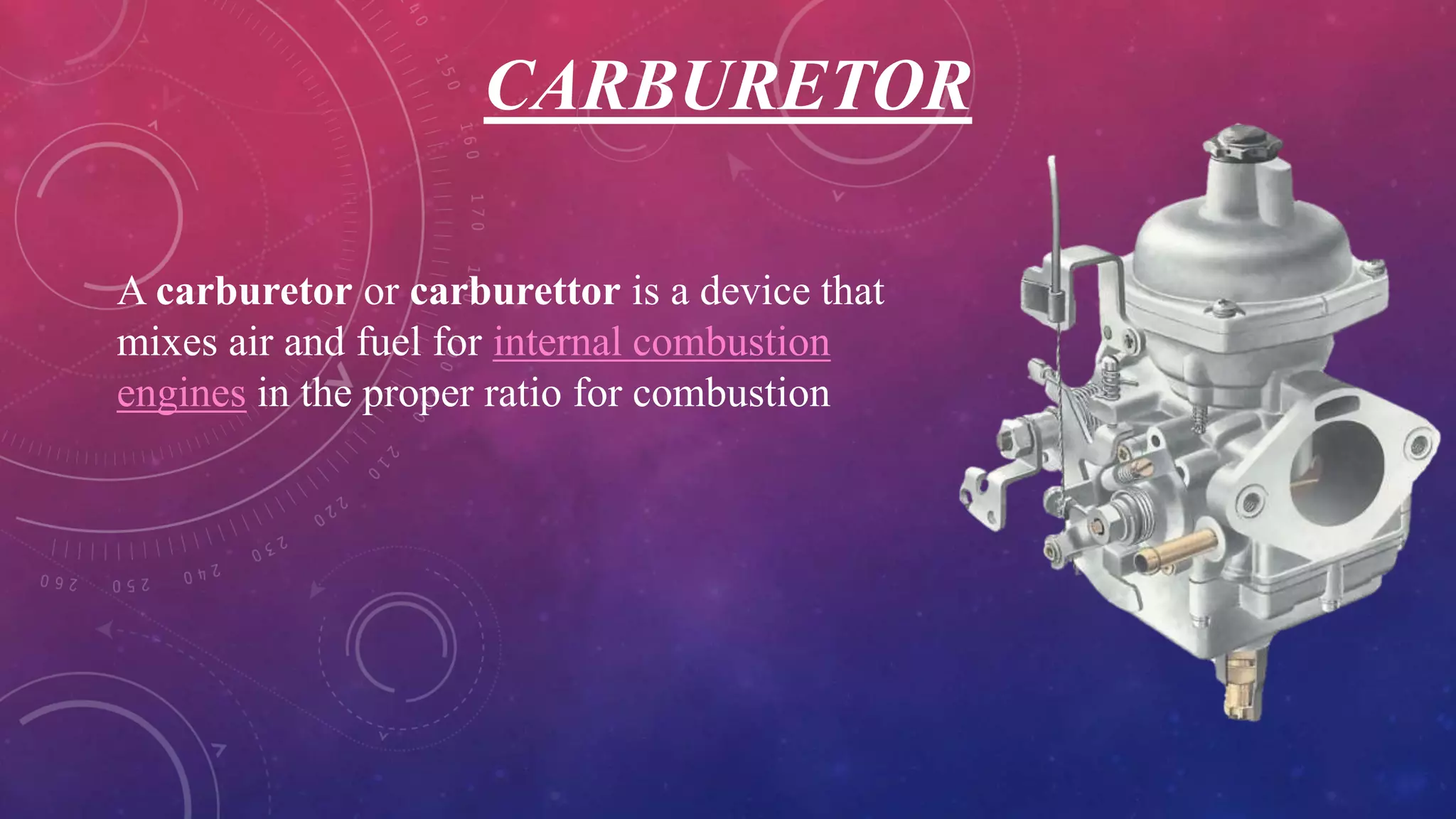
A carburetor or carburettor is a device that
mixes air and fuel for internal combustion
engines in the proper ratio for combustion
THE MAIN COMPONENTS OF A
CARBURETOR
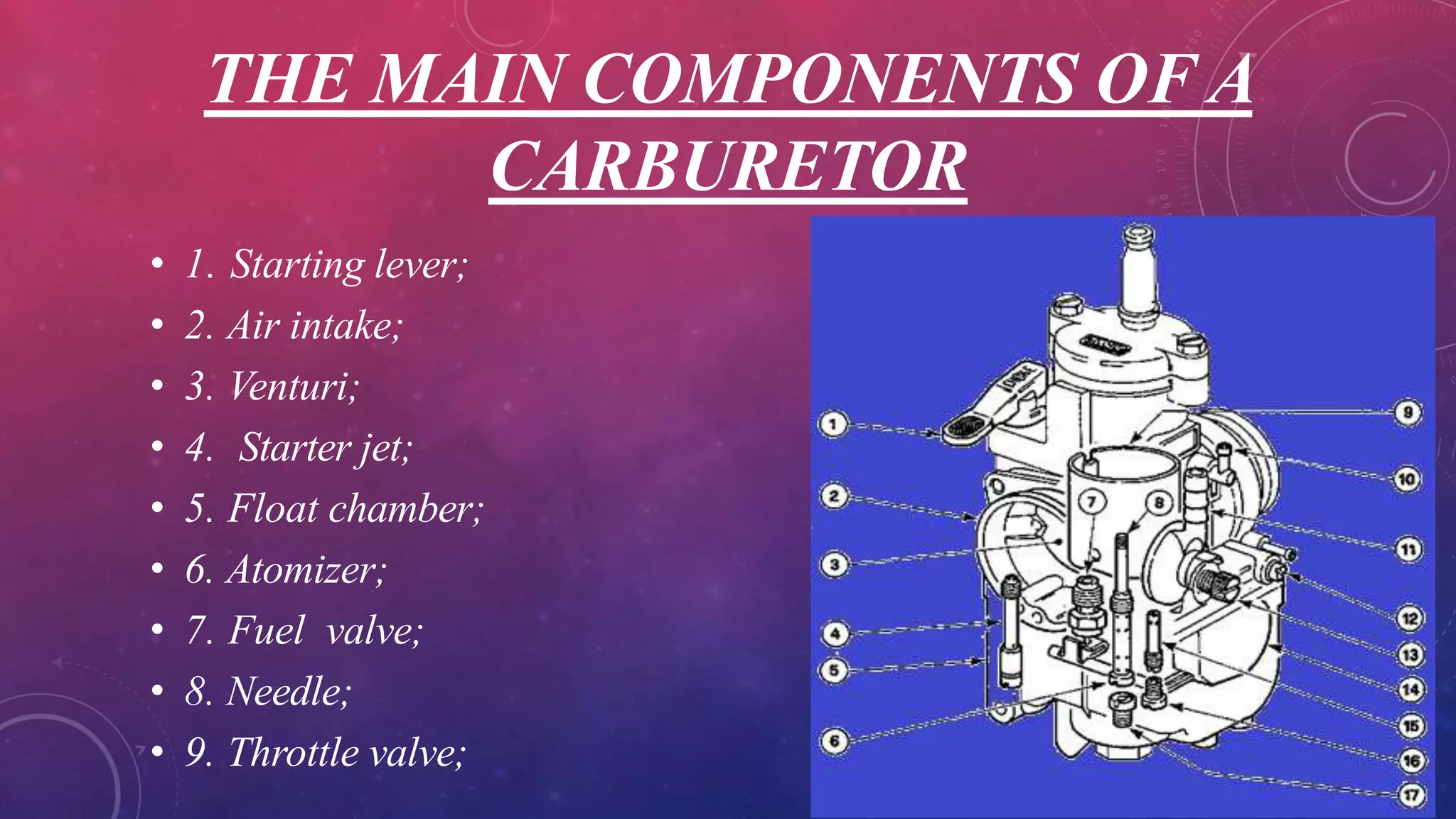
• 1. Starting lever;
• 2. Air intake;
• 3. Venturi;
• 4. Starter jet;
• 5. Float chamber;
• 6. Atomizer;
• 7. Fuel valve;
• 8. Needle;
• 9. Throttle valve;
THE MAIN COMPONENTS OF A
CARBURETOR
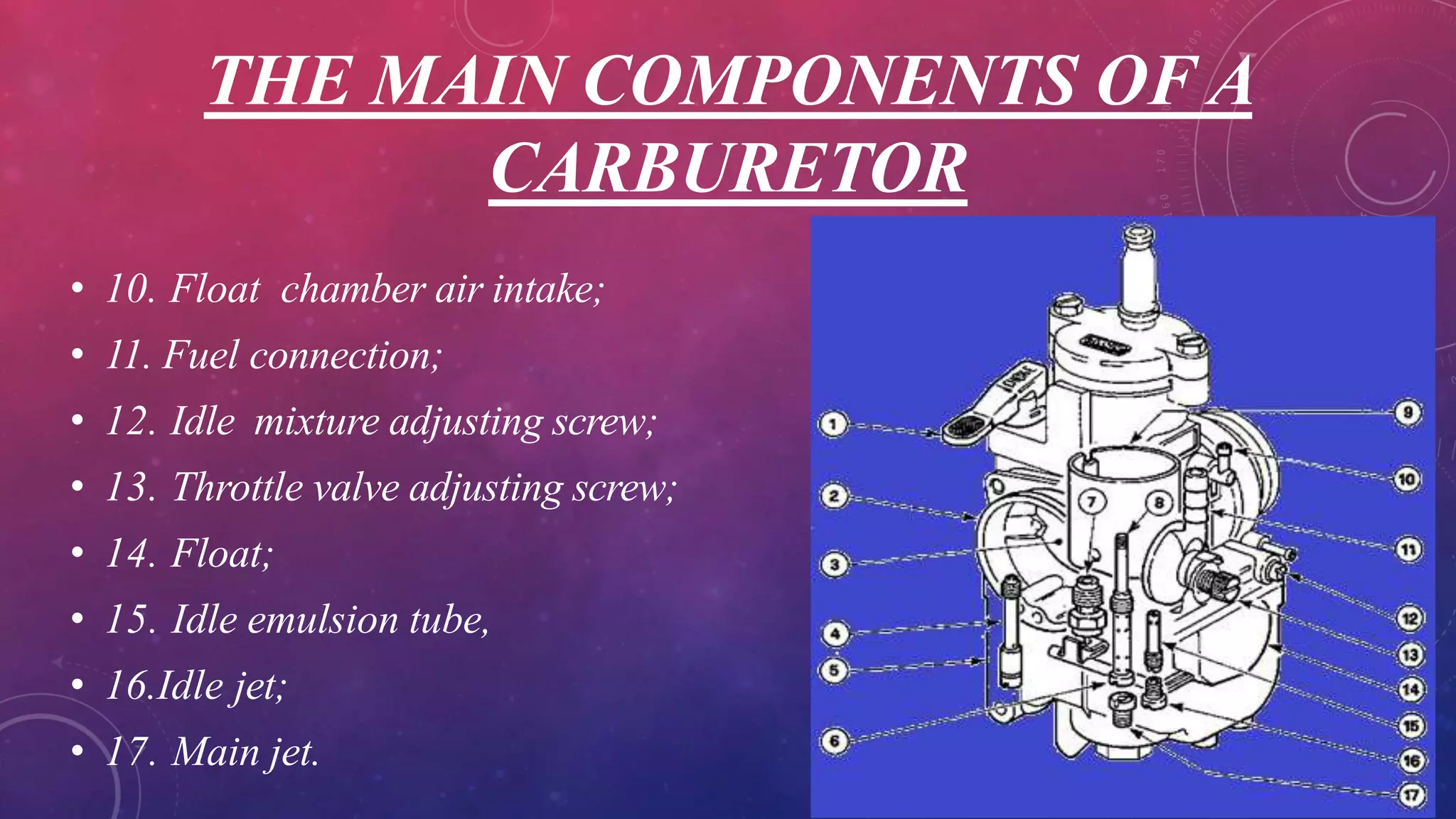
• 10. Float chamber air intake;
• 11. Fuel connection;
• 12. Idle mixture adjusting screw;
• 13. Throttle valve adjusting screw;
• 14. Float;
• 15. Idle emulsion tube,
• 16.Idle jet;
• 17. Main jet.
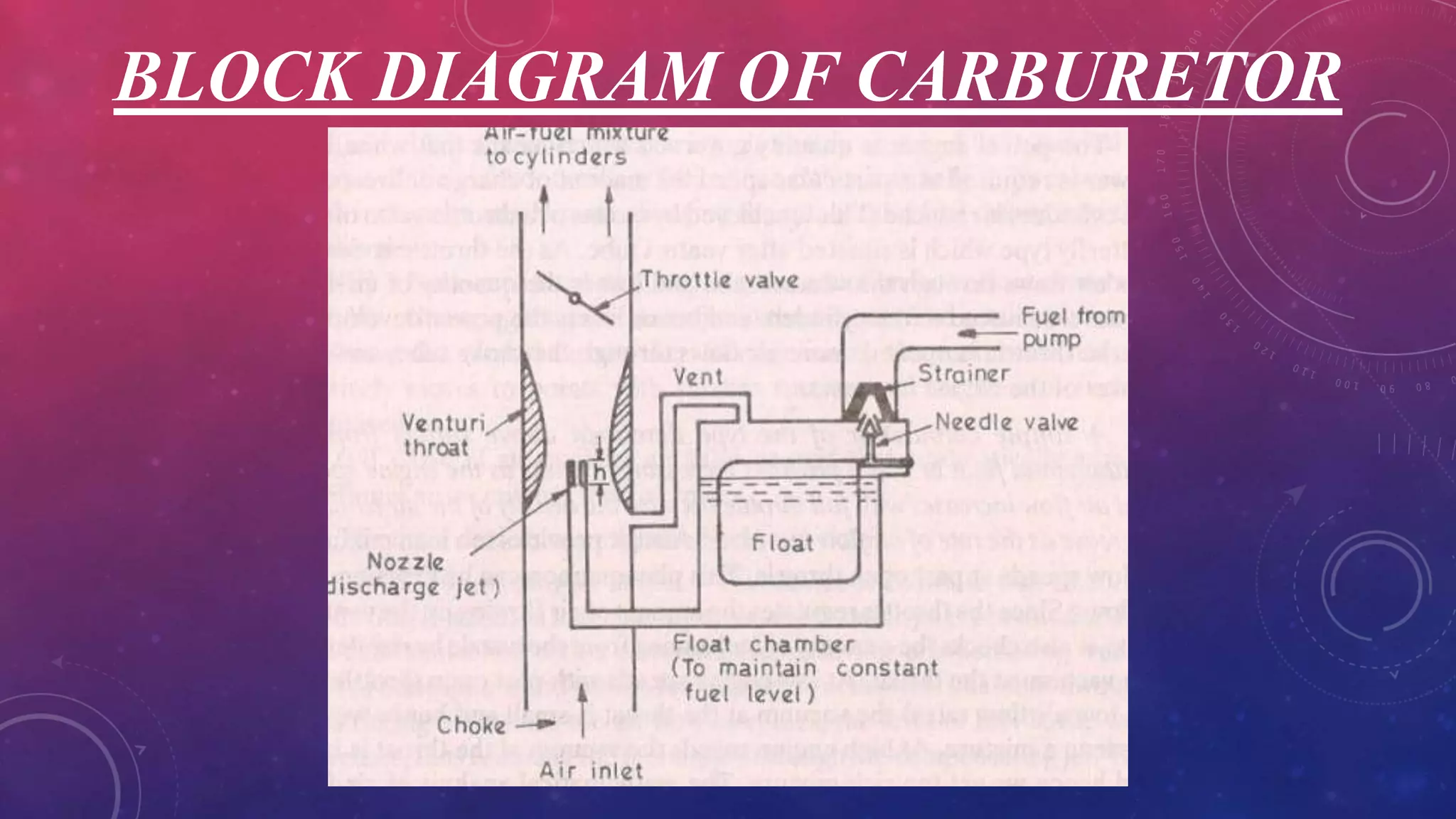
BLOCK DIAGRAM OF CARBURETOR
FUNCTION OF CARBURETOR
Functions of it include,
A. Setting the ratio of air and fuel mixture.
B. Making the mixture into the mist.
C. Increase or decrease the amount of the mixture according to
engine speed and load changing
BASIC FORMS OF CARBURETORS
There are three general types of carburetors depending on the
direction of flow of air.
1. UP DRAUGHT CARBURETOR
2. DOWNDRAUGHT CARBURETOR
3. HORIZONTAL CARBURETOR
UP DRAUGHT CARBURETOR
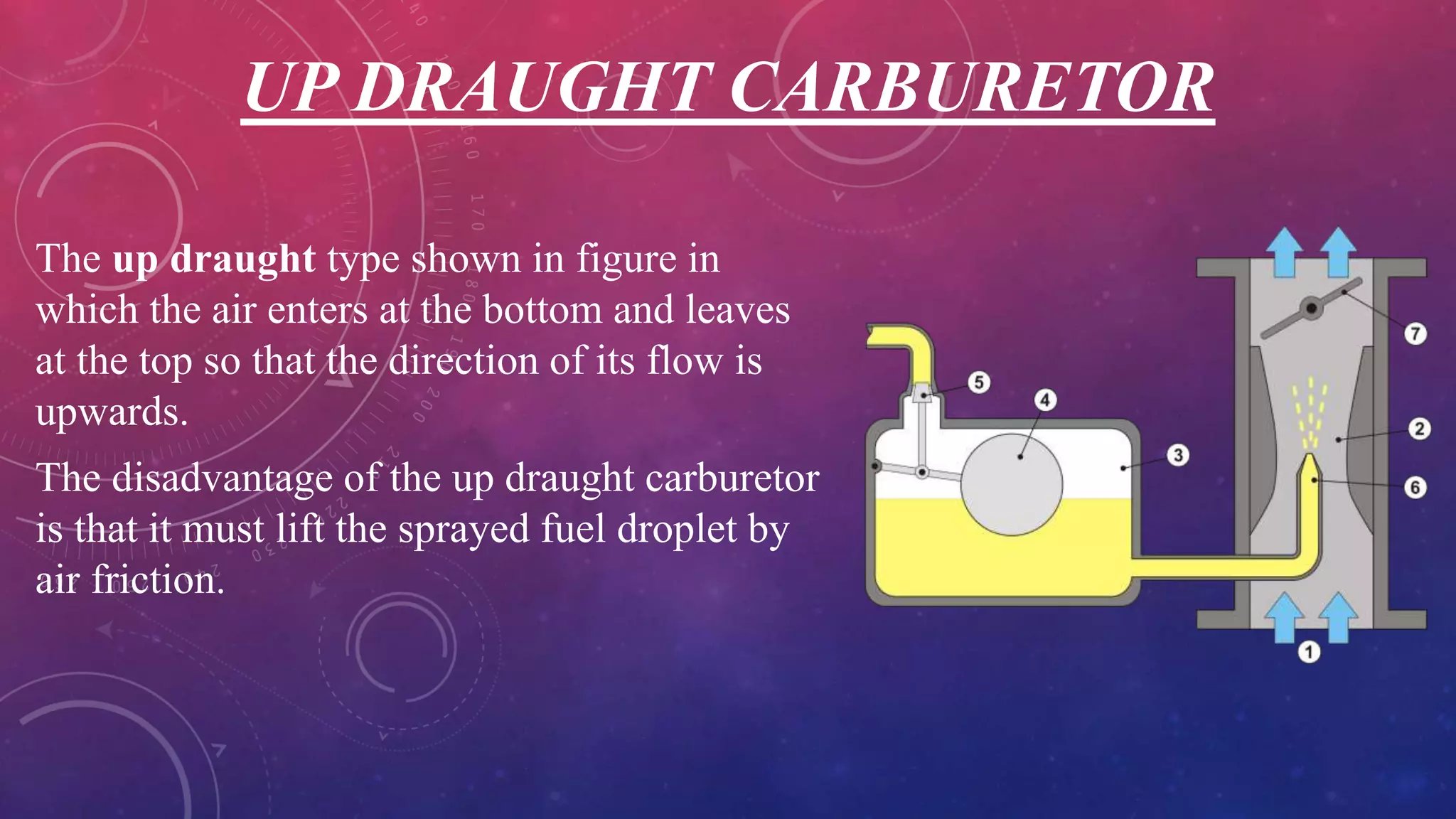
The up draught type shown in figure in
which the air enters at the bottom and leaves
at the top so that the direction of its flow is
upwards.
The disadvantage of the up draught carburetor
is that it must lift the sprayed fuel droplet by
air friction.
DOWNDRAUGHT CARBURETOR
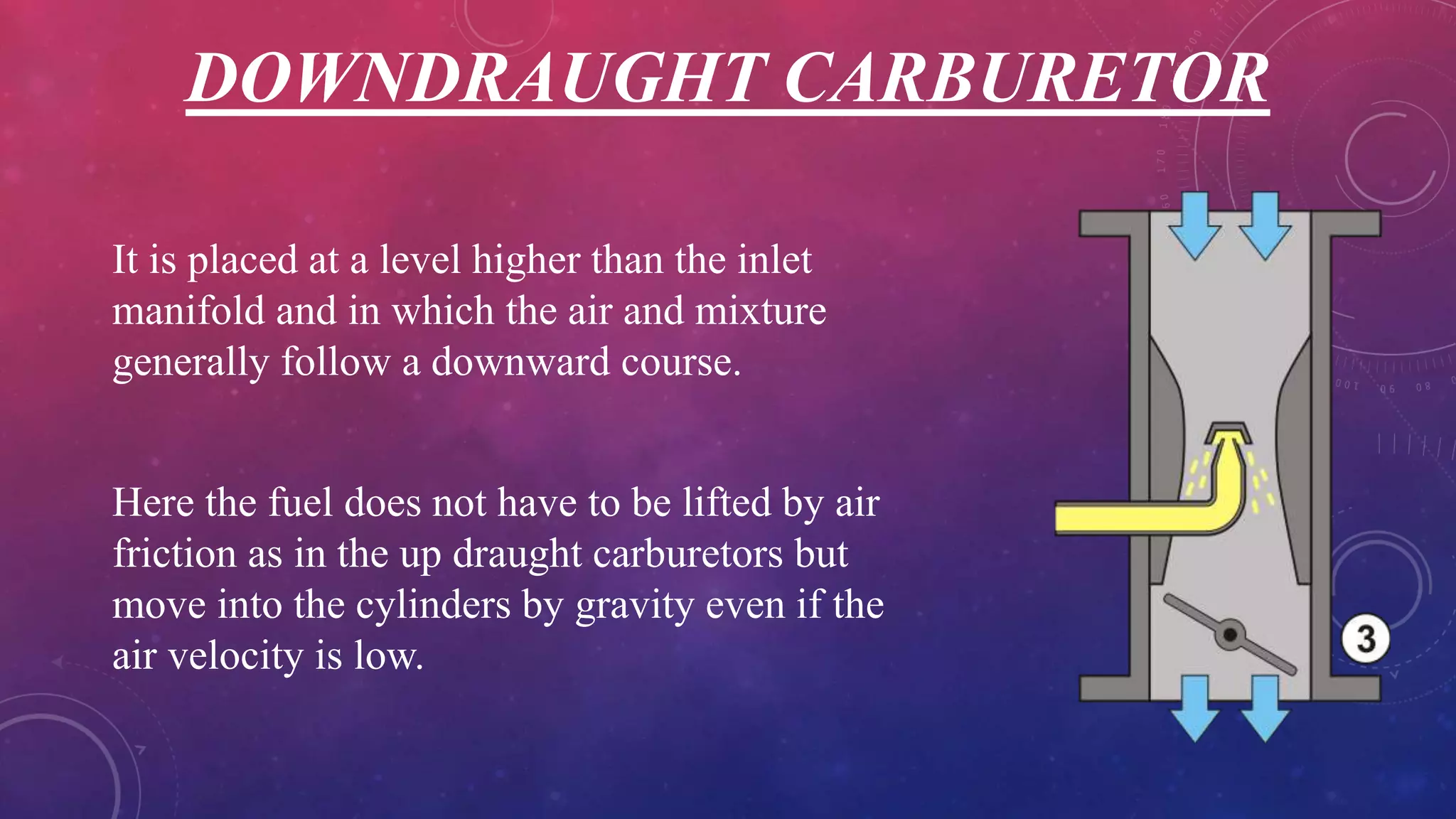
It is placed at a level higher than the inlet
manifold and in which the air and mixture
generally follow a downward course.
Here the fuel does not have to be lifted by air
friction as in the up draught carburetors but
move into the cylinders by gravity even if the
air velocity is low.
HORIZONTAL CARBURETOR
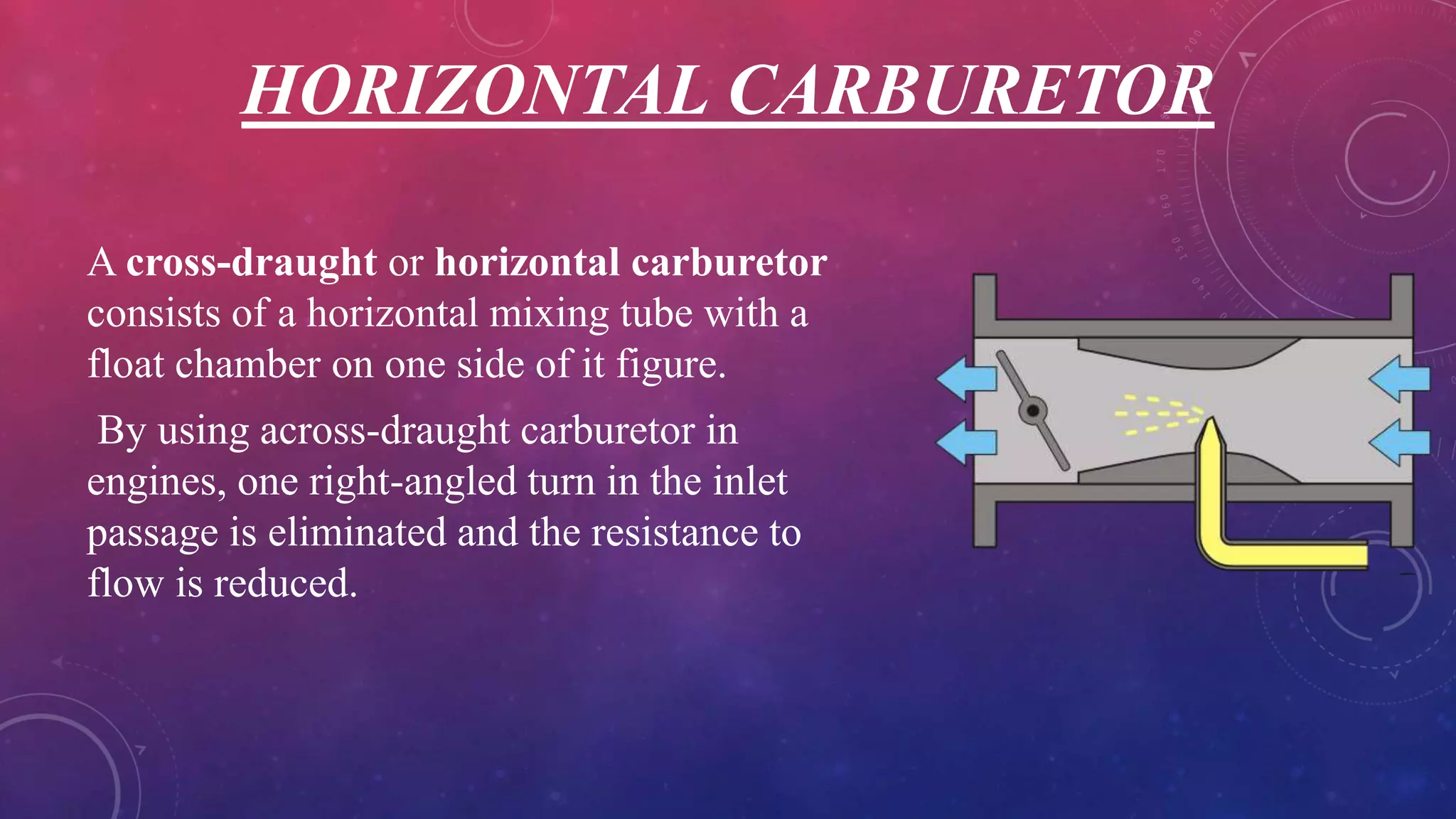
A cross-draught or horizontal carburetor
consists of a horizontal mixing tube with a
float chamber on one side of it figure.
By using across-draught carburetor in
engines, one right-angled turn in the inlet
passage is eliminated and the resistance to
flow is reduced.
CONSTANT CHOKE CARBURETOR
• Air and fuel flow area are
always maintained constant.
• But the depression or
difference which causes the
flow of fuel and air to be
maintained as per demand.
• The solex and Zenith
carburetors belong to these
class.
CONSTANT VACUUM CARBURETOR
• Its called variable choke
carburetor.
• Air and fuel flow areas are
varied as per demand, vacuum
is constant always same.
• The S.U and Carter carburetors
belong to this class.
MULTIPLE VENTURE CARBURETOR
• The boost venture is located concentrically within the main
venture.
• The discharge edge of the boost venture is located at the throat
of the main venture.
• Only fraction of air passes through boost venture.
• This result following:
• High depression is created at the region of nozzle.
• At boost venture throat velocity of air is as high as 200 m/s
• Excellent low speed full throttle operation is possible.
• More efficient mixing of the air and fuel is obtained without
incurring an avveptable reduction in volumetric efficiency.
MULTIJET CARBURETORS
• A single barrel carburetor has only one
barrel, whereas a dual carburetor has two
barrels.
• Each of these two barrels has different
fuel jet, choke, throttle, idling system etc.
• Passenger cars with six or more cylinders
are provided with dual carburetors.
• Each venture supplies the air-fuel
mixture to half of cylinders.
DIFFERENT MODERN CARBURETORS
There are mainly two type of carburetors.
• Open choke
• Vacuum type.
S.V carburetor are constant venture type.
Zenith, solex, carter and Stromberg
carburetors are constant venture type.
TYPES OF DIFFERENT MODERN
CARBURETORS
• Zenith Carburetor
• Solex Carburetor
• Carter Carburetor
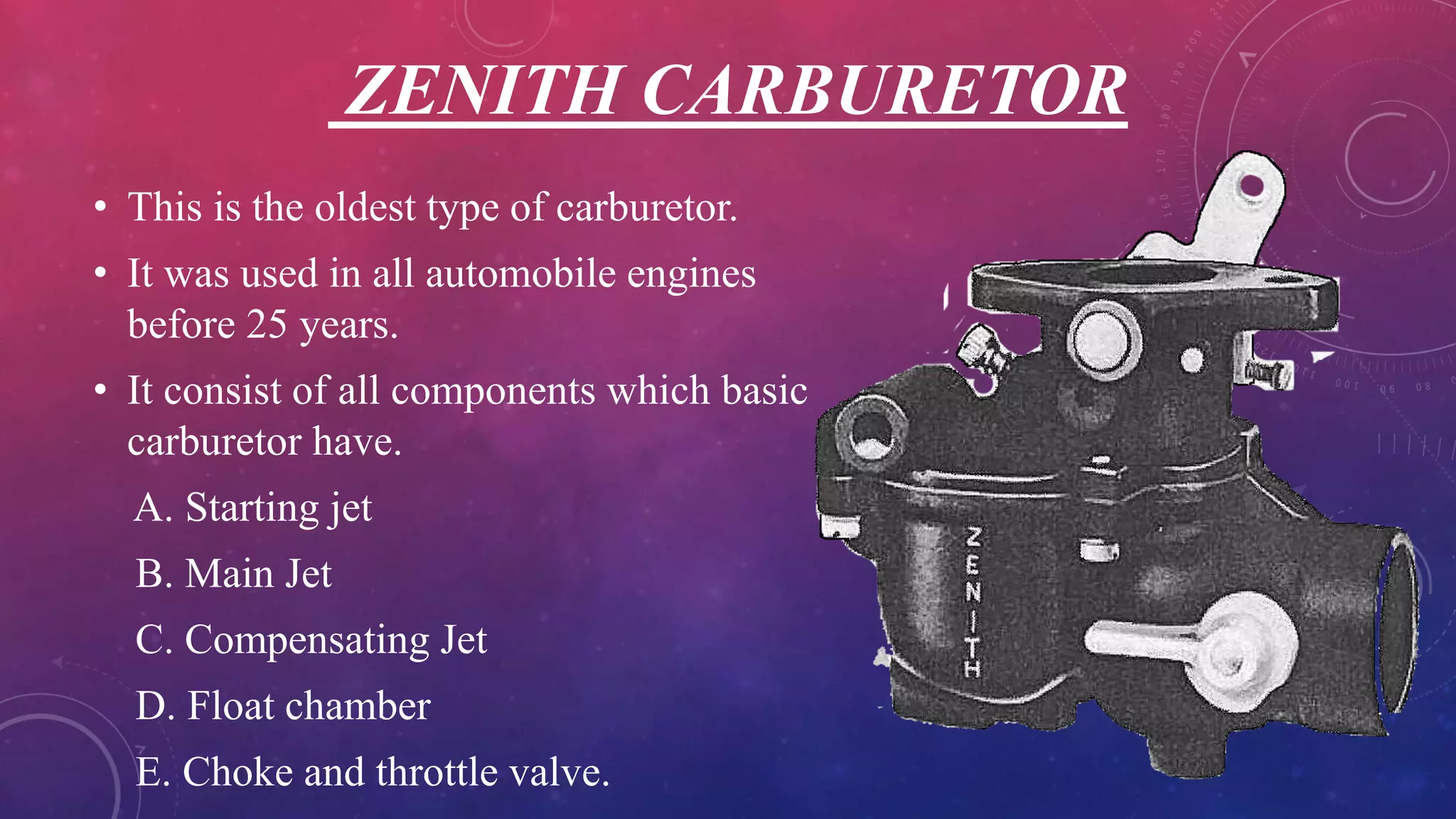
ZENITH CARBURETOR
• This is the oldest type of carburetor.
• It was used in all automobile engines
before 25 years.
• It consist of all components which basic
carburetor have.
A. Starting jet
B. Main Jet
C. Compensating Jet
D. Float chamber
E. Choke and throttle valve.
SOLEX CARBURETOR
• This is most common type of carburetor used
in Fiat and Standard cars.
• It is famous for good and easy starting
• Performance and reliability.
• Its also runs on starting jet for starting
purpose.
• In addition it contains starting jet,
compensating jet and accelerating jet.
CARTER CARBURETOR
• It was founded by William Carter.
• Carter Carburetor Company in was
established in 1909, and ceased
operation in 1985.
• A carter carburetor is an American make
carburettor and is used in jeeps. It is a
standard equipment on chevorolet and
Pontiac series of cars.
ADVANTAGES OF CARBURETOR
• Carburetor parts are not expensive as that of fuel injectors, especially EFI,
which would give you large savings.
• With the use of carburetor you get more air and fuel mixture.
• In terms of road test, carburetors have more power and precision.
• Carburetors are not restricted by the amount of gas pumped from the fuel tank
which means that cylinders may pull more fuel through the carburetor that
would lead to denser mixture in the chamber and greater power as well.
DISADVANTAGES OF CARBURETOR
• At a very low speed, the mixture supplied by a carburetor is so weak that it
will not ignite properly and for its enrichment, at such conditions some
arrangement in the carburetor is required.
• The working of carburetor is affected by changes of atmospheric pressure.
• It gives the proper mixture at only one engine speed and load, therefore,
suitable only for engines running at constant speed increase or decrease.
• More fuels are consumed since carburetors are heavier than fuel injectors.
• More air emissions than fuel injectors.
• Maintenance costs of carburetor is higher than with fuel injection system
introduction to carburetor

introduction to carburetor

  • 1.
    A SEMINAR REPORTON INTRODUCTION TO CARBURETOR
  • 2.
    CARBURETOR A carburetor orcarburettor is a device that mixes air and fuel for internal combustion engines in the proper ratio for combustion
  • 3.
    THE MAIN COMPONENTSOF A CARBURETOR • 1. Starting lever; • 2. Air intake; • 3. Venturi; • 4. Starter jet; • 5. Float chamber; • 6. Atomizer; • 7. Fuel valve; • 8. Needle; • 9. Throttle valve;
  • 4.
    THE MAIN COMPONENTSOF A CARBURETOR • 10. Float chamber air intake; • 11. Fuel connection; • 12. Idle mixture adjusting screw; • 13. Throttle valve adjusting screw; • 14. Float; • 15. Idle emulsion tube, • 16.Idle jet; • 17. Main jet.
  • 5.
    BLOCK DIAGRAM OFCARBURETOR
  • 6.
    FUNCTION OF CARBURETOR Functionsof it include, A. Setting the ratio of air and fuel mixture. B. Making the mixture into the mist. C. Increase or decrease the amount of the mixture according to engine speed and load changing
  • 7.
    BASIC FORMS OFCARBURETORS There are three general types of carburetors depending on the direction of flow of air. 1. UP DRAUGHT CARBURETOR 2. DOWNDRAUGHT CARBURETOR 3. HORIZONTAL CARBURETOR
  • 8.
    UP DRAUGHT CARBURETOR Theup draught type shown in figure in which the air enters at the bottom and leaves at the top so that the direction of its flow is upwards. The disadvantage of the up draught carburetor is that it must lift the sprayed fuel droplet by air friction.
  • 9.
    DOWNDRAUGHT CARBURETOR It isplaced at a level higher than the inlet manifold and in which the air and mixture generally follow a downward course. Here the fuel does not have to be lifted by air friction as in the up draught carburetors but move into the cylinders by gravity even if the air velocity is low.
  • 10.
    HORIZONTAL CARBURETOR A cross-draughtor horizontal carburetor consists of a horizontal mixing tube with a float chamber on one side of it figure. By using across-draught carburetor in engines, one right-angled turn in the inlet passage is eliminated and the resistance to flow is reduced.
  • 11.
    CONSTANT CHOKE CARBURETOR •Air and fuel flow area are always maintained constant. • But the depression or difference which causes the flow of fuel and air to be maintained as per demand. • The solex and Zenith carburetors belong to these class.
  • 12.
    CONSTANT VACUUM CARBURETOR •Its called variable choke carburetor. • Air and fuel flow areas are varied as per demand, vacuum is constant always same. • The S.U and Carter carburetors belong to this class.
  • 13.
    MULTIPLE VENTURE CARBURETOR •The boost venture is located concentrically within the main venture. • The discharge edge of the boost venture is located at the throat of the main venture. • Only fraction of air passes through boost venture. • This result following: • High depression is created at the region of nozzle. • At boost venture throat velocity of air is as high as 200 m/s • Excellent low speed full throttle operation is possible. • More efficient mixing of the air and fuel is obtained without incurring an avveptable reduction in volumetric efficiency.
  • 14.
    MULTIJET CARBURETORS • Asingle barrel carburetor has only one barrel, whereas a dual carburetor has two barrels. • Each of these two barrels has different fuel jet, choke, throttle, idling system etc. • Passenger cars with six or more cylinders are provided with dual carburetors. • Each venture supplies the air-fuel mixture to half of cylinders.
  • 15.
    DIFFERENT MODERN CARBURETORS Thereare mainly two type of carburetors. • Open choke • Vacuum type. S.V carburetor are constant venture type. Zenith, solex, carter and Stromberg carburetors are constant venture type.
  • 16.
    TYPES OF DIFFERENTMODERN CARBURETORS • Zenith Carburetor • Solex Carburetor • Carter Carburetor
  • 17.
    ZENITH CARBURETOR • Thisis the oldest type of carburetor. • It was used in all automobile engines before 25 years. • It consist of all components which basic carburetor have. A. Starting jet B. Main Jet C. Compensating Jet D. Float chamber E. Choke and throttle valve.
  • 18.
    SOLEX CARBURETOR • Thisis most common type of carburetor used in Fiat and Standard cars. • It is famous for good and easy starting • Performance and reliability. • Its also runs on starting jet for starting purpose. • In addition it contains starting jet, compensating jet and accelerating jet.
  • 19.
    CARTER CARBURETOR • Itwas founded by William Carter. • Carter Carburetor Company in was established in 1909, and ceased operation in 1985. • A carter carburetor is an American make carburettor and is used in jeeps. It is a standard equipment on chevorolet and Pontiac series of cars.
  • 20.
    ADVANTAGES OF CARBURETOR •Carburetor parts are not expensive as that of fuel injectors, especially EFI, which would give you large savings. • With the use of carburetor you get more air and fuel mixture. • In terms of road test, carburetors have more power and precision. • Carburetors are not restricted by the amount of gas pumped from the fuel tank which means that cylinders may pull more fuel through the carburetor that would lead to denser mixture in the chamber and greater power as well.
  • 21.
    DISADVANTAGES OF CARBURETOR •At a very low speed, the mixture supplied by a carburetor is so weak that it will not ignite properly and for its enrichment, at such conditions some arrangement in the carburetor is required. • The working of carburetor is affected by changes of atmospheric pressure. • It gives the proper mixture at only one engine speed and load, therefore, suitable only for engines running at constant speed increase or decrease. • More fuels are consumed since carburetors are heavier than fuel injectors. • More air emissions than fuel injectors. • Maintenance costs of carburetor is higher than with fuel injection system