jahangirabad institute of technology12/31/2016 1
CONTENTS
 What is PSYCHROMETRY?
 Properties of PSYCHROMETRY
 PSYCHROMETRIC Processes
 PSYCHROMETRIC CHART
12/31/2016 jahangirabad institute of technology 2
Psychrometry
 Psychrometry is the science dealing with the physical laws of air – water
vapour
mixtures.
 When designing an air conditioning system, the temperature and moisture
content of the air to be conditioned, and the same properties of the air
needed to produce the desired air conditioning effect.
 In other words, we can say that Psychrometry is the study of MOIST AIR
or mixture of dry air and water vapour.
12/31/2016 jahangirabad institute of technology 3
PROPERTIESOF PSYCHROMETRY
 DEW POINT TEMPERATURE
 RELATIVE HUMIDITY
 HUMIDITY RATIO
 DRY-BULB TEMPERATURE
 WET BULB TEMPERATURE
 HUMIDITY
• Specific humidity
• Absolute humidity
 PSYCHROMETRIC RATIO
12/31/2016 jahangirabad institute of technology 4
Dew Point
 The temperature at which moisture starts to condense out of the air is known
as DEW POINT.
 Dew point is also known as saturation temperature.
 Dew point temperature is determined by moving from a state point
horizontally to the left along lines of constant humidity ratio until the upper,
curved, saturation temperature boundary is reached.
12/31/2016 jahangirabad institute of technology 5
DRY -BULB TEMPERATURE
 The dry-bulb temperature is the temperature indicated by a
thermometer exposed to the air in a place sheltered from direct solar
radiation. The term dry-bulb is customarily added to temperature to
distinguish it from wet-bulb and dew point temperature.
12/31/2016 jahangirabad institute of technology 6
WET BULB TEMPERATURE
 Wet bulb temperature is the temperature recorded by thermometer
when the bulb is enveloped by cotton wick saturated with water.
 The accuracy of a simple wet-bulb thermometer depends on how fast
air passes over the bulb and how well the thermometer is shielded from
the radiant temperature of its surroundings.
12/31/2016 jahangirabad institute of technology 7
HUMIDITY
 Specific Humidity:
 Specific humidity is defined as the proportion of the mass of
water vapour per unit mass of the moist air sample (dry air plus
the water vapour); it is closely related to humidity ratio and
always lower in value.
 Absolute Humidity:
 The mass of water vapor per unit volume of air containing the
water vapor. This quantity is also known as the water vapour
density.
12/31/2016 jahangirabad institute of technology 8
Psychometric Ratio
 The psychrometric ratio is the ratio of the heat transfer coefficient to
the product of mass transfer coefficient and humid heat at a wetted
surface. It may be evaluated with the following equation:
 r = hc / ky cs
 where:
 r= Psychrometric ratio, dimensionless
 hc = convective heat transfer coefficient, W m-2 K-1
 ky= convective mass transfer coefficient, kg m-2 s-1
 cs= humid heat, J kg-1 K-1
12/31/2016 jahangirabad institute of technology 9
Psychrometric Processes or
Air conditioning Processes
1. Sensible Heating : it is addition of heat to moist air
without the addition of moisture. It follows a constant
humidity ratio line on the psychrometric chart.
m m
1 2
t1
h1
t2
h2
Q
12/31/2016 jahangirabad institute of technology 10
Sensible heating
12/31/2016 jahangirabad institute of technology 11
tcmQ p 
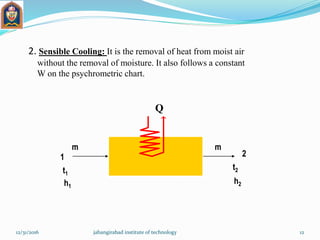
2. Sensible Cooling: It is the removal of heat from moist air
without the removal of moisture. It also follows a constant
W on the psychrometric chart.
m m
1 2
t1
h1
t2
h2
Q
12/31/2016 jahangirabad institute of technology 12
Sensible Heat & Cooling Processes
12/31/2016 jahangirabad institute of technology 13
 Heating & Cooling process –
addition or removal of sensible
heat without change in absolute
moisture content.
 NOTE: RH changes as
temperature changes.
3. Cooling and Dehumidifying: It is the removal of heat and
moisture from moist air, it involves sensible and latent
heat transfer.
m m
1 2
t1
h1
t2
h2
Q
mw
hw
12/31/2016 jahangirabad institute of technology 14
Psychrometry - Dehumidification
12/31/2016 jahangirabad institute of technology 15
 Dehumidification by cooling –
in cooling coils temp of air
reduces and the saturation point
(dew point) is reached.
 Further cooling results in
reduction of absolute humidity.
Dehumidification by Cooling
12/31/2016 jahangirabad institute of technology 16
4. Heating and Humidifying: It is the addition of heat and
moisture to moist air, it also involves sensible and latent
heat transfer.
m m
1 2
t1
h1
t2
h2
Q
mw
hw
12/31/2016 jahangirabad institute of technology 17
5. HUMIDIFYING : It is the addition of moisture to moist
air without the addition of heat.
m m
1 2
t1
h1
t2
h2
mw
hw
12/31/2016 jahangirabad institute of technology 18
Removing Sensible Heat and Moisture
12/31/2016 jahangirabad institute of technology 19
Adiabatic or evaporative cooling
 A psychrometric process which invovles the cooling without heat loss
or gain. Sensible heat lost by air is converted to latent heat in the added
water vapor.
12/31/2016 jahangirabad institute of technology 20
12/31/2016 jahangirabad institute of technology 21
ADIABATIC MIXING OF MOIST
AIR & STREAM
 A psychrometric process that invovles no net heat loss
or gain during the mixing of two air streams.
12/31/2016 jahangirabad institute of technology 22
Adiabatic mixing
 Governing equation
12/31/2016 jahangirabad institute of technology 23
hmQhm
outin
  
Psychrometry – Climate Classification
 Climate Classification
shows the various
approximate zones of
temperature and humidity
on the psychrometric chart.
12/31/2016
jahangirabad institute of technology
24
12/31/2016 jahangirabad institute of technology 25
Basic Factors That Affect Human
Comfort In The Internal Environment
Thermal and air quality
 What affects the surroundings you live in?
 Air quality is affected by how hot it is outside or inside your environment
 What is humidity and what affects humidity?
 The amount of moisture that is present within the air will have an effect on
humidity, which is linked to the amount of ventilation entering
 What is the normal temperature of a human being?
 Human temperature maintain an average core temperature of 37º depending
on the metabolic rate
12/31/2016 jahangirabad institute of technology 26
Nature of heat
• What is the measure of temperature
• Temperature is measured in degrees celsius
• The lower is 0 fixed at a melting point of ice at a stand at atmospheric
pressure of 101.32kN/m2
• The upper point is 100 degrees – temperature of steam above the boiling
point
• What is the acceptable value of temperature taken at normal design?
• Normal design temperature are taken at 21 degrees inside and -1 degrees
outside on average
12/31/2016 jahangirabad institute of technology 27
Thermodynamic temperature scale
• This is another measure of temperature in degrees Kelvin
• 0 degree celsius= 273.16 Kelvin (K)
• 100 degree celsius = 317.16 Kelvin
• The unit of thermodynamic temperature is the fraction of the
thermodynamic temperature at the triple point water
• (equilibrium point of the temperature and pressure at which three known
phases of substance can exist i.e. liquid, water vapour and pure ice)
12/31/2016 jahangirabad institute of technology 28
 How do we measure the quantity of heat?
 Heat is measured in joules (J) which is a measure of work done
 The rate of expenditure of energy or doing work or of heat loss is
measured in watts (W)
 1 watt is = 1 Joule per second
 1 W =1 J/s
12/31/2016
jahangirabad institute of
technology 29
Heat transfer
 Name three ways heat is transferred from one mass to another, for instance a
person sitting next to a radiator.
 Conduction
 Convection
 Radiation
12/31/2016 jahangirabad institute of technology 30
Thermal comfort
 In high activity the temperature rises and the more heat you will give off.
Several factors influences the level heat is generated (metabolic rate)
including:
 Your surface area
 Age
 Gender
 Level of activity
 e.g.
 Sleeping heat output 70W. Lifting 440W.
12/31/2016 jahangirabad institute of technology 31
Typical heat output of an adult male
Activity Example Heat output
Immobile Sleeping 70W
Seated Watching TV 115W
Light work Office 140W
Medium work Factory Work 265W
Heavy work Lifting 440W
12/31/2016 jahangirabad institute of technology 32
Heat losses from buildings
 Comfortable temperature for humans is provided by balancing the heat lost
through conduction and ventilation through the fabric with similar heat
 Optimum temperature will depend on material used , type of construction,
orientation of the building and degree of exposure to the rain and wind
12/31/2016 jahangirabad institute of technology 33
Room temperatures
 What would you consider in design to maintain temperature in buildings?
 The resistance of a material to the passage of heat and the thermal
conductivity of the material in passing the heat along are the basics of
understanding of maintaining a steady temperature and a comfortable
thermal indoor environment
 In order to maintain a comfortable room temperature the building must be
provided with as much heat as is lost through ventilation
12/31/2016 jahangirabad institute of technology 34
What will the loss of heat in buildings
depend on?
 Materials used
 Type of construction
 Orientation of the building in relation to the sun
 Degree of exposure to rain and wind
12/31/2016 jahangirabad institute of technology 35
RELATIVE HUMIDITY
 Humans are used to a relative humidity of between 40 and 60%. Greater
than this we start to describe air as being ‘Humid’.
12/31/2016 jahangirabad institute of technology 36
HEAT LOSS DUE TO VENTILATION
 Natural ventilation leads to the complete volume of air in a room changing a
certain number of times in one hour
 Type of room Air changes in hr
 Halls 1.0
 Bedrooms /lounges 1.5
 WCs and bathrooms 2.0
12/31/2016 jahangirabad institute of technology 37

Air conditioning

  • 1.
    jahangirabad institute oftechnology12/31/2016 1
  • 2.
    CONTENTS  What isPSYCHROMETRY?  Properties of PSYCHROMETRY  PSYCHROMETRIC Processes  PSYCHROMETRIC CHART 12/31/2016 jahangirabad institute of technology 2
  • 3.
    Psychrometry  Psychrometry isthe science dealing with the physical laws of air – water vapour mixtures.  When designing an air conditioning system, the temperature and moisture content of the air to be conditioned, and the same properties of the air needed to produce the desired air conditioning effect.  In other words, we can say that Psychrometry is the study of MOIST AIR or mixture of dry air and water vapour. 12/31/2016 jahangirabad institute of technology 3
  • 4.
    PROPERTIESOF PSYCHROMETRY  DEWPOINT TEMPERATURE  RELATIVE HUMIDITY  HUMIDITY RATIO  DRY-BULB TEMPERATURE  WET BULB TEMPERATURE  HUMIDITY • Specific humidity • Absolute humidity  PSYCHROMETRIC RATIO 12/31/2016 jahangirabad institute of technology 4
  • 5.
    Dew Point  Thetemperature at which moisture starts to condense out of the air is known as DEW POINT.  Dew point is also known as saturation temperature.  Dew point temperature is determined by moving from a state point horizontally to the left along lines of constant humidity ratio until the upper, curved, saturation temperature boundary is reached. 12/31/2016 jahangirabad institute of technology 5
  • 6.
    DRY -BULB TEMPERATURE The dry-bulb temperature is the temperature indicated by a thermometer exposed to the air in a place sheltered from direct solar radiation. The term dry-bulb is customarily added to temperature to distinguish it from wet-bulb and dew point temperature. 12/31/2016 jahangirabad institute of technology 6
  • 7.
    WET BULB TEMPERATURE Wet bulb temperature is the temperature recorded by thermometer when the bulb is enveloped by cotton wick saturated with water.  The accuracy of a simple wet-bulb thermometer depends on how fast air passes over the bulb and how well the thermometer is shielded from the radiant temperature of its surroundings. 12/31/2016 jahangirabad institute of technology 7
  • 8.
    HUMIDITY  Specific Humidity: Specific humidity is defined as the proportion of the mass of water vapour per unit mass of the moist air sample (dry air plus the water vapour); it is closely related to humidity ratio and always lower in value.  Absolute Humidity:  The mass of water vapor per unit volume of air containing the water vapor. This quantity is also known as the water vapour density. 12/31/2016 jahangirabad institute of technology 8
  • 9.
    Psychometric Ratio  Thepsychrometric ratio is the ratio of the heat transfer coefficient to the product of mass transfer coefficient and humid heat at a wetted surface. It may be evaluated with the following equation:  r = hc / ky cs  where:  r= Psychrometric ratio, dimensionless  hc = convective heat transfer coefficient, W m-2 K-1  ky= convective mass transfer coefficient, kg m-2 s-1  cs= humid heat, J kg-1 K-1 12/31/2016 jahangirabad institute of technology 9
  • 10.
    Psychrometric Processes or Airconditioning Processes 1. Sensible Heating : it is addition of heat to moist air without the addition of moisture. It follows a constant humidity ratio line on the psychrometric chart. m m 1 2 t1 h1 t2 h2 Q 12/31/2016 jahangirabad institute of technology 10
  • 11.
    Sensible heating 12/31/2016 jahangirabadinstitute of technology 11 tcmQ p 
  • 12.
    2. Sensible Cooling:It is the removal of heat from moist air without the removal of moisture. It also follows a constant W on the psychrometric chart. m m 1 2 t1 h1 t2 h2 Q 12/31/2016 jahangirabad institute of technology 12
  • 13.
    Sensible Heat &Cooling Processes 12/31/2016 jahangirabad institute of technology 13  Heating & Cooling process – addition or removal of sensible heat without change in absolute moisture content.  NOTE: RH changes as temperature changes.
  • 14.
    3. Cooling andDehumidifying: It is the removal of heat and moisture from moist air, it involves sensible and latent heat transfer. m m 1 2 t1 h1 t2 h2 Q mw hw 12/31/2016 jahangirabad institute of technology 14
  • 15.
    Psychrometry - Dehumidification 12/31/2016jahangirabad institute of technology 15  Dehumidification by cooling – in cooling coils temp of air reduces and the saturation point (dew point) is reached.  Further cooling results in reduction of absolute humidity.
  • 16.
    Dehumidification by Cooling 12/31/2016jahangirabad institute of technology 16
  • 17.
    4. Heating andHumidifying: It is the addition of heat and moisture to moist air, it also involves sensible and latent heat transfer. m m 1 2 t1 h1 t2 h2 Q mw hw 12/31/2016 jahangirabad institute of technology 17
  • 18.
    5. HUMIDIFYING :It is the addition of moisture to moist air without the addition of heat. m m 1 2 t1 h1 t2 h2 mw hw 12/31/2016 jahangirabad institute of technology 18
  • 19.
    Removing Sensible Heatand Moisture 12/31/2016 jahangirabad institute of technology 19
  • 20.
    Adiabatic or evaporativecooling  A psychrometric process which invovles the cooling without heat loss or gain. Sensible heat lost by air is converted to latent heat in the added water vapor. 12/31/2016 jahangirabad institute of technology 20
  • 21.
  • 22.
    ADIABATIC MIXING OFMOIST AIR & STREAM  A psychrometric process that invovles no net heat loss or gain during the mixing of two air streams. 12/31/2016 jahangirabad institute of technology 22
  • 23.
    Adiabatic mixing  Governingequation 12/31/2016 jahangirabad institute of technology 23 hmQhm outin   
  • 24.
    Psychrometry – ClimateClassification  Climate Classification shows the various approximate zones of temperature and humidity on the psychrometric chart. 12/31/2016 jahangirabad institute of technology 24
  • 25.
    12/31/2016 jahangirabad instituteof technology 25 Basic Factors That Affect Human Comfort In The Internal Environment
  • 26.
    Thermal and airquality  What affects the surroundings you live in?  Air quality is affected by how hot it is outside or inside your environment  What is humidity and what affects humidity?  The amount of moisture that is present within the air will have an effect on humidity, which is linked to the amount of ventilation entering  What is the normal temperature of a human being?  Human temperature maintain an average core temperature of 37º depending on the metabolic rate 12/31/2016 jahangirabad institute of technology 26
  • 27.
    Nature of heat •What is the measure of temperature • Temperature is measured in degrees celsius • The lower is 0 fixed at a melting point of ice at a stand at atmospheric pressure of 101.32kN/m2 • The upper point is 100 degrees – temperature of steam above the boiling point • What is the acceptable value of temperature taken at normal design? • Normal design temperature are taken at 21 degrees inside and -1 degrees outside on average 12/31/2016 jahangirabad institute of technology 27
  • 28.
    Thermodynamic temperature scale •This is another measure of temperature in degrees Kelvin • 0 degree celsius= 273.16 Kelvin (K) • 100 degree celsius = 317.16 Kelvin • The unit of thermodynamic temperature is the fraction of the thermodynamic temperature at the triple point water • (equilibrium point of the temperature and pressure at which three known phases of substance can exist i.e. liquid, water vapour and pure ice) 12/31/2016 jahangirabad institute of technology 28
  • 29.
     How dowe measure the quantity of heat?  Heat is measured in joules (J) which is a measure of work done  The rate of expenditure of energy or doing work or of heat loss is measured in watts (W)  1 watt is = 1 Joule per second  1 W =1 J/s 12/31/2016 jahangirabad institute of technology 29
  • 30.
    Heat transfer  Namethree ways heat is transferred from one mass to another, for instance a person sitting next to a radiator.  Conduction  Convection  Radiation 12/31/2016 jahangirabad institute of technology 30
  • 31.
    Thermal comfort  Inhigh activity the temperature rises and the more heat you will give off. Several factors influences the level heat is generated (metabolic rate) including:  Your surface area  Age  Gender  Level of activity  e.g.  Sleeping heat output 70W. Lifting 440W. 12/31/2016 jahangirabad institute of technology 31
  • 32.
    Typical heat outputof an adult male Activity Example Heat output Immobile Sleeping 70W Seated Watching TV 115W Light work Office 140W Medium work Factory Work 265W Heavy work Lifting 440W 12/31/2016 jahangirabad institute of technology 32
  • 33.
    Heat losses frombuildings  Comfortable temperature for humans is provided by balancing the heat lost through conduction and ventilation through the fabric with similar heat  Optimum temperature will depend on material used , type of construction, orientation of the building and degree of exposure to the rain and wind 12/31/2016 jahangirabad institute of technology 33
  • 34.
    Room temperatures  Whatwould you consider in design to maintain temperature in buildings?  The resistance of a material to the passage of heat and the thermal conductivity of the material in passing the heat along are the basics of understanding of maintaining a steady temperature and a comfortable thermal indoor environment  In order to maintain a comfortable room temperature the building must be provided with as much heat as is lost through ventilation 12/31/2016 jahangirabad institute of technology 34
  • 35.
    What will theloss of heat in buildings depend on?  Materials used  Type of construction  Orientation of the building in relation to the sun  Degree of exposure to rain and wind 12/31/2016 jahangirabad institute of technology 35
  • 36.
    RELATIVE HUMIDITY  Humansare used to a relative humidity of between 40 and 60%. Greater than this we start to describe air as being ‘Humid’. 12/31/2016 jahangirabad institute of technology 36
  • 37.
    HEAT LOSS DUETO VENTILATION  Natural ventilation leads to the complete volume of air in a room changing a certain number of times in one hour  Type of room Air changes in hr  Halls 1.0  Bedrooms /lounges 1.5  WCs and bathrooms 2.0 12/31/2016 jahangirabad institute of technology 37