VISHWAKARMA GOVT.
ENGINEERING COLLEGE.
 SUB: STRUCTURALANALYSIS-1
 TOPIC:TYPES OF STATICALLY DETERMINATE &
INDETERMINATE STRUCTURES.
 CIVIL
 SEM-4.
DETERMINATE AND
INDETERMINATE STRUCTURES
 Structure is an assemblage of a number of components
like slabs, beams, columns, walls, foundations and so on,
which remains in equilibrium.
 It has to satisfy the fundamental criteria of strength,
stiffness, economy, durability and compatibility, for its
existence.
 It is generally classified into two categories as
Determinate and Indeterminate structures or Redundant
Structures.
 Any structure is designed for the stress resultants of
bending moment, shear force, deflection, torsional
stresses, and axial stresses.
 If these moments, shears and stresses are evaluated at
various critical sections, then based on these, the
proportioning can be done.
 Evaluation of these stresses, moments and forces and
plotting them for that structural component is known as
analysis.
 Determination of dimensions for these components of
these stresses and proportioning is known as design.
 Determinate structures are analysed just by the use of
basic equilibrium equations.
 By this analysis, the unknown reactions are found for
the further determination of stresses.
 Redundant or indeterminate structures are not capable
of being analysed by mere use of basic equilibrium
equations.
 Along with the basic equilibrium equations, some extra
conditions are required to be used like compatibility
conditions of deformations etc to get the unknown
reactions for drawing bending moment and shear force
diagrams.
 Example of determinate structures are: simply
supported beams, cantilever beams, single and double
overhanging beams, three hinged arches, etc.
 Examples of indeterminate structures are: fixed beams,
continuous beams, fixed arches, two hinged arches,
portals, multi-storied frames, etc.
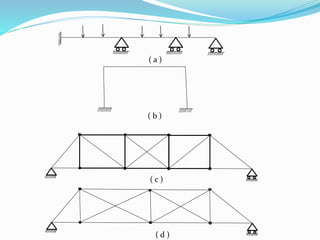
 Indeterminate Structures: a structure is termed as
statically indeterminate, if it can not be analysed from
principles of statics alone, A statically indeterminate
structure may be aclassified as:
 Externally indeterminate,
 example: continuous beams and frames shown in
figure-1(a) and (b).
 Internally indeterminate, example: trusses shown in
figure-1(c) and (d).

( a )
( b )
( c )
( d )
 EXTERNALLY INDETERMINATE STRUCTURES:
 A structure is usually externally indeterminate or
redundant if the reactions at the supports can not be
determined by using three equations of equilibrium,

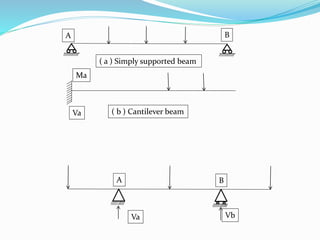
 In the case of beams subjected to vertical loads only,
two reactions can be determined by conditions of
equilibrium.
 Therefore, simply supported cantilever and overhanging
beams shown in figure 2 are statically determinate
structures.
( a ) Simply supported beam
( b ) Cantilever beam
A B
Va Vb
Va
Ma
A B
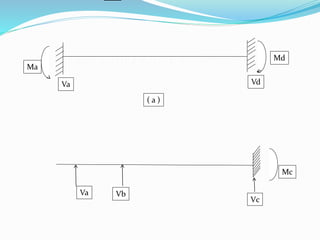
 If however a beam rests on more than two supports or
in addition any of the end support is fixed, there are
more than two reactions to be determined.
 These reactions can not be determined by conditions of
equilibrium alone. The degree of indeterminacy or
redundancy is given by the number of extra or
redundant reactions to be determined.
 The beam shown in figure 3 (a) is statically
indeterminate to three degree because there are three
unknown reactions.
 The beam in figure 3(b) is statically redundant to two
degree.
Va Vd
Ma
Md
( a )
Va Vb
Vc
Mc
 A external static indeterminacy is statically determinate if there
are only three external reactions, because there are three
conditions of equilibrium for such a system.
 A external static indeterminacy shown in figure 4 are statically
determinate because there are only three reactions to be
determined.
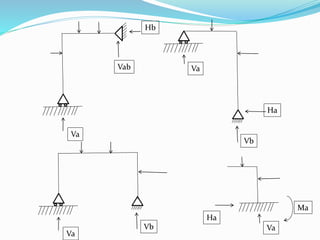
 If a external static indeterminacy has more than three reactions it
is statically indeterminate, the degree of indeterminacy or
redundancy being equal to the number of redundant or extra
reactions to be determined.
 Therefore, the external static indeterminacy of figure 5(a) and (b)
are redundant by one degree, that of figure 5(c) is redundant by
two degrees, that of figure 5(d) is redundant by three degrees, and
that of figure 5(e) is redundant by 5 degrees.
Va
Vab
Vb
Ha
Va
Hb
Va
Vb Va
Ha
Ma
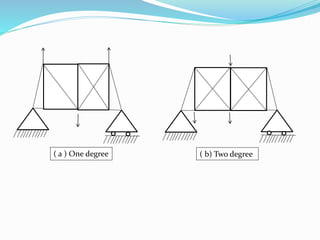
( a ) One degree ( b) Two degree
Thank You

Static Indeterminacy and Kinematic Indeterminacy

  • 1.
    VISHWAKARMA GOVT. ENGINEERING COLLEGE. SUB: STRUCTURALANALYSIS-1  TOPIC:TYPES OF STATICALLY DETERMINATE & INDETERMINATE STRUCTURES.  CIVIL  SEM-4.
  • 2.
    DETERMINATE AND INDETERMINATE STRUCTURES Structure is an assemblage of a number of components like slabs, beams, columns, walls, foundations and so on, which remains in equilibrium.  It has to satisfy the fundamental criteria of strength, stiffness, economy, durability and compatibility, for its existence.  It is generally classified into two categories as Determinate and Indeterminate structures or Redundant Structures.
  • 3.
     Any structureis designed for the stress resultants of bending moment, shear force, deflection, torsional stresses, and axial stresses.  If these moments, shears and stresses are evaluated at various critical sections, then based on these, the proportioning can be done.  Evaluation of these stresses, moments and forces and plotting them for that structural component is known as analysis.  Determination of dimensions for these components of these stresses and proportioning is known as design.
  • 4.
     Determinate structuresare analysed just by the use of basic equilibrium equations.  By this analysis, the unknown reactions are found for the further determination of stresses.  Redundant or indeterminate structures are not capable of being analysed by mere use of basic equilibrium equations.  Along with the basic equilibrium equations, some extra conditions are required to be used like compatibility conditions of deformations etc to get the unknown reactions for drawing bending moment and shear force diagrams.
  • 5.
     Example ofdeterminate structures are: simply supported beams, cantilever beams, single and double overhanging beams, three hinged arches, etc.  Examples of indeterminate structures are: fixed beams, continuous beams, fixed arches, two hinged arches, portals, multi-storied frames, etc.
  • 6.
     Indeterminate Structures:a structure is termed as statically indeterminate, if it can not be analysed from principles of statics alone, A statically indeterminate structure may be aclassified as:  Externally indeterminate,  example: continuous beams and frames shown in figure-1(a) and (b).  Internally indeterminate, example: trusses shown in figure-1(c) and (d). 
  • 7.
    ( a ) (b ) ( c ) ( d )
  • 8.
     EXTERNALLY INDETERMINATESTRUCTURES:  A structure is usually externally indeterminate or redundant if the reactions at the supports can not be determined by using three equations of equilibrium,   In the case of beams subjected to vertical loads only, two reactions can be determined by conditions of equilibrium.  Therefore, simply supported cantilever and overhanging beams shown in figure 2 are statically determinate structures.
  • 9.
    ( a )Simply supported beam ( b ) Cantilever beam A B Va Vb Va Ma A B
  • 10.
     If howevera beam rests on more than two supports or in addition any of the end support is fixed, there are more than two reactions to be determined.  These reactions can not be determined by conditions of equilibrium alone. The degree of indeterminacy or redundancy is given by the number of extra or redundant reactions to be determined.  The beam shown in figure 3 (a) is statically indeterminate to three degree because there are three unknown reactions.  The beam in figure 3(b) is statically redundant to two degree.
  • 11.
    Va Vd Ma Md ( a) Va Vb Vc Mc
  • 12.
     A externalstatic indeterminacy is statically determinate if there are only three external reactions, because there are three conditions of equilibrium for such a system.  A external static indeterminacy shown in figure 4 are statically determinate because there are only three reactions to be determined.  If a external static indeterminacy has more than three reactions it is statically indeterminate, the degree of indeterminacy or redundancy being equal to the number of redundant or extra reactions to be determined.  Therefore, the external static indeterminacy of figure 5(a) and (b) are redundant by one degree, that of figure 5(c) is redundant by two degrees, that of figure 5(d) is redundant by three degrees, and that of figure 5(e) is redundant by 5 degrees.
  • 13.
  • 15.
    ( a )One degree ( b) Two degree
  • 16.