International Journal of Technical Research and Applications e-ISSN: 2320-8163,
www.ijtra.com Volume 2, Issue 1 (Jan-Feb 2014), PP. 33-35
33 | P a g e
STUDY THE WORKING STRESS
METHOD AND LIMIT STATE METHOD
AND IN RCC CHIMNEY DESIGN
RajaVarma
Department Of Civil Engineering
Saroj Institute of Technology & Management
Abstract – Every industry focus to build and improve the
chimney to create the eco-friend organization as well as to
satisfy the strict environmental board.
IS: 4998 criteria for design of reinforced concrete chimneys
is using working stress method for chimney designing.
There are some limitations of working stress method. Also
the designing is difficult involving lengthy, cumbersome
and iterative computational effort.
So we should recognize this problem and we should use
some time saving techniques like interaction envelopes to
optimize the structural design.
Chimneys with various heights from 65m to 280m are
analyzed and designed by working stress method and limit
state method for collapse and comparison of results are
discussed in this paper. Generation of interaction curves for
hollow circular section is also discussed in this paper.
Key words: Reinforced Concrete Chimneys; Limit State
Method; Working Stress Method; Pu-Mu Interaction curves
I. INTRODUCTION
Chimneys, as we all know today, are hollow, tall and
slender vertical structures that carry smoke or steam
away from a fire or engine at a high enough elevation so
that after dilution due to atmospheric turbulence, their
concentration and that of their entrained solid
particulates is within acceptable limits on reaching the
ground.
IS: 4998 (Part I) CRITERIA FOR DESIGN OF
REINFORCED CONCRETE CHIMNEYS [1][2]
is using
working stress method for chimney designing.
The working stress method, though ensures satisfactory
performance at the working loads, is unrealistic and
irrational at ultimate load and it does not guarantee the
satisfactory performance of the structure at service loads.
The working stress method is logically not applicable to
concrete structures because this method assumes that the
materials of which the structure is made up, namely
concrete and steel, both obey Hook’s law. The
applicability of the Hook’s law is rather limited in
respect of concrete structures.
Among the advantages claimed for the limit state
approach are that the degree of safety of the various parts
of a structure is more uniform and also that a
probabilistic approach to safety is possible. To ensure
satisfactory performance of a structure serviceability
check like check for deflection and cracking is also
needed which are considered in limit state method.
II. ANALYSIS OF CHIMNEY
The chimney shall be divided in to ten or more sections
along its height and the load at any section shall be
calculated by suitable averaging the loads above it. The
moments are calculated from the sectional forces treating
the chimney as cantilever structure.
Analysis consist of calculation of factored dead load
(W) which includes Shell weight, Brick lining weight
and wind load according to IS: 4998 (Part I)[1] [2]
, then
factored moment (M) because of this wind load is
calculated at section.
III. DESIGNING
A. Working Stress Method
Chimney is designed according to IS: 4998 (Part I) [1] [2]
and following steps are followed:
1. Determine eccentricity (e) = M/W
2. Determine (eccentricity/radius) at section
3. Assume the p (percentage of steel at section) at
the section under consideration
4. Select the value of m (modular ratio)for concrete
grade to be used
5. Determine α (position of neutral axis)
6. Determine compressive stresses for different
values of α and β (β = constant depends on
openings in chimneys) in concrete and steel
7. Calculate temperature stresses in steel and
concrete
8. Calculate stresses in steel and concrete due to
wind induced moment. And check combined
stresses
B. Limit State Method for Collapse
1. Calculate the W/fck D2
and M / fck D3
.
2. Calculate ratio d/D and D’/D
Where, d=inner diameter of concrete shell
D=outer diameter of concrete shell
D’=D - concrete cover
International Journal of Technical Research and Applications e-ISSN: 2320-8163,
www.ijtra.com Volume 2, Issue 1 (Jan-Feb 2014), PP. 33-35
34 | P a g e
3. Refer the suitable Pu-Mu Interaction curves
4. From selected interaction curve take appropriate
value
of p/fck
5. Calculate p percentage of steel required at
section for the value of fck used
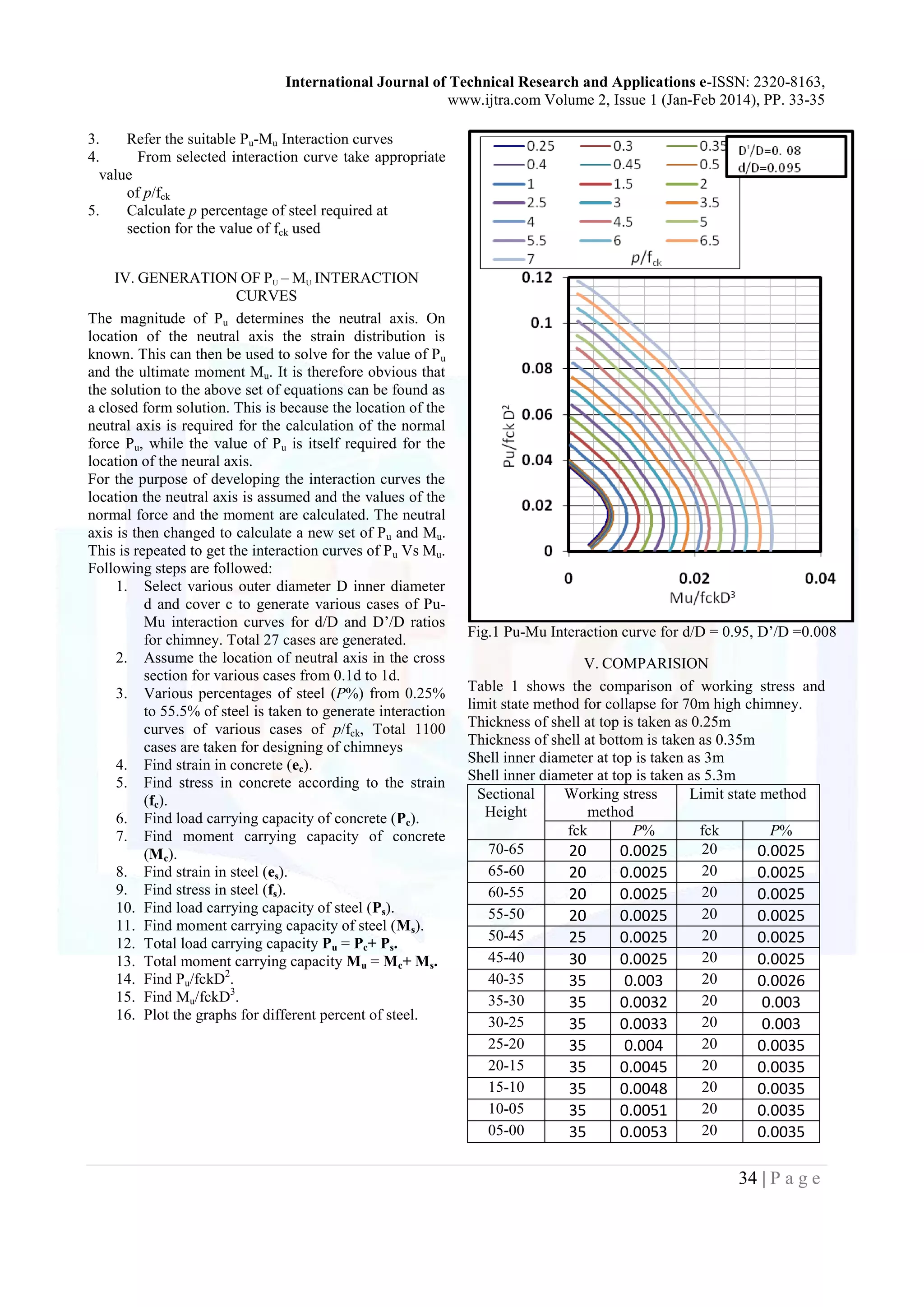
IV. GENERATION OF PU – MU INTERACTION
CURVES
The magnitude of Pu determines the neutral axis. On
location of the neutral axis the strain distribution is
known. This can then be used to solve for the value of Pu
and the ultimate moment Mu. It is therefore obvious that
the solution to the above set of equations can be found as
a closed form solution. This is because the location of the
neutral axis is required for the calculation of the normal
force Pu, while the value of Pu is itself required for the
location of the neural axis.
For the purpose of developing the interaction curves the
location the neutral axis is assumed and the values of the
normal force and the moment are calculated. The neutral
axis is then changed to calculate a new set of Pu and Mu.
This is repeated to get the interaction curves of Pu Vs Mu.
Following steps are followed:
1. Select various outer diameter D inner diameter
d and cover c to generate various cases of Pu-
Mu interaction curves for d/D and D’/D ratios
for chimney. Total 27 cases are generated.
2. Assume the location of neutral axis in the cross
section for various cases from 0.1d to 1d.
3. Various percentages of steel (P%) from 0.25%
to 55.5% of steel is taken to generate interaction
curves of various cases of p/fck, Total 1100
cases are taken for designing of chimneys
4. Find strain in concrete (ec).
5. Find stress in concrete according to the strain
(fc).
6. Find load carrying capacity of concrete (Pc).
7. Find moment carrying capacity of concrete
(Mc).
8. Find strain in steel (es).
9. Find stress in steel (fs).
10. Find load carrying capacity of steel (Ps).
11. Find moment carrying capacity of steel (Ms).
12. Total load carrying capacity Pu = Pc+ Ps.
13. Total moment carrying capacity Mu = Mc+ Ms.
14. Find Pu/fckD2
.
15. Find Mu/fckD3
.
16. Plot the graphs for different percent of steel.
Fig.1 Pu-Mu Interaction curve for d/D = 0.95, D’/D =0.008
V. COMPARISION
Table 1 shows the comparison of working stress and
limit state method for collapse for 70m high chimney.
Thickness of shell at top is taken as 0.25m
Thickness of shell at bottom is taken as 0.35m
Shell inner diameter at top is taken as 3m
Shell inner diameter at top is taken as 5.3m
Sectional
Height
Working stress
method
Limit state method
fck P% fck P%
70-65 20 0.0025 20 0.0025
65-60 20 0.0025 20 0.0025
60-55 20 0.0025 20 0.0025
55-50 20 0.0025 20 0.0025
50-45 25 0.0025 20 0.0025
45-40 30 0.0025 20 0.0025
40-35 35 0.003 20 0.0026
35-30 35 0.0032 20 0.003
30-25 35 0.0033 20 0.003
25-20 35 0.004 20 0.0035
20-15 35 0.0045 20 0.0035
15-10 35 0.0048 20 0.0035
10-05 35 0.0051 20 0.0035
05-00 35 0.0053 20 0.0035
International Journal of Technical Research and Applications e-ISSN: 2320-8163,
www.ijtra.com Volume 2, Issue 1 (Jan-Feb 2014), PP. 33-35
35 | P a g e
Table 1 comparison of working stress method and limit
state method limit of collapse for chimney of height
70m.
Result shows that Limit State method is much more
economical than working stress method.
VI. FUTURE SCOPE
Earthquake forces consideration is beyond the scope,
also chimneys with openings and chimneys without
lining are beyond the scope.
Limit State of serviceability is beyond the scope.
REFERENCES
[1] IS: 4998 (Part I) – 1975
Criteria for design of reinforce concrete chimney.
[2] IS: 4998 (Part I) – 1992 (Revised edition)
Criteria for design of reinforced concrete
chimneys
[3] CICIND (Part A: The shell) – 2001 (Revised
edition)
Model code for concrete chimneys
[4] IS: 875 (Part 3: wind loads) – 1987
Code of practice for design loads (other than
earthquake) for buildings and structure
[5] IS: 456 - 2000
Plain and reinforced concrete code of practice
[6] SP: 16
Design aids for reinforced concrete to is: 456 –
1978
[7] Limit State Theory and Design of Reinforced
Concrete
By Dr. V. L. Shah and Late Dr. S. R. Karve
[8] Design of Tall Chimneys
By Mr. S. N. Manohar
[9] Load –moment interaction envelopes for design of
tall stacks –
A limit state approach by K. S. Babu Narayan and
Subhash C. Yaragal

STUDY THE WORKING STRESS METHOD AND LIMIT STATE METHOD AND IN RCC CHIMNEY DESIGN

  • 1.
    International Journal ofTechnical Research and Applications e-ISSN: 2320-8163, www.ijtra.com Volume 2, Issue 1 (Jan-Feb 2014), PP. 33-35 33 | P a g e STUDY THE WORKING STRESS METHOD AND LIMIT STATE METHOD AND IN RCC CHIMNEY DESIGN RajaVarma Department Of Civil Engineering Saroj Institute of Technology & Management Abstract – Every industry focus to build and improve the chimney to create the eco-friend organization as well as to satisfy the strict environmental board. IS: 4998 criteria for design of reinforced concrete chimneys is using working stress method for chimney designing. There are some limitations of working stress method. Also the designing is difficult involving lengthy, cumbersome and iterative computational effort. So we should recognize this problem and we should use some time saving techniques like interaction envelopes to optimize the structural design. Chimneys with various heights from 65m to 280m are analyzed and designed by working stress method and limit state method for collapse and comparison of results are discussed in this paper. Generation of interaction curves for hollow circular section is also discussed in this paper. Key words: Reinforced Concrete Chimneys; Limit State Method; Working Stress Method; Pu-Mu Interaction curves I. INTRODUCTION Chimneys, as we all know today, are hollow, tall and slender vertical structures that carry smoke or steam away from a fire or engine at a high enough elevation so that after dilution due to atmospheric turbulence, their concentration and that of their entrained solid particulates is within acceptable limits on reaching the ground. IS: 4998 (Part I) CRITERIA FOR DESIGN OF REINFORCED CONCRETE CHIMNEYS [1][2] is using working stress method for chimney designing. The working stress method, though ensures satisfactory performance at the working loads, is unrealistic and irrational at ultimate load and it does not guarantee the satisfactory performance of the structure at service loads. The working stress method is logically not applicable to concrete structures because this method assumes that the materials of which the structure is made up, namely concrete and steel, both obey Hook’s law. The applicability of the Hook’s law is rather limited in respect of concrete structures. Among the advantages claimed for the limit state approach are that the degree of safety of the various parts of a structure is more uniform and also that a probabilistic approach to safety is possible. To ensure satisfactory performance of a structure serviceability check like check for deflection and cracking is also needed which are considered in limit state method. II. ANALYSIS OF CHIMNEY The chimney shall be divided in to ten or more sections along its height and the load at any section shall be calculated by suitable averaging the loads above it. The moments are calculated from the sectional forces treating the chimney as cantilever structure. Analysis consist of calculation of factored dead load (W) which includes Shell weight, Brick lining weight and wind load according to IS: 4998 (Part I)[1] [2] , then factored moment (M) because of this wind load is calculated at section. III. DESIGNING A. Working Stress Method Chimney is designed according to IS: 4998 (Part I) [1] [2] and following steps are followed: 1. Determine eccentricity (e) = M/W 2. Determine (eccentricity/radius) at section 3. Assume the p (percentage of steel at section) at the section under consideration 4. Select the value of m (modular ratio)for concrete grade to be used 5. Determine α (position of neutral axis) 6. Determine compressive stresses for different values of α and β (β = constant depends on openings in chimneys) in concrete and steel 7. Calculate temperature stresses in steel and concrete 8. Calculate stresses in steel and concrete due to wind induced moment. And check combined stresses B. Limit State Method for Collapse 1. Calculate the W/fck D2 and M / fck D3 . 2. Calculate ratio d/D and D’/D Where, d=inner diameter of concrete shell D=outer diameter of concrete shell D’=D - concrete cover
  • 2.
    International Journal ofTechnical Research and Applications e-ISSN: 2320-8163, www.ijtra.com Volume 2, Issue 1 (Jan-Feb 2014), PP. 33-35 34 | P a g e 3. Refer the suitable Pu-Mu Interaction curves 4. From selected interaction curve take appropriate value of p/fck 5. Calculate p percentage of steel required at section for the value of fck used IV. GENERATION OF PU – MU INTERACTION CURVES The magnitude of Pu determines the neutral axis. On location of the neutral axis the strain distribution is known. This can then be used to solve for the value of Pu and the ultimate moment Mu. It is therefore obvious that the solution to the above set of equations can be found as a closed form solution. This is because the location of the neutral axis is required for the calculation of the normal force Pu, while the value of Pu is itself required for the location of the neural axis. For the purpose of developing the interaction curves the location the neutral axis is assumed and the values of the normal force and the moment are calculated. The neutral axis is then changed to calculate a new set of Pu and Mu. This is repeated to get the interaction curves of Pu Vs Mu. Following steps are followed: 1. Select various outer diameter D inner diameter d and cover c to generate various cases of Pu- Mu interaction curves for d/D and D’/D ratios for chimney. Total 27 cases are generated. 2. Assume the location of neutral axis in the cross section for various cases from 0.1d to 1d. 3. Various percentages of steel (P%) from 0.25% to 55.5% of steel is taken to generate interaction curves of various cases of p/fck, Total 1100 cases are taken for designing of chimneys 4. Find strain in concrete (ec). 5. Find stress in concrete according to the strain (fc). 6. Find load carrying capacity of concrete (Pc). 7. Find moment carrying capacity of concrete (Mc). 8. Find strain in steel (es). 9. Find stress in steel (fs). 10. Find load carrying capacity of steel (Ps). 11. Find moment carrying capacity of steel (Ms). 12. Total load carrying capacity Pu = Pc+ Ps. 13. Total moment carrying capacity Mu = Mc+ Ms. 14. Find Pu/fckD2 . 15. Find Mu/fckD3 . 16. Plot the graphs for different percent of steel. Fig.1 Pu-Mu Interaction curve for d/D = 0.95, D’/D =0.008 V. COMPARISION Table 1 shows the comparison of working stress and limit state method for collapse for 70m high chimney. Thickness of shell at top is taken as 0.25m Thickness of shell at bottom is taken as 0.35m Shell inner diameter at top is taken as 3m Shell inner diameter at top is taken as 5.3m Sectional Height Working stress method Limit state method fck P% fck P% 70-65 20 0.0025 20 0.0025 65-60 20 0.0025 20 0.0025 60-55 20 0.0025 20 0.0025 55-50 20 0.0025 20 0.0025 50-45 25 0.0025 20 0.0025 45-40 30 0.0025 20 0.0025 40-35 35 0.003 20 0.0026 35-30 35 0.0032 20 0.003 30-25 35 0.0033 20 0.003 25-20 35 0.004 20 0.0035 20-15 35 0.0045 20 0.0035 15-10 35 0.0048 20 0.0035 10-05 35 0.0051 20 0.0035 05-00 35 0.0053 20 0.0035
  • 3.
    International Journal ofTechnical Research and Applications e-ISSN: 2320-8163, www.ijtra.com Volume 2, Issue 1 (Jan-Feb 2014), PP. 33-35 35 | P a g e Table 1 comparison of working stress method and limit state method limit of collapse for chimney of height 70m. Result shows that Limit State method is much more economical than working stress method. VI. FUTURE SCOPE Earthquake forces consideration is beyond the scope, also chimneys with openings and chimneys without lining are beyond the scope. Limit State of serviceability is beyond the scope. REFERENCES [1] IS: 4998 (Part I) – 1975 Criteria for design of reinforce concrete chimney. [2] IS: 4998 (Part I) – 1992 (Revised edition) Criteria for design of reinforced concrete chimneys [3] CICIND (Part A: The shell) – 2001 (Revised edition) Model code for concrete chimneys [4] IS: 875 (Part 3: wind loads) – 1987 Code of practice for design loads (other than earthquake) for buildings and structure [5] IS: 456 - 2000 Plain and reinforced concrete code of practice [6] SP: 16 Design aids for reinforced concrete to is: 456 – 1978 [7] Limit State Theory and Design of Reinforced Concrete By Dr. V. L. Shah and Late Dr. S. R. Karve [8] Design of Tall Chimneys By Mr. S. N. Manohar [9] Load –moment interaction envelopes for design of tall stacks – A limit state approach by K. S. Babu Narayan and Subhash C. Yaragal