Lecturenotes
Prepared by
Prem Kumar Soni
Asst. Prof.
LNCT-S
12/5/2016 1Lecture notes Chapter 5 By Prem Kumar Soni
TRUSSES
12/5/2016 2Lecture notes Chapter 5 By Prem Kumar Soni
CONTENTS :
1. Introduction.
2. Plane truss.
3. Statical determinacy and stability of trusses.
4. Analysis of statically determinate plane truss.
5. Sign conventions used.
6. Method of joints.
7. Identification of zero force members.
8. Examples on method of joints.
9. Method of sections.
10. Examples on method of sections.
11. Exercise problems.
12/5/2016 3Lecture notes Chapter 5 By Prem Kumar Soni
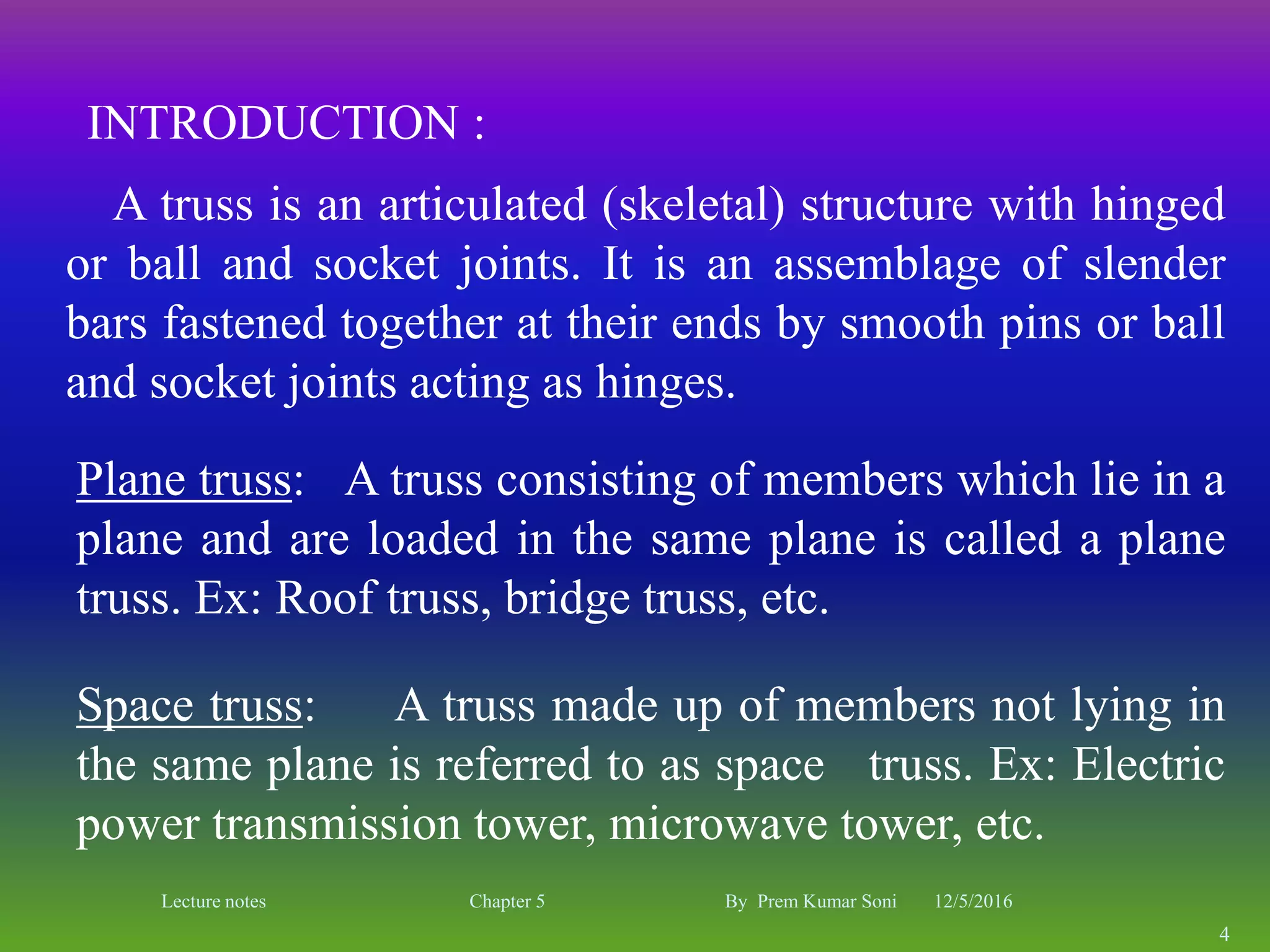
INTRODUCTION :
A truss is an articulated (skeletal) structure with hinged
or ball and socket joints. It is an assemblage of slender
bars fastened together at their ends by smooth pins or ball
and socket joints acting as hinges.
Plane truss: A truss consisting of members which lie in a
plane and are loaded in the same plane is called a plane
truss. Ex: Roof truss, bridge truss, etc.
Space truss: A truss made up of members not lying in
the same plane is referred to as space truss. Ex: Electric
power transmission tower, microwave tower, etc.
12/5/2016
4
Lecture notes Chapter 5 By Prem Kumar Soni
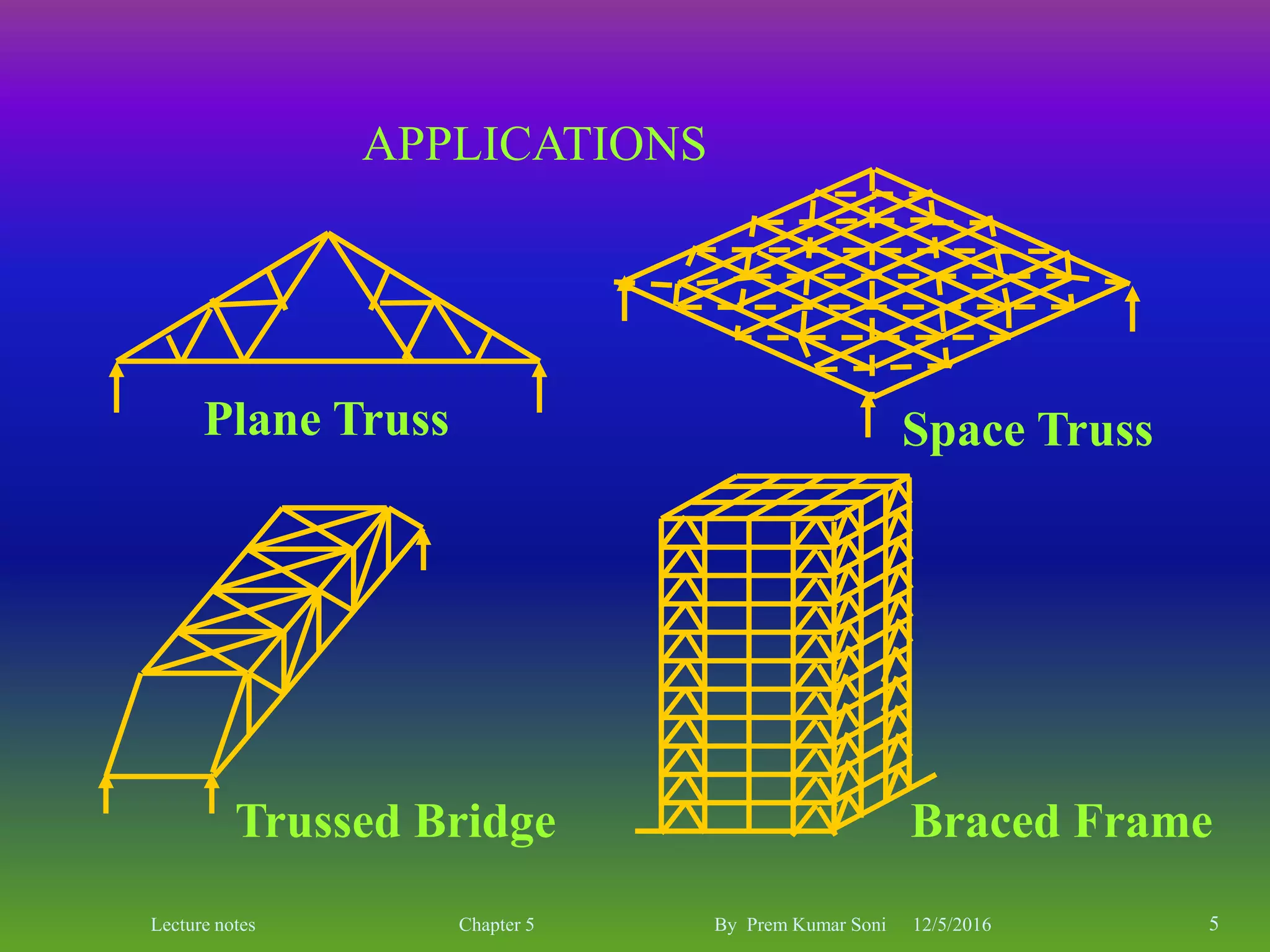
APPLICATIONS
Plane Truss Space Truss
Trussed Bridge Braced Frame
12/5/2016 5Lecture notes Chapter 5 By Prem Kumar Soni
12/5/2016 6Lecture notes Chapter 5 By Prem Kumar Soni
Truss
 In a truss, the joints are of pin type, where end
of the members can rotate freely. Moreover,
individual truss members should not directly
loaded transversely; loads should be applied at
the joints of members so that no bending or
shear forces will be generated on truss
members. Self-weight of the members should
be dumped both end for the same reason.
12/5/2016Lecture notes Chapter 5 By Prem Kumar Soni 7
Frame
 Unlike truss, the members of frames are
connected rigidly at joints, and individual
members can carry transverse load, which may
generate bending moment, shear forces along
with axial forces.
12/5/2016Lecture notes Chapter 5 By Prem Kumar Soni 8
 Truss- In truss, joints are of pin joint type and
can freely rotate about the pin. So, they
cannot transfer moments.
 In practical, truss have no flexibility in joints.
 Frame- In frame, joints are joined by welding
abd bolting so they are rigid and cannot rotate
freely. They can transfer moments as well as
axial loads.
 Frames are of 2types. Rigid non collapsible
and non rigid collapsible.
12/5/2016Lecture notes Chapter 5 By Prem Kumar Soni 9
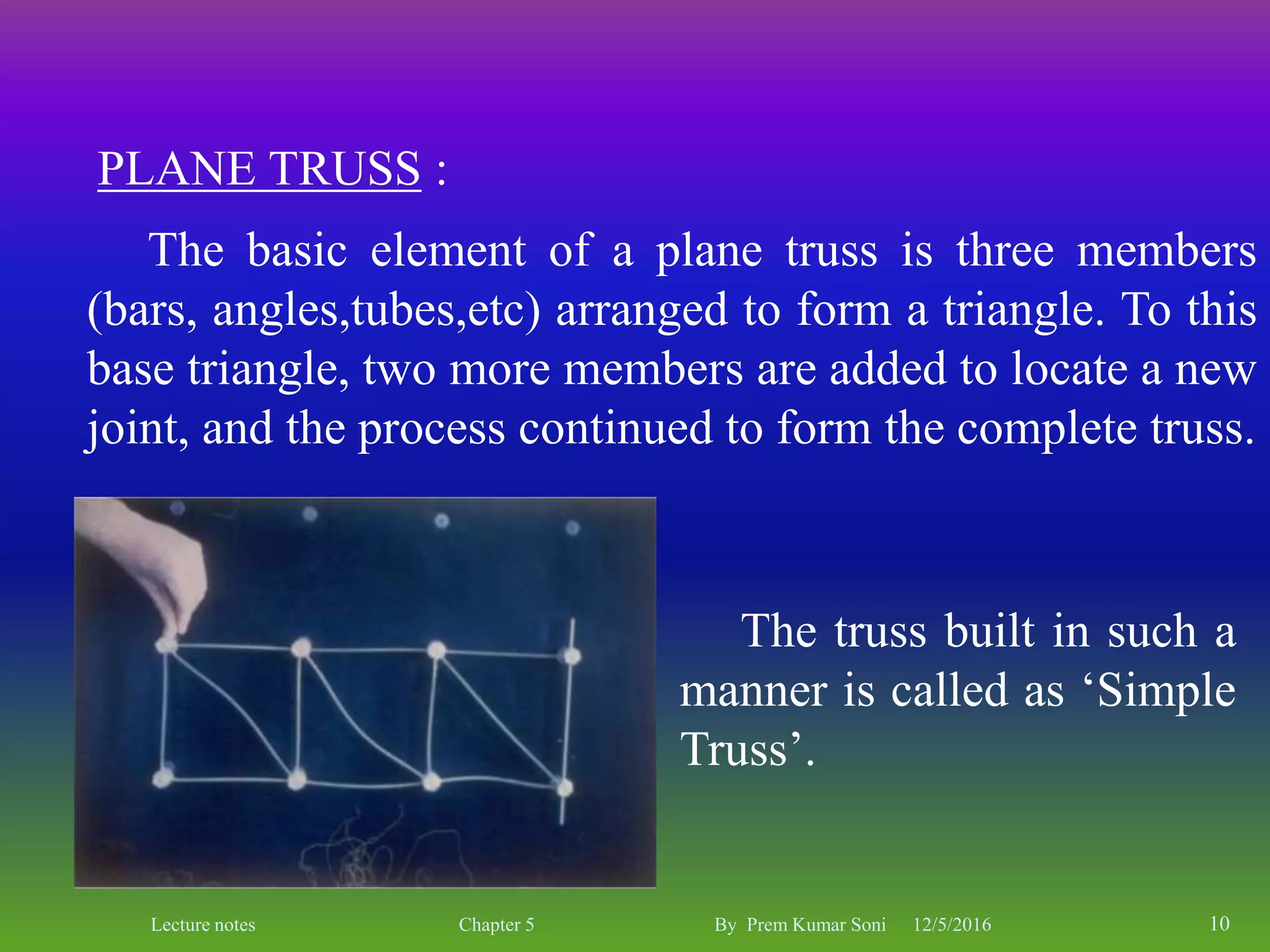
The basic element of a plane truss is three members
(bars, angles,tubes,etc) arranged to form a triangle. To this
base triangle, two more members are added to locate a new
joint, and the process continued to form the complete truss.
The truss built in such a
manner is called as ‘Simple
Truss’.
PLANE TRUSS :
12/5/2016 10Lecture notes Chapter 5 By Prem Kumar Soni
T T
Tension Member
The free body diagram of a member shows that it is
acted upon by two equal and opposite forces.
The hinged joint permits members to rotate with
respect to each other and hence the members are
subjected to purely axial forces.
A truss is held in position by the supports and the
loads are applied only at joints.
12/5/2016 11
Lecture notes Chapter 5 By Prem Kumar Soni
Compression Member
The convention for internal forces, i.e., the action of
forces in the members on the joints is shown.
TENSION COMPRESSION
C C
T C
12/5/2016 12Lecture notes Chapter 5 By Prem Kumar Soni
STATICAL DETERMINACY AND STABILITY OF
TRUSSES :
Total number of unknowns = m + c
Let m = number of unknown member forces.
c = number of unknown constrained reaction components
( usually three, if statically determinate externally )
j = number of joints
Each joint has two equations of equilibrium (H=0 and
V=0).
Hence number of equilibrium equations available = 2j.
12/5/2016 13Lecture notes Chapter 5 By Prem Kumar Soni
If the number of unknowns is less than the number of
available equations, then the truss is unstable.
If total number of unknowns is equal to total number of
equations available, then the truss is statically determinate.
If number of unknowns is more than the number of
available equations, then the truss is statically
indeterminate.
i.e., m+c = 2j
i.e., m+c > 2j
i.e., m+c < 2j
STATICAL DETERMINACY AND STABILITY OF
TRUSSES : (contd..)
12/5/2016 14Lecture notes Chapter 5 By Prem Kumar Soni
Degree of indeterminacy, i = (m+c) – 2j
Degree of internal indeterminacy. ii = i – ie = m+3 – 2j
Degree of external indeterminacy, ie = c – 3
STATICAL DETERMINACY AND STABILITY OF
TRUSSES : (contd..)
12/5/2016 15Lecture notes Chapter 5 By Prem Kumar Soni
(iii)When ii > 0, number of members is more than the
number required. Such a truss is called statically
indeterminate or redundant truss.
STATICAL DETERMINACY AND STABILITY OF
TRUSSES : (contd..)
(ii) When ii < 0, the number of members provided is less
than that required for stability. Such a truss is called
unstable or deficient truss.
(i) When ii = 0, m = 2j – 3 and the structure is statically
determinate internally and is stable. Such a truss is
called a perfect truss.
When we consider the internal indeterminacy, we have the
following cases of truss:
12/5/2016 16Lecture notes Chapter 5 By Prem Kumar Soni
STATICAL DETERMINACY AND STABILITY OF
TRUSSES : (contd..)
When we consider the external indeterminacy, we have the
following cases of truss:
(i) When c = 3 (=> ie = 0 ), the truss is said to be
statically determinate externally.
(ii) When c < 3 (=> ie < 0 ), the truss is said to be
unstable externally.
(iii)When c > 3 (=> ie > 0 ), the truss is said to be
statically indeterminate externally.
12/5/2016 17Lecture notes Chapter 5 By Prem Kumar Soni
ANALYSIS OF STATICALLY DETERMINATE PLANE
TRUSS :
The assumptions made in the analysis are as follows:
The members of the truss are connected at the ends by
frictionless hinges.
The axes of all members lie in a single plane called
‘middle plane of the truss’.
All the external forces acting on the truss are applied at
the joints only.
All the loads are applied in the plane of the truss.
12/5/2016 18Lecture notes Chapter 5 By Prem Kumar Soni
The following methods of analysis will be adopted :
A.) Method of joints. B.) Method of sections.
METHOD OF JOINTS :
A member in a pin - jointed truss has only one internal
force resultant i.e., the axial force. Hence the F.B.D of any
joint is a concurrent system in equilibrium.
SIGN CONVENTIONS USED :
Positive sign is used for tension.
Negative sign is used for compression.
Clockwise moment ( )is taken positive and anti-
clockwise moment ( ) is taken as negative.
12/5/2016 19
Lecture notes Chapter 5 By Prem Kumar Soni
METHOD OF JOINTS : (contd..)
The procedure for method of joints is as follows :
 The support reactions of the truss are first obtained
considering the three conditions of equilibrium, applied to
the truss as a whole (H=0, V=0 and M=0).
 Taking the F.B.D of a joint which has not more than two
unknowns (preferably), and applying the equations of
equilibrium for a coplanar concurrent force system (H=0
and V=0), the unknowns are evaluated.
 The analysis is continued with the next joint with
two unknowns (preferably), until the forces in all the
members are obtained. 12/5/2016 20Lecture notes Chapter 5 By Prem Kumar Soni
IDENTIFICATION OF ZERO FORCE MEMBERS :
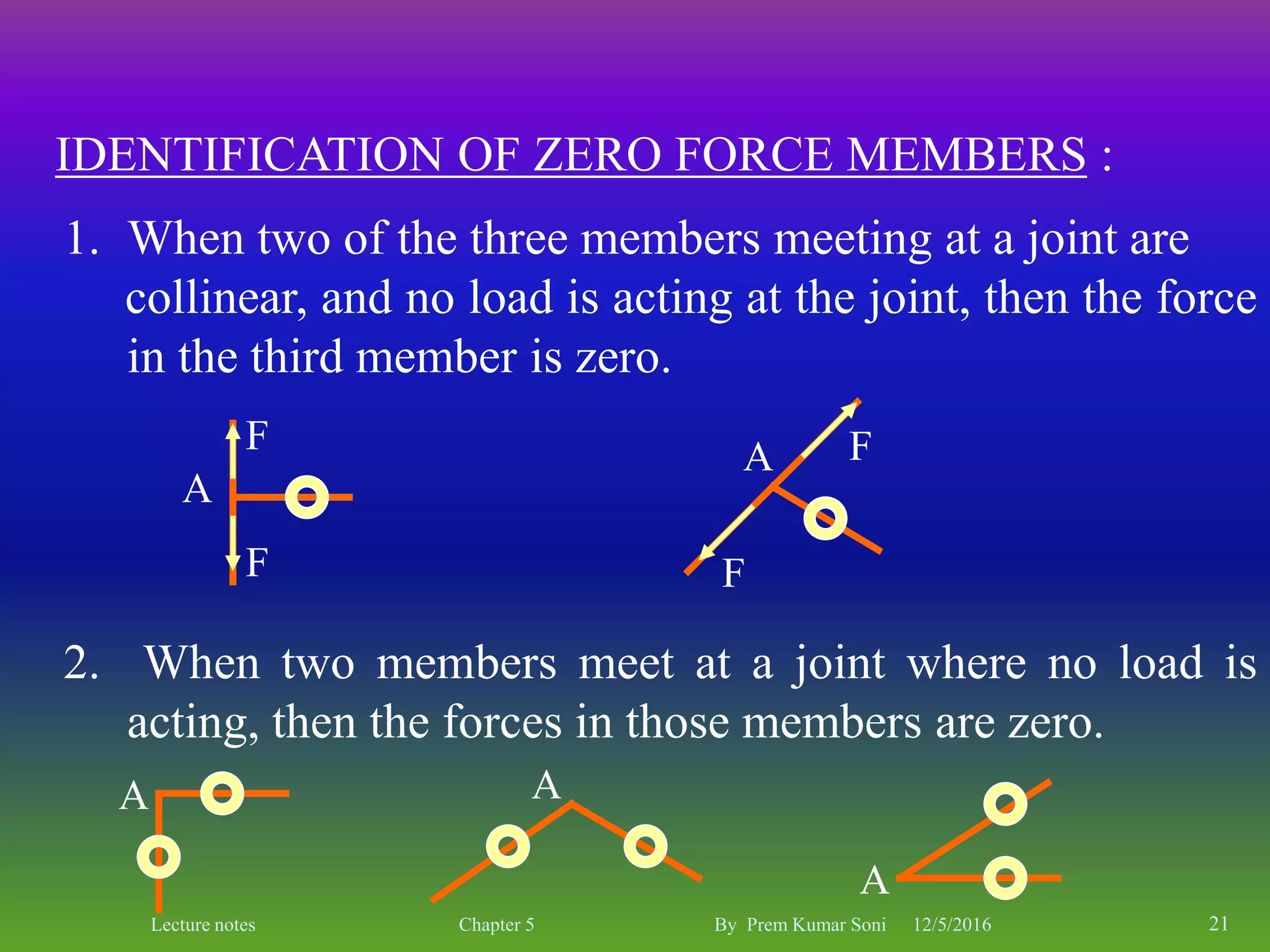
1. When two of the three members meeting at a joint are
collinear, and no load is acting at the joint, then the force
in the third member is zero.
A
A F
FF
F
2. When two members meet at a joint where no load is
acting, then the forces in those members are zero.
A A
A
12/5/2016 21Lecture notes Chapter 5 By Prem Kumar Soni
IDENTIFICATION OF ZERO FORCE MEMBERS :
(contd..)
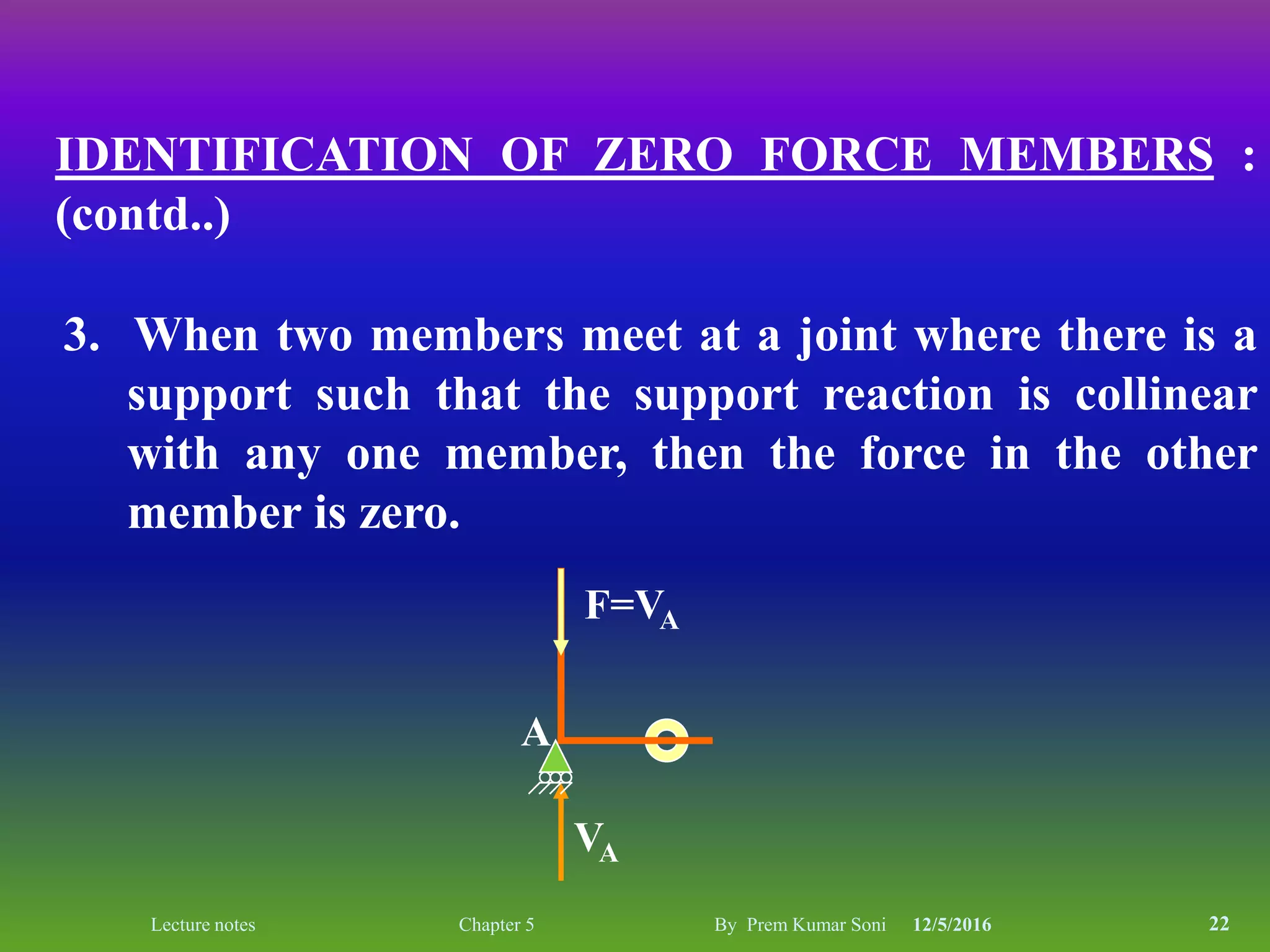
3. When two members meet at a joint where there is a
support such that the support reaction is collinear
with any one member, then the force in the other
member is zero.
VA
A
F=VA
12/5/2016 22Lecture notes Chapter 5 By Prem Kumar Soni
METHOD OF SECTIONS :
In this method we can directly determine the force in
any member without proceeding to that member by a
joint by joint analysis. The method is as follows :
 Determine the reactions at the supports of the truss given.
 Take an imaginary cutting plane through the truss,
dividing it into two parts, such that it passes through
members in which forces are required.
12/5/2016 23Lecture notes Chapter 5 By Prem Kumar Soni
METHOD OF SECTIONS : (contd..)
 The cutting plane should be taken in such a way that it cuts
a maximum of three members in which forces are unknown,
preferably.
 Now consider any one part to the left or right of the section,
and evaluate the unknowns by applying the conditions of
equilibrium for the coplanar non-concurrent force system
(H=0, V=0 and M=0).
12/5/2016 24Lecture notes Chapter 5 By Prem Kumar Soni
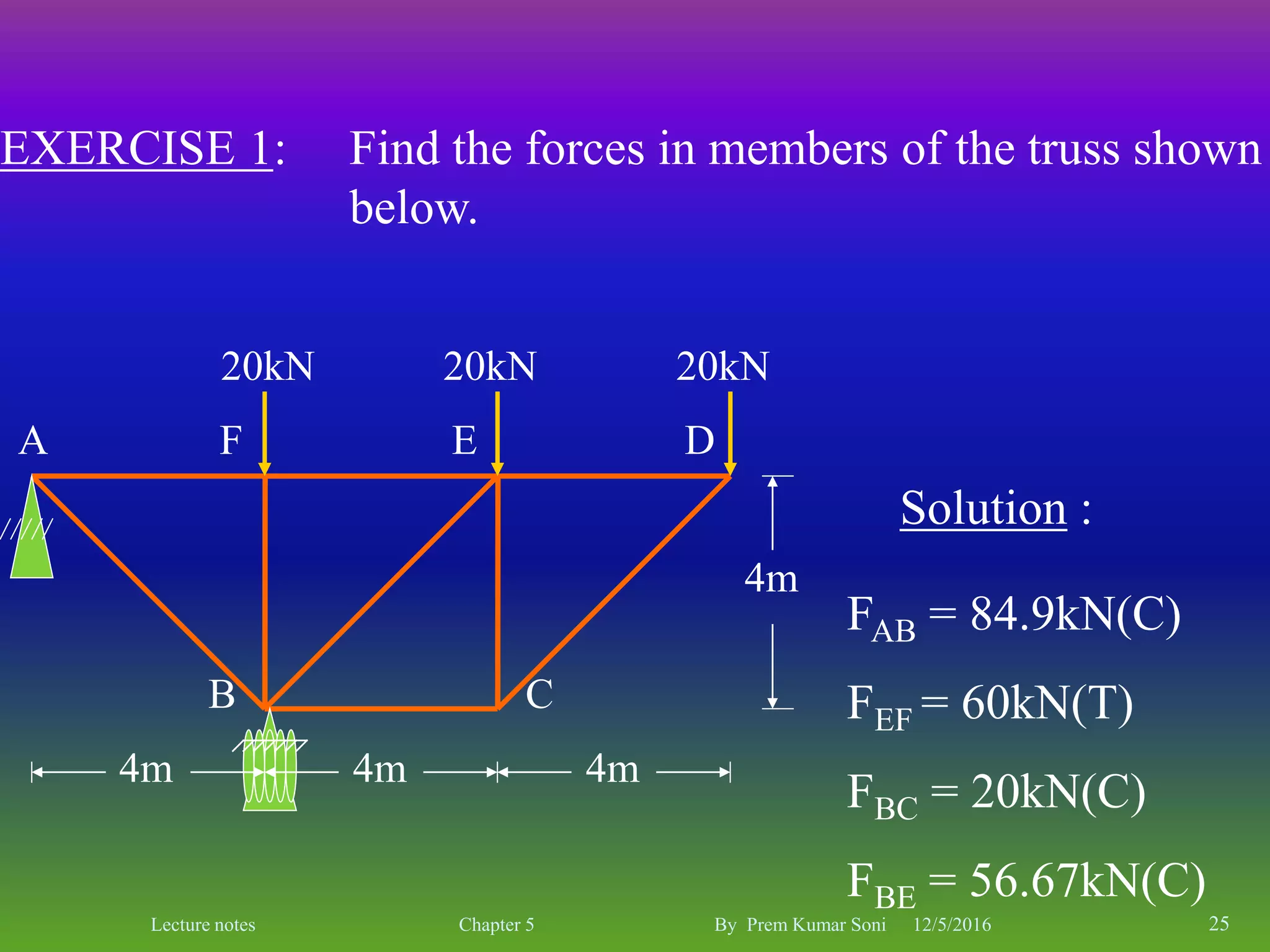
EXERCISE 1: Find the forces in members of the truss shown
below.
Solution :
FAB = 84.9kN(C)
FEF = 60kN(T)
FBC = 20kN(C)
FBE = 56.67kN(C)
20kN20kN 20kN
B
A
C
DEF
4m 4m 4m
4m
12/5/2016 25Lecture notes Chapter 5 By Prem Kumar Soni
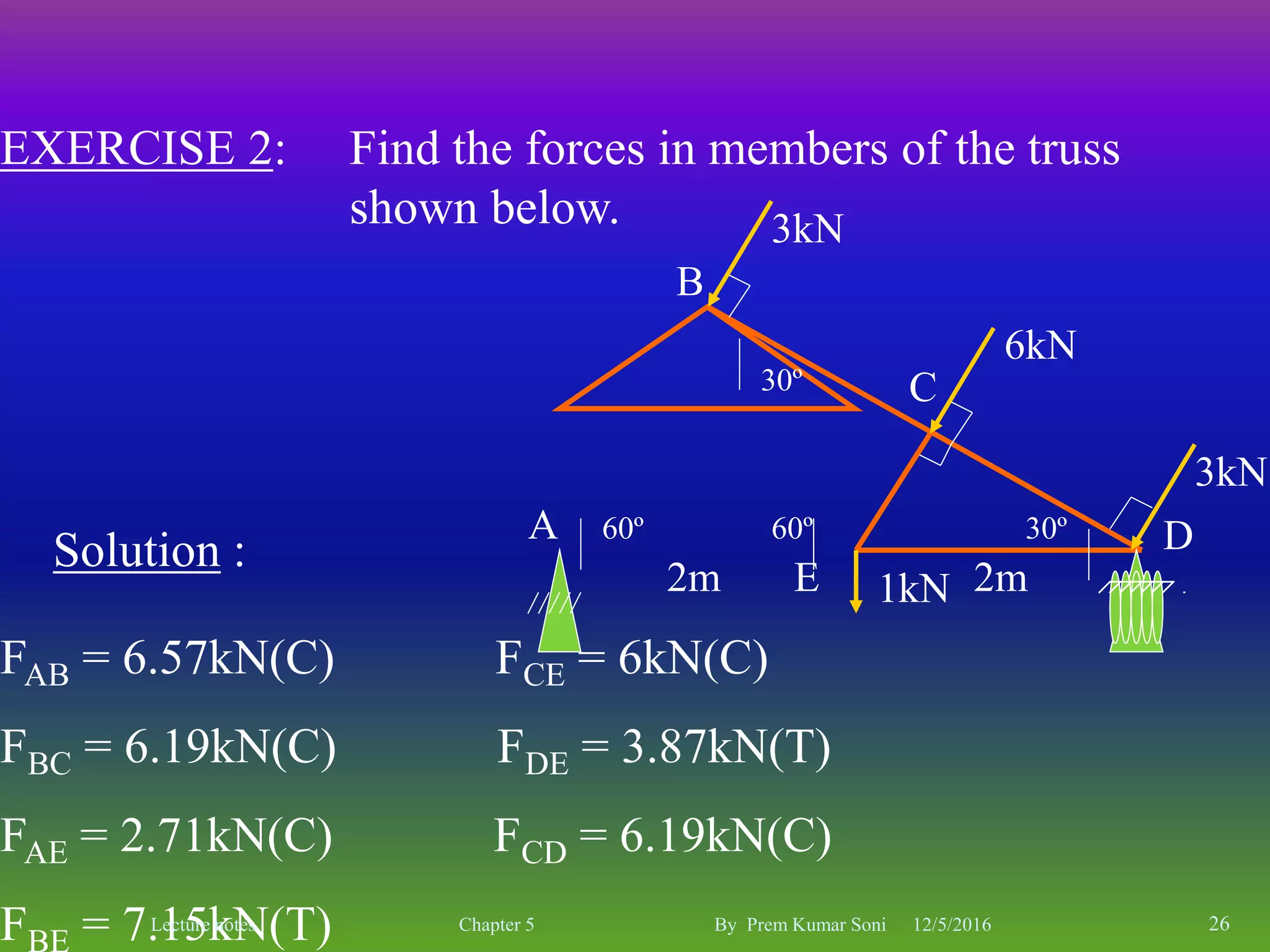
EXERCISE 2: Find the forces in members of the truss
shown below.
Solution :
FAB = 6.57kN(C) FCE = 6kN(C)
FBC = 6.19kN(C) FDE = 3.87kN(T)
FAE = 2.71kN(C) FCD = 6.19kN(C)
F = 7.15kN(T)
E2m 2m
60º 60º
30º
30º
3kN
6kN
3kN
A
B
C
D
1kN
12/5/2016 26Lecture notes Chapter 5 By Prem Kumar Soni
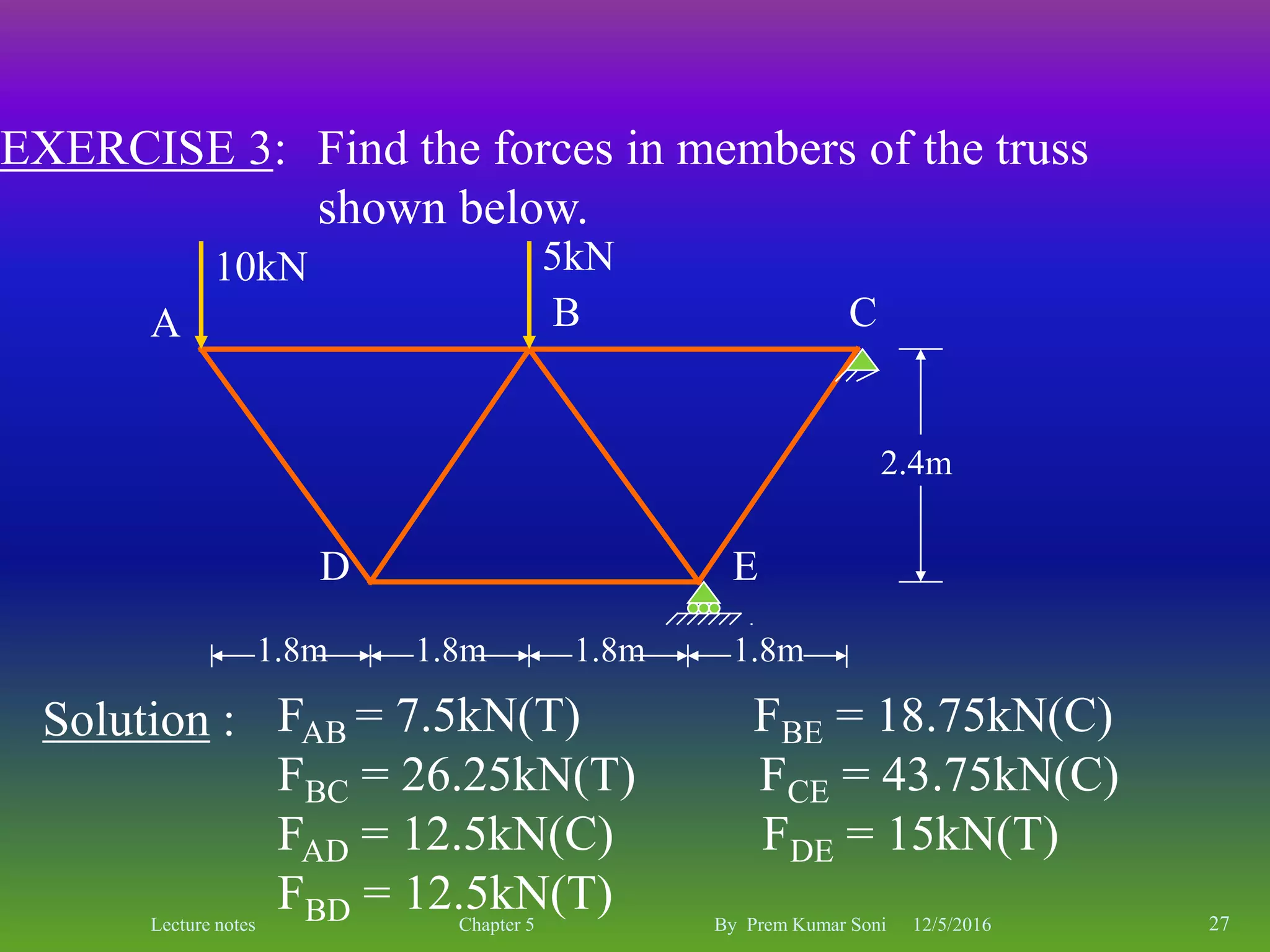
EXERCISE 3: Find the forces in members of the truss
shown below.
Solution : FAB = 7.5kN(T) FBE = 18.75kN(C)
FBC = 26.25kN(T) FCE = 43.75kN(C)
FAD = 12.5kN(C) FDE = 15kN(T)
FBD = 12.5kN(T)
BA C
D E
1.8m 1.8m
2.4m
10kN 5kN
1.8m 1.8m
12/5/2016 27Lecture notes Chapter 5 By Prem Kumar Soni
EXERCISE 4: Find the forces in members CE, CF and FH of th
truss shown below.
Solution : FCE = 10kN(T)
FCF = 7.07kN(C)
FFH =5kN(T)
20kN
3m 3m 3m 3m
A
B C
D
E
F
G
H
I
J
3m
12/5/2016 28Lecture notes Chapter 5 By Prem Kumar Soni
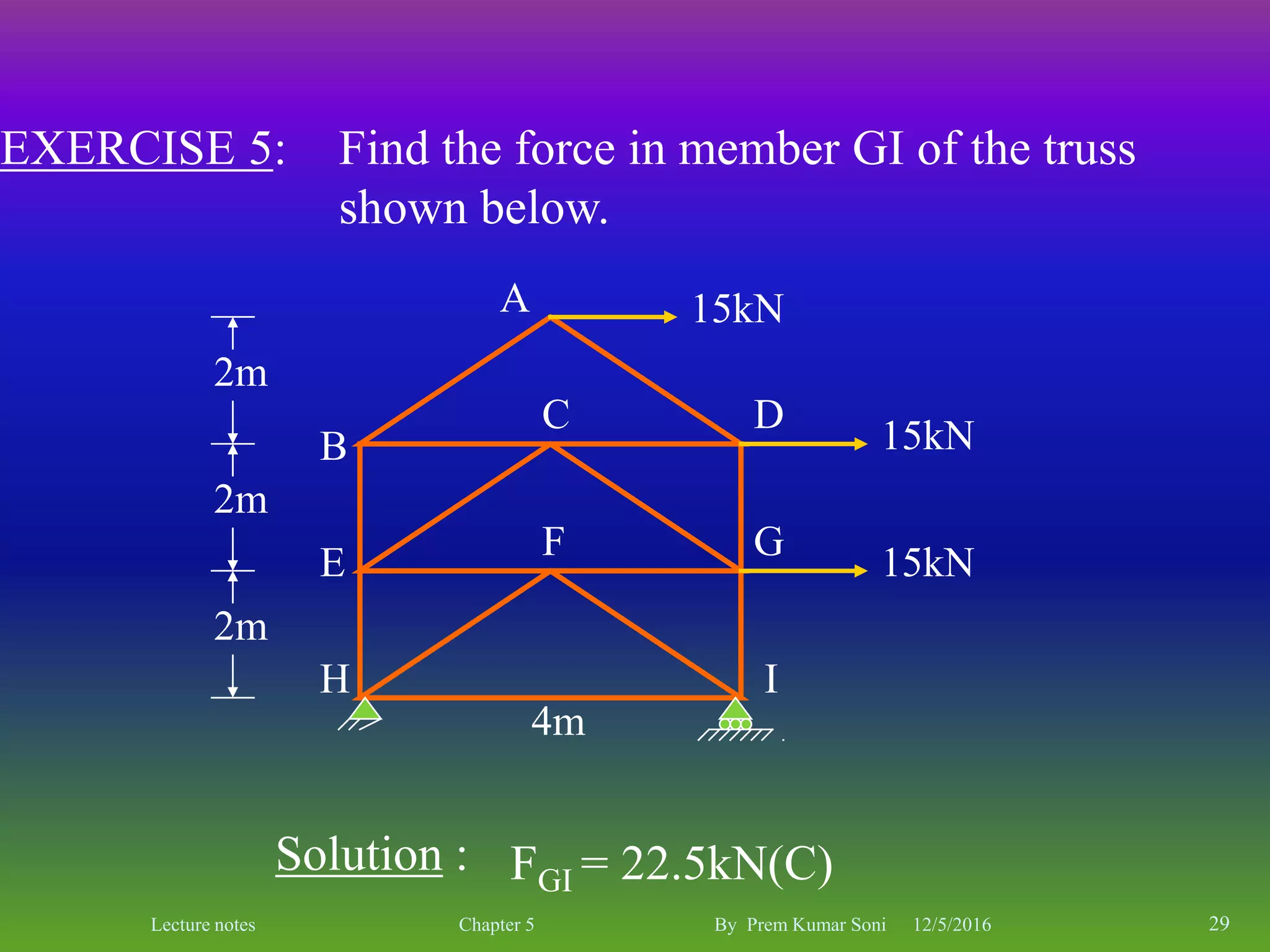
EXERCISE 5: Find the force in member GI of the truss
shown below.
Solution : FGI = 22.5kN(C)
A
B
C D
E
F G
H I
2m
2m
2m
4m
15kN
15kN
15kN
12/5/2016 29Lecture notes Chapter 5 By Prem Kumar Soni
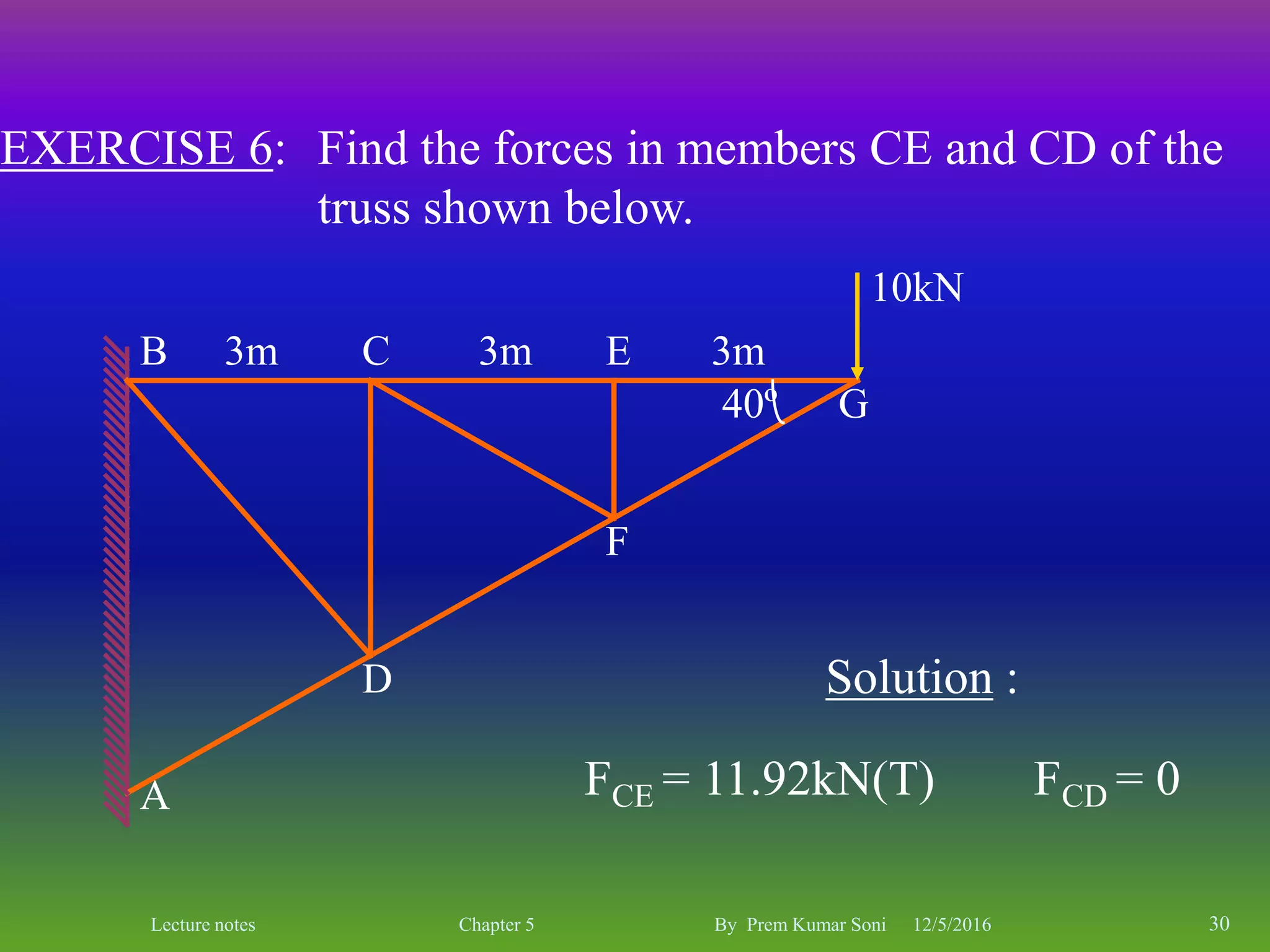
EXERCISE 6: Find the forces in members CE and CD of the
truss shown below.
Solution :
FCE = 11.92kN(T) FCD = 0A
B C
D
E
F
G40º
3m 3m3m
10kN
12/5/2016 30Lecture notes Chapter 5 By Prem Kumar Soni
EXERCISE 7: If force in member BC is 30kN(C), find
magnitude of load W.
Solution : W =10kN
A B C
DE
W W
a a
a
12/5/2016 31Lecture notes Chapter 5 By Prem Kumar Soni
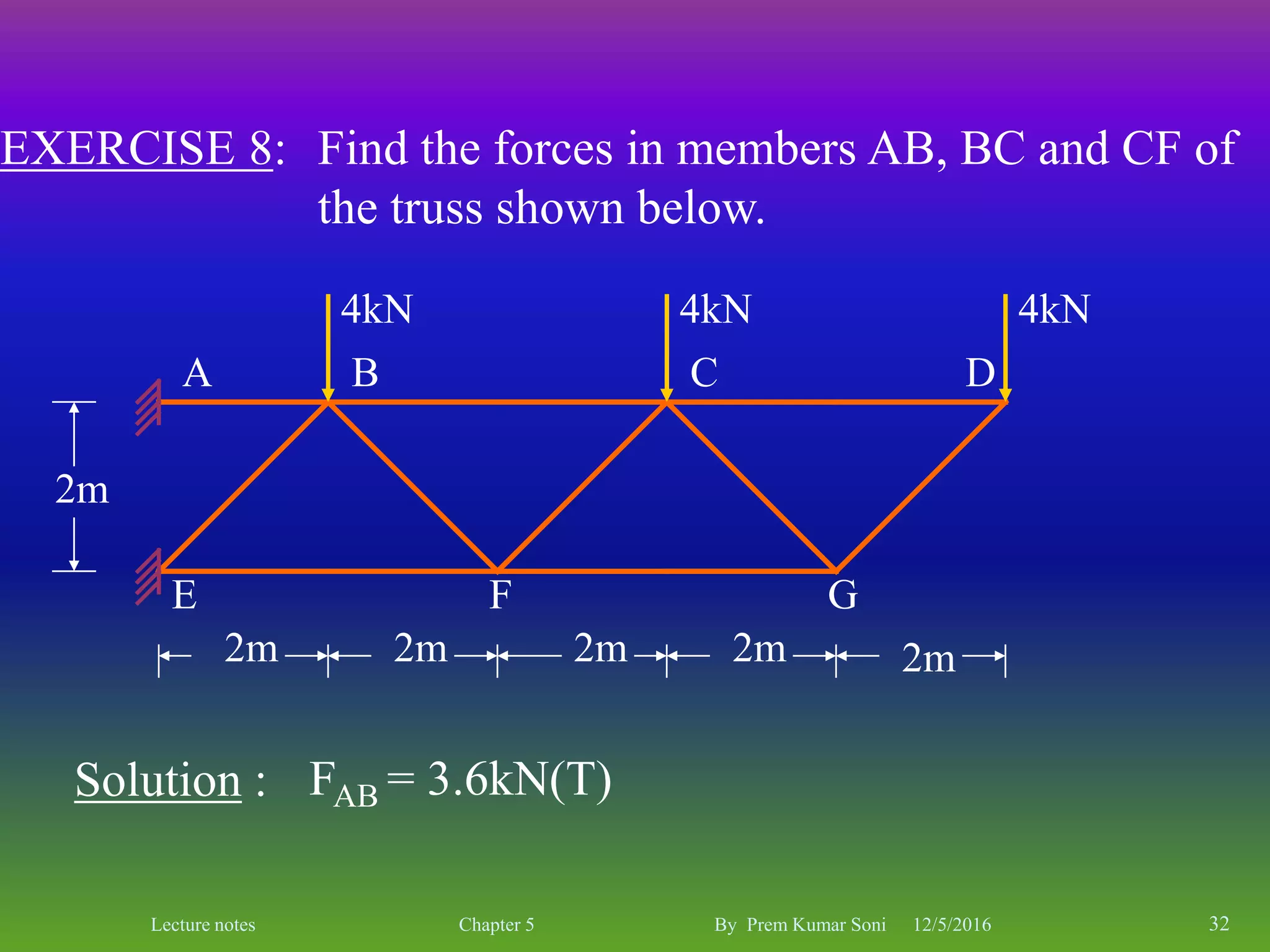
EXERCISE 8: Find the forces in members AB, BC and CF of
the truss shown below.
Solution : FAB = 3.6kN(T)
2m2m 2m 2m 2m
2m
4kN
A
4kN 4kN
B C D
E F G
12/5/2016 32Lecture notes Chapter 5 By Prem Kumar Soni
THANK YOU.
12/5/2016 33Lecture notes Chapter 5 By Prem Kumar Soni
12/5/2016 34Lecture notes Chapter 5 By Prem Kumar Soni

Truss

  • 1.
    Lecturenotes Prepared by Prem KumarSoni Asst. Prof. LNCT-S 12/5/2016 1Lecture notes Chapter 5 By Prem Kumar Soni
  • 2.
    TRUSSES 12/5/2016 2Lecture notesChapter 5 By Prem Kumar Soni
  • 3.
    CONTENTS : 1. Introduction. 2.Plane truss. 3. Statical determinacy and stability of trusses. 4. Analysis of statically determinate plane truss. 5. Sign conventions used. 6. Method of joints. 7. Identification of zero force members. 8. Examples on method of joints. 9. Method of sections. 10. Examples on method of sections. 11. Exercise problems. 12/5/2016 3Lecture notes Chapter 5 By Prem Kumar Soni
  • 4.
    INTRODUCTION : A trussis an articulated (skeletal) structure with hinged or ball and socket joints. It is an assemblage of slender bars fastened together at their ends by smooth pins or ball and socket joints acting as hinges. Plane truss: A truss consisting of members which lie in a plane and are loaded in the same plane is called a plane truss. Ex: Roof truss, bridge truss, etc. Space truss: A truss made up of members not lying in the same plane is referred to as space truss. Ex: Electric power transmission tower, microwave tower, etc. 12/5/2016 4 Lecture notes Chapter 5 By Prem Kumar Soni
  • 5.
    APPLICATIONS Plane Truss SpaceTruss Trussed Bridge Braced Frame 12/5/2016 5Lecture notes Chapter 5 By Prem Kumar Soni
  • 6.
    12/5/2016 6Lecture notesChapter 5 By Prem Kumar Soni
  • 7.
    Truss  In atruss, the joints are of pin type, where end of the members can rotate freely. Moreover, individual truss members should not directly loaded transversely; loads should be applied at the joints of members so that no bending or shear forces will be generated on truss members. Self-weight of the members should be dumped both end for the same reason. 12/5/2016Lecture notes Chapter 5 By Prem Kumar Soni 7
  • 8.
    Frame  Unlike truss,the members of frames are connected rigidly at joints, and individual members can carry transverse load, which may generate bending moment, shear forces along with axial forces. 12/5/2016Lecture notes Chapter 5 By Prem Kumar Soni 8
  • 9.
     Truss- Intruss, joints are of pin joint type and can freely rotate about the pin. So, they cannot transfer moments.  In practical, truss have no flexibility in joints.  Frame- In frame, joints are joined by welding abd bolting so they are rigid and cannot rotate freely. They can transfer moments as well as axial loads.  Frames are of 2types. Rigid non collapsible and non rigid collapsible. 12/5/2016Lecture notes Chapter 5 By Prem Kumar Soni 9
  • 10.
    The basic elementof a plane truss is three members (bars, angles,tubes,etc) arranged to form a triangle. To this base triangle, two more members are added to locate a new joint, and the process continued to form the complete truss. The truss built in such a manner is called as ‘Simple Truss’. PLANE TRUSS : 12/5/2016 10Lecture notes Chapter 5 By Prem Kumar Soni
  • 11.
    T T Tension Member Thefree body diagram of a member shows that it is acted upon by two equal and opposite forces. The hinged joint permits members to rotate with respect to each other and hence the members are subjected to purely axial forces. A truss is held in position by the supports and the loads are applied only at joints. 12/5/2016 11 Lecture notes Chapter 5 By Prem Kumar Soni
  • 12.
    Compression Member The conventionfor internal forces, i.e., the action of forces in the members on the joints is shown. TENSION COMPRESSION C C T C 12/5/2016 12Lecture notes Chapter 5 By Prem Kumar Soni
  • 13.
    STATICAL DETERMINACY ANDSTABILITY OF TRUSSES : Total number of unknowns = m + c Let m = number of unknown member forces. c = number of unknown constrained reaction components ( usually three, if statically determinate externally ) j = number of joints Each joint has two equations of equilibrium (H=0 and V=0). Hence number of equilibrium equations available = 2j. 12/5/2016 13Lecture notes Chapter 5 By Prem Kumar Soni
  • 14.
    If the numberof unknowns is less than the number of available equations, then the truss is unstable. If total number of unknowns is equal to total number of equations available, then the truss is statically determinate. If number of unknowns is more than the number of available equations, then the truss is statically indeterminate. i.e., m+c = 2j i.e., m+c > 2j i.e., m+c < 2j STATICAL DETERMINACY AND STABILITY OF TRUSSES : (contd..) 12/5/2016 14Lecture notes Chapter 5 By Prem Kumar Soni
  • 15.
    Degree of indeterminacy,i = (m+c) – 2j Degree of internal indeterminacy. ii = i – ie = m+3 – 2j Degree of external indeterminacy, ie = c – 3 STATICAL DETERMINACY AND STABILITY OF TRUSSES : (contd..) 12/5/2016 15Lecture notes Chapter 5 By Prem Kumar Soni
  • 16.
    (iii)When ii >0, number of members is more than the number required. Such a truss is called statically indeterminate or redundant truss. STATICAL DETERMINACY AND STABILITY OF TRUSSES : (contd..) (ii) When ii < 0, the number of members provided is less than that required for stability. Such a truss is called unstable or deficient truss. (i) When ii = 0, m = 2j – 3 and the structure is statically determinate internally and is stable. Such a truss is called a perfect truss. When we consider the internal indeterminacy, we have the following cases of truss: 12/5/2016 16Lecture notes Chapter 5 By Prem Kumar Soni
  • 17.
    STATICAL DETERMINACY ANDSTABILITY OF TRUSSES : (contd..) When we consider the external indeterminacy, we have the following cases of truss: (i) When c = 3 (=> ie = 0 ), the truss is said to be statically determinate externally. (ii) When c < 3 (=> ie < 0 ), the truss is said to be unstable externally. (iii)When c > 3 (=> ie > 0 ), the truss is said to be statically indeterminate externally. 12/5/2016 17Lecture notes Chapter 5 By Prem Kumar Soni
  • 18.
    ANALYSIS OF STATICALLYDETERMINATE PLANE TRUSS : The assumptions made in the analysis are as follows: The members of the truss are connected at the ends by frictionless hinges. The axes of all members lie in a single plane called ‘middle plane of the truss’. All the external forces acting on the truss are applied at the joints only. All the loads are applied in the plane of the truss. 12/5/2016 18Lecture notes Chapter 5 By Prem Kumar Soni
  • 19.
    The following methodsof analysis will be adopted : A.) Method of joints. B.) Method of sections. METHOD OF JOINTS : A member in a pin - jointed truss has only one internal force resultant i.e., the axial force. Hence the F.B.D of any joint is a concurrent system in equilibrium. SIGN CONVENTIONS USED : Positive sign is used for tension. Negative sign is used for compression. Clockwise moment ( )is taken positive and anti- clockwise moment ( ) is taken as negative. 12/5/2016 19 Lecture notes Chapter 5 By Prem Kumar Soni
  • 20.
    METHOD OF JOINTS: (contd..) The procedure for method of joints is as follows :  The support reactions of the truss are first obtained considering the three conditions of equilibrium, applied to the truss as a whole (H=0, V=0 and M=0).  Taking the F.B.D of a joint which has not more than two unknowns (preferably), and applying the equations of equilibrium for a coplanar concurrent force system (H=0 and V=0), the unknowns are evaluated.  The analysis is continued with the next joint with two unknowns (preferably), until the forces in all the members are obtained. 12/5/2016 20Lecture notes Chapter 5 By Prem Kumar Soni
  • 21.
    IDENTIFICATION OF ZEROFORCE MEMBERS : 1. When two of the three members meeting at a joint are collinear, and no load is acting at the joint, then the force in the third member is zero. A A F FF F 2. When two members meet at a joint where no load is acting, then the forces in those members are zero. A A A 12/5/2016 21Lecture notes Chapter 5 By Prem Kumar Soni
  • 22.
    IDENTIFICATION OF ZEROFORCE MEMBERS : (contd..) 3. When two members meet at a joint where there is a support such that the support reaction is collinear with any one member, then the force in the other member is zero. VA A F=VA 12/5/2016 22Lecture notes Chapter 5 By Prem Kumar Soni
  • 23.
    METHOD OF SECTIONS: In this method we can directly determine the force in any member without proceeding to that member by a joint by joint analysis. The method is as follows :  Determine the reactions at the supports of the truss given.  Take an imaginary cutting plane through the truss, dividing it into two parts, such that it passes through members in which forces are required. 12/5/2016 23Lecture notes Chapter 5 By Prem Kumar Soni
  • 24.
    METHOD OF SECTIONS: (contd..)  The cutting plane should be taken in such a way that it cuts a maximum of three members in which forces are unknown, preferably.  Now consider any one part to the left or right of the section, and evaluate the unknowns by applying the conditions of equilibrium for the coplanar non-concurrent force system (H=0, V=0 and M=0). 12/5/2016 24Lecture notes Chapter 5 By Prem Kumar Soni
  • 25.
    EXERCISE 1: Findthe forces in members of the truss shown below. Solution : FAB = 84.9kN(C) FEF = 60kN(T) FBC = 20kN(C) FBE = 56.67kN(C) 20kN20kN 20kN B A C DEF 4m 4m 4m 4m 12/5/2016 25Lecture notes Chapter 5 By Prem Kumar Soni
  • 26.
    EXERCISE 2: Findthe forces in members of the truss shown below. Solution : FAB = 6.57kN(C) FCE = 6kN(C) FBC = 6.19kN(C) FDE = 3.87kN(T) FAE = 2.71kN(C) FCD = 6.19kN(C) F = 7.15kN(T) E2m 2m 60º 60º 30º 30º 3kN 6kN 3kN A B C D 1kN 12/5/2016 26Lecture notes Chapter 5 By Prem Kumar Soni
  • 27.
    EXERCISE 3: Findthe forces in members of the truss shown below. Solution : FAB = 7.5kN(T) FBE = 18.75kN(C) FBC = 26.25kN(T) FCE = 43.75kN(C) FAD = 12.5kN(C) FDE = 15kN(T) FBD = 12.5kN(T) BA C D E 1.8m 1.8m 2.4m 10kN 5kN 1.8m 1.8m 12/5/2016 27Lecture notes Chapter 5 By Prem Kumar Soni
  • 28.
    EXERCISE 4: Findthe forces in members CE, CF and FH of th truss shown below. Solution : FCE = 10kN(T) FCF = 7.07kN(C) FFH =5kN(T) 20kN 3m 3m 3m 3m A B C D E F G H I J 3m 12/5/2016 28Lecture notes Chapter 5 By Prem Kumar Soni
  • 29.
    EXERCISE 5: Findthe force in member GI of the truss shown below. Solution : FGI = 22.5kN(C) A B C D E F G H I 2m 2m 2m 4m 15kN 15kN 15kN 12/5/2016 29Lecture notes Chapter 5 By Prem Kumar Soni
  • 30.
    EXERCISE 6: Findthe forces in members CE and CD of the truss shown below. Solution : FCE = 11.92kN(T) FCD = 0A B C D E F G40º 3m 3m3m 10kN 12/5/2016 30Lecture notes Chapter 5 By Prem Kumar Soni
  • 31.
    EXERCISE 7: Ifforce in member BC is 30kN(C), find magnitude of load W. Solution : W =10kN A B C DE W W a a a 12/5/2016 31Lecture notes Chapter 5 By Prem Kumar Soni
  • 32.
    EXERCISE 8: Findthe forces in members AB, BC and CF of the truss shown below. Solution : FAB = 3.6kN(T) 2m2m 2m 2m 2m 2m 4kN A 4kN 4kN B C D E F G 12/5/2016 32Lecture notes Chapter 5 By Prem Kumar Soni
  • 33.
    THANK YOU. 12/5/2016 33Lecturenotes Chapter 5 By Prem Kumar Soni
  • 34.
    12/5/2016 34Lecture notesChapter 5 By Prem Kumar Soni