BEAM
HORIZONTAL STRUCTRAL MEMBER
PREPARED BY: TEMOOR ABBAS
APPLIED AND REACTIVE FORCES
 Forces that act on a Body can be divided into
two Primary types: applied and reactive.
 In common Engineering usage, applied forces are
forces that act directly on a structure like, dead,
live load etc.)
 Reactive forces are forces generated by the action
of one body on another and hence typically occur
at connections or supports.
 The existence of reactive forces follows from
Newton’s third law, which state that to every
action , there is an equal and opposite reaction.
SUPPORTS
To bear or hold up (a load, mass, structure, part, etc.);
serve as a foundation or base for any structure.
To sustain or withstand (weight, pressure, strain, etc.)
without giving way
It is a aid or assistance to any structure by preserve its load
Supports are used to connect structures to the ground or
other bodies in order to restrict (confine) their movements
under the applied loads. The loads tend to move the
structures, but supports prevent the movements by exerting
opposing forces, or reactions, to neutralize the effects of
loads thereby keeping the structures in equilibrium.
TYPES OF SUPPORTS
 Supports are grouped into three categories,
depending on the number of reactions
( 1,2,or3) they exert on the structures.
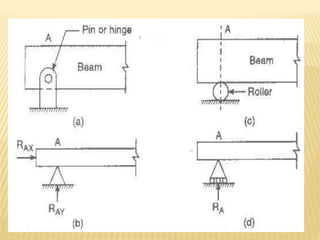
 1) Roller support
 2) Hinge support
 3) fixed support
ROLLER SUPPORT
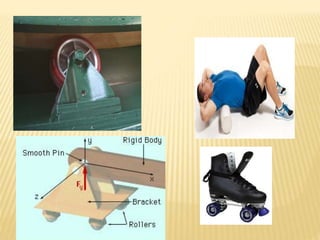
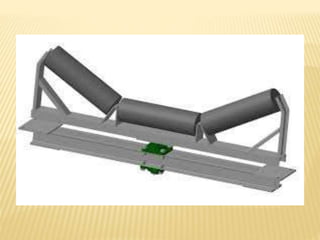
 Roller supports are free to rotate and
translate along the surface upon which the
roller rests.
 The surface can be horizontal, vertical, or
sloped at any angle.
 The resulting reaction force is always a
single force that is perpendicular to, and
away from, the surface
Restrains the structure from moving in one or two perpendicular directions.
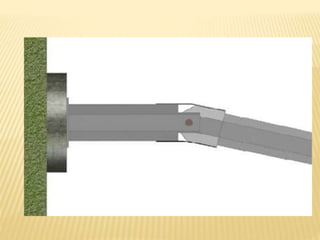
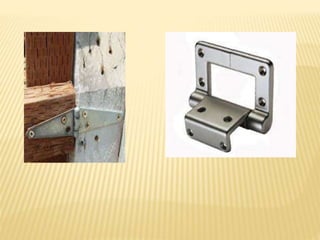
HINGE SUPPORT
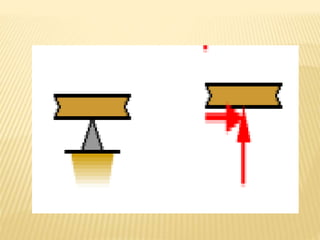
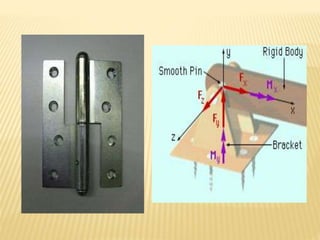
 A Hinge support can resist both vertical and
horizontal forces but not a moment. They will allow
the structural member to rotate, but not to translate
in any direction
 Pin or hinge support is used when we need to
prevent the structure from moving or restrain its
translational degrees of freedom.
 A hinge is a type of bearing that connects two solid
objects, typically allowing only a limited angle of
rotation between them. Two objects connected by an
ideal hinge rotate relative to each other about a
fixed axis of rotation.
FIXED SUPPORT
 Fixed supports can resist vertical and
horizontal forces as well as a moment. Since
they restrain both rotation and translation,
they are also known as rigid supports.
BEAM
 A beam is a structural member (horizontal)
that is design to support the applied load
(vertical). It resists the applied loading by a
combination of internal transverse shear
force and bending moment.
 It is perhaps the most important and widely
used structural members and can be
classified according to its support conditions.
 Extremely common structural element
 In buildings majority of loads are vertical and
majority of useable surfaces are horizontal
1/39
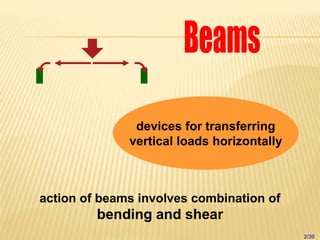
devices for transferring
vertical loads horizontally
action of beams involves combination of
bending and shear
2/39
TYPES OF BEAMS
 The following are the important types of
beams:
 1. Cantilever
 2. simply supported
 3. overhanging
 4. Fixed beams
 5. Continuous beam
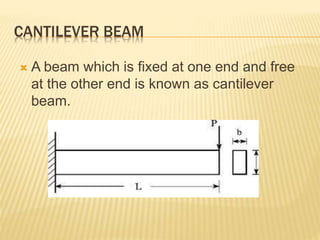
CANTILEVER BEAM
 A beam which is fixed at one end and free
at the other end is known as cantilever
beam.
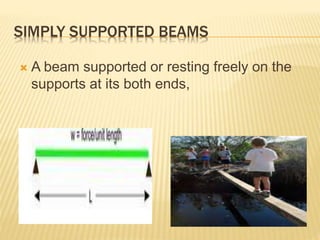
SIMPLY SUPPORTED BEAMS
 A beam supported or resting freely on the
supports at its both ends,
FIXED BEAMS
 A beam whose both ends are fixed and is
restrained against rotation and vertical
movement. Also known as built-in beam or
encastred beam.
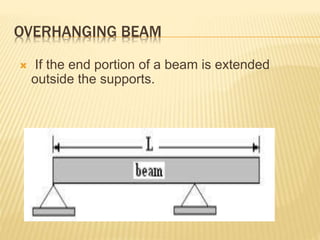
OVERHANGING BEAM
 If the end portion of a beam is extended
outside the supports.
CONTINUOUS BEAMS
 A beam which is provided with more than
two supports.
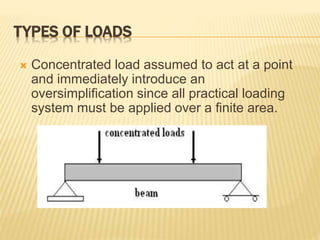
TYPES OF LOADS
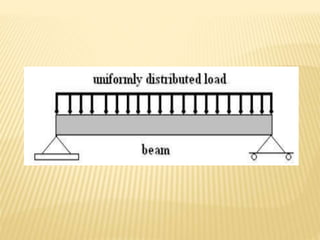
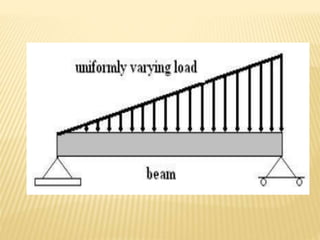
 Concentrated load assumed to act at a point
and immediately introduce an
oversimplification since all practical loading
system must be applied over a finite area.
 Point loads, from concentrated loads or other beams
 Distributed loads, from anything continuous
Distributed Load
10/39
Point Load
Reactions
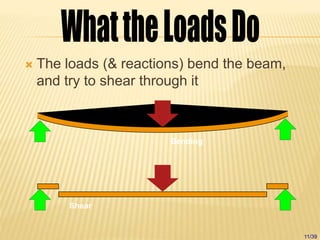
 The loads (& reactions) bend the beam,
and try to shear through it
Bending
Shear
11/39
12/39
e
Bending
e
e
e
C
T
Shear
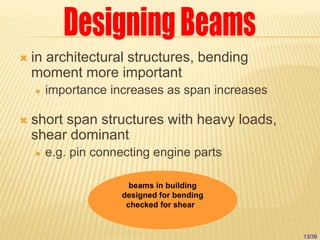
 in architectural structures, bending
moment more important
● importance increases as span increases
 short span structures with heavy loads,
shear dominant
● e.g. pin connecting engine parts
beams in building
designed for bending
checked for shear
13/39
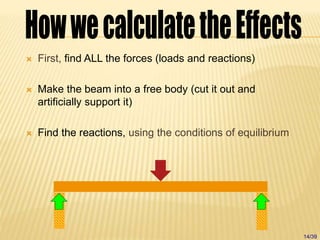
 First, find ALL the forces (loads and reactions)
 Make the beam into a free body (cut it out and
artificially support it)
 Find the reactions, using the conditions of equilibrium
14/39
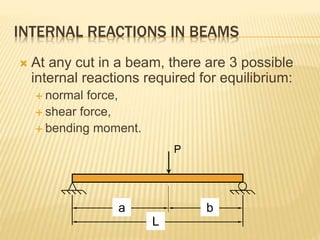
INTERNAL REACTIONS IN BEAMS
 At any cut in a beam, there are 3 possible
internal reactions required for equilibrium:
 normal force,
 shear force,
 bending moment.
L
P
a b
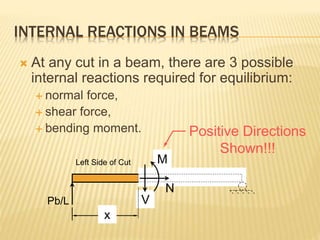
INTERNAL REACTIONS IN BEAMS
 At any cut in a beam, there are 3 possible
internal reactions required for equilibrium:
 normal force,
 shear force,
 bending moment.
Pb/L
x
Left Side of Cut
V
M
N
Positive Directions
Shown!!!
INTERNAL REACTIONS IN BEAMS
 At any cut in a beam, there are 3 possible
internal reactions required for equilibrium:
 normal force,
 shear force,
 bending moment.
Pa/L
L - x
Right Side of CutVM
N
Positive Directions
Shown!!!
SHEAR FORCES, BENDING MOMENTS -
SIGN CONVENTIONS
Shear forces:
Bending moments:
left section right section
positive shear:
negative shear:
Negative moment
positive moment
C.W
ACW
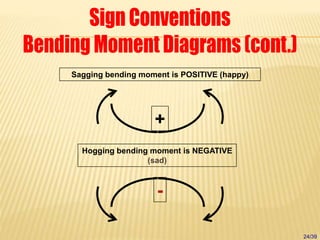
Sagging bending moment is POSITIVE (happy)
+
Hogging bending moment is NEGATIVE
(sad)
-
24/39
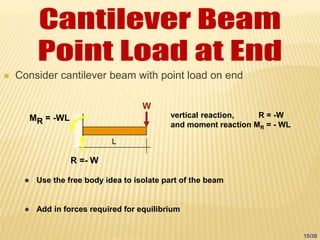
 Consider cantilever beam with point load on end
W
L
R =- W
MR = -WL vertical reaction, R = -W
and moment reaction MR = - WL
 Use the free body idea to isolate part of the beam
 Add in forces required for equilibrium
15/39
Take section anywhere at distance, x from end
Shear V =- W constant along length
Add in forces, V = -W and moment M = - Wx
V = -W
Shear Force Diagram
Bending Moment BM = -W.x
when x = L BM = -WL
when x = 0 BM = 0 Bending Moment Diagram
BM = WL
BM = -Wx
x
W
V = -W
M = -Wx
16/39
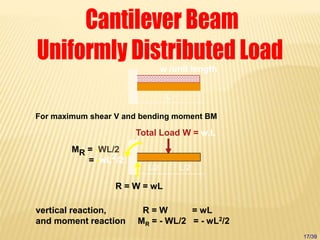
For maximum shear V and bending moment BM
L
w /unit length
vertical reaction, R = W = wL
and moment reaction MR = - WL/2 = - wL2/2
Total Load W = w.L
L/2 L/2
R = W = wL
MR = -WL/2
= -wL2/2
17/39
Take section anywhere at distance, x from end
Shear V = wx
when x = L V = W = wL
when x = 0 V = 0
Add in forces, V = w.x and moment M = - wx.x/2
Bending Moment BM = w.x2/2
when x = L BM = wL2/2 = WL/2
when x = 0 BM = 0
(parabolic)
V = wL
= W
Shear Force Diagram
X/2
wx
X/2
For distributed V and BM
V = wx
M = -wx2/2
Bending Moment Diagram
BM = wL2/2
= WL/2
BM = wx /2
2
18/39
Shear force and bending moment

Shear force and bending moment

  • 1.
  • 2.
    APPLIED AND REACTIVEFORCES  Forces that act on a Body can be divided into two Primary types: applied and reactive.  In common Engineering usage, applied forces are forces that act directly on a structure like, dead, live load etc.)  Reactive forces are forces generated by the action of one body on another and hence typically occur at connections or supports.  The existence of reactive forces follows from Newton’s third law, which state that to every action , there is an equal and opposite reaction.
  • 3.
    SUPPORTS To bear orhold up (a load, mass, structure, part, etc.); serve as a foundation or base for any structure. To sustain or withstand (weight, pressure, strain, etc.) without giving way It is a aid or assistance to any structure by preserve its load Supports are used to connect structures to the ground or other bodies in order to restrict (confine) their movements under the applied loads. The loads tend to move the structures, but supports prevent the movements by exerting opposing forces, or reactions, to neutralize the effects of loads thereby keeping the structures in equilibrium.
  • 4.
    TYPES OF SUPPORTS Supports are grouped into three categories, depending on the number of reactions ( 1,2,or3) they exert on the structures.  1) Roller support  2) Hinge support  3) fixed support
  • 5.
    ROLLER SUPPORT  Rollersupports are free to rotate and translate along the surface upon which the roller rests.  The surface can be horizontal, vertical, or sloped at any angle.  The resulting reaction force is always a single force that is perpendicular to, and away from, the surface
  • 6.
    Restrains the structurefrom moving in one or two perpendicular directions.
  • 10.
    HINGE SUPPORT  AHinge support can resist both vertical and horizontal forces but not a moment. They will allow the structural member to rotate, but not to translate in any direction  Pin or hinge support is used when we need to prevent the structure from moving or restrain its translational degrees of freedom.  A hinge is a type of bearing that connects two solid objects, typically allowing only a limited angle of rotation between them. Two objects connected by an ideal hinge rotate relative to each other about a fixed axis of rotation.
  • 16.
    FIXED SUPPORT  Fixedsupports can resist vertical and horizontal forces as well as a moment. Since they restrain both rotation and translation, they are also known as rigid supports.
  • 19.
    BEAM  A beamis a structural member (horizontal) that is design to support the applied load (vertical). It resists the applied loading by a combination of internal transverse shear force and bending moment.  It is perhaps the most important and widely used structural members and can be classified according to its support conditions.
  • 20.
     Extremely commonstructural element  In buildings majority of loads are vertical and majority of useable surfaces are horizontal 1/39
  • 21.
    devices for transferring verticalloads horizontally action of beams involves combination of bending and shear 2/39
  • 22.
    TYPES OF BEAMS The following are the important types of beams:  1. Cantilever  2. simply supported  3. overhanging  4. Fixed beams  5. Continuous beam
  • 23.
    CANTILEVER BEAM  Abeam which is fixed at one end and free at the other end is known as cantilever beam.
  • 25.
    SIMPLY SUPPORTED BEAMS A beam supported or resting freely on the supports at its both ends,
  • 26.
    FIXED BEAMS  Abeam whose both ends are fixed and is restrained against rotation and vertical movement. Also known as built-in beam or encastred beam.
  • 27.
    OVERHANGING BEAM  Ifthe end portion of a beam is extended outside the supports.
  • 29.
    CONTINUOUS BEAMS  Abeam which is provided with more than two supports.
  • 30.
    TYPES OF LOADS Concentrated load assumed to act at a point and immediately introduce an oversimplification since all practical loading system must be applied over a finite area.
  • 31.
     Point loads,from concentrated loads or other beams  Distributed loads, from anything continuous Distributed Load 10/39 Point Load Reactions
  • 34.
     The loads(& reactions) bend the beam, and try to shear through it Bending Shear 11/39
  • 35.
  • 36.
     in architecturalstructures, bending moment more important ● importance increases as span increases  short span structures with heavy loads, shear dominant ● e.g. pin connecting engine parts beams in building designed for bending checked for shear 13/39
  • 37.
     First, findALL the forces (loads and reactions)  Make the beam into a free body (cut it out and artificially support it)  Find the reactions, using the conditions of equilibrium 14/39
  • 38.
    INTERNAL REACTIONS INBEAMS  At any cut in a beam, there are 3 possible internal reactions required for equilibrium:  normal force,  shear force,  bending moment. L P a b
  • 39.
    INTERNAL REACTIONS INBEAMS  At any cut in a beam, there are 3 possible internal reactions required for equilibrium:  normal force,  shear force,  bending moment. Pb/L x Left Side of Cut V M N Positive Directions Shown!!!
  • 40.
    INTERNAL REACTIONS INBEAMS  At any cut in a beam, there are 3 possible internal reactions required for equilibrium:  normal force,  shear force,  bending moment. Pa/L L - x Right Side of CutVM N Positive Directions Shown!!!
  • 41.
    SHEAR FORCES, BENDINGMOMENTS - SIGN CONVENTIONS Shear forces: Bending moments: left section right section positive shear: negative shear: Negative moment positive moment C.W ACW
  • 42.
    Sagging bending momentis POSITIVE (happy) + Hogging bending moment is NEGATIVE (sad) - 24/39
  • 43.
     Consider cantileverbeam with point load on end W L R =- W MR = -WL vertical reaction, R = -W and moment reaction MR = - WL  Use the free body idea to isolate part of the beam  Add in forces required for equilibrium 15/39
  • 44.
    Take section anywhereat distance, x from end Shear V =- W constant along length Add in forces, V = -W and moment M = - Wx V = -W Shear Force Diagram Bending Moment BM = -W.x when x = L BM = -WL when x = 0 BM = 0 Bending Moment Diagram BM = WL BM = -Wx x W V = -W M = -Wx 16/39
  • 45.
    For maximum shearV and bending moment BM L w /unit length vertical reaction, R = W = wL and moment reaction MR = - WL/2 = - wL2/2 Total Load W = w.L L/2 L/2 R = W = wL MR = -WL/2 = -wL2/2 17/39
  • 46.
    Take section anywhereat distance, x from end Shear V = wx when x = L V = W = wL when x = 0 V = 0 Add in forces, V = w.x and moment M = - wx.x/2 Bending Moment BM = w.x2/2 when x = L BM = wL2/2 = WL/2 when x = 0 BM = 0 (parabolic) V = wL = W Shear Force Diagram X/2 wx X/2 For distributed V and BM V = wx M = -wx2/2 Bending Moment Diagram BM = wL2/2 = WL/2 BM = wx /2 2 18/39