Deflection of BeamsChapter 9
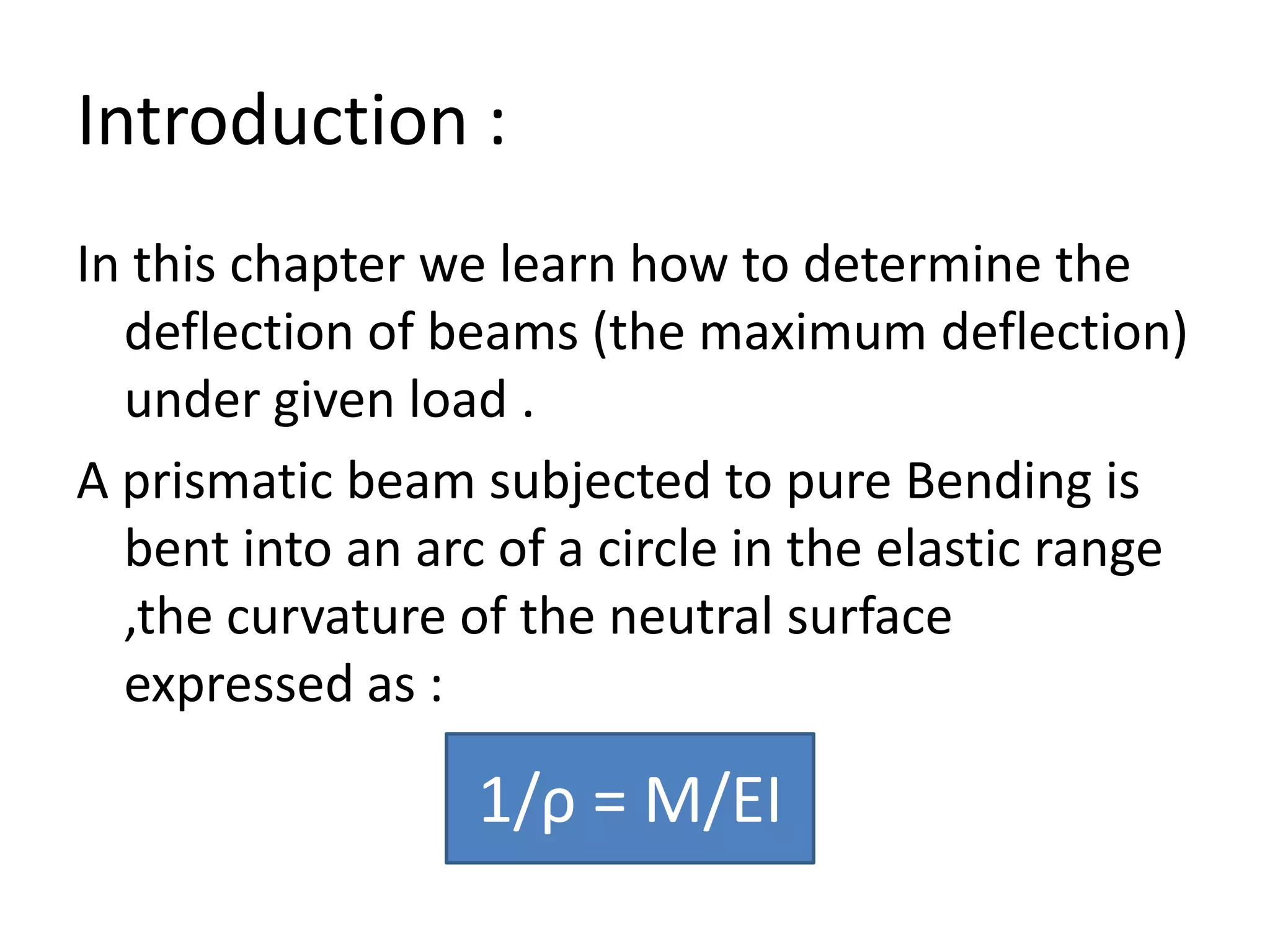
Introduction :In this chapter we learn how to determine the deflection of beams (the maximum deflection) under given load .A prismatic beam subjected to pure Bending is bent into an arc of a circle in the elastic range ,the curvature of the neutral surface expressed as :1/ρ = M/EI
Where , M is the bending Moment	   , E is the modulus of elasticity	   , I is the moment of inertia of the cross section about it’s neutral axis .
Both the Moment “M” & the Curvature of neutral axis “1/ρ” will vary denoting by the distance of the section from the left of the beam “x” .We write 1/ρ = M(x)/EI
We notice that the deflection at the ends y = 0       due to supportsdy/dx = 0 at A,B ,also dy/dx = 0 at the max. deflectionDeflection
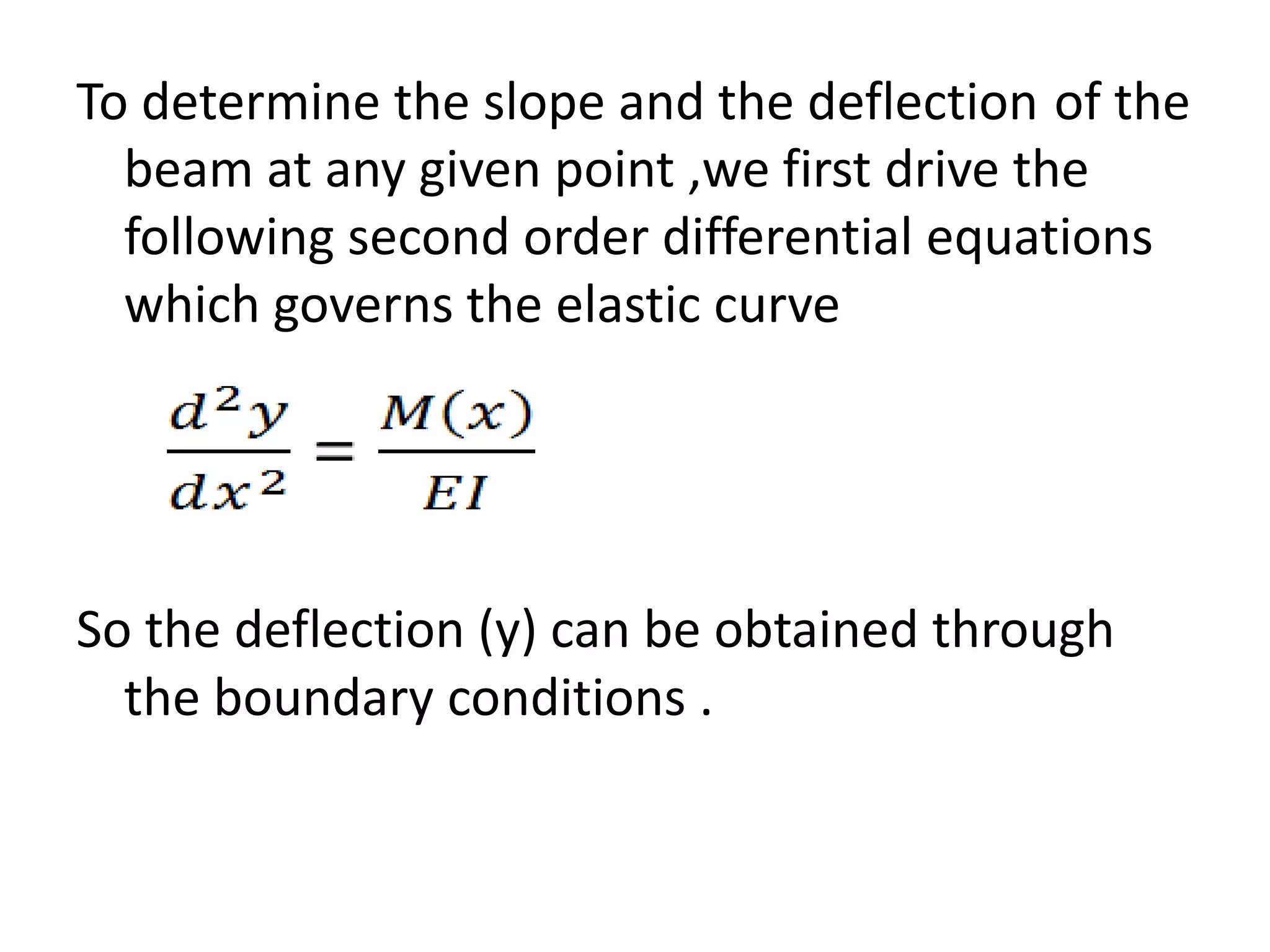
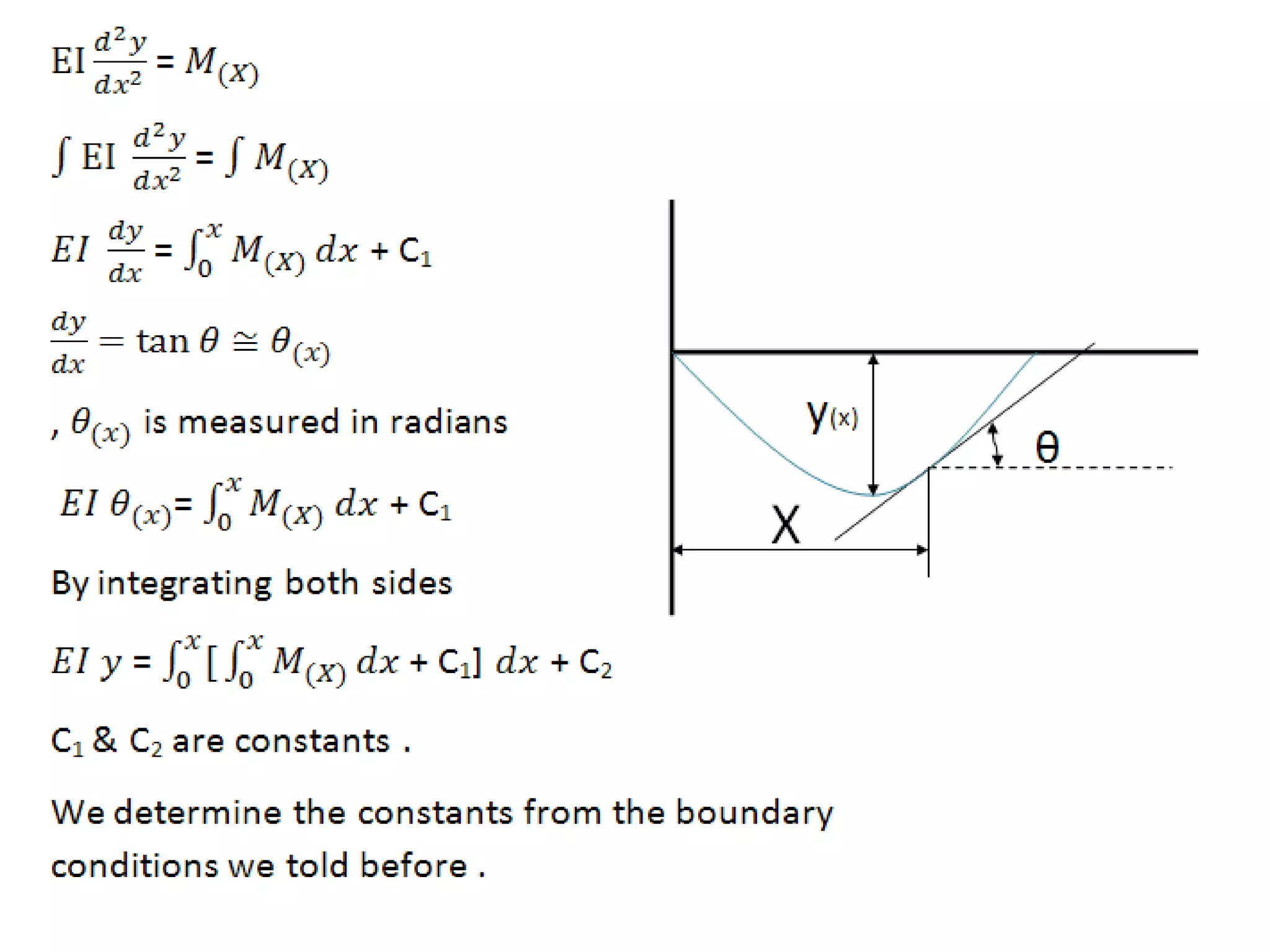
To determine the slope and the deflectionof the beam at any given point ,we first drive the following second order differential equations which governs the elastic curveSo the deflection (y) can be obtained through the boundary conditions .
In the next fig. two differential equations are required due to the effective force (p) at point (D) .One for the portion (AD) ,the other one for the portion (DB) .PD
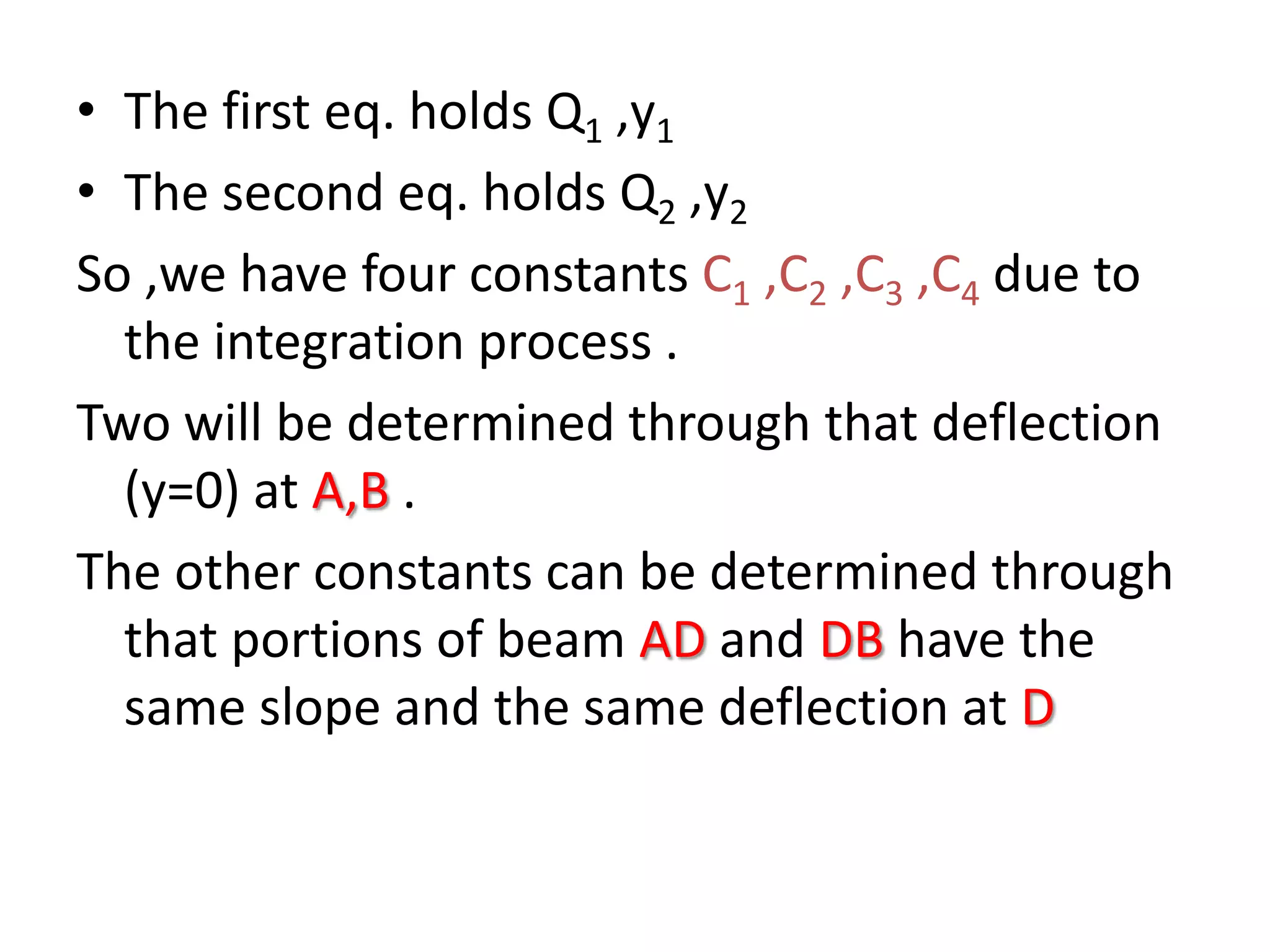
The first eq. holds Q1 ,y1The second eq. holds Q2 ,y2So ,we have four constants C1 ,C2 ,C3 ,C4 due to the integration process .Two will be determined through that deflection (y=0) at A,B .The other constants can be determined through that portions of beam AD and DB have the same slope and the same deflection at D
If we took an exampleM(X) = -PxWe notice that the radius of curvature “ρ” = ∞ ,so that M = 0PBALPBA
P2P1CAlso we can conclude from the next example , P1>P2We notice that +ve M so that the elastic curve is concaved downward .ADB+ve M-ve MElastic curveQ(x,y)
Equation of elastic curve:We know the curvature of a plane curve at point Q(x,y) is expressed asWhere       ,     are the 1st & 2nd derivatives of a function y(x) represented by a curve ,the slope	is so small and it’s square is negligible ,so we get that
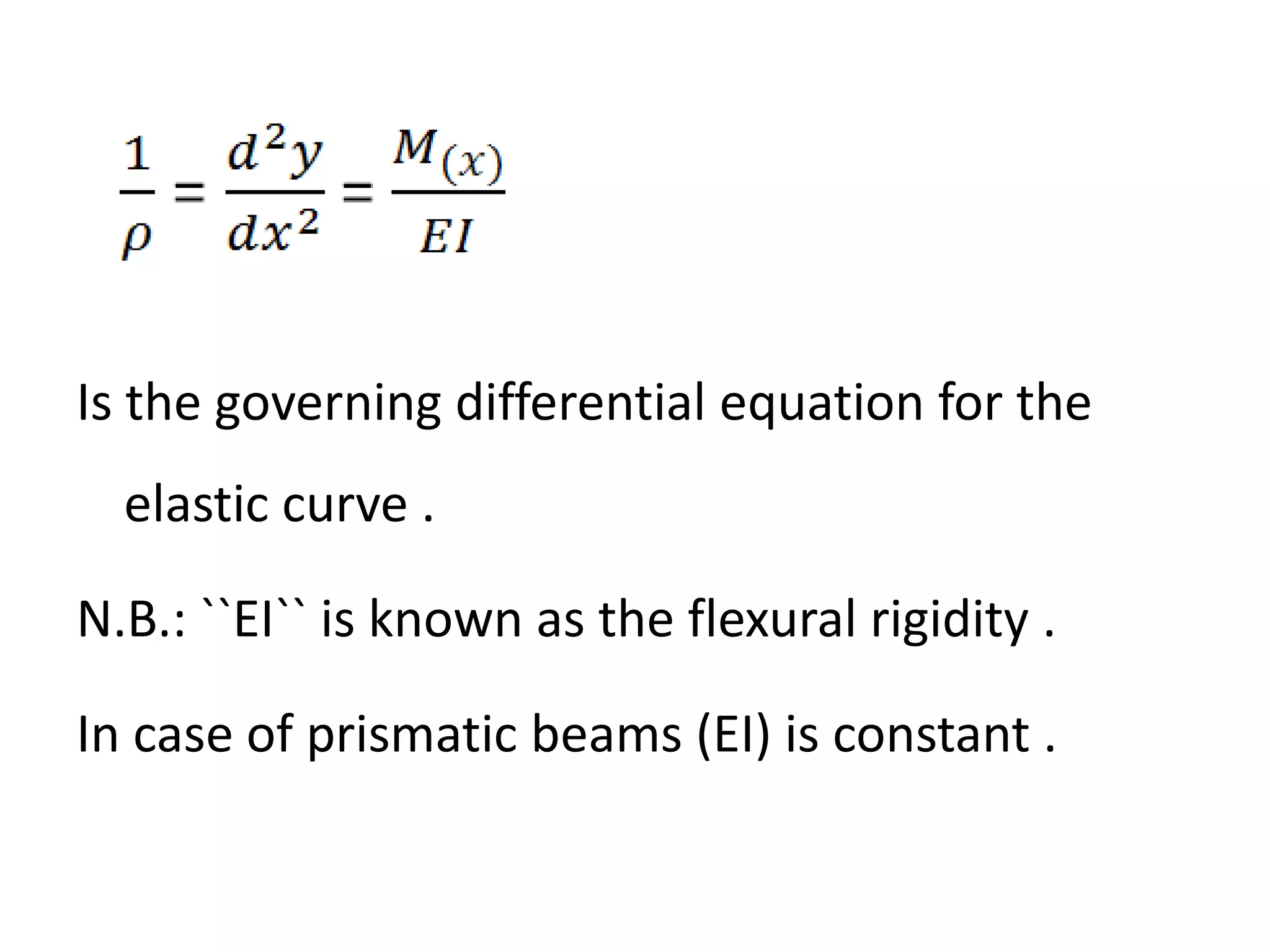
Is the governing differential equation for the elastic curve .N.B.: ``EI`` is known as the flexural rigidity .In case of prismatic beams (EI) is constant .
Deflection of beams

Deflection of beams

  • 1.
  • 2.
    Introduction :In thischapter we learn how to determine the deflection of beams (the maximum deflection) under given load .A prismatic beam subjected to pure Bending is bent into an arc of a circle in the elastic range ,the curvature of the neutral surface expressed as :1/ρ = M/EI
  • 3.
    Where , Mis the bending Moment , E is the modulus of elasticity , I is the moment of inertia of the cross section about it’s neutral axis .
  • 4.
    Both the Moment“M” & the Curvature of neutral axis “1/ρ” will vary denoting by the distance of the section from the left of the beam “x” .We write 1/ρ = M(x)/EI
  • 5.
    We notice thatthe deflection at the ends y = 0 due to supportsdy/dx = 0 at A,B ,also dy/dx = 0 at the max. deflectionDeflection
  • 6.
    To determine theslope and the deflectionof the beam at any given point ,we first drive the following second order differential equations which governs the elastic curveSo the deflection (y) can be obtained through the boundary conditions .
  • 7.
    In the nextfig. two differential equations are required due to the effective force (p) at point (D) .One for the portion (AD) ,the other one for the portion (DB) .PD
  • 8.
    The first eq.holds Q1 ,y1The second eq. holds Q2 ,y2So ,we have four constants C1 ,C2 ,C3 ,C4 due to the integration process .Two will be determined through that deflection (y=0) at A,B .The other constants can be determined through that portions of beam AD and DB have the same slope and the same deflection at D
  • 9.
    If we tookan exampleM(X) = -PxWe notice that the radius of curvature “ρ” = ∞ ,so that M = 0PBALPBA
  • 10.
    P2P1CAlso we canconclude from the next example , P1>P2We notice that +ve M so that the elastic curve is concaved downward .ADB+ve M-ve MElastic curveQ(x,y)
  • 11.
    Equation of elasticcurve:We know the curvature of a plane curve at point Q(x,y) is expressed asWhere , are the 1st & 2nd derivatives of a function y(x) represented by a curve ,the slope is so small and it’s square is negligible ,so we get that
  • 12.
    Is the governingdifferential equation for the elastic curve .N.B.: ``EI`` is known as the flexural rigidity .In case of prismatic beams (EI) is constant .