Special Technologies
An Introduction to
Shape Memory Alloys (SMAs)
Mehrshad Mehrpouya
mehrshad.mehrpouya@uniroma1.it
Sapienza University of Rome
Department of Mechanical and Aerospace Engineering
Special Technology
Types of Materials
- Metals
- Ceramics
- Polymers
- Composites
- Semiconductors
REVIEW!
Department of Mechanical and Aerospace Engineering
Special Technology
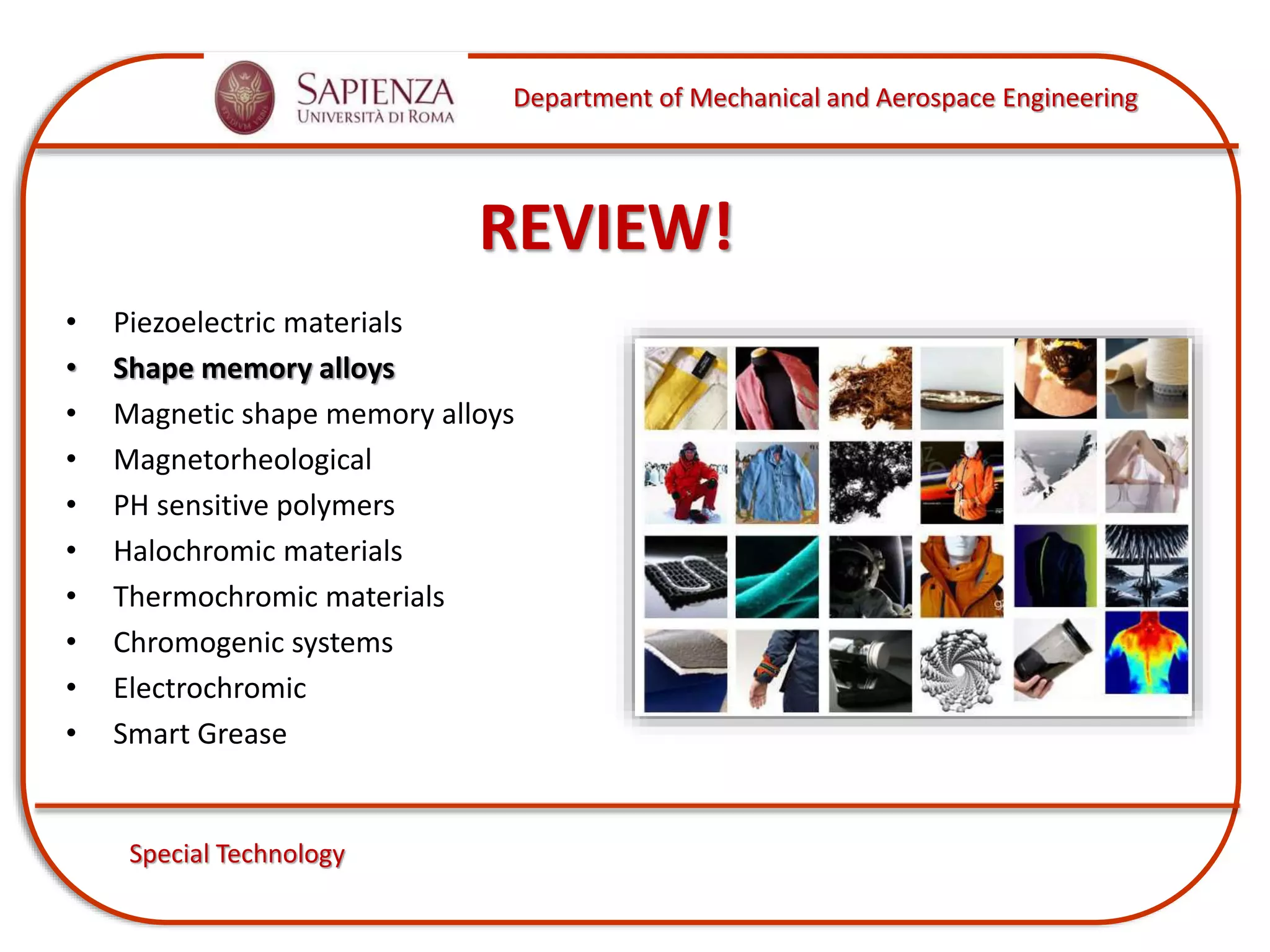
• Piezoelectric materials
• Shape memory alloys
• Magnetic shape memory alloys
• Magnetorheological
• PH sensitive polymers
• Halochromic materials
• Thermochromic materials
• Chromogenic systems
• Electrochromic
• Smart Grease
REVIEW!
Department of Mechanical and Aerospace Engineering
Special Technology
What are Shape Memory Alloys?
Shape Memory Alloys (SMAs) are metallic alloys that undergo a solid-to-solid phase
transformation which can exhibit large recoverable strains.
Example: Nitinol
Department of Mechanical and Aerospace Engineering
Special Technology
Department of Mechanical and Aerospace Engineering
Special Technology
Timeline of Memory Metals
• 1932 - A. Ölander discovers the pseudoelastic properties of Au-Cd alloy.
• 1949 - Memory effect of Au-Cd reported by Kurdjumov & Kandros.
• 1967 – At Naval Ordance Laboratory, Beuhler discovers shape memory
effect in nickel titanium alloy, Nitinol, which proved to be a major
breakthrough in the field of shape memory alloys.
• 1970-1980 – First reports of nickel-titanium implants being used in
medical applications.
• Mid-1990s – Memory metals start to become widespread in medicine and
soon move to other applications.
Department of Mechanical and Aerospace Engineering
Special Technology
Number of publications per year
Department of Mechanical and Aerospace Engineering
Special Technology
Geographic distribution
Department of Mechanical and Aerospace Engineering
Special Technology
Shape Memory Alloys
Alloy Transformation Composition
Transformation Temp. Rang
(°C)
Hysteresis (°C)
Ag-Cd 44/49 at % Cd -190 to -50 ~15
Au-Cd 46.5/50 at % Cd 30 to 100 ~15
Cu-Al-Ni
14/14.5 wt %Al, 3/4.5 wt %Ni
-140 to 100 ~35
Cu-Sn ~15 at % Sn -120 to 30 −
Cu-Zn 38.5/41.5 wt % Zn -180 to -10 ~10
Cu-Zn-X (X=Si,Sn,Al) few wt % X -180 to 200 ~10
In-Ti 18/23 at % Ti 60 to 100 ~4
Ni-Al 36/38 at % Al -180 to 100 ~10
Ni-Ti ~49/51 at % Ni -50 to 110 ~30
Fe-Pt ~25 at % Pt ~-130 ~4
Mn-Cu 5/35 wn % Cu -250 to 180 ~25
Fe-Mn-Si 32 wt % Mn -200 to 150 ~100
Department of Mechanical and Aerospace Engineering
Special Technology
Ferromagnetic shape-memory alloys
• Shows shape-memory effect in response to a magnetic field
• Deformation due to magnetic field is known as
magnetoelastic deformation.
• Ni-Ti is non-magnetic
• Examples of ferromagnetic SMAs: Ni2MnGa, Fe-Pd, Fe3Pt
Department of Mechanical and Aerospace Engineering
Special Technology
Material behavior
in Micro-size
Department of Mechanical and Aerospace Engineering
Special Technology
Mf Ms As Af
AusteniteMartensite TEMPERATURE
Mf Ms As Af
AusteniteMartensite TEMPERATURE
(twinned)
(twinned)
Characteristic temperatures:
Mf=Martensitic Finish
Ms=Martensitic Start
As=Austenitic Start
Af=Austenitic Finish
Thermally Induced Phase Transformation in SMAs
Department of Mechanical and Aerospace Engineering
Special Technology
How are SMAs working?
Department of Mechanical and Aerospace Engineering
Special Technology
Triggers for
Martensitic
Transformation
(MT)
Stress
Temperature
Department of Mechanical and Aerospace Engineering
Special Technology
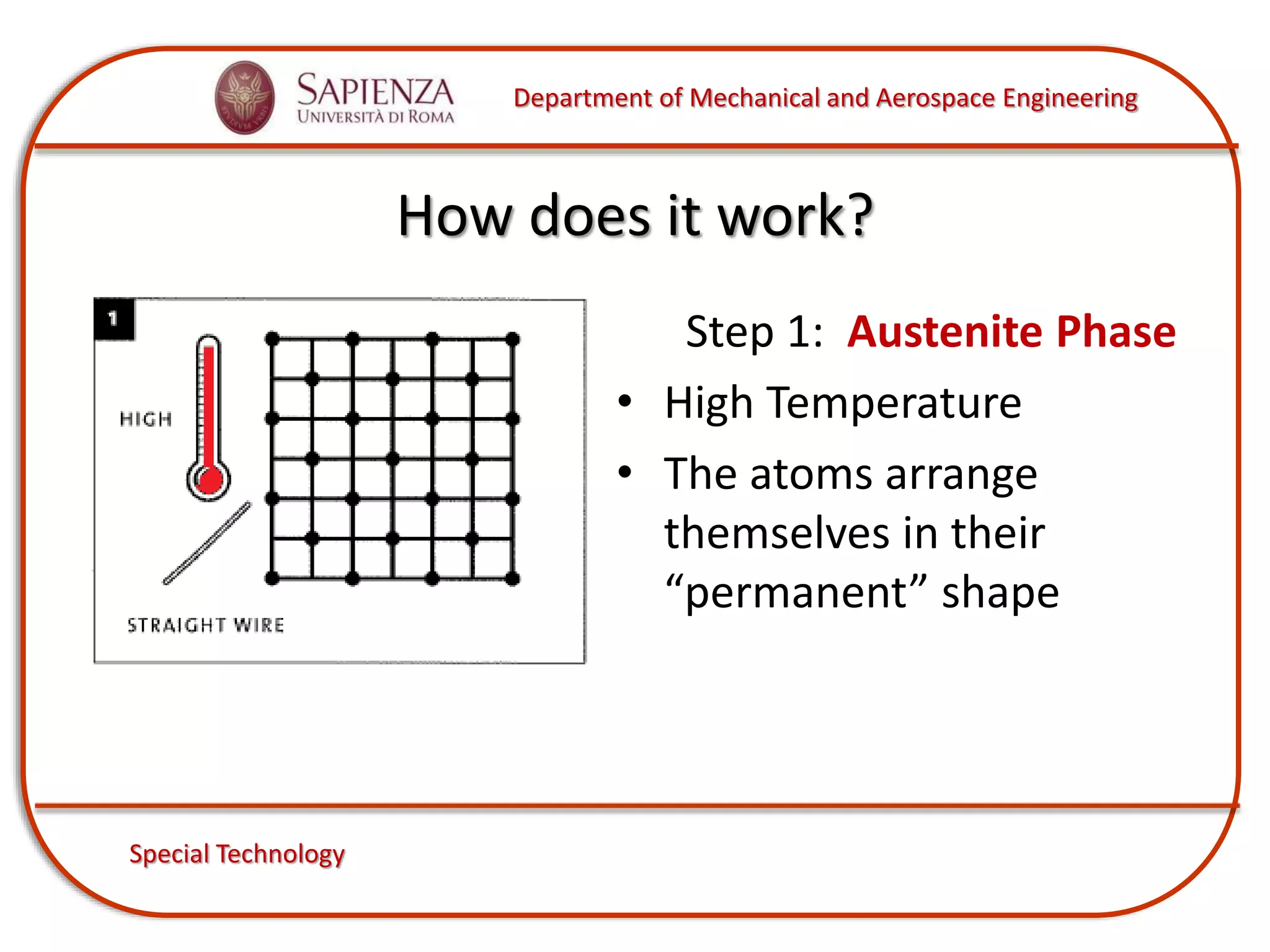
How does it work?
Step 1: Austenite Phase
• High Temperature
• The atoms arrange
themselves in their
“permanent” shape
Department of Mechanical and Aerospace Engineering
Special Technology
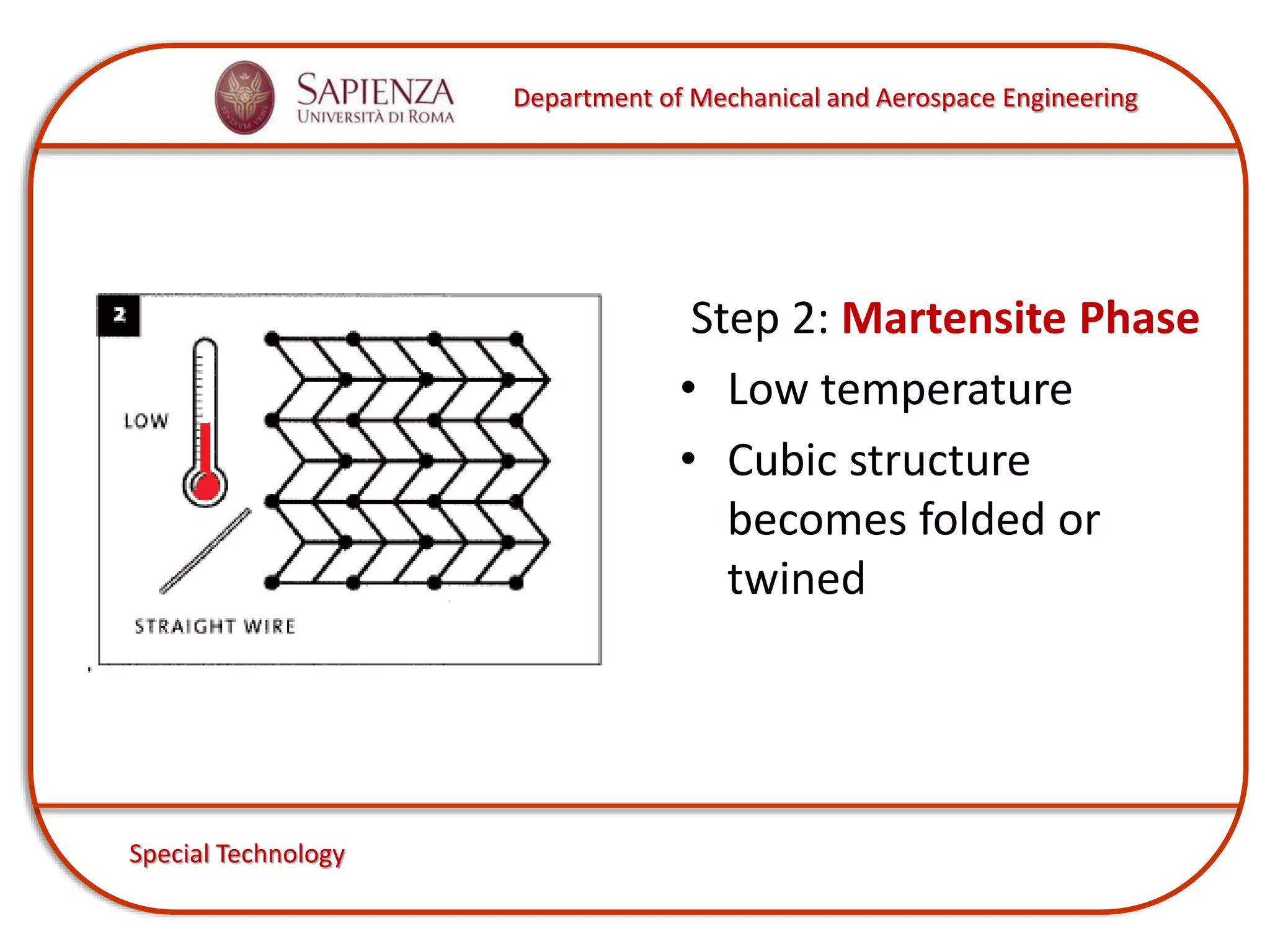
Step 2: Martensite Phase
• Low temperature
• Cubic structure
becomes folded or
twined
Department of Mechanical and Aerospace Engineering
Special Technology
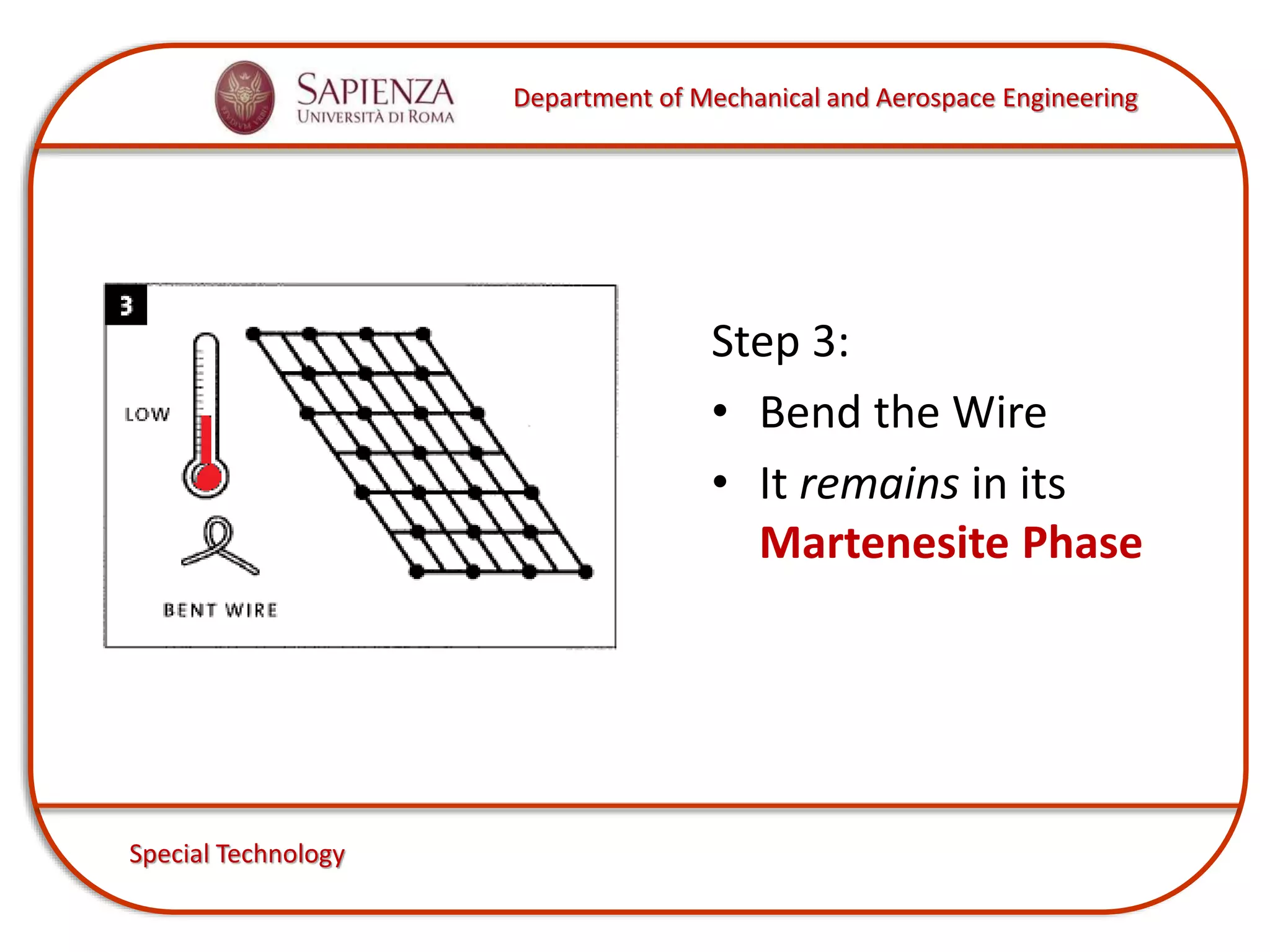
Step 3:
• Bend the Wire
• It remains in its
Martenesite Phase
Department of Mechanical and Aerospace Engineering
Special Technology
Step 4: Austenite Phase
• Heat the wire above the
transition temperature
of 50 degrees
• It moves back to its
original position!
Department of Mechanical and Aerospace Engineering
Special Technology
Austenite & Martensite Phases
Department of Mechanical and Aerospace Engineering
Special Technology
SMAs
Pseudoelasticity
or Superelasticity
(SE)
Shape Memory
Effect (SME)
Department of Mechanical and Aerospace Engineering
Special Technology
Shape Memory Alloys
• Pseudoelasticity or Superelasticity (SE)
– When the metal is changed to the martensite phase simply by strain.
The metal becomes pliable and can withstand strains of up to 8%.
• Shape Memory Effect (SME)
– These materials have an ability to “remember” its austenite phase. As
the metal is cooled to the martensite phase, it can be easily deformed.
When the temperature is raised to the austenite phase, it reforms to
the original shape of the material.
A mix of roughly 50% nickel and 50% titanium is the most common SMA.
Also CuZnAl and CuAlNi are widely used.
Department of Mechanical and Aerospace Engineering
Special Technology
Superelastic behavior (SE)
SMAs deformed above a critical
temperature show a large
reversible elastic deformation
(recoverable strains up to 10%.
much exceeding the elasticity) as a
result of stress-induced
martensitic transformation.
Superelastic behavior
T > Af
Hysteresis loop means
energy dissipation,
hence vibration damping
Stress
Department of Mechanical and Aerospace Engineering
Special Technology
Applications of
superelastic behavior
• Orthodontal braces
• Frames for eyeglasses
• Underwires for brassieres
• Antennas for cellular phones
Department of Mechanical and Aerospace Engineering
Special Technology
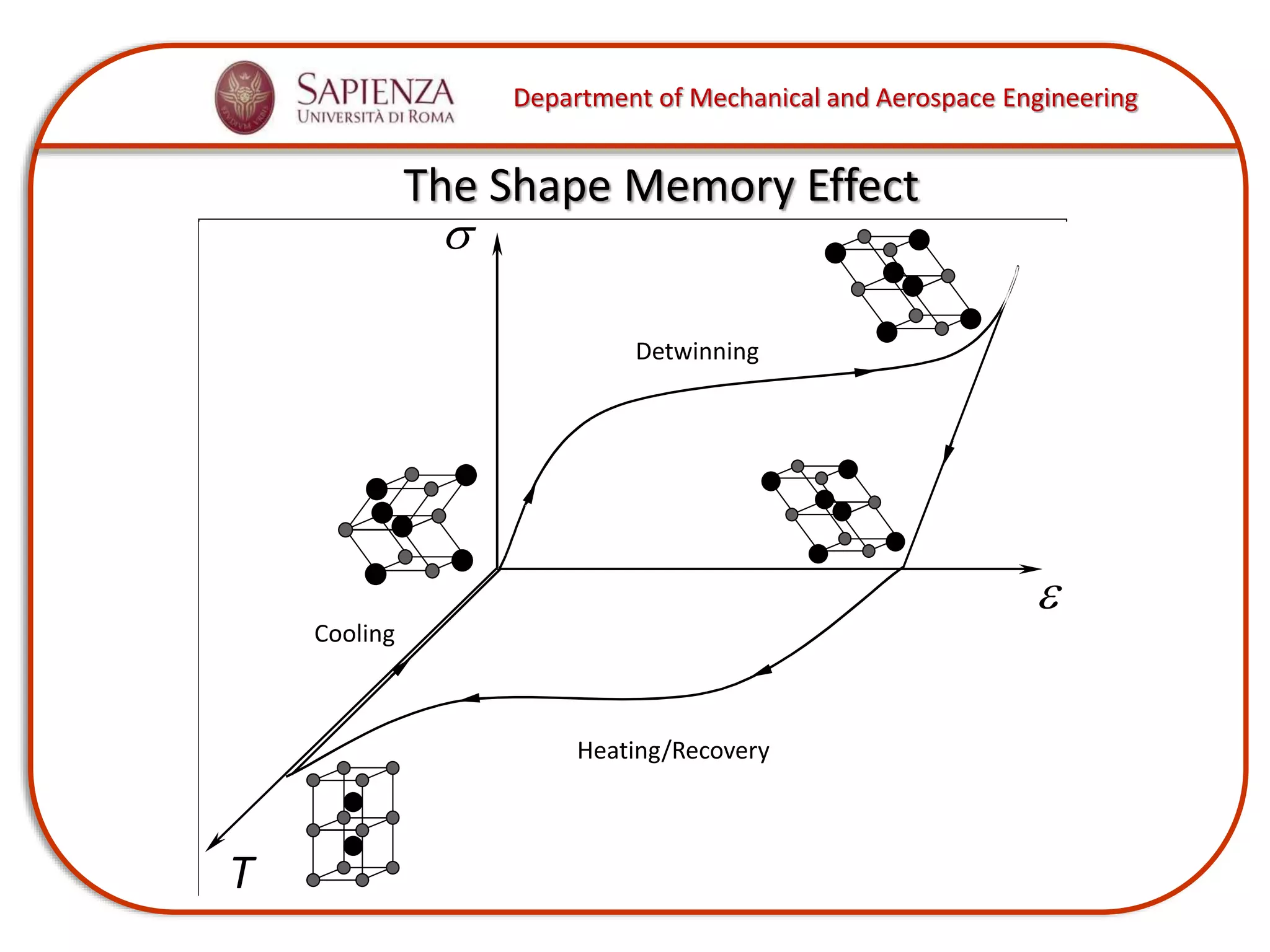
Shape Memory Effect (SME)
• Martensitic phase transformation that occurs as a result of
stress or temperature change
Department of Mechanical and Aerospace Engineering
The Shape Memory Effect
s
e
T
Cooling
Detwinning
Heating/Recovery
Department of Mechanical and Aerospace Engineering
Special Technology
Applications of shape memory effect
• Self-expandable cardiovascular stent
• Blood clot filters
• Engines
• Actuators for smart systems
• Couplings
• Flaps that change direction of airflow depending upon temperature
(for air conditioners)
Department of Mechanical and Aerospace Engineering
Special Technology
SHAPE MEMORY ALLOY (NITINOL)
Inactive
Active - Bending Active - Twist
Department of Mechanical and Aerospace Engineering
Special Technology
Department of Mechanical and Aerospace Engineering
Special Technology
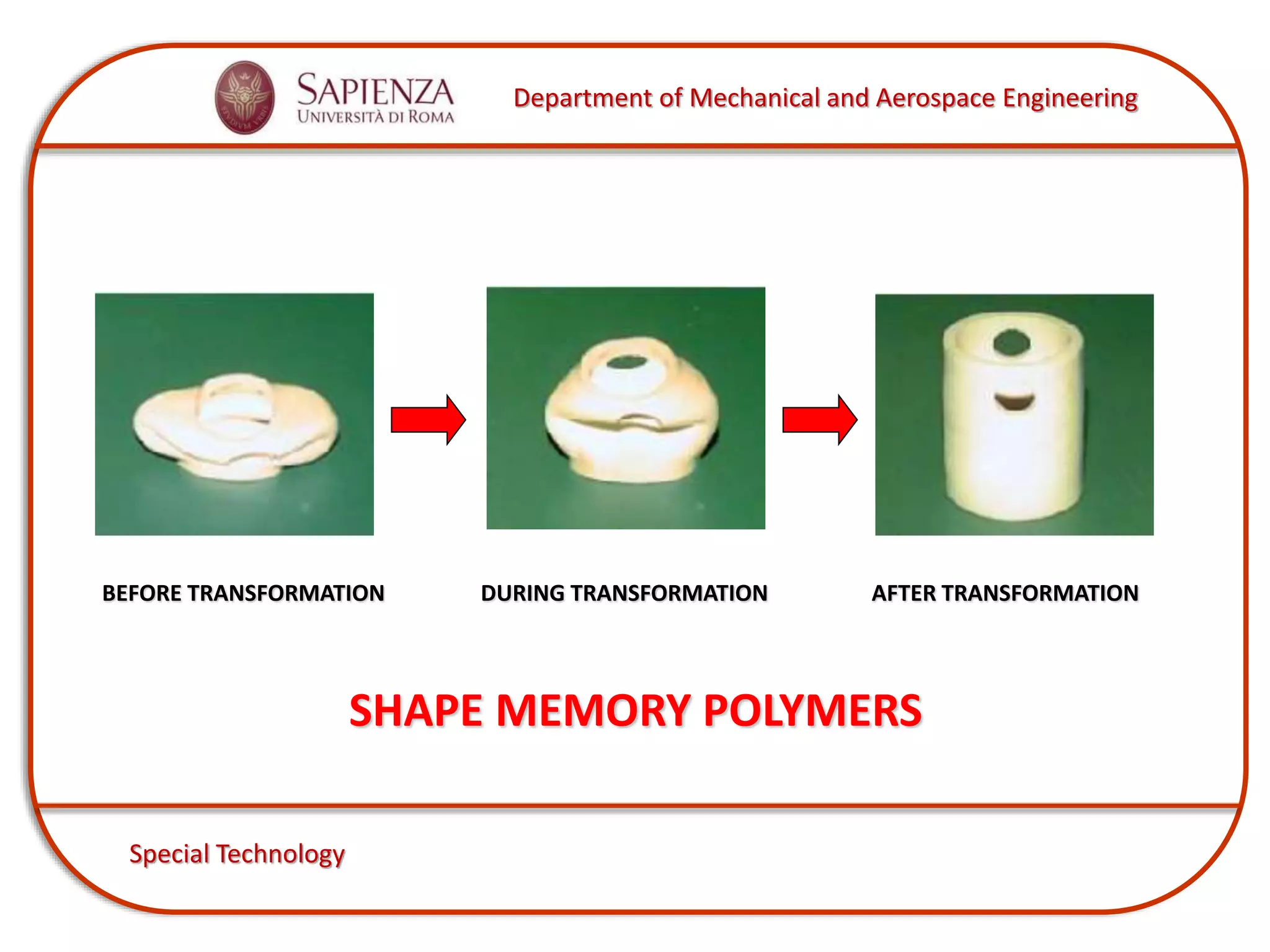
BEFORE TRANSFORMATION DURING TRANSFORMATION AFTER TRANSFORMATION
SHAPE MEMORY POLYMERS
Department of Mechanical and Aerospace Engineering
Special Technology
AFTER TRANSFORMATIONBEFORE TRANSFORMATION DURING TRANSFORMATION
SHAPE MEMORY POLYMERS
Department of Mechanical and Aerospace Engineering
Special Technology
SHAPE MEMORY POLYMERS
Department of Mechanical and Aerospace Engineering
Special Technology
Types of shape-memory behavior
One-way shape memory:
transformation to the desired
shape occurs only upon heating,
i.e., memory is with the
austenite phase.
Department of Mechanical and Aerospace Engineering
Special Technology
Types of shape-memory behavior
Two-way shape memory: the deformed shape is
remembered during cooling, in addition to the
original shape being remembered during heating,
i.e., memory is with both austenite and martensite
phases (requires training to attain memory during
cooling; formation of favorably oriented twins
during cooling between Ms and Mf)
Department of Mechanical and Aerospace Engineering
Special Technology
Physical properties of Nitinol (versus SS)
Department of Mechanical and Aerospace Engineering
Special Technology
The applications
of SMAs
Department of Mechanical and Aerospace Engineering
Special Technology
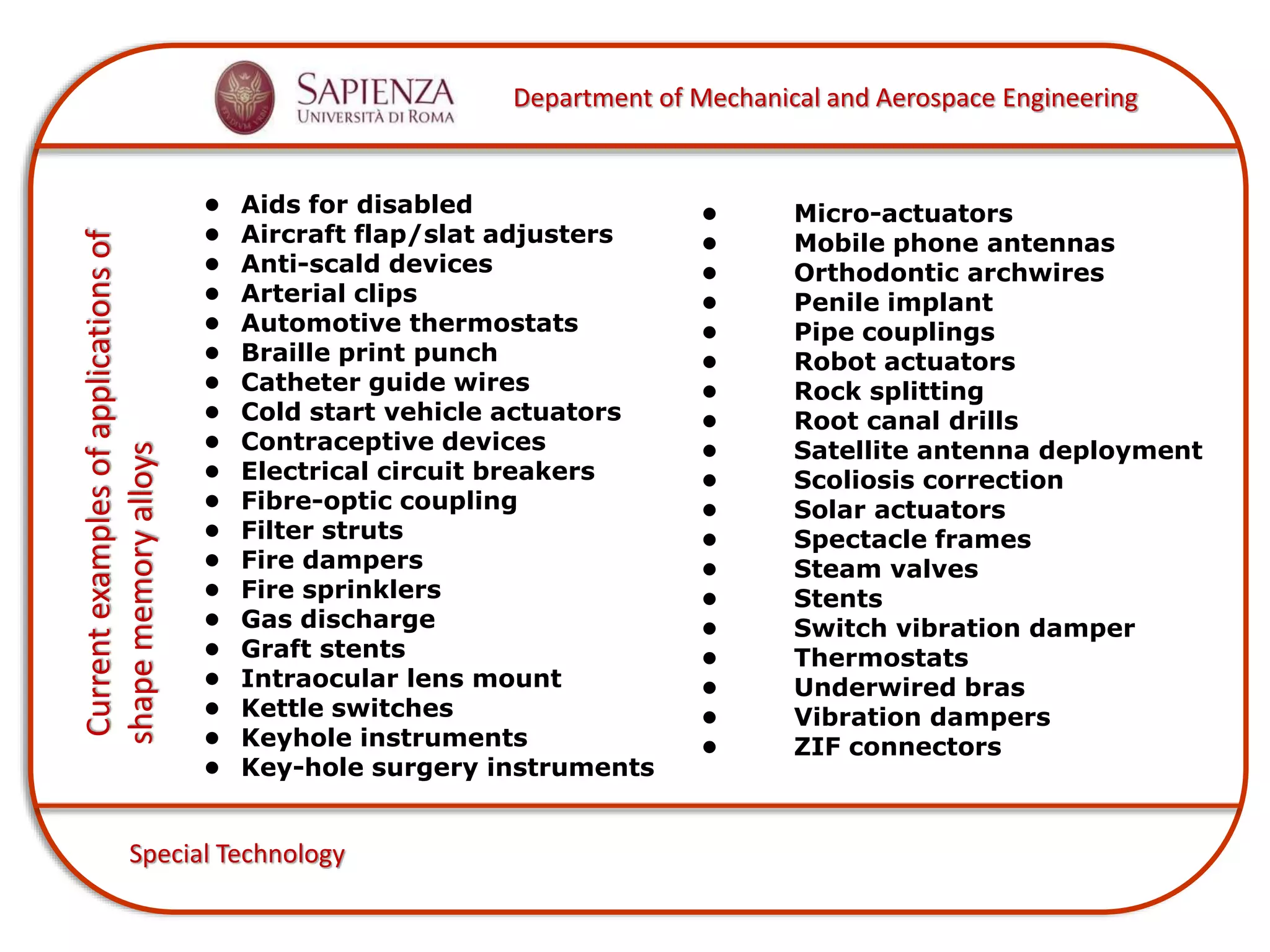
• Micro-actuators
• Mobile phone antennas
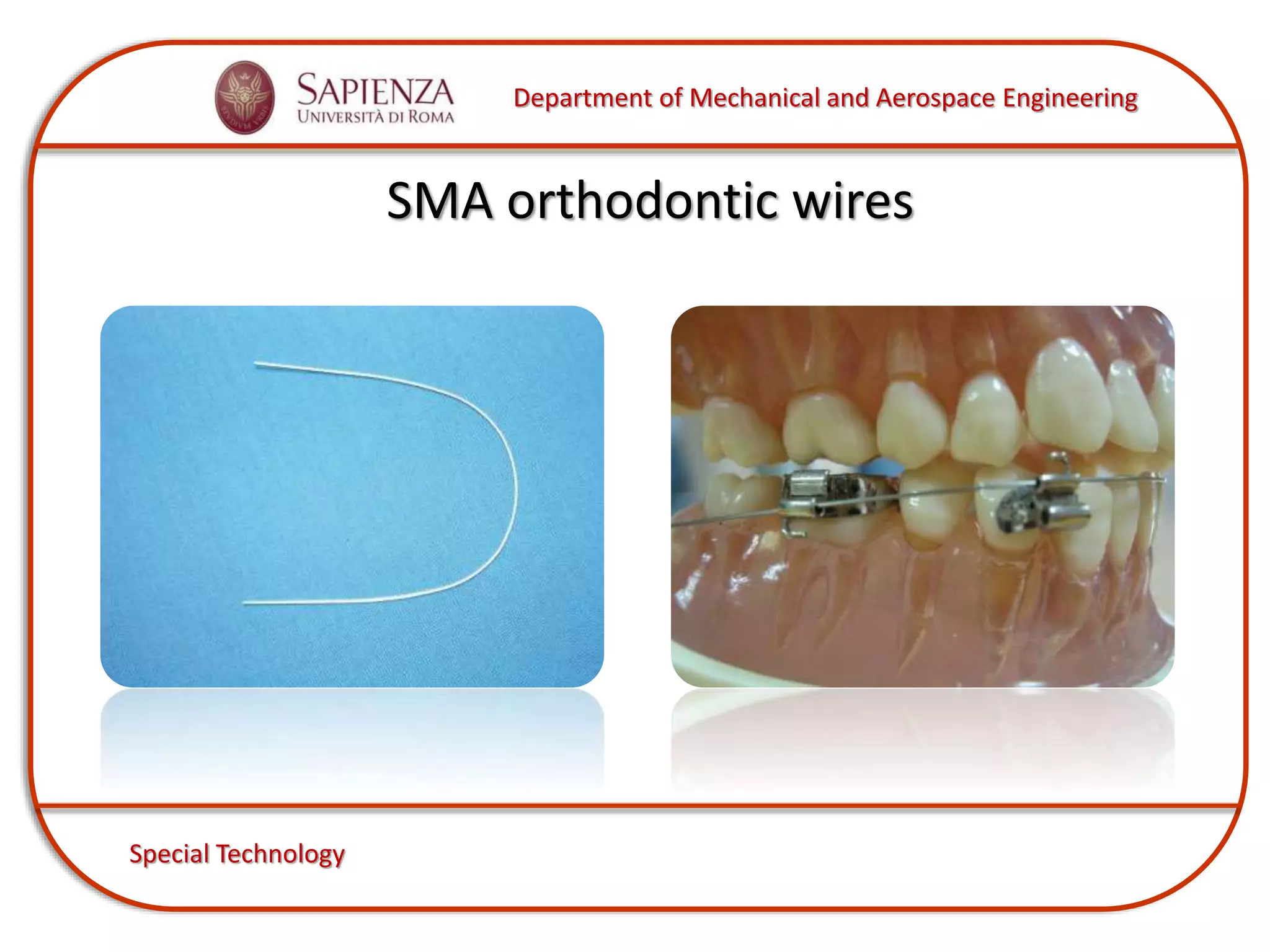
• Orthodontic archwires
• Penile implant
• Pipe couplings
• Robot actuators
• Rock splitting
• Root canal drills
• Satellite antenna deployment
• Scoliosis correction
• Solar actuators
• Spectacle frames
• Steam valves
• Stents
• Switch vibration damper
• Thermostats
• Underwired bras
• Vibration dampers
• ZIF connectors
• Aids for disabled
• Aircraft flap/slat adjusters
• Anti-scald devices
• Arterial clips
• Automotive thermostats
• Braille print punch
• Catheter guide wires
• Cold start vehicle actuators
• Contraceptive devices
• Electrical circuit breakers
• Fibre-optic coupling
• Filter struts
• Fire dampers
• Fire sprinklers
• Gas discharge
• Graft stents
• Intraocular lens mount
• Kettle switches
• Keyhole instruments
• Key-hole surgery instruments
Currentexamplesofapplicationsof
shapememoryalloys
Department of Mechanical and Aerospace Engineering
Special Technology
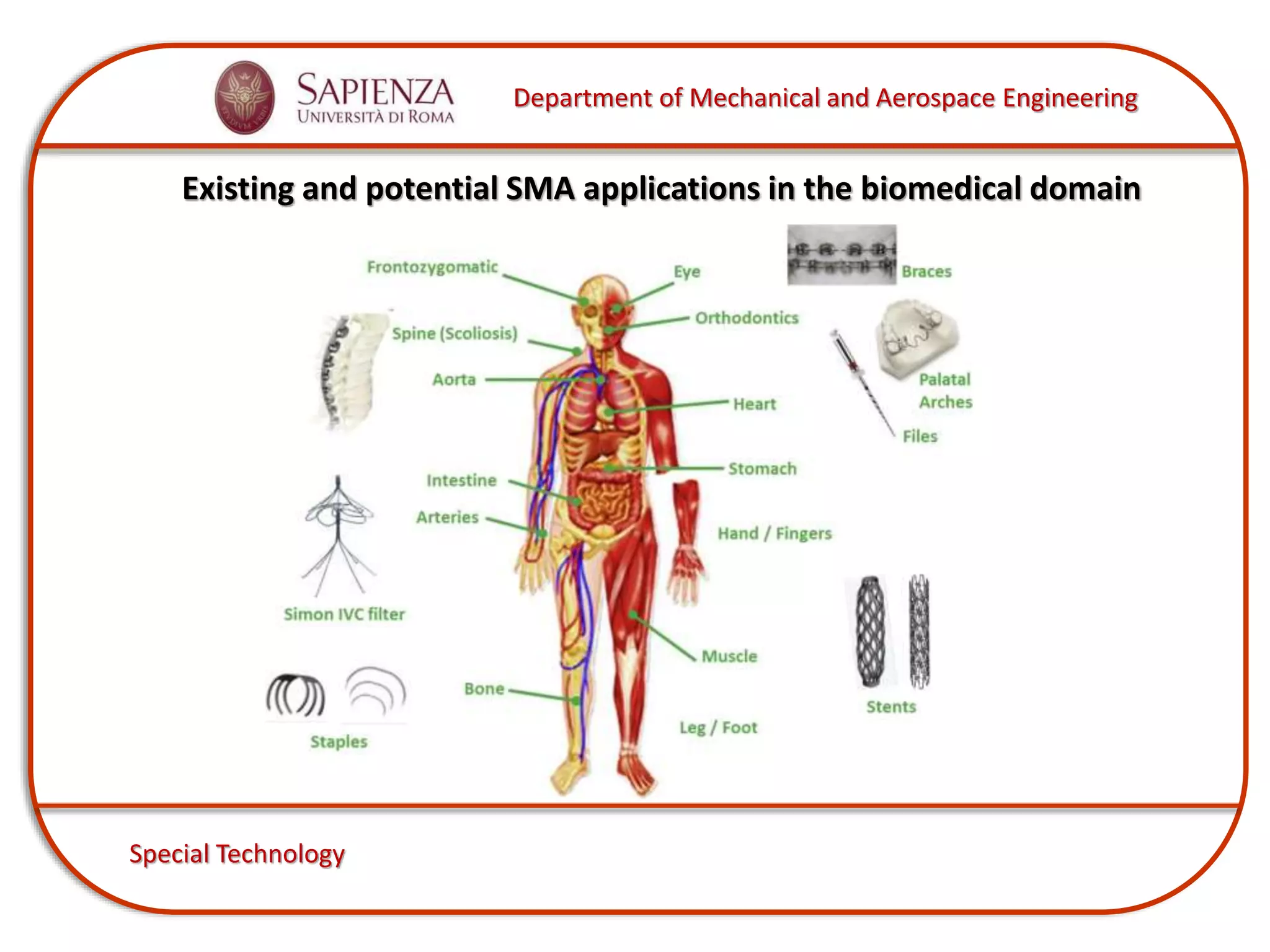
Existing and potential SMA applications in the biomedical domain
Department of Mechanical and Aerospace Engineering
Special Technology
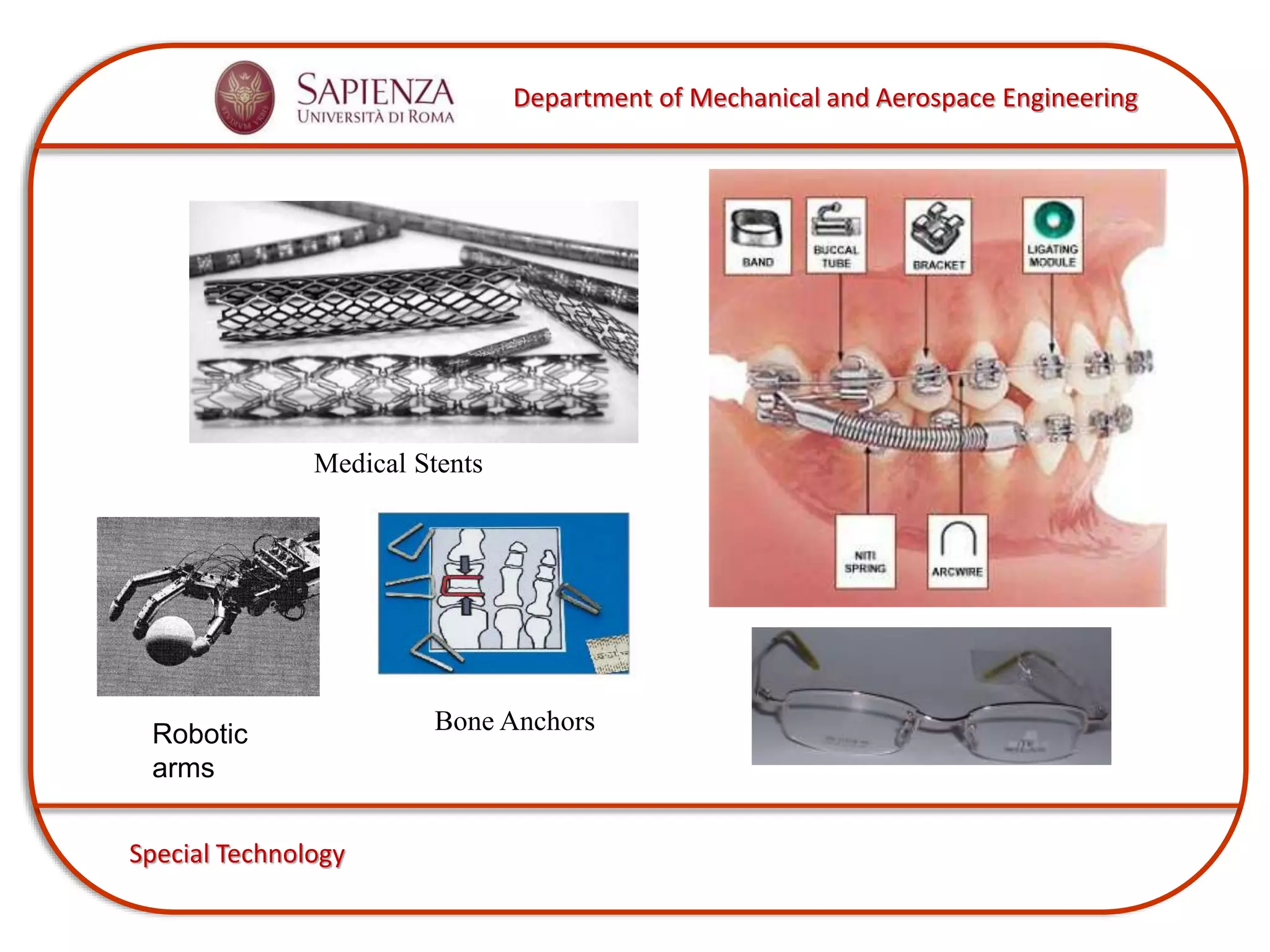
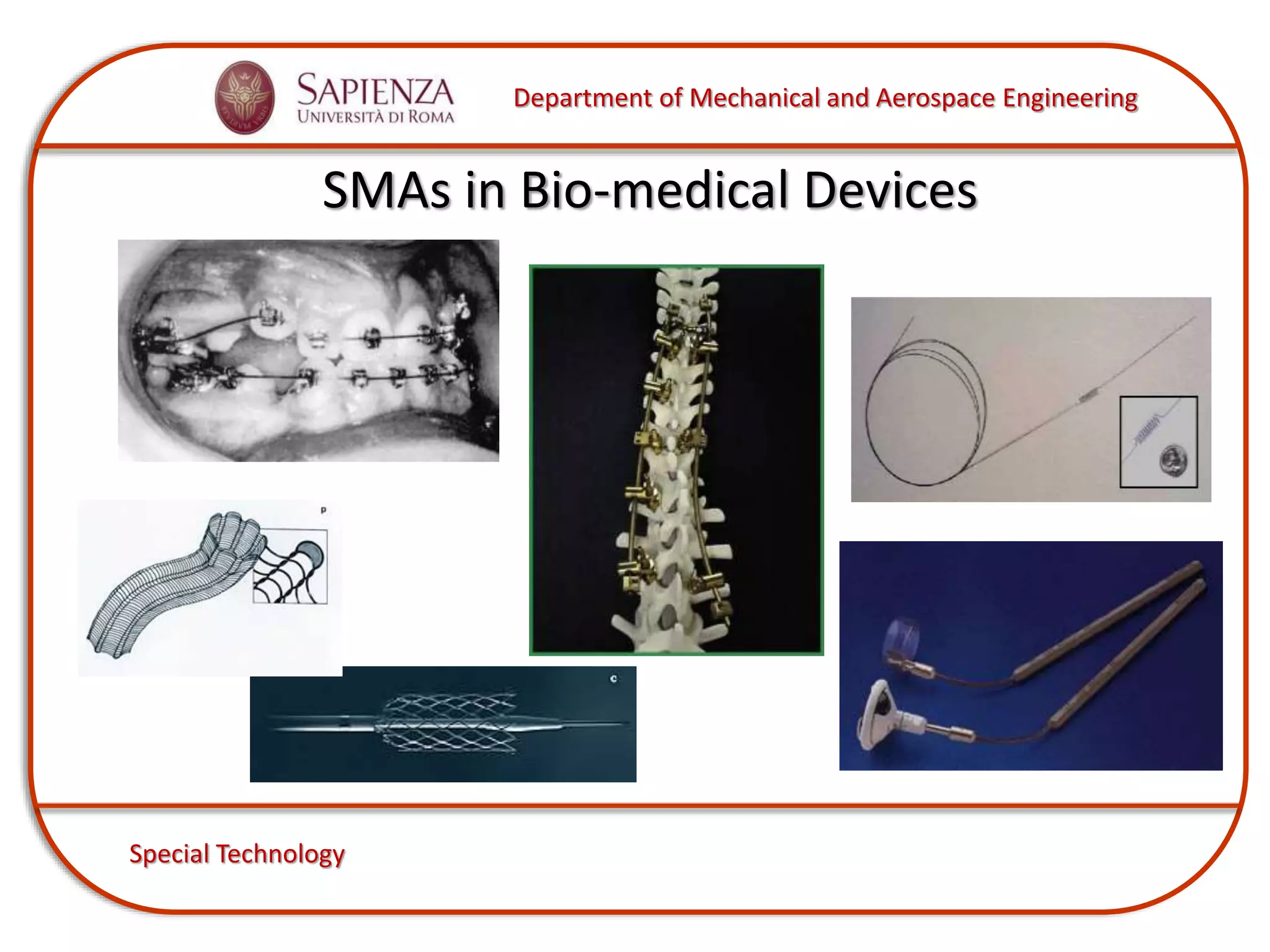
SMAs in Bio-medical Devices
Department of Mechanical and Aerospace Engineering
Special Technology
Bone AnchorsRobotic
arms
Medical Stents
Department of Mechanical and Aerospace Engineering
Special Technology
SMA orthodontic wires
Department of Mechanical and Aerospace Engineering
Special Technology
Nitinol is used in medicine for
stents: A collapsed stent can be
inserted into a vein and heated
(returning to its original expanded
shape) helping to improve blood
flow. Also, as a replacement for
sutures where nitinol wire can be
weaved through two structures
then allowed to transform into it's
pre-formed shape which should
hold the structures in place.
SMAs Stents
Department of Mechanical and Aerospace Engineering
Special Technology
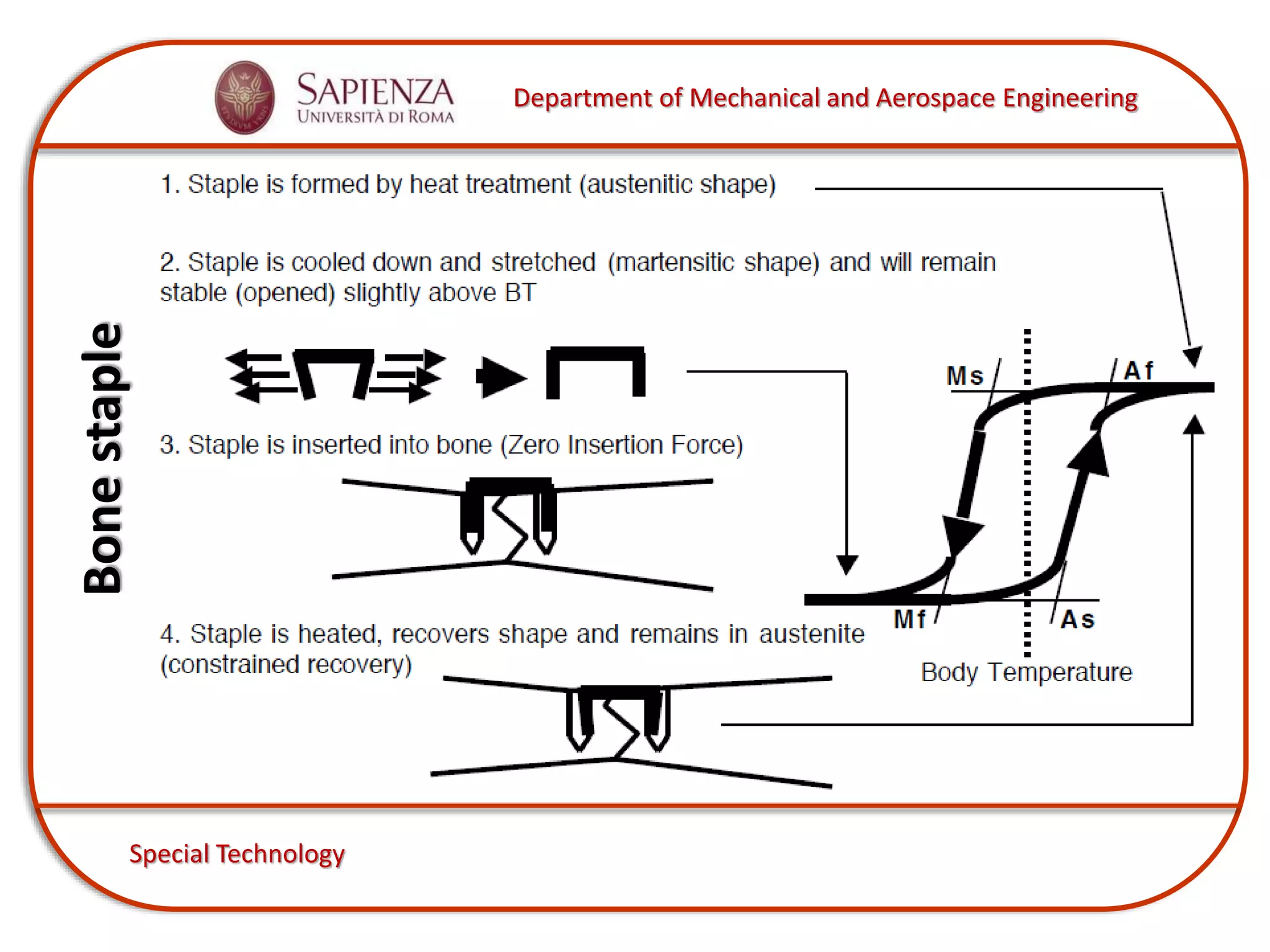
Bonestaple
Department of Mechanical and Aerospace Engineering
Special Technology
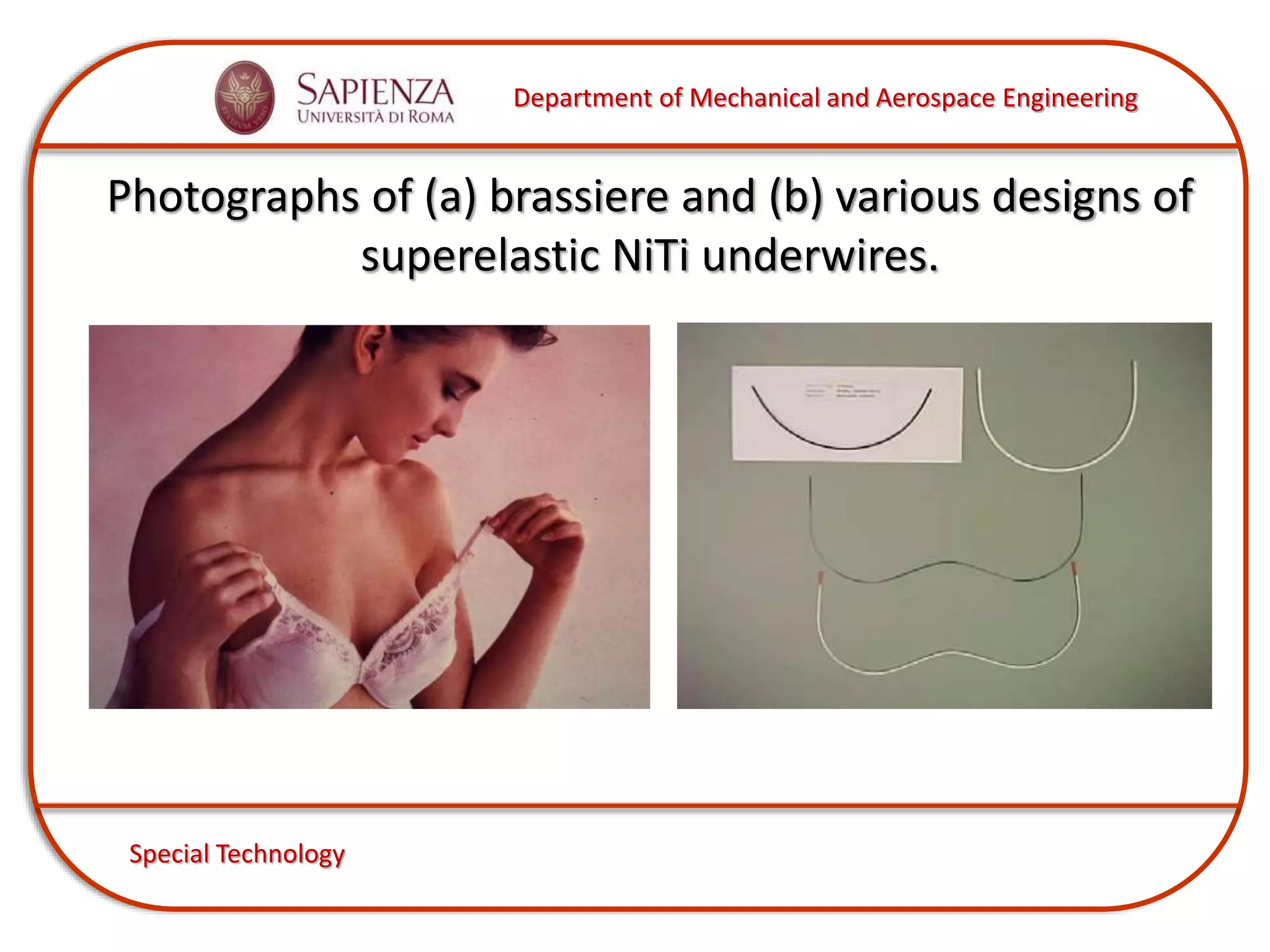
Photographs of (a) brassiere and (b) various designs of
superelastic NiTi underwires.
Department of Mechanical and Aerospace Engineering
Special Technology
Existing and potential SMA applications in the automotive domain
Department of Mechanical and Aerospace Engineering
Special Technology
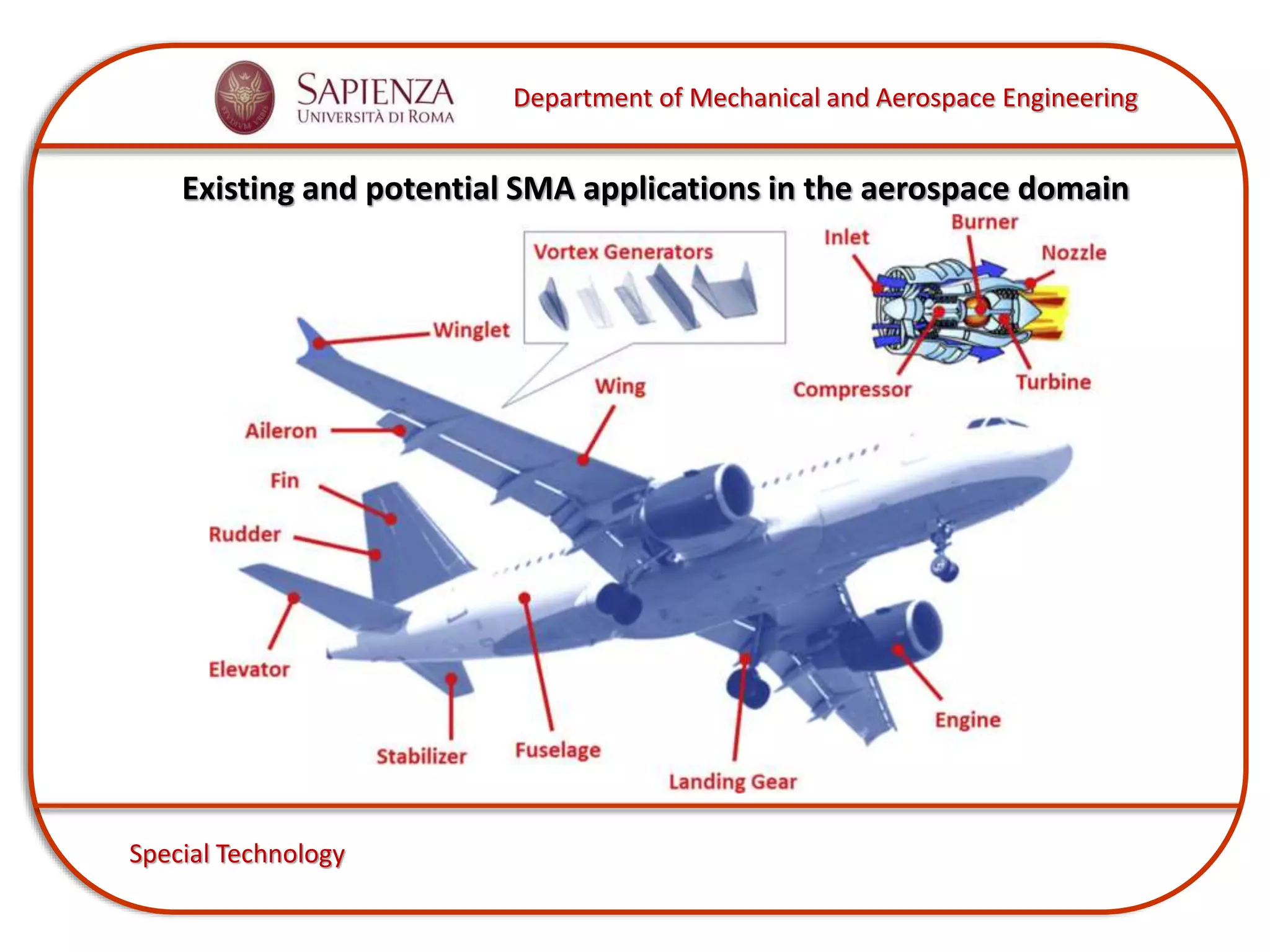
Existing and potential SMA applications in the aerospace domain
Department of Mechanical and Aerospace Engineering
Special Technology
Picture of wing with SMA wires
The wires in the picture are used to replace the actuator. Electric
pulses sent through the wires allow for precise movement of the
wings, as would be needed in an aircraft. This reduces the need
for maintenance, weighs less, and is less costly.
Department of Mechanical and Aerospace Engineering
Special Technology
Department of Mechanical and Aerospace Engineering
Special Technology
SMAs Microactuators
Department of Mechanical and Aerospace Engineering
Special Technology
Department of Mechanical and Aerospace Engineering
Special Technology
SMAs Micro-actuators
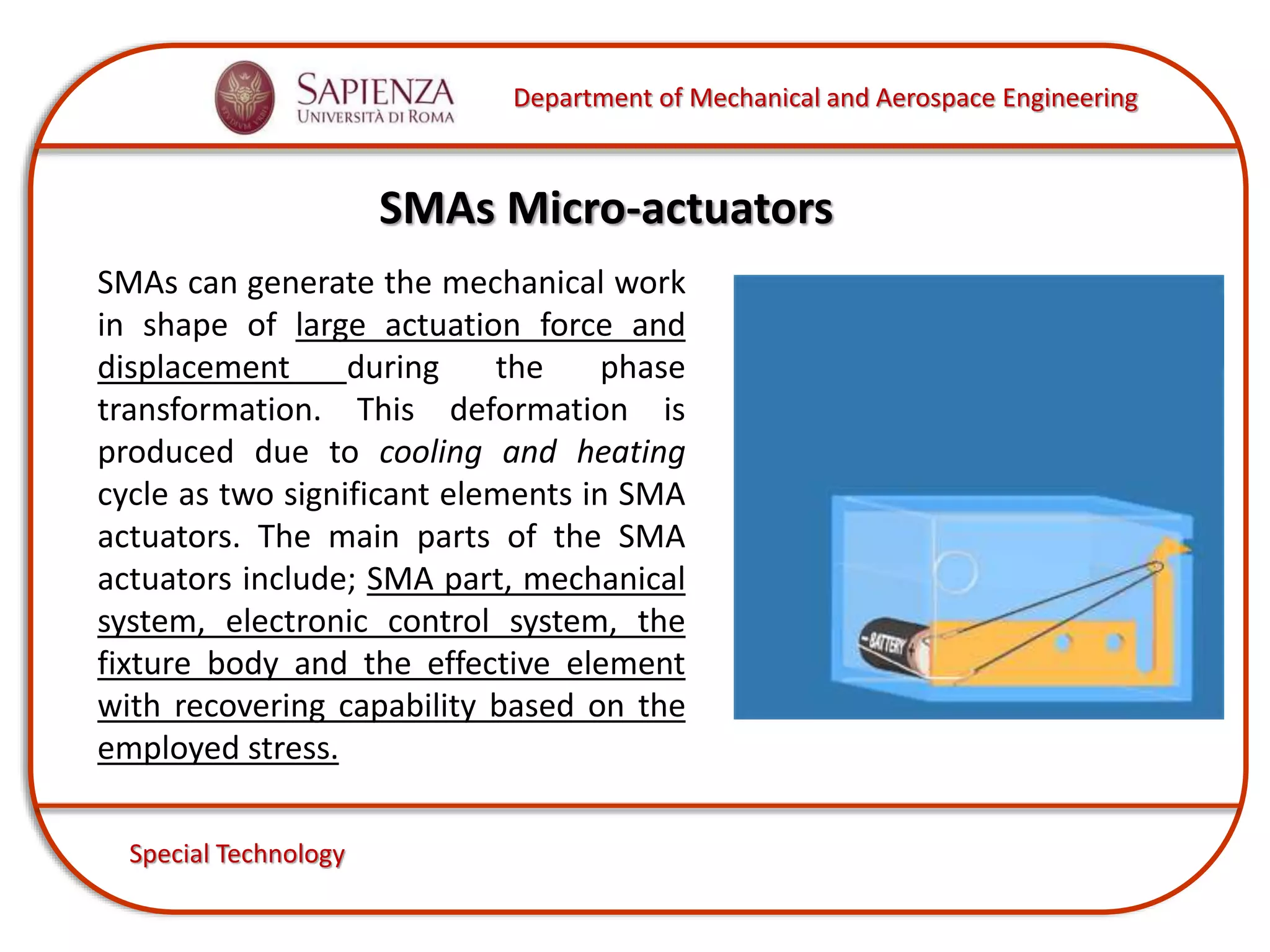
SMAs can generate the mechanical work
in shape of large actuation force and
displacement during the phase
transformation. This deformation is
produced due to cooling and heating
cycle as two significant elements in SMA
actuators. The main parts of the SMA
actuators include; SMA part, mechanical
system, electronic control system, the
fixture body and the effective element
with recovering capability based on the
employed stress.
Department of Mechanical and Aerospace Engineering
Special Technology
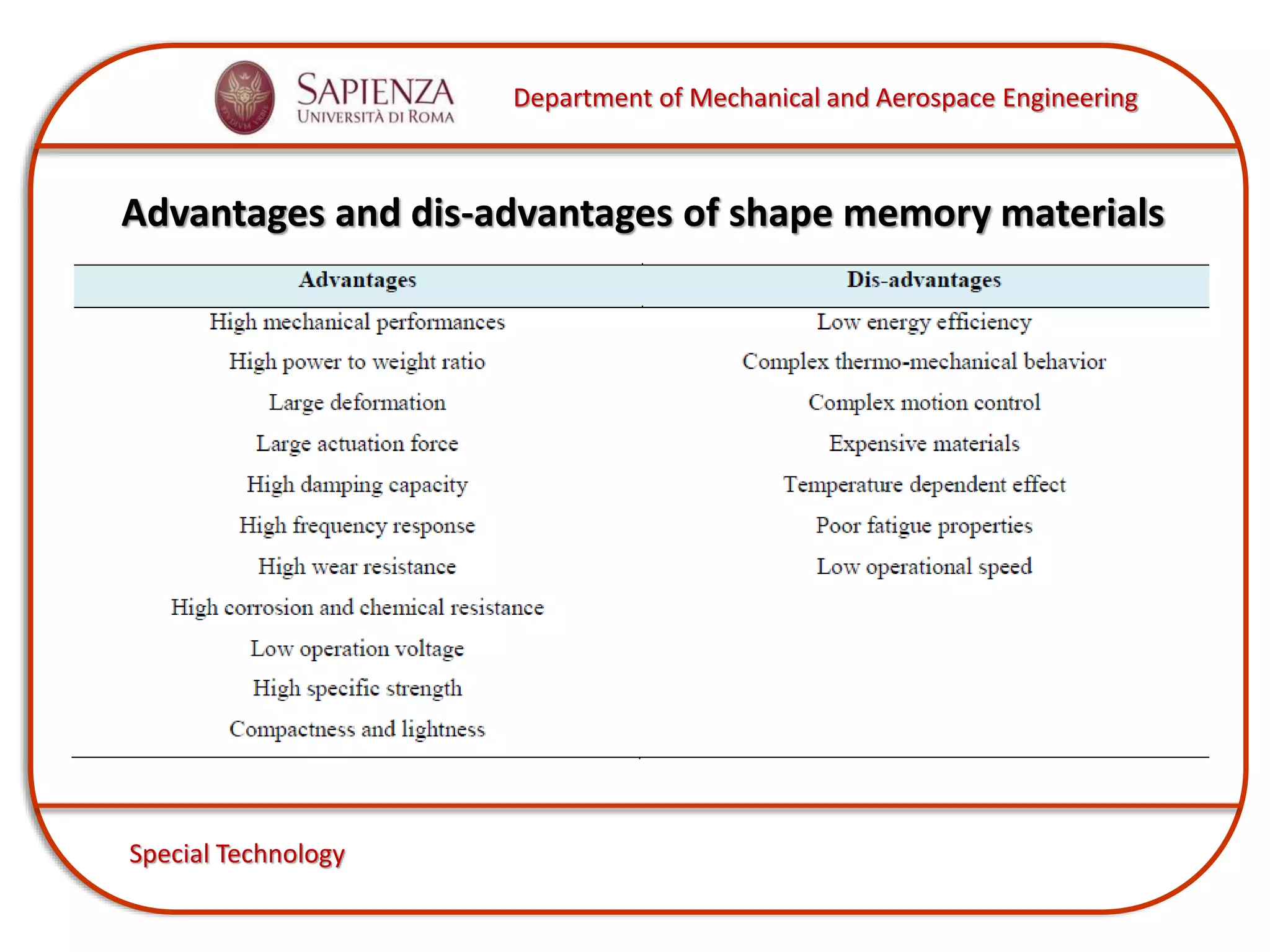
Advantages and dis-advantages of shape memory materials
Department of Mechanical and Aerospace Engineering
Special Technology
SMAs Micro-actuators
The most common applications of NiTi thin films are
concentrated on microactuators due to their particular
capabilities in MEMS, such as micropumps, microvalves,
microgrippers, micropositioners, microsprings,
microspacers, and microwrappers, etc.
Department of Mechanical and Aerospace Engineering
Special Technology
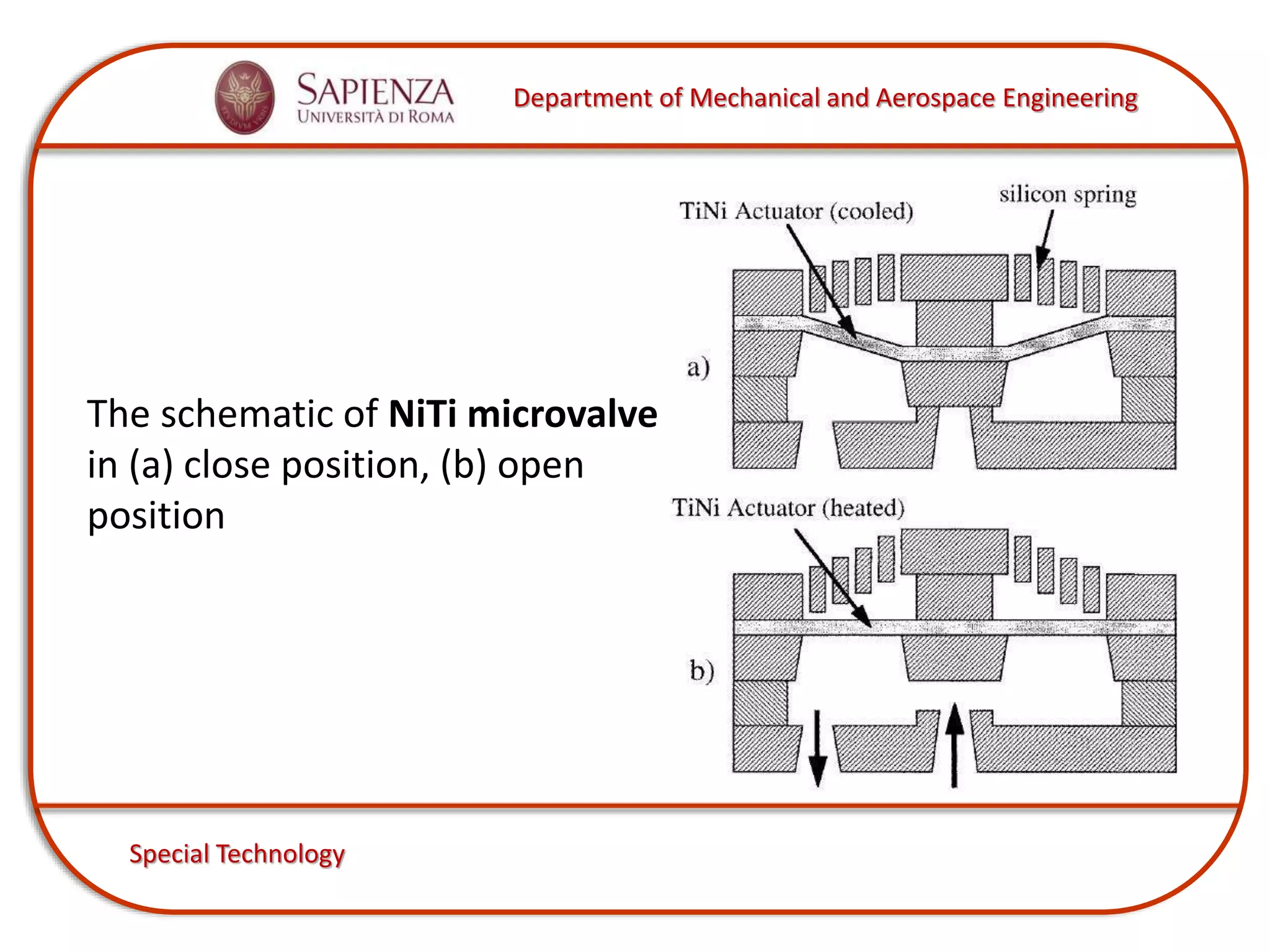
The schematic of NiTi microvalve
in (a) close position, (b) open
position
Department of Mechanical and Aerospace Engineering
Special Technology
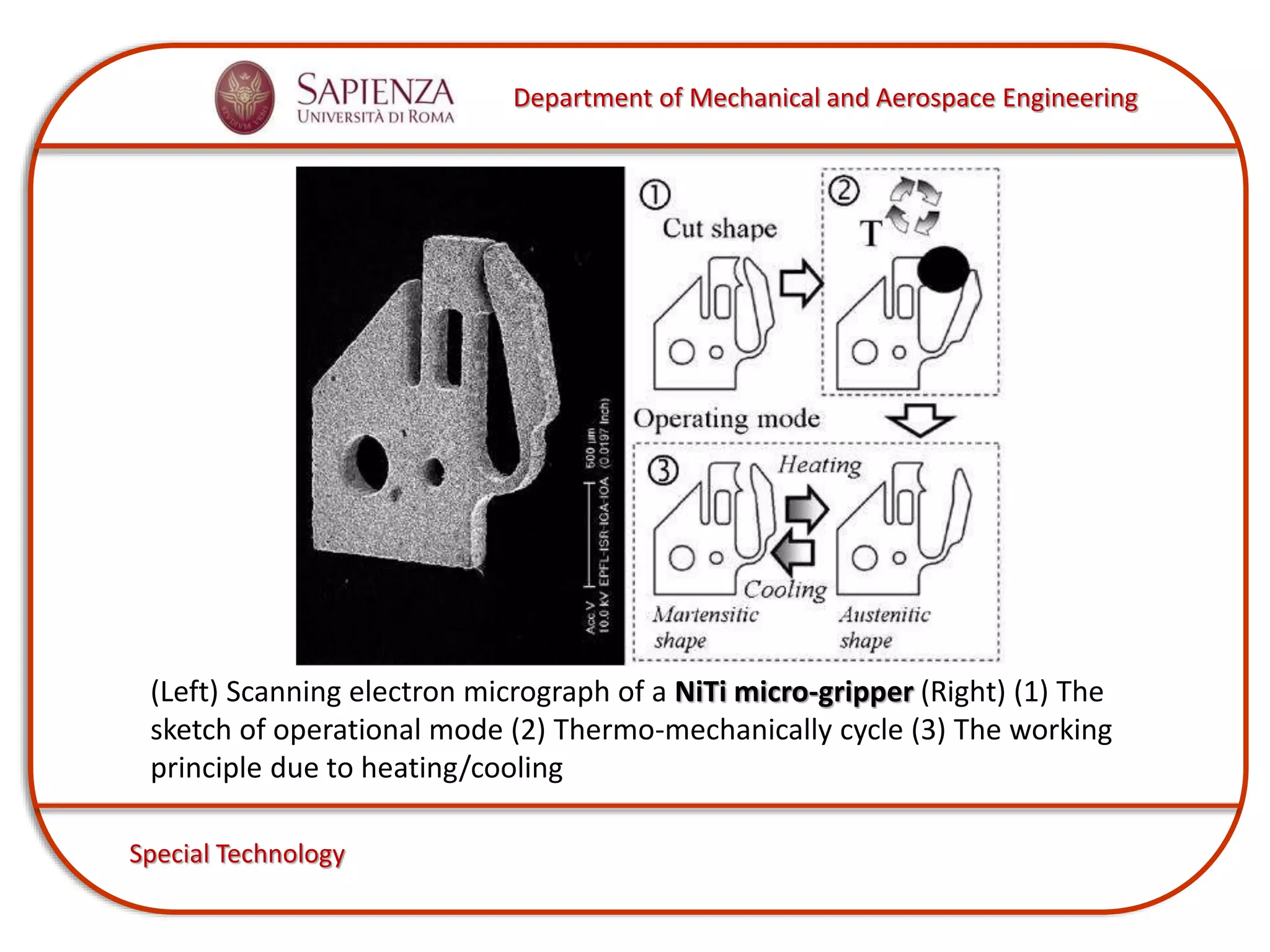
(Left) Scanning electron micrograph of a NiTi micro-gripper (Right) (1) The
sketch of operational mode (2) Thermo-mechanically cycle (3) The working
principle due to heating/cooling
Department of Mechanical and Aerospace Engineering
Special Technology
Magnetic microgripper (a) the
schematic of the body, (b) Gripping
a micro-object by the micro-tip
Department of Mechanical and Aerospace Engineering
Special Technology
A NiTi microgripper with a hook
structure and two C-shape probes
(a) cooled state (b) heated state
Department of Mechanical and Aerospace Engineering
Special Technology
The micro wrapper based on NiTi thin film
Department of Mechanical and Aerospace Engineering
Special Technology
Schematics of the operation of MicroSwitches
Department of Mechanical and Aerospace Engineering
Special Technology
Problems With SMAs
• Fatigue from cycling
– Causes deformations and grain boundaries
– Begin to slip along planes/boundaries
• Overstress
– A load above 8% strain could cause the SMA to completely lose its
original austenite shape
• Difficulty in machining process
• Difficulty with computer programming
• More expensive to manufacture than steel and aluminum
Department of Mechanical and Aerospace Engineering
Special Technology

Shape Memory Alloys (SMAs)

  • 1.
    Special Technologies An Introductionto Shape Memory Alloys (SMAs) Mehrshad Mehrpouya mehrshad.mehrpouya@uniroma1.it Sapienza University of Rome Department of Mechanical and Aerospace Engineering
  • 2.
    Department of Mechanicaland Aerospace Engineering Special Technology Types of Materials - Metals - Ceramics - Polymers - Composites - Semiconductors REVIEW!
  • 3.
    Department of Mechanicaland Aerospace Engineering Special Technology • Piezoelectric materials • Shape memory alloys • Magnetic shape memory alloys • Magnetorheological • PH sensitive polymers • Halochromic materials • Thermochromic materials • Chromogenic systems • Electrochromic • Smart Grease REVIEW!
  • 4.
    Department of Mechanicaland Aerospace Engineering Special Technology What are Shape Memory Alloys? Shape Memory Alloys (SMAs) are metallic alloys that undergo a solid-to-solid phase transformation which can exhibit large recoverable strains. Example: Nitinol
  • 5.
    Department of Mechanicaland Aerospace Engineering Special Technology
  • 6.
    Department of Mechanicaland Aerospace Engineering Special Technology Timeline of Memory Metals • 1932 - A. Ölander discovers the pseudoelastic properties of Au-Cd alloy. • 1949 - Memory effect of Au-Cd reported by Kurdjumov & Kandros. • 1967 – At Naval Ordance Laboratory, Beuhler discovers shape memory effect in nickel titanium alloy, Nitinol, which proved to be a major breakthrough in the field of shape memory alloys. • 1970-1980 – First reports of nickel-titanium implants being used in medical applications. • Mid-1990s – Memory metals start to become widespread in medicine and soon move to other applications.
  • 7.
    Department of Mechanicaland Aerospace Engineering Special Technology Number of publications per year
  • 8.
    Department of Mechanicaland Aerospace Engineering Special Technology Geographic distribution
  • 9.
    Department of Mechanicaland Aerospace Engineering Special Technology Shape Memory Alloys Alloy Transformation Composition Transformation Temp. Rang (°C) Hysteresis (°C) Ag-Cd 44/49 at % Cd -190 to -50 ~15 Au-Cd 46.5/50 at % Cd 30 to 100 ~15 Cu-Al-Ni 14/14.5 wt %Al, 3/4.5 wt %Ni -140 to 100 ~35 Cu-Sn ~15 at % Sn -120 to 30 − Cu-Zn 38.5/41.5 wt % Zn -180 to -10 ~10 Cu-Zn-X (X=Si,Sn,Al) few wt % X -180 to 200 ~10 In-Ti 18/23 at % Ti 60 to 100 ~4 Ni-Al 36/38 at % Al -180 to 100 ~10 Ni-Ti ~49/51 at % Ni -50 to 110 ~30 Fe-Pt ~25 at % Pt ~-130 ~4 Mn-Cu 5/35 wn % Cu -250 to 180 ~25 Fe-Mn-Si 32 wt % Mn -200 to 150 ~100
  • 10.
    Department of Mechanicaland Aerospace Engineering Special Technology Ferromagnetic shape-memory alloys • Shows shape-memory effect in response to a magnetic field • Deformation due to magnetic field is known as magnetoelastic deformation. • Ni-Ti is non-magnetic • Examples of ferromagnetic SMAs: Ni2MnGa, Fe-Pd, Fe3Pt
  • 11.
    Department of Mechanicaland Aerospace Engineering Special Technology Material behavior in Micro-size
  • 12.
    Department of Mechanicaland Aerospace Engineering Special Technology Mf Ms As Af AusteniteMartensite TEMPERATURE Mf Ms As Af AusteniteMartensite TEMPERATURE (twinned) (twinned) Characteristic temperatures: Mf=Martensitic Finish Ms=Martensitic Start As=Austenitic Start Af=Austenitic Finish Thermally Induced Phase Transformation in SMAs
  • 13.
    Department of Mechanicaland Aerospace Engineering Special Technology How are SMAs working?
  • 14.
    Department of Mechanicaland Aerospace Engineering Special Technology Triggers for Martensitic Transformation (MT) Stress Temperature
  • 15.
    Department of Mechanicaland Aerospace Engineering Special Technology How does it work? Step 1: Austenite Phase • High Temperature • The atoms arrange themselves in their “permanent” shape
  • 16.
    Department of Mechanicaland Aerospace Engineering Special Technology Step 2: Martensite Phase • Low temperature • Cubic structure becomes folded or twined
  • 17.
    Department of Mechanicaland Aerospace Engineering Special Technology Step 3: • Bend the Wire • It remains in its Martenesite Phase
  • 18.
    Department of Mechanicaland Aerospace Engineering Special Technology Step 4: Austenite Phase • Heat the wire above the transition temperature of 50 degrees • It moves back to its original position!
  • 19.
    Department of Mechanicaland Aerospace Engineering Special Technology Austenite & Martensite Phases
  • 20.
    Department of Mechanicaland Aerospace Engineering Special Technology SMAs Pseudoelasticity or Superelasticity (SE) Shape Memory Effect (SME)
  • 21.
    Department of Mechanicaland Aerospace Engineering Special Technology Shape Memory Alloys • Pseudoelasticity or Superelasticity (SE) – When the metal is changed to the martensite phase simply by strain. The metal becomes pliable and can withstand strains of up to 8%. • Shape Memory Effect (SME) – These materials have an ability to “remember” its austenite phase. As the metal is cooled to the martensite phase, it can be easily deformed. When the temperature is raised to the austenite phase, it reforms to the original shape of the material. A mix of roughly 50% nickel and 50% titanium is the most common SMA. Also CuZnAl and CuAlNi are widely used.
  • 22.
    Department of Mechanicaland Aerospace Engineering Special Technology Superelastic behavior (SE) SMAs deformed above a critical temperature show a large reversible elastic deformation (recoverable strains up to 10%. much exceeding the elasticity) as a result of stress-induced martensitic transformation.
  • 23.
    Superelastic behavior T >Af Hysteresis loop means energy dissipation, hence vibration damping Stress
  • 24.
    Department of Mechanicaland Aerospace Engineering Special Technology Applications of superelastic behavior • Orthodontal braces • Frames for eyeglasses • Underwires for brassieres • Antennas for cellular phones
  • 25.
    Department of Mechanicaland Aerospace Engineering Special Technology Shape Memory Effect (SME) • Martensitic phase transformation that occurs as a result of stress or temperature change
  • 26.
    Department of Mechanicaland Aerospace Engineering The Shape Memory Effect s e T Cooling Detwinning Heating/Recovery
  • 27.
    Department of Mechanicaland Aerospace Engineering Special Technology Applications of shape memory effect • Self-expandable cardiovascular stent • Blood clot filters • Engines • Actuators for smart systems • Couplings • Flaps that change direction of airflow depending upon temperature (for air conditioners)
  • 28.
    Department of Mechanicaland Aerospace Engineering Special Technology SHAPE MEMORY ALLOY (NITINOL) Inactive Active - Bending Active - Twist
  • 29.
    Department of Mechanicaland Aerospace Engineering Special Technology
  • 30.
    Department of Mechanicaland Aerospace Engineering Special Technology BEFORE TRANSFORMATION DURING TRANSFORMATION AFTER TRANSFORMATION SHAPE MEMORY POLYMERS
  • 31.
    Department of Mechanicaland Aerospace Engineering Special Technology AFTER TRANSFORMATIONBEFORE TRANSFORMATION DURING TRANSFORMATION SHAPE MEMORY POLYMERS
  • 32.
    Department of Mechanicaland Aerospace Engineering Special Technology SHAPE MEMORY POLYMERS
  • 33.
    Department of Mechanicaland Aerospace Engineering Special Technology Types of shape-memory behavior One-way shape memory: transformation to the desired shape occurs only upon heating, i.e., memory is with the austenite phase.
  • 34.
    Department of Mechanicaland Aerospace Engineering Special Technology Types of shape-memory behavior Two-way shape memory: the deformed shape is remembered during cooling, in addition to the original shape being remembered during heating, i.e., memory is with both austenite and martensite phases (requires training to attain memory during cooling; formation of favorably oriented twins during cooling between Ms and Mf)
  • 35.
    Department of Mechanicaland Aerospace Engineering Special Technology Physical properties of Nitinol (versus SS)
  • 36.
    Department of Mechanicaland Aerospace Engineering Special Technology The applications of SMAs
  • 37.
    Department of Mechanicaland Aerospace Engineering Special Technology • Micro-actuators • Mobile phone antennas • Orthodontic archwires • Penile implant • Pipe couplings • Robot actuators • Rock splitting • Root canal drills • Satellite antenna deployment • Scoliosis correction • Solar actuators • Spectacle frames • Steam valves • Stents • Switch vibration damper • Thermostats • Underwired bras • Vibration dampers • ZIF connectors • Aids for disabled • Aircraft flap/slat adjusters • Anti-scald devices • Arterial clips • Automotive thermostats • Braille print punch • Catheter guide wires • Cold start vehicle actuators • Contraceptive devices • Electrical circuit breakers • Fibre-optic coupling • Filter struts • Fire dampers • Fire sprinklers • Gas discharge • Graft stents • Intraocular lens mount • Kettle switches • Keyhole instruments • Key-hole surgery instruments Currentexamplesofapplicationsof shapememoryalloys
  • 38.
    Department of Mechanicaland Aerospace Engineering Special Technology Existing and potential SMA applications in the biomedical domain
  • 39.
    Department of Mechanicaland Aerospace Engineering Special Technology SMAs in Bio-medical Devices
  • 40.
    Department of Mechanicaland Aerospace Engineering Special Technology Bone AnchorsRobotic arms Medical Stents
  • 41.
    Department of Mechanicaland Aerospace Engineering Special Technology SMA orthodontic wires
  • 42.
    Department of Mechanicaland Aerospace Engineering Special Technology Nitinol is used in medicine for stents: A collapsed stent can be inserted into a vein and heated (returning to its original expanded shape) helping to improve blood flow. Also, as a replacement for sutures where nitinol wire can be weaved through two structures then allowed to transform into it's pre-formed shape which should hold the structures in place. SMAs Stents
  • 43.
    Department of Mechanicaland Aerospace Engineering Special Technology Bonestaple
  • 44.
    Department of Mechanicaland Aerospace Engineering Special Technology Photographs of (a) brassiere and (b) various designs of superelastic NiTi underwires.
  • 45.
    Department of Mechanicaland Aerospace Engineering Special Technology Existing and potential SMA applications in the automotive domain
  • 46.
    Department of Mechanicaland Aerospace Engineering Special Technology Existing and potential SMA applications in the aerospace domain
  • 47.
    Department of Mechanicaland Aerospace Engineering Special Technology Picture of wing with SMA wires The wires in the picture are used to replace the actuator. Electric pulses sent through the wires allow for precise movement of the wings, as would be needed in an aircraft. This reduces the need for maintenance, weighs less, and is less costly.
  • 48.
    Department of Mechanicaland Aerospace Engineering Special Technology
  • 49.
    Department of Mechanicaland Aerospace Engineering Special Technology SMAs Microactuators
  • 50.
    Department of Mechanicaland Aerospace Engineering Special Technology
  • 51.
    Department of Mechanicaland Aerospace Engineering Special Technology SMAs Micro-actuators SMAs can generate the mechanical work in shape of large actuation force and displacement during the phase transformation. This deformation is produced due to cooling and heating cycle as two significant elements in SMA actuators. The main parts of the SMA actuators include; SMA part, mechanical system, electronic control system, the fixture body and the effective element with recovering capability based on the employed stress.
  • 52.
    Department of Mechanicaland Aerospace Engineering Special Technology Advantages and dis-advantages of shape memory materials
  • 53.
    Department of Mechanicaland Aerospace Engineering Special Technology SMAs Micro-actuators The most common applications of NiTi thin films are concentrated on microactuators due to their particular capabilities in MEMS, such as micropumps, microvalves, microgrippers, micropositioners, microsprings, microspacers, and microwrappers, etc.
  • 54.
    Department of Mechanicaland Aerospace Engineering Special Technology The schematic of NiTi microvalve in (a) close position, (b) open position
  • 55.
    Department of Mechanicaland Aerospace Engineering Special Technology (Left) Scanning electron micrograph of a NiTi micro-gripper (Right) (1) The sketch of operational mode (2) Thermo-mechanically cycle (3) The working principle due to heating/cooling
  • 56.
    Department of Mechanicaland Aerospace Engineering Special Technology Magnetic microgripper (a) the schematic of the body, (b) Gripping a micro-object by the micro-tip
  • 57.
    Department of Mechanicaland Aerospace Engineering Special Technology A NiTi microgripper with a hook structure and two C-shape probes (a) cooled state (b) heated state
  • 58.
    Department of Mechanicaland Aerospace Engineering Special Technology The micro wrapper based on NiTi thin film
  • 59.
    Department of Mechanicaland Aerospace Engineering Special Technology Schematics of the operation of MicroSwitches
  • 60.
    Department of Mechanicaland Aerospace Engineering Special Technology Problems With SMAs • Fatigue from cycling – Causes deformations and grain boundaries – Begin to slip along planes/boundaries • Overstress – A load above 8% strain could cause the SMA to completely lose its original austenite shape • Difficulty in machining process • Difficulty with computer programming • More expensive to manufacture than steel and aluminum
  • 61.
    Department of Mechanicaland Aerospace Engineering Special Technology