CONTENTS
NAME
1.HISTORY OF SMA
2.INTRODUCTION
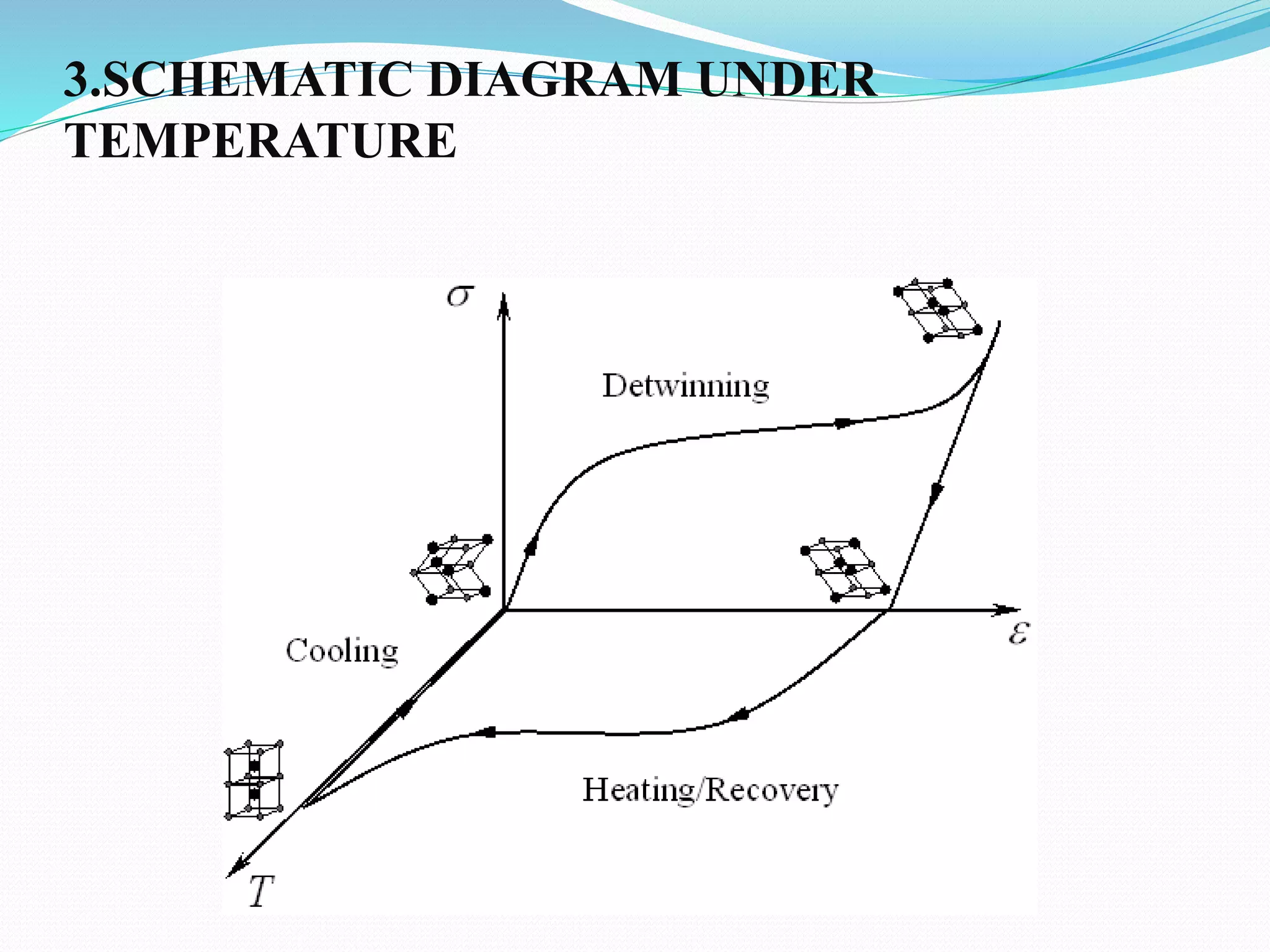
3.SCHEMATIC DIAGRAM UNDER TEMPERATURE
4.SUPERELASTIC SMAS
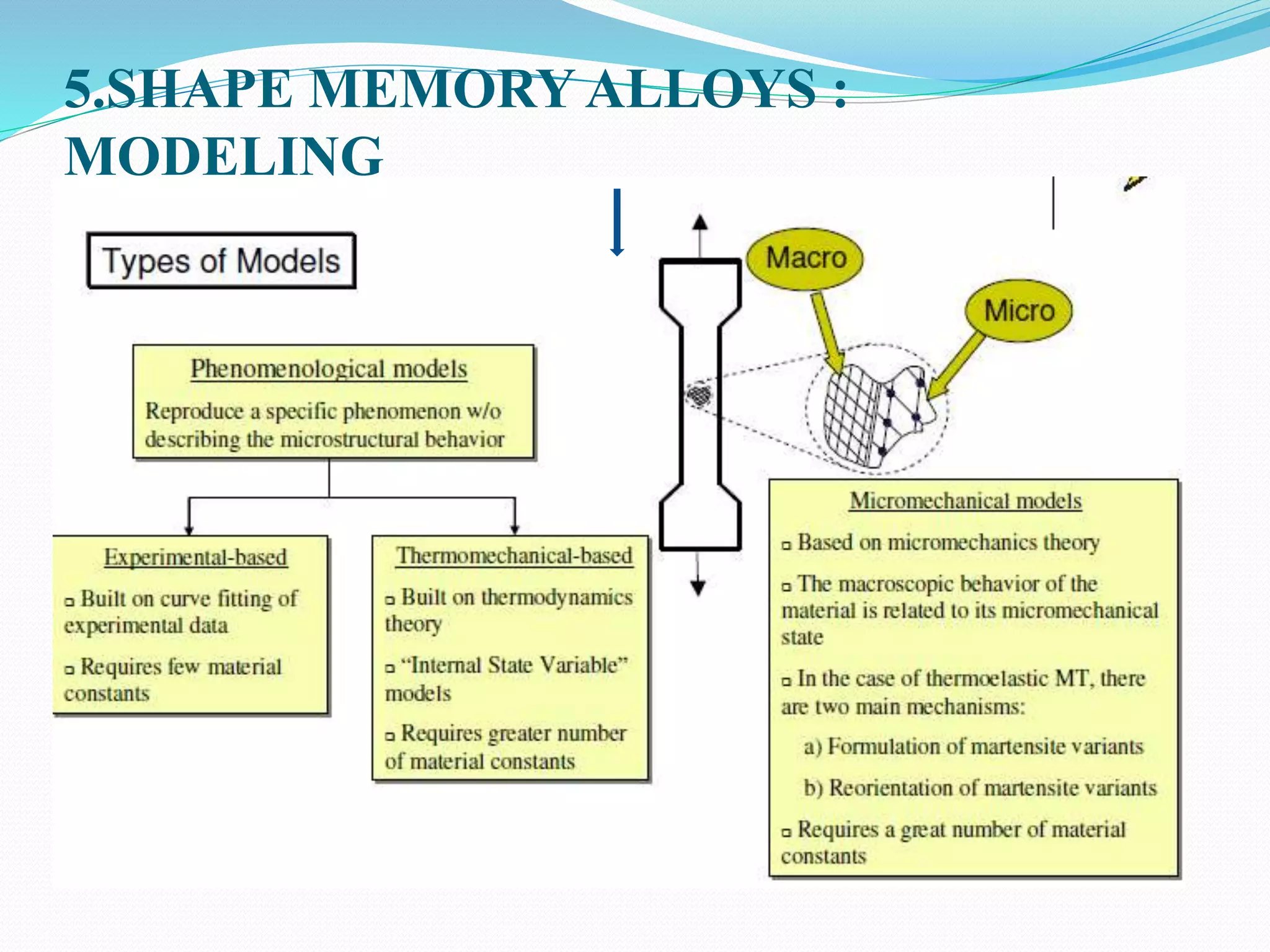
5.SHAPE MEMORY ALLOYS : MODELING
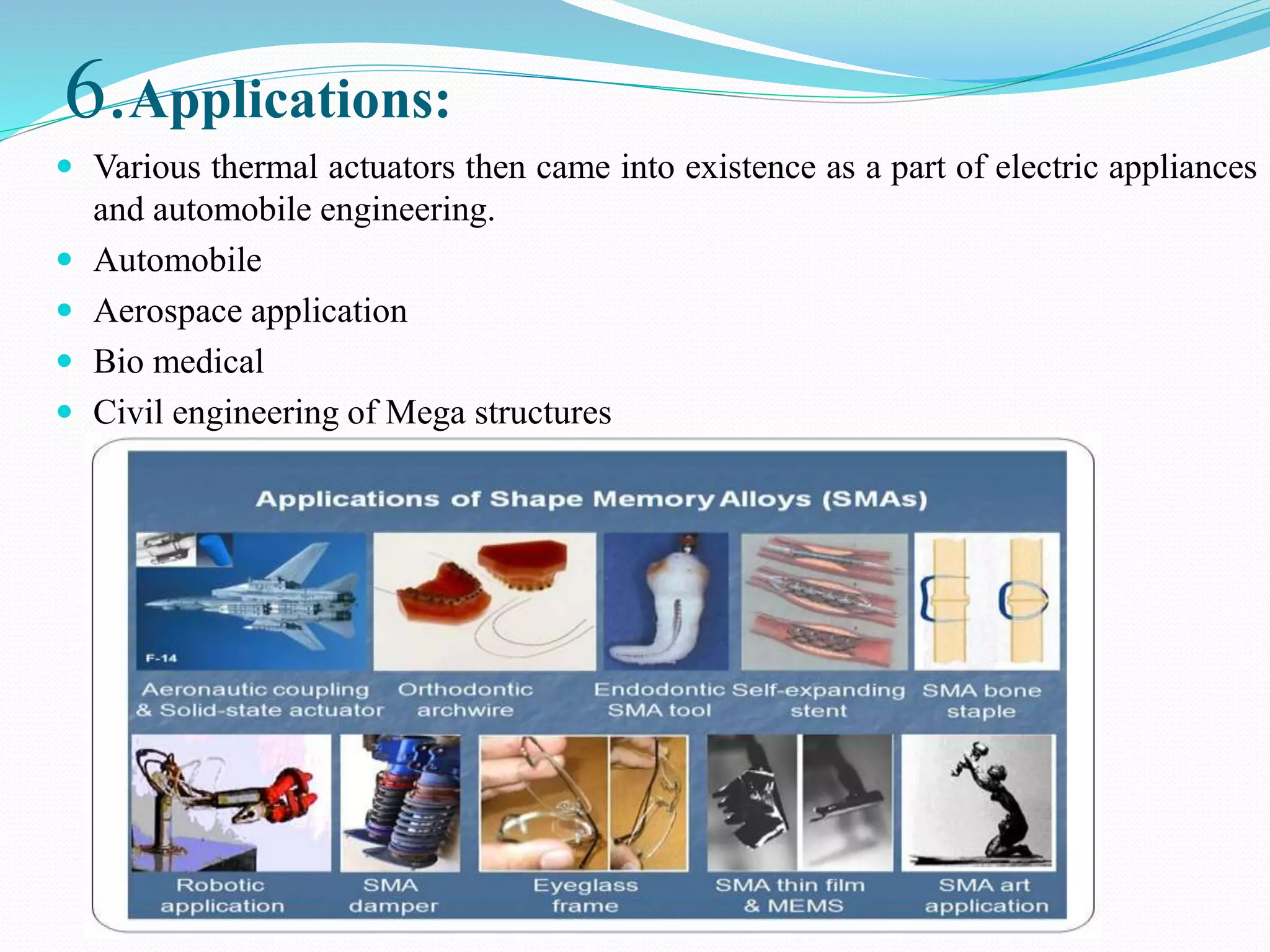
6.APPLICATIONS
7.FUTURE APPLICATIONS OF SMA
8.ADVANTAGES
9.DISADVANTAGES
10.CONCLUSION
1.HISTORY OF SMA
 SMAs were first discovered in 1951
 Further publicized after the discovery of Ni-Ti alloy in
1963
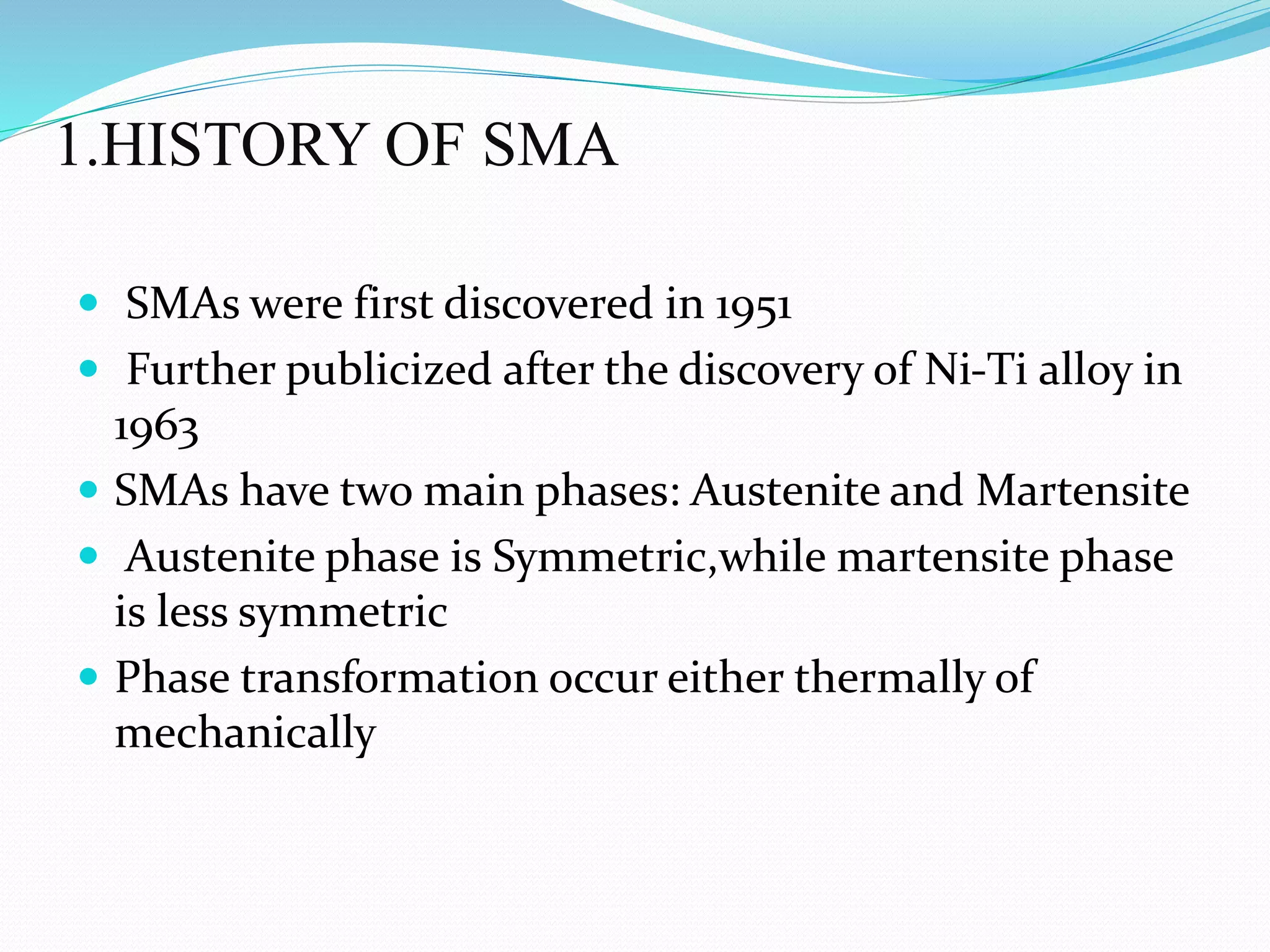
 SMAs have two main phases: Austenite and Martensite
 Austenite phase is Symmetric,while martensite phase
is less symmetric
 Phase transformation occur either thermally of
mechanically
2.INTRODUCTION
 Shape Memory Alloys (SMAs) are a
unique class of metal alloys that can
recover apparent permanent strains
when they are heated above a
certain temperature.
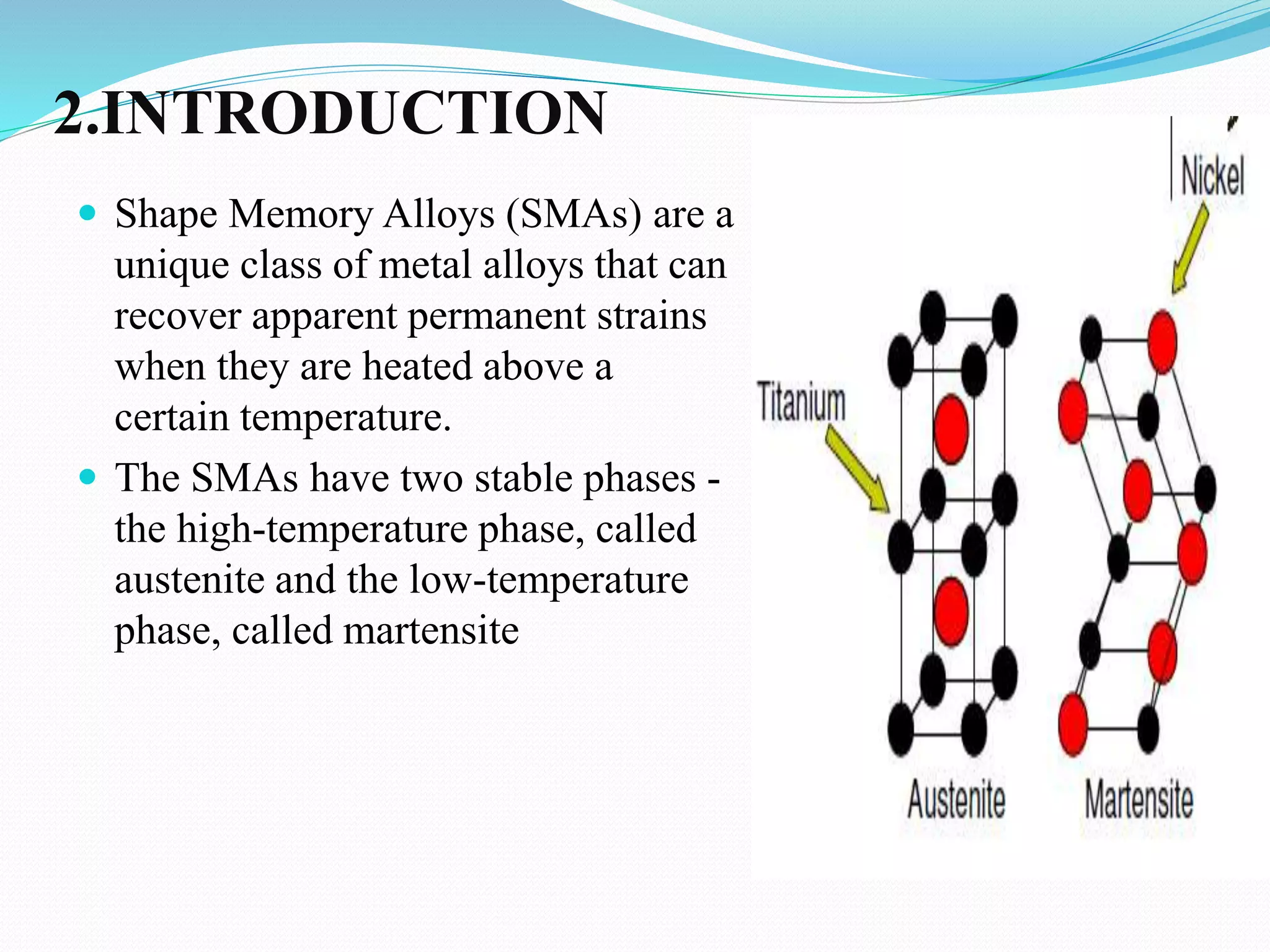
 The SMAs have two stable phases -
the high-temperature phase, called
austenite and the low-temperature
phase, called martensite
3.SCHEMATIC DIAGRAM UNDER
TEMPERATURE
4.SUPERELASTIC SMAs
 Super elastic SMAs are characterized
by:
 1) Excellent recentering capability
 2) Controlled level of force at
moderate strain levels
 3) Strain hardening at large strain
levels
 4) Hysteretic energy dissipation
 5) Excellent corrosion resistance
 6) High fatigue strength
Casati, R., Passaretti,
F., & Tuissi, A. (2011).
Effect of electrical
heating conditions on
functional fatigue .
5.SHAPE MEMORY ALLOYS :
MODELING
6.Applications:
 Various thermal actuators then came into existence as a part of electric appliances
and automobile engineering.
 Automobile
 Aerospace application
 Bio medical
 Civil engineering of Mega structures
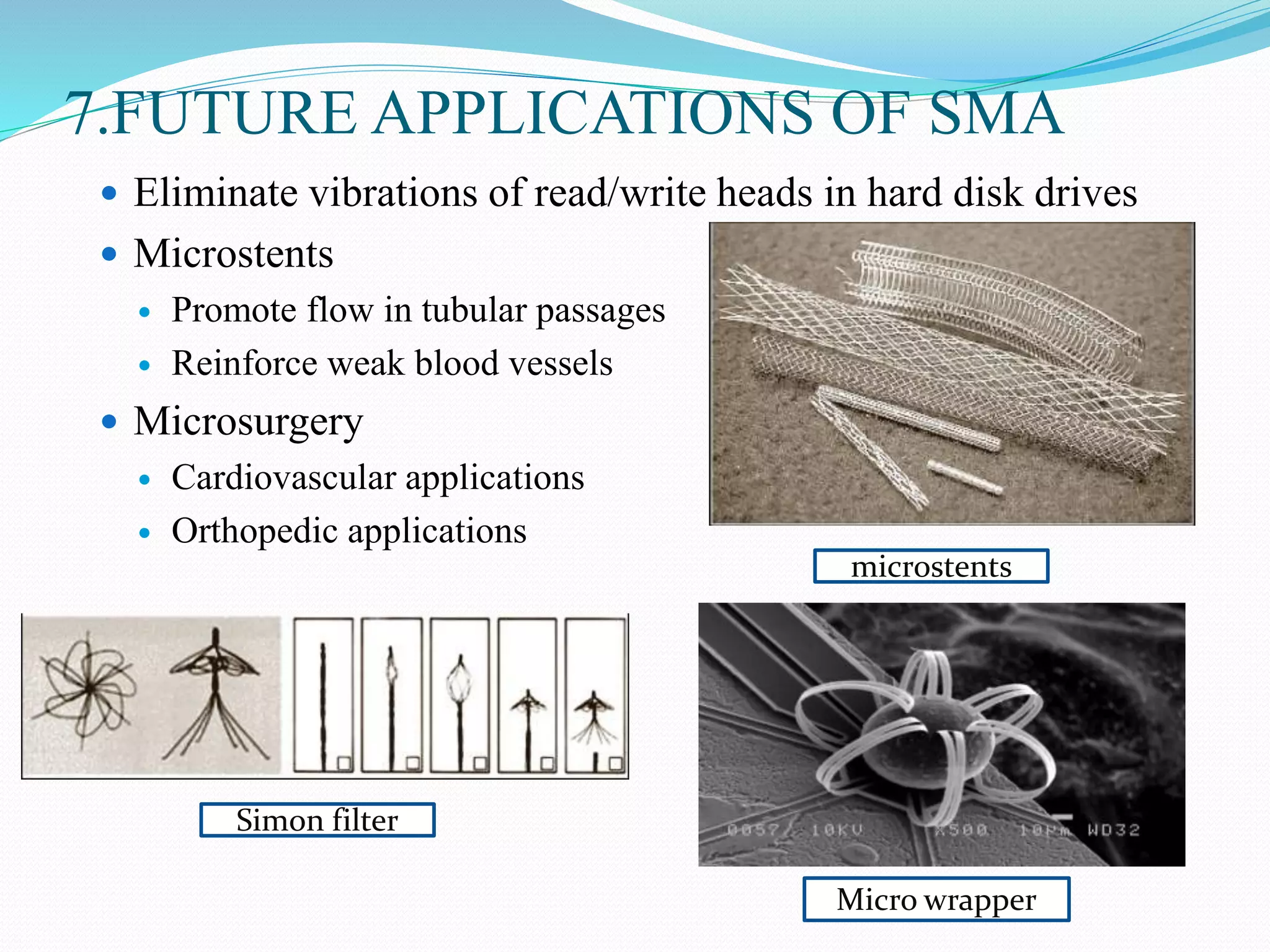
7.FUTURE APPLICATIONS OF SMA
 Eliminate vibrations of read/write heads in hard disk drives
 Microstents
 Promote flow in tubular passages
 Reinforce weak blood vessels
 Microsurgery
 Cardiovascular applications
 Orthopedic applications
microstents
Simon filter
Micro wrapper
8. ADVANTAGES
• High strength
• Good elasticity
• Fatigue Resistance
• Wear resistance
• Easy fabrication
• Easy to sterilize
• High Power/weight ratio
• Light weight
• Shape memory
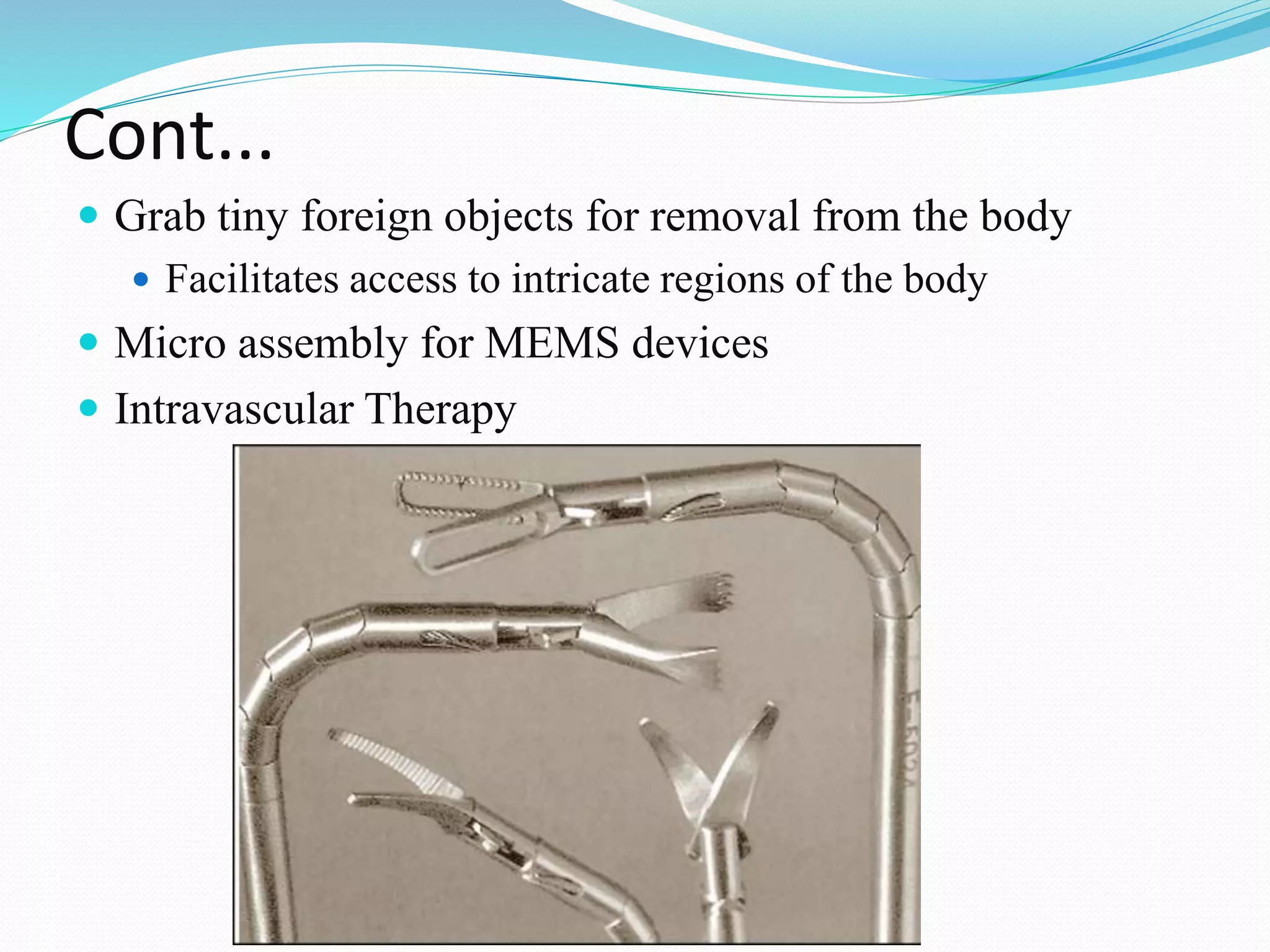
Cont...
 Grab tiny foreign objects for removal from the body
 Facilitates access to intricate regions of the body
 Micro assembly for MEMS devices
 Intravascular Therapy
9.DISADVANTAGES OF SMAs
 The main disadvantages of SMA’s are:
 Initial Expensive
 Sensitivity of material properties in fabrication.
 Residual Stress’s developed in thin films.
 Nonlinearity of actuation force.
 Lower maximum frequency compared to other micro
actuator devices.
• Poor fatigue Property.
10
REFERENCE
 Casati, R., Passaretti, F., & Tuissi, A. (2011). Effect of electrical
heating conditions on functional fatigue of thin NiTi wire for
shape memory actuators Retrieved 06 2011, from ScienceDirect:
http://www.sciencedirect.com/
 de Haan, J. (1994, juli). Geheugenwerking bij NiTi-legeringen.
Retrieved 06 2011, from alexandria.tue.nl:
http://alexandria.tue.nl/repository/books/642146.pdf
 Detailed Introduction to Shape Memory Alloys. (n.d.). Retrieved
06 2011, from smart.tamu.edu:
http://smart.tamu.edu/overview/smaintro/detailed/detailed.html
 Djavareshkian, M., Esmaeli, A., & Parsani, A. (2011).
Aerodynamics of smart flap under ground effect Retrieved 07
2011, from ScienceDirect: http://www.sciencedirect.com
 Kanada, T. (2008, 05 05). A new drive system using a shape
memory alloy (SMA). Retrieved 06 2011, from
joam.inoe.ro/download.php?idu=1360
Shape Memory Alloy ppt

Shape Memory Alloy ppt

  • 2.
    CONTENTS NAME 1.HISTORY OF SMA 2.INTRODUCTION 3.SCHEMATICDIAGRAM UNDER TEMPERATURE 4.SUPERELASTIC SMAS 5.SHAPE MEMORY ALLOYS : MODELING 6.APPLICATIONS 7.FUTURE APPLICATIONS OF SMA 8.ADVANTAGES 9.DISADVANTAGES 10.CONCLUSION
  • 3.
    1.HISTORY OF SMA SMAs were first discovered in 1951  Further publicized after the discovery of Ni-Ti alloy in 1963  SMAs have two main phases: Austenite and Martensite  Austenite phase is Symmetric,while martensite phase is less symmetric  Phase transformation occur either thermally of mechanically
  • 4.
    2.INTRODUCTION  Shape MemoryAlloys (SMAs) are a unique class of metal alloys that can recover apparent permanent strains when they are heated above a certain temperature.  The SMAs have two stable phases - the high-temperature phase, called austenite and the low-temperature phase, called martensite
  • 5.
  • 6.
    4.SUPERELASTIC SMAs  Superelastic SMAs are characterized by:  1) Excellent recentering capability  2) Controlled level of force at moderate strain levels  3) Strain hardening at large strain levels  4) Hysteretic energy dissipation  5) Excellent corrosion resistance  6) High fatigue strength Casati, R., Passaretti, F., & Tuissi, A. (2011). Effect of electrical heating conditions on functional fatigue .
  • 7.
  • 8.
    6.Applications:  Various thermalactuators then came into existence as a part of electric appliances and automobile engineering.  Automobile  Aerospace application  Bio medical  Civil engineering of Mega structures
  • 9.
    7.FUTURE APPLICATIONS OFSMA  Eliminate vibrations of read/write heads in hard disk drives  Microstents  Promote flow in tubular passages  Reinforce weak blood vessels  Microsurgery  Cardiovascular applications  Orthopedic applications microstents Simon filter Micro wrapper
  • 10.
    8. ADVANTAGES • Highstrength • Good elasticity • Fatigue Resistance • Wear resistance • Easy fabrication • Easy to sterilize • High Power/weight ratio • Light weight • Shape memory
  • 11.
    Cont...  Grab tinyforeign objects for removal from the body  Facilitates access to intricate regions of the body  Micro assembly for MEMS devices  Intravascular Therapy
  • 12.
    9.DISADVANTAGES OF SMAs The main disadvantages of SMA’s are:  Initial Expensive  Sensitivity of material properties in fabrication.  Residual Stress’s developed in thin films.  Nonlinearity of actuation force.  Lower maximum frequency compared to other micro actuator devices. • Poor fatigue Property.
  • 13.
  • 14.
    REFERENCE  Casati, R.,Passaretti, F., & Tuissi, A. (2011). Effect of electrical heating conditions on functional fatigue of thin NiTi wire for shape memory actuators Retrieved 06 2011, from ScienceDirect: http://www.sciencedirect.com/  de Haan, J. (1994, juli). Geheugenwerking bij NiTi-legeringen. Retrieved 06 2011, from alexandria.tue.nl: http://alexandria.tue.nl/repository/books/642146.pdf  Detailed Introduction to Shape Memory Alloys. (n.d.). Retrieved 06 2011, from smart.tamu.edu: http://smart.tamu.edu/overview/smaintro/detailed/detailed.html  Djavareshkian, M., Esmaeli, A., & Parsani, A. (2011). Aerodynamics of smart flap under ground effect Retrieved 07 2011, from ScienceDirect: http://www.sciencedirect.com  Kanada, T. (2008, 05 05). A new drive system using a shape memory alloy (SMA). Retrieved 06 2011, from joam.inoe.ro/download.php?idu=1360