Material Science and Engineering
Department of Materials and Metallurgical Engineering
National Institute of Foundry & Forge Technology
Hatia,Ranchi-834003
Under the esteemed guidance of: Presented by:
DR. RATNESH GUPTA UDIT KUMAR
Assistant Professor M.tech (2017-2019)
Materials and Metallurgical Department Roll no.- MM17M20
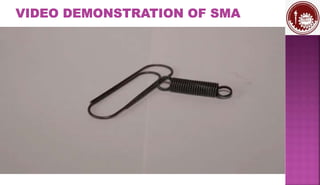
 Shape memory alloys are metal alloys that “remember” their original shapes and having
the ability to return to original shape after being deformed by heating.
 A class of smart materials.
 The most effective and widely used alloys are NiTi, CuZnAl, and CuAlNi.
 They can take large stresses without undergoing permanent deformation.
 SMA also exhibits superelastic (pseudoelastic) behavior.
 1938- Arne Olande observed shape and recovery ability of Au-Cd alloy.
 1938- Greninger and Mooradian observed the formation and disappearance of martensitic
phase by varying the temperature of a Cu-Zn alloy.
 1962-63- The nickel-titanium alloys were first developed in United States Naval
Ordnance Laboratory by Buehler and Frederic and commercialized under the trade name
Nitinol (Nickel Titanium Naval Ordnance Laboratories),where the two elements are
present in roughly equal atomic percentages .
 Mid-1990’s – Shape memory alloys start to become widespread in medicine and soon
move to other applications.
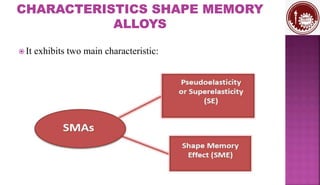
 It exhibits two main characteristic:
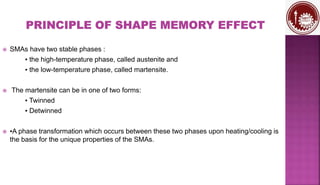
 SMAs have two stable phases :
▪ the high-temperature phase, called austenite and
▪ the low-temperature phase, called martensite.
 The martensite can be in one of two forms:
▪ Twinned
▪ Detwinned
 ▪A phase transformation which occurs between these two phases upon heating/cooling is
the basis for the unique properties of the SMAs.
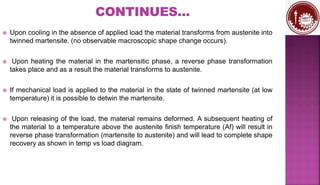
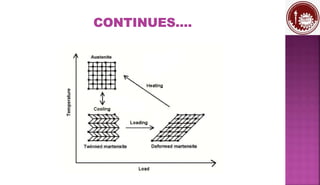
 Upon cooling in the absence of applied load the material transforms from austenite into
twinned martensite. (no observable macroscopic shape change occurs).
 Upon heating the material in the martensitic phase, a reverse phase transformation
takes place and as a result the material transforms to austenite.
 If mechanical load is applied to the material in the state of twinned martensite (at low
temperature) it is possible to detwin the martensite.
 Upon releasing of the load, the material remains deformed. A subsequent heating of
the material to a temperature above the austenite finish temperature (Af) will result in
reverse phase transformation (martensite to austenite) and will lead to complete shape
recovery as shown in temp vs load diagram.
1)One way shape memory alloy
 The material remembers only one shape.
 The material is deformed at a lower
temperature.
 When heated, the material attains its
pre-deformed shape.
Martensite
Reversible deformation
Heated
Cooled
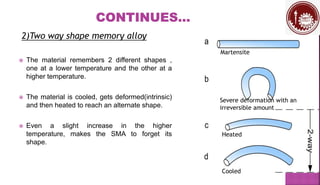
2)Two way shape memory alloy
 The material remembers 2 different shapes ,
one at a lower temperature and the other at a
higher temperature.
 The material is cooled, gets deformed(intrinsic)
and then heated to reach an alternate shape.
 Even a slight increase in the higher
temperature, makes the SMA to forget its
shape.
Martensite
Severe deformation with an
irreversible amount
Heated
Cooled
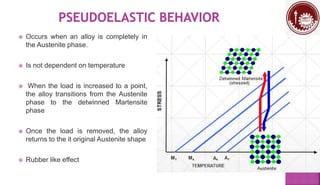
 Occurs when an alloy is completely in
the Austenite phase.
 Is not dependent on temperature
 When the load is increased to a point,
the alloy transitions from the Austenite
phase to the detwinned Martensite
phase
 Once the load is removed, the alloy
returns to the it original Austenite shape
 Rubber like effect
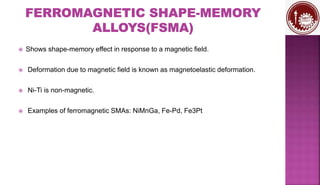
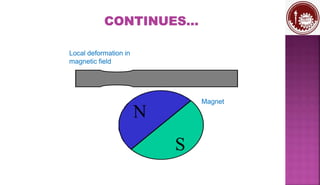
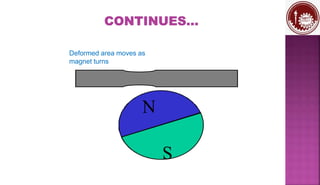
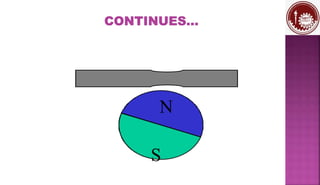
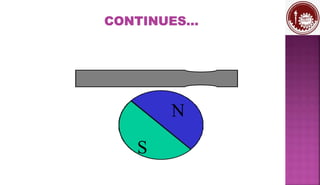
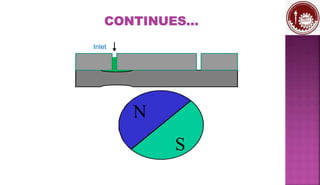
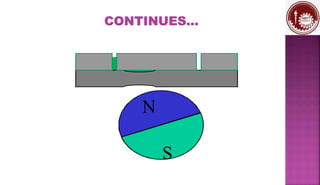
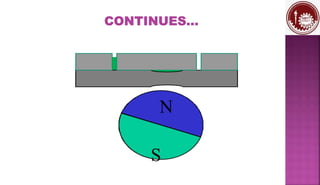
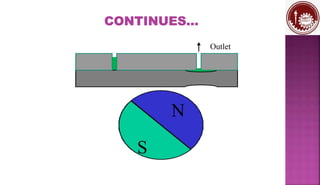
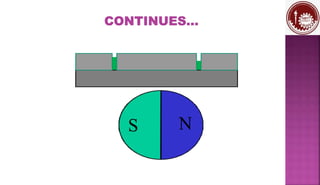
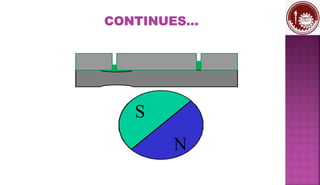
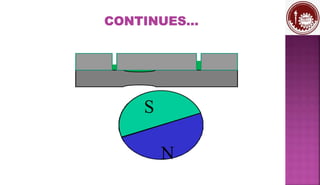
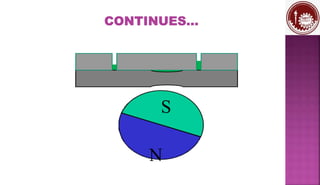
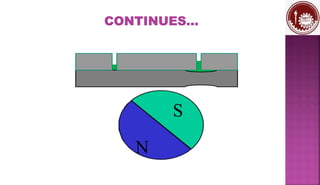
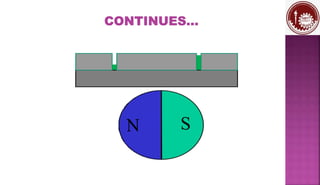
 Shows shape-memory effect in response to a magnetic field.
 Deformation due to magnetic field is known as magnetoelastic deformation.
 Ni-Ti is non-magnetic.
 Examples of ferromagnetic SMAs: NiMnGa, Fe-Pd, Fe3Pt
MSM-element
N
S
Magnet
Local deformation in
magnetic field
N
S
Deformed area moves as
magnet turns
N
S
N
S
N
S
Inlet
N
S
N
S
N
S
Outlet
NS
S
N
S
N
S
N
S
N
SN
 The National Metallurgical Laboratory, the third in the Council of Scientific &
Industrial Research (CSIR) family of 38 laboratories established in the year 1946 is
currently working on the Synthesis of ferromagnetic shape memory alloys (NiMnGa
based) by melt spinning technique.
 Melt spinning is a technique used for rapid cooling of liquids. A wheel is cooled
internally, usually by water or liquid nitrogen, and rotated. A thin stream of liquid is then
dripped onto the wheel and cooled, causing rapid solidification.
 Using melt spinning technique a NiMnGa based ferromagnetic shape memory alloy
could be prepared in the form of ribbons.
 The ribbons can be directly used as sheet type actuator material.
 High power/weight ratio.
 High corrosion and chemical resistance.
 High damping capacity.
 Compactness and lightness.
 High wear resistance
 Diverse field of application.
 Good elasticity.
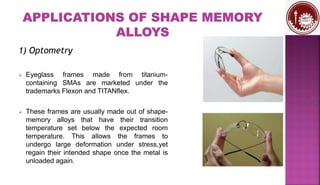
1) Optometry
 Eyeglass frames made from titanium-
containing SMAs are marketed under the
trademarks Flexon and TITANflex.
 These frames are usually made out of shape-
memory alloys that have their transition
temperature set below the expected room
temperature. This allows the frames to
undergo large deformation under stress,yet
regain their intended shape once the metal is
unloaded again.
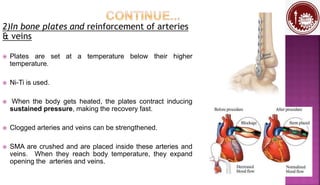
2)In bone plates and reinforcement of arteries
& veins
 Plates are set at a temperature below their higher
temperature.
 Ni-Ti is used.
 When the body gets heated, the plates contract inducing
sustained pressure, making the recovery fast.
 Clogged arteries and veins can be strengthened.
 SMA are crushed and are placed inside these arteries and
veins. When they reach body temperature, they expand
opening the arteries and veins.
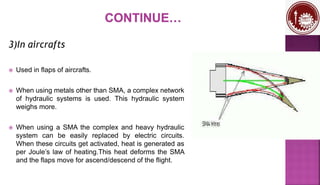
3)In aircrafts
 Used in flaps of aircrafts.
 When using metals other than SMA, a complex network
of hydraulic systems is used. This hydraulic system
weighs more.
 When using a SMA the complex and heavy hydraulic
system can be easily replaced by electric circuits.
When these circuits get activated, heat is generated as
per Joule’s law of heating.This heat deforms the SMA
and the flaps move for ascend/descend of the flight.
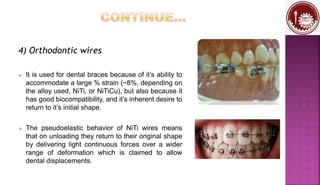
4) Orthodontic wires
 It is used for dental braces because of it’s ability to
accommodate a large % strain (~8%, depending on
the alloy used, NiTi, or NiTiCu), but also because it
has good biocompatibility, and it’s inherent desire to
return to it’s initial shape.
 The pseudoelastic behavior of NiTi wires means
that on unloading they return to their original shape
by delivering light continuous forces over a wider
range of deformation which is claimed to allow
dental displacements.
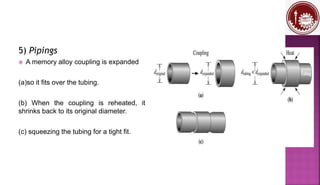
5) Pipings
 A memory alloy coupling is expanded
(a)so it fits over the tubing.
(b) When the coupling is reheated, it
shrinks back to its original diameter.
(c) squeezing the tubing for a tight fit.
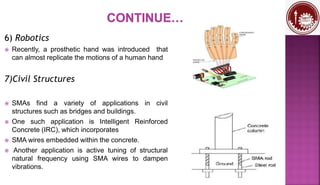
6) Robotics
 Recently, a prosthetic hand was introduced that
can almost replicate the motions of a human hand
7)Civil Structures
 SMAs find a variety of applications in civil
structures such as bridges and buildings.
 One such application is Intelligent Reinforced
Concrete (IRC), which incorporates
 SMA wires embedded within the concrete.
 Another application is active tuning of structural
natural frequency using SMA wires to dampen
vibrations.
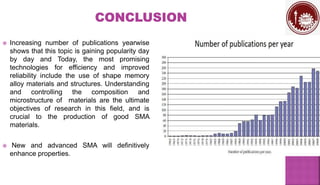
 Increasing number of publications yearwise
shows that this topic is gaining popularity day
by day and Today, the most promising
technologies for efficiency and improved
reliability include the use of shape memory
alloy materials and structures. Understanding
and controlling the composition and
microstructure of materials are the ultimate
objectives of research in this field, and is
crucial to the production of good SMA
materials.
 New and advanced SMA will definitively
enhance properties.
 http://www.nmlindia.org/ferromagneticshapememoryalloys.html
 http://en.wikipedia.org/wiki/Shape_memory_alloy
 http://www.smaterial.com/SMA/sma.html
 Detailed Introduction to Shape Memory Alloys. (n.d.). Retrieved 06 2011, from
smart. tamu.edu:http:// smart.tamu.edu/overview/ smaintro/detailed/detailed.html
 Kanada, T. (2008, 05 05). A new drive system using a shape memory alloy (SMA).
Retrieved 06 2011, from joam.inoe.ro/download.php?idu=1360
 https://www.quora.com/Why-is-a-shape-memory-alloy-used-for-dental-braces
Shape memory alloys

Shape memory alloys

  • 1.
    Material Science andEngineering Department of Materials and Metallurgical Engineering National Institute of Foundry & Forge Technology Hatia,Ranchi-834003 Under the esteemed guidance of: Presented by: DR. RATNESH GUPTA UDIT KUMAR Assistant Professor M.tech (2017-2019) Materials and Metallurgical Department Roll no.- MM17M20
  • 2.
     Shape memoryalloys are metal alloys that “remember” their original shapes and having the ability to return to original shape after being deformed by heating.  A class of smart materials.  The most effective and widely used alloys are NiTi, CuZnAl, and CuAlNi.  They can take large stresses without undergoing permanent deformation.  SMA also exhibits superelastic (pseudoelastic) behavior.
  • 3.
     1938- ArneOlande observed shape and recovery ability of Au-Cd alloy.  1938- Greninger and Mooradian observed the formation and disappearance of martensitic phase by varying the temperature of a Cu-Zn alloy.  1962-63- The nickel-titanium alloys were first developed in United States Naval Ordnance Laboratory by Buehler and Frederic and commercialized under the trade name Nitinol (Nickel Titanium Naval Ordnance Laboratories),where the two elements are present in roughly equal atomic percentages .  Mid-1990’s – Shape memory alloys start to become widespread in medicine and soon move to other applications.
  • 5.
     It exhibitstwo main characteristic:
  • 6.
     SMAs havetwo stable phases : ▪ the high-temperature phase, called austenite and ▪ the low-temperature phase, called martensite.  The martensite can be in one of two forms: ▪ Twinned ▪ Detwinned  ▪A phase transformation which occurs between these two phases upon heating/cooling is the basis for the unique properties of the SMAs.
  • 7.
     Upon coolingin the absence of applied load the material transforms from austenite into twinned martensite. (no observable macroscopic shape change occurs).  Upon heating the material in the martensitic phase, a reverse phase transformation takes place and as a result the material transforms to austenite.  If mechanical load is applied to the material in the state of twinned martensite (at low temperature) it is possible to detwin the martensite.  Upon releasing of the load, the material remains deformed. A subsequent heating of the material to a temperature above the austenite finish temperature (Af) will result in reverse phase transformation (martensite to austenite) and will lead to complete shape recovery as shown in temp vs load diagram.
  • 9.
    1)One way shapememory alloy  The material remembers only one shape.  The material is deformed at a lower temperature.  When heated, the material attains its pre-deformed shape. Martensite Reversible deformation Heated Cooled
  • 10.
    2)Two way shapememory alloy  The material remembers 2 different shapes , one at a lower temperature and the other at a higher temperature.  The material is cooled, gets deformed(intrinsic) and then heated to reach an alternate shape.  Even a slight increase in the higher temperature, makes the SMA to forget its shape. Martensite Severe deformation with an irreversible amount Heated Cooled
  • 11.
     Occurs whenan alloy is completely in the Austenite phase.  Is not dependent on temperature  When the load is increased to a point, the alloy transitions from the Austenite phase to the detwinned Martensite phase  Once the load is removed, the alloy returns to the it original Austenite shape  Rubber like effect
  • 12.
     Shows shape-memoryeffect in response to a magnetic field.  Deformation due to magnetic field is known as magnetoelastic deformation.  Ni-Ti is non-magnetic.  Examples of ferromagnetic SMAs: NiMnGa, Fe-Pd, Fe3Pt
  • 13.
  • 14.
  • 15.
    N S Deformed area movesas magnet turns
  • 16.
  • 17.
  • 18.
  • 19.
  • 20.
  • 21.
  • 22.
  • 23.
  • 24.
  • 25.
  • 26.
  • 27.
  • 28.
     The NationalMetallurgical Laboratory, the third in the Council of Scientific & Industrial Research (CSIR) family of 38 laboratories established in the year 1946 is currently working on the Synthesis of ferromagnetic shape memory alloys (NiMnGa based) by melt spinning technique.  Melt spinning is a technique used for rapid cooling of liquids. A wheel is cooled internally, usually by water or liquid nitrogen, and rotated. A thin stream of liquid is then dripped onto the wheel and cooled, causing rapid solidification.  Using melt spinning technique a NiMnGa based ferromagnetic shape memory alloy could be prepared in the form of ribbons.  The ribbons can be directly used as sheet type actuator material.
  • 29.
     High power/weightratio.  High corrosion and chemical resistance.  High damping capacity.  Compactness and lightness.  High wear resistance  Diverse field of application.  Good elasticity.
  • 30.
    1) Optometry  Eyeglassframes made from titanium- containing SMAs are marketed under the trademarks Flexon and TITANflex.  These frames are usually made out of shape- memory alloys that have their transition temperature set below the expected room temperature. This allows the frames to undergo large deformation under stress,yet regain their intended shape once the metal is unloaded again.
  • 31.
    2)In bone platesand reinforcement of arteries & veins  Plates are set at a temperature below their higher temperature.  Ni-Ti is used.  When the body gets heated, the plates contract inducing sustained pressure, making the recovery fast.  Clogged arteries and veins can be strengthened.  SMA are crushed and are placed inside these arteries and veins. When they reach body temperature, they expand opening the arteries and veins.
  • 32.
    3)In aircrafts  Usedin flaps of aircrafts.  When using metals other than SMA, a complex network of hydraulic systems is used. This hydraulic system weighs more.  When using a SMA the complex and heavy hydraulic system can be easily replaced by electric circuits. When these circuits get activated, heat is generated as per Joule’s law of heating.This heat deforms the SMA and the flaps move for ascend/descend of the flight.
  • 33.
    4) Orthodontic wires It is used for dental braces because of it’s ability to accommodate a large % strain (~8%, depending on the alloy used, NiTi, or NiTiCu), but also because it has good biocompatibility, and it’s inherent desire to return to it’s initial shape.  The pseudoelastic behavior of NiTi wires means that on unloading they return to their original shape by delivering light continuous forces over a wider range of deformation which is claimed to allow dental displacements.
  • 34.
    5) Pipings  Amemory alloy coupling is expanded (a)so it fits over the tubing. (b) When the coupling is reheated, it shrinks back to its original diameter. (c) squeezing the tubing for a tight fit.
  • 35.
    6) Robotics  Recently,a prosthetic hand was introduced that can almost replicate the motions of a human hand 7)Civil Structures  SMAs find a variety of applications in civil structures such as bridges and buildings.  One such application is Intelligent Reinforced Concrete (IRC), which incorporates  SMA wires embedded within the concrete.  Another application is active tuning of structural natural frequency using SMA wires to dampen vibrations.
  • 36.
     Increasing numberof publications yearwise shows that this topic is gaining popularity day by day and Today, the most promising technologies for efficiency and improved reliability include the use of shape memory alloy materials and structures. Understanding and controlling the composition and microstructure of materials are the ultimate objectives of research in this field, and is crucial to the production of good SMA materials.  New and advanced SMA will definitively enhance properties.
  • 37.
     http://www.nmlindia.org/ferromagneticshapememoryalloys.html  http://en.wikipedia.org/wiki/Shape_memory_alloy http://www.smaterial.com/SMA/sma.html  Detailed Introduction to Shape Memory Alloys. (n.d.). Retrieved 06 2011, from smart. tamu.edu:http:// smart.tamu.edu/overview/ smaintro/detailed/detailed.html  Kanada, T. (2008, 05 05). A new drive system using a shape memory alloy (SMA). Retrieved 06 2011, from joam.inoe.ro/download.php?idu=1360  https://www.quora.com/Why-is-a-shape-memory-alloy-used-for-dental-braces