Special Technologies
Four-Dimensional (4D) Printing
Mehrshad Mehrpouya, Ph.D.
Sapienza University of Rome
Department of Mechanical and Aerospace Engineering
Special Technologies
Additive Manufacturing
• Additive manufacturing, also known as 3D printing, is a
process that creates a physical object from a digital
design.
• Additive manufacturing uses data computer-aided-design
(CAD) software or 3D object scanners to direct hardware
to deposit material, layer upon layer, in precise geometric
shapes.
• Although the terms "3D printing" and "rapid prototyping"
are casually used to discuss additive manufacturing, each
process is actually a subset of additive manufacturing.
Department of Mechanical and Aerospace Engineering
Special Technologies
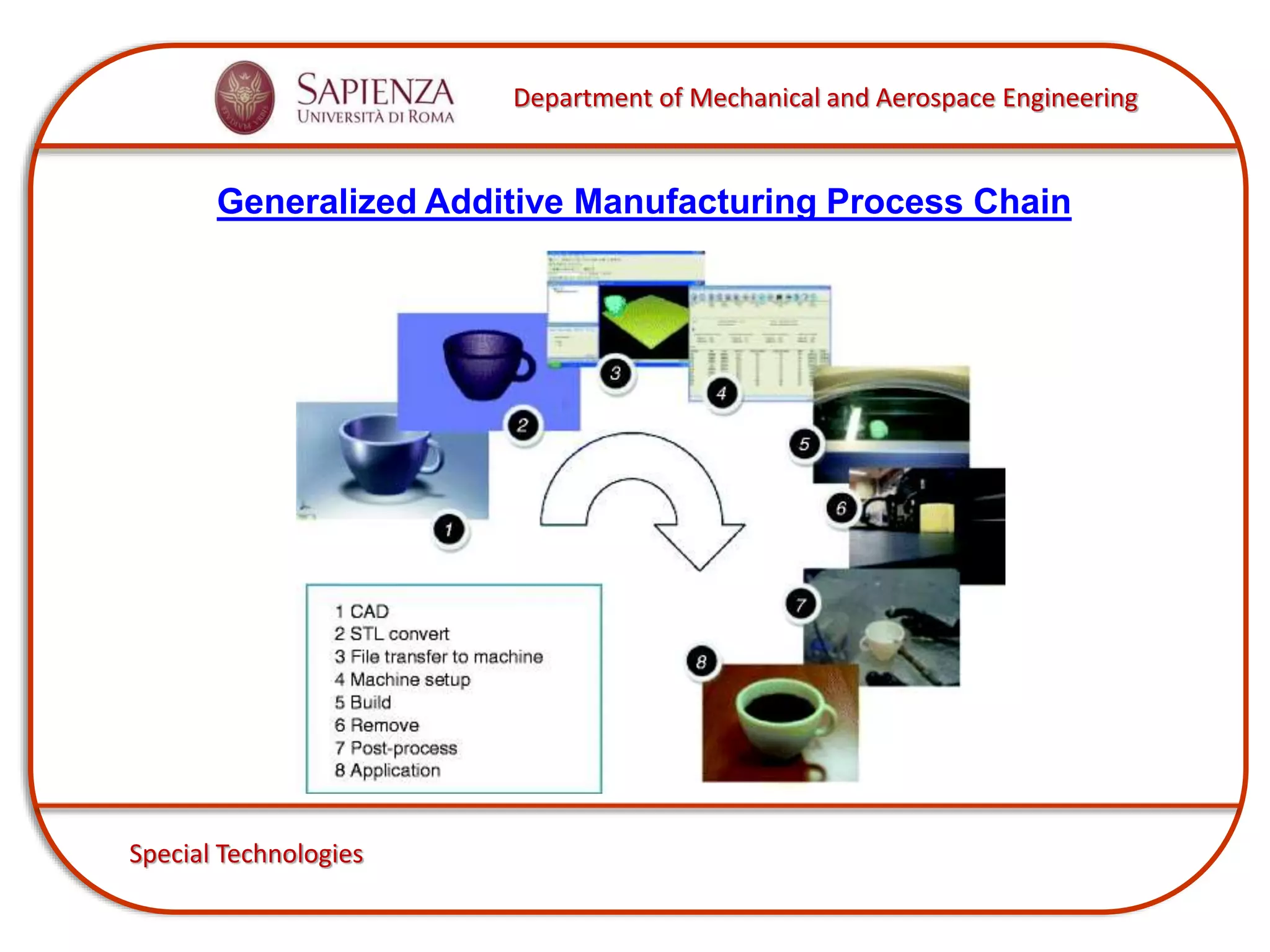
Generalized Additive Manufacturing Process Chain
Department of Mechanical and Aerospace Engineering
Special Technologies
Department of Mechanical and Aerospace Engineering
Special Technologies
Additive Manufacturing-based on Deposition Processes
Department of Mechanical and Aerospace Engineering
Special Technologies
Types of 3D Printing Technology
Department of Mechanical and Aerospace Engineering
Special Technologies
Stereolithography
Stereolithography is one the oldest 3D printing method.
Patented by Charles Hull, co-founder of 3D Systems,
Inc in 1986, this printing technology converts liquid
plastics into solid 3D objects. Stereolithography
apparatus (SLA) machine or printer is needed in order
to work with Stereolithography technique.
Form 1+ printer for Stereo lithography 3D
printing (Formlabs, 2017)
Department of Mechanical and Aerospace Engineering
Special Technologies
Fused Deposition Modeling
• Fused deposition modeling (FDM) technology
was developed and invented by Stratasys ltd.
founder Scott Crump, in 1980s.
• Fused deposition modeling techniques are used to
print functional prototypes as well as final end
use products. Because of its high performance
and engineering grade thermoplastic, this printing
process is widely used by engineers,
manufacturers and other professionals. 3D Printer Mojo from Stratasys
(Stratasys, Stratasys, 2016)
Department of Mechanical and Aerospace Engineering
Special Technologies
Fused Deposition Modeling
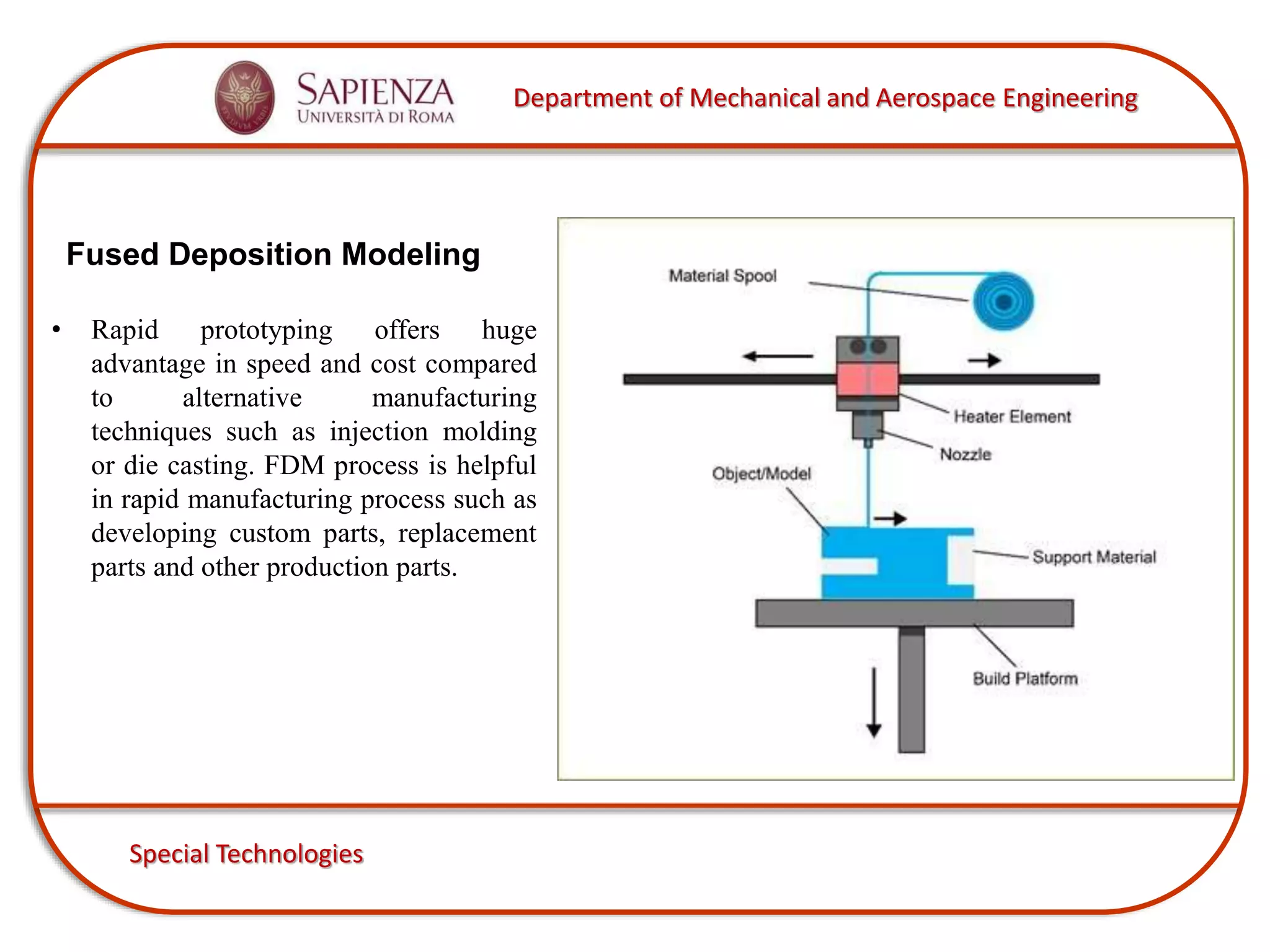
• Rapid prototyping offers huge
advantage in speed and cost compared
to alternative manufacturing
techniques such as injection molding
or die casting. FDM process is helpful
in rapid manufacturing process such as
developing custom parts, replacement
parts and other production parts.
Department of Mechanical and Aerospace Engineering
Special Technologies
Characteristics of Fused Deposition Modeling:
• Design freedom.
• This technology is easy and simple to use.
• Easily creates good sized strong, non-brittle geometrically complex structure.
• Thermoplastics used in this production process are mechanically strong and
clean to environment.
• Apart from above advantages, the main disadvantage is time consuming slow
process and post processing. The model needs to be sanding and filling for good
surface finish.
Department of Mechanical and Aerospace Engineering
Special Technologies
Digital Light Processing
• Digital Light Processing (DLP) is another 3D
printing process similar to Stereolithography
technology.
• Based on Digital Micro Mirror Device (DMD)
developed by Texas Instruments, Digital Light
Processing (DLP) is a new way to project and
display information with superior image
quality, high brightness projection.
• Digital Micro Mirror Device (DMD) is a fast,
reflective digital light switch that controls light
source precisely using binary pulse width
modulation technique.
Digital Light processing (Industry 3. P., 3D Printing
Process, 2016)
Department of Mechanical and Aerospace Engineering
Special Technologies
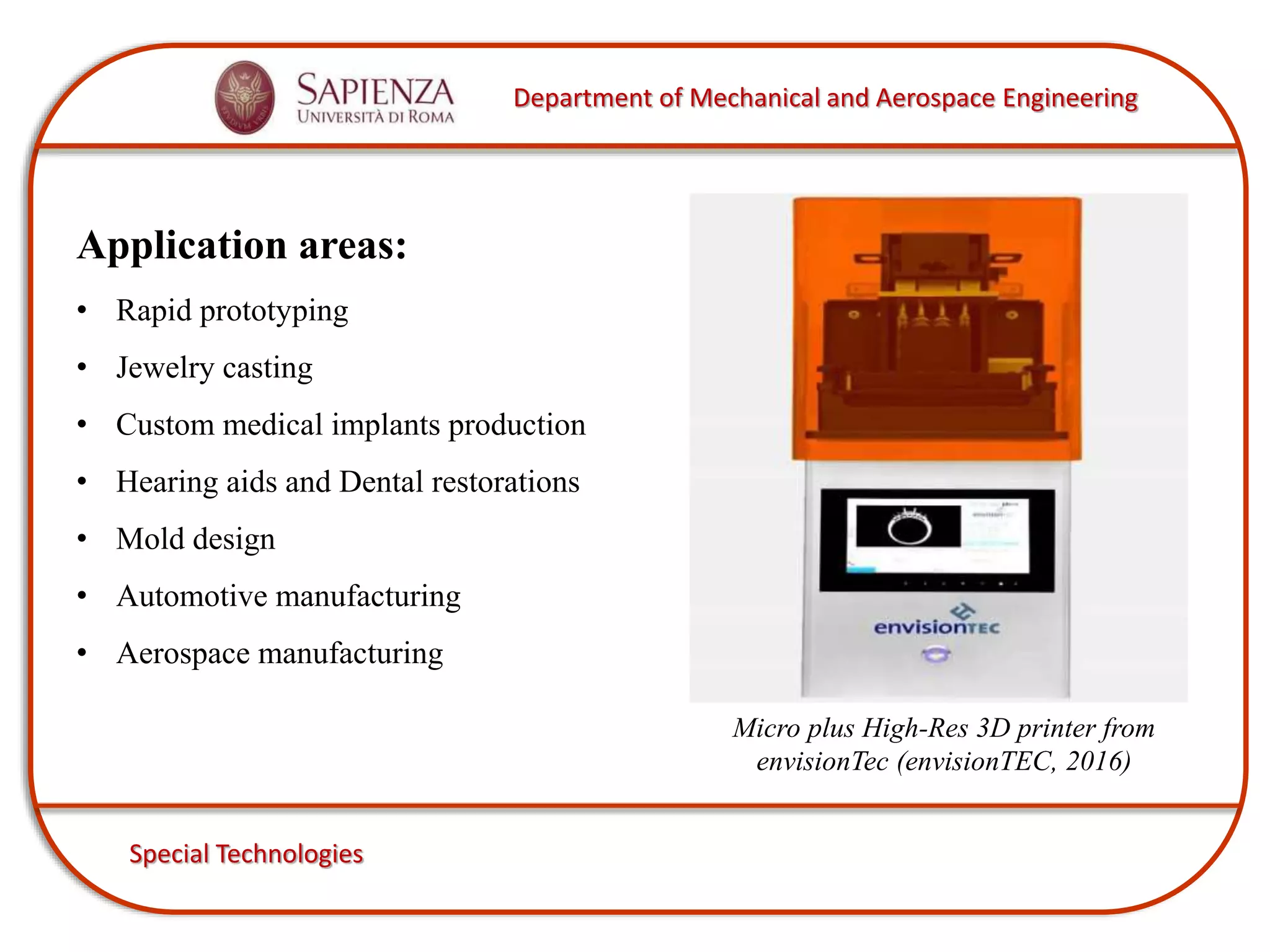
Application areas:
• Rapid prototyping
• Jewelry casting
• Custom medical implants production
• Hearing aids and Dental restorations
• Mold design
• Automotive manufacturing
• Aerospace manufacturing
Micro plus High-Res 3D printer from
envisionTec (envisionTEC, 2016)
Department of Mechanical and Aerospace Engineering
Special Technologies
Selective Laser Sintering (SLS)
• SLS process is similar to
Stereolithography process but uses
powdered materials instead of
liquid resin.
• The materials like nylon,
ceramics, glass, aluminum, silver
or steel can be used for printing.
• Due to variety of materials that
can be used, this 3D printing
process is widely used for
customized products.
Selective Laser Sinstering process (Industry 3. P., 3D
Printing Process, 2016)
Department of Mechanical and Aerospace Engineering
Special Technologies
Selective Laser Sintering (SLS)
Department of Mechanical and Aerospace Engineering
Special Technologies
Selective Laser Melting (SLM)
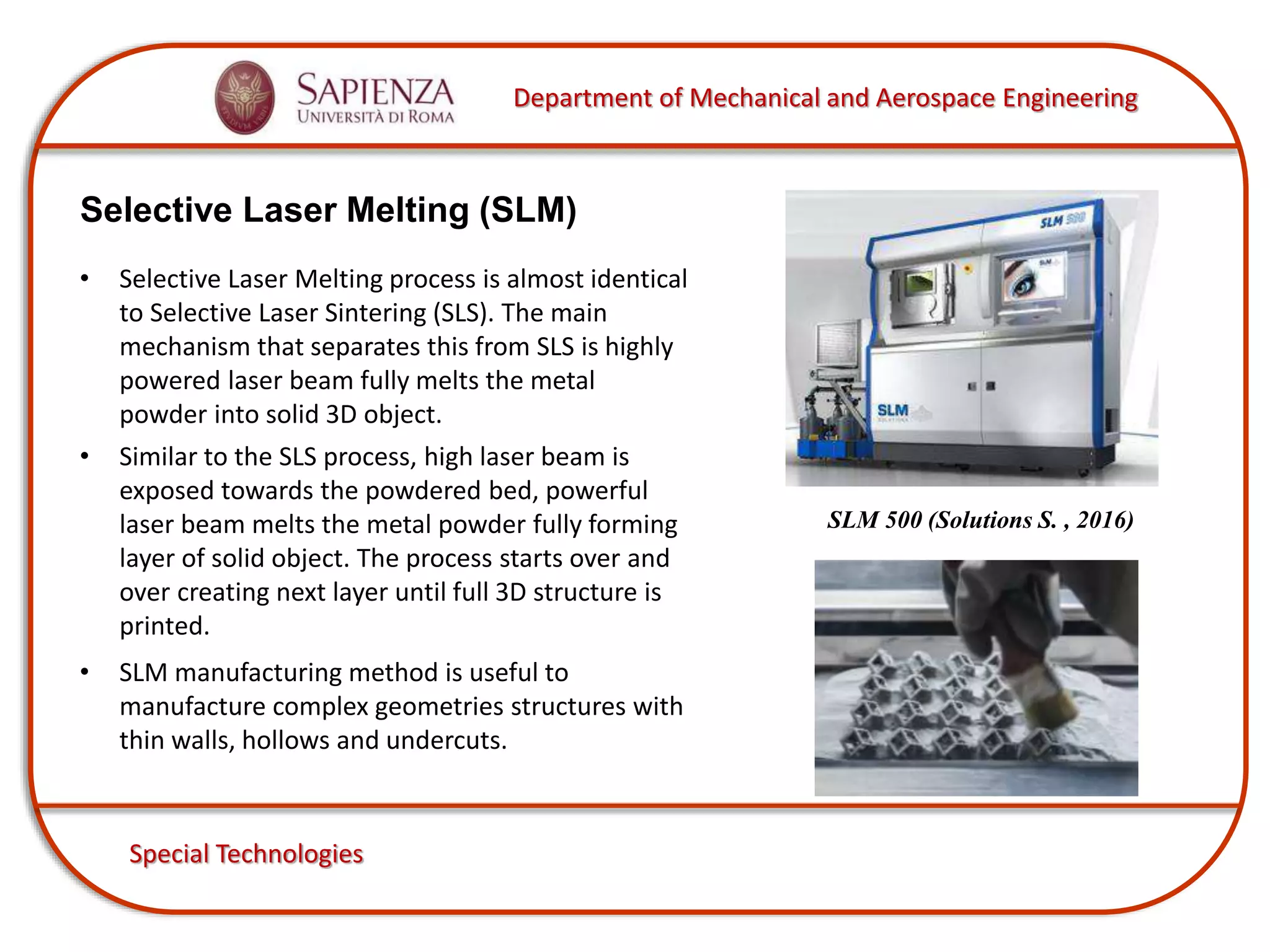
SLM 500 (Solutions S. , 2016)
• Selective Laser Melting process is almost identical
to Selective Laser Sintering (SLS). The main
mechanism that separates this from SLS is highly
powered laser beam fully melts the metal
powder into solid 3D object.
• Similar to the SLS process, high laser beam is
exposed towards the powdered bed, powerful
laser beam melts the metal powder fully forming
layer of solid object. The process starts over and
over creating next layer until full 3D structure is
printed.
• SLM manufacturing method is useful to
manufacture complex geometries structures with
thin walls, hollows and undercuts.
Department of Mechanical and Aerospace Engineering
Special Technologies
Selective Laser Melting (SLM)
Department of Mechanical and Aerospace Engineering
Special Technologies
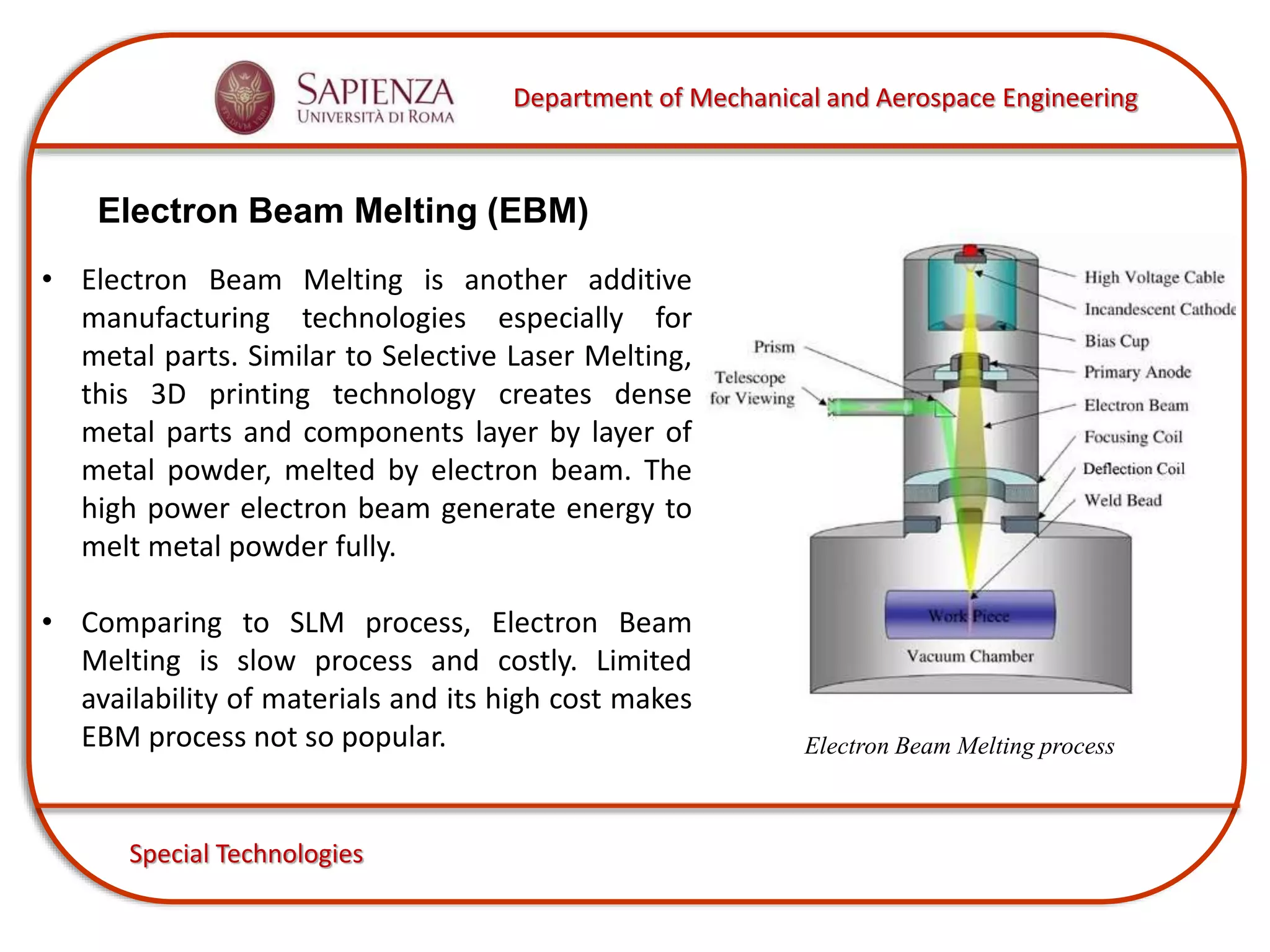
Electron Beam Melting (EBM)
Electron Beam Melting process
• Electron Beam Melting is another additive
manufacturing technologies especially for
metal parts. Similar to Selective Laser Melting,
this 3D printing technology creates dense
metal parts and components layer by layer of
metal powder, melted by electron beam. The
high power electron beam generate energy to
melt metal powder fully.
• Comparing to SLM process, Electron Beam
Melting is slow process and costly. Limited
availability of materials and its high cost makes
EBM process not so popular.
Department of Mechanical and Aerospace Engineering
Special Technologies
Electron Beam Melting (EBM)
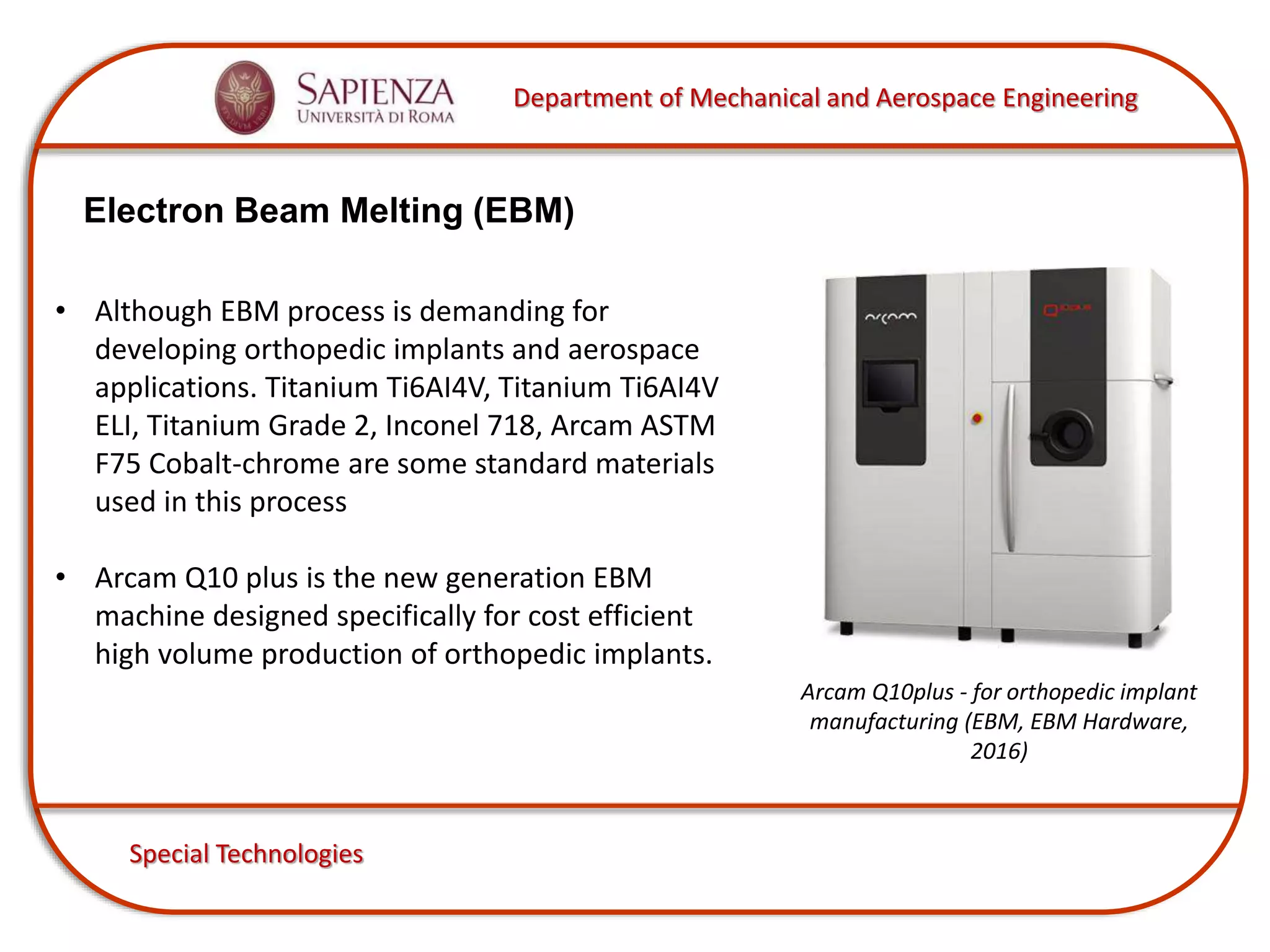
Arcam Q10plus - for orthopedic implant
manufacturing (EBM, EBM Hardware,
2016)
• Although EBM process is demanding for
developing orthopedic implants and aerospace
applications. Titanium Ti6AI4V, Titanium Ti6AI4V
ELI, Titanium Grade 2, Inconel 718, Arcam ASTM
F75 Cobalt-chrome are some standard materials
used in this process
• Arcam Q10 plus is the new generation EBM
machine designed specifically for cost efficient
high volume production of orthopedic implants.
Department of Mechanical and Aerospace Engineering
Special Technologies
Laminated Object Manufacturing (LOM)
• Laminated Object Manufacturing is the most
affordable and fastest way to print 3D shapes.
In simple form, sheets of different types of
materials are bonded together and cut in the
right structure according to the 3D model. LOM
process is mainly used for prototyping rather
than production purpose.
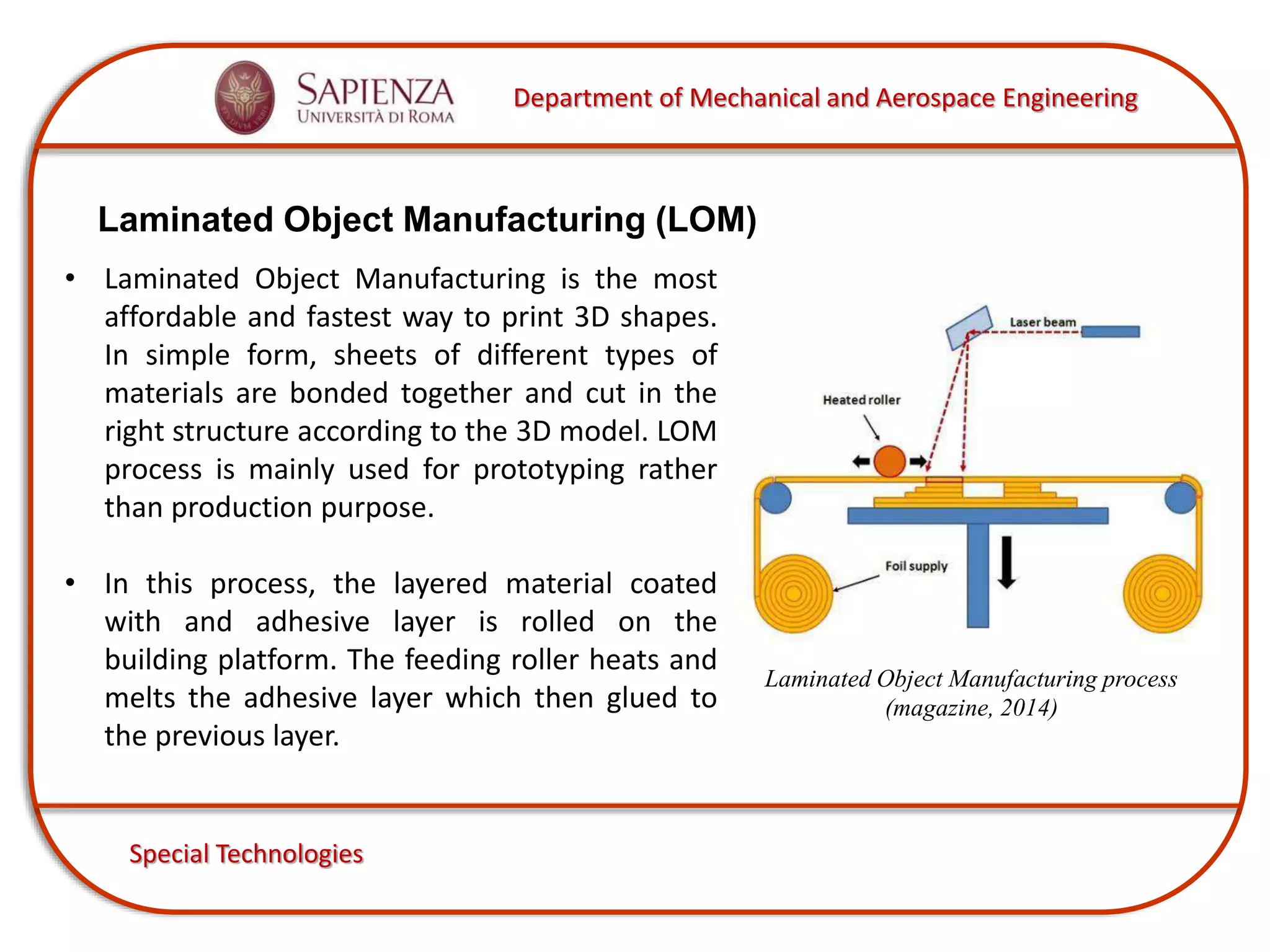
• In this process, the layered material coated
with and adhesive layer is rolled on the
building platform. The feeding roller heats and
melts the adhesive layer which then glued to
the previous layer.
Laminated Object Manufacturing process
(magazine, 2014)
Department of Mechanical and Aerospace Engineering
Special Technologies
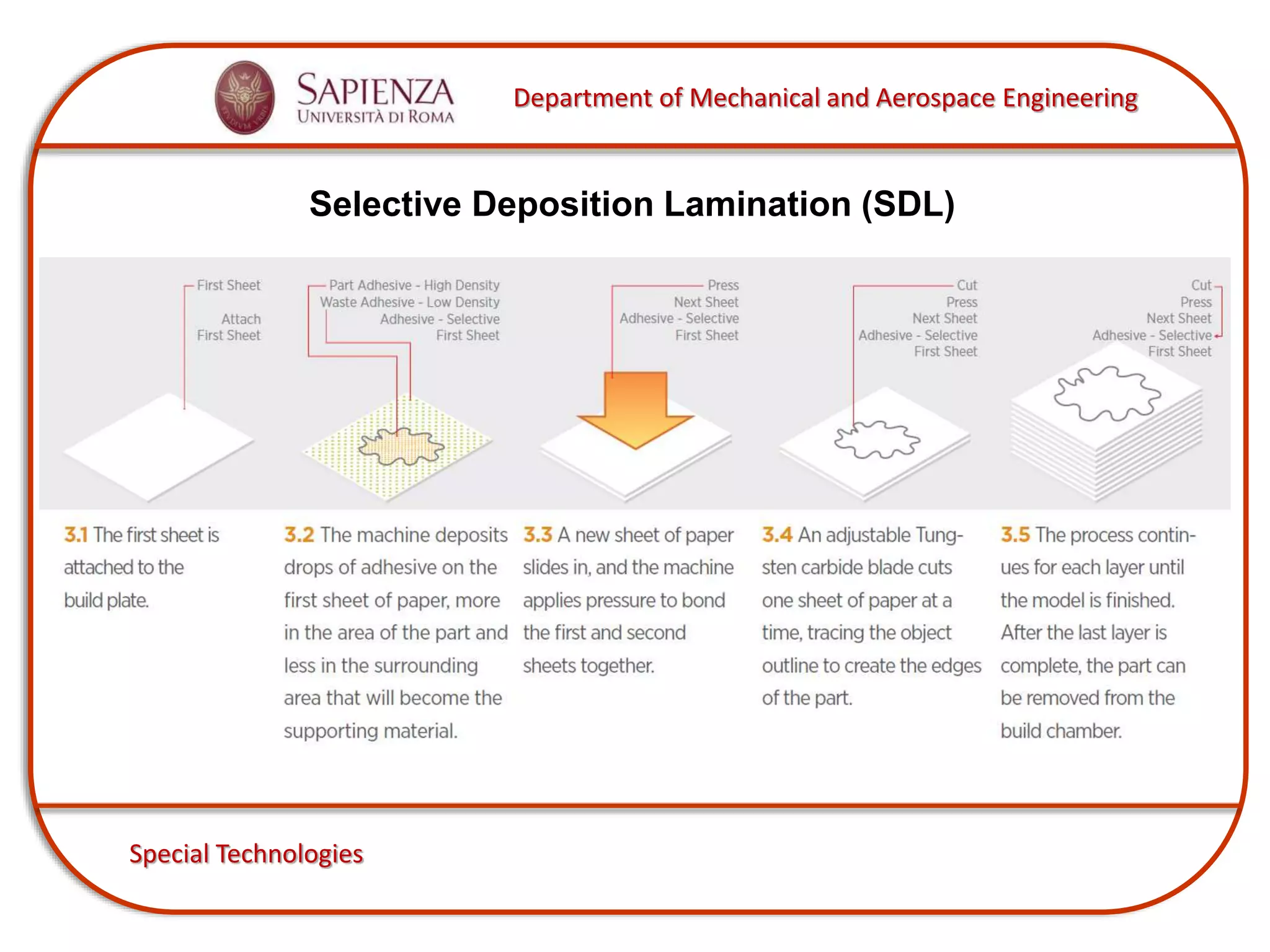
Selective Deposition Lamination (SDL)
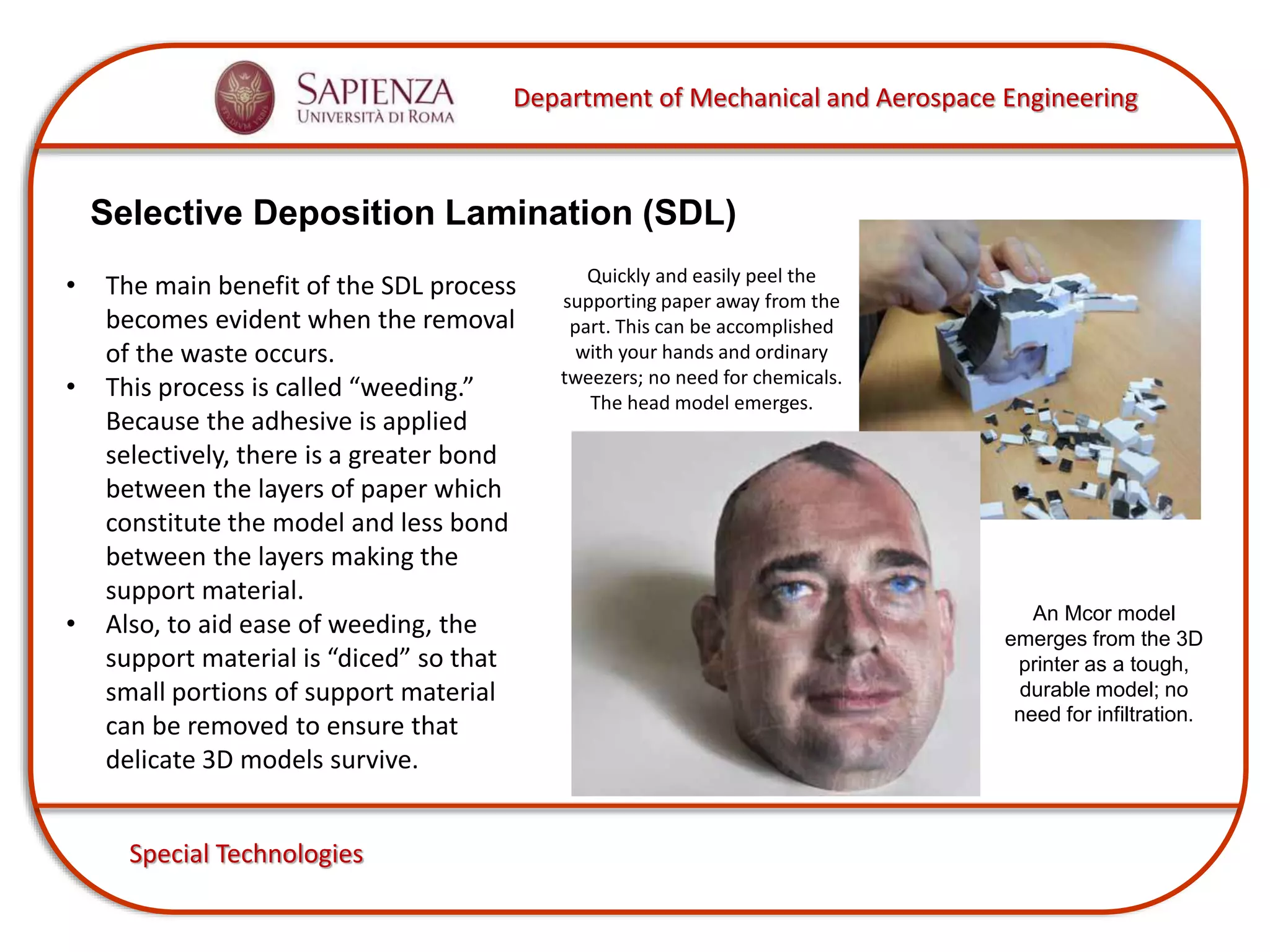
Quickly and easily peel the
supporting paper away from the
part. This can be accomplished
with your hands and ordinary
tweezers; no need for chemicals.
The head model emerges.
An Mcor model
emerges from the 3D
printer as a tough,
durable model; no
need for infiltration.
• The main benefit of the SDL process
becomes evident when the removal
of the waste occurs.
• This process is called “weeding.”
Because the adhesive is applied
selectively, there is a greater bond
between the layers of paper which
constitute the model and less bond
between the layers making the
support material.
• Also, to aid ease of weeding, the
support material is “diced” so that
small portions of support material
can be removed to ensure that
delicate 3D models survive.
Department of Mechanical and Aerospace Engineering
Special Technologies
Selective Deposition Lamination (SDL)
Department of Mechanical and Aerospace Engineering
Special Technologies
Materials used in 3D Printing
Department of Mechanical and Aerospace Engineering
Special Technologies
Department of Mechanical and Aerospace Engineering
Special Technologies
Plastics
• Biodegradable plastic, Polylactic acid (PLA) is
mostly used in filament form.
• ABS is another strong plastic material used for 3D
printing. ABS provides high strength with high
temperature resistance.
• Nylon also called Polyamide is the most commonly
used plastic material. Because of its durability,
flexibility and strong character, nylon is used
commonly in powder form. Nylon is perfect all-
rounder and allows for fully functional end products
Department of Mechanical and Aerospace Engineering
Special Technologies
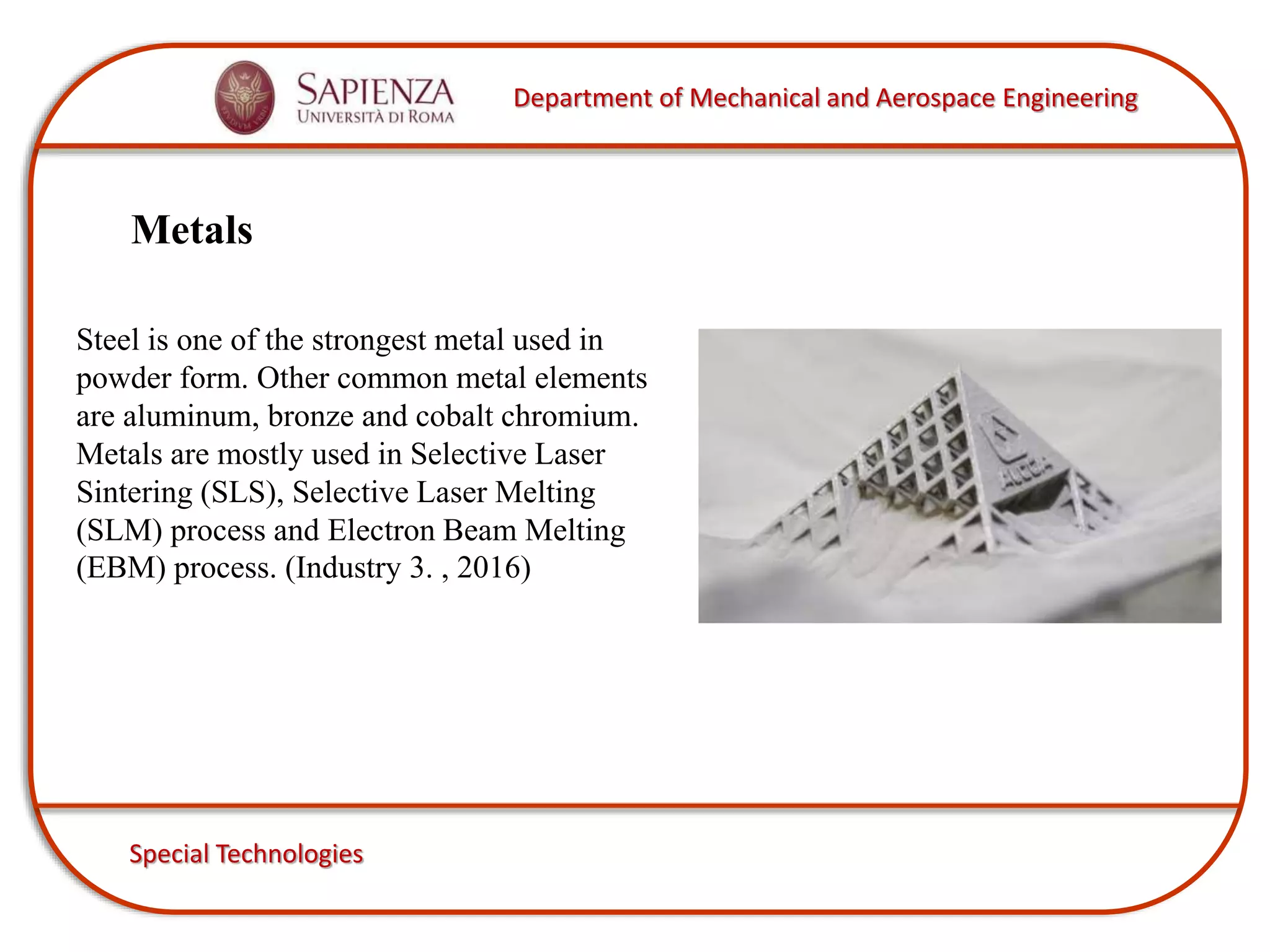
Metals
Steel is one of the strongest metal used in
powder form. Other common metal elements
are aluminum, bronze and cobalt chromium.
Metals are mostly used in Selective Laser
Sintering (SLS), Selective Laser Melting
(SLM) process and Electron Beam Melting
(EBM) process. (Industry 3. , 2016)
Department of Mechanical and Aerospace Engineering
Special Technologies
Ceramics
Ceramics are not so commonly used and new group
to materials. They are unique material with the
possibilities of creating smooth surface texture and
geometry. (Industry 3. , 2016)
Paper
Laminated Object Manufacturing and Selective
Deposition Lamination technologies use paper as
one of the material to print 3D body. As paper are
inexpensive, safe, eco-friendly and recyclable, they
are mostly applied in prototyping rather than
production. (Industry 3. , 2016)
Department of Mechanical and Aerospace Engineering
Special Technologies
Food
Food 3D printing is the latest trend in additive manufacturing field. Chocolate is the
most commonly used material for designing and printing eye watering models. Mmuse-
Delta Model Desktop Food 3D Printer prints pancakes, chocolates and candies of
desired model. (Store, 2016)
Department of Mechanical and Aerospace Engineering
Special Technologies
3D printing Application
Department of Mechanical and Aerospace Engineering
Special Technologies
Medical Field
Department of Mechanical and Aerospace Engineering
Special Technologies
Aeronautics and Aerospace
Department of Mechanical and Aerospace Engineering
Special Technologies
Architecture
Department of Mechanical and Aerospace Engineering
Special Technologies
Automotive
Department of Mechanical and Aerospace Engineering
Special Technologies
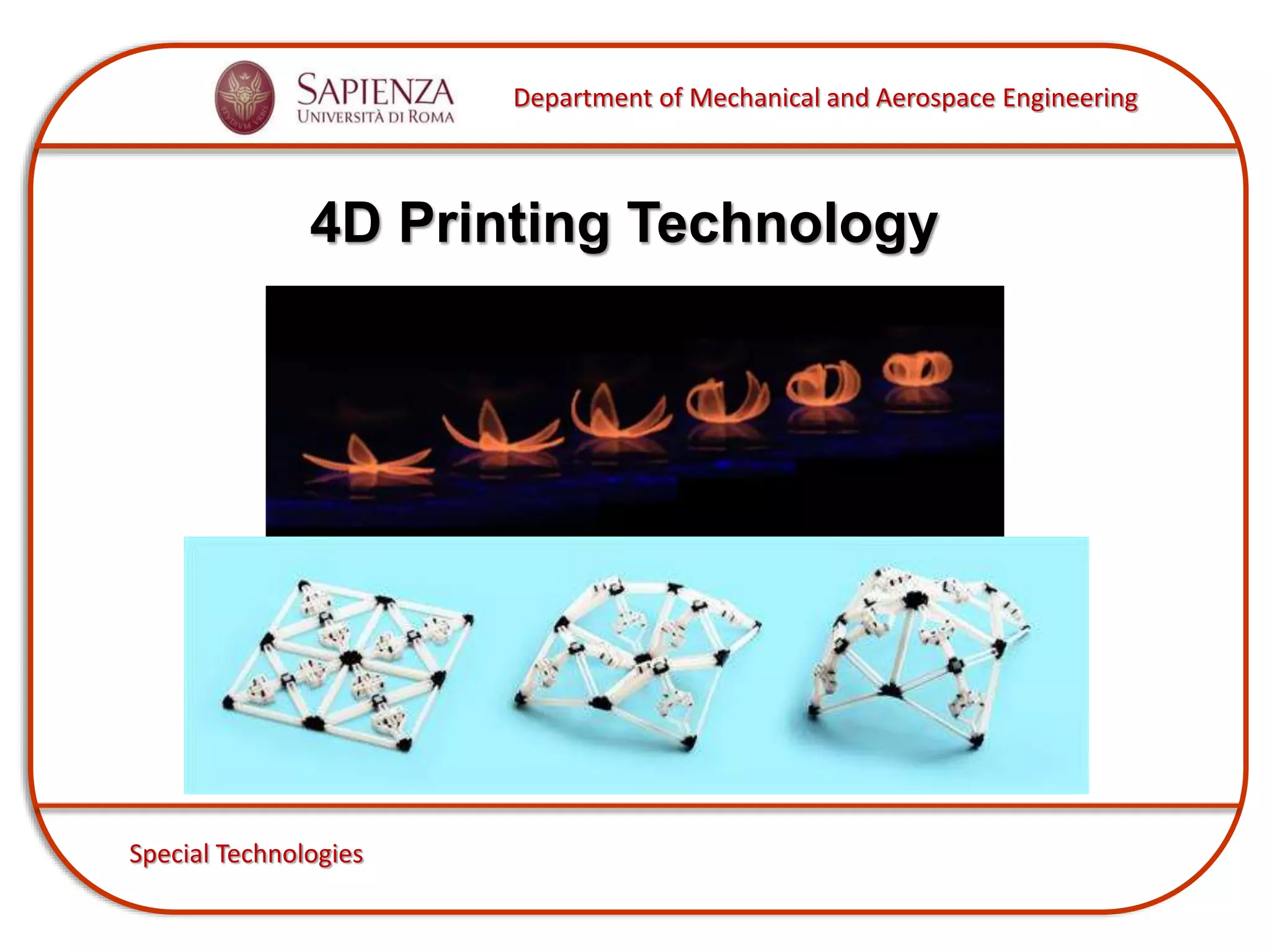
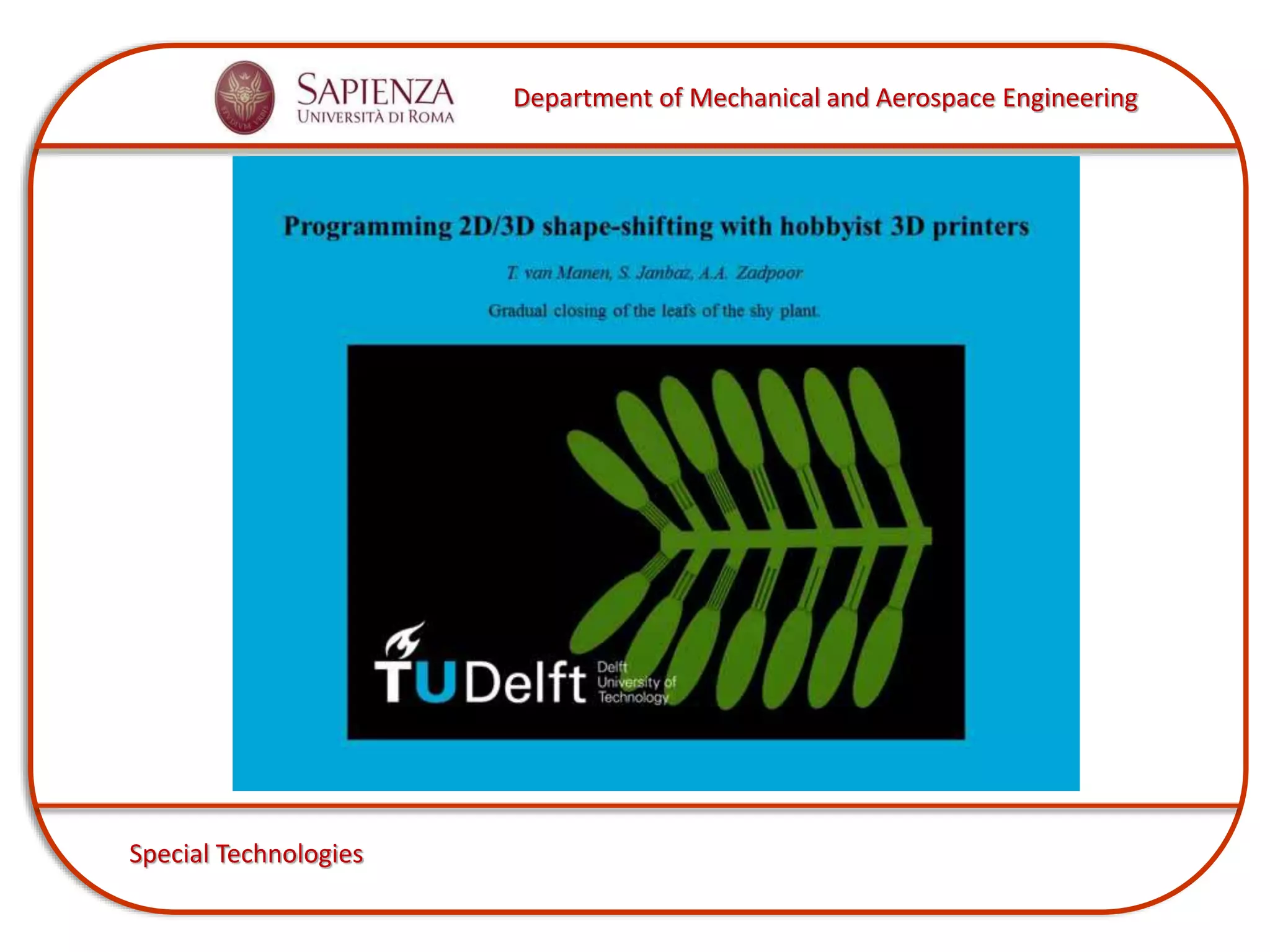
4D Printing Technology
Department of Mechanical and Aerospace Engineering
Special Technologies
4D Printing Technology
• 3D printed materials can be more flexible
and useful, the structures of the material
can transform in a pre-programmed way in
response to any external stimulus. In
general, self-changing structure of 3D
printed part after post process is called 4D
printing process. (Stratasys, 4D Printing,
2014)
• The term 4D printing is developed in a
collaboration between MIT´s Self-
Assembly Lab and Stratasys education and
R&D department.
Department of Mechanical and Aerospace Engineering
Special Technologies
3Dprintingmarketanalysis
Chart showing 3D printing market (Marketsandmarkets, 2016)
Department of Mechanical and Aerospace Engineering
Special Technologies
Graph showing 4D printing market (Marketsandmarkets, 2016)
4DPrintingMarketAnalysis
Department of Mechanical and Aerospace Engineering
Special Technologies
Line chart for 3D & 4D printing market (Marketsandmarkets, 2016)
4DPrintingMarketAnalysis
Department of Mechanical and Aerospace Engineering
Special Technologies
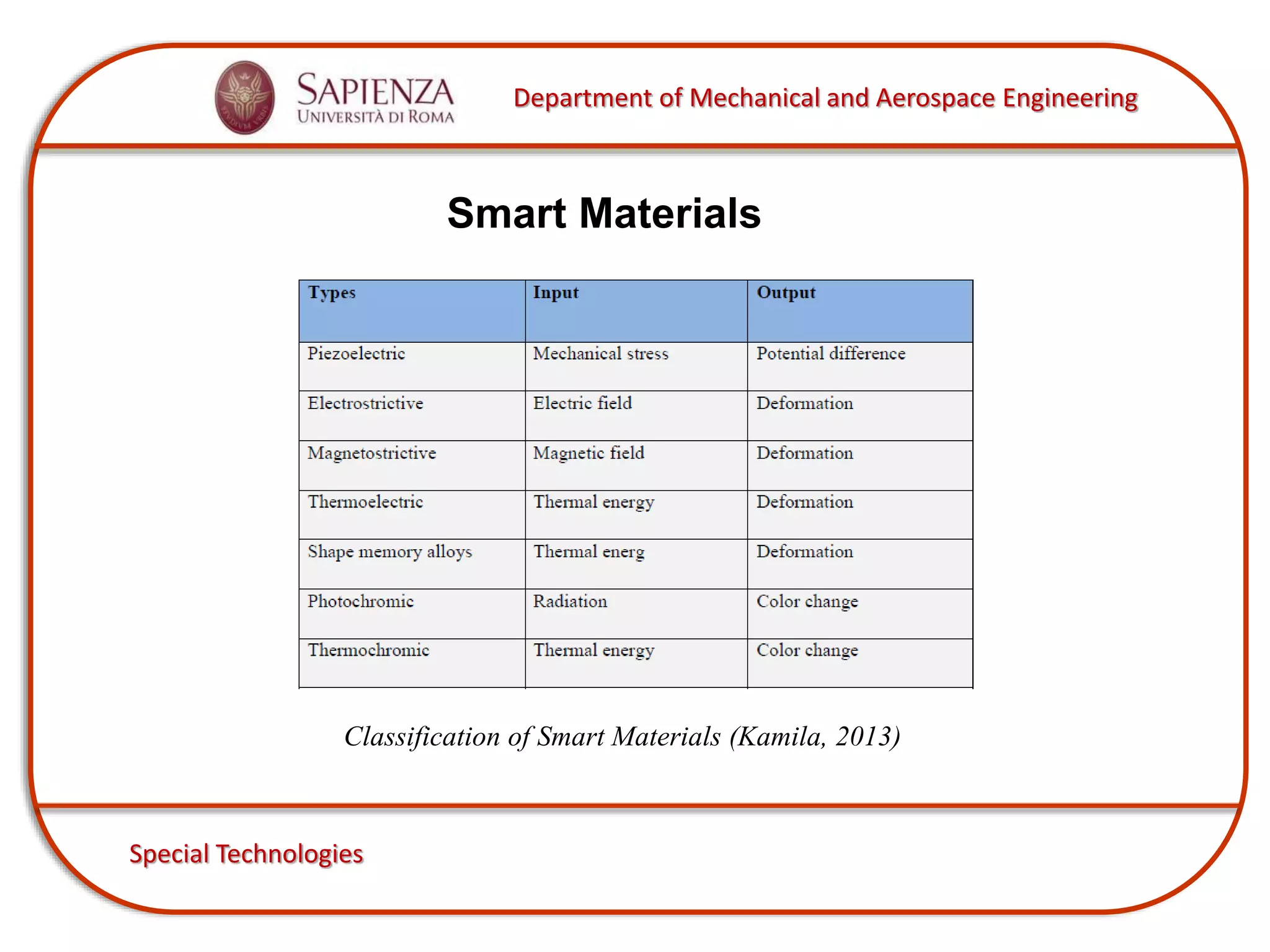
Smart Materials
Classification of Smart Materials (Kamila, 2013)
Department of Mechanical and Aerospace Engineering
Special Technologies
Shape Memory polymers
Time line of shape memory tube (Marc
Behl, 2007)
Shape memory alloys go transformation under
predefined shape from one to another when
exposed to appropriate stimulus. Initially
founded on thermal induced dual-shape
research, this concept has been extended to
other activating process such as direct thermal
actuation or indirect actuation.
Department of Mechanical and Aerospace Engineering
Special Technologies
Joint and folding angle strands
Self-Folding Strand (Self-Assembly Lab, 2016)
Printing 4D joint includes multiple layers of
material. Composition of rigid polymer, expanding
material and digital material depicts the folding
direction and pattern. Those materials are placed
above or below of each other depending upon the
type of transformation.
Department of Mechanical and Aerospace Engineering
Special Technologies
Custom Angle Surfaces
Self-Folding Truncated Octahedron
(Self-Assembly Lab, 2016)
• Similar mechanism as folding strand described
previously, series of flat two dimensional structures
were generated with edge joints. The position and
spacing of materials at each joint specifies the
desired fold angle hence positioned accordingly.
• 4D printed self-folding truncated octahedron
demonstrating the “transformation over time”
when submerging in water.
Department of Mechanical and Aerospace Engineering
Special Technologies
Homogeneous 4D printed staple that
demonstrates the tightening function
Curved-Crease Origami
(Self-Assembly Lab, 2016)
Department of Mechanical and Aerospace Engineering
Special Technologies
Sequential shape-
shifting.
(a) Sequentially closing of a box
based on the environmental
temperature. by the American
Chemical Society. (b) Selective
unfolding of an ionoprinted hydrogel
box based on the solvent. (c)
Sequential shapeshifting based on
different responses to the same
activation stimulus. Published by The
Royal Society of Chemistry (Manen,
materials today, 2017)
Department of Mechanical and Aerospace Engineering
Special Technologies
Department of Mechanical and Aerospace Engineering
Special Technologies
Department of Mechanical and Aerospace Engineering
Special Technologies
Department of Mechanical and Aerospace Engineering
Special Technologies
Department of Mechanical and Aerospace Engineering
Special Technologies
Case study
3D printed PLA cantilever used to test its shape fixing and shape memory
behavior. (a) The original PLA cantilever is printed at 0° or 180°. (b) The
cantilever is placed into a pool of 70°C water and fixed at a 90° angle (α) then
cooled to Tg. (c) The cantilever is returned to the heated water and the
bending angle (α′) is recorded (Leist 2017).
Department of Mechanical and Aerospace Engineering
Special Technologies
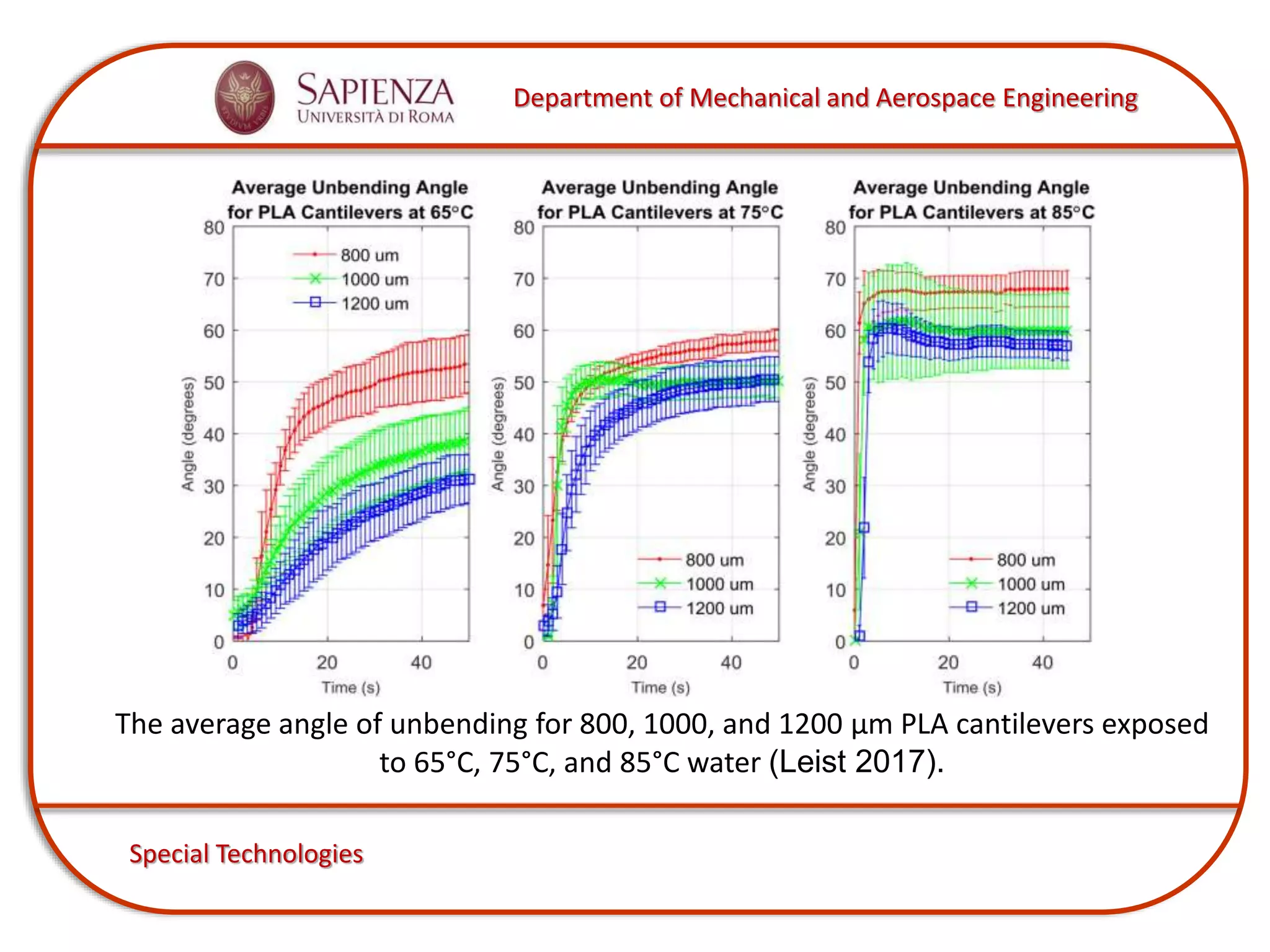
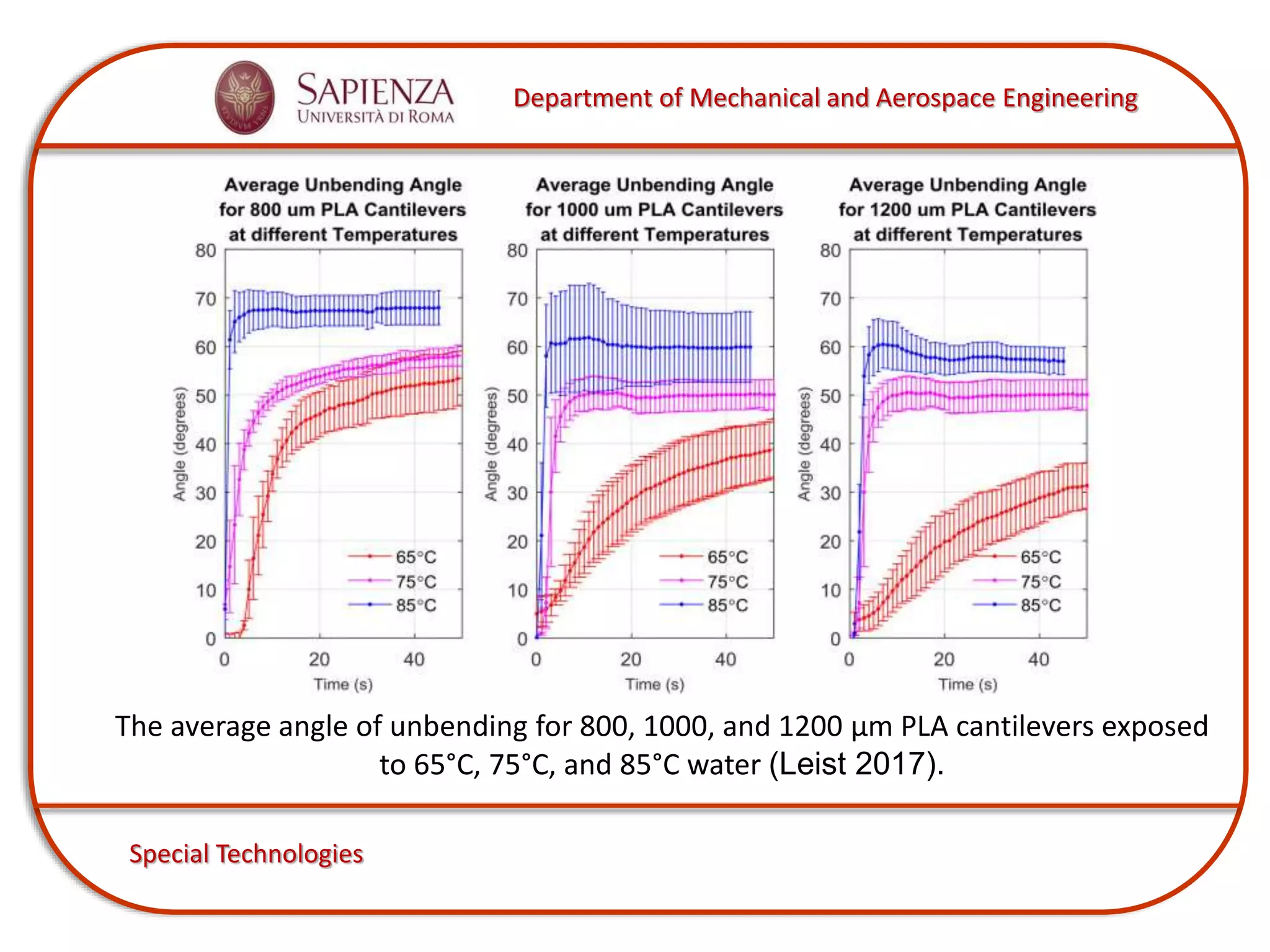
The average angle of unbending for 800, 1000, and 1200 μm PLA cantilevers exposed
to 65°C, 75°C, and 85°C water (Leist 2017).
Department of Mechanical and Aerospace Engineering
Special Technologies
The average angle of unbending for 800, 1000, and 1200 μm PLA cantilevers exposed
to 65°C, 75°C, and 85°C water (Leist 2017).
Department of Mechanical and Aerospace Engineering
Special Technologies

Four Dimensional (4D) Printing

  • 1.
    Special Technologies Four-Dimensional (4D)Printing Mehrshad Mehrpouya, Ph.D. Sapienza University of Rome Department of Mechanical and Aerospace Engineering
  • 2.
    Department of Mechanicaland Aerospace Engineering Special Technologies Additive Manufacturing • Additive manufacturing, also known as 3D printing, is a process that creates a physical object from a digital design. • Additive manufacturing uses data computer-aided-design (CAD) software or 3D object scanners to direct hardware to deposit material, layer upon layer, in precise geometric shapes. • Although the terms "3D printing" and "rapid prototyping" are casually used to discuss additive manufacturing, each process is actually a subset of additive manufacturing.
  • 3.
    Department of Mechanicaland Aerospace Engineering Special Technologies Generalized Additive Manufacturing Process Chain
  • 4.
    Department of Mechanicaland Aerospace Engineering Special Technologies
  • 5.
    Department of Mechanicaland Aerospace Engineering Special Technologies Additive Manufacturing-based on Deposition Processes
  • 6.
    Department of Mechanicaland Aerospace Engineering Special Technologies Types of 3D Printing Technology
  • 7.
    Department of Mechanicaland Aerospace Engineering Special Technologies Stereolithography Stereolithography is one the oldest 3D printing method. Patented by Charles Hull, co-founder of 3D Systems, Inc in 1986, this printing technology converts liquid plastics into solid 3D objects. Stereolithography apparatus (SLA) machine or printer is needed in order to work with Stereolithography technique. Form 1+ printer for Stereo lithography 3D printing (Formlabs, 2017)
  • 8.
    Department of Mechanicaland Aerospace Engineering Special Technologies Fused Deposition Modeling • Fused deposition modeling (FDM) technology was developed and invented by Stratasys ltd. founder Scott Crump, in 1980s. • Fused deposition modeling techniques are used to print functional prototypes as well as final end use products. Because of its high performance and engineering grade thermoplastic, this printing process is widely used by engineers, manufacturers and other professionals. 3D Printer Mojo from Stratasys (Stratasys, Stratasys, 2016)
  • 9.
    Department of Mechanicaland Aerospace Engineering Special Technologies Fused Deposition Modeling • Rapid prototyping offers huge advantage in speed and cost compared to alternative manufacturing techniques such as injection molding or die casting. FDM process is helpful in rapid manufacturing process such as developing custom parts, replacement parts and other production parts.
  • 10.
    Department of Mechanicaland Aerospace Engineering Special Technologies Characteristics of Fused Deposition Modeling: • Design freedom. • This technology is easy and simple to use. • Easily creates good sized strong, non-brittle geometrically complex structure. • Thermoplastics used in this production process are mechanically strong and clean to environment. • Apart from above advantages, the main disadvantage is time consuming slow process and post processing. The model needs to be sanding and filling for good surface finish.
  • 11.
    Department of Mechanicaland Aerospace Engineering Special Technologies Digital Light Processing • Digital Light Processing (DLP) is another 3D printing process similar to Stereolithography technology. • Based on Digital Micro Mirror Device (DMD) developed by Texas Instruments, Digital Light Processing (DLP) is a new way to project and display information with superior image quality, high brightness projection. • Digital Micro Mirror Device (DMD) is a fast, reflective digital light switch that controls light source precisely using binary pulse width modulation technique. Digital Light processing (Industry 3. P., 3D Printing Process, 2016)
  • 12.
    Department of Mechanicaland Aerospace Engineering Special Technologies Application areas: • Rapid prototyping • Jewelry casting • Custom medical implants production • Hearing aids and Dental restorations • Mold design • Automotive manufacturing • Aerospace manufacturing Micro plus High-Res 3D printer from envisionTec (envisionTEC, 2016)
  • 13.
    Department of Mechanicaland Aerospace Engineering Special Technologies Selective Laser Sintering (SLS) • SLS process is similar to Stereolithography process but uses powdered materials instead of liquid resin. • The materials like nylon, ceramics, glass, aluminum, silver or steel can be used for printing. • Due to variety of materials that can be used, this 3D printing process is widely used for customized products. Selective Laser Sinstering process (Industry 3. P., 3D Printing Process, 2016)
  • 14.
    Department of Mechanicaland Aerospace Engineering Special Technologies Selective Laser Sintering (SLS)
  • 15.
    Department of Mechanicaland Aerospace Engineering Special Technologies Selective Laser Melting (SLM) SLM 500 (Solutions S. , 2016) • Selective Laser Melting process is almost identical to Selective Laser Sintering (SLS). The main mechanism that separates this from SLS is highly powered laser beam fully melts the metal powder into solid 3D object. • Similar to the SLS process, high laser beam is exposed towards the powdered bed, powerful laser beam melts the metal powder fully forming layer of solid object. The process starts over and over creating next layer until full 3D structure is printed. • SLM manufacturing method is useful to manufacture complex geometries structures with thin walls, hollows and undercuts.
  • 16.
    Department of Mechanicaland Aerospace Engineering Special Technologies Selective Laser Melting (SLM)
  • 17.
    Department of Mechanicaland Aerospace Engineering Special Technologies Electron Beam Melting (EBM) Electron Beam Melting process • Electron Beam Melting is another additive manufacturing technologies especially for metal parts. Similar to Selective Laser Melting, this 3D printing technology creates dense metal parts and components layer by layer of metal powder, melted by electron beam. The high power electron beam generate energy to melt metal powder fully. • Comparing to SLM process, Electron Beam Melting is slow process and costly. Limited availability of materials and its high cost makes EBM process not so popular.
  • 18.
    Department of Mechanicaland Aerospace Engineering Special Technologies Electron Beam Melting (EBM) Arcam Q10plus - for orthopedic implant manufacturing (EBM, EBM Hardware, 2016) • Although EBM process is demanding for developing orthopedic implants and aerospace applications. Titanium Ti6AI4V, Titanium Ti6AI4V ELI, Titanium Grade 2, Inconel 718, Arcam ASTM F75 Cobalt-chrome are some standard materials used in this process • Arcam Q10 plus is the new generation EBM machine designed specifically for cost efficient high volume production of orthopedic implants.
  • 19.
    Department of Mechanicaland Aerospace Engineering Special Technologies Laminated Object Manufacturing (LOM) • Laminated Object Manufacturing is the most affordable and fastest way to print 3D shapes. In simple form, sheets of different types of materials are bonded together and cut in the right structure according to the 3D model. LOM process is mainly used for prototyping rather than production purpose. • In this process, the layered material coated with and adhesive layer is rolled on the building platform. The feeding roller heats and melts the adhesive layer which then glued to the previous layer. Laminated Object Manufacturing process (magazine, 2014)
  • 20.
    Department of Mechanicaland Aerospace Engineering Special Technologies Selective Deposition Lamination (SDL) Quickly and easily peel the supporting paper away from the part. This can be accomplished with your hands and ordinary tweezers; no need for chemicals. The head model emerges. An Mcor model emerges from the 3D printer as a tough, durable model; no need for infiltration. • The main benefit of the SDL process becomes evident when the removal of the waste occurs. • This process is called “weeding.” Because the adhesive is applied selectively, there is a greater bond between the layers of paper which constitute the model and less bond between the layers making the support material. • Also, to aid ease of weeding, the support material is “diced” so that small portions of support material can be removed to ensure that delicate 3D models survive.
  • 21.
    Department of Mechanicaland Aerospace Engineering Special Technologies Selective Deposition Lamination (SDL)
  • 22.
    Department of Mechanicaland Aerospace Engineering Special Technologies Materials used in 3D Printing
  • 23.
    Department of Mechanicaland Aerospace Engineering Special Technologies
  • 24.
    Department of Mechanicaland Aerospace Engineering Special Technologies Plastics • Biodegradable plastic, Polylactic acid (PLA) is mostly used in filament form. • ABS is another strong plastic material used for 3D printing. ABS provides high strength with high temperature resistance. • Nylon also called Polyamide is the most commonly used plastic material. Because of its durability, flexibility and strong character, nylon is used commonly in powder form. Nylon is perfect all- rounder and allows for fully functional end products
  • 25.
    Department of Mechanicaland Aerospace Engineering Special Technologies Metals Steel is one of the strongest metal used in powder form. Other common metal elements are aluminum, bronze and cobalt chromium. Metals are mostly used in Selective Laser Sintering (SLS), Selective Laser Melting (SLM) process and Electron Beam Melting (EBM) process. (Industry 3. , 2016)
  • 26.
    Department of Mechanicaland Aerospace Engineering Special Technologies Ceramics Ceramics are not so commonly used and new group to materials. They are unique material with the possibilities of creating smooth surface texture and geometry. (Industry 3. , 2016) Paper Laminated Object Manufacturing and Selective Deposition Lamination technologies use paper as one of the material to print 3D body. As paper are inexpensive, safe, eco-friendly and recyclable, they are mostly applied in prototyping rather than production. (Industry 3. , 2016)
  • 27.
    Department of Mechanicaland Aerospace Engineering Special Technologies Food Food 3D printing is the latest trend in additive manufacturing field. Chocolate is the most commonly used material for designing and printing eye watering models. Mmuse- Delta Model Desktop Food 3D Printer prints pancakes, chocolates and candies of desired model. (Store, 2016)
  • 28.
    Department of Mechanicaland Aerospace Engineering Special Technologies 3D printing Application
  • 29.
    Department of Mechanicaland Aerospace Engineering Special Technologies Medical Field
  • 30.
    Department of Mechanicaland Aerospace Engineering Special Technologies Aeronautics and Aerospace
  • 31.
    Department of Mechanicaland Aerospace Engineering Special Technologies Architecture
  • 32.
    Department of Mechanicaland Aerospace Engineering Special Technologies Automotive
  • 33.
    Department of Mechanicaland Aerospace Engineering Special Technologies 4D Printing Technology
  • 34.
    Department of Mechanicaland Aerospace Engineering Special Technologies 4D Printing Technology • 3D printed materials can be more flexible and useful, the structures of the material can transform in a pre-programmed way in response to any external stimulus. In general, self-changing structure of 3D printed part after post process is called 4D printing process. (Stratasys, 4D Printing, 2014) • The term 4D printing is developed in a collaboration between MIT´s Self- Assembly Lab and Stratasys education and R&D department.
  • 35.
    Department of Mechanicaland Aerospace Engineering Special Technologies 3Dprintingmarketanalysis Chart showing 3D printing market (Marketsandmarkets, 2016)
  • 36.
    Department of Mechanicaland Aerospace Engineering Special Technologies Graph showing 4D printing market (Marketsandmarkets, 2016) 4DPrintingMarketAnalysis
  • 37.
    Department of Mechanicaland Aerospace Engineering Special Technologies Line chart for 3D & 4D printing market (Marketsandmarkets, 2016) 4DPrintingMarketAnalysis
  • 38.
    Department of Mechanicaland Aerospace Engineering Special Technologies Smart Materials Classification of Smart Materials (Kamila, 2013)
  • 39.
    Department of Mechanicaland Aerospace Engineering Special Technologies Shape Memory polymers Time line of shape memory tube (Marc Behl, 2007) Shape memory alloys go transformation under predefined shape from one to another when exposed to appropriate stimulus. Initially founded on thermal induced dual-shape research, this concept has been extended to other activating process such as direct thermal actuation or indirect actuation.
  • 40.
    Department of Mechanicaland Aerospace Engineering Special Technologies Joint and folding angle strands Self-Folding Strand (Self-Assembly Lab, 2016) Printing 4D joint includes multiple layers of material. Composition of rigid polymer, expanding material and digital material depicts the folding direction and pattern. Those materials are placed above or below of each other depending upon the type of transformation.
  • 41.
    Department of Mechanicaland Aerospace Engineering Special Technologies Custom Angle Surfaces Self-Folding Truncated Octahedron (Self-Assembly Lab, 2016) • Similar mechanism as folding strand described previously, series of flat two dimensional structures were generated with edge joints. The position and spacing of materials at each joint specifies the desired fold angle hence positioned accordingly. • 4D printed self-folding truncated octahedron demonstrating the “transformation over time” when submerging in water.
  • 42.
    Department of Mechanicaland Aerospace Engineering Special Technologies Homogeneous 4D printed staple that demonstrates the tightening function Curved-Crease Origami (Self-Assembly Lab, 2016)
  • 43.
    Department of Mechanicaland Aerospace Engineering Special Technologies Sequential shape- shifting. (a) Sequentially closing of a box based on the environmental temperature. by the American Chemical Society. (b) Selective unfolding of an ionoprinted hydrogel box based on the solvent. (c) Sequential shapeshifting based on different responses to the same activation stimulus. Published by The Royal Society of Chemistry (Manen, materials today, 2017)
  • 44.
    Department of Mechanicaland Aerospace Engineering Special Technologies
  • 45.
    Department of Mechanicaland Aerospace Engineering Special Technologies
  • 46.
    Department of Mechanicaland Aerospace Engineering Special Technologies
  • 47.
    Department of Mechanicaland Aerospace Engineering Special Technologies
  • 48.
    Department of Mechanicaland Aerospace Engineering Special Technologies Case study 3D printed PLA cantilever used to test its shape fixing and shape memory behavior. (a) The original PLA cantilever is printed at 0° or 180°. (b) The cantilever is placed into a pool of 70°C water and fixed at a 90° angle (α) then cooled to Tg. (c) The cantilever is returned to the heated water and the bending angle (α′) is recorded (Leist 2017).
  • 49.
    Department of Mechanicaland Aerospace Engineering Special Technologies The average angle of unbending for 800, 1000, and 1200 μm PLA cantilevers exposed to 65°C, 75°C, and 85°C water (Leist 2017).
  • 50.
    Department of Mechanicaland Aerospace Engineering Special Technologies The average angle of unbending for 800, 1000, and 1200 μm PLA cantilevers exposed to 65°C, 75°C, and 85°C water (Leist 2017).
  • 51.
    Department of Mechanicaland Aerospace Engineering Special Technologies