SHAPE
MEMORY
ALLOYS
ADITYA ABHINAV
119MM0934
METALLURGICAL AND MATERIALS
ENGINEERING
Outline
Introduction of shape memory alloys
History of shape memory alloys
Working Principle
Types of shape memory alloys
Characteristics of SMA
Applications of SMA
Advantages/ Limitations of SMA
Conclusion
References
Introduction of SMA
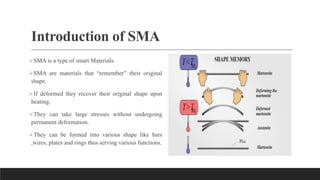
SMA is a type of smart Materials.
SMA are materials that “remember” their original
shape.
If deformed they recover their original shape upon
heating.
They can take large stresses without undergoing
permanent deformation.
They can be formed into various shape like bars
,wires, plates and rings thus serving various functions.
History of SMA
1938:Arne Olande observed shape and recovery
ability of Au-Cd alloy.
1938:Greninger and Mooradian observed the
formation and Mooradian observed the formation
and disappearance of martensitic phase by
varying the temperature of a Cu-Zn alloy.
1962-63:William J Buehler and Fredric Wang
observed the shape effect of Nickle and Titanium
alloy at the United States Navel Ordnance
Laboratory.
How do they work
We all know the most common phase changes:
SMAs shape changes based on a solid sate
phase transformation.
The transition from one form of crystalline
structure to another creates the mechanism by
which the shape change occurs in SMAs. This
change involves transition from a monoclinic
crystal form (martensite) to an ordered cubic
crystal form(austenite).
Austenite
High temperature phase
Cubic Crystal Structure
Martensite
Low temperature phase
Monoclinic Crystal Structure
How do they work
Types of SMA
Current shape memory alloys are:
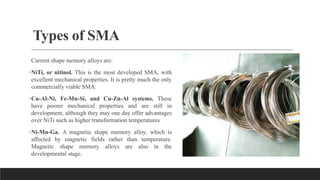
•NiTi, or nitinol. This is the most developed SMA, with
excellent mechanical properties. It is pretty much the only
commercially viable SMA.
•Cu-Al-Ni, Fe-Mn-Si, and Cu-Zn-Al systems. These
have poorer mechanical properties and are still in
development, although they may one day offer advantages
over NiTi such as higher transformation temperatures
•Ni-Mn-Ga. A magnetic shape memory alloy, which is
affected by magnetic fields rather than temperature.
Magnetic shape memory alloys are also in the
developmental stage.
Characteristics of SMA
It exhibits two main characteristics :
1) Shape Memory Effect :It is based on
martensitic phase transformation taking
place without diffusion.
Two types of shape memory behavior:
-One way shape memory
-Two way shape memory
2) Pseudo-elasticity : Pseudo–elasticity
occurs in shape memory alloys when it is
completely in austenite phase it occurs
due to stress induced phase
transformation without a change in
temperature.
Applications of SMA
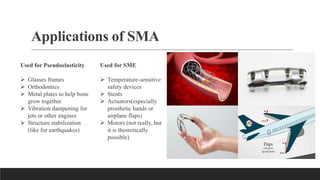
Used for Pseudoelasticity
 Glasses frames
 Orthodontics
 Metal plates to help bone
grow together
 Vibration dampening for
jets or other engines
 Structure stabilization
(like for earthquakes)
Used for SME
 Temperature-sensitive
safety devices
 Stents
 Actuators(especially
prosthetic hands or
airplane flaps)
 Motors (not really, but
it is theoretically
possible)
Advantages and Limitation
Advantages :
High power/weight ratio
comparatively
High strain recovery
High strength
Noiseless and silent Operation
Limitations :
Poor fatigue properties
Lower transformation temperature
Relatively expensive to manufacture and machine
compared to other materials.
Conclusion
Shape memory alloys are awesome! They have a temperature induced transformation martensite–>austenite,
which gives the shape memory effect (SME) as well as a stress-induced transformation austenite–>martensite,
which give the pseudoelastic effect.
The many uses and application of shape memory alloys ensure a bright future for these metals. Advances in the
field of SMAs for use in many different fields of study seem very promising.
References
1) What Are Shape Memory Alloys? (Metallurgy, How They Work, and Applications) – Materials Science &
Engineering (msestudent.com)
2) Shape-memory alloy – Wikipedia
3) Ti-Ni Shape-Memory Alloy - Stanford Materials
Thanks

SHAPE MEMORY ALLOYS.pptx

  • 1.
  • 2.
    Outline Introduction of shapememory alloys History of shape memory alloys Working Principle Types of shape memory alloys Characteristics of SMA Applications of SMA Advantages/ Limitations of SMA Conclusion References
  • 3.
    Introduction of SMA SMAis a type of smart Materials. SMA are materials that “remember” their original shape. If deformed they recover their original shape upon heating. They can take large stresses without undergoing permanent deformation. They can be formed into various shape like bars ,wires, plates and rings thus serving various functions.
  • 4.
    History of SMA 1938:ArneOlande observed shape and recovery ability of Au-Cd alloy. 1938:Greninger and Mooradian observed the formation and Mooradian observed the formation and disappearance of martensitic phase by varying the temperature of a Cu-Zn alloy. 1962-63:William J Buehler and Fredric Wang observed the shape effect of Nickle and Titanium alloy at the United States Navel Ordnance Laboratory.
  • 5.
    How do theywork We all know the most common phase changes: SMAs shape changes based on a solid sate phase transformation. The transition from one form of crystalline structure to another creates the mechanism by which the shape change occurs in SMAs. This change involves transition from a monoclinic crystal form (martensite) to an ordered cubic crystal form(austenite). Austenite High temperature phase Cubic Crystal Structure Martensite Low temperature phase Monoclinic Crystal Structure
  • 6.
  • 7.
    Types of SMA Currentshape memory alloys are: •NiTi, or nitinol. This is the most developed SMA, with excellent mechanical properties. It is pretty much the only commercially viable SMA. •Cu-Al-Ni, Fe-Mn-Si, and Cu-Zn-Al systems. These have poorer mechanical properties and are still in development, although they may one day offer advantages over NiTi such as higher transformation temperatures •Ni-Mn-Ga. A magnetic shape memory alloy, which is affected by magnetic fields rather than temperature. Magnetic shape memory alloys are also in the developmental stage.
  • 8.
    Characteristics of SMA Itexhibits two main characteristics : 1) Shape Memory Effect :It is based on martensitic phase transformation taking place without diffusion. Two types of shape memory behavior: -One way shape memory -Two way shape memory 2) Pseudo-elasticity : Pseudo–elasticity occurs in shape memory alloys when it is completely in austenite phase it occurs due to stress induced phase transformation without a change in temperature.
  • 9.
    Applications of SMA Usedfor Pseudoelasticity  Glasses frames  Orthodontics  Metal plates to help bone grow together  Vibration dampening for jets or other engines  Structure stabilization (like for earthquakes) Used for SME  Temperature-sensitive safety devices  Stents  Actuators(especially prosthetic hands or airplane flaps)  Motors (not really, but it is theoretically possible)
  • 10.
    Advantages and Limitation Advantages: High power/weight ratio comparatively High strain recovery High strength Noiseless and silent Operation Limitations : Poor fatigue properties Lower transformation temperature Relatively expensive to manufacture and machine compared to other materials.
  • 11.
    Conclusion Shape memory alloysare awesome! They have a temperature induced transformation martensite–>austenite, which gives the shape memory effect (SME) as well as a stress-induced transformation austenite–>martensite, which give the pseudoelastic effect. The many uses and application of shape memory alloys ensure a bright future for these metals. Advances in the field of SMAs for use in many different fields of study seem very promising. References 1) What Are Shape Memory Alloys? (Metallurgy, How They Work, and Applications) – Materials Science & Engineering (msestudent.com) 2) Shape-memory alloy – Wikipedia 3) Ti-Ni Shape-Memory Alloy - Stanford Materials
  • 12.