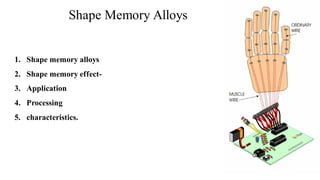
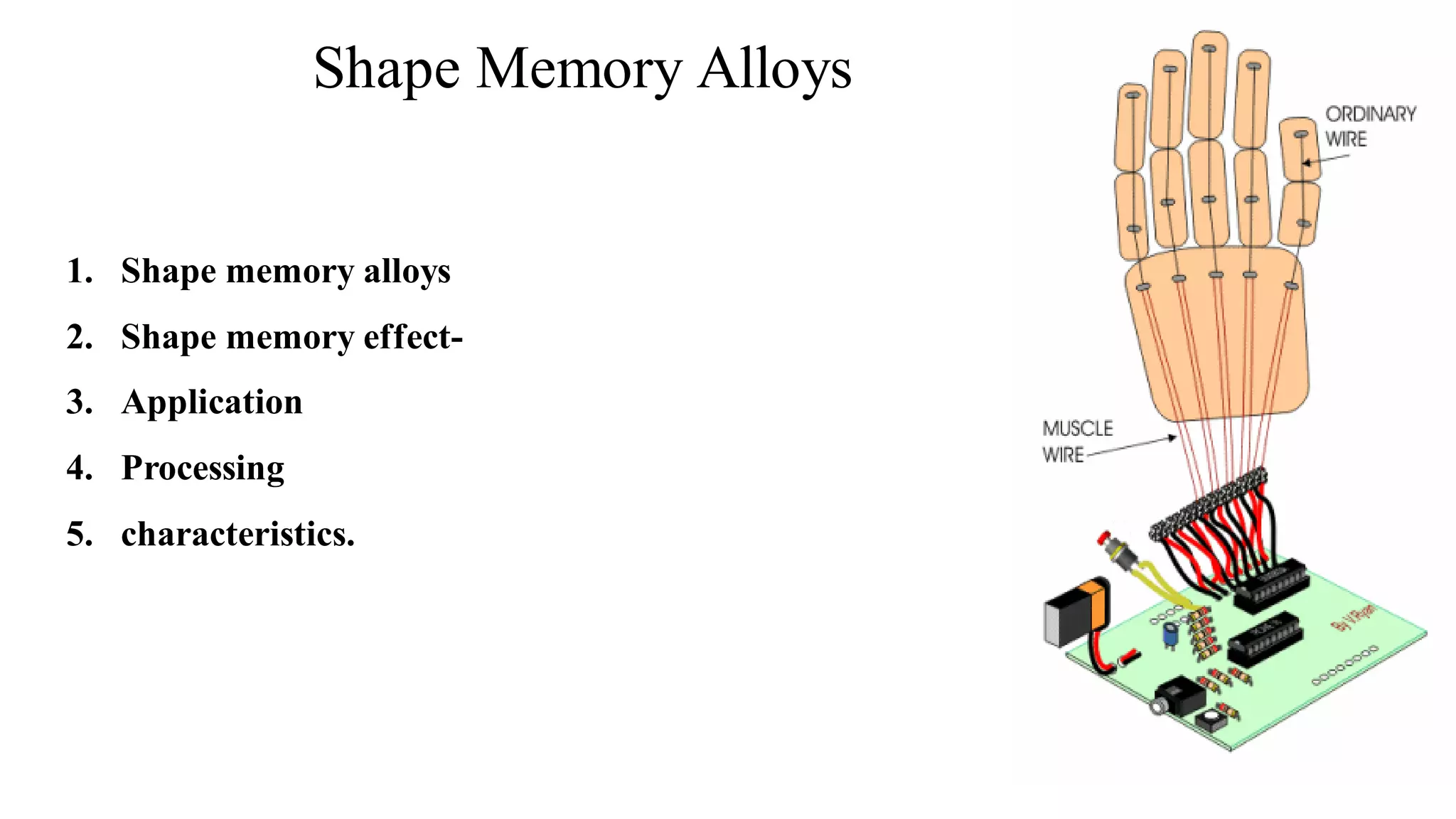
1. Shape memory alloys
2. Shape memory effect-
3. Application
4. Processing
5. characteristics.
Shape Memory Alloys
Shape Memory Alloys
• Certain classes of metallic alloys have a special ability to ‘memorize’ their shape at a low
temperature, and recover large deformations imparted at a low temperature on thermal activation.
These alloys are called Shape Memory Alloys (SMA).
• The recovery of strains imparted to the material at a lower temperature, as a result of heating, is
called the Shape Memory Effect (SME).
• The shape memory effect was first discovered by Chang and Read in 1951 in the Au-Cd (Gold-
Cadmium) alloy system. However, the effect became more well known after the discovery of
Nickel-Titanium alloys.
• Other alloys exhibiting the shape memory effect include Cu-Al-Ni, Cu-Zn-Al, Au-Cd, Mn-Cu and Ni-
Mn-Ga, with recoverable strains of 3–8%.
• However, NiTi is the most practical material in terms of its superior ductility, higher resistance to
corrosion and abrasion, higher tensile strength, and lower susceptibility to grain boundary fracture.
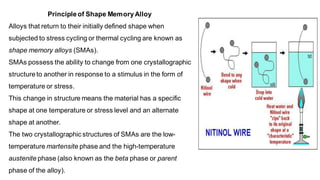
Principleof Shape MemoryAlloy
Alloys that return to their initially defined shape when
subjected to stress cycling or thermal cycling are known as
shape memory alloys (SMAs).
SMAs possess the ability to change from one crystallographic
structureto another in response to a stimulus in the form of
temperature or stress.
This change in structure means the material has a specific
shape at one temperature or stress level and an alternate
shape at another.
The two crystallographic structures of SMAs are the low-
temperature martensite phase and the high-temperature
austenite phase (also known as the beta phase or parent
phase of the alloy).
• Two key characteristics of an SMA are the shape memory effect (SME) and pseudoelasticity.
• The shape memory effect is the material’s ability to recover large mechanically induced
strains (up to 8%) at low temperatures by moderate increases in temperature (approximately
10–20◦C).
• Pseudoelasticity refers to the material’s ability, in a somewhat higher temperature regime, to
undergo strains (up to 8%) during loading and then recover upon unloading in a hysteresis
loop.
Characteristics of an SMA
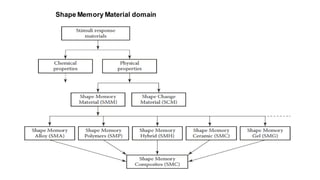
Shape Memory Material domain
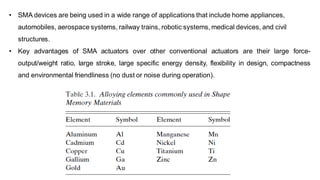
• SMA devices are being used in a wide range of applications that include home appliances,
automobiles, aerospace systems, railway trains, robotic systems, medical devices, and civil
structures.
• Key advantages of SMA actuators over other conventional actuators are their large force-
output/weight ratio, large stroke, large specific energy density, flexibility in design, compactness
and environmental friendliness (no dust or noise during operation).
Applications of SMA
1. Microvalve (Actuators) One of the most commonapplications of SMAs is mocrovalves. Fig. shows a
microvalve made of Ni –Ti alloy actuator. Actuator is a microsensor that can trigger the operation of a device.
The electrical signal initiates an action.
2. Toys and novelties-Shape memory alloys are used to make toys and ornamental goods.
3. A butterfly using SMA. Moves its wings in response to pulses of electricity.
4. Medical field Blood clot filters - Blood clot filters are SMAs, properly shaped and inserted in veins to stop the
passing blood clots.
5. When the SMA is in contact with the clot at a lower temperature, it expands and stops the clot and blood
passes through the veins.
6. They are used in artificial hearts. Orthodontic applications
7. NiTi wire holds the teeth tight with a constantstress irrespective of the strain produced by the teeth
movement. It resists permanent deformation even if it is bent. NiTi is non-toxic and non-corrosive with body
fluid.
Other Applicationof Shape Memory Alloy
1. SMAs (NiTi) are used to make eye glass frames and medical tools. Sun-glasses made from superelastic Ni-
Ti frames provide good comfort and durability.
2. Antennawires- The flexibility of superelasticNi –Ti wire makes it ideal for use as retractableantennas.
3. Thermostats- SMAs are used as thermostat to open and close the valves at required temperature.
4. Cryofit hydraulic couplings -SMAs materials are used as couplings for metal pipes
5. Springs, shock absorbers, and valves
6. Due to the excellent elastic propertyof the SMAs, springs can be made which have varied industrial
applications. Some of them are listed here.
7. Engine micro valves
8. Medical stents (Stentsare internal inplantsupportsprovided for body organs)
9. Firesafety valves and
10. Aerospace latchingmechanisms
11. Steppingmotors
12. Digital SMA steppingmotors are used for roboticcontrol.
13. Titanium-aluminiumshape memory alloys offer excellent strength with less weight and dominate inthe
aircraft industry.
14. They are high temperatureSMAs, for possible use in aircraft engines and other high temperature
environments.
Deployment of a shape memory
cardiovascular stent. A blood
vessel filled with plaque, reducing
the area for blood flow in the
cross-section, has been provided
with a stent and a guide wire,
which is inserted via some other
body part. The stent is deployed to
push against the plaque and
increase the effective blood flow
area, after which the guide wire is
removed and the stent remains.
Boeing variable geometry chevron.
SMA in robotics. (a)
Application of biomechanics: a
prosthetic hand using SMA
actuators.
(b) BionicOpter, inspired by
the dragonfly.
Typical Example of SMA application in Medical and Aircraft
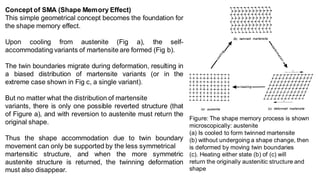
Concept of SMA (Shape Memory Effect)
This simple geometrical concept becomes the foundation for
the shape memory effect.
Upon cooling from austenite (Fig a), the self-
accommodating variants of martensite are formed (Fig b).
The twin boundaries migrate during deformation, resulting in
a biased distribution of martensite variants (or in the
extreme case shown in Fig c, a single variant).
But no matter what the distribution of martensite
variants, there is only one possible reverted structure (that
of Figure a), and with reversion to austenite must return the
original shape.
Thus the shape accommodation due to twin boundary
movement can only be supported by the less symmetrical
martensitic structure, and when the more symmetric
austenite structure is returned, the twinning deformation
must also disappear.
Figure: The shape memory process is shown
microscopically: austenite
(a) Is cooled to form twinned martensite
(b) without undergoing a shape change, then
is deformed by moving twin boundaries
(c). Heating either state (b) of (c) will
return the originally austenitic structure and
shape
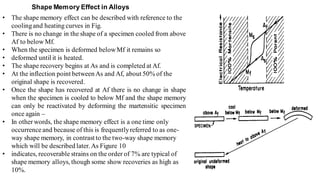
• The shape memory effect can be described with reference to the
coolingand heating curves in Fig.
• There is no change in the shape of a specimen cooled from above
Af to below Mf.
• When the specimen is deformed belowMf it remains so
• deformed until it is heated.
• The shape recovery begins at As and is completed at Af.
• At the inflection point between As and Af, about 50% of the
original shape is recovered.
• Once the shape has recovered at Af there is no change in shape
when the specimen is cooled to below Mf and the shape memory
can only be reactivated by deforming the martensitic specimen
once again –
• In otherwords, the shape memory effect is a one time only
occurrence and because of this is frequentlyreferred to as one-
way shape memory, in contrast to the two-way shape memory
which will be described later. As Figure 10
• indicates, recoverable strains on the order of 7% are typical of
shape memory alloys, though some show recoveries as high as
10%.
Shape Memory Effect in Alloys
One-Way and Two-Way Shape Memory in Alloys
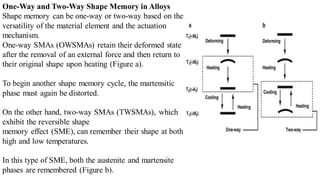
Shape memory can be one-way or two-way based on the
versatility of the material element and the actuation
mechanism.
One-way SMAs (OWSMAs) retain their deformed state
after the removal of an external force and then return to
their original shape upon heating (Figure a).
To begin another shape memory cycle, the martensitic
phase must again be distorted.
On the other hand, two-way SMAs (TWSMAs), which
exhibit the reversible shape
memory effect (SME), can remember their shape at both
high and low temperatures.
In this type of SME, both the austenite and martensite
phases are remembered (Figure b).
Experimental Phenomenologyof SMA
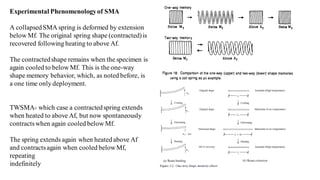
A collapsedSMA spring is deformed by extension
below Mf. The original spring shape (contracted) is
recovered following heating to above Af.
The contractedshape remains when the specimen is
again cooled to below Mf. This is the one-way
shape memory behavior, which, as noted before, is
a one time only deployment.
TWSMA- which case a contractedspring extends
when heated to above Af, but now spontaneously
contractswhen again cooled below Mf.
The spring extends again when heated above Af
and contractsagain when cooled belowMf,
repeating
indefinitely
shape memory effect is both thermal and mechanical, i.e the shape memory is caused by heating
We now consider another type of shape memory which is temperature independent: superelasticity.
Superelasticity or pseudoelasticity in SMAs is a phenomenon whereby the large strains induced by
loading an SMA are recovered upon unloading.
Superelasticity can be thought of as stress-driven shape memory in SMAs. By utilizing stress above
the Ms temperature, the martensite in SMAs can be isothermally induced; this is known as stress-
induced martensite (SIM).
Upon the removal of stress, the shape memory vanishes and the original shape is memorized as an
elastic material, which is mechanical shape memory rather than thermal shape memory.
SMAs exhibit superelasticity because of two components: the formation of the reversible stress-
induced martensite upon loading the alloy in its austenitic phase and its transformation back to the
austenite phase upon unloading.
Superelasticity of SMA
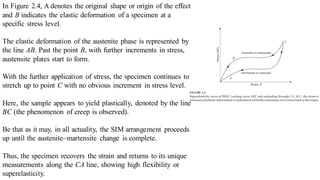
In Figure 2.4, A denotes the original shape or origin of the effect
and B indicates the elastic deformation of a specimen at a
specific stress level.
The elastic deformation of the austenite phase is represented by
the line AB. Past the point B, with further increments in stress,
austensite plates start to form.
With the further application of stress, the specimen continues to
stretch up to point C with no obvious increment in stress level.
Here, the sample appears to yield plastically, denoted by the line
BC (the phenomenon of creep is observed).
Be that as it may, in all actuality, the SIM arrangement proceeds
up until the austenite–martensite change is complete.
Thus, the specimen recovers the strain and returns to its unique
measurements along the CA line, showing high flexibility or
superelasticity.
SMA fibers can be used as fillers in fiber-reinforced composites to improve tensile
properties using the residual stress in the matrix.
This property is similar to prestressing mechanisms in civil engineering structures,
which enhances the tensile/compressive properties of material elements taking
heavy loads.
Apart from imparting tensile strength as fiber reinforcements, SMA wires can form
composites with polymer/metal/ceramic matrices.
SMA fibers have useful properties, such as high damping capacities, sensing and
actuating functions, and electrical conductivity, thus making them competent
candidates for reinforcement in composites.
Processing complexity, advantageous properties, and availability are the deciding factors in the
popularity of any technology, and the same is the case with SMAs. The properties of Nitinol
depend on the exact composition of the metal components (the titanium and nickel parts) and
the method of preparation.
The physical properties of Nitinol include a melting point of around 1240–1310°C and a
density of approximately 6.5 g/cc, with an elastic modulus of around 80 GPa for the austenitic
phase and 35 GPa for the martensitic phase.
The electrical resistivity varies between 75 × 10−6 (martensite) and 80 × 10−6 Ω cm
(austenite). A thermal conductivity ranging between 0.086 (martensite) and 0.18 W/cm K
(austenite) has been recorded by researchers.
The four Ps are the principles, properties, processing, and products required for SMAs to address the
challenges at the product level. For property enhancement, the basic principles and processing
methods are to be reviewed for optimization, and thus the four Ps are complementary to SMA
realization.

5 Shape Memory Alloy basics

  • 1.
    1. Shape memoryalloys 2. Shape memory effect- 3. Application 4. Processing 5. characteristics. Shape Memory Alloys
  • 2.
    Shape Memory Alloys •Certain classes of metallic alloys have a special ability to ‘memorize’ their shape at a low temperature, and recover large deformations imparted at a low temperature on thermal activation. These alloys are called Shape Memory Alloys (SMA). • The recovery of strains imparted to the material at a lower temperature, as a result of heating, is called the Shape Memory Effect (SME). • The shape memory effect was first discovered by Chang and Read in 1951 in the Au-Cd (Gold- Cadmium) alloy system. However, the effect became more well known after the discovery of Nickel-Titanium alloys. • Other alloys exhibiting the shape memory effect include Cu-Al-Ni, Cu-Zn-Al, Au-Cd, Mn-Cu and Ni- Mn-Ga, with recoverable strains of 3–8%. • However, NiTi is the most practical material in terms of its superior ductility, higher resistance to corrosion and abrasion, higher tensile strength, and lower susceptibility to grain boundary fracture.
  • 3.
    Principleof Shape MemoryAlloy Alloysthat return to their initially defined shape when subjected to stress cycling or thermal cycling are known as shape memory alloys (SMAs). SMAs possess the ability to change from one crystallographic structureto another in response to a stimulus in the form of temperature or stress. This change in structure means the material has a specific shape at one temperature or stress level and an alternate shape at another. The two crystallographic structures of SMAs are the low- temperature martensite phase and the high-temperature austenite phase (also known as the beta phase or parent phase of the alloy).
  • 4.
    • Two keycharacteristics of an SMA are the shape memory effect (SME) and pseudoelasticity. • The shape memory effect is the material’s ability to recover large mechanically induced strains (up to 8%) at low temperatures by moderate increases in temperature (approximately 10–20◦C). • Pseudoelasticity refers to the material’s ability, in a somewhat higher temperature regime, to undergo strains (up to 8%) during loading and then recover upon unloading in a hysteresis loop. Characteristics of an SMA
  • 5.
  • 6.
    • SMA devicesare being used in a wide range of applications that include home appliances, automobiles, aerospace systems, railway trains, robotic systems, medical devices, and civil structures. • Key advantages of SMA actuators over other conventional actuators are their large force- output/weight ratio, large stroke, large specific energy density, flexibility in design, compactness and environmental friendliness (no dust or noise during operation).
  • 7.
    Applications of SMA 1.Microvalve (Actuators) One of the most commonapplications of SMAs is mocrovalves. Fig. shows a microvalve made of Ni –Ti alloy actuator. Actuator is a microsensor that can trigger the operation of a device. The electrical signal initiates an action. 2. Toys and novelties-Shape memory alloys are used to make toys and ornamental goods. 3. A butterfly using SMA. Moves its wings in response to pulses of electricity. 4. Medical field Blood clot filters - Blood clot filters are SMAs, properly shaped and inserted in veins to stop the passing blood clots. 5. When the SMA is in contact with the clot at a lower temperature, it expands and stops the clot and blood passes through the veins. 6. They are used in artificial hearts. Orthodontic applications 7. NiTi wire holds the teeth tight with a constantstress irrespective of the strain produced by the teeth movement. It resists permanent deformation even if it is bent. NiTi is non-toxic and non-corrosive with body fluid.
  • 8.
    Other Applicationof ShapeMemory Alloy 1. SMAs (NiTi) are used to make eye glass frames and medical tools. Sun-glasses made from superelastic Ni- Ti frames provide good comfort and durability. 2. Antennawires- The flexibility of superelasticNi –Ti wire makes it ideal for use as retractableantennas. 3. Thermostats- SMAs are used as thermostat to open and close the valves at required temperature. 4. Cryofit hydraulic couplings -SMAs materials are used as couplings for metal pipes 5. Springs, shock absorbers, and valves 6. Due to the excellent elastic propertyof the SMAs, springs can be made which have varied industrial applications. Some of them are listed here. 7. Engine micro valves 8. Medical stents (Stentsare internal inplantsupportsprovided for body organs) 9. Firesafety valves and 10. Aerospace latchingmechanisms 11. Steppingmotors 12. Digital SMA steppingmotors are used for roboticcontrol. 13. Titanium-aluminiumshape memory alloys offer excellent strength with less weight and dominate inthe aircraft industry. 14. They are high temperatureSMAs, for possible use in aircraft engines and other high temperature environments.
  • 9.
    Deployment of ashape memory cardiovascular stent. A blood vessel filled with plaque, reducing the area for blood flow in the cross-section, has been provided with a stent and a guide wire, which is inserted via some other body part. The stent is deployed to push against the plaque and increase the effective blood flow area, after which the guide wire is removed and the stent remains. Boeing variable geometry chevron. SMA in robotics. (a) Application of biomechanics: a prosthetic hand using SMA actuators. (b) BionicOpter, inspired by the dragonfly. Typical Example of SMA application in Medical and Aircraft
  • 10.
    Concept of SMA(Shape Memory Effect) This simple geometrical concept becomes the foundation for the shape memory effect. Upon cooling from austenite (Fig a), the self- accommodating variants of martensite are formed (Fig b). The twin boundaries migrate during deformation, resulting in a biased distribution of martensite variants (or in the extreme case shown in Fig c, a single variant). But no matter what the distribution of martensite variants, there is only one possible reverted structure (that of Figure a), and with reversion to austenite must return the original shape. Thus the shape accommodation due to twin boundary movement can only be supported by the less symmetrical martensitic structure, and when the more symmetric austenite structure is returned, the twinning deformation must also disappear. Figure: The shape memory process is shown microscopically: austenite (a) Is cooled to form twinned martensite (b) without undergoing a shape change, then is deformed by moving twin boundaries (c). Heating either state (b) of (c) will return the originally austenitic structure and shape
  • 11.
    • The shapememory effect can be described with reference to the coolingand heating curves in Fig. • There is no change in the shape of a specimen cooled from above Af to below Mf. • When the specimen is deformed belowMf it remains so • deformed until it is heated. • The shape recovery begins at As and is completed at Af. • At the inflection point between As and Af, about 50% of the original shape is recovered. • Once the shape has recovered at Af there is no change in shape when the specimen is cooled to below Mf and the shape memory can only be reactivated by deforming the martensitic specimen once again – • In otherwords, the shape memory effect is a one time only occurrence and because of this is frequentlyreferred to as one- way shape memory, in contrast to the two-way shape memory which will be described later. As Figure 10 • indicates, recoverable strains on the order of 7% are typical of shape memory alloys, though some show recoveries as high as 10%. Shape Memory Effect in Alloys
  • 12.
    One-Way and Two-WayShape Memory in Alloys Shape memory can be one-way or two-way based on the versatility of the material element and the actuation mechanism. One-way SMAs (OWSMAs) retain their deformed state after the removal of an external force and then return to their original shape upon heating (Figure a). To begin another shape memory cycle, the martensitic phase must again be distorted. On the other hand, two-way SMAs (TWSMAs), which exhibit the reversible shape memory effect (SME), can remember their shape at both high and low temperatures. In this type of SME, both the austenite and martensite phases are remembered (Figure b).
  • 13.
    Experimental Phenomenologyof SMA AcollapsedSMA spring is deformed by extension below Mf. The original spring shape (contracted) is recovered following heating to above Af. The contractedshape remains when the specimen is again cooled to below Mf. This is the one-way shape memory behavior, which, as noted before, is a one time only deployment. TWSMA- which case a contractedspring extends when heated to above Af, but now spontaneously contractswhen again cooled below Mf. The spring extends again when heated above Af and contractsagain when cooled belowMf, repeating indefinitely
  • 14.
    shape memory effectis both thermal and mechanical, i.e the shape memory is caused by heating We now consider another type of shape memory which is temperature independent: superelasticity. Superelasticity or pseudoelasticity in SMAs is a phenomenon whereby the large strains induced by loading an SMA are recovered upon unloading. Superelasticity can be thought of as stress-driven shape memory in SMAs. By utilizing stress above the Ms temperature, the martensite in SMAs can be isothermally induced; this is known as stress- induced martensite (SIM). Upon the removal of stress, the shape memory vanishes and the original shape is memorized as an elastic material, which is mechanical shape memory rather than thermal shape memory. SMAs exhibit superelasticity because of two components: the formation of the reversible stress- induced martensite upon loading the alloy in its austenitic phase and its transformation back to the austenite phase upon unloading. Superelasticity of SMA
  • 15.
    In Figure 2.4,A denotes the original shape or origin of the effect and B indicates the elastic deformation of a specimen at a specific stress level. The elastic deformation of the austenite phase is represented by the line AB. Past the point B, with further increments in stress, austensite plates start to form. With the further application of stress, the specimen continues to stretch up to point C with no obvious increment in stress level. Here, the sample appears to yield plastically, denoted by the line BC (the phenomenon of creep is observed). Be that as it may, in all actuality, the SIM arrangement proceeds up until the austenite–martensite change is complete. Thus, the specimen recovers the strain and returns to its unique measurements along the CA line, showing high flexibility or superelasticity.
  • 16.
    SMA fibers canbe used as fillers in fiber-reinforced composites to improve tensile properties using the residual stress in the matrix. This property is similar to prestressing mechanisms in civil engineering structures, which enhances the tensile/compressive properties of material elements taking heavy loads. Apart from imparting tensile strength as fiber reinforcements, SMA wires can form composites with polymer/metal/ceramic matrices. SMA fibers have useful properties, such as high damping capacities, sensing and actuating functions, and electrical conductivity, thus making them competent candidates for reinforcement in composites.
  • 17.
    Processing complexity, advantageousproperties, and availability are the deciding factors in the popularity of any technology, and the same is the case with SMAs. The properties of Nitinol depend on the exact composition of the metal components (the titanium and nickel parts) and the method of preparation. The physical properties of Nitinol include a melting point of around 1240–1310°C and a density of approximately 6.5 g/cc, with an elastic modulus of around 80 GPa for the austenitic phase and 35 GPa for the martensitic phase. The electrical resistivity varies between 75 × 10−6 (martensite) and 80 × 10−6 Ω cm (austenite). A thermal conductivity ranging between 0.086 (martensite) and 0.18 W/cm K (austenite) has been recorded by researchers. The four Ps are the principles, properties, processing, and products required for SMAs to address the challenges at the product level. For property enhancement, the basic principles and processing methods are to be reviewed for optimization, and thus the four Ps are complementary to SMA realization.