Shape Memory alloys
& Its applications
SAJITH BABU GEORGE
1MTMD 1567204
CHRIST UNIVERSITY
Memory of Memory Metals
 1932 - A. Ölander discovers the pseudoelastic
properties of Au-Cd alloy.
 1949 - Memory effect of Au-Cd reported by Kurdjumov
& Kandros.
 1967 – At Naval Ordance Laboratory, Beuhler discovers
shape memory effect in nickel titanium alloy, Nitinol,
which proved to be a major breakthrough in the field of
shape memory alloys.
 1970-1980 – First reports of nickel-titanium implants
being used in medical applications.
 Mid-1990s – Memory metals start to become widespread
in medicine and soon move to other applications.
What is shape memory alloys?
 A shape-memory alloys (SMA, smart metal,
memory metal, memory alloy, muscle wire,
smart alloy) are metal alloys that can be
deformed at one temperature but when
heated or cooled, return to their “original”
shape
 The alloy appears to have a memory
 The most effective and widely used alloys are
NiTi, CuZnAl, and CuAlNi
 SMA also exhibits superelastic (pseudoelastic)
behavior
Basic working principle..
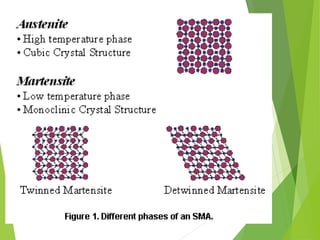
 SMAs have two stable phases :
 the high-temperature phase, called Austenite and
 the low-temperature phase, called Martensite.
 The martensite can be in one of two forms:
 twinned
 detwinned
 A phase transformation which occurs between these
two phases upon heating/cooling is the basis for the
unique properties of the SMAs
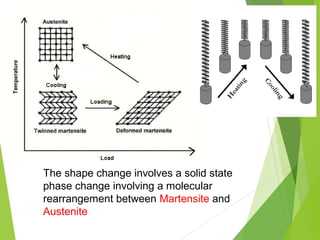
The shape change involves a solid state
phase change involving a molecular
rearrangement between Martensite and
Austenite
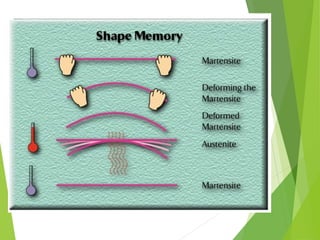
 Upon cooling in the absence of applied load the
material transforms from austenite into twinned
martensite. (no observable macroscopic shape
change occurs)
 Upon heating the material in the martensitic
phase, a reverse phase transformation takes
place and as a result the material transforms to
austenite.
 If mechanical load is applied to the material in
the state of twinned martensite (at low
temperature) it is possible to detwin the
martensite.
 Upon releasing of the load, the material
remains deformed. A subsequent heating of the
material to a temperature above the austenite
finish temperature (Af) will result in reverse
phase transformation (martensite to austenite)
and will lead to complete shape recovery.
(Af: temperature at which transformation of
martensite to austenite is complete )
 SMA remembers the shape when it have
austenitic structure.
 So if we need SMA to remember and
regain/recover certain shape, the shape should
be formed when structure is austenite
 Reheating the material will result in complete
shape recovery
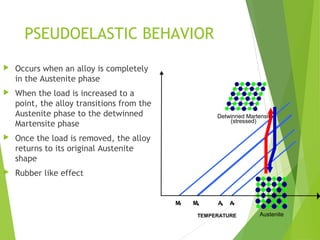
PSEUDOELASTIC BEHAVIOR
 Occurs when an alloy is completely
in the Austenite phase
 When the load is increased to a
point, the alloy transitions from the
Austenite phase to the detwinned
Martensite phase
 Once the load is removed, the alloy
returns to its original Austenite
shape
 Rubber like effect
TEMPERATURE
Mf Ms As Aff s s f
Austenite
Detwinned Martensite
(stressed)
NITINOL (Ni-Ti)
 Was discovered in Naval Ordnance
Laboratory (NOL), Maryland, USA
 Ni- 50% , Ti- 50%
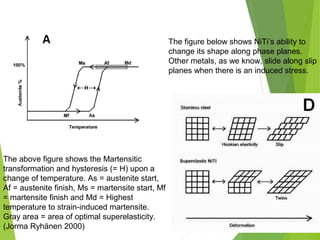
The above figure shows the Martensitic
transformation and hysteresis (= H) upon a
change of temperature. As = austenite start,
Af = austenite finish, Ms = martensite start, Mf
= martensite finish and Md = Highest
temperature to strain-induced martensite.
Gray area = area of optimal superelasticity.
(Jorma Ryhänen 2000)
The figure below shows NiTi’s ability to
change its shape along phase planes.
Other metals, as we know, slide along slip
planes when there is an induced stress.
APPLICATIONS
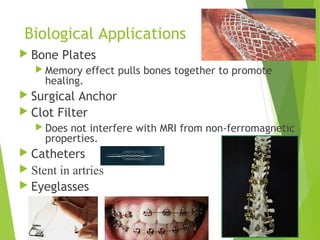
Biological Applications
 Bone Plates
 Memory effect pulls bones together to promote
healing.
 Surgical Anchor
 Clot Filter
 Does not interfere with MRI from non-ferromagnetic
properties.
 Catheters
 Stent in artries
 Eyeglasses
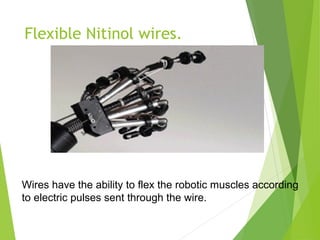
Flexible Nitinol wires.
Wires have the ability to flex the robotic muscles according
to electric pulses sent through the wire.
Nitinol Wires
 Nitinol is generally doped with other materials
like Cr, Cu, Al, or Fe.
 Flexinol is a popular brand of SMA wire.
 Flexinol is designed to take more repeated
stress cycles than pure NiTi mixes.
 Specifically designed to manufacturer’s needs.
Aircraft Maneuverability
Nitinol wires can be used in
applications such as the
actuators for planes.
Many use bulky hydraulic
systems which are
expensive and need a lot
of maintenance.
USAF Aircraft Pictures
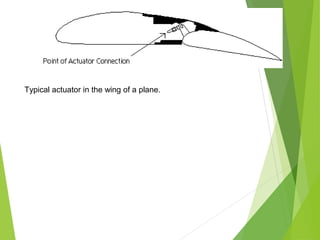
Typical actuator in the wing of a plane.
Picture of wing with SMA wires.
The wires in the picture are used to replace
the actuator. Electric pulses sent through
the wires allow for precise movement of the
wings, as would be needed in an aircraft.
This reduces the need for maintenance,
weighs less, and is less costly.
Other Applications
 Small incision tweezers
 Anti-scalding devices/Fire sprinklers
 Household appliances
 A deep fryer that lowers the basket
into the old at a certain temperature
 Prevent structural damage to
bridges/buildings
 Robots
ADVANTAGES AND
DISADVANTAGES OF SHAPE
MEMORY ALLOYS
 ADVANTAGES
 Bio-compatibility
 Diverse field of application
 Good mechanical
properties(strong,corrosion resistant)
 DISADVANTAGES
 Expensive
 Poor fatigue properties
 overstress
What materials are SMA’s
1)Nickel-titanium alloys
2) Copper-base alloys such as CuZnAl and CuAlNi
3) Ag-Cd 44/49 at.% C
4) Au-Cd 46.5/50 at.% Cd
5) Cu-Al-Ni 14/14.5 wt.% Al and 3/4.5 wt.% Ni
6) Cu-Sn approx. 15 at.% Sn
7) Cu-Zn 38.5/41.5 wt.% Z
8) Cu-Zn-X (X = Si,Sn,Al) a few wt.% of
9)In-Ti 18/23 at.% Ti
10) Ni-Al 36/38 at.% Al
11) Ni-Ti 49/51 at.% Ni
12) Fe-Pt approx. 25 at.% Pt
13) Mn-Cu 5/35 at.% Cu
14) Fe-Mn-Si
15) Pt alloys
DO YOU WANT TO ASK ANY
QUESTION?
http://en.wikipedia.org/wiki/Shape_memory_alloy
http://www.smaterial.com/SMA/sma.html
Lin, Richard. Shape Memory Alloys and Their Applications
Google images…
References:
Shape memory alloys

Shape memory alloys

  • 1.
    Shape Memory alloys &Its applications SAJITH BABU GEORGE 1MTMD 1567204 CHRIST UNIVERSITY
  • 2.
    Memory of MemoryMetals  1932 - A. Ölander discovers the pseudoelastic properties of Au-Cd alloy.  1949 - Memory effect of Au-Cd reported by Kurdjumov & Kandros.  1967 – At Naval Ordance Laboratory, Beuhler discovers shape memory effect in nickel titanium alloy, Nitinol, which proved to be a major breakthrough in the field of shape memory alloys.  1970-1980 – First reports of nickel-titanium implants being used in medical applications.  Mid-1990s – Memory metals start to become widespread in medicine and soon move to other applications.
  • 3.
    What is shapememory alloys?  A shape-memory alloys (SMA, smart metal, memory metal, memory alloy, muscle wire, smart alloy) are metal alloys that can be deformed at one temperature but when heated or cooled, return to their “original” shape  The alloy appears to have a memory  The most effective and widely used alloys are NiTi, CuZnAl, and CuAlNi  SMA also exhibits superelastic (pseudoelastic) behavior
  • 4.
    Basic working principle.. SMAs have two stable phases :  the high-temperature phase, called Austenite and  the low-temperature phase, called Martensite.  The martensite can be in one of two forms:  twinned  detwinned  A phase transformation which occurs between these two phases upon heating/cooling is the basis for the unique properties of the SMAs
  • 6.
    The shape changeinvolves a solid state phase change involving a molecular rearrangement between Martensite and Austenite
  • 7.
     Upon coolingin the absence of applied load the material transforms from austenite into twinned martensite. (no observable macroscopic shape change occurs)  Upon heating the material in the martensitic phase, a reverse phase transformation takes place and as a result the material transforms to austenite.  If mechanical load is applied to the material in the state of twinned martensite (at low temperature) it is possible to detwin the martensite.
  • 8.
     Upon releasingof the load, the material remains deformed. A subsequent heating of the material to a temperature above the austenite finish temperature (Af) will result in reverse phase transformation (martensite to austenite) and will lead to complete shape recovery. (Af: temperature at which transformation of martensite to austenite is complete )  SMA remembers the shape when it have austenitic structure.  So if we need SMA to remember and regain/recover certain shape, the shape should be formed when structure is austenite  Reheating the material will result in complete shape recovery
  • 10.
    PSEUDOELASTIC BEHAVIOR  Occurswhen an alloy is completely in the Austenite phase  When the load is increased to a point, the alloy transitions from the Austenite phase to the detwinned Martensite phase  Once the load is removed, the alloy returns to its original Austenite shape  Rubber like effect TEMPERATURE Mf Ms As Aff s s f Austenite Detwinned Martensite (stressed)
  • 11.
    NITINOL (Ni-Ti)  Wasdiscovered in Naval Ordnance Laboratory (NOL), Maryland, USA  Ni- 50% , Ti- 50%
  • 12.
    The above figureshows the Martensitic transformation and hysteresis (= H) upon a change of temperature. As = austenite start, Af = austenite finish, Ms = martensite start, Mf = martensite finish and Md = Highest temperature to strain-induced martensite. Gray area = area of optimal superelasticity. (Jorma Ryhänen 2000) The figure below shows NiTi’s ability to change its shape along phase planes. Other metals, as we know, slide along slip planes when there is an induced stress.
  • 13.
  • 14.
    Biological Applications  BonePlates  Memory effect pulls bones together to promote healing.  Surgical Anchor  Clot Filter  Does not interfere with MRI from non-ferromagnetic properties.  Catheters  Stent in artries  Eyeglasses
  • 15.
    Flexible Nitinol wires. Wireshave the ability to flex the robotic muscles according to electric pulses sent through the wire.
  • 16.
    Nitinol Wires  Nitinolis generally doped with other materials like Cr, Cu, Al, or Fe.  Flexinol is a popular brand of SMA wire.  Flexinol is designed to take more repeated stress cycles than pure NiTi mixes.  Specifically designed to manufacturer’s needs.
  • 17.
    Aircraft Maneuverability Nitinol wirescan be used in applications such as the actuators for planes. Many use bulky hydraulic systems which are expensive and need a lot of maintenance. USAF Aircraft Pictures
  • 18.
    Typical actuator inthe wing of a plane.
  • 19.
    Picture of wingwith SMA wires. The wires in the picture are used to replace the actuator. Electric pulses sent through the wires allow for precise movement of the wings, as would be needed in an aircraft. This reduces the need for maintenance, weighs less, and is less costly.
  • 20.
    Other Applications  Smallincision tweezers  Anti-scalding devices/Fire sprinklers  Household appliances  A deep fryer that lowers the basket into the old at a certain temperature  Prevent structural damage to bridges/buildings  Robots
  • 21.
    ADVANTAGES AND DISADVANTAGES OFSHAPE MEMORY ALLOYS  ADVANTAGES  Bio-compatibility  Diverse field of application  Good mechanical properties(strong,corrosion resistant)  DISADVANTAGES  Expensive  Poor fatigue properties  overstress
  • 22.
    What materials areSMA’s 1)Nickel-titanium alloys 2) Copper-base alloys such as CuZnAl and CuAlNi 3) Ag-Cd 44/49 at.% C 4) Au-Cd 46.5/50 at.% Cd 5) Cu-Al-Ni 14/14.5 wt.% Al and 3/4.5 wt.% Ni 6) Cu-Sn approx. 15 at.% Sn 7) Cu-Zn 38.5/41.5 wt.% Z 8) Cu-Zn-X (X = Si,Sn,Al) a few wt.% of 9)In-Ti 18/23 at.% Ti 10) Ni-Al 36/38 at.% Al 11) Ni-Ti 49/51 at.% Ni 12) Fe-Pt approx. 25 at.% Pt 13) Mn-Cu 5/35 at.% Cu 14) Fe-Mn-Si 15) Pt alloys
  • 23.
    DO YOU WANTTO ASK ANY QUESTION?
  • 24.