Shape Memory Polymers
Introduction, Processing Characterization,
Applications/Limitations
Introduction
 What is its history?
 Why it is called shape memory polymer?
 What is shape memory Effect?
Lets Think Technically!!!
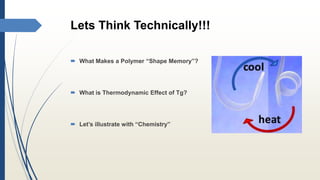
 What Makes a Polymer “Shape Memory”?
 What is Thermodynamic Effect of Tg?
 Let’s illustrate with “Chemistry”
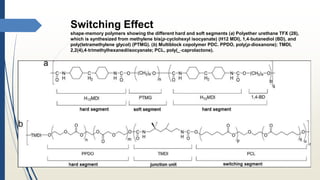
Switching Effect
shape‐memory polymers showing the different hard and soft segments (a) Polyether urethane TFX (28),
which is synthesized from methylene bis(p‐cyclohexyl isocyanate) (H12 MDI), 1,4‐butanediol (BD), and
poly(tetramethylene glycol) (PTMG). (b) Multiblock copolymer PDC. PPDO, poly(p‐dioxanone); TMDI,
2,2(4),4‐trimethylhexanediisocyanate; PCL, poly(_‐caprolactone).
Ways of Activation of SMP’s
 Thermo responsive SMP’s
 Electrical induced SMP’s
 Light Induced SMP’s
 Magnetically Induced SMP’s
 Water Activated SMP’s
Applications:
 Medical usage
 (neuro surgery and veins blocking)
 Textile usage
 (wrinkle free clothes, stretchable fiber)
 Equipment's for disable people
Limitation and Future Outcomes
 Transition Limit
 Temperature Limitation
 Research
 Presently we have shape memory polymers which can remember one shape.Now
people are trying to develop the shape memory polymers which can remember
more than position . The polymer can shift between two positions . This could lead
to artificial muscle.

Shape memory polymers

  • 1.
    Shape Memory Polymers Introduction,Processing Characterization, Applications/Limitations
  • 2.
    Introduction  What isits history?  Why it is called shape memory polymer?  What is shape memory Effect?
  • 3.
    Lets Think Technically!!! What Makes a Polymer “Shape Memory”?  What is Thermodynamic Effect of Tg?  Let’s illustrate with “Chemistry”
  • 4.
    Switching Effect shape‐memory polymersshowing the different hard and soft segments (a) Polyether urethane TFX (28), which is synthesized from methylene bis(p‐cyclohexyl isocyanate) (H12 MDI), 1,4‐butanediol (BD), and poly(tetramethylene glycol) (PTMG). (b) Multiblock copolymer PDC. PPDO, poly(p‐dioxanone); TMDI, 2,2(4),4‐trimethylhexanediisocyanate; PCL, poly(_‐caprolactone).
  • 5.
    Ways of Activationof SMP’s  Thermo responsive SMP’s  Electrical induced SMP’s  Light Induced SMP’s  Magnetically Induced SMP’s  Water Activated SMP’s
  • 6.
    Applications:  Medical usage (neuro surgery and veins blocking)  Textile usage  (wrinkle free clothes, stretchable fiber)  Equipment's for disable people
  • 7.
    Limitation and FutureOutcomes  Transition Limit  Temperature Limitation  Research  Presently we have shape memory polymers which can remember one shape.Now people are trying to develop the shape memory polymers which can remember more than position . The polymer can shift between two positions . This could lead to artificial muscle.