SHAPE MEMORY ALLOYS
DONE BY RAMVIKAS GS
INTRODUCTION TO SMA
 Shape memory alloy is an alloy
 SMA is one of the type of smart materials
 Shape memory alloys are materials
that “remember” their original shape .
 It gets deformed then recover their original shape
Upon heating.
~They can take large stress without undergoing
permanent deformation
HOW DO THEY WORK
 We all know the most common phase changes
 SMA’s shape changes based on a solid state phase transformation.
 The transition from one form of crystalline structure structure to another creates
the mechanism by which the shape changes occur in SMA’s .This change
involves transition from a monoclinic crystal from martensitic to an ordered cubic
crystal from austenite.
HISTORY OF SHAPE MEMORY ALLOYS
 1938:Arne olande observed shape and recovery ability of AU-Cd alloy
 1938:greninger and Mooradium observed the formation and
disappearance of martensitic phase by varying the temperature of a CU-
ZN alloy
 1962-63 william.j.Buchler and frederic Wang observed the shape
memory effect in Nickel and Titanium alloy at the united states naval
ordnance laboratory.
 Nitinol –Nickel Titanium naval ordnance laboratories.
 Where the two elements are present in roughly equal atomic
percentages
 Eg-nitinol 55,Nitinol
TYPES OF SHAPE MEMORY ALLOYS CHARACTERISTICS OF SMA
 These two main families of alloys
 Based on copper(cu): cu-al-ni and cu-zn-
al are used for narrow hysteresis and
adapatability.
 Based on NICKEL(NI);NI-TI ternary(x)
 Now way days NI-TI-X are used than
90% of new SMA applications.
 Ni-ti alloys are more expensive to melt
and produced than copper alloy but they
are preferred for their corrosion
resistance,bioompatibility,and higher
electrical resisting heating in actuator
application
 IT exhibits two main characteristics
 1.SHAPE MEMORY EFFECT
 2.SUPER ELASTICITY;
 SHAPE MEMORY EFFECT –It is based
on martensite phase transformation
taking place without diffusion . Martensite
phase transformation that occurs as a
result of stress and temperature change
SHAPE MEMORY EFFECT BEHAVIOUR
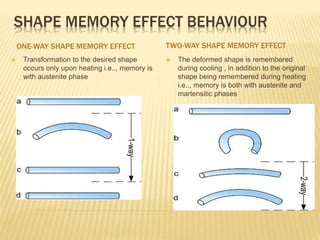
ONE-WAY SHAPE MEMORY EFFECT TWO-WAY SHAPE MEMORY EFFECT
 Transformation to the desired shape
occurs only upon heating i.e.., memory is
with austenite phase
 The deformed shape is remembered
during cooling , in addition to the original
shape being remembered during heating
i.e.., memory is both with austenite and
martensitic phases
SUPER ELASTICITY SHAPE MEMORY
(PSUEDOELSTICITY)
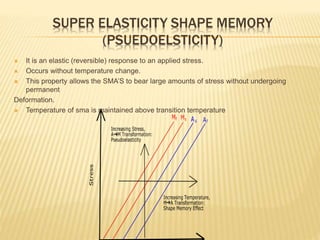
 It is an elastic (reversible) response to an applied stress.
 Occurs without temperature change.
 This property allows the SMA’S to bear large amounts of stress without undergoing
permanent
Deformation.
 Temperature of sma is maintained above transition temperature
PROPERTIES OF SHAPE MEMORY ALLOY
 The copper-based and ni-ti alloy are considered to be engineering materials.
 These composition can be manufactured to almost any shape and size
 The yield strength of shape-memory alloys is lower than of conventional steel ,but some
composition have a higher yield strength than plastic and aluminum
 The yield stress for NI-TI can reach 500 mpa
 The maximum recoverable strain these materials can hold without permanent damage is
up to 8% for some alloys
 This compares with a maximum strain 0.5% for conventional steels
ADVANTAGES OF SHAPE MEMORY ALLOY
 Very high power/weight ratio comparatively
 Accessible voltages can accomplish THERMO ELASTIC TRANSFORMATION
 Higher strain recovery
 Higher strength
 Compactness ,allowing for reduction in overall actuator size
 Noiseless and silent operation
 High corrosive resistance
APPLICATIONS OF SHAPE MEMORY ALLOY
AIRCRAFT CIVIL STRUCTURES
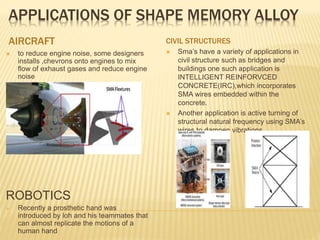
 to reduce engine noise, some designers
installs ,chevrons onto engines to mix
flow of exhaust gases and reduce engine
noise
ROBOTICS
 Recently a prosthetic hand was
introduced by loh and his teammates that
can almost replicate the motions of a
human hand
 Sma’s have a variety of applications in
civil structure such as bridges and
buildings one such application is
INTELLIGENT REINFORVCED
CONCRETE(IRC),which incorporates
SMA wires embedded within the
concrete.
 Another application is active turning of
structural natural frequency using SMA’s
wires to dampen vibrations
LIMITATIONS OF SHAPE MEMORY ALLOY
 Heat dissipation , need mechanism for cooling
 Less stiffness/high flexibility
 Relatively expensive to manufacture and machine compared to other
materials such as steel and aluminum
 Most SMA’s have poor fatigue properties( a steel component may
survive for more than one hundred time more cycles than a SMA
element)
PIPING
 The first consumer commercial application
was a shape-memory coupling for piping
eg ; oil line for industrial purpose , water
pipes
 Use of memory alloys for coupling tubing;
a memory alloys for coupling is expanded
so it fits over the tubing
 MEDICINE
 STENT- a reinforced grafts for vascular
application to replace or repair damaged
arteries
FUTURE SCOPE APPLICATION OF SMA
 There are many possible application for sma
 Future application are envisioned to include engines in car and airplanes and electrical
generators utilizing the mechanical energy resulting from shape transformers
 Nitinol with its shape memory property is also envisioned for use as car frames
 Other possible automotive applications using SMA include engine cooling , carburetor and
engine lubrication controls ,and control of a radiator blind ” to reduce the flow of air through
the radiator at start up when the engine is cold and hence to reduce fuel usage and
exhaust emissions
CONCLUSION
 The many uses and applications of shape memory alloy ensure a bright
future for these metals
 Research is currently carried out at many places of robotics departments
and material science department
 With the innovative ideas for application of sma’s and the number of
products on the market using SMA’s continually growing , advances in
the field of shape memory alloys for use in many different fields of study
seen very promising
shape memory alloys

shape memory alloys

  • 1.
  • 2.
    INTRODUCTION TO SMA Shape memory alloy is an alloy  SMA is one of the type of smart materials  Shape memory alloys are materials that “remember” their original shape .  It gets deformed then recover their original shape Upon heating. ~They can take large stress without undergoing permanent deformation
  • 3.
    HOW DO THEYWORK  We all know the most common phase changes  SMA’s shape changes based on a solid state phase transformation.  The transition from one form of crystalline structure structure to another creates the mechanism by which the shape changes occur in SMA’s .This change involves transition from a monoclinic crystal from martensitic to an ordered cubic crystal from austenite.
  • 4.
    HISTORY OF SHAPEMEMORY ALLOYS  1938:Arne olande observed shape and recovery ability of AU-Cd alloy  1938:greninger and Mooradium observed the formation and disappearance of martensitic phase by varying the temperature of a CU- ZN alloy  1962-63 william.j.Buchler and frederic Wang observed the shape memory effect in Nickel and Titanium alloy at the united states naval ordnance laboratory.  Nitinol –Nickel Titanium naval ordnance laboratories.  Where the two elements are present in roughly equal atomic percentages  Eg-nitinol 55,Nitinol
  • 5.
    TYPES OF SHAPEMEMORY ALLOYS CHARACTERISTICS OF SMA  These two main families of alloys  Based on copper(cu): cu-al-ni and cu-zn- al are used for narrow hysteresis and adapatability.  Based on NICKEL(NI);NI-TI ternary(x)  Now way days NI-TI-X are used than 90% of new SMA applications.  Ni-ti alloys are more expensive to melt and produced than copper alloy but they are preferred for their corrosion resistance,bioompatibility,and higher electrical resisting heating in actuator application  IT exhibits two main characteristics  1.SHAPE MEMORY EFFECT  2.SUPER ELASTICITY;  SHAPE MEMORY EFFECT –It is based on martensite phase transformation taking place without diffusion . Martensite phase transformation that occurs as a result of stress and temperature change
  • 6.
    SHAPE MEMORY EFFECTBEHAVIOUR ONE-WAY SHAPE MEMORY EFFECT TWO-WAY SHAPE MEMORY EFFECT  Transformation to the desired shape occurs only upon heating i.e.., memory is with austenite phase  The deformed shape is remembered during cooling , in addition to the original shape being remembered during heating i.e.., memory is both with austenite and martensitic phases
  • 7.
    SUPER ELASTICITY SHAPEMEMORY (PSUEDOELSTICITY)  It is an elastic (reversible) response to an applied stress.  Occurs without temperature change.  This property allows the SMA’S to bear large amounts of stress without undergoing permanent Deformation.  Temperature of sma is maintained above transition temperature
  • 8.
    PROPERTIES OF SHAPEMEMORY ALLOY  The copper-based and ni-ti alloy are considered to be engineering materials.  These composition can be manufactured to almost any shape and size  The yield strength of shape-memory alloys is lower than of conventional steel ,but some composition have a higher yield strength than plastic and aluminum  The yield stress for NI-TI can reach 500 mpa  The maximum recoverable strain these materials can hold without permanent damage is up to 8% for some alloys  This compares with a maximum strain 0.5% for conventional steels
  • 9.
    ADVANTAGES OF SHAPEMEMORY ALLOY  Very high power/weight ratio comparatively  Accessible voltages can accomplish THERMO ELASTIC TRANSFORMATION  Higher strain recovery  Higher strength  Compactness ,allowing for reduction in overall actuator size  Noiseless and silent operation  High corrosive resistance
  • 10.
    APPLICATIONS OF SHAPEMEMORY ALLOY AIRCRAFT CIVIL STRUCTURES  to reduce engine noise, some designers installs ,chevrons onto engines to mix flow of exhaust gases and reduce engine noise ROBOTICS  Recently a prosthetic hand was introduced by loh and his teammates that can almost replicate the motions of a human hand  Sma’s have a variety of applications in civil structure such as bridges and buildings one such application is INTELLIGENT REINFORVCED CONCRETE(IRC),which incorporates SMA wires embedded within the concrete.  Another application is active turning of structural natural frequency using SMA’s wires to dampen vibrations
  • 11.
    LIMITATIONS OF SHAPEMEMORY ALLOY  Heat dissipation , need mechanism for cooling  Less stiffness/high flexibility  Relatively expensive to manufacture and machine compared to other materials such as steel and aluminum  Most SMA’s have poor fatigue properties( a steel component may survive for more than one hundred time more cycles than a SMA element)
  • 12.
    PIPING  The firstconsumer commercial application was a shape-memory coupling for piping eg ; oil line for industrial purpose , water pipes  Use of memory alloys for coupling tubing; a memory alloys for coupling is expanded so it fits over the tubing  MEDICINE  STENT- a reinforced grafts for vascular application to replace or repair damaged arteries
  • 13.
    FUTURE SCOPE APPLICATIONOF SMA  There are many possible application for sma  Future application are envisioned to include engines in car and airplanes and electrical generators utilizing the mechanical energy resulting from shape transformers  Nitinol with its shape memory property is also envisioned for use as car frames  Other possible automotive applications using SMA include engine cooling , carburetor and engine lubrication controls ,and control of a radiator blind ” to reduce the flow of air through the radiator at start up when the engine is cold and hence to reduce fuel usage and exhaust emissions
  • 14.
    CONCLUSION  The manyuses and applications of shape memory alloy ensure a bright future for these metals  Research is currently carried out at many places of robotics departments and material science department  With the innovative ideas for application of sma’s and the number of products on the market using SMA’s continually growing , advances in the field of shape memory alloys for use in many different fields of study seen very promising