SHAPE MEMORY ALLOYS
(SMART MATERIAL)
WHAT ARE SMART MATERIALS ?
Smart materials are designed materials that have
one or more properties that can be changed
significantly in a controlled fashion by external
stimuli such as stress, temperature, moisture, ph,
electric or magnetic fields.
Traditional vs. Smart Materials
Traditional structures
Designed for certain performance requirements eg.load,
speed, life span Unable to modify its specifications if there
is a change of environment
Smart Structures
Can accommodate unpredictable environments. Can meet
exacting performance requirement. Offer more efficient
solutions for a wide range of applications
Some Smart Materials
PIEZOELECTRICITY THERMOCHROMISM
SHAPE MEMORY ALLOYS PHOTOMECHANICAL EFFECT
MAGNETOSTRICTION POLYCRYPTOLACTONE
PH SENSITIVE POLYMERS SELF HEALING MATERIALS
HALOCHROMIC MATERIALS DIELECTRIC ELASTOMERS
PHOTOCHROMISM THERMOELECTRIC MATERIALS
SHAPE MEMORY ALLOYS
Shape memory alloys remember its original shape
and that when deformed returns to its
predeformed shape when heated.
• The alloy appears to have a memory.
• Shape Memory Alloys exhibits super-elastic
behaviour also known as pseudo elastic
behaviour.
• SMAs deformed above a critical temperature
show a large reversible elastic deformation
(recoverable strains up to 10%. much exceeding
the elasticity) as a result of stress-induced
martensitic transformation
• Shape Memory Alloys have two stable phases :
The high temperature phase called AUSTENITE
and
The low temperature phase called MARTENSITE
• The Martensite can be in one of the two forms
Twinned Martensite
Detwinned Martensite
• Martensite is a diffusion less solid-state phase
transformation; no change in composition.
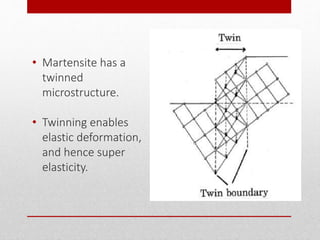
• Martensite has a
twinned
microstructure.
• Twinning enables
elastic deformation,
and hence super
elasticity.
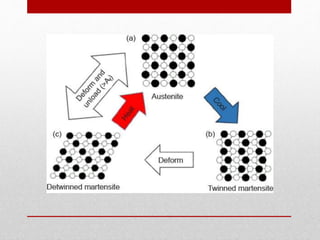
• Upon cooling in the absence of applied load, the
material transforms from Austenite into twinned
Martensite. (no observable macroscopic shape
change occurs)
• Upon heating the material in the martensitic phase,
a reverse transformation takes place and as a result
the material transforms to Austenite.
• If mechanical load is applied to the material in the
state of twinned Martensite (at low temperature), it
is possible to detwin the martensite.
• Upon releasing of the load, the material remains
deformed. A subsequent heating of the material
to a temperature above the Austenite finish
temperature will result in reverse transformation
(martensite to austenite) and will lead to
complete shape recovery.
• Shape Memory Alloy remembers the shape when
it have austenitic structure.
• Reheating the material will result in complete
shape recovery.
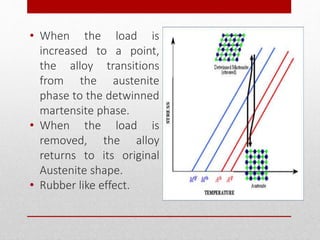
• When the load is
increased to a point,
the alloy transitions
from the austenite
phase to the detwinned
martensite phase.
• When the load is
removed, the alloy
returns to its original
Austenite shape.
• Rubber like effect.
EXAMPLES OF SMA
Nickel Titanium Alloy (Ni-Ti) commonly called as
Nitinol.
Cu-Al-Zn
Cu-Al-Ni
Fe-Mn-Si
ADVANTAGES
• High Strength
• Good Elasticity
• Fatigue Resistance
• Easy Fabrication
• Wear Resistance
• Light Weight
DISADVANTAGES
• Initial Expensive
• Sensitivity of material properties in fabrication
• Poor fatigue property
• Residual Stresses developed in thin films
• Overstress
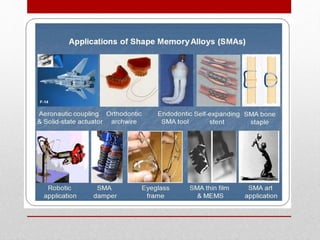
APPLICATIONS OF SMA
• Automobile applications
• Aerospace applications
• Biomedical
• Civil Engineering of Mega structures
SHAPE MEMORY ALLOYS
Seminar on shape memory alloys

Seminar on shape memory alloys

  • 1.
  • 2.
    WHAT ARE SMARTMATERIALS ? Smart materials are designed materials that have one or more properties that can be changed significantly in a controlled fashion by external stimuli such as stress, temperature, moisture, ph, electric or magnetic fields.
  • 3.
    Traditional vs. SmartMaterials Traditional structures Designed for certain performance requirements eg.load, speed, life span Unable to modify its specifications if there is a change of environment Smart Structures Can accommodate unpredictable environments. Can meet exacting performance requirement. Offer more efficient solutions for a wide range of applications
  • 4.
    Some Smart Materials PIEZOELECTRICITYTHERMOCHROMISM SHAPE MEMORY ALLOYS PHOTOMECHANICAL EFFECT MAGNETOSTRICTION POLYCRYPTOLACTONE PH SENSITIVE POLYMERS SELF HEALING MATERIALS HALOCHROMIC MATERIALS DIELECTRIC ELASTOMERS PHOTOCHROMISM THERMOELECTRIC MATERIALS
  • 5.
    SHAPE MEMORY ALLOYS Shapememory alloys remember its original shape and that when deformed returns to its predeformed shape when heated.
  • 6.
    • The alloyappears to have a memory. • Shape Memory Alloys exhibits super-elastic behaviour also known as pseudo elastic behaviour. • SMAs deformed above a critical temperature show a large reversible elastic deformation (recoverable strains up to 10%. much exceeding the elasticity) as a result of stress-induced martensitic transformation
  • 7.
    • Shape MemoryAlloys have two stable phases : The high temperature phase called AUSTENITE and The low temperature phase called MARTENSITE • The Martensite can be in one of the two forms Twinned Martensite Detwinned Martensite • Martensite is a diffusion less solid-state phase transformation; no change in composition.
  • 8.
    • Martensite hasa twinned microstructure. • Twinning enables elastic deformation, and hence super elasticity.
  • 9.
    • Upon coolingin the absence of applied load, the material transforms from Austenite into twinned Martensite. (no observable macroscopic shape change occurs) • Upon heating the material in the martensitic phase, a reverse transformation takes place and as a result the material transforms to Austenite. • If mechanical load is applied to the material in the state of twinned Martensite (at low temperature), it is possible to detwin the martensite.
  • 10.
    • Upon releasingof the load, the material remains deformed. A subsequent heating of the material to a temperature above the Austenite finish temperature will result in reverse transformation (martensite to austenite) and will lead to complete shape recovery. • Shape Memory Alloy remembers the shape when it have austenitic structure. • Reheating the material will result in complete shape recovery.
  • 11.
    • When theload is increased to a point, the alloy transitions from the austenite phase to the detwinned martensite phase. • When the load is removed, the alloy returns to its original Austenite shape. • Rubber like effect.
  • 13.
    EXAMPLES OF SMA NickelTitanium Alloy (Ni-Ti) commonly called as Nitinol. Cu-Al-Zn Cu-Al-Ni Fe-Mn-Si
  • 14.
    ADVANTAGES • High Strength •Good Elasticity • Fatigue Resistance • Easy Fabrication • Wear Resistance • Light Weight
  • 15.
    DISADVANTAGES • Initial Expensive •Sensitivity of material properties in fabrication • Poor fatigue property • Residual Stresses developed in thin films • Overstress
  • 16.
    APPLICATIONS OF SMA •Automobile applications • Aerospace applications • Biomedical • Civil Engineering of Mega structures
  • 18.